Further
extensions
of characterizations of chaotic order associated with
Kantorovich type
inequalities
東京理科大学 理橋本 雅史 (MasashiHashimoto)
東京理科大学 理柳田 昌宏 (Masahiro Yanagida)
東京理科大学 理山崎 丈明 (Takeaki Yamazaki)
Abstract
Thisreportis based on the following papers:
[HYM] M.Hashimoto and T.Yamazaki, Further extensions
of
characterizationsof
chaotic orderassociatedwith Kantorovich type inequalities, Scientiae Mathematicae, 3 (2000), 127-136.
[HYN] M.HashimotoandM.Yanagida, Further characterizations
of
chaotic order associated withKantorovich type inequalities via Furuta inequality, preprint.
We showed characterizations ofchaotic order via Kantorovich inequality in [33]. Recently as
a nice application of generalized $\mathrm{F}\backslash _{1\mathrm{r}\mathrm{U}}\mathrm{t}\mathrm{a}$inequality, Furuta and Seo showed an extension of one
of our results and a related result on operator equations. In this report, by using essentially
the same idea as theirs, we shall show further extensions of both their results andour another
previousresult whichisa characterizationof chaotic order via Specht’s ratio. Moreover weshall
showfurtherextensions ofour results.
1
Introduction
We remark that Theorem $\mathrm{F}$ yields L\"owner-Heinz theorem when weput $r=0$ in (i) or (ii) stated
above. Alternativeproofs of Theorem$\mathrm{F}$ are given in $[6][24]$ and alsoan elementary one-pageproof in
[11]. It is shown in [29] that the domain drawn for$p,$$q$ and $r$ in the Figure 1 is best possibleone for
Theorem F.
As an extension of Theorem $\mathrm{F}$, thefollowing Theorem $\mathrm{G}$
was
obtained in [15].Theorem $\mathrm{G}([15])$
.
If
$A\geq B\geq 0$ with $A>0$, thenfor
each $t\in[0,1]$ and$p\geq 1$,is decreasing
for
$r\geq t$ and$s\geq 1$, and$F_{p,t}(A, A, r, s)\geq F_{p,t}(A, B, r, s)$, that is,for
each $t\in[0,1]$ and$p\geq 1$,
(1.1) $A^{1-t+r}\geq\{A^{\frac{r}{2}}(A^{\frac{-t}{2}B^{p}A\overline{T}}t)^{s_{A^{\frac{r}{2}}}}\}^{\frac{1-t+r}{(p-t)_{S}+f}}$
holds
for
any$s\geq 1$ and$r\geq t$.Ando-Hiai [2] established excellent $\log$ majorization results and proved the following useful
in-equality equivalent to the main $\log$majorization theorem:
If
$A\geq B\geq 0$ with $A>0$ , then$A^{r}\geq\{A^{\frac{r}{2}}(A^{\frac{-1}{2}B^{p}A)}\overline{-}T^{1}rA^{\frac{r}{2}}\}^{\frac{1}{p}}$
holds
for
any$p\geq 1$ and$r\geq 1$. Theorem $\mathrm{G}$ interpolatesthe inequality stated above by Ando-HiaiandTheorem$\mathrm{F}$ itself, and alsoextends results of$[7][12]$ and [13]. Anice meantheoretic proofofTheorem
$\mathrm{G}$ is shown in [8] andone-page proofof (1.1) is shown in [18]. In [21], we showed equivalence relation
among the inequality (1.1), monotonicity of the function $F_{p,t}(A, B, r, S)$ in Theorem $\mathrm{G}$ and related
results. The best $\mathrm{p}\mathrm{o}\mathrm{s}\mathrm{S}\mathrm{i}\mathrm{b}\mathrm{i}\mathrm{l}\mathrm{i}\mathrm{t}\mathrm{y}.$
, of the outside exponents of both sides in (1.1) is shown in [30] and its
simplified proofs are shown in [9] and [32].
Onthe other hand, related toL\"owner-Heinztheorem,the following proposition is also well known:
$A\geq B\geq 0$ does not always assure$A^{\alpha}\geq B^{\alpha}$
for
any$\alpha>1$.
As a way tosettle this inconvenient, thefollowing result is given in [17].
Theorem A.l ([17]).
If
$A\geq B\geq 0$ and $MI\geq A\geq mI>0$, then$( \frac{M}{m})^{p-1}Ap\geq K_{+}(m, M,p)Ap\geq B^{p}$
for
$p\geq 1$,where
(1.2) $K_{+}(m, M,p)= \frac{(p-1)^{p1}-}{p^{\mathrm{p}}}\frac{(M^{pp}-m)^{p}}{(M-m)(mM^{p}-m^{pM})^{p1}-}$ .
We remark that Theorem A.l is related to both$\mathrm{H}\ddot{\mathrm{o}}1\mathrm{d}\mathrm{e}\mathrm{r}- \mathrm{M}\mathrm{c}\mathrm{c}_{\mathrm{a}}\mathrm{r}\mathrm{t}\mathrm{h}\mathrm{y}$ inequality [25] andKantorovich
inequality:
If
$MI\geq A\geq mI>0$, then $(A^{-1}x, x)(Ax, x) \leq\frac{(m+M)^{2}}{4mM}$ holdsfor
every unit vector$x$ in $H$. The number $\frac{(m+M)^{2}}{4mM}$ is called Kantorovich constant and $K_{+}(m, M, 2)= \frac{(m+M)^{2}}{4mM}$ where
$K_{+}(m, M,p)$ is stated in (1.2), so that $K_{+}(m, M,p)$ is a generalization of Kantorovich constant.
Many authors have been investigating Kantorovich inequality, amongothers, there is along research series ofMond-Pe\v{c}ari\v{c},
some
of themare
[26] and [27].The order between positive invertible operators $A$ and $B$ defined by $\log A\geq\log B$ is said to be
chaotic order which is
a
weaker order than usual order $A\geq B$.
As an application of Theorem $\mathrm{F}$, thefollowing characterization ofchaotic order is well known.
Theorem A.2 ([7] [13]). Let $A$ and$B$ be positive invertible operators. Then the following assertions
are mutually equivalent:
(i) $\log A\geq\log B$.
(ii) $A^{p}\geq$ $(A\epsilon 2B^{\mathrm{P}}A^{5}2)^{\frac{1}{2}}\mathrm{i}$
for
all$p\geq 0$.(iii) $A^{u}\geq(A^{\frac{u}{2}}B^{p}A^{\frac{u}{2})^{\frac{\mathrm{u}}{P+u}}}$
for
all$p\geq 0$ and$u\geq 0$.
$(\mathrm{i})\Leftrightarrow(\mathrm{i}\mathrm{i})$ of Theorem A.2is shown in [1]. Recentlyasimpleand excellent proof of$(\mathrm{i})\Rightarrow(\mathrm{i}\mathrm{i}\mathrm{i})$is shown
in [31] by only applying Theorem $\mathrm{F}$, and asimplified proofof
$(\mathrm{i}\mathrm{i})\Rightarrow(\mathrm{i})$ is shown in [22].
We prove the following two other characterizations of chaotic order in [33] as applications of
Theorem B.l ([33]). Let $A$ and $B$ be positive invertible operators satisfying $MI\geq A\geq mI>0$. Then the following assertions
are
mutually equivalent: $\iota$(i) $\log A\geq\log B$
.
(ii) $\frac{(m^{p}+M^{p})2}{4m^{p}M^{\mathrm{p}}}A^{p}\geq B^{p}$
for
all$p\geq 0$.Theorem B.2 ([33]). $Lei$ $A$ and $B$ be positive invertible operators satisfying $MI\geq A\geq mI>0$
.
Then the following assertions are mutually equivalent:(i) $\log A\geq\log B$
.
(ii) $M_{h}(p)A^{p}\geq B^{p}$
for
all$p\geq 0$, where$h= \frac{M}{m}>1$ and(1.3) $M_{h}(p)= \frac{h^{\frac{p}{h\mathrm{P}-1}}}{e\log h^{\frac{p}{h\mathrm{P}-1}}}$
.
Theorem B.2 gives a more precise sufficient condition for chaotic order than Theorem B.l since
$\frac{(m^{pp}+M)^{2}}{4m^{p}M^{p}}\geq M_{h}(p)$ holds for all$p\geq 0$ by the following lemma.
Lemma B.3 ([33]). Let $K_{+}(m, M,p)$ be
defined
in (1.2). Then$F(p, r, m, M)=K_{+}(m^{r},$$M^{r}, \frac{p+r}{r})$
is an increasing
function of
$p,$ $r$ and $M$, and also a decreasingfunction
of
$m$for
$p>$. $0,$ $r>0$ and
$M>m>0$
.
Moreover,$\lim_{rarrow+0}K_{+}(m^{r},$ $Mr, \frac{p+r}{r})=M_{h}(p)$,
and
(1.4) $( \frac{M}{m})^{p}\geq K_{+}(m^{r},$$M^{r}, \frac{p+r}{r})\geq M_{h}(p)\geq 1$
.
hold
for
$p>0,$ $r>0$ and$M>m>0$
, where $h= \frac{M}{m}>1$ and$M_{h}(p)$ bedefined
in (1.3).We remark that $M_{h}(1)= \frac{(h-1)h^{7}\mathrm{i}\frac{1}{-1}}{e\log h}$ is called Specht’s ratio $[4][28]$, which is the best upper bound
of the ratio of the arithmeticmean to the geometric
mean
of numbers $x_{i}$ satisfying $M\geq x_{i}\geq m>0$ $(i=1,2, \cdots, n)$, that is, the following inequality holds:$\frac{(h-\mathrm{l})h^{\frac{1}{h-1}}}{e\log h}\sqrt[n]{x_{1}x_{2n}X}\geq\frac{x_{1}+x_{2}+\cdots+X_{n}}{n}$
.
In [3], we showed a simplified proofofTheorem B.2 by using determinant for positive operators
defined in [4] and [5]. Moreover
we
showed the following result which interpolates $(\mathrm{i})\Rightarrow(\mathrm{i}\mathrm{i})$ ofbothTheorem B.l and Theorem B.2 in [33]. Theorem B.4 $([33])$
.
$\cdot$ Let
$A$ and$B$ be positive invertible operators satisfying$MI\geq A\geq mI>0$.
If
$\log A\geq\log B$, then$K_{+}(m^{r},$$M^{r}, \frac{p+r}{r})A^{p}\geq B^{p}$ holds
for
$p>0$ and$r>0$, where $K_{+}(m, M,p)$ isdefined
in (1.2).As anice application of Theorem $\mathrm{G}$, Furuta and Seoestablished the following
result in [22].
Theorem C.l ([22]). Let $A$ and $B$ be positive invertible operators. Then the following assertions
are mutually equivalent: (i) $\log A\geq\log B$.
(ii) For each $\alpha\in[0,1],$ $p\geq 0,$ $u\geq 0$ and $s\geq 1$ such that $(p+\alpha u)s\geq(1-\alpha)u$, there exists the
unique invertiblepositive contraction $T$satisfying
TA$(p+\alpha u)s\tau=(A^{\frac{\alpha u}{2}}BpA^{\alpha}\tau^{u})^{s}$.
(iii) For each $\alpha\in[0,1],$$p\geq u\geq 0$ and $s\geq 1$, there exists the unique invertible positive contraction
$T$satisfying
TA$(p+ \alpha u)sT=(A^{\frac{\alpha u}{2}B^{p}}A\frac{\alpha u}{2})^{s}$.
(iv) For each$p\geq 0$, there exists the unique invertiblepositive contraction $T$satisfying $TA^{p}T=B^{p}$.
Moreoveras an extension of Theorem B.l, Furutaand Seo also showed the followingresult based
on Theorem C.l in [22].
Theorem C.2 ([22]). Let$A$ and $B$ be positive invertible operators satisfying $MI\geq A\geq mI>0$.
Then the following assertions are mutually equivalent:
(i) $\log A\geq\log B$
.
(ii) For each$\alpha\in[0,1],$ $p\geq 0$ and$u\geq 0$,
$\frac{(m^{(p+)s}+\alpha uM^{(u}p+\alpha)_{S})^{2}}{4m(p+\alpha u)sM(p+\alpha u)S}A^{(u)s}p+\alpha\geq(A^{\frac{\alpha u}{2}B^{p}}A^{\underline{\alpha}}Tu)^{s}$
holds
for
all$s\geq 1$ such that $(p+\alpha u)s\geq(1-\alpha)u$.
(iii) Foreach $\alpha\in[0,1]$ and$p\geq u\geq 0$,
$\frac{(m^{(p+\alpha u)_{S}}+M(P+\alpha u)_{S})^{2}}{4m^{(u)s}p+\alpha M(p+\alpha u)s}A^{(p+)_{S}}\alpha u\geq(A^{\frac{\alpha u}{2}B^{p}A^{\frac{\alpha u}{2}}})^{s}$
holds
for
all$s\geq 1$.(iv) $\frac{(m^{p}+M^{p})2}{4m^{p}M^{p}}A^{\mathrm{p}}\geq B^{p}$ holds
for
all$p\geq 0$.In this report, we shall show a further extension of Theorem C.l. And also, by using Theorem $\mathrm{G}$, we shall showafurther extension of Theorem C.2 which interpolates both TheoremB.land Theorem
B.2. Moreover we shall attempt to extendTheorem C.l and Theorem C.2by usingTheorem F.
2
Extensions
of the results
by
Furuta and Seo
Firstly, as an extension of Theorem C.l, we have the following characterization of chaotic order
viaoperator equations.
Theorem 1. Let $A$ and $B$ be positive invertible operators. Then
for
each natural number$n$, the
(i) $\log A\geq\log B$.
(ii) For each $\alpha\in[0,1],$ $p\geq 0,$ $u\geq 0,$ $s\geq 1$ and$r\geq 1-\alpha$ such that $\{nr+(n+1)\alpha\}u\geq(p+\alpha u)s$,
there exists the unique invertible positive contraction$T=T(n, \alpha,p, u, S, r)$ satisfying
(2.1) $T(A^{\frac{(p+\alpha u)s+fu}{n+1}} \tau)^{n}=A^{\frac{-(\mathrm{p}+\alpha u)s+n\gamma u}{2(n+1)}}(A^{\underline{\alpha}}T^{u}B^{p}A\tau_{)^{s}}\alpha uA\frac{-(p+\alpha u\rangle s+nr\mathrm{u}}{2(n+1)}$
(iii) For each$\alpha\in[0,1],$$p\geq nu\geq 0,$ $s\geq 1$ and real numbers$r$ such that$\{nr+(n+1)\alpha\}u\geq(p+\alpha u)s$,
there exists the unique invertible positive contraction $T=T(n, \alpha,p, u, S, r)$ satisfying
(2.1) $T(A^{\frac{(p+\alpha u)s+r\mathrm{u}}{n+1}} \tau)^{n}=A^{\frac{-(P+\alpha u\rangle s+nru}{2(n+1)}}(A^{\underline{\alpha}_{5}\underline{u}_{BA^{\alpha}}}p-\tau_{)A}^{u}s\frac{-(p+\alpha u)_{S}+n\prime u}{2(n+1)}$
(iv) For each$p\geq 0$, there exists the unique invertible positive contraction$T=T(n,p)$ satisfying
$\tau(A^{\epsilon_{T)}}nn--B^{p}$.
The following Corollary 2 is easily obtained by Theorem 1.
Corollary 2. Let $A$ and $B$ be positive invertible operators. Then
for
each natural number $n$, thefollowing assertions are mutually equivalent:
(i) $\log A\geq\log B$.
(ii) For each $\alpha\in[0,1],$ $p\geq 0,$ $u\geq 0$ and $s\geq 1$ such that $(p+\alpha u)s\geq n(1-\alpha)u$, there exists the
unique invertible positive contraction$T=T(n, \alpha,p, u, S)$ satisfying
$T(A^{\frac{(p+\alpha u)S}{n}}\tau)^{n}=(A^{\frac{\alpha u}{2}B^{p}A^{\frac{\alpha u}{2}}})^{s}$
.
(iii) For each $\alpha\in[0,1],$ $p\geq nu\geq 0$ and$s\geq 1$, there exists the unique invertiblepositive contraction
$T=T(n, \alpha,p, u, S)$ satisfying
$T(A^{\frac{(p+\alpha u)_{S}}{n}}\tau)^{n}=(A^{\tau}\alpha\underline{u}B^{p}A^{\tau}-\alpha u)^{s}$.
(iv) For each$p\geq 0$, there exists the unique invertible positive contraction$T=T(n,p)$ satisfying $\tau(A\frac{p}{n}T)^{n}=Bp$.
Remark 1. Corollary 2 implies Theorem C.l when we put $n=1$ , that is, Theorem 1 includes Theorem C.l as aspecial case.
Secondly, as anextension of Theorem C.2,wehave thefollowing Kantorovich type characterization
ofchaotic order.
Theorem 3. Let $A$ and $B$ be positive invertible operators satisfying $MI\geq A\geq mI>0$ and
$K_{+}(m, M,p)$ be
defined
in (1.2). Then the following assertions are mutually equivalent:..(i) $\log A\geq\log B$.
(ii) For each natural number$n,$ $\alpha\in[0,1],$ $p\geq 0$ and$u\geq 0$,
$K_{+}(m^{\frac{(p+\alpha u)S+ru}{n+1}},$$M^{\frac{(p+\alpha \mathrm{u})_{S+ru}}{n+1}},$
$n+1)A^{(\alpha}p+u)S \geq(A^{\alpha u}-TB^{p}A\frac{\alpha u}{2})^{s}$
(iii) For each natural number$n,$ $\alpha\in[0,1]$ and$p\geq nu\geq 0$,
(2.2) $K_{+}(m^{\frac{(p+\alpha u)S+Tu}{n+1}},$$M^{\frac{(\mathrm{p}+\alpha u)S+fu}{\mathfrak{n}+1}}$,$n+1)A^{()S}p+\alpha u\geq(A^{\alpha u_{B^{\mathrm{P}}A^{\frac{\alpha \mathrm{u}}{2})^{S}}}}-T$
holds
for
all$s\geq 1$ and real number$r$ such that$\{nr+(n+1)\alpha\}u\geq(p+\alpha u)s$.
(iv) For each natural number$n$ and$p\geq nu\geq 0$,
$K_{+}(mn\mp^{u}+r1$,$M^{\frac{p+ru}{n+1}},$$n+1$
)
$A^{p}\geq B^{p}$holds
for
all real number$r$ such that$nru\geq p$.
Remark 2. Theorem 3 implies Theorem C.2 as follows. We have (ii) [resp. $(\mathrm{i}\mathrm{i}\mathrm{i})$] of Theorem C.2
when we put $n=1$ and $r= \frac{(p+\alpha u)_{S}}{u}$ in (ii) [resp. $(\mathrm{i}\mathrm{i}\mathrm{i})$] of Theorem 3. And put $n=1$ and $r=Ru$ in
(iv) ofTheorem 3, then wehave (iv) ofTheorem C.2.
As mentioned above, Theorem3 yieldsTheoremC.2 and Theorem C.2yieldsTheorem B.l.
More-over
Theorem 3 also yields the following Theorem 4 and Theorem 4 yields Theorem B.2, which is a more preciseestimation than Theorem B.1.Theorem 4. Let $A$ and $B$ be positive invertible operators satisfying $MI\geq A\geq mI>0$, and
$K_{+}(m, M,p)$ and $M_{h}(p)$ be
defined
in (1.2) and (1.3), respectivery. Then the following assertionsare mutually equivalent:
(i) $\log A\geq\log B$.
(ii) For each natural number $n,$ $\alpha\in[0,1],$ $p\geq 0$ and$u\geq 0$
$K_{+}(m^{\frac{(p+\alpha u)_{S-\alpha}u}{n}},$ $M^{\frac{(p+\alpha u\rangle s-\alpha u}{n}},$$n+1)A(\mathrm{p}+\alpha u)s\geq(A^{\frac{\alpha u}{2}B^{p}A^{-}\tau^{\underline{u}}})\alpha s$
holds
for
all $s\geq 1$ such that $(p+\alpha u)s\geq(n+\alpha)u$.(iii) For each natural number $n,$ $\alpha\in[0,1]$ and$p\geq nu\geq 0$,
$K_{+}(m^{\frac{\langle p+\alpha u)S-\alpha u}{n}},$$M^{\frac{(\mathrm{p}+\alpha u)s-\alpha \mathrm{u}}{n}},$$n+1)A^{()s}p+\alpha u\geq(A^{\frac{\alpha u}{2}B^{p}A^{\frac{\alpha u}{2}}})^{s}$
holds
for
all $s\geq 1$.
(iv) $M_{h}(p)A^{p}\geq B^{p}$ holds
for
all$p\geq 0$, where $h= \frac{M}{m}>1$.3
Proofs of results
In order to prove Theorem 1, we prepare the following result which is an application of Theorem
G.
Proposition 5. Let$A$ and$B$ be positive invertible operators.
If
$\log A\geq\log B$, then(3.1) $A^{\frac{(p+\alpha u)s+ru}{q}} \geq\{A\frac{ru}{2}(A^{\frac{\alpha u}{2}B^{p}A^{\frac{\alpha u}{2})^{s_{A^{\frac{ru}{2}}}}\}^{\frac{1}{q}}}}$
holds
for
any$u\geq 0,$ $p\geq 0,$ $\alpha\in[0,1],$ $s\geq 1,$ $r\geq 1-\alpha$ and$q\geq 1$ with $u(\alpha+r)q\geq(p+\alpha u)s+ru$.We remark that Proposition 5 is
a
part of[16, Theorem 2.2]. For the sake oflater argument,we
Proof of
Proposition 5. Both sidesof (3.1)equal $I$incase
$u=0$,so
thatwe
have only toconsiderthecase
$u>0$.
By Theorem A.2, $\log A\geq\log B$ implies the following (3.2): 1(3.2) $A^{u} \geq(A^{\frac{u}{2}}B^{p}A\frac{\mathrm{u}}{2})^{\frac{u}{\mathrm{P}+u}}$ for$p\geq 0$ and $u>0$.
Put $A_{1}=A^{u}$ and $B_{1}=(A^{\frac{u}{2}}B^{p}A^{\frac{u}{2}})^{\frac{\mathrm{u}}{P+u}}$ , then $A_{1}\geq B_{1}>0$
.
By (1.1) of Theorem$\mathrm{G}$,(3.3) $A^{\frac{(p_{1}-t)s+\gamma}{1q}}\geq\{A^{\frac{r}{12}}(A_{1}^{\overline{\tau}^{\underline{\ell}}}$Bpl$A^{\overline{\tau}^{\underline{t}}}1)s_{A^{\frac{r}{12}}}\}^{\frac{1}{q}}$
holds for $p_{1}\geq 1,$ $t\in[0,1],$ $s\geq 1,$ $r\geq t$ and $q\geq 1$ with $(1-t+r)q\geq(p_{1}-t)s+r$
.
$(3.3)$ is equivalentto the following (3.4):
(3.4) $A^{\frac{u(p_{1}-t)s+ru}{q}} \geq[A^{\frac{ru}{2}\{(}A^{-u}-_{\sigma^{\underline{l}}}A\frac{u}{2}BpA^{\frac{\mathrm{u}}{2})}\frac{up1}{p+u}A-_{\tau^{t}}-u\}^{S}A^{\frac{ru}{2}}]^{\frac{1}{q}}$
.
Put$p_{1}= \frac{p+u}{u}\geq 1$ and $\alpha=1-t\in[0,1]$ in (3.4), then we have the following (3.1):
(3.1) $A^{\frac{(p+\alpha u)s+ru}{q}} \geq\{A^{\frac{ru}{2}(A^{\frac{au}{2}B^{p}A^{\frac{\alpha u}{2})^{s}\}}}}A^{\frac{ru}{2}}\frac{1}{q}$
for $u>0,$$p\geq 0,$ $\alpha\in[0,1],$ $s\geq 1,$ $r\geq 1-\alpha$ and $q\geq 1$ with $u(\alpha+r)q\geq(p+\alpha u)s+ru$.
Consequently, the proofofProposition 5 is complete. $\square$
Proof of
Theorem 1. Let $n$ bea natural number. We shall show $(\mathrm{i})\Rightarrow(\mathrm{i}\mathrm{i})\Rightarrow(\mathrm{i}\mathrm{i}\mathrm{i})\Rightarrow(\mathrm{i}\mathrm{v})\Rightarrow(\mathrm{i})$as
follows: $(\mathrm{i})\Rightarrow(\mathrm{i}\mathrm{i})$: Incase
$u=0,$ $(\mathrm{i}\mathrm{i})$ holds obviously since the assumption of (ii)ensures
$ps=0$ and (2.1)turns out to be $T^{n+1}=I$, so that we have only to show the
case
$u>0$ as follows: By putting $q=n+1\geq 1$ in (3.1) ofProposition 5, $\log A\geq\log B$ implies the following (3.5):.
(3.5) $A^{\frac{(p+\alpha u)s+ru}{n+1}} \geq\{A^{\frac{ru}{2}(A^{\frac{\alpha u}{2}B^{p}}}A\frac{\alpha u}{2})sA^{\frac{ru}{2}}\}\frac{1}{n+1}$
for $\alpha\in[0,1],$$p\geq 0,$$u>0,$$s\geq 1$ and $r\geq 1-\alpha$ such that $\{nr+(n+1)\alpha\}u\geq(p+\alpha u)s$
.
$(3.5)$ impliesthe following (3.6):
(3.6) $I \geq A^{\frac{-\{(p+\alpha u)S+ru\}}{2(n+1)}}(A^{\frac{ru}{2}D^{S}A^{\frac{ru}{2})^{\frac{1}{n+1}A}}}\frac{-\{(p+\alpha u)s+ru\}}{2(n+1)}>0$,
where $D=A^{\underline{\alpha}}\tau^{u}B^{p}A\tau\underline{\alpha}u$. Let $T=T(n, \alpha,p, u, S, r)$ be defined as follows:
(3.7) $T=A^{\frac{-\{(p+\alpha u)s+fu\}}{2(n+1)}()^{\frac{1}{n+1}}}A^{\frac{ru}{2}D^{S}}A \frac{ru}{2}A\frac{-\{(_{P+a\mathrm{L})S+r}u\}}{2(n+1)}$
Then it turns out that$T$ is an invertible positive contractionby (3.6) and
(3.8) $A^{\frac{(p+\alpha u)S+ru}{2(n+1)}}$
TA$\frac{(\mathrm{p}+\alpha u)s+ru}{2(n+1)}=(A^{\frac{ru}{2}D^{s_{A}}}\frac{ru}{2})^{\frac{1}{n+1}}$
holds by (3.7). Taking the (n+l)-th power ofboth sides of (3.8),
we
obtain(3.9) $(A^{\frac{(p+\alpha \mathrm{u})s+ru}{2(n+1)}\tau A^{\frac{(\mathrm{p}+\alpha u)S+ru}{2(n+1)})^{n+1}}}=A^{\frac{ru}{2}D^{s}A^{\frac{ru}{2}}}$,
(3.9) is equivalent to
$A^{\frac{(p+\alpha u)s+ru}{2(n+1\rangle}}T(A^{\frac{(\mathrm{p}+\alpha u)s+ru}{n+1}T})^{n}A^{\frac{(p+\alpha u)s+ru}{2(n+1)}}=A^{\frac{ru}{2}(A^{\frac{\alpha u}{2}}}B^{\mathrm{P}}A^{\frac{\alpha u}{2}})^{S}A \frac{ru}{2}$,
that is, we have (2.1).
and $r\geq 1-\alpha$such that $\{nr+(n+1)\alpha\}u\geq(p+\alpha u)s$, there exists an invertible positive contraction $S=S(n, \alpha,p, u, S, r)$ satisfying:
(3.10) $S(A^{\frac{(\mathrm{p}+\alpha u)s+ru}{n+1}}s)^{n}=A^{\frac{-(p+\alpha u)s+nru}{2(n+1)}}(A^{\frac{\alpha u}{2}B^{p}}A^{\frac{\alpha u}{2}})^{s}A^{\frac{-(p+\alpha \mathrm{u})s+nru}{2(n+1)}}$
By (2.1) and (3.10), wehave
(3.11) $S(A^{\frac{(p+au\rangle s+ru}{n+1}}s)^{n}=T(A^{\frac{(p+\alpha u)s+ru}{n+1}}\tau)^{n}$.
(3.11) is equivalent to
$(A^{\frac{(p+\alpha u)s+ru}{2(n+1)}SA^{\frac{(p+\alpha u)S+ru}{2(n+1)}}})^{n+1}=$ ($A^{\frac{(p+\alpha u)s+ru}{2(n+1)}}$
TA$\frac{(p+\alpha u)S+ru}{2(n+1)}$
)$n+1$.
Then wehave $S=T$
.
Hence the proof of $(\mathrm{i})\Rightarrow(\mathrm{i}\mathrm{i})$is complete.$(\mathrm{i}\mathrm{i})\Rightarrow(\mathrm{i}\mathrm{i}\mathrm{i}):(\mathrm{i}\mathrm{i}\mathrm{i})$ holds in case $u=0$ obviously by the same discussion as (ii). Let $p\geq nu>0$ in (ii),
then thecondition $r\geq 1-\alpha$ follows from$p\geq nu>0$ and the other assumptionsof(ii) since
$r \geq\frac{(p+\alpha u)s}{nu}-\frac{n+1}{n}\alpha\geq\frac{p+\alpha u}{nu}-\frac{n+1}{n}\alpha=\frac{p}{nu}-\alpha\geq 1-\alpha$ ,
so that
we
have (iii).$(\mathrm{i}\mathrm{i}\mathrm{i})\Rightarrow(\mathrm{i}\mathrm{V})$: Put $r= \frac{(_{P+\alpha}u)s}{nu},$ $\alpha=0$and $s=1$ in (iii), then we have
$T(A^{B}n.\tau)n=B^{p}$
holds for each $p\geq nu>0$, i.e., $p>0$
.
(iv) holds in case $p=0$ obviously, so that the proof of$(\mathrm{i}\mathrm{i}\mathrm{i})\Rightarrow(\mathrm{i}_{\mathrm{V})}$iscomplete.
$(\mathrm{i}\mathrm{v})\Rightarrow(\mathrm{i})$: Assume (iv). Then we have
(3.12) $(A^{\frac{p}{2\mathfrak{n}}\tau A}\#_{n})n+1=A^{\frac{p}{2n}\tau(A^{B}T)^{n_{A2n}}}nL=A^{\frac{p}{2n}B^{p}A^{\frac{p}{2n}}}$ by (iv).
By taking the $\frac{1}{n+1}$th power of both sides of (3.12),
we
have the following (3.13):(3.13) A$Rn\geq A^{\mathrm{n}_{TA2n}}2nx=(A^{\mathrm{A}}2nBpA^{B}2\overline{n})^{\frac{1}{n+1}}$
holdsfor any$p\geq 0$ since $I\geq T>0$
.
Put $X=(A^{L}2nB^{p}A2\mathrm{p}n)^{\frac{1}{n+1}}$, then we have$\frac{A^{B}n-I}{p}\geq\frac{(A^{L}2nBpA\frac{p}{2n})^{\frac{1}{n+1}}-I}{p}$ by (3.13)
(3.14) $= \frac{X-I}{p}=\frac{(Xn+1-I)(x^{n}+X^{n}-1I)+\cdots+x+-1}{p}$
$=( \frac{A^{\frac{p}{2n}(B^{p}-I})A^{\mathrm{A}}2n}{p}+\frac{A^{\epsilon}n-I}{p})(X^{n}+x^{n}-1+\cdots+X+I)^{-}1$ .
Tending$parrow+\mathrm{O}$ in (3.14), we have
$\frac{1}{n}\log A\geq\frac{1}{n+1}(\log B+\frac{1}{n}\log A)$
since $X=(A^{\mathrm{p}}2nB^{p}A2\mathrm{A}n)^{\frac{1}{n+1}}arrow I$as$parrow+\mathrm{O}$, sothat $\log A\geq\log B$
.
We remark that
a
proofof $(\mathrm{i}\mathrm{v})\Rightarrow(\mathrm{i})$ has been already shown in [14, Theorem 2.1], and the idea offactorization which we
use
in the above proof of $(\mathrm{i}\mathrm{v})\Rightarrow(\mathrm{i})$ isdue to Fhruta $[20][19]$.
Proof
of
Corollary 2. Put $r= \frac{(p+\alpha u)s}{nu}$ in (ii) and (iii) of Theorem 1, then the condition $\{nr+(n+$$1)\alpha\}u\geq(p+\alpha u)s$in (ii) is satisfied and $r\geq 1-\alpha$can be rewritten
as
$(p+\alpha u)s\geq n(1-\alpha)u$.
Thenwe
have Corollary 2. $\square$Inorder toprove Theorem 3, we prepare the following lemma.
Lemma 6. Let$A$ bea$p_{\mathit{0}\mathit{8}iti}ve$invertibleoperator satisfying$MI\geq A\geq mI>0$ and$T$ beaninvertible
positive contraction. Then
$K_{+}(m, M,p+1)A^{p}\geq T^{\frac{1}{2}}(T^{\frac{1}{2}}AT^{\frac{1}{2}})^{p}\tau^{\frac{1}{2}}$
holds
for
$p>0$, where $K_{+}(m, M,p)$ isdefined
in (1.2).We need the following Lemma D.l toprove Lemma6.
Lemma D.l ([15]). Let$A$ be a positive invertible operator and$B$ be an invertible operator. Then
$(BAB^{*})^{\lambda}=BA^{\frac{1}{2}}(A^{\frac{1}{2}}B^{*}BA \frac{1}{2})\lambda-1A^{\frac{1}{2}}B^{*}$
holds
for
any realnumber $\lambda$.
Proof
of
Lemma 6. The condition $I\geq T>0$ asserts $A\geq A^{\frac{1}{2}}TA^{\frac{1}{2}}>0$.
Put $A_{1}=A$ and $B_{1}=$$A^{\frac{1}{2}}$TA$\frac{1}{2}$
, then $A_{1}$ and $B_{1}$ satisfy $A_{1}\geq B_{1}>0$with$MI\geq A_{1}\geq mI>0$
.
ApplyingTheorem A.l,(3.15) $K_{+}(m, M,p+1)A_{1}p+1\geq B_{1^{p+1}}$
holds for$p>0$, where$K_{+}(m, M,p)$ isdefined in (1.2). (3.15) is equivalent to the following by Lemma
D.1.
$K_{+}(m, M,p+1)A^{p+1}\geq(A^{\frac{1}{2}TA^{\frac{1}{2}}})^{p+}1$
(3.16)
$=A^{\frac{1}{2}}T^{\frac{1}{2}}(T^{\frac{1}{2}}A\tau^{\frac{1}{2}})pT^{\frac{1}{2}}A^{\frac{1}{2}}$.
Multiplying $A^{-\overline{\tau}^{1}}$ on
both sides of(3.16), the proof is complete. $\square$
Proof
of
Theorem 3.$(\mathrm{i})\Rightarrow(\mathrm{i}\mathrm{i})$: Let $n$ be a nutural number, $\alpha\in[0,1],$ $p\geq 0,$ $u\geq 0,$ $s\geq 1$ and $r\geq 1-\alpha$ such that
$\{nr+(n+1)\alpha\}u\geq(p+\alpha u)s$. By $(\mathrm{i})\Rightarrow(\mathrm{i}\mathrm{i})$ ofTheorem 1, there exists the unique invertible positive
contraction$T$ satisfying the following (2.1):
(2.1) $T(A^{\frac{(p+\alpha u)s+f\mathrm{u}}{n+1}\tau)^{n}=}A^{\frac{-(\mathrm{p}+\alpha u)_{S}+nru}{2(n+1)}}(A^{\frac{\alpha u}{2}B^{p}A\tau)^{s}} \alpha uA\frac{-(p+\alpha u)s+nru}{2(n+1)}$
By scrutinizing the proof of Theorem 1, (2.1) is equivalent to the following (3.9): (3.9) $(A^{\frac{(p+\alpha u)_{S}+\prime u}{2(n+1)}}TA^{\frac{(p+\alpha u)s+ru}{2(n+1)}})n+1=A^{\frac{ru}{2}D^{s}A^{\frac{ru}{2}}}$ ,
where $D=A^{\frac{\alpha u}{2}B^{p}A^{\alpha}T^{u}}-$. $(3.9)$
can
be rewrittenas
(3.17) $A^{\frac{(p+\alpha u\rangle s+ru}{2(n+1)}\tau^{\frac{1}{2}}}(\tau^{\frac{1}{2}}A^{\frac{(p+\alpha u)_{S}+\Gamma u}{n+1}}\tau^{\frac{1}{2})A^{\frac{(p+\alpha u)s+ru}{2(n+1)}}}n_{T^{\frac{1}{2}}}=A^{\frac{ru}{2}D^{s}A^{\frac{ru}{2}}}$
.
Let $A_{1}=A^{\frac{(_{P+\alpha u})_{S+ru}}{n+1}}$ Then $MI\geq A\geq mI>0$
ensures
$M^{\frac{(p+\alpha u)_{S}+ru}{n+1}I}\geq A_{1}\geq m^{\frac{(p+\alpha u)s+ru}{n+1}}I$ $>0$ andholds for each nutural number$n$ by Lemma 6. (3.18)
can
berewritten as$K_{+}(m^{\frac{(p+\alpha u)s+ru}{n+1}},$$M^{\frac{\langle p+au)s+ru}{n+1}},$$n+1)A^{\frac{\{(p+\alpha \mathrm{u})s+ru\}n}{n+1}}$
(3.19)
$\geq T^{\frac{1}{2}}(T^{\frac{1}{2}}A^{\frac{(p+\alpha \mathrm{u})S+ru}{n+1}\tau}\frac{1}{2})nT^{\frac{1}{2}}$.
Multiplying $A^{\frac{(p+\alpha u)S+ru}{2(n+1)}}$
on bothsides of (3.19), wehave
$K_{+}(m^{\frac{(p+\alpha u)s+ru}{n+1}},$$M^{\frac{(p+\alpha u)s+ru}{n+1}},$$n+1)A^{()_{S}}p+\alpha u+ru$
(3.20) $\geq A^{\frac{(p+\alpha u)S+ru}{2(n+1)}}T^{\frac{1}{2}}(T^{\frac{1}{2}}A^{\frac{(p+au)S+ru}{n+1}}\tau^{\frac{1}{2})A^{\frac{(p+\alpha u)s+ru}{2(n+1)}}}n_{T^{\frac{1}{2}}}$
$=A^{\frac{ru}{2}D^{s}A^{\frac{ru}{2}}}$.
Hence the proofof$(\mathrm{i})\Rightarrow(\mathrm{i}\mathrm{i})$is complete.
$(\mathrm{i}\mathrm{i})\Rightarrow(\mathrm{i}\mathrm{i}\mathrm{i}):(\mathrm{i}\mathrm{i}\mathrm{i})$holdsin
case
$u=0$since the assumption of(iii) ensures$ps=0$ and (2.2) turns out tobe $K_{+}(1,1, n+1)I\geq I$ by (1.4) in LemmaB.3. Let$p\geq nu>0$ in (ii), then the condition $r\geq 1-\alpha$
follows from$p\geq nu>0$ and the other assumption of(ii) since
$r \geq\frac{(p+\alpha u)s}{nu}-\frac{n+1}{n}\alpha\geq\frac{p+\alpha u}{nu}-\frac{n+1}{n}\alpha=\frac{p}{nu}-\alpha\geq 1-\alpha$ ,
sothat wehave (iii).
$(\mathrm{i}\mathrm{i}\mathrm{i})\Rightarrow(\mathrm{i}\mathrm{V})$: Put $\alpha=0$and $s=1$ in (iii).
Proof of
$(\mathrm{i}\mathrm{v})\Rightarrow(\mathrm{i})$. Put $n=1$ and $r=I\mathrm{i}u$ in (iv). Then $K_{+}(m^{p}, M^{\mathrm{P}}, 2)= \frac{(M^{p}+m^{p})^{2}}{4m^{p}M^{p}}$by (1.2), sothat
(3.21) $\frac{(m^{p}+M^{p})2}{4m^{p}M^{p}}A^{p}\geq B^{p}$
holds for all$p\geq u>0$, i.e.,$p>0$. By Theorem B.1, (3.21) implies (i).
Whence the proof of Theorem 3is complete. $\square$
Proof
of
Theorem4.
Incase$u=0,$ $(\mathrm{i})\Rightarrow(\mathrm{i}\mathrm{i})\Rightarrow(\mathrm{i}\mathrm{i}\mathrm{i})$ holds by Theorem B.4, because (ii) and (iii) canberewritten
as
follows: For each nutural number $n$,$K_{+}(m^{L^{\underline{s}}}n,$$M^{\frac{ps}{n}}, \frac{ps+^{L^{\underline{s}}}n}{L^{s},n})A^{ps}\geq B^{ps}$
holdsfor$ps\geq 0$.
$(\mathrm{i})\Rightarrow(\mathrm{i}\mathrm{i})$: In $(\mathrm{i})\Rightarrow(\mathrm{i}\mathrm{i})$ of Theorem 3,
we
canput$r= \frac{(p+\alpha u)s}{nu}-\frac{n+1}{n}\alpha$ since $(p+\alpha u)s\geq(n+\alpha)u$yields$r= \frac{(_{\mathrm{P}+\alpha}u)s}{nu}-\frac{n+1}{n}\alpha\geq 1-\alpha$
.
Hence the proof of$(\mathrm{i})\Rightarrow(\mathrm{i}\mathrm{i})$ is complete.$(\mathrm{i}\mathrm{i})\Rightarrow(\mathrm{i}\mathrm{i}\mathrm{i})$: Put$p\geq nu\geq 0$, then the required condition $(p+\alpha u)s\geq(n+\alpha)u$is satisfied.
$(\mathrm{i}\mathrm{i}\mathrm{i})\Rightarrow(\mathrm{i}\mathrm{v})$: Put$u=0$in (iii), we have, for each nutural number $n$,
(3.22) $K_{+}(m^{L^{s_{-}}}n,$$M^{L^{S}}n,$$n+1)A^{ps}\geq B^{ps}$
holdsfor$ps\geq 0$
.
$(3.22)$ is equivalent to$K_{+}(m^{L^{s_{-}}}n,$ $Mn, \frac{ps+^{L^{s}}n}{L^{s},n}L^{S})A^{p}s\geq B^{ps}$.
Tending$narrow\infty$ (i.e., $E^{\underline{s}}narrow 0$), we have (iv) by Lemma B.3. $(\mathrm{i}\mathrm{v})\Rightarrow(\mathrm{i})$ has been already shown in TheoremB.2.
4
Some
consideration
on
the results
Inthis section, we shall rewrite the results shown in Section2 into
more
simpleform by expressingthem without
one
of the parameter $u$. We recall that in order to give their proofs in Section 3,we
usedthe following result which is an application of Theorem G.
Proposition 5. Let $A$ and $B$ be positive invertible operators.
If
$\log A\geq\log B$, then(3.1) $A^{\frac{(_{P+\alpha}u\rangle s+ru}{q}}\geq\{A^{\mathscr{E}}(A^{\alpha u_{B^{P}}}-TA^{-}\tau\alpha u)^{s}A\tau^{u}r\}^{\frac{1}{q}}$
holds
for
any $u\geq 0,$ $p\geq 0,$ $\alpha\in[0,1],$ $s\geq 1,$ $r\geq 1-\alpha$ and$q\geq 1$ with $u(\alpha+r)q\geq(p+\alpha u)s+ru$.
In (3.1), the parameter $u$ does not appear by itself, but appears only in the form of $\alpha u$ and $ru$
.
Put $\alpha_{1}=\alpha u$ and $r_{1}=ru$in Proposition 5, then (3.1) can be rewritten as follows:
$A^{\frac{\mathrm{t}p+\alpha_{1^{)+r_{1}}}s}{q}}\geq\{A^{\lrcorner}(A\not\simeq\alpha B^{p}r_{2}\alpha\neq A)s_{A\}^{\frac{1}{q}}}\not\simeq r$
.
Here we consider the conditions of the parameters $\alpha_{1}$ and $r_{1}$. We recall
that the conditions of the parameters $\alpha,$ $r$ and $u$ are asfollows:
(4.1) $\alpha\in[0,1],$ $r\geq 1-\alpha$and $u\geq 0$.
(4.1) is equivalent to the following (4.2):
(4.2)
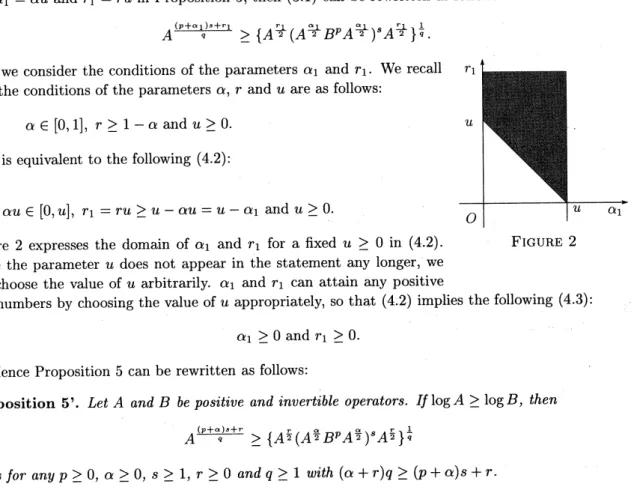
$\alpha_{1}=\alpha u\in[0, u],$ $r_{1}=ru\geq u-\alpha u=u-\alpha_{1}$ and $u\geq 0$
.
Figure 2 expresses the domain of$\alpha_{1}$ and $r_{1}$ for a fixed $u\geq 0$ in (4.2). FIGURE 2
Since the parameter $u$ does not appear in the statement any longer, we
can choose the value of$u$ arbitrarily. $\alpha_{1}$ and $r_{1}$ can attain any positive
real numbers by choosing the value of$u$ appropriately,so that (4.2) implies the following (4.3):
(4.3) $\alpha_{1}\geq 0$and $r_{1}\geq 0$.
Hence Proposition 5
can
be rewritten asfollows:Proposition 5’. Let$A$ and$B$ be positive andinvertible operators.
If
$\log A\geq\log B$, then(4.4) $A^{\frac{(p+\alpha)s+r}{q}} \geq\{A^{\frac{r}{2}}(A^{\frac{\alpha}{2}}BPA\frac{\alpha}{2})sA^{\frac{r}{2}\}^{\frac{1}{q}}}$
holds
for
any$p\geq 0,$ $\alpha\geq 0,$ $s\geq 1,$ $r\geq 0$ and$q\geq 1$ with $(\alpha+r)q\geq(p+\alpha)s+r$.By using Proposition 5’ instead of Proposition 5 in their proofs,
our
previous results in Section 2can be rewritten asfollows. Here
we
omit to describethe proofs.Theorem 1’. Let $A$ and $B$ be positive invertible operators. Then
for
each natural number$n$, thefollowing assertions are mutually equivalent:
(i) $\log A\geq\log B$
.
(ii) For each $\alpha\geq 0,$ $p\geq 0,$ $s\geq 1$ and $r \geq\max\{0, \frac{1}{n}(p+\alpha)s-\frac{(n+1)}{n}\alpha\}$, there exists the unique
invertiblepositive contraction$T=\tau(n, \alpha,p, s, r)$ satisfying
(iii) For each $\alpha\geq 0,$ $p\geq n\alpha,$ $s\geq 1$ and $r \geq\frac{1}{n}(p+\alpha)s-\frac{n+1}{n}\alpha$, there exists the unique invertible
positive contraction$T=\tau(n, \alpha,p, s, r)$ satisfying
$T(A^{\frac{(p+\alpha)s+r}{n+1}\tau)^{n}=}A^{\frac{-(p+\alpha)s+nr}{2(n+1)}}(A^{\frac{\alpha}{2}}B^{p}A^{\frac{\alpha}{2}})^{s_{A^{\frac{-(p+\alpha)S+nr}{2(\mathfrak{n}+1)}}}}$
(iv) For each$p\geq 0$, there exists the unique invertible positive contraction$T=T(n,p)$ satisfying $T(A^{P_{-}}nT)^{n}=B^{p}$.
Corollary 2’. Let $A$ and $B$ be positive invertible operators. Then
for
each natural number $n$, thefollowing assertions are mutually equivalent:
(i) $\log A\geq\log B$.
(ii) For each $\alpha\geq 0,$ $p\geq 0$ and $s\geq 1$, there exists the unique invertible positive contraction $T=$ $T(n, \alpha,p, S)$ satisfying
$T(A^{\frac{(p+\alpha)s}{n}}\tau)^{n}=(A^{\frac{\alpha}{2}}B^{p}A^{\frac{\alpha}{2}})^{s}$
(iii) For each $\alpha\geq 0,$ $p\geq n\alpha$ and $s\geq 1$, there exists the unique invertible positive contraction
$T=T(n, \alpha,p, S)$ satisfying
$T(A^{\frac{(p+\alpha)s}{n}}\tau)^{n}=(A^{\frac{\alpha}{2}}B^{p}A^{\frac{\alpha}{2}})^{s}$
(iv) For each$p\geq 0$, there exists the unique invertible positive contraction $T=T(n,p)$ satisfying
$T(A^{\frac{p}{\mathfrak{n}}}T)^{n}=B^{p}$.
Theorem 3’. Let $A$ and $B$ be positive invertible operators satisfying $MI\geq A\geq mI>0$, and let
$K_{+}(m, M,p)$ be
defined
in (1.2). Then the following assertions are mutually equivalent:(i) $\log A\geq\log B$
.
(ii) For each natural number$n,$ $\alpha\geq 0$ and$p\geq 0$,
$K_{+}(m^{\frac{(p+\alpha)S+r}{n+1}},$$M^{\frac{(p+\alpha)S+r}{n+1}},$$n+1)A^{(p+\alpha)s} \geq(A^{\frac{\alpha}{2}}B^{p}A\frac{\alpha}{2})^{s}$
holds
for
all $s\geq 1$ and$r \geq\max\{0, \frac{1}{n}(p+\alpha)s-\frac{n+1}{n}\alpha\}$.(iii) For each natural number$n,$ $\alpha\geq 0$ and$p\geq n\alpha$,
$K_{+}(m^{\frac{(p+\alpha)S+r}{n+1}},$$M^{\frac{(p+\alpha)s+r}{n+1}},$$n+1)A^{(+\alpha}p)_{S} \geq(A^{\frac{\alpha}{2}}B^{p}A\frac{\alpha}{2})^{s}$
holds
for
all $s\geq 1$ and$r \geq\frac{1}{n}(p+\alpha)s-\frac{n+1}{n}\alpha$.(iv) For each natural number$n$ and$p\geq 0$,
$K_{+}$
(
$m^{\frac{p+r}{n+1}}$
,$M^{\frac{p+r}{n+1}},$$n+1$
)
$A^{p}\geq B^{p}$holds
for
all$r \geq\frac{p}{n}$.
Theorem 4’. Let $A$ and $B$ be positive invertible operators satisfying $MI\geq A\geq mI>0$, and let
$K_{+}(m, M,p)$ and$M_{h}(p)$ be
defined
in (1.2) and (1.3), respectively. Then the following assertions aremutually equivalent:
(i) $\log A\geq\log B$.
(ii) Foreach natural number$n,$ $\alpha\geq 0$ and$p\geq 0$,
$K_{+}(m^{\frac{(p+\alpha)s-\alpha}{n}},$$M^{\frac{(p+\alpha)s-\alpha}{n}},$$n+1)A^{(\alpha)S}\mathrm{P}+\geq(A^{\frac{\alpha}{2}}B^{p}A^{\frac{\alpha}{2}})^{s}$
holds
for
all$s\geq 1$ and $(p+\alpha)s\geq(n+1)\alpha$.(iii) For each natural number$n,$ $\alpha\geq 0$ and$p\geq n\alpha$,
$K_{+}(m^{\frac{(p+\alpha)s-\alpha}{n}},$$M^{\frac{(p+\alpha)s-\alpha}{n}},$$n+1)A^{()s}\mathrm{P}+\alpha\geq(A^{\frac{\alpha}{2}}B^{p}A^{\frac{\alpha}{2}})^{s}$
holds
for
all $s\geq 1$.(iv) $M_{h}(p)A^{p}\geq B^{p}$ holds
for
all$p\geq 0$, where $h= \frac{M}{m}>1$.5
Further
extentions
of
our
results
In the previous section, we rewroteourresults intomore simple form. In this section,
we
consider whether the domain of$s$canbe extendedornot. InTheorem 1, Corollary 2, Theorem 3and Theorem4, the parameter $s$ is restricted to$s\geq 1$. Even after rewriting into simple form, thisrestriction does
not be relaxed. Practically, we canfind that this restriction derivesfromProposition 5
or
Proposition 5’. In other words, it derives from Theorem G.Contrary to Proposition 5’, we have the following result as an application of Theorem F. Proposition 7. Let$A$ and $B$ be positive invertible operators.
If
$\log A\geq\log B$, then(4.4) $A^{\frac{(p+\alpha)_{S}+\gamma}{q}} \geq\{A^{\frac{r}{2}}(A^{\frac{\alpha}{2}}B^{p}A^{\frac{\alpha}{2}})^{s}A\frac{r}{2}\}^{\frac{1}{q}}$
holds
for
any$p\geq 0,$ $\alpha\geq 0,$ $s\geq 0,$ $r\geq 0$ and$q\geq 1$ such that $(\alpha+r)q\geq(p+\alpha)s+r$.
We remark that $\mathrm{P}\mathrm{r}\mathrm{o}\mathrm{p}\mathrm{o}\mathrm{S}\mathrm{i}\mathrm{t}_{\vec{1}}\mathrm{o}\mathrm{n}7$ is an immediate corollary of [23, Theorem 1], which is a function
version of Proposition 7.
Proof of
Proposition 7. (i) Case $\alpha>0$.
ByTheorem A.2, $\log A\geq\log B$ implies the following (5.1):(5.1) $A^{\alpha}\geq(A^{\frac{\alpha}{2}}B^{p}A^{\frac{\alpha}{2}})^{\frac{\alpha}{p+\alpha}}$ for$p\geq 0$ and $\alpha>0$
.
Put $A_{1}=A^{\alpha}$ and $B_{1}=(A^{\frac{\alpha}{2}}B^{p}A^{\frac{\alpha}{2}})^{\frac{\alpha}{P+\alpha}}$ , then$A_{1}\geq B_{1}>0$ by (5.1). By Theorem$\mathrm{F}$,
(5.2) $A^{\frac{p_{1}+r_{1}}{1q}}\geq(A^{\frac{r_{1}}{12}}B^{p_{1}}A^{2}11\lrcorner r)^{\frac{1}{\mathrm{q}}}$
holds for$p_{1}\geq 0,$ $r_{1}\geq 0$ and $q\geq 1$ with $(1+r_{1})q\geq p_{1}+r_{1}$. $(5.2)$ is equivalent to the following (5.3):
(5.3) $A^{\frac{(p1+r1)\alpha}{q}} \geq\{A^{\frac{r_{1}\alpha}{2}(A^{\frac{\alpha}{2}}B^{\mathrm{P}}A)^{\frac{P1^{\alpha}}{p+\alpha}A^{\frac{1^{\alpha}}{2}}}}\frac{\alpha}{2}.\}^{\frac{1}{\mathrm{q}}}$
Put $s= \frac{p_{1}\alpha}{p+\alpha}$ and $r=r_{1}\alpha$, then the conditions$p_{1}= \frac{(p+\alpha)s}{\alpha}\geq 0,$ $r_{1}= \frac{r}{\alpha}\geq 0$ and $(1+r_{1})q\geq p_{1}+r_{1}$
are equivalent to$s\geq 0,$ $r\geq 0$ and $(\alpha+r)q\geq(p+\alpha)s+r$, respectively, and (5.3)
can
be rewrittenasfollows:
for$p\geq 0,$ $\alpha>0,$ $s\geq 0,$ $r\geq 0$ and $q\geq 1$ with $(\alpha+r)q\geq(p+\alpha)s+r$.
(ii) Case $\alpha=0$. $(4.4)$ can be rewritten
as
follows:(5.4) $A^{\epsilon_{\frac{s+r}{q}}}\geq(A^{\frac{r}{2}}B^{ps}A^{\frac{r}{2}})^{\frac{1}{\mathrm{q}}}$ .
(5.4) holds for$p\geq 0,$ $s\geq 0,$ $r\geq 0$ and $q\geq 1$ such that $rq\geq ps+r$ byTheorem A.2.
Consequently, the proofofProposition
7
is complete. $\square$Bycomparing Proposition 5’,
an
application ofTheorem $\mathrm{G}$, with Proposition 7, an applicationofTheorem$\mathrm{F}$,
we can
findthat Proposition 7isan
extension ofProposition 5’ since the inequalitiesare
thesame but the domain$s\geq 0$ of Proposition 7includes the domain $s\geq 1$ of Proposition 5’.
We havethe following results whichareextensionsof Theorem 1’ and Theorem 3’ by using Propo-sition 7insteadof Proposition 5’,
Theorem 8. Let $A$ and $B$ be positive invertible operators. Then
for
each natural number $n$, thefollowing$as\mathit{8}erti_{\mathit{0}}nS$ are mutually equivalent:
(i) $\log A\geq\log B$
.
(ii) For each $\alpha\geq 0,$ $p\geq 0,$ $s\geq 0$ and $r \geq\max\{0, \frac{1}{n}(p+\alpha)s-\frac{n+1}{n}\alpha\}$, there exists the unique invertiblepositive contraction $T=\tau(n, \alpha,p, s, r)$ satisfying
(5.5) $T(A^{\frac{\langle p+\alpha)s+r}{n+1}\tau})^{n}=A^{\frac{-(p+\alpha)S+nr}{2\langle n+1)}}(A^{\frac{\alpha}{2}}B^{p}A \frac{\alpha}{2})s_{A^{\frac{-(p+\alpha)s+nr}{2(n+1)}}}$
(iii) For each $\alpha\geq 0,$ $p\geq 0$ and $s\geq 0$, there exists the unique invertible positive contraction $T=$
$T(n, \alpha,p, S)$ satisfying
$T(A^{\frac{(p+\alpha)s}{n}}\tau)^{n}=(A^{\frac{\alpha}{2}}BpA^{\frac{\alpha}{2}})^{s}$
(iv) For each$p\geq 0$, there exists the unique invertiblepositive contraction$T=T(n,p)$ satisfying $T(A^{B}n.T)^{n}=B^{p}$
.
Theorem 9. Let $A$ and $B$ be positive invertible operators satisfying $MI\geq A\geq mI>0$, and let
$K_{+}(m, M,p)$ and$M_{h}(p)$ be
defined
in (1.2) and (1.3), respectively. Then thefollowing assertions aremutually equivalent:
(i) $\log A\geq\log B$.
(ii) For each natural number$n,$ $\alpha\geq 0$ and$p\geq 0$,
(5.6) $K_{+}(m^{\frac{(p+\alpha)s+r}{n+1}},$$M^{\frac{(P+\alpha)S+\Gamma}{n+1}},$
$n+1)A^{(p+}\alpha)_{S}\geq(A^{\frac{\alpha}{2}}B^{p}A^{\frac{a}{2}})^{s}$
holds
for
$s\geq 0$ and$r \geq\max\{0, \frac{1}{n}(p+\alpha)s-\frac{n+1}{n}\alpha\}$.
(iii) For each natural number$n,$ $\alpha\geq 0$ and$p\geq 0$,
$K_{+}(m^{\frac{(p+\alpha)s-\alpha}{n}},$$M^{\frac{(p+a)s-\alpha}{n}},$$n+1)A^{(p+)s}\alpha\geq(A^{\frac{\alpha}{2}}B^{p}A^{\frac{a}{2}})^{s}$
holds
for
$s\geq 0$ such that $(p+\alpha)s\geq(n+1)\alpha$.(iv) For each natural number$n$ and$p\geq 0$,
$K_{+}(m^{g\mathrm{g}}n,$$Mn,$$n+1)A^{p}\geq B^{p}$
(v) $\frac{(m^{p}+M^{p})^{2}}{4m^{p}M^{p}}A^{p}\geq B^{p}$ holds
for
all$p\geq 0$.(vi) $M_{h}(p)A^{p}\geq B^{p}$ holds
for
all$p\geq 0$, where $h= \frac{M}{m}>1$.
Proofs of Theorem 8 and Theorem 9
are
slight$\mathrm{m}\mathrm{o}\mathrm{d}.\mathrm{i}\mathrm{f}\mathrm{i}$.cation
$\mathrm{o}\mathrm{f}|$proofs ofTheorem 1 and Theorem
3, respectivery. So that we omit describetheir proofs.
ByComparingthe
new
results Theorem8and Theorem 9with therefined formerresults Theorem1’, Corollary 2’, Theorem 3’ and Theorem 4’, it turns out that the
new
results are extensions of theformer results since the domain $s\geq 0$ of the new results includes the domain $s\geq 1$ of the former
results. This fact is based on Proposition 5’ and Proposition 7 which are used in the proofs of the
former and
new
results, respectively.References
[1] T.Ando, On some operator inequalities, Math. Ann., 279 (1987), 157-159.
[2] T.Ando and F.Hiai, Log majorization and complementary Golden-Thompson type inequalities,
Linear AlgebraAppl., 197, 198 (1994), 113-131.
[3] J.I.Fujii, T.Furuta, T.Yamazaki and M.Yanagida, Simplified proof
of
characterizationof
chaotic order via Specht’s ratio, Scientiae Mathematicae, 2 (1999), 63-64.[4] J.I.Fujii,S.Izuminoand Y.Seo,Determinant
for
$posi_{\vee}^{\neq_{ie}}v$operators and Specht’s theorem, ScientiaeMathematicae, 1 (1998),
307-310.
[5] J.I.Fujii and Y.Seo, Determinant
for
positive operators, Scientiae Mathematicae, 1 (1998), 153-156.[6] M.Fujii, Furuta’s inequality and its mean theoretic approach, J. Operator Theory, 23 (1990),
67-72.
[7] M.Fujii, T.Furuta and E.Kamei, Furuta’s inequality and its application toAndo’stheorem, Linear Algebra Appl., 179 (1993), 161-169.
[8] M.Fujii and E.Kamei, Meantheoretic approach to the grand Furuta inequality, Proc. Amer. Math. Soc., 124 (1996), 2751-2756.
[9] M.Fujii, A.MatsumotoandR.Nakamoto, A short proof
of
the best possibilityfor
the grandFuruta inequality, J. Inequal. Appl., 4 (1999), 339-344.[10] T.Furuta, A $\geq B\geq 0$ assures $(B^{r}A^{p}Br)^{1}/q\geq B^{()}p+2r/q$
for
r $\geq 0,$p $\geq 0,$ q $\geq$ 1 with $(1+2r)q\geq$$p+2r$, Proc. Amer. Math. Soc., 101 (1987), 85-88.
[11] T.Furuta, An elementaryproof
of
an order preserving inequality, Proc. Japan Acad., 65 (1989),126.
[12] T.Furuta, Two operator
functions
with monotone property, Proc. Amer. Math. Soc., 111 (1991),511-516.
[13] T.Furuta, Applications
of
order preserving operator inequalities, Oper. Theory Adv. Appl., 59(1992), 180-190.
[14] T.Furuta, Applications
of
Furuta inequality to operator inequalities and norm inequalities pre-serving some orders, Oper. Theory Adv. Appl., 61 (1992), 115-122.[15] T.Furuta, Extension
of
the Furuta inequality and Ando-Hiai $log$-majorization, Linear AlgebraAppl., 219 (1995), 139-155.
[16] T.Furuta, Characterizations
of
operators satisfying $\log$A $\geq\log$B and applications, Topics inoperator theory, operator algebras and applications (Timi\S oara, 1994), 101-113, Rom. Acad.,
Bucharest, 1995.
[17] T.Furuta, Operator inequalitie8 associated with H\"older-McCarthy and Kantorovich inequalities, J. Inequal. Appl., 2 (1998),
137-148.
[18] T.Furuta, Simplified proof
of
an order preserving operator inequality, Proc. Japan. Acad., 74(1998), 114.
[19] T.Furuta, Simple proof
of
the concavity on operatorentropy$f(A)=-A\log$A, to appear in Math. Inequal. Appl.[20] T.Furuta, Logarithmic order and dual logarithmic order, preprint.
[21] T.Furuta, M.Hashimoto and M.Ito, Equivalence relation between generalized Furuta inequality
[22] T.Furuta and Y.Seo, An application
of
generalized Furuta inequality to Kantorovich typeinequal-ities, Scientiae Mathematicae, 2 (1999), 393-399.
[23] J.F.Jiang, E.Kamei and M.Fujii, Operator
functions
associated with grand Furuta inequality, Math. Inequal. Appl., 1 (1998),267-277.
[24] E.Kamei, A satellite to Furuta’s inequality, Math. Japon., 33 (1988),
883-886.
[25] $\mathrm{C}.\mathrm{A}.\mathrm{M}_{\mathrm{C}}\mathrm{C}\mathrm{a}\mathrm{r}\mathrm{t}\mathrm{h}\mathrm{y},$
$c_{p}$, Israel J. Math., 5 (1967), 249-271.
[26] B.Mond and J.E.Pe\v{c}ari\v{c}, Convex inequalities in Hilbert space, Houston J. Math., 19 (1993),
405-420.
[27] B.MondandJ.E.Pe\v{c}ari\v{c}, A matrix version
of
Ky Fan generalizationof
theKantorovichinequality,Linear and Multilinear Algebra, 36 (1994), 217-221.
[28] W.Specht, Zur Theorie der elementaren Mittel, Math. Z., 74 (1960), 91-98.
[29] K.Tanahashi, Best possibility
of
the Furuta inequality, Proc. Amer. Math. Soc., 124 (1996),141-146.
[30] K.Tanahashi, The best possibility
of
the grand Furuta inequality, Proc. Amer. Math. Soc., 128(2000), 511-519.
[31] M.Uchiyama, Some exponential operator inequalities, Math. Inequal. Appl., 2 (1999), 469-471.
[32] T.Yamazaki, Simplified proof
of
Tanahashi’s result on the best possibilityof
generalized Furutainequality, Math. Inequal. Appl., 2 (1999), 473-477.
[33] T.Yamazaki and M.Yanagida, Characterizations