Original article
Effect of group activities on health promotion for the community-dwelling elderly
Masako Fukasawa1 and Haruyasu Yamaguchi1
1 Gunma University Graduate School of Health Sciences, Japan
Abstract
Objective: In Japan, the Integrated Community Care System aims to support residents to live as independently as possible at home.
Koreisya-Kyoshitsu and Fureaiikiiki salons are two types of group activities for community-dwelling elderly. We investigated effec- tive ways of conducting such activities.
Methods: We analyzed 96 subjects from 8 salons and 354 subjects from 10 Koreisya-Kyoshitsu. Self-completed questionnaires includ- ed the following: attributes, the Motor Fitness Scale (MFS), revised Philadelphia Geriatric Center Morale Scale (PGCMS), Measure- ment of Psychological Independence (MPI), instrumental activities of daily living (IADL), and self-rated health status (SRH). Follow- up assessment was conducted 6 months later. Representatives from 8 salons and staff members from 10 Koreisya-Kyoshitsu answered an additional questionnaire on management.
Results: In Koreisya-Kyoshitsu, physical performance (MFS) (p = 0.007) and subjective well-being (PGCMS) (p = 0.001) im- proved significantly, whereas psychological independence (MPI) deteriorated significantly (p = 0.015). The MFS scores significantly improved in the sub-group with a high number of sessions (7 or more) (p = 0.043), as well as in the non-volunteer sub-group (p
= 0.004). The PGCMS scores significantly improved in the sub- group with a high number of sessions (p < 0.001). The MPI scores significantly deteriorated in the sub-group with a low frequency of sessions (6 or less) and in the non-volunteer sub-group (p = 0.013 and p = 0.010, respectively). In salons, the frequency of going out decreased significantly (p = 0.049). Functional status (IADL) sig- nificantly improved in the “twice or more a month” sub-group (p = 0.046), whereas it significantly deteriorated in the “once a month”
sub-group (p = 0.004). The proportion of volunteers/organizers in
Koreisya-Kyoshitsu (23.4%) was significantly lower than that in salons (39.6%).
Conclusion: The frequency (number) of sessions, but not the vol- unteer/non-volunteer attribute, was a key factor in obtaining the health promotion effects of group activities in both Koreisya-Ky- oshitsu and salons.
Key words: community-dwelling elderly, volunteer, frequency, group activity, health promotion
(J Rural Med 2016; 11(1): 17–24)
Introduction
In Japan, there are two types of group activities for community-dwelling elderly: Koreisya-Kyoshitsu and Fureaiikiiki salons. Koreisya-Kyoshitsu are culture, art, or science classes for seniors (social educational activities), constituting a form of lifelong learning, and have been held in municipal community centers since 1973 through subsi- dies (public assistance). Session sites (community centers) are accessible by foot, bicycle, and car. Staff members plan the content of activities and the period of Koreisya-Kyoshit- su every year.
Fureaiikiiki salons (salons) are self-active. They were proposed by the Japan National Council of Social Welfare in 1994 and are operated by volunteer citizens (organiz- ers)1). The Municipal Council of Social Welfare offers grants (mutual aid) for partial coverage of costs. The salons’ ses- sion sites are autonomous community centers within par- ticipants’ walking distance. Salon activities are continuous, effortless, pleasant, and free. Organizers and participants discuss how to conduct salons in an effective manner.
The Japanese Ministry of Health, Labour and Welfare is planning to establish the “Integrated Community Care Sys- tem” by 2025, which will integrate housing, medical care, long-term care, preventive services, and livelihood support in the community2). The Integrated Community Care Sys- tem aims to support residents so that they can live as in-
©2016 The Japanese Association of Rural Medicine Received: September 24, 2015, Accepted: February 23, 2016
Correspondence: Masako Fukasawa, Gunma University Graduate School of Health Sciences, 3-39-15 Showa-machi, Maebashi, Gunma 371-8514, Japan
E-mail: [email protected]
This is an open-access article distributed under the terms of the Creative Commons Attribution Non-Commercial No Derivatives (by-nc-nd) License <http://creativecommons.org/licenses/by-nc-nd/4.0/>.
dependently as possible at home3). Koreisya-Kyoshitsu and salons provide preventive services and livelihood support for the Integrated Community Care System.
At present, staff of Koreisya-Kyoshitsu and organizers of salons decide on the content of activities and the dura- tion/frequency of sessions, based on their experience and intuition. It is important to ascertain effective ways of con- ducting activities serving as health promotion for the com- munity-dwelling elderly.
In the present study, we investigated the health promo- tion effects of Koreisya-Kyoshitsu and salons, to reveal ef- fective ways of conducting activities.
Methods Subjects
Participants of the salon group consisted of 187 people from 8 salons in Gunma Prefecture. We distributed baseline questionnaires and collected these from185 people (98.9%);
2 people declined due to mental fatigue. In the follow-up assessment, we collected 115 (62.2%), as 70 people were ab- sent. Of the 115 people, 96 answered all the questions, and their data were analyzed (96/185, 51.9%).
The participants of Koreisya-Kyoshitsu consisted of 574 people from 10 Koreisya-Kyoshitsu in Maebashi City, Gun- ma. We distributed and collected baseline assessment from 569 people (99.1%), as 5 people declined. We mailed follow- up assessment questionnaires to 569 people after 6 months, and asked them to fill and return the questionnaires by mail.
In the follow-up assessment, we collected 492 out of 569 (86.5%) questionnaires because 77 people did not return the second questionnaire by mail. We analyzed 354 out of 569 (62.2%) people, who had answered all the questions.
Finally, we analyzed 96 subjects from 8 salons in Gunma Prefecture, and 354 subjects from 10 Koreisya-Kyoshitsu in Maebashi City, Gunma.
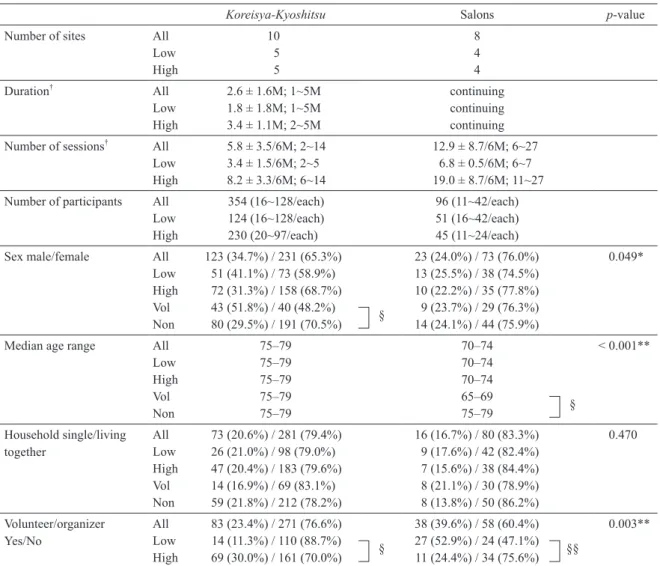
The 8 salons started receiving grants from the Munici- pal Council of Social Welfare between October 2011 and August 2012. The 96 subjects consisted of 38 organizers (39.6%) and 58 participants (60.4%). The subjects’ median age range was 70–74 years. Twenty-three were male (24.0%) and 73 were female (76.0%) (Table 1).
The 10 Koreisya-Kyoshitsu were operated as community service centers of Maebashi City between January and No- vember 2012. The 354 participants were all elderly and com- munity-dwellers, and consisted of 83 volunteers (23.4%) and 271 participants (76.6%). The participants median age range was 75–79 years. One hundred and twenty-three were male (34.7%) and 231 were female (65.3%) (Table 1).
Survey
We explained the outline and aim of the study to staff at the Municipal Council of Social Welfare and community centers. Salon sessions were held at regular intervals. The frequency of salon sessions was between once a month and once a week. Koreisya-Kyoshitsu were held 3–15 times dur- ing the surveyed 6 months. The period, frequency, and class content of Koreisya-Kyoshitsu differed across community centers (Table 1). Class content included talking, exercise, singing, fancywork, tours, and so on. We explained the out- line and aim of the study to participants at the first session.
Baseline assessment was conducted at the second session.
Follow-up assessment was conducted 6 months after base- line assessment. Salon participants answered questionnaires at the sessions. The term “session” in this study refers to each convention of a salon and Koreisya-Kyoshitsu. Six months after the first assessment, we mailed questionnaires to participants for follow-up assessment of Koreisya-Kyo- ushitsu. We asked them to answer the questionnaires and return them by mail.
Written informed consent was obtained from all sub- jects. The study was approved by the Epidemiologic Re- search Ethics Committee of the Gunma University Faculty of Medicine (22-9).
Evaluation
The following five questionnaires were self-completed:
the Motor Fitness Scale (MFS)4), revised Philadelphia Geri- atric Center Morale Scale (PGCMS)5), Measurement of Psy- chological Independence (MPI)6), instrumental activities of daily living (IADL)7), and self-rated health status (SRH) 8).
The MFS consisted of 14 items and assessed physical performance. Possible responses to each item were 1 for
“yes” and 0 for “no.” The MFS was divided into the fol- lowing three subscales: mobility, 6 items; strength, 4 items;
and balance, 4 items. Higher scores indicated better per- formance4). The MFS is a fitness test for elderly persons in daily life. The reliability and validity of the MFS have been reported4).
The PGCMS consisted of 17 items and assessed sub- jective well-being. The Japanese edition was developed by Koyano et al.9). The PGCMS evaluates subjective well-being among elderly persons9). The reliability of the PGCMS has been reported10). Subjects were assigned a score of 1 for a positive answer and 0 for a negative answer. The total score was 17 points. The PGCMS was divided into the following three subscales: agitation, 6 items; attitude towards aging, 5 items; and loneliness/dissatisfaction, 6 items. Higher scores indicated higher morale5).
The MPI consisted of 8 items and assessed the inten- tion of psychological independence,: that is, taking interest,
having a purpose in life, becoming absorbed in something, doing something for someone, deciding for oneself, sticking to one’s opinion, acting accountably, and being confident about one’s opinion. Each item was rated from 1 (“think so”) to 4 (“don’t think so”). Lower scores indicated higher levels of psychological independence. Scores ranged from 8 to 32. The MPI was divided into two subscales, namely, pur- posefulness, 4 items; and personal accountability, 4 items.
The reliability and validity of the MPI have been reported6). IADL assessed functional status. IADL is a subscale of the Tokyo Metropolitan Institute of Gerontology Index of Competence (TMIG-IC). Possible responses to each item were 1 for “yes” and 0 for “no.” The total score was 5 points.
Higher scores indicated higher functional status7). The reli-
ability and validity of IADL have been reported11).
SRH assessed subjective psychosocial well-being8). SRH was scored on a 4-point Likert scale (1 for “excellent” or
“very good,” 2 for “good,” 3 for “fair,” and 4 for “poor”).
In addition, we requested participants to complete a questionnaire regarding the following: age group (5-year step), sex, family composition, familiar person in the neigh- borhood (Yes/No), volunteering for the session on the spot (Yes/No), the frequency of going out and the frequency of group activity (4 for “almost every day,” 3 for “3–4 times/
week,” 2 for “almost once a week,” and 1 for “less than once a week”), and the frequency of participation in this session.
Table 1 Characteristics of participants
Koreisya-Kyoshitsu Salons p-value
Number of sites All 10 8
Low 5 4
High 5 4
Duration† All 2.6 ± 1.6M; 1~5M continuing
Low 1.8 ± 1.8M; 1~5M continuing
High 3.4 ± 1.1M; 2~5M continuing
Number of sessions† All 5.8 ± 3.5/6M; 2~14 12.9 ± 8.7/6M; 6~27
Low 3.4 ± 1.5/6M; 2~5 6.8 ± 0.5/6M; 6~7
High 8.2 ± 3.3/6M; 6~14 19.0 ± 8.7/6M; 11~27
Number of participants All 354 (16~128/each) 96 (11~42/each)
Low 124 (16~128/each) 51 (16~42/each)
High 230 (20~97/each) 45 (11~24/each)
Sex male/female All 123 (34.7%) / 231 (65.3%) 23 (24.0%) / 73 (76.0%) 0.049*
Low 51 (41.1%) / 73 (58.9%) 13 (25.5%) / 38 (74.5%) High 72 (31.3%) / 158 (68.7%) 10 (22.2%) / 35 (77.8%) Vol 43 (51.8%) / 40 (48.2%) § 9 (23.7%) / 29 (76.3%) Non 80 (29.5%) / 191 (70.5%) 14 (24.1%) / 44 (75.9%)
Median age range All 75–79 70–74 < 0.001**
Low 75–79 70–74
High 75–79 70–74
Vol 75–79 65–69 §
Non 75–79 75–79
Household single/living
together All 73 (20.6%) / 281 (79.4%) 16 (16.7%) / 80 (83.3%) 0.470
Low 26 (21.0%) / 98 (79.0%) 9 (17.6%) / 42 (82.4%) High 47 (20.4%) / 183 (79.6%) 7 (15.6%) / 38 (84.4%) Vol 14 (16.9%) / 69 (83.1%) 8 (21.1%) / 30 (78.9%) Non 59 (21.8%) / 212 (78.2%) 8 (13.8%) / 50 (86.2%) Volunteer/organizer
Yes/No All 83 (23.4%) / 271 (76.6%) 38 (39.6%) / 58 (60.4%) 0.003**
Low 14 (11.3%) / 110 (88.7%) § 27 (52.9%) / 24 (47.1%) §§
High 69 (30.0%) / 161 (70.0%) 11 (24.4%) / 34 (75.6%)
*p < 0.05, **p < 0.01. † Results are expressed as: mean ± standard deviation. † First session not included. All p-values were based on the χ2-test and the Mann-Whitney U test. “Low” of Koreisya-Kyoshitsu, 6 or less; “High” of Koreisya-Kyoshitsu, 7 or more (First session in- cluded). “Low” of salons, once a month; “High” of salons, twice or more a month. M, months; “Vol”, volunteers; “Non”, non-volunteers.
§, p < 0.001; §§, p = 0.004.
Analysis
Statistical analysis was performed using SPSS 22.OJ for Windows. Spearman’s correlation coefficient was employed for the PGCMS and the MPI. The Shapiro-Wilk test was used to assess whether the data were normally distributed or not. When data were not normally distributed, the Wilcoxon signed-rank test was used. We regarded p < 0.05 as indica- tive of significance.
We added sub-group analyses. We classified subjects of Koreisya-Kyoshitsu into 2 sub-groups by the number of ses- sions, as follows: 5 Kyoshitsu were classified under the sub- group with a low number of sessions (6 times or less; low), and 5 under the sub-group with a high number of sessions (7 times or more; high). We classified salon subjects into 2 sub- groups, as follows: 4 salons were classified under the “once a month” (Low) sub-group, and 4 under the “twice or more a month” (High) sub-group. We also classified subjects of Koreisya-Kyoshitsu and salons into 2 subgroups, as follows:
volunteer/organizer subgroup (Vol) and non-volunteer/orga- nizer subgroup (Non).
The sample size of this research was as follows: The number of participants in each salon was 10–30, and that of participants in each course of the Koreisya-Kyoshitsu was 20–40. We tried to satisfy the sample size requirements.
Results
Characteristics of Koreisya-Kyoshitsu and salons
In salons, there was a negative correlation between the PGCMS scores and the MPI scores (r = –.261, p < 0.05;
Spearman’s correlation coefficient). In Koreisya-Kyoshitsu, there was a negative correlation between the PGCMS scores and the MPI scores (r = –.315, p < 0.01; Spearman’s correla- tion coefficient).
Table 1 shows the characteristics and demographic data of the participants of Koreisya-Kyoshitsu and salons. The mean duration of Koreisya-Kyoshitsu from the second ses- sion to the last session was 2.6 ± 1.6 months in the 6-month survey period. The Koreisya-Kyoshitsu sessions were held 5.8 ± 3.5 times, excluding the first session. During the 6-month survey, salons were held 12.9 ± 8.7 times, exclud- ing the first session. Salons were held about twice as much as Koreisya-Kyoshitsu were. In Koreisya-Kyoshitsu, the number of participants at each session ranged between 10 and 100, depending on class content. In salons, the number of participants at each session ranged between 10 and 40.
Females participated significantly more than males did in Koreisya-Kyoshitsu and salons. The median age range of participants in Koreisya-Kyoshitsu (75–79) was significant- ly higher than that in salons (70–74) (p = 0.001; Mann-Whit- ney U test). Koreisya-Kyoshitsu showed significantly lower
participation of Vol than salons did (p = 0.003; χ2-test).
In Koreisya-Kyoshitsu, the proportion of Vol in the low- frequency sub-group was significantly smaller than that in the high-frequency sub-group (p < 0.001; χ2-test). In salons, the proportion of Vol in the low-frequency sub-group was significantly larger than that in the high-frequency sub- group (p = 0.004; χ2-test).
In Koreisya-Kyoshitsu, the proportion of males in Vol was significantly higher than that in Non (p < 0.001; χ2-test).
In salons, the median age of Vol was significantly lower than that of Non (p < 0.001; Mann-Whitney U test).
Effects and number of sessions of Koreisya-Kyoshitsu Table 2 shows the results for Koreisya-Kyoshitsu. The MFS scores changed from 11.58 ± 2.70 to 11.79 ± 2.67, dem- onstrating significant improvement (p = 0.007; Wilcoxon signed-rank test). The PGCMS scores changed from 12.59
± 3.18 to 13.01 ± 3.28, demonstrating significant improve- ment (p = 0.001). The MPI scores changed from 11.87 ± 3.28 to 12.27 ± 3.36, showing significant deterioration (p = 0.015). There were no significant changes in IADL scores, SRH scores, the frequency of going out, and the frequency of group activity (Table 2).
In the sub-group with a high number of sessions (7 times or more), the MFS scores increased significantly from 11.67
± 2.54 to 11.84 ± 2.54 (p = 0.043), and the PGCMS scores increased significantly from 12.53 ± 3.23 to 13.26 ± 3.15 (p
< 0.001).In the sub-group with low session numbers 6 times or less), the MPI scores changed from 11.59 ± 2.95 to 12.28
± 3.28, showing significant deterioration (p = 0.013).
We further classified the subjects of Koreisya-Kyoshitsu into 2 sub-groups, according to participants’ attribute of either Vol or Non. The baseline SRH scores was signifi- cantly lower (better health) in Vol than in Non (p < 0.000;
Mann-Whitney U test). In Vol, the PGCMS scores increased significantly from 12.65 ± 2.56 to 13.61 ± 3.04 (p < 0.001), showing improved well-being. In Non, the MFS scores in- creased significantly from 11.45 ± 2.81 to 11.72 ± 2.74 (p
= 0.004), showing improved physical performance. The MPI scores increased from 12.04 ± 3.30 to 12.53 ± 3.51 (p
= 0.010), showing significant deterioration of psychological independence.
Effects and frequency of salons sessions
Table 3 shows the results for salons. Among the salon subjects, the frequency of going out changed from 3.75 ± 0.48 to 3.64 ± 0.65, showing a significant decrease (p = 0.049). There were no significant changes in the MFS scores, PGCMS scores, MPI scores, IADL scores, SRH scores, and the frequency of group activity (Table 3).
In the “once a month” (Low) sub-group, IADL scores
changed from 4.76 ± 0.55 to 4.57 ± 0.81, showing signifi- cant deterioration (p = 0.004).The frequency of going out changed from 3.75 ± 0.48 to 3.57 ± 0.76, showing a declining tendency (p = 0.059). In the “twice or more a month” (High) sub-group, IADL scores changed from 4.73 ± 0.78 to 4.82
± 0.75, demonstrating significant improvement (p = 0.046).
At baseline, the SRH scores of Vol was significantly lower (better health) than that of Non (p = 0.004; Mann-Whitney U test). Moreover, the MFS scores of Vol was significantly
higher (better physical performance) than that of Non (p <
0.001; Mann-Whitney U test) (Table 3).
Discussion
The sex, age group, and volunteer/organizer proportions differed significantly between Koreisya-Kyoshitsu and sa- lons, even though the activities were similar. The percent- ages of females and young-old elderly persons were higher
Table 2 Health promotion effects of Koreisya-Kyoshitsu
Scale Subjects n Baseline† Follow-up† p-value
Frequency of going out All 354 3.66 ± 0.57 3.70 ± 0.53 0.215
Low 124 3.59 ± 0.63 3.67 ± 0.55 0.149
High 230 3.70 ± 0.54 3.72 ± 0.51 0.655
Vol 83 3.76 ± 0.46 3.74 ± 0.50 0.705
Non 271 3.64 ± 0.60 3.69 ± 0.54 0.112
Frequency of group activity All 354 2.48 ± 0.90 2.52 ± 0.89 0.379
Low 124 2.35 ± 0.88 2.40 ± 0.89 0.455
High 230 2.56 ± 0.90 2.58 ± 0.88 0.589
Vol 83 2.82 ± 0.77 2.70 ± 0.87 0.179
Non 271 2.38 ± 0.92 2.46 ± 0.89 0.097
SRH‡ All 354 2.01 ± 0.59 2.01 ± 0.51 0.745
Low 124 2.06 ± 0.62 2.09 ± 0.57 0.602
High 230 1.97 ± 0.57 1.97 ± 0.48 0.980
Vol trend (base) 83 1.95 ± 0.54 1.95 ± 0.49 1.000
Non p < 0.001** 271 2.02 ± 0.60 2.03 ± 0.52 0.723
MFS All 354 11.58 ± 2.70 11.79 ± 2.67 0.007**
Low 124 11.41 ± 2.97 11.68 ± 2.91 0.071
High 230 11.67 ± 2.54 11.84 ± 2.54 0.043*
Vol 83 12.02 ± 2.24 12.00 ± 2.44 0.692
Non 271 11.45 ± 2.81 11.72 ± 2.74 0.004**
PGCMS All 354 12.59 ± 3.18 13.01 ± 3.28 0.001**
Low 124 12.69 ± 3.10 12.55 ± 3.47 0.859
High 230 12.53 ± 3.23 13.26 ± 3.15 0.000**
Vol 83 12.65 ± 2.56 13.61 ± 3.04 0.000**
Non 271 12.57 ± 3.35 12.83 ± 3.33 0.138
MPI‡ All 354 11.87 ± 3.28 12.27 ± 3.36 0.015*
Low 124 11.59 ± 2.95 12.28 ± 3.28 0.013*
High 230 12.02 ± 3.45 12.26 ± 3.41 0.259
Vol 83 11.31 ± 3.18 11.41 ± 2.66 0.753
Non 271 12.04 ± 3.30 12.53 ± 3.51 0.010*
IADL All 354 4.86 ± 0.44 4.84 ± 0.45 0.308
Low 124 4.89 ± 0.39 4.86 ± 0.43 0.426
High 230 4.85 ± 0.47 4.83 ± 0.46 0.471
Vol 83 4.88 ± 0.45 4.87 ± 0.41 0.710
Non 271 4.86 ± 0.44 4.84 ± 0.46 0.334
† Results are expressed as: mean ± standard deviation. Baseline was the second session. Follow-up was 6 months later. ‡ Lower number indicates a better condition. *p < 0.05, **p < 0.01. All p-values were based on the Wilcoxon signed-rank test. SRH, self- rated health status; MFS, Motor Fitness Scale; PGCMS, revised Philadelphia Geriatric Center Morale Scale; MPI, Measurement of Psychological Independence; IADL, instrumental activities of daily living. “Low”, 6 or less; “High”, 7 or more. “Vol”, volun- teers; “Non”, non-volunteers.
in salons than in Koreisya-Kyoshitsu. Previous studies have reported that young-old elderly persons tend to attend sa- lons12). Thus, Koreisya-Kyoshitsu and salons showed a dif- ferent pattern in terms of age group: Koreisya-Kyoshitsu participants tended to be of an older age group.
Koreisya-Kyoshitsu participants showed improved phys- ical performance and subjective well-being, although psy- chological independence deteriorated. In the sub-group with low session numbers, psychological independence deterio-
rated. In the sub-group with high session numbers, physical performance and subjective well-being improved. Thus, we found that the number of sessions is important for the health promotion of participants in Koreisya-Kyoshitsu. Koreisya- Kyoshitsu were held 5.8 ± 3.5 times in the 6-month survey period. Although the total number of sessions of Koreisya- Kyoshitsu was half of that of salons during the 6-month sur- vey period, Koreisya-Kyoshitsu showed health-promoting effects. The first reason is that previous studies have report-
Table 3 Health promotion effects of salons
Scale Subjects n Baseline† Follow-up† p-value
Frequency of going out All 96 3.75 ± 0.48 3.64 ± 0.65 0.049*
Low 51 3.75 ± 0.48 3.57 ± 0.76 0.059
High 45 3.76 ± 0.48 3.71 ± 0.51 0.480
Vol 38 3.87 ± 0.34 3.79 ± 0.47 0.257
Non 58 3.67 ± 0.54 3.53 ± 0.73 0.106
Frequency of group activity All 96 2.35 ± 0.91 2.44 ± 0.81 0.264
Low 51 2.45 ± 0.90 2.49 ± 0.83 0.637
High 45 2.24 ± 0.91 2.38 ± 0.78 0.317
Vol 38 2.68 ± 0.84 2.74 ± 0.72 0.635
Non 58 2.14 ± 0.89 2.24 ± 0.80 0.320
SRH‡ All 96 2.01 ± 0.61 2.02 ± 0.58 0.858
Low 51 1.92 ± 0.59 2.02 ± 0.58 0.096
High 45 2.11 ± 0.61 2.02 ± 0.58 0.400
Vol trend (base) 38 1.89 ± 0.45 1.84 ± 0.49 0.414
Non p = 0.004** 58 2.09 ± 0.68 2.14 ± 0.61 0.552
MFS All 96 11.26 ± 3.27 11.40 ± 3.25 0.368
Low 51 11.22 ± 3.25 11.22 ± 3.32 0.890
High 45 11.31 ± 3.33 11.60 ± 3.20 0.277
Vol trend (base) 38 12.79 ± 1.40 12.84 ± 1.41 0.939 Non p < 0.001** 58 10.26 ± 3.74 10.45 ± 3.75 0.287
PGCMS All 96 12.73 ± 2.75 12.96 ± 2.92 0.298
Low 51 12.90 ± 3.00 12.65 ± 3.08 0.791
High 45 12.53 ± 2.46 13.31 ± 2.72 0.073
Vol 38 13.26 ± 2.90 13.82 ± 2.76 0.140
Non 58 12.38 ± 2.62 12.40 ± 2.91 0.812
MPI‡ All 96 12.21 ± 3.45 12.45 ± 3.29 0.312
Low 51 11.43 ± 2.93 12.20 ± 3.25 0.106
High 45 13.09 ± 3.81 12.73 ± 3.34 0.797
Vol 38 11.66 ± 2.91 11.58 ± 2.69 0.836
Non 58 12.57 ± 3.75 13.02 ± 3.53 0.266
IADL All 96 4.75 ± 0.66 4.69 ± 0.79 0.134
Low 51 4.76 ± 0.55 4.57 ± 0.81 0.004**
High 45 4.73 ± 0.78 4.82 ± 0.75 0.046*
Vol 38 4.92 ± 0.27 4.87 ± 0.41 0.157
Non 58 4.64 ± 0.81 4.57 ± 0.94 0.285
† Results are expressed as: mean ± standard deviation. Baseline was the second session. Follow-up was 6 months later. ‡ Lower number indicates a better condition. *p < 0.05, **p < 0.01. All p-values were based on the Wilcoxon signed-rank test. SRH, self- rated health status; MFS, Motor Fitness Scale; PGCMS, revised Philadelphia Geriatric Center Morale Scale; MPI, Measurement of Psychological Independence; IADL, instrumental activities of daily living. “Low”, 6 or less; “High”, 7 or more. “Vol”, volun- teers; “Non”, non-volunteers.
ed that people with higher physical and psychological func- tioning more frequently use shops and community centers than do those with lower functioning13). Shops and recreation facilities with walking distance are important for facilitat- ing physical activity among seniors14). Previous studies have reported that higher frequency of vehicle use, especially bi- cycles, improves the amount of leisure and work activity15). The second reason is that education programs have posi- tive effects. Participants learn various things at each ses- sion, obtaining knowledge and skills. In a previous study, even one session of stress management education for the elderly reduced general stress responses16). Compared to the young-old elderly, depression among the old-old elderly sig- nificantly decreases, as the number of friends, morale, and social activities increase17). Participation in different kinds of activities is related to “Successful Aging”18). Certainly, participants of Koreisya-Kyoshitsu could obtain various educational benefits through multifarious activities. Thus, Koreisya-Kyoshitsu is suitable for the old-old elderly. Inten- sive education, such as 6 sessions in 3 months, might show health-promoting effects.
In the sub-group analysis, psychological independence (MPI) significantly deteriorated in the Low and Non sub- groups. Psychological independence evaluates taking an in- terest, having a purpose in life, doing something for some- one, and so on. Volunteers need to acquire these attributes.
Ishikawa et al. have verified the association of depression with less engagement in outside activities among elders liv- ing an independent life19). We assume that high-frequency participation maintains purposefulness and prevents dete- rioration of psychological independence.
In a longitudinal study of nearly two years, participants in a newly opened community salon showed significant improvement in self-rated health, compared to the control group20). IADL deteriorated in the “once a month” sub-group of salons, but improved in the “twice or more a month” sub- group. Salons allow participants to communicate with oth- ers in their respective community. The maintenance of the independence of elderly persons who engage in social in- teraction is important; IADL research is consistent with the independence index of the elderly21).
We assumed that low frequency (once a month) in sa- lons, as compared to high frequency, was associated with poor social interaction. Thus, IADL deteriorated. Among the community-dwelling elderly, a higher frequency of communication with neighbors is related to higher life satis- faction22) and lower depression12, 22). Moreover, elderly salon participants can obtain information on health and welfare services23, 24). Previous studies have shown that exercise guidance from classmates is better than that from profes- sionals25). Overweight/obese individuals have been found to
effectively lose weight through the support of teammates26). However, in the present study, we suggested frequency as a key factor affecting health promotion in salons.
The present study has several limitations. Salons were assessed through a subjective survey. Our questionnaires did not elicit medical history information from participants.
The number of participants and duration of the survey were limited. The season and location of Koreisya-Kyoshitsu/sa- lons may influence the results. There were significant dif- ferences in some evaluation between baseline groups, ow- ing to the field survey. Koreisya-Kyoshitsu and salons had different management styles. We could not obtain control groups in the community. In both Koreisya-Kyoshitsu and salons, participants were a mixture of volunteers/organizers and non-volunteers. The activity program was decided upon in each course of the Koreisya-Kyoshitsu/salon, and was not standardized.
Conclusion
The present study showed that the frequency/number of sessions affected the health promotion among participants in both Koreisya-Kyoshitsu and salons.
Acknowledgments
We would like to thank all the people who participated in the present study, volunteers for assistance of the assess- ment, and staff and students at Gunma University (Mae- bashi, Japan). We also wish to thank the Municipal Council of Social Welfare in Gunma Prefecture, the Lifelong Learn- ing Division of Maebashi City, the community center of Maebashi City, and the Maebashi City office.
References
1. Takano K, Sakamoto T, Ookura F. Social participation of aged people and residents association. Bulletin of the Graduate Schools Yamaguchi Prefectural University 2007; 8: 129–137 (in Japanese, Abstract in English).
2. The current situation and the future direction of the Long-term Care Insurance System in Japan –With a Focus on the Hous- ing for the Elderly–. March 7, 2013. Available at:http://www.
mhlw.go.jp/english/policy/care-welfare/care-welfare-elderly/
dl/ri_130311-01.pdf#search=’The+current+situation+and+th e+future+direction+of+the+Longterm+Care+Insurance+Syst em+in+Japan’ Accessed 22 December 2014.
3. The integrated community care based on 5 standpoints, self- help, mutual aid, mutual assistance and public help. Avail- able at: http://www.mhlw.go.jp/seisakunitsuite/bunya/huku- shi_kaigo/kaigo_koureisha/chiiki-houkatsu/dl/link1-3.pdf.
Accessed 19 January 2014.
4. Kinugasa T, Nagasaki H. Reliability and validity of the Motor Fitness Scale for older adults in the community. Aging (Mi- lano) 1998; 10: 295–302. [Medline]
5. Lawton MP. The Philadelphia Geriatric Center Morale Scale:
a revision. J Gerontol 1975; 30: 85–89. [Medline] [CrossRef]
6. Suzuki Y, Sakihara S. Measurement of psychological inde- pendence: scale validity and reliability. Minzoku Eisei 2003;
69: 47–56 (in Japanese, Abstract in English).
7. Koyano W, Shibata H, Nakazato K, et al. Measurement of competence in the elderly living at home: development of an index of competence. Nippon Koshu Eisei Zasshi 1987; 34:
109–114 (JJPH).
8. Shibata H, Suzuki T, Osada H, et al. Roujinhokenkatudou no tenkai. Kenkoudo no sokutei. Igakusyoin, Tokyo, 1992; 74-95 (in Japanese).
9. Koyano W. Rounenseishinigakukanrenryouiki de mochi- irarerusokudo QOL nadowosokuteisurutamenosokudo (2).
Rounen Seishin Igaku Zasshi 1996; 7: 431–441 (in Japanese).
10. Koyano W, Shibata H, Haga H, et al. PGC moralu sukelu no kouzou saikin no kaiteisagyouga motarashita mono. Shakai Rounengaku 1989; 5: 129–142 (in Japanese).
11. Koyano W, Shibata H, Nakazato K, et al. Measurement of competence: reliability and validity of the TMIG Index of Competence. Arch Gerontol Geriatr 1991; 13: 103–116.
[Medline] [CrossRef]
12. Honda H, Ueki S, Okada T, et al. Relationships between participation in community activities and psychosocial and physical health of community-dwelling elderly. Nippon Ko- shu Eisei Zasshi 2010; 57: 968–976 (in Japanese). [Medline]
13. Hirai H, Kondo K. Related factors in the elderly’s use of mu- nicipal institutions: basic study for promoting participation in a care prevention program. Nippon Koshu Eisei Zasshi 2008;
55: 37–45 (in Japanese). [Medline]
14. Shigematsu R, Sallis JF, Conway TL, et al. Age differences in the relation of perceived neighborhood environment to walking. Med Sci Sports Exerc 2009; 41: 314–321. [Medline]
[CrossRef]
15. Tsunoda K, Mitsuishi Y, Tsuji T, et al. Association of the physical activity of community-dwelling older adults with transportation modes, depression and social networks. Nip- pon Ronen Igakkai Zasshi Japanese Journal of Geriatrics 2011; 48: 516–523 (in Japanese). [Medline] [CrossRef]
16. Nakamura N, Matsuo N, Takemura K. The effect of one-
session stress management education for the elderly. Nihon Kenkou Kyoiku Gakkaishi 2003; 11: 13–22 (in Japanese, Ab- stract in English).
17. Demura S, Sato S. Relationships between depression, lifestyle and quality of life in the community dwelling elderly: a com- parison between gender and age groups. J Physiol Anthropol Appl Human Sci 2003; 22: 159–166. [Medline] [CrossRef]
18. Menec VH. The relation between everyday activities and suc- cessful aging: a 6-year longitudinal study. J Gerontol B Psy- chol Sci Soc Sci 2003; 58: S74–S82. [Medline] [CrossRef]
19. Ishikawa M, Tamakoshi K, Yatsuya H, et al. Factors related to frequency of engaging in outside activities among elderly persons living an independent life at home. Nagoya J Med Sci 2006; 68: 121–130. [Medline]
20. Ichida Y, Hirai H, Kondo K, et al. Does social participation improve self-rated health in the older population? A quasi-ex- perimental intervention study. Soc Sci Med 2013; 94: 83–90.
[Medline] [CrossRef]
21. Miyabara H, Oda T. Relationships among lifestyle and inde- pendence in the elderly. Rigaku Ryouhou Kagaku 2008; 23:
85–89 (in Japanese, Abstract in English). [CrossRef]
22. Shimanuki H, Sakihara S, Haga H, et al. Relationship be- tween social contact, life satisfaction and mental health in elderly persons in a rural Okinawan community: Comparison by IADL levels. Minzoku Eisei 2003; 69: 195–204 (in Japa- nese, Abstract in English).
23. Ura C, Yatomi N, Homma A. The differences in the usage of the sources of information by IADL among the elderly.
Rounen Seishin Igaku Zasshi 2003; 14: 1271–1279 (in Japa- nese, Abstract in English).
24. Kobayashi E, Sugisawa H, Fukaya T, et al. The role of social networks in elders’ awareness of health and welfare services.
Rounen Shakai Kagaku 2000; 22: 357–366 (in Japanese, Ab- stract in English).
25. Dorgo S, Robinson KM, Bader J. The effectiveness of a peer- mentored older adult fitness program on perceived physical, mental, and social function. J Am Acad Nurse Pract 2009; 21:
116–122. [Medline] [CrossRef]
26. Leahey TM, Kumar R, Weinberg BM, et al. Teammates and social influence affect weight loss outcomes in a team-based weight loss competition. Obesity (Silver Spring) 2012; 20:
1413–1418. [Medline] [CrossRef]