A Study on the Characteristics of Farmers’
Management Capability in Thailand
(
ࢱ࠾ࡅࡿ㎰ᐙࡢ⤒Ⴀ⬟ຊࡢ≉ᚩ㛵ࡍࡿ◊✲)
PANATDA UTARANAKORN
The United Graduate School of Agricultural Sciences, Tottori University, Japan
2016
A Study on the Characteristics of Farmers’
Management Capability in Thailand
(ࢱ࠾ࡅࡿ㎰ᐙࡢ⤒Ⴀ⬟ຊࡢ≉ᚩ㛵ࡍࡿ◊✲)
By
Panatda Utaranakorn
A Dissertation Submitted to the United Graduate School of Agricultural Sciences, Tottori University, Japan
In partial fulfillment of the requirement for the degree of
DOCTOR OF PHILOSOPHY IN MANAGERIAL ECONOMICS
Supervisors:
Professor Dr. Hideo FURUTSUKA
(April 2016 – September 2016)Professor Dr. Kumi YASUNOBU
Associate Professor Dr. Norikazu INOUE
(October 2014 – September 2016)Professor Dr. Hajime KOBAYSHI
(October 2013 – March 2016)Associate Professor Dr. Akira ISHIDA
(October 2013 – September 2014)2016
iii
Acknowledgement
I would firstly like to express my sincere gratitude to the Ministry of Education, Culture, Sports, Science and Technology of the Government of Japan for offering me the Japanese government scholarship (Monbukagakusho) to pursue higher studies in Japan. I am deeply grateful to my advisors, Prof. Kumi YASUNOBU for the continuous support of my study and related research, for her patience, motivation, and immense knowledge. Her guidance helped me in all the time of research and writing of this thesis.
I could not have imagined having a better advisor and mentor for my study. Besides my advisor, I would like to thank the rest of my academic supervisors: Prof. Hajime KOBAYASHI, Prof. Hideo FURUTSUKA, Prof. Norikazu INOUE and Prof. Akira ISHIDA, for their insightful comments and encouragement, but also for the hard question which incented me to widen my research from various perspectives.
My sincere thanks also goes to Prof. Kumi YASUNOBU again who provided me an opportunity to join their team as intern, and who gave access to the laboratory and research facilities. Without her precious support it would not be possible to conduct this research. I thank my fellow labmates in for the stimulating discussions, and for all the fun we have had in the last five years. Also I thank to all of the professionals, officers, farmers and other folks who welcomed me into their home and offices, offered their time for me as well as trusted me with their stories, in the following institutions: Khon Kaen University, Community Development Department of Nong Song Hong district, Agricultural Extension Office of Nong Song Hong district, Wang Hin sub-district and Non Han sub-district. I could not have completed this work without their valuable insights and opinions. In particular, I am grateful to Dr. Weera Pakuthai, Assoc. Prof.
iv
Prensak Pugdee and Assist. Prof. Supaporn Puangchomphoo for enlightening me the first glance of research.
Last but not the least, I would like to thank my family: my parents and to my brothers, my sisters, my relatives and my lovely friends for supporting me spiritually throughout writing this thesis and my life in general.
Panatda Utaranakorn
v
Dedication
I dedicate this thesis to my parents, farther Mr. Boo Utaranakorn and mother Mrs. Junjira Utaranakorn, who have lead me through the valley of darkness with light of hope and support. I hope this achievement will complete the dream that you have had for me since twenty-seven years ago when you chose to give me the best education you could. This dissertation is also dedicated to my beloved friend, my dearest brothers and sisters, who encourage and support me. Furthermore, I am sincerely thankful for all the people in my life, who touch my heart.
vi
Table of Contents
Acknowledgement iii
Dedication v
List of Tables xi
List of Figures xiii
Acronyms and abbreviations xiv
Chapter 1: Introduction 1
1.1 Background of the study 1
1.2 Objectives of the study 4
1.3 Thesis structure 4
Chapter 2: Literature Review on Farm Management Capability 7 2.1 Definition of farm management capability 7
2.2 Farm managerial ability of farmer 9
2.3 Farmers’ attitudes and perception toward farm management 13
2.4 Decision-making process 14
2.5 Farm production efficiency 16
Chapter 3: Research Design 21
3.1 Analytical framework of the study 21
3.1.1 Research questions 23
3.2 The study area 23
3.2.1 Overview of agriculture in Thailand and in Northeast region
23
3.2.2 Description of the study area 24 Chapter 4: Farmers’ Managerial Ability and Its Determinant 28 4.1 Introduction and specific objectives 28
4.2 Sample and data collection 29
vii
4.3 Analytical methods 30
4.4 Results and discussion 31
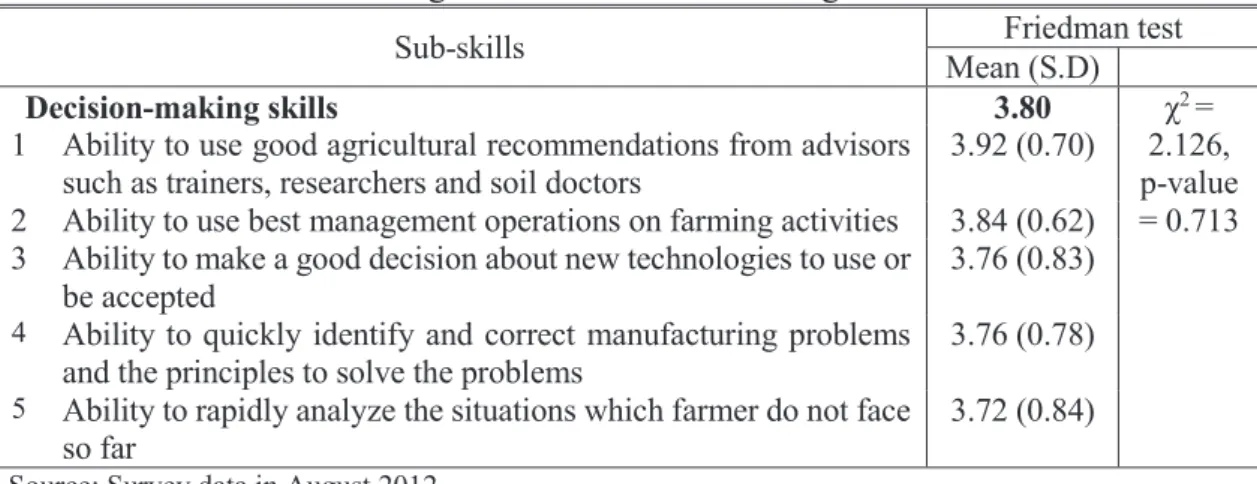
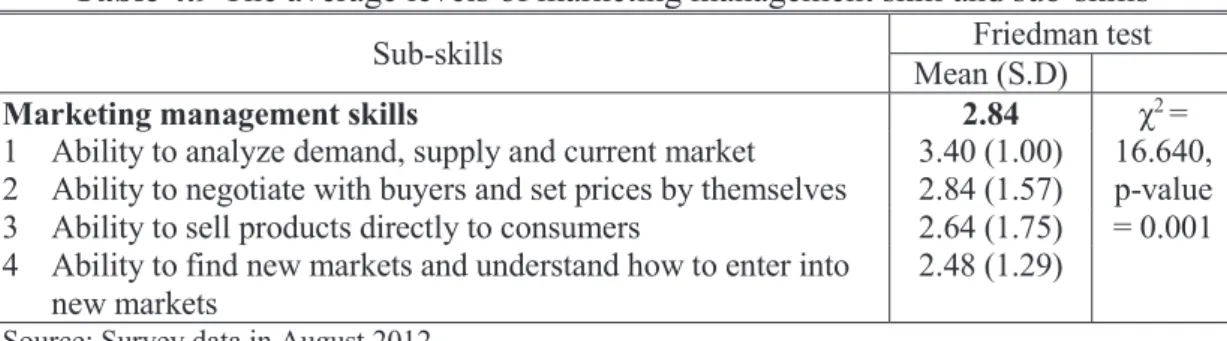
4.4.1 Levels of farmer’s managerial ability 31 4.4.1.1 Risk orientation skills 31 4.4.1.2 Resource mobilization skills 32 4.4.1.3 Decision-making skills 33
4.4.1.4 Communicative skills 34
4.4.1.5 Technical skills 35
4.4.1.6 Planning and goal setting skills 36 4.4.1.7 Information-searching skills 37 4.4.1.8 Accounting and financial management
skills
38
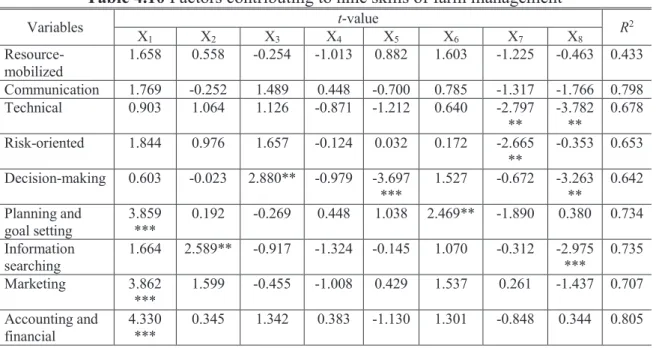
4.4.1.9 Marketing management skills 39 4.4.2 Factors contributing to nine managerial abilities 40
4.5 Summary 42
Chapter 5: Farmers’ Attitudes toward Farm Management and Farm Development
43
5.1 Introduction and specific objectives 43
5.2 Sample and data collection 44
5.3 Analytical methods 45
5.4 Results and discussion 47
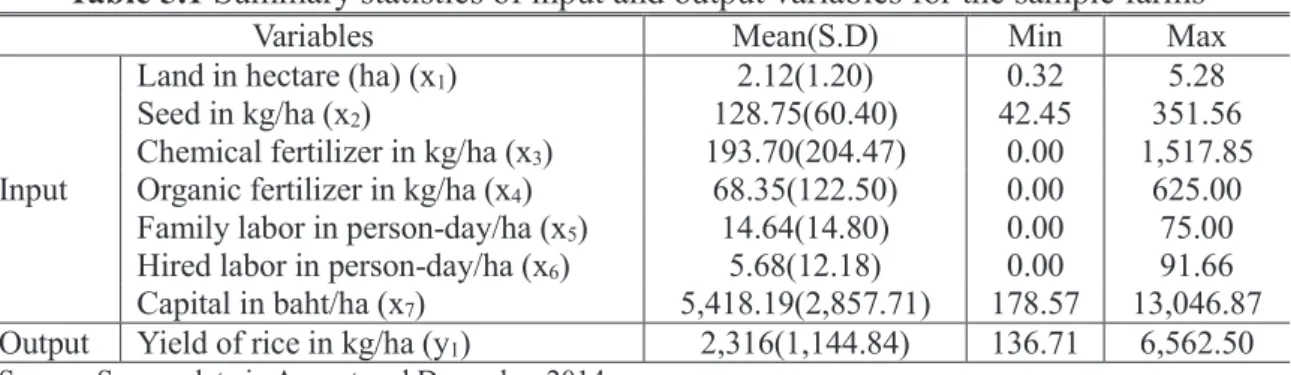
5.4.1 Descriptive statistics of the variables 47 5.4.2 Identifying efficient and inefficient farms based on
technical efficiency scores
48
5.4.3 Demographic profile of rice farmers between efficient and inefficient farms
49
5.4.4 Farmers’ attitudes toward farm management between 51
viii efficient and inefficient farms
5.4.5 Farmers’ attitudes toward farm development of efficient and inefficient farms
56
5.5 Summary 58
Chapter 6: Searching and Sharing Agricultural Information within Social Networks
61
6.1 Introduction and specific objectives 61
6.2 Sample and data collection 62
6.3 Analytical methods 63
6.4 Results and discussion 63
6.4.1 Socioeconomic characteristics of farmers 63 6.4.2 Managerial ability of farmers 64 6.4.3 The structure of farmers’ social networks 65 6.4.4 The network structure of farmers with high managerial ability
65
6.4.5 Information sharing topics within connected networks
67
6.5 Summary 68
Chapter 7: Farmers’ Decision-Making in Agricultural Problems 70 7.1 Introduction and specific objectives 70
7.2 Sample and data collection 71
7.3 Analytical methods 71
7.4 Results and discussion 72
7.4.1 General characteristics of the sample farmers 72 7.4.2 Sources of technical information and roles in farmers’
decision-making
73
7.4.3 Identifying agricultural problems 74
ix
7.4.4 Problem definition and implementation of farmers 76 7.4.5 Decision-making events for individual farmers through case studies
79
7.4.5.1 Case study: Farmer A 81 7.4.5.2 Case study: Farmer B 82 7.4.5.3 Case study: Farmer C 84 7.4.5.4 Case study: Farmer D 85 7.4.5.5 Case study: Farmer E 86
7.5 Summary 87
Chapter 8: Evaluation of Technical, Allocative and Economic Efficiencies
89
8.1 Introduction and specific objectives 89
8.2 Sample and data collection 90
8.3 Analytical methods 91
8.4 Results and discussion 93
8.4.1 Descriptive statistics of all variables 93 8.4.2 Technical, allocative and economic efficiencies 95 8.4.3 Farm and farmer specific factors causing technical and
allocative efficiency
96
8.5 Summary 99
Chapter 9: Conclusions 101
9.1 Summary of main findings 101
9.2 Conclusions and Implications 104
9.3 Suggestions for future research 105
References 107
Appendix 125
Thesis summary 130
x
Thesis summary in Japanese 134
List of Publications 137
xi
List of Tables
Table 2.1 Summary key approaches of three major ability tests 11 Table 4.1 The average levels of risk-oriented skill and sub-skills 32 Table 4.2 The average levels of resource-mobilized skill and sub-skills 33 Table 4.3 The average levels of decision-making skill and sub-skills 34 Table 4.4 The average levels of communicative skill and sub-skills 35 Table 4.5 The average levels of technical skill and sub-skills 36 Table 4.6 The average levels of planning and goal setting skill and sub-skills 37 Table 4.7 The average levels of information searching skill and sub-skills 38 Table 4.8 The average levels of accounting and financial skill and sub-skills 39 Table 4.9 The average levels of marketing management skill and sub-skills 40 Table 4.10 Factors contributing to nine skills of farm management 41 Table 5.1 Summary statistics of input and output variables for the sample
farms
48 Table 5.2 Distribution of technical (TE), pure technical (PTE) and scale
efficiency (SE) scores of rice farms
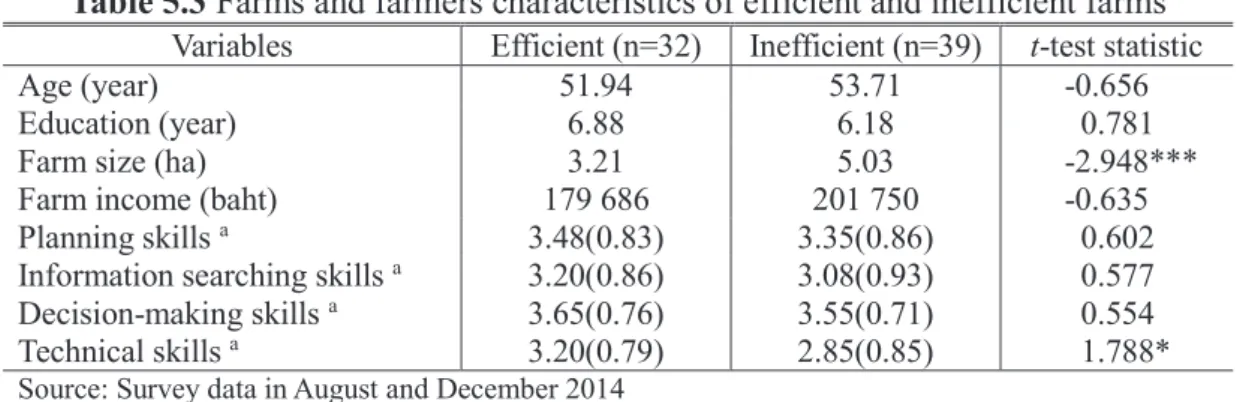
49 Table 5.3 Farms and farmers characteristics of efficient and inefficient farms 51 Table 5.4 Mean scores of attitudes of attention to farming 52 Table 5.5 Mean scores of attitudes regarding the openness to ideas 53 Table 5.6 Mean scores of attitudes about business orientation and financial
risk
54 Table 5.7 Mean scores of attitudes regarding success and satisfaction with
farming
54 Table 5.8 Mean scores of attitudes with respect to emergent management
and stress behavior
56 Table 5.9 Farmer’s attitudes toward farm development between efficient and
inefficient farms
58 Table 6.1 Information sources for farmers’ agricultural information and
number of times discussed in the group
67 Table 7.1 General characteristics of the sampled farmers (n=57) 72 Table 7.2 Information sources and the role of information sources in making
decision
74
xii
Table 7.3 Distributions of farmers’ perception on problem detections (n=57) 75 Table 7.4 General characteristics and decision-making in problems of five
case studies
80 Table 8.1 Summary statistic of variables using in DEA model 93 Table 8.2 Summary statistic of variables using in Tobit regression model 94 Table 8.3 Technical (TE), allocative (AE) and economic (EE) efficiencies
using DEA approach; average for farm types
96 Table 8.4 Estimating factors of technical and allocative efficiencies 99
xiii
List of Figures
Figure 1.1 The structural organization of thesis 6
Figure 3.1 Analytical framework of the study 22
Figure 3.2 Rainfall amount and distribution pattern in Khon Kaen Province during 2000-2013
25 Figure 3.3 Location of Nong Song Hong and Non Sila, the study area, in
Khon Kaen Province in Northeast of Thailand
26 Figure 6.1 Managerial ability of farmers towards farm management 64 Figure 6.2 The structure of transferring and receiving agricultural
information
66 Figure 7.1a Farmers’ actions to deal with drought problem 77 Figure 7.1b Farmers’ actions to deal with a problem of low prices of selling
products
77 Figure 7.1c Farmers’ actions to deal with a problem of speeding of weeds 78 Figure 7.1d Farmers’ actions to deal with a problem of distribution of pests
and diseases
78
xiv
Acronyms and abbreviations
AE Allocative Efficiency
ALRO Agricultural Land Reform Office
BAAC Bank for Agriculture and Agricultural Cooperatives
CRS Constant Return to Scale
DEA Data Envelopment Analysis
DOAE Department of Agricultural Extension
EE Economic Efficiency
FAO Food and Agricultural Organization of the United Nations
GDP Gross Domestic Product
Ha Hectare
JICA Japan International Cooperation Agency
JIRCAS Japan International Research Center for Agricultural Sciences
KDML105 A variety of the non-glutinous rice, namely “Kaow Dowk Mali 105”
Km Kilometer
Km2 Square kilometer
LDD Land Development Department
OAE Office of Agricultural Economics
Mm Millimeter
NE Northeastern region
N-P-K Nitrogen (N), Phosphorus (P), Potassium (K)
NSM New Slack Model
xv
NSTDA National Sciences and Technology Development Agency Rai A measurement unit of land is used in Thailand, which 1 rai
is equal to 0.16 ha or 0.395 acre
RD6 A variety of the glutinous rice, namely “Kor-Khor 6) RD15 A variety of the non-glutinous rice, namely “Kor-Khor 15”
S.D Standard Deviation
SE Scale Efficiency
SFA Stochastic Frontier Analysis
TE Technical Efficiency
VRS Variable Return to Scale
1
Chapter 1 Introduction
1.1 Background of the study
Farmers in developing countries are frequently exposed to uncertainties in weather, prices and diseases, and suffer under the constraints of farm resources (Kahan, 2013). Moreover, changes in agriculture following the introduction of new technologies, more borrowing or leased capital, new marketing alternatives, government policies and changing economic environments have both positive and negative effects on agricultural production (Marks, 2011; Kay et al., 2016). This means that farms, like other small business, require good management to survive and prosper (Kay et al., 2016).
Researchers, government officers and non-governmental, and international development organizations have attempted to identify and promote appropriate solutions for farmers by developing major agricultural inputs, farm resources and technologies (Olson, 2004). Improving the management capability of farmers is one way to do this, and has been extensively described in the literature (e.g., Rougoor et al., 1998; Olson, 2004; Solano et al., 2006; Hansson, 2008; Nuthall, 2009a; Phelan and Sharpley, 2012).
Improvements to management capability help farmers to operate their farms effectively and to increase farm production and profitability efficiently (Zimmerman et al., 2006;
Kay et al., 2016).
Management capability refers to a farmer’s ability to apply existing knowledge and skills to operate a farm effectively, to deal with problems and opportunities in the optimal way and to produce the required outcomes (Rougoor et al., 1998; Pillay, 2008;
Trinder, 2008). In addition, management capability forms the fourth major agricultural input, and plays a key role in the efficient management of other three primary inputs: land,
2
labor and capital (Olson, 2004; Nuthall, 2009a). The efficiency of production of a farm’s land, labor and capital is critically dependent on the management capability of farmers (Nuthall, 2009a). Accordingly, it is necessary to address the concept of improving farmers’
management capability as a basic goal of policies and strategies for developing farm practice and increasing the production and competitiveness of farmers (Phelan and Sharpley, 2012).
The concept of improvement to farmers’ management capability has received considerable attention in both developed and developing countries in recent decades (e.g., Solano et al., 2006; Hansson, 2008; Phelan and Sharpley, 2012; Alcedo et al., 2013). In this regard, while studies are available which examines the management capability of farmers around the world, there is still no clear evidence of the various aspects of the management capability of farmers in Thailand. Even though Thai farmers, particularly small-scale farmers, are likely to require good management capability to thrive under the changes of agricultural and economic sectors. Small-scale farmers in rural areas cannot rely on an agricultural income for their living and must allocate their time between on- farm and off-farm activities (Jonathan and Sakunee, 2001; Barnaud et al., 2006; Andreas et al., 2012). The small-scale farmers also face several problems in terms of agricultural production such as labor shortages, limited farm sizes, scarcity of water, poor soil fertility, outbreaks of pests or diseases, increasing prices for inputs (e.g., land, and fertilizers) and wages, lower level of capital and high interest rates on loans, and declining and fluctuating farm-gate prices (FAO, 2001; Jitsanguan, 2001; Andreas et al., 2012; Jessop et al., 2012; Kahan, 2013; Thida and Ito, 2008; Winai, 2015).
Therefore, it is crucial to address the improvement of the management capability of farmers as a primary goal of policies for development of farmers in Thailand, as in other countries. To improve this management capability, it is necessary to obtain a good
3
understanding of the characteristics involved (Rougoor et al., 1998). To take this, there is a need to clearly examine the personal characteristics (e.g., abilities and skills, attitudes and perceptions, and biography) and decision-making processes that represent the management capability of a particular farmer (Rougoor et al., 1998, 1999; Hansson, 2008; Ali and Kumar, 2011; Kahan, 2012; Vukelić and Rodić, 2014; Kay et al., 2016).
In terms of personal aspects, the study of a farmer’s ability is an essential first step, since farmers use these abilities every day in carrying out farm activities and making appropriate decisions to make their farm successful (Nuthall, 2006, 2010a). An examination of farmers’ attitudes is also important, since these play a central role in a farmer’s behavior and decision-making during the gathering of information and adoption of new technology (Willock et al., 1999a; Edwards-Jones, 2006). The study of the decision-making of farmers provides a broader understanding of their vocational behavior (Willock et al., 1999a). To understand farmers’ decision-making, an examination of the processes of searching for information and making decisions is required (Nuthall, 2001).
Furthermore, in order to see the impacts of the management capability of farmers on farm operation, an estimation of farm outcomes needs to be considered. As these outcomes provide empirical evidence which can be used to improve management capability (Solano et al., 2006; Kahan, 2012, 2013). When evaluating farm outcomes, the measurement of production efficiency provides an important method of obtaining a farm’s potential output. This measurement can determine the gap between the potential and actual production of the farm (Umanath and Rajasekar, 2013; Kay et al., 2016). This can also provide a better understanding of the farm’s production and the causative factors involved in this.
4 1.2 Objectives of the study
The main objective is to study the characteristics of the management capability of farmers in Thailand. The motives for focusing on this are to clarify the present characteristics of the farmers’ management capability and determine out potential ways of improving this capability for farmers so that they may thrive within the constraints of the agricultural and economic sectors. The specific objectives of this study were to:
x measure the level of farmers’ managerial ability and to find out the determinants related to farmers’ ability;
x clarify the farmers’ attitudes toward farm management and farm development;
x study the farmers’ processes of searching and sharing agricultural information within their social networks;
x describe the farmers’ decision-making in agricultural problems and illustrate the decision events of individual farmers through case studies; and
x evaluate the outcomes of farm performance, measured in terms of technical, allocative and economic efficiencies, and identify the factors associated with increasing efficiency.
1.3 Thesis structure
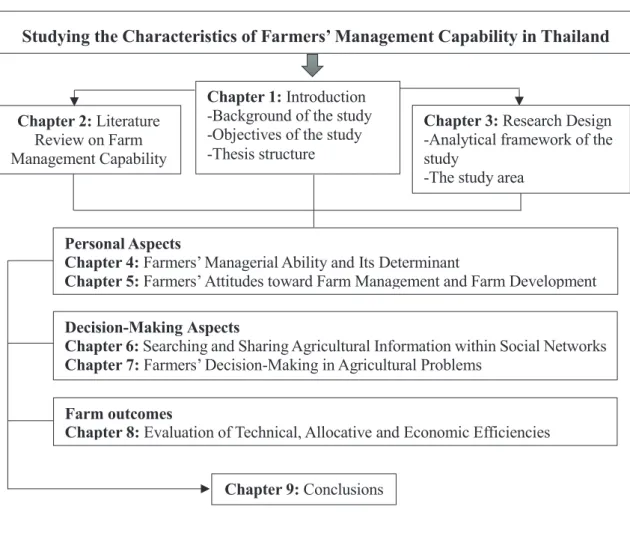
To achieve the main objective, this study is organized into nine chapters (Figure 1.1). This chapter has presented the general background to the study and a statement of the research problems. Chapter 2 provides a brief account of the definition of management capability, followed by an overview of the definitions of farmers’ abilities, farmers’ attitudes and perceptions, decision-making processes and production efficiency.
Chapter 3 is devoted to the detailed description of the research framework and research questions used in this study. It also includes an overview of agriculture in Thailand and in Northeast region, and a description of the area under consideration.
5
In order to achieve the objective of understanding the characteristics of the management capability of farmers, this study emphasizes the examination of two major aspects: personal characteristics and decision-making processes. Chapters 4 and 5 present the results with regard to the personal aspects of farmers. Chapter 4 describes the levels of farmers’ managerial ability as measured using the managerial competency test. This chapter also describes the results of the determinant contributing to improvements to this managerial ability. In Chapter 5, the discussion focuses on clarifying the farmers’
attitudes towards farm management and farm development.
The findings from the investigation of farmers’ decision-making processes are presented in Chapters 6 and 7. Chapter 6 addresses the processes used by farmers in searching for and sharing agricultural information within their social networks. Chapter 7 illustrates the farmers’ decision-making processes regarding agricultural problems. This chapter also describes the decision experiences of individual farmers through case studies.
Chapter 8 describes the impacts of management capability on farm performance.
This chapter gives a measurement of farm outcomes through an evaluation of technical, allocative and economic efficiencies, including a determination of the factors associated with the level of technical and allocative efficiencies. In the final chapter (Chapter 9), a summary of the major findings, conclusions and implications are presented, as well as suggestions for further research.
6
Figure 1.1 The structural organization of thesis
Studying the Characteristics of Farmers’ Management Capability in Thailand
Chapter 1: Introduction -Background of the study -Objectives of the study -Thesis structure Chapter 2: Literature
Review on Farm Management Capability
Chapter 3: Research Design -Analytical framework of the study
-The study area
Personal Aspects
Chapter 4: Farmers’ Managerial Ability and Its Determinant
Chapter 5: Farmers’ Attitudes toward Farm Management and Farm Development
Decision-Making Aspects
Chapter 6: Searching and Sharing Agricultural Information within Social Networks Chapter 7: Farmers’ Decision-Making in Agricultural Problems
Farm outcomes
Chapter 8: Evaluation of Technical, Allocative and Economic Efficiencies Chapter 9: Conclusions
7
Chapter 2
Literature Review on Farm Management Capability
To better understand the concept of farmers’ management capability, it is essential to define what it means. Thus, the purpose of this chapter is to give a brief account of the definition, looking at farmers’managerial abilities, farmers’ attitudes toward farm management and farm development, decision-making processes, and farms’
production efficiency (farm outcome).
2.1 Definition of farm management capability
Capability has always been seen as a key function of managing the agricultural production of land, labor and capital (Olson, 2004; Nuthall, 2009a). However, there is still no clear approach to studying farm management capability, as past studies have used several methods.
Before these processes are discussed, the terms involved need to be defined.
Accordingly, “farm management” is concerned with the decisions that affect farm profitability (Castle et al., (1987) cited in Rougoor et al., 1998). Kay et al. (2016) determine that farm management helps the farmer make the right decision in farming, which can be divided into two major categories: strategic and tactical management.
Smallwood and Ulrich (2004) state that capability is the collective skills, abilities and expertises of an organization; they suggest that for social issues using “capability” and
“ability”, which refers to an individual’s leadership, is more appropriate than using
“competence.”
Trinder (2008) proposes managerial capability is “the ability to apply knowledge and skills to produce a required outcome.” Pillay (2008) determines that managerial competencies (capabilities) are sets of knowledge, skills, behaviors and
8
attitudes that enable managers to perform their work effectively and efficiently.
Moreover, Chong (2011) states that management competency is the ability to effectively manage varying perceptions and the expectation of others and competencies refer to the performance of personal, task-specific and social interaction.
With regard to the definitions of farmers’ management capability, Portugal and Jones (1984) define management capability as the capability of farmers to be informed, evaluate new alternatives, take decisions, master technology and interact with other sectors of society. Rougoor et al. (1998) determine management capability as “having the appropriate personal characteristics and skills, which include drives and motivations, abilities and capabilities as well as biography, to deal with the right problems and opportunities in the right way.” In addition, Rougoor et al. (1998) propose a concept of management capability with two aspects: personal (drives and motivations, abilities and capabilities, and biography) and decision-making (planning, implementation and control). Alcedo et al. (2013), who studied farmers’ capacity for livestock production in the Northeastern Philippines, state that capability is “the ability of farmers to raise farm outcomes in the proper production and management practices”. Furthermore, Vukelić and Rodić (2014) reviewed previous research and defined farmers’ management capacities as the “possession of appropriate personal characteristics and capacities of farmers to cope with specific problems and opportunities at the right time and in the right way.”
According to the concept of Rougoor et al. (1998), some researchers have tried to understand the correlations between biography aspects and the efficiency of the future development of decision-making support systems, technology transfer activities and developing management practices, particularly in terms of livestock farms. For example, Rougoor (1999), applied the framework of management capacity to analyze the
9
relationship between dairy herd management, milk production and economic performance and found that a farmer’s attitudes and personality had an influence on farm management and milk production. Solano et al. (2006) studied the impact of biographies (personal aspects) and decision-making profiles on management and performance; they pointed out that decision-making profiles for sharing decisions, maximizing income and revenue, and obtaining information from multiple sources had the highest impact on management practices, whereas farmers’ biographical profiles (personal aspects) had no significant bearing on farm performance. Hansson (2008) found that personal aspects (e.g., values, attitudes, perceptions, locus of control, education, experience and age) are more important for the economic efficiency of dairy farms, both in long and short term than managerial (or decision-making) aspects (i.e., searching for information, planning, forecasting and evaluating, and responsibility).
2.2 Farm managerial ability of farmer
To improve farmers’ management capabilities, studying personal aspects with reference to their abilities is important. This is because the farmers’ managerial abilities are used every day while performing farm activities (Nuthall, 2006). Moreover, Nuthall (2010a) defined managerial ability as a farmer’s skill at making the right decisions and implementing them for a successful farm. The literature shows that the farmers’
managerial ability is important for them to develop their management, practice and production.
However, despite many articles and textbooks on farm management describe the importance of managerial ability, it is still interesting to consider how to develop programs for improving farmers’ managerial ability. Even though previous studies have examined aspects of farmers’ personal characteristics such as age, education and farming experience, their actual abilities and capabilities are rarely explicitly examined, as they
10
are more difficult to qualify and assess (Nuthall, 2009a).
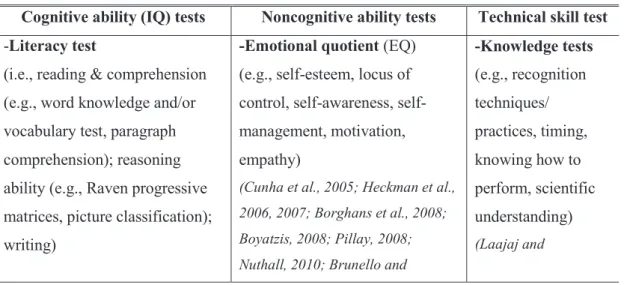
To find potential ways to improve farmers’ managerial abilities, many researchers have created measurement approaches for clarifying them, despite the difficulty in qualifying and accessing the information. As a result, numerous measurement techniques (e.g., cognitive, noncognitive and technical skills) have been developed in recent decades. Among these measurements, cognitive and noncognitive ability tests are widely used to measure farmers’ actual managerial abilities.
Several studies involving the educational and agricultural sectors have measured the managerial ability of farmers using cognitive and/or noncognitive concepts aimed at better understanding and finding potential ways for improvement (Table 2.1).
For example, Nel et al. (1998) defined competency (ability) as the individual characteristics related to criterion-referenced effective management and/or performance in a job and they determined eight dimensions of competency: communication, maximization of achievement, initiative, individual leadership, analysis, judgement, planning and organizing, and motivation. Nuthall (2001, 2002, 2006, 2009a, 2009b, 2010a, 2010b, 2011) attempted to determine the best way to measure farmers’ managerial ability through reviewing its basic and potential improvements using psychological concepts. Nuthall (2006, 2009a, 2010b) determined that a basic concept of managerial skills (or abilities) included managerial attributes (e.g., observation, planning, recording, introspection and communication), personal attributes (e.g., personality, intelligence, motivation, judging people, confidence and taking risk) and entrepreneurial skills (e.g., information seeking, negotiation, forecasting, control belief, risk factors and consideration).
Furthermore, Allahyari et al. (2011) analyzed farm management skills in poultry production enterprises in Iran through splitting farm managerial ability
11
(competencies) in nine skills, including planning and goal setting, accountancy and finance, marketing, seeking for information, resource mobilization, risk orientation, communication and technical skills. They suggested that marketing and information- searching skills should be improved by promoting extension services such as training programs. Gaurav and Singh (2012) found that cognitive ability has a positive relationship with farmers’ educational and financial management in rural India, of which mathematical ability contributed to a higher financial aptitude and debt literacy. In 2015, Frese and coauthors determined that the noncognitive abilities of female farmers in rural Malawi were significantly associated with cash crop adoption.
On the other hand, some studies have used a set of farmer demographics or production practices as a proxy variable for unobserved managerial ability. For instance, Ford and Shonkwiler (1994) used financial, dairy and crop management as proxies of unobserved managerial ability, finding that dairy management was an important determinant of a farm’s financial success. Alvarez and Arias (2003) used economies of scale (technical efficiency) as a proxy for managerial ability, indicating that increasing the farm size with a fixed managerial ability is related to diseconomies of scale.
Table 2.1 Summary key approaches of three major ability tests
Cognitive ability (IQ) tests Noncognitive ability tests Technical skill test -Literacy test
(i.e., reading & comprehension (e.g., word knowledge and/or vocabulary test, paragraph comprehension); reasoning ability (e.g., Raven progressive matrices, picture classification);
writing)
-Emotional quotient (EQ) (e.g., self-esteem, locus of control, self-awareness, self- management, motivation, empathy)
(Cunha et al., 2005; Heckman et al., 2006, 2007; Borghans et al., 2008;
Boyatzis, 2008; Pillay, 2008;
Nuthall, 2010; Brunello and
-Knowledge tests (e.g., recognition techniques/
practices, timing, knowing how to perform, scientific understanding) (Laajaj and
12 (Harcher et al., 2002; Heckman et
al., 2006; Keenan et al., 2008;
Nuthall, 2010; Brunello & Schlotter, 2011; Williams et al., 2011; Glewwe et al., 2013; Laajaj and Macours, 2015)
Schlotter, 2011; Glewwe et al., 2013; Goleman, 2014; Laajaj and Macours, 2015)
Macourse, 2015)
-Short-term memory (e.g., arithmetic, digit span) (Harcher et al., 2002;Colom et al., 2004; Boyatzis, 2008; Nuthall, 2010; Frese et al., 2015)
-Big five personality traits (i.e., introversion, openness, agreeableness,
conscientiousness, emotional stability)
(Borghans et al., 2008; Frese et al., 2015; Laajaj and Macours, 2015) -Mathematical tests
(e.g., math problem, practical calculation)
(Colom et al., 2004; Heckman et al., 2006; Nuthall, 2010; Brunello and Schlotter, 2011; Gaurav and Singh, 2012; Glewwe et al., 2013; Frese et al., 2015)
-Managerial competencies (or abilities)
(e.g., planning, organizing, leading, problem analysis, management style, timing ability, communication, risk aversion) (Nel et al., 1998; Nuthall, 2002, 2006, 2010; Pillay, 2008; Allahyari et al., 2011; Chong, 2011, Ferruz et al., 2012)
-Processing speed
(e.g., finding A’s, coding speed) (Harcher et al., 2002; Colom et al., 2004; Heckman et al., 2006)
-Social competencies (e.g., social awareness,
relationship management, social desirability, social skill,
leadership, teamwork) (Borghans et al., 2008; Boyatzis, 2008; Brunello and Schlotter, 2011;
Goleman, 2014)
13
2.3 Farmers’ attitudes and perceptions toward farm management
Attitudes play an important role in farmer behavior, so the study of farmers’
attitudes has received considerable attention in recent decades (Edwards-Jones, 2006).
For example, the study of Willock et al. (1999b) determined that farmers’ attitudes are classified as risk taking (aversion), innovative, environmental, satisfaction with farming, stress and attitudes toward legislation. Willock et al. (1999a) also pointed out that attitude toward risk aversion has major importance in the study of farmers’ decision-making.
Waiblinger et al. (2002) stated that farmers’ attitudes and characteristics are important factors in successful production (milk yield). Nuthall (2002, 2006, 2009a) studied farmers’ personalities (or attitudes) through providing 25 statements of farm managerial styles and asking farmers to rate their attitudes on a five-point-Likert scale (true to not true). Palacios (2005), who studied farmers’ attitudes toward sustainable agriculture in Japan, found that young farmers’ attitudes to the model of sustainable agriculture can support Japanese agriculture’s sustainability. Sadati et al. (2010) examined the attitudes and perceptions of Iranian farmers on the concept of sustainable agriculture by giving 24 statements of attitudes and using a five-point-Likert scale (strongly disagree to strongly agree). Samah et al. (2012) discovered Malaysian contract farmers’ attitudes using 14 statements on sustainable agriculture and a five-point-Likert scale to capture farmers’ attitudes, with ranging from strongly disagree to strongly agree. Haneishi et al.
(2014) analyzed the effects of farmers’ attitudes toward risks in farm decision-making and rice production, finding that farmers’ risk attitudes significantly affected rice production (yield). Odongo and Muhua (2015) determined farmers’ attitudes from six components: information focus, negative, change orientation, passive dependence, heritage and resigned unhappiness.
14 2.4 Decision-making process
The managerial decision-making process has recently been given more attention, both in theoretical studies and in empirical research explaining the differences in farm outcomes (Trip et al., 2002). To clearly explain the variation in farm outcomes, studies should include aspects of the managerial decision-making process (Wilson et al., 2001) because decision-making is the principal activity of farm management (Kahan, 2013).
To formulate an effective policy to support the development of farm production, we need a better understanding of why different farmers make different decisions on farm strategy (Hansson and Ferguson, 2011). Studying farmers’ decision-making provides a broader understanding of their vocational behavior (Willock et al., 1999a). To comprehend farmers’ decision-making capabilities, we should not only study decision- making processes but also clearly examine the processes of learning and thinking about information (Nuthall, 2001).
In a review of literature on decision-making processes, Öhlmér et al. (1998) proposed a strategic model of decision-making processes that includes four steps:
problem detection, problem definition, analysis and choice, and implementation, which consists of four sub processes: searching and paying attention, planning, evaluating and choosing, and bearing responsibility. A number of empirical studies have worked similarly on decision-making aspects, such as Rougoor et al. (1998), who suggested that aspects related to decision-making include planning, implementation and control. Solano et al. (2003) studied the role of personal information sources on the decision-making process. They describe the decision-making process in four phases: problem detection, seeking for problem solutions, seeking for new practices and opinion. In addition, Solano et al. (2001) determined that technology transfer activities (e.g., extension and training)
15
is one of the factors involved in the decision-making, They found that operational decisions are mostly related to farm labor and family members, while technical decisions are related to technical advisors and family members. Olson (2004) stated that decision- making processes are usually considered as a set of eight steps: determining values and setting goals, problem detection, problem definition, observation, analysis, development of intension, implementation and responsibility bearing. Bolfíková et al. (2010) studied manager’s decision-making with five key dimensions of organizational learning: system thinking, personal mastery, mental models, building shared visions and team learning.
Hansson and Ferguson (2011) indicated the factors contributing to decision-making processes included decision structure, business structure, cognitive structure and network structure. Ali and Kumar (2011) studied farmers’ decision-making processes by examining three stages: production planning, cultivation practices and post-harvest management, and marketing. Kahan (2013) determined that the basic decision-making process in risk management includes setting goals and objectives, looking at the different ways to achieve goals, evaluating opportunities and alternatives, selecting opportunities and alternatives, planning for implementation and evaluating selected opportunities.
Perea et al. (2014) stated that decision-making can be viewed as a process with three elements: information access (information, record, advisers, dedication), use of information (record use, information use), and formality of the decision-making process (objectives, planning, evaluation).
Kay et al. (2016) proposed the decision-making has seven steps: identifying and defining the problem or opportunity, identifying alternative solutions, collecting data and information, analyzing the alternatives and making a decision, implementing the decision, monitoring and evaluating the results and accepting responsibility.16 2.5 Farm production efficiency
Farmers with different managerial capabilities (e.g., abilities, attitudes, biography, and decision-making) usually achieve different outcomes despite similar farm environments, climate, technology choices and economic conditions (Barkema, et al., 1999; McBride and Johnson, 2006). Hence, to successfully develop farmers’
capabilities and farm production, it is crucial to investigate farm outcomes.
When evaluating farm outcomes, measuring production efficiency provides an important way to attain a farm’s potential output, which can determine the gap between the potential and actual production of the farm as well as the give attention to farmers’
technology and resource endowment (Umanath and Rajasekar, 2013; Kay et al., 2016).
This result also provides a better understanding of the production and the causative factors.
To estimate production efficiency, three concepts proposed by Farrell (1957) are commonly used: 1) technical efficiency: measuring the ability of farmers to produce either maximum potential outputs with a given set of inputs or at a minimum cost with continual producing a given number of outputs; 2) allocative efficiency: the ability of farmers to use inputs in optimal proportions with respective prices; 3) economic efficiency: the capacity of a farm to produce a predetermined quantity of output at minimum cost for a given level of technology (Farrell, 1957) or the capacity to choose an optimal level and structure of inputs and outputs for maximum profit (Coelli et al., 2005). Furthermore, as the farm size increases, labor and machinery can be better adjusted; the optimal size is reached when marginal returns equal marginal costs (Rajčániová, 2004). Accordingly, scale efficiency is also usually considered to better understand whether a farm’s scale is efficient.
Technical and allocative efficiency can be measured by two main approaches:
17
input-oriented and output-oriented. Input-oriented (minimum cost) is used to examine
“whether and to what extent it is possible to reduce its input (s) without reducing the output (s)”, whereas an output-oriented (maximum profit) approach determines “what is the maximum output producible from the same input bundle” (Ray, 2004).
Furthermore, Farrell (1957) determined that there are two main methodologies for measuring technical efficiency: a parametric method (stochastic frontier approach or SFM) and a nonparametric method (data envelopment analysis or DEA). These two methods differ in two ways: 1) the parametric method (SFM) is stochastic and attempts to distinguish between the effects of noise and the effects of inefficiency, whereas nonparametric (DEA) is deterministic and under noise inefficiency (Porcelli, 2009); and 2) the parametric method (SFM) requires the assumption of a functional form, while the nonparametric (DEA) one does not (Coelli, 1995). In addition, one advantage of the nonparametric method (DEA) is that it can analyze multiple inputs and outputs in different units (Coelli et al., 2005).
According to the concepts of estimating production efficiency, previous researchers have widely suggested measuring production efficiency in terms of crop and/or livestock farms aimed at developing farm management practices, improving farm production and increasing farm efficiency. Some examples of the empirical findings on estimation of the technical efficiency of crop farms are available in the literature. Wilson et al. (2001) found that wheat farmers in eastern England still have room to increase technical efficiency, finding the farmers’ education and managerial experience had a significant influence on the farm efficiency results.Binam et al. (2004) mentioned that it is necessary to increase the technical efficiency for smallholding farmers in the slash and burn agricultural zone of Cameroon, indicating that credit, soil fertility, social capital, farm location, and extension services were significantly related to improving technical
18
efficiency. Villano and Fleming (2006) studied technical efficiency in rice production in the Philippines, finding that there is a high level of technical efficiency estimates, which can be attributed to the instability of farming conditions in a rain-fed lowland environment. The significant factors influencing efficiency were the area planted for rice, labor and the amount of fertilizer used. Idiong (2007) mentioned that rice farmers were not fully technical efficient and that education, membership of cooperatives/farmer associations and access to credit significantly influenced the positive efficiency. In 2007, Bozoğlu and Ceyhan determined that education, experience, credit use, women’s participation in the farm and information were significantly associated with the technical efficiency of vegetable farms in Turkey. Dağistan (2010) suggested that wheat farmers should reduce input costs by 20% to increase technical efficiency and the efficiency level is mainly affected by farmer’s education and farm size. Furthermore, Khai and Yabe (2011) indicated that the mean technical efficiency of rice farms was 81.6% and the factors associated with technical efficiency were intensive labor, irrigation and education.
Latruffe et al. (2005) found that livestock farms were more efficient technically and in scale than crop farms and they pointed out that education was a significant factor for technically efficient practices. Galanopoulos et al. (2006) indicated that there is ample potential to increase efficient utilization of inputs in domestic pig farming; the factors related to increasing this are the choice of insemination method, origin of the genotype, the feedstuff preparation system, the mortality rate of piglets and the size class.
Aldeseit (2013) indicated that dairy farms in Jordan were not operating at an optimal size and a supporting extension service could help farmers improve their management practice and increase technical efficiency.
With regard to samples that investigate economic efficiency, i.e., allocative and technical efficiencies, in crop farms, Jha et al. (2000) stated that wheat farmers with large
19
farms experienced more technical and allocative efficiencies than small farms. Coelli et al. (2002) measured costs and technical, allocative and scale efficiencies in Bangladesh rice farms, finding that rice farms’ efficiencies were higher in the dry season than in the wet season. Moreover, farmers with better access to input markets and less off-farm work were more efficient than others. Dhungana et al. (2004) found that gender, age, education and family labor were significant in improving the efficiency of Nepalese rice farms.
Haji (2006) looked at that the existence of substantial allocative and economic inefficiencies in vegetable production of smallholders in eastern Ethiopia, finding that assets, crop diversification, consumption expenditures and farm size had a significant impact on allocative and economic efficiencies, whereas asset, off/non-farm income, farm size, extension visits and family size were significant determinants of technical efficiency. Li et al. (2010) mentioned that smallholding farms participating in the Grain for Green program had substantial economic inefficiencies, finding that the determinant factors related to the levels of efficiencies were farm size, remittance, land tenancy, and land fragmentation. Mburu et al. (2014) indicated that wheat farmers were not fully efficient in technical, allocative and economic terms, pointing out that education, distance to extension advice and farm size had a strong influence the efficiency levels.
Bojnec and Latruffe (2007) determined that farmers with crops, dairy, livestock using own feed, fruit and forestry were fully technical, scale, allocative and economic efficiencies. Hansson and Öhlmér (2008) determined that to increase the economic, technical and allocative efficiencies for Swedish dairy farms, changing breeding and feeding practices was crucial.
In case of Thailand, for example, Krasachat (2004) indicated that the technical efficiency of rice farms in Thailand in 1999 was widely diverse suggesting an influence of the diversity of natural resources. Rahman (2009) stated that the average technical
20
efficiency of Jasmine rice producers in northern and northeastern Thailand was 63%, pointing out that land, irrigation and fertilizers were significant factors. Shamsudin et al.
(2011) found that the mean technical efficiency for rice farms in central Thailand was 85% and the significant factors related to technical efficiency were gender, farm experience, good agricultural practices, and cropping intensity. Srisompun and Isvilanonda (2012) found that the technical efficiency of rice production (88%) in 1987/88 had decreased to 72% by 2007/08; they suggested that crop diversification is one of the strategies that can be used to improve production efficiency. Srisompun et al.
(2013) determined that the technical efficiency of three farming systems (i.e., rice monoculture, rice-sweet corn, and rice-peanut) did not make a significant difference, finding that fertilizers and seeds were important factors influencing rice production.
Athipanyakul et al. (2014) found that the mean technical efficiency of upland rice production was 70% and pointed out that a significant factor affecting technical efficiency was the training program, which transformed knowledge on upland rice production. Overall, according to previous studies, most new agricultural technologies have only been partially introduced to improve production and increase efficiency.
Furthermore, there are only a few studies on other farm production systems. For example, Todsadee et al. (2012) investigated the technical efficiency of broiler farms, and Krasachat (2012) estimated the technical efficiency of durian farms.
21
Chapter 3 Research Design
3.1 Analytical framework of the study
In this study, we applied the conceptual framework of Rougoor et al. (1998) to clarify the aspects of farmers’ management capability and generate appropriate ways to improve it. Management capability is the ability of farmers to manage farm practices and increase production as well as deal with problems, opportunities as and risks in the right way and at the right time. Farmers’ management capability may affect farm outcomes such as economic, technical and allocative efficiency.
Based on the model developed by Rougoor et al. (1998) and on further aspects in the literature described previous (in Chapter 2), we identified the parts of analytical framework in Figure 3.1 to discuss the management capability of farmers. In this study, we presented descriptions of two concepts of management capability: personal and decision-making, including evaluation of farm outcomes.
Personal characteristics and skills include: socio-economic characteristics of the farmer and farm, farmer’s managerial abilities and farmers’ attitudes toward farm management and farm development. We measured farmers’ managerial abilities using a noncognitive test, namely “managerial competence” and the questions were modified from a case study of Allahyari et al. (2011), including ideas make during our observations of the study area. We measured farmers’ attitudes towards farm management, looking at attention paid to farming, openness to ideas, business orientation, financial risk, success in farming, satisfaction, emergent management, and stress behavior. To form the set-up questions, we adjusted some questions from the study of Nuthall (2009a, 2006, 2002) and
22 included our ideas.
Decision-making aspects was described through representing a series of case studies. In this study, we examined farmers’ decision-making, which focused on the processes of increasing knowledge by searching and sharing agricultural information within social networks, and the aspects of farmers’ decision-making in agricultural problems through case studies of individual farmers. With regard to decision-making aspects, four key processes were used: detecting problem, defining problem, analyzing and choosing the potential solution to deal with problem, and implementation.
To measure farm outcomes, we estimated the technical and scale efficiencies of rice farms. We also measured economic and allocative efficiencies, including the technical efficiency of multiple crops (i.e., rice, sugarcane, cassava). Moreover, we identified the determinant factors of technical and allocative efficiencies to improve the
23
efficiency of farms with multiple crops. In this study, we applied data envelopment analysis (DEA) approach to calculate the technical, scale and economic efficiencies through the DEA Online Software (http://www.deaos.com).
3.1.1 Research questions
Based on ideas in the literature discussed in chapter 2 and on simple logic, this study addresses five major questions:
1. What is the level of managerial ability of farmers, and what are the determinant contributing to farmers’ ability?
2. What are the attitudes of farmers toward farm management and farm development?
3. How do farmers search for and share agricultural information within their networks?
4. What are the aspects of farmers’ decision-making in agricultural problems?
5. What are the outcomes of farm management performance, measured in terms of production efficiency scores and the factors associated with improving efficiency?
3.2 The study area
3.2.1 Overview of agriculture in Thailand and in Northeast region
In Thailand, agricultural food production in particular-not only generates economic value, but also plays a key role in people’s livelihoods and household finances (NSTDA, 2011). In 2012 the population of Thailand was estimated at 64.5 million people, with 23.7 million (37% of the total population) involved in the agricultural sector (DOAE, 2012). The total utilized land area of Thailand is about 321 million rai or 51.3 million hectares. Of this, 149 million rai (46%) are mainly used for agricultural activities. Of the
24
total agricultural area, 68% is used for cultivating food crops, which in 2013 included 70 million rai of paddy land and 31 million rai allocated for upland field crops such as cassava, sugarcane and maize (OAE, 2014). However, the total contribution of agricultural production only accounted for 9% of Thai GDP; about 1.3% of Thailand’s GDP comes from rice exports (Lee, 2015).
The Northeast is the largest region of Thailand, with a total of around 63.8 million rai (10.2 million ha) of agricultural land, divided into 42.7 million rai of rice paddies, 11.9 million rai of upland field crop and 4.3 million rai of orchard and perennial crops (OAE, 2014). Only around 6.3 million rai are irrigated even though government offices and international agencies are investing in and administering funds mainly with building water resources for rice and vegetable farming (Polthanee et al., 2014).
Consequently, the majority of farmers in this region depend on rainfall. The mean annual rainfall in 2014 was 1,394 mm. and there were 101 rainy days (OAE, 2014).
In this region, the average holding of farmland is about 27 rai (4.3 ha) per household. Approximately 85% of farmers are small-scale (Barnaud et al., 2006), and their landholding tends to be less than 20 rai (World Bank, 2003, as cited in Nagayets, 2005). Most small-scale farmers live in rain-fed areas have inadequate supply of water and lack opportunities for market access (Andreas et al., 2012). These farmers mainly produce foods for home consumption then sell surplus products for a cash income. Rice is the major crop, followed by maize, cassava and sugarcane. The average annual cash income per household in 2011 was 140,565 baht from the agricultural sector and 99,666 baht from the non-agricultural sector (DOAE, 2013).
3.2.2 Description of the study area
This study was conducted in Khon Kaen Province, in Northeastern Thailand.
25
Khon Kaen is a central city of the upper Northeast and is about 445 km from Bangkok, the national capital. This province is bordered by Loei, Udonthani, and Nong Bua Lam Phu to the North, Kalasin and Maha Sarakham to the East, Nakhon Ratchasima and Buriram to the South, and Chaiyaphum and Phetchabun to the West. It consists of 26 districts and total land area is 10,886 km2 (6.8 million rai), with about 4.6 million rai (68%) used mainly for agricultural production. The total population of the area was 1.7 million people in 2012, and about 552, 760 people (33%) were actively engaged in agricultural activities. For the economy, the total of GDP was 155,272 million baht in 2013, approximately 10.8% from the agricultural sector. The GDP per capita was 81,884 baht.
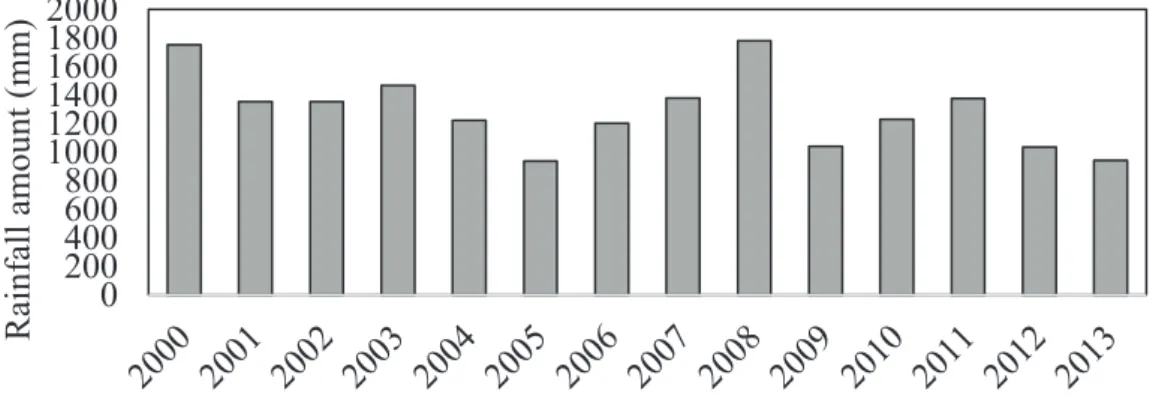
In terms of physical geography, the elevation of Khon Kaen is approximately 200-250 meters above mean sea level. The climate is influenced by both Northeast and Southwest monsoons. The Northeast monsoon occurs from November to February and brings a cold front, while the Southeast brings rain from April to September. The average annual rainfall of Khon Kaen Province during 2000-2013 was 1,290.5 mm, with a minor peak in 2008 (1,780.6 mm) and major peaks in 2005 (936.5 mm) and 2013 (943.1 mm) (Figure 3.2). The annual daily average temperature ranges between 19Ԩ in January
2000 400600 1000800 12001400 16001800 2000
Rainfall amount (mm)
Figure 3.2 Rainfall amount and distribution pattern in Khon Kaen Province during 2000−2013
Source:Northeastern Meteorological Center (Upper Part), 2016
26 (winter) and 35Ԩ in April (summer).
The data were collected from farmers living in two districts of the province’s 26 districts: Nong Song Hong and Non Sila. In Nong Song Hong district (Amphoe), the villages (ban) in which our major farmer survey was conducted are Wang Thong and Wang Hin. We also interviewed farmers living in Kud Long and Nong Nam Kun, which are located in the district of Non Sila. These two districts are about 97 km from the city.
The location of the two districts is shown in Figure 3.3.
These districts fall under the “Project for Revitalization of the Deteriorated Environment in the Land Reform Areas through Integrated Agricultural Development (Stage 1)”, covering the four provinces of Khon Kaen (eight districts), Maha Sarakham (three districts), Sakon Nakhon (four districts), and Mukdahan provinces (one district).
The Agricultural Land Reform Office (ALRO) and the Japan International Cooperation Agency (JICA) undertook this project to ensure food security and self-sufficiency for family farmers living in areas with scarce water resources during the period 1999 to 2011.
27
The conceptual framework of the project incorporated “sustainability,” “appropriate development model,” and “farmer participation” (Research and Development Institute, 2007). The project’s major activities included digging a farm pond, recommending adoption of “integrated farming” and “organic farming” by using participatory action research and rural appraisal (Research and Development Institute, 2007).
The primary objective of the farmers in these areas is to produce agricultural products both for home consumption and for cash income. As agricultural income plays a key role in household finances, farmers not only produce paddy rice but also cash crops such as sugarcane, cassava, vegetables and a variety of fruit. In particular, the farmers allocate about 63% of RD 6 (glutinous rice) and 50% of KDML105 (non-glutinous rice) for home consumption. Surplus rice can be sold when the need for an emergency cash income arises. Other crops like sugarcane, cassava, vegetables and fruit, are mainly (>90%) taken to the market to get cash income.
In general, farmers can grow rice once a year due to the dependence on rain water.
Unfortunately, because of the irregular rainfall and scarce water supply in recent years, some farmers have not had enough rice for their home consumption so they have to buy and/or borrow rice from other farmers or their relatives, with an agreement to return the same amount of rice in the following year after harvest. In the meantime, farmers have shifted to increasing sugarcane and/or cassava planted areas to manage the risk of inadequate water supply for agriculture. Vegetables were grown for sale if farmers had enough water all year round.
28
Chapter 4
Farmers’ Managerial Ability and Its Determinant
4.1 Introduction and specific objectives
In Northeast of Thailand, smallholders, particularly family based farms face with several obstacles such as scarce water in dry season, small-scale land for farming, risk and severity of disasters. Moreover, their bargaining power and access to high-value markets are limits, forcing them to accept the farm-gate offered by middlemen who are monopolistic in the local market and tend to exploit their position (Andreas et al., 2012).
Farmers no more rely only on agriculture income and they have to allot their time between on-farm and off-farm jobs (Jonathan and Sakunee, 2001). As a result, it leads to more difficult for farmers to prosper their farming.
For the farmers thrive in these situations, developing farmers’ management capability through improving their managerial ability is one of the alternative solutions (McLean-Meyinsse and Brown, 1994; Rougoor et al., 1998; Lawrence, 2011; Allahyari et al., 2011). As among four basic agricultural inputs (i.e., land, labor, capital, and management), managerial capability, including ability has the important role to manage effectively (Lawrence, 2011). Hence, if farmers improved their ability to manage the inputs of land, labor, and capital, their farm outputs may increase (Allahyari et al., 2011).
This is because the farmers’ managerial ability has relegated to adopt effective production technology in order to achieve maximum output vis-à-vis income and efficiency (McLean-Meyinsse and Brown, 1994; Nell et al., 1998; Rougoor et al., 1998;
Allahyari et al., 2011; Lawrence, 2011).
Furthermore, to improve farmers’ managerial ability, there are various determinants as changes in production patterns have occurred as new influencing factors.
29
In the past, even though many research have endeavored to determine factors associated with managerial ability such as age, level of education, experience, training, and source of labor (Rhone et al., 2008; Nuthall, 2011, 2009b; Lawrence, 2011; Yamohamadi et al., 2014), more efforts are needed because farmers in different locations and dynamic times appear to be influenced by different factors. In addition, a better understanding of the determinants would be useful to policymakers who aim at formulating policies that help farmers improve skills and farm productions.
From these aspects, it is essential to focus on management aspect of factors of production as call “managerial skills” because putting more effort into understanding the levels of managerial ability can be useful to improve farmers’ ability (Nuthall, 2001).
Moreover, attaining expertise to improve farmers’ abilities is a necessary step to support farm household and agricultural production in Thailand.
Although the farm management ability is necessary for farmers, there is no study on farm management in Thailand and no information is currently available on farm managerial ability. Thus, the aim of this chapter was initiated to record the measuring levels of farm managerial ability of farmers and to identify the specific factors associated with managerial ability of farmers. This information will be used as the primary areas for future research.
4.2 Sample and data collection
A purposive random sampling technique was used to select farmers living in two villages, namely Wang Thong and Non Sa-At in August 2012. The total number of households in Wang Thong and Non Sa-At village are 165 and 217, respectively.
Agricultural activities play a key role in household finances in the two villages. Rice production is the majority, followed by vegetables and sugarcane. The rice cultivation season usually starts in May (the end of dry season) and lasts for 4 months. The growing
30
of vegetables such as cucumber, long bean, chili, and tomato usually starts after harvesting paddy rice. An average income of the farmers is at 30,000 baht per capita per year.
This study employed noncognitive test, called “managerial competency test” in regard to measuring farmers’ managerial ability (as detailed in Table 2.1). The main instrument used for data collection was face-to-face oral interview with 37 farmers using a structured questionnaire. The questionnaire consisted of nine skills, which adopted from the case study of Allahyari et al. (2011). Five-point Likert scale was used for ranking the respondent’s perspective to managerial ability, on the scale of 1 to 5 which corresponding with very low to very high. The reliability of questionnaire was calculated using Cronbach’s alpha and was estimated at 0.97, thus making it highly reliability.
To identify the specific factors related to the managerial ability, farm managerial skills is a dependent variable. While participation in group activities (X1), household income (X2), age of farmer (X3), education (X4), farming experience (X5), rice-cultivated area (X6), farm working hours (X7), and planting vegetables in rice fields (X8) are considered as independent variables (Kirkley et al., 1998; Hellin et al., 2009; Lawrence, 2011).
4.3 Analytical methods
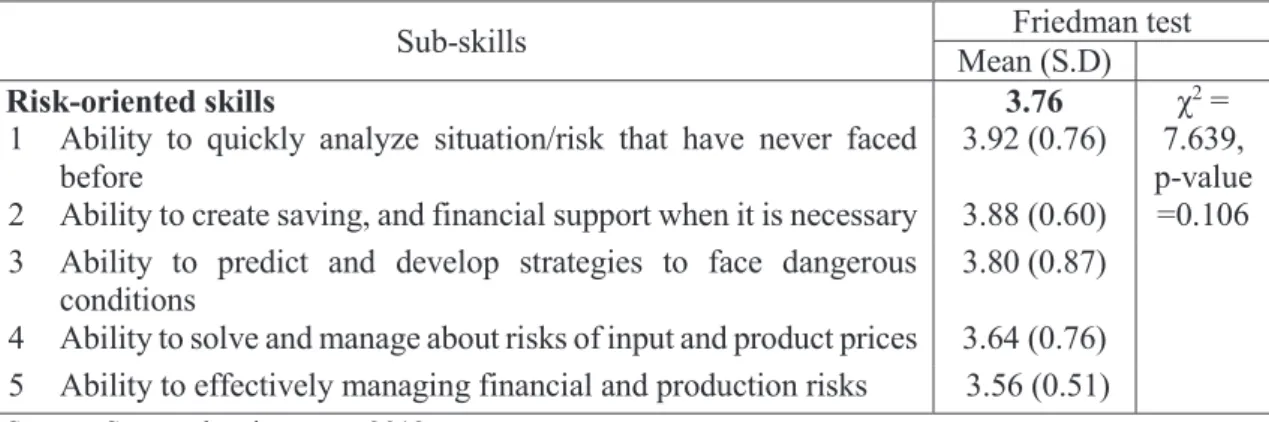
Descriptive statistics (mean and standard deviation) were utilized to indicate the perspective of farmer’s managerial ability. In addition, to interpret on the mean score of the managerial ability, interval scale was applied, of which includes five scale levels:
1.00-1.79 (very low), 1.80-2.59 (low), 2.60-3.39 (moderate), 3.40-4.19 (high), and 4.20- 5.00 (very high). Furthermore, Friedman test was carried out to indicate the statistically significant difference among means of sub-skills.
To identify factors contributing to farm managerial abilities, multiple linear