Carbon, oxygen and strontium isotope geochemistry of metacarbonate rocks in the Highland Complex, Sri Lanka
Momoko Shirakawa1, Naho Otsuji2, M. Satish-Kumar1 and Sanjeewa Malaviarachchi3
1 Department of Geology, Faculty of Science, Niigata University
2 JFE Techno-Research Corporation, Kawasaki, Japan
3University of Peradeniya, Peradeniya, Sri Lanka
The geology of Sri Lanka is a key in understanding the formation of Gondowana surpercontinent. It is generally considered that Sri Lanka is one of the continents that faced the then existed “Mozambique Ocean”, possibly adjacent to peninsular India, Madagascar, Mozambique, southeastern Africa and Droning Maud Land in the east Antarctica. Therefore, the metamorphosed sedimentary rocks in each of these continents carry information of the paleo ocean that existed before the Gondwana formation. In this study, we paid attention to metacarbonate rocks in the Highland Complex, Sri Lanka, in order to estimate the sedimentation age.
Based on Nd-model ages the Proterozoic basement of Sri Lanka has been subdivided into four lithotectonic units, namely, the Highland Complex (HC), the Wanni Complex (WC), the Vijayan Complex (VC), and the Kadugannawa Complex (KC). The HC basement is mainly composed of meta sedimentary rocks, whereas, the WC and the VC exposes mainly meta igneous rocks. The HC is composed of granulite facie metaquartzites, metacarbonate and metapelitic gneisses. The metamorphic P-T condition decrease from 8-9 kbar and 800-900℃ in the east and southeast to 4.5-6 kbar and 600-700℃ in the southwest and central HC. The central parts of HC has been considered to have been affected by the UHT conditions, where the P-T estimates range between 925-1150℃ at pressures of 9 to 12.5 kbar (Dharmapriya et al., 2015).
The metacarbonate rocks in the HC generally occur as layers parallel with other metasedimentary lithological units and show a NE trend. Thickness of the layers varies from few meters to about 3 km. In the central HC, the layers follow the regional fold structure surrounding the KC. The studied metacarbonate outcrop consists of alternate layers of massive carbonates and calc-slicates. Both calcite-rich and dolomite-rich coarse metacarbonate rocks are observed with grain sizes varying form coarse or fine, calcite has yellowing to bluish or white color. Silicate minerals like phlogopite, apatite, olivine, diopside,wollastonite, ilmenite, humite and graphite are present in some layers.
In order to obtain the primary sedimentary geochemical information, a preliminary screening and selection of geochemically pure metacarbonate rock samples was performed. As a first step, we measured oxygen and carbon isotope ratios to choose the least altered sample, which possibly preserve the marine chemical composition at the time of sedimentation. We have carried out the carbon and oxygen isotope measurements using a Finnigan MAT-251 mass spectrometer and an online reaction system with H3PO4 at Niigata University. Calcite and dolomite were distinguished from each other by staining using Alizarin Red-S. Sampling was carried out using a knife-edge under a binocular microscope on polished slabs. The results are presented in the usual δ notation with respect to V-PDB and V-SMOW standards.
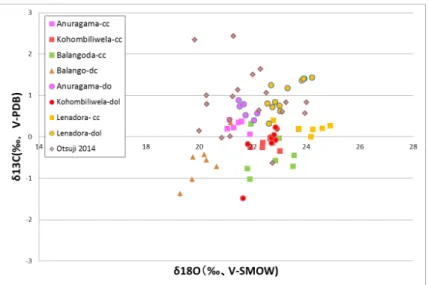
Out of the pure metacarbonate samples that consist only of calcite/dolomite mineral or minor amounts of calc-silicate minerals, the δ18O and δ13C values range between 19 to 25 ‰ and -1.3 to 2.4 ‰, respectively. Multiple samples analysed from the same locality showed similar isotope data suggesting homogenization of isotopes within a layer. In all localities calcite has slightly higher carbon isotopic composition than that of dolomite.
In general, all the metacarbonate rocks have highδ18O values, suggesting that the oxygen isotopic compositions were not affected by external fluids during digenesis, dolomitization or metamorphism. The carbonate rocks deposited in the late Proterozoic have carbon and oxygen isotopic compositions of -12~10‰ and 25±5‰, respectively (Halverson et al., 2010).
While the Neoproterozoic sea water hasδ13C values of 0±2‰. And Phanerozoic sea water indicate carbon and oxygen isotope compositions of -2~+6‰
and 0~-8‰.
Carbon and oxygen isotopes exchange with fluids during diagenesis, dolomitization and metamorphism. Subsequent to the carbonate sedimentation, they undergo dissolution, re-precipitation and isotopic re-equilibration with surrounding pore water, which in most cases are considered as contemporaneous seawater or ground water, if lithification occurs in the land. Therefore it is believed that the Precambrian carbonate rocks, the
limestones and dolostones of even un-metamorphosed sedimentary sequences do not preserve exact initial Precambrian marine chemical composition, but an artifact that in most cases are nearer to it. Isotopic shift due to diagenesis of carbonate rocks, cause a decrease in δ13C and δ18O values during lithification of carbonate sediments that were deposited in both Neoproterozoic and Phanerozoic time (e.g. Knauth and Kennedy, 2009).
Based on the above result, the metacarbonate samples examined in this study are considered to have preserved the Neoproterozoic sea water chemical composition, with minimum effects of diagenesis and metamorphism. Thus, our preliminary data indicate that some of the metacarbonate rocks preserve primary strontium isotope composition in the range of
87Sr/86Sr between 0.7051 and 0.7074. These initial ratios correspond to a depositional age of Tonian to early Cryogenian, based on chemostratigraphic curve of Halverson et al. (2010). When compared the Sri Lanka date with those from the Sør Rondane Mountains, East Antarctica, of which the 87Sr/86Sr ratios range between 0.7051 and 0.7103 (Otsuji et al., 2013), the majority of the Sr isotope ratios fall between 0.7055 to 0.7070, indicating a depositional age between 880~850Ma, comparable to those obtained for the Highland Complex metacarbonates. These results will lead to understand the processes and timing of Gondwana formation. Further detailed studies are being carried out, to understand the reliability and regional extent of depositional ages for the metacarbonate rocks in the Highland Complex, Sri Lanka.
References
Dharmapriya, P.L., Sanjeeva, K., Galli, A., Ben-Xun Su, Subasinghe, N.D., and Dissanayake, C.B., 2015, Rare evidence for formation of garnet+corundum during isobaric cooling of ultrahigh temperature metapelites: New insights for retrograde P-T trajectory of the Highland Complex. Sri Lanka. Lithos, 200-223, 30-317.
Halverson, G.P., Wade, B.P., Hurtgen, M.T. and Barovich, K.M., 2010, Neoproterozoic chemostratigraphy. Precambrian Research, 182, 337-350.
Knauth, L.P. and Kennedy, M, J., 2009, The late Precambrian greening of the Earth. Nature, 460, 728-732.
Otsuji, N., Satish-Kumar, M., Kamei, A., Tsuchiya, N,. Kawakami, T., Ishikawa, M. and Grantham, G.H., 2013, Late-Tonian to early-Crygenian apparent depositional ages for metacarbonate rocks from the Sør Rondane Mountains,East Antarctica. Precambrian Research , 234 , 257-278.
Figure 1. Carbon and oxygen isotopic composition of metacarbonate rocks from the Highland Complex