III
Thermal and Mechanical Properties of Glass Cullet Mixed with Asphalt as Low-Exothermic Pavement Material
by
Keinosuke GOTOH*, Minoru YAMANAKA**, Motoki SARUWATARI*** and Teruo MOCHISHITA**
The asphalt pavement contributes to the heat island phenomenon of the city. Thus in order to decrease the temperature of asphalt pavement and to utilize glass cullet as a recycling material as an aggregate, some tests were carried out. In this study the specimen in which the cullet was entrapped in cold-laid paving materials and non-mixing specimen are made respectively, and the surface temperature of each specimen is measured by the thermal video camera. A set of tests have been conducted and results indicated the clear effect of glass cullet in reducing the radiation temperature ofasph~ltpavement.
1. Introduction
The phenomenon called the heat island has appeared in the metropolitan cities of Japan. In the city, the temperature rises in comparison with the suburbs because it consumes the high-density energy and prevents the decrease of temperature by the evaporation of water, since most of the ground is being covered with concrete and asphalt and so on1). Because the temperature of the pavement surface is very high, it is considered that the effect to the heat island is too big for the pavement.
The followings can be considered as the probable countermeasures such as: 1) raising the albedo by changing color, 2) using the material characterized the high thermal conductivity or high specific heat as a pavement or a aggregate, 3) using the latent heat transportation by giving permeability or water retention to the pavement, and 4) reducing the irradiance by shades such as the street tree2).
The authors carried out to develop the low-exothermic pavement material by using the disposal pottery as one of the waste in order to decreasing the surface temperature of road3),4).
This study discussed the thermal and mechanical properties of pavement materials by mixing glass cullet as one of the recycling materials in the asphalt pavement in order to develop the low-temperature pavement material.
2. Glass Cullet
The glass cullet is used in this study to substitute part for the gravel in producing asphalt. The recycling of the glass bottles is mainly done by following two methods viz; reuse of the returnable bottles and recycle as raw material for producing glass bottles which is also known as glass cullet.
The glass bottles are recovered separately in different the colors from various roots such as classified collection by the municipality, recovery from wine(sake) stores and restaurants. These glass bottles are transferred to the cullet traders with the disposing facility of 30 places in Japan, which carries out the process of crushing, cleaning, and removing of foreign substance, etc. After that, the produced cullet is utilized as a main raw material of glass bottle in bottle factories.
Regarding the change of the use rate of glass cullee), the output of the glass bottle decreases since 1994, and becomes 1975000 tons in 1998. The utilized quantity and utilization rate of cullet is increasing year by year, and the utilized quantity of cullet in 1998 is 1459000 tons, and the utilization rate of cullet is 73.9%.
At present, over 90% of the cullet produced is used for glass bottle production, about 40000 tons of the cullet per year have been utilized as a glass fiber raw materiaI6). And annually cullet of about 60000 tons are utilized as tiles, blocks, aggregates for road pavement (asphalt pavement, Received on April 20, 2001
* Division of Environmental Systems Science, Granduate School of Science and Technology
** Department of Civil Engineering
***Ex-student, Department of Civil Engineering
112 Keinosuke GOTOH, Minoru YAMANAKA, Motoki SARUWATARI, Teruo MOCHISHITA
Table I Example of waste utilized as a pavement material7)
Wastes Utilization
Glass cullet Asphalt concrete aggregate.
Melting and solidificated material of solid waste
Asphalt concrete aggregate, Subgrade incineration ash
Sintering material of solid waste incineration ash Asphalt concrete aggregate, Subgrade Recycling recovered paper sludge Fibrous admixture
Reinforced plastic Modified asphalt material
Disused pottery product Asphalt concrete aggregate
Scrap tire Special pavement aggregate
permeable resin solidification pavement), lightweight aggregates, subgrades, backfill materials, etc.
Because it is anticipated that in the future municipalities would enforce the strict classification of waste based on the Packaging Waste Recycling Law, it is necessary to discuss the increasing use of glass cullet more than only glass bottle raw material.
Table I shows the example of waste utilized as a pavement materiae). In this study the glass cullet has been examined as asphalt concrete aggregate, which is the pavement material similar to the other waste.
Although the glass cullet is being utilized as raw glass fiber materials, tile blocks, aggregates, etc for recycling, but it has been observed that it's use is not still sufficient.
3. Specimens and Testing Method 3.1 Specimens
The glass cullet used in this study was collected by some self-governing communities in Kyushu district mainly and produced by the Kyushu Environmental Recycle Cooperatives. The glass cullet is a splinter of glass bottle which are of different sizes such as small, middle and large.
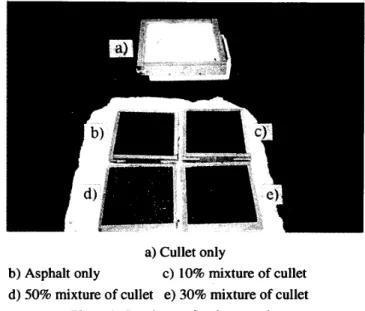
For the purpose of the test, three different type of specimens were prepared viz; l)asphalt only, 2)mixture of asphalt and cullet, and 3)cullet only. The mixture ratio of cullet and asphalt are 10%, 30% and 50% in volume. In the preparation of specimens, the compaction was carried out using the large compression tester in the equal pressure.
The particle size of used cullet is 1.2~5.0mm. The dimension of specimen is 30.Ocm in width and is 5.Ocm in thickness.
Photo 1 shows the measurement of each specimen. These specimens were placed on the Expanded Polystyrene board placed above ordinary concrete slab as a heat insulating
a) Cullet only
b) Asphalt only c) 10% mixture of cullet d) 50% mixture of cullet e) 30% mixture of cullet Photo 1 Specimens for the experiment material.
3.2 Measuring Surface TemperaturebyThermal Video Camera
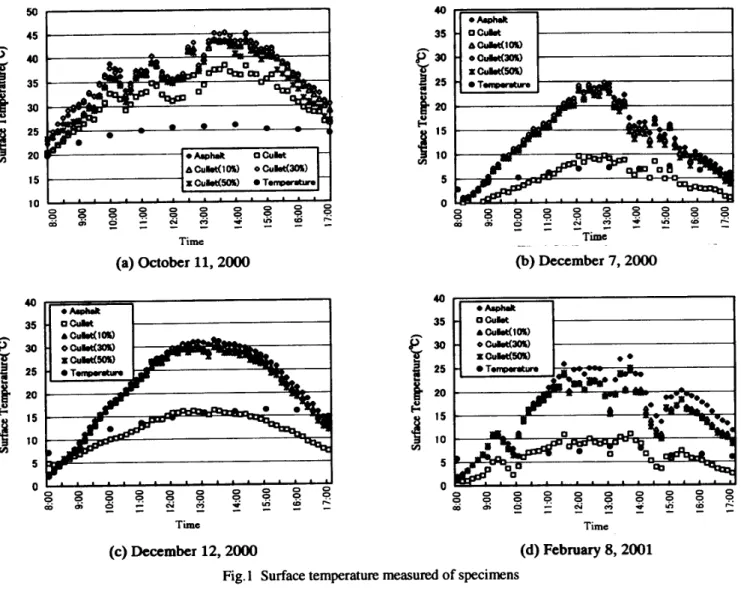
To check the effect of cullet on the radiation temperature of these specimens, all of the specimens were exposed to sunlight in an open space in front of the thermal camera in order to measure their surface radiation temperature. The thermometry by the thermal camera was carried out at the roof of Faculty of Engineering, Nagasaki University, and it was measured from 8:OOAM~17 :OOPM in 10 minutes intervals. The experiment was conducted for 4 days in October II, December 7 and 12 in 2000 and February 8 in 2001. The weather condition was fair during the experiment days.
3.3CBR Test
For checking the strength of the specimens, CBR test was carried out by following the same proportion of mix as
The'cmal and Mechanical Properties of Glass Cullet Mixed with Asphalt as Low-Exothermic Pavement Material 113
.e
0 0 0 0 0 0
0 0 0 0 0 0
eN M .. .n <0 r.;
-Time
(b)December7, 2000
0 0 Cl Cl 0 0 0 Cl Cl
0 0 9- 0 0 0 0 0 ~
a; 0 eN M .. .n cD
Time
eAaphelt DCuIet
• Cullet( I01) oCulet(3OlO
• Cullet(5OI) .T~
40
eAaphelt
35 DCulit
~30 6 Culet(10l) oCulet(3OlO
• Cullt(5OI)
I 25 .T~
~1-2015
~ 10
{I)
5
0 00 8 8 0'?
cD .,;; 0
40 35
1~ 30252015
~ 10
{I)
5
0 0 Cl
cD 50
45
~!!I 40
i 3530
~ •
~ 25
{I) 20 .Alph8lt DCuIet
6 Cullet(1(1) oCu1let(301l)
15 • Cullet(5OI) .T.~
10
0 0 0 0 0 0 0 0 0 0
0 9- 9- 9- 9- 0 9- 0 9- 9-
cD en 0 := .... M ... .n CD ...
Time
(a) October11, 2000
40 eAIplIeIt
35 DCulit
J
• Cullt(10l) 30 oCullet(3OlO
• Cullet(5OI)
25 .T...--
20
i 1510
{I)
5
0 0 0 0 0 0 0 0 0 0
0 Cl Cl Cl
ClcD Cl.,;; 00 9- N0 ~ 9-... .n cD r.:..:
Time
(c) December12,2000 (d) February 8, 2001
Fig. 1 Surface temperature measured of specimens done in specimen preparation.
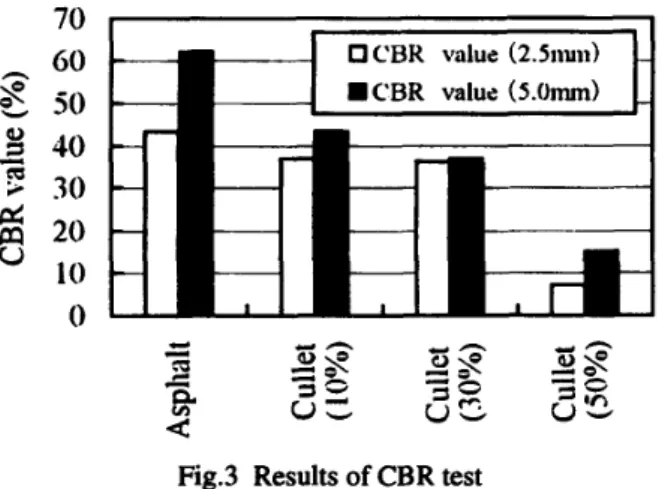
CBR test was carried out in order to obtain the index of intensity as a material of base or subgrade. The piston of 5cm in diameter is penetrated into the specimen surface, and measured the load when the piston penetrate 2.5mm or 5.0mm in depth. CBR value shows the percentage of measured load as proportion to standard load.
In this study the CBR test tells us about the required thickness of the asphalt pavement or concrete pavement.
8.0
""'
~ e 7.0
~ :; 6.0
lU..c:
S' ~ 5.0 .... -:SlU 4.0
e .-=' ~ 3.0
e CJ
.~ is 2.0 cu ...
~ ~ 1.0
:.a 0.0
- 0 -Oct.l1,2000 - Dec. 7,2000 --G-Dec.t t.2000
- . - Feb.8.2001 ...
4. Results and Discussions 4.1ThermalProperties
Figures 1 (a), (b), (c) and (d) are the surface temperatures measured for samples prepared by mixing asphalt with different percentages of cullet.
From Fig.l (a) it is clear that the surface temperature rises from 8:00 to 14:00 with the rise in the temperature in either specimen.Itseems that the surface temperature of the cullet only is the lowest and that the surface temperature rises as mixture rate of the cullet decrease.
10 30 50
Mixture rate of cullet(%) Fig.2 the maximum temperature difference between
various rate of mixture of cullet with asphalt only
Regarding Fig.l(b),(c) and (d) it can be found that the temperature of the specimen mixed the cullet decreases in comparison with the asphalt only in spite of the winter season such as December or February.
Figure 2 shows the maximum temperature difference between various rate of mixture of cullet with asphalt only.
114 Keinosuke GOTOH, Minoru YAMANAKA, Motoki SARUWATARI, Teruo MOCHISHITA
Fig.3 Results of CBR test
It is proven that the maximum temperature difference with the asphalt rises as the mix rate of the cullet increases.
Therefore it is clear that the cullet had the characteristic of reducingthesurface temperature when mixed with asphalt in which the surface temperature is made to decrease by mixinginthe asphalt.
References
1)Environment Agency edited (2000): The environment white paper (general remarks), pp.238-243 (in Japanese)
2) T.Kinouchi and H.Kobayashi (l995):Measures for Lowering Surface Temperature of Pavements for Comfortable Thermal Environment, Journal of Environmental Systems and Engineering, Japan Society of Civil Engineers, No.622, VII-II, pp.23-33 (in Japanese)
3) K.Gotoh, M.Yamanaka and M.Abdelhadi (1998):
Development of Low-Temperature Pavement Method by Using Ceramics with Asphalt, Proc. the 4th International Symposium on Environmental Geotechnology and Global Sustainable Development, Boston, USA, Vol.2, p.1614(abstraet), 5p.(full paper).
4) K.Gotoh, E.Yamada, M.Yamanaka and H.Yoshoda (1999): Development of Road Pavement Material used Low- Temperature of Ceramics, Proc. the Annual Meeting of Japan Society of Civil Engineers,Seibu Branch, Fukuoka, Japan, pp. 908-909(in Japanese).
5) Japan Glass Bottle Association (2000):
http://www.glassbottle.org/
6) Industry Recycling Dictionary Editing Committee (2000): Industry Recycling Dictionary, pp.412-416 (in Japanese)
7) T.Ikeda(1999): Present State and Problem of Pavement Technique, Civil Engineering, Vol.54, No.2, pp.28-34 (in Japanese)
mixture ratio of the cullet with asphalt increases. Then, in this form this proposed technique is difficult to use to produce the general paved material for road construction, but it can be used to produce paved materials for sidewalk or parking, which does not require high strength.
The workability and the durability of the proposed technique leaves the area for further study.
--
.9."t!.
- 0u-=.'1
value (2.5null) value (5.0mm)
70
~ 6050
(1) 40
";j=
30
;...
~ 20
l:Q
U 10
0 ";j-
«~
4.2 Mechanical Properties
Figure 3 shows the CBR values for all tested specimens.
These results indicatedthatthe CBR value of the specimen of asphalt only is the highest, and the CBR value of asphalt mixed cullet decreases accordingly as the mixing ratio of thecullet rises. The reason for this might be that, with the increase in the ratio of cullet, the adhesion with the asphalt becomes weaker because the surface of cullet is smooth.
Therefore it can be said that the adhesive strength must be raised in both the materials in order to increase the strength of specimen.
s.Conclusion
From the results of the surface temperature measured, it can be concluded that the cullet has the ability to decrease the surface temperature when mixed with the asphalt.
However, from the results of CBR tests it has been observed that the strength becomes weaker when the