Acta Med. Nagasaki 61: 33−35−
[Case report]
16-year-old boy had been healthy since birth. He began to
play soccer at 8 years old and never experienced any major injury. About 6 months prior to visit our hospital, he experi- enced pain in the left hip during practice of soccer, but symp- toms improved after rest and he did not seek treatment.
However, after a soccer match, he experienced a recurrence of left hip pain, unable to move his hip joint, and he had a fever of 38.2℃. He visited a local physician, coxarthrosis was suspected, and he was transferred to emergency depart- ment of our hospital.
Evaluation revealed tenderness from the left pubis across
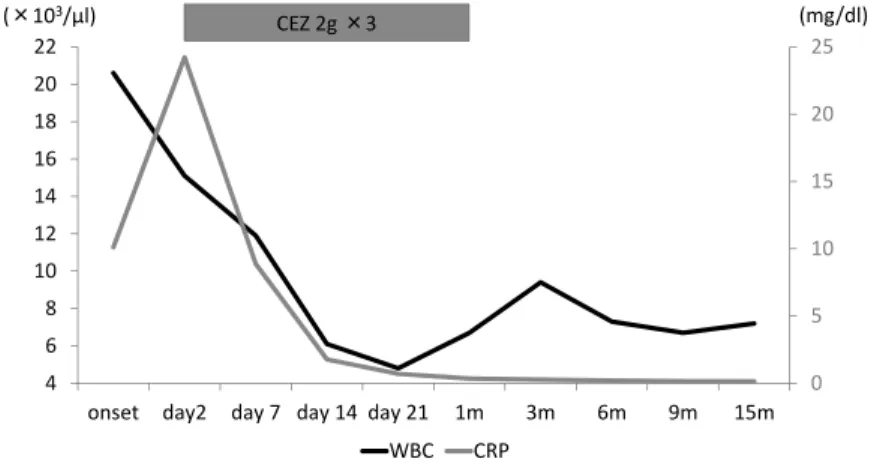
the hip joint, with pain on abduction of the hip. Plain pelvis radiography showed irregularity of the pubic symphysis (Fig. 1a), and magnetic resonance imaging (MRI) T2- weighted imaging (T2WI) showed abnormal signal intensi- ties, suggesting inflammation from the pubic symphysis along the left inferior pubic margin (Fig. 1b). Blood testing indicated an elevated inflammatory response with a white blood cell (WBC) count of 20,600/μl and C-reactive pro- tein (CRP) level of 10.1 mg/dl. The patient was initially di-
agnosed as osteitis pubis, admitted to the hospital for rest, and prescribed analgesics. Although pain improved, blood tests the next day still showed a WBC count of 15,100/μl and CRP of 24.2 mg/dl. In addition, he still had a tempera- ture of 38.5℃, indicating no improvement of inflammation, so blood cultures were drawn. Gram staining revealed Gram- positive cocci, and osteomyelitis of the pubic symphysis (os- teomyelitis pubis) was diagnosed. Cefazolin (CEZ) was ad- ministered at 2 g three times daily.
The final blood culture results showed methicillin-sensi-
tive Staphylococcus aureus (MSSA), so a decision was made to continue antibiotic therapy for 4 weeks. After treatment started, fever completely resolved within 1 week. In addi- tion, pubic and hip pain rapidly resolved with rest and anal- gesics. Blood test values peaked on hospital day 2, and sub- sequently, both WBC count and CRP gradually decreased.
On hospital day 16, the patient could walk without pain and was discharged (Fig. 2).
He completed treatment with CEZ 2 g three times daily
for 4 weeks with his local physician. On day 28 after onset, WBC count and CRP had normalized, so the patient returned to daily activities. Blood tests confirmed that there was no
MS#AMN 07197
Case Report
A case of osteomyelitis pubis in a high school soccer player
Takashi MiyaMoTo, Tatsuya FukushiMa, kenji Taguchi, Makoto osaki
Department of Orthopaedic Surgery, Nagasaki University Graduate School of Biomedical Sciences, Nagasaki, Japan
Osteomyelitis pubis in athletes is very rare. This pathology is often confused with osteitis pubis, and delays in treatment may lead to residual sequelae. We encountered a case of osteomyelitis pubis in a 16-year-old high school soccer player. Despite early diagnosis, starting treatment, and subsidence of infection, the patient was unable to return to competitive sports. We report this case and discuss the relevant literature.
ACTA MEDICA NAGASAKIENSIA 61: 33−35, 2017 Key words: Osteomyelitis pubis, athlete, Soccer player
Address correspondence: Takashi Miyamoto, Department of Orthopaedic Surgery, Nagasaki University Graduate School of Biomedical Sciences 1-7-1 Sakamoto, Nagasaki 852-8501, Japan
Tel: +81-95-819-7321, Fax: +81-95-849-7325, E-mail: [email protected] Received August 30, 2016; Accepted September 23, 2016
34 Takashi Miyamoto et al.: A case of osteomyelitis pubis
exacerbation of inflammatory response, and he was permit- ted to start jogging 3 months after onset. At 6 months after onset, he was also permitted to return to competitive soccer, but he experienced groin pain every time he played and found it difficult to perform at his former competitive level.
MRI was performed at 14 months after onset, and T2WI showed signal hyperintensity in the pubis only (Fig.3); how- ever, blood test results remained normal, with a WBC count of 7200/μl and CRP level of 0.14 mg/dl. Clinically, the os- teomyelitis had resolved, but the patient was in his last year of high school at the time, and since he was unable to play soccer at the level he desired, he decided not to return to competition. The patient is able to perform daily activities and light exercise without any complaints of pain.
0 5 10 15 20 25
4 6 8 10 12 14 16 18 20 22
onset day2 day 7 day 14 day 21 1m 3m 6m 9m 15m WBC CRP
CEZ 2g ×3
(×103/μl) (mg/dl)
Figure 2
Figure 1 a Plain pelvis radiography. Showing irregularity of the pubic symphysis.
b MR image of the pubic symphysis on coronal section. T2WI showed abnormal signal intensities around the pubic symphysis.
Figure 2
Figure 3 Plain pelvis radiography after 1year and four month. Still showing irregularity of the pubic symphysis.
a b
35 Takashi Miyamoto et al.: A case of osteomyelitis pubis
[Discussion]
Osteomyelitis pubis is a very rare disease, and differential
diagnosis from osteitis pubis is very important. Osteitis pu- bis is associated with local inflammation and often occurs after vaginal delivery or pelvic surgery
1). In recent years, os- teitis pubis has also often been reported in competitive sports involving athletes kicking or performing sudden changes in speed, and the rate of similar symptoms of groin pain is 5–13% among soccer players
2).
The first-choice approach to osteitis pubis is conservative
treatment
3), and symptoms often improve with rest and oral analgesics. However, when resistance to conservative treat- ment is encountered, osteomyelitis pubis must also be con- sidered. If treatment is delayed, pelvic ring instability, pubic symphysis diastasis, or bladder perforation may occur
4). In patients with suspected osteitis pubis who also have fever, nausea, or vomiting, osteomyelitis pubis must always be ac- tively considered
1).
Ross and Hu5)
reviewed 100 cases of osteomyelitis pubis and reported fever in 74%. Choi
3) reviewed 10 cases in ath-letes and reported fever in 100% of these patients. Our pa- tient, a soccer player who had been healthy since birth, was transferred to our hospital with a chief complaint of fever and tenderness involving the pubis and hip. Osteitis pubis was initially suspected, but symptoms did not improve with rest and analgesics; therefore, osteomyelitis pubis was sus- pected. The diagnosis was confirmed based on imaging find- ings and positive blood cultures for S. aureus, and antibiotic therapy was started. Choi
3)reported
S. aureus from bloodcultures in 4 patients, and from aspirations in 3 patients with osteomyelitis pubis. Ross and Hu
5)also reported S. aureus as the major causative organism among athletes.
Osteomyelitis pubis may also coexist with osteitis pubis4)
. Our patient probably initially had osteitis pubis associated with playing soccer, and symptoms improved when he re- frained from sports activities. When he was evaluated at our hospital, infection established for some reason unknown, re- sulting in bacteremia.
In the report by Choi3)
, 6 patients underwent 6 weeks of intravenous (IV) antibiotic therapy, 2 patients had 2 weeks
of IV antibiotics, followed by 4 weeks of oral antibiotics, and treatment duration was unknown in 2 patients. However, none of those patients had undergone surgical treatment.
Seven patients returned to sports activities after an average of 3.2 months. Pham
1)reported good outcomes with proper diagnosis and treatment. Our patient received 4 weeks of IV treatment and was able to jog after 3 months; however, he was ultimately unable to return to competitive soccer. Al- though osteomyelitis did not recur after initial treatment, the patient experienced inguinal pain with strenuous physical activity, and had to discontinue soccer practice. The patient began to feel that his coach no longer had faith in his perfor- mance, and he found it difficult to maintain his motivation.
This also affected his ability to return to competitive sports.
[Conclusion]
The differential diagnosis of inguinal pain in athletes
without specific injury includes osteitis pubis, but when the patient also presents with high fever, osteomyelitis pubis must be suspected, and blood culture is recommended. With long-term antibiotic therapy, the prognosis of osteomyelitis pubis is good, but some patients might not able to return to competitive sports. To maintain the motivation of athletes, it is also important to explain the need for early and long-term treatment to coaches and parents.
References
1. Pham DV, Scott KG. Presentation of osteitis and osteomyelitis pubis as acute abdominal pain. Permanente J 11:65-68, 2007
2. Hiti CJ, Stevens KJ, Jamati MK, et al. Athletic Osteitis Pubis. Sport Med 41: 361-376, 2011
3. Choi H, McCartney M, Best TM. Treatment of osteitis pubis and osteo- myelitis of the pubic symphysis in athletes: a systematic review. Br J Sports Med 45:57-64, 2011
4. Pauli S, Willemsen P, Declerck K, et al. Osteomyelitis pubis versus os- teitis pubis: a case presentation and review of the literature. Br J Sports Med 36:71-73, 2002
5. Ross JJ, Hu LT. Septic arthritis of the pubic symphysis: review of 100 cases. Medicine 82:340-345, 2003
36 Takashi Miyamoto et al.: A case of osteomyelitis pubis