1
The most internationalized Chinese firm and Chinese culture (guanxi)
Yasuhiro Okabe & Jùn tāo Mǎ
11. Its management system
The Chinese iron bowl employment system induced lazy behaviors in workers (Su &
Wright, 2012). Most workers lacked the discipline which was normally required in the industrial era (Ibid.). Haier’s CEO Zhang made similar comments. He stated “Chinese people tend to ignore rules and do not pay enough attention to details. We need tough management system with fair rewards and penalty features to help our workers get things done properly.” (Lin, 2005, p.1). Haier needed to focus on customer needs, product quality, and improve operation efficiency. To these objectives, Haier introduced the OEC management control system, the SST market chain system, and the race track model by open competitive bidding.
In the OEC management O stands for overall, E stands for everyone, everything, and every day, C stands for control and clear. Every employee has to accomplish the work every day (Lin, 2005). Never leave today’s work for tomorrow (Xu, Zhu, Zheng &
Wang, 2007). The OEC management aims at overall control of everything that every employee finishes on his or her job every day with a 1% increase over what was done the previous day (Lin, 2005)
The OEC is a philosophy. It is actualized by a 3E (everyone, everything, and everyday) card, in which workers fill out todays’ job performance. It is checked and calculated wages of workers and shown on the bulletin board in the factory. There is no proportion of guaranteed or fixed wage, the evaluation is instantaneously and open, and there is no room for the discretion of the management.
SST represents suo chou, suo pei and tiao zha in Chinese language. Suo chou is the basic piece rate wage measured by rightly done job. Suo pei and tiao zha are rewards and penalties, respectively. If workers find defects of the preceding process, they received rewards (suo pei), and if they fail to find defects whether the defects were due to workers own faults or other workers’, they received penalties (tiao zha). In the SST system the preceding process is regarded as a supplier, the next process as a customer, the operation itself as products (Mizuno, 2009). The SST aims at introducing market-chain mechanism into the organization and internalized market transaction and
1 Jùn tāo Mǎ graduated from the master course at Dokkyo University and works at Sankyu Inc.
2
market competition. The SST is applied for line-workers. The salary of engineers is determined by market performance of the new products that they developed.
Haier introduced the race track model of promotion. It is open competitive bidding system for job placements. Any qualified can bit for the job. No age, education, or seniority does not matter as long as the candidates acquire the necessary knowledge and skills.
Haier also has the policy of regular demotion of fixed rate of inferiors. The bottom 5-10% are automatically demoted every year (Yoshiwara & Hua, 2002). This applies to top executives. In 2002 out of fifty-eight top executives 13 were severely punished; 3 were fired, 6 demoted, 4 received performance improvement order with a certain time limit. Despite that they have long contributed to the success of the firm, their past contributions were not counted.
Haier management system is characterized as a stick and carrot approach. Its process looks open and fair. It is strongly relied on financial incentives. The incentives are exclusively based on individualistic performance.
2. High involvement HR practices
High involvement HR practices are the source of competitive advantages of the firm (Yang, 2012). They improve employees’ work-related attitudes and performance behaviors (Gray & Garrett, 2009).
However, there is no uniform view about which practices that should be included in such HR systems (Su & Wright, 2012). For example, Arthur (1994) pointed out six HR practices, Cappelli and Neumark (2001) eight practices, and Guthrie (2001) twelve practices. Despite of variety of practices, four HR practices, that is information, empowerment, training and compensation seem to be included in all previous research (Guerrero & Barraud-Didier, 2004)
In addition, selective staffing (Bae & Lawler, 2000; Delaney & Huselid, 1996;
Ichniowski et al., 1997) and the job design (Guest & Hoque, 1994; Guest et al., 2003;
Hoque, 1999) are often included in high involvement HR practices
However, most of these theoretical frameworks have tested validity in an
Anglo-American context. HRM systems must be understood in the context of
organizations (Jackson & Schuler, 1995). Contextual factors include legal systems,
social institutions, labor market characteristics, national culture and so on. Chinese
firms are significantly different from Anglo-American counterparts in those contextual
factors (Su & Wright, 2012).
3
Previous research suggested that the high involvement HR practices were not effective and not implemented in the Chinese firms (ex. ibid). This research found that some were actually implemented with the firm’s definite intentions, others are there spontaneously or not at all implemented.
Chinese society is a guanxi-based society (Tian, 2007), in which an individual is connected to others through various personal ties and relations (Yan, 1996). Good subordinate-superiors guanxi is considered to be a core of HRM concept in China, because it still has significant influence on critical subordinates’ work-related behaviors such as turnover intensions (Wong, Wong & Wong, 2010). This research also included guanxi as an independent variable.
3. The aims and research methods
The purpose of this study is threefold; firstly to investigate how the above HR practices are implemented in Haier, secondly how those practices influence the attitudes and behaviors of managers there, thirdly how guanxi affect the above relationship.
The sample was corrected by the cooperation of a senior HR manager at Haier.
Fifty-seven managers were randomly selected to fill out questionnaires and the following interviews. After the analysis of the data, the results were fed back to the senior HR manager and further investigation was done though e-mails exchanges with her.
4. Independent variables Pay & welfare benefits
The Gini coefficient is a widely used measure of economic inequality. According to the National Bureau of Statistics in China (2012), China’s official coefficient stood at 0.474, which is already above the internationally recognized warning line of 0.4, indicating greater inequality and possibility of social turbulence.
China has 2.7 million U.S. dollar millionaires and 251 billionaires, according to the Hurun Report (2013), but 13 percent of its people live on less than $1.25 per day, 29.8%
less than $2, and 71.6% less than $5 according to the World Bank survey (2008).
The Chinese House hold Finance Survey Center of Chengdu’s Southwest University of
Finance and Economics (2012) put the country's Gini coefficient at, much higher, 0.61
in 2010.
4
Existing an enormous income gap in today’s China reasonably account for the obsession that Chinese have with money. Performance based compensation system would provide substantial incentives for managers to work hard to accomplish their performance objectives (Su & Wright, 2011).
The official inflation rate for 2009-2013 on average, is 2.67%. However, the sampled managers suggested the actual feeling of the inflation is more than 10%. Due to this, the senior HR manager suggested pay rise would not catch up the inflation rate, hence no one would be happy the amount of salary. However, nearly one third of the managers are happy about it (Table 1).
Table1: The degree of satisfaction with pay Unsatisfied
Rather unsatisfied Rather satisfied Satisfied Total
7 33 12 5 57
12.3%
57.9%
21.1%
8.8%
100%
The Company welfare and benefits include housing allowance, paid holidays, and gifts in lunar New Year in Haier. These are thought to be the standard for Chinese firms.
Welfare and benefits have been regarded as the second salary, but they have meaning more than fringes. It has strategic importance to influence attitudes and behaviors of employees (DeNisi & Griffin, 2001). At Haier the proportion of the satisfied with the corporate welfare and benefits is over 40 percent. Nearly half of the managers are satisfied with them (Table 2).
Table2: The degree of satisfaction with welfare & benefits Unsatisfied
Rather unsatisfied Rather satisfied Satisfied Total
8 26 19 4 57
14.0%
45.6%
33.3%
7.0%
100%
Empowerment
According to Liang, Marier and Cui (2012), two cultural issues hinder empowerment
HR practices in Chinese firms, high power distance (Hofsted, 2001) and low trust (ibid,
1980). In a high-power distance culture, the power is distributed according to certain
hierarchical status or positions (Fu & Kamenou, 2011). Subordinates are expected to
5
show respects to superiors and follow their orders (ibid.). It is culturally awkward to question and challenge their superiors’ though and opinions (Liang et al, 2012).
Superiors would also be uncomfortable with different voices from their subordinates ((Fu & Kamenou, 2011).
The essence of empowerment is decentralizing decision-making which enables employees to participate in the process of decisions-makings (Yang, 2011).
Delegation of decision-making is contradiction in the Chinese high-power distance context.
Fukuyama (1995) categorized Chinese as a low-trust society in which trust is limited only in-groups such as family and relatives. According to Kim and Wright (2011), trust is a critical contextual condition to delegation of decision-making. The low trust level between employers and employees in Chinese organizations would make it difficult to implement empowerment HR practices.
Previous studies (ex. Akhtar et al., 2008; Cunningham, 2010; Su & Wright, 2012) found that empowerment practices are not implemented in Chinese firms. This is also the case with Haier. Our interviews with the senior HR manager found that the decision-making is predominantly top-down style and participative decision-making, involving subordinates in the decision-making processes, are not being applied in Haier.
She commented that it is most likely that subordinates wouldn’t like it either.
Information sharing
Information sharing is organizational practices and arrangements ensuring that individuals have enough information on organizational activities (Wood & Wall, 2007).
It is generally recognized that information sharing increases feelings of mutual trust and makes employees feel important to the organization (Pfeffer, 1989; Rodwell, Kienzle &
Shadur, 1998). It also facilitates organizational transparency and decreases turnovers (Ahmad & Schroeder, 2003).
Consistent with findings of other Chinese firms’ studies such as Akhtar et al. (2008), Fu and Kamenou (2011), and Su and Wright (2012), information sharing mechanisms have not been established prevalently in Haier, according to the interviews with the senior HR manager. She suggested that managers focused on their own performance, were not much interested in what was going on in other departments or the whole plant.
Although the official information sharing mechanisms are not introduced in Haier, the
questionnaire research data show sharing seems to be occurred spontaneously through
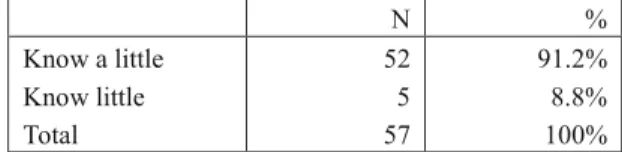
informal networks, to some extent. Table3 to 5 shows that the degree of information
sharing on their own departments, other departments, and the whole plant, respectively.
6 Table 3: Information on your own department
N %
Know well Know a little Total
12 45 57
21.1%
78.9%
100%
Table 4: Information on other department
N %
Know a little Know little Total
52 5 57
91.2%
8.8%
100%
Table 5: Information on the whole plant
N %
Know a little Know little Not know at all Total
53 3 1 57
93.0%
5.3%
1.8%
100%
Development
All respondents received basic/introductory training when they entered the organization (Table 6). It is much longer than the simple orientation. Relatively long length of the training indicates that it is necessary time to learn rules and regulations of Haier and its way of management. The contents of the training are organization specific and focus on necessary skills to perform the duties.
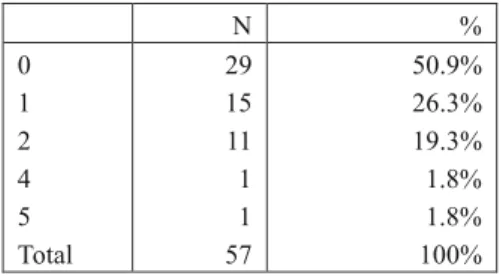
In contrast, more than a half of respondents have not received off-the job training after joining the organization (Table 7). Those who received are for pre-promotion training or voluntary training outside the organization. The senor HR manager commented, “we don’t provide training because it is costly”.
The estimated the average yearly turnover rate is 20% to 40% over the last 10 years
(Liang, et al., 2012) and white-collar professionals change their jobs every two to three
years (Schmidt, 2011). Extensive non-organization specific training would accelerate
the risks of poaching given the rapid expansion of the economy and short supply of
managerial talents (Liang, et al., 2012).
7 Table 6: The length of basic/introductory training
N %
1 week 2 weeks 1 month
More than 1 month Total
15 10 13 19 57
26.3%
17.5%
22.8%
33.3%
100%
Table 7: The frequency of off-the-job training
N %
0 1 2 4 5 Total
29 15 11 1 1 57
50.9%
26.3%
19.3%
1.8%
1.8%
100%
Selective recruitment
According to the senior HR manager, in addition to basic management skills, adaptability, creativity, strategic thinking and human resource developmental skills are the factors evaluated in selection interviews. Table 8 shows many different ways of the selection process. A manager suggested that for those who have good guanxi it is much easier to obtain good positions in the organization. The interview is mere formality for them. It would be very difficult and cause troubles to reject the candidates with good guanxi, since the recommender would lose his face. The variety of the selection methods comes from the degree of guanxi rather than selective recruitment.
Table 8: The frequency of off-the-job training Simple test and interview
Test only 1 interview 1 interview with test 2 interviews with test
More than 3 interviews with test Total
2 1 17 17 19 1 57
3.5%
1.8%
29.8%
29.8%
33.3%
1.8%
100%
8
Job design
According to Guest et al. (2003), job design is defined as making full use of skills and ability. However, managerial jobs, in nature, are expected to make full use of skills and ability to accomplish the duties. The managerial job in its characteristics is autonomous.
What must be done is given and how it is done is left to individual discretion. The performance is measured by MBO (manage by objectives), that is, objectives that should be accomplished are given and the performance is measured by the attainment rate.
Whether one feel it is stimulating and interesting or too hard to attain objectives depend on individual subjective interpretation. Quite a large proportion of the managers (68.4%) were dissatisfied with the job contents (Table 9).
Table 9: The frequency of distribution on satisfaction in job content
N %
Dissatisfied Rather dissatisfied Rather satisfied Satisfied Total
7 32 14 4 57
12.3%
56.1%
24.6%
7.0%
100%
According to the annual report of Haier, the average annual increase rate in revenue is astonishingly 62.17% for the last 5 years (2006-2010). The business has been rapidly expanding in Haier. As a result, managers has been constantly busy and demanded. The main complaints are "too much demanding”, "too busy”, "have to do a lot of things in limited time”. The problem seems to lie in heavy workload rather than the job content itself. Managers are heavily pressurized to make good performances. They are instantly related to the level of pay. Poor performance indicates increasing the risk of losing the jobs.
However, a manager suggested, "the dissatisfaction is not simply busy but rather unfair treatment in terms of career opportunities and uneven workloads”. Some managers are provided with blessed career from the start, while others are not. This implies that guanxi influences in job assignments as well.
Guanxi
Guanxi is characterized mainly by reciprocity, personal indebtedness, and strong
in-group favoritism (Zhang, 2011) Whereas these relational exchanges may apply
across all cultures, the weakness or lack of other balancing institutions in China has
allowed guanxi to evolve so pervasively to dominate social and business activities
9
throughout the country (Lovett, Simmons & Kali, 1999).
Guthrie (1998) suggested that guanxi would be in decline as China develops rational-legal systems based on formal laws and procedures. Furthermore, he continued that competitive pressure in a market economy shift would select on the basis of merits, regardless of personal and political relationship (ibid.)
However, Zhang (2011) argued that 'China’s 30 years of reform and its embracing of capitalism have not lessened the significance of guanxi ' (p.582). The country is still regulated by rule of man rather than the rule of law (Fu & Kamenou, 2011).
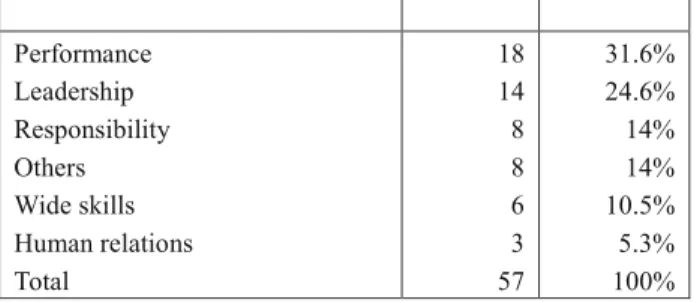
This research asked what the determinant factor for promotion is. Examples are good performance, leadership, responsibility, wide skills and good human relation with superiors (guanxi). The result is in Table 10.
Table 10: The frequency of distribution on determinants of promotion Performance
Leadership Responsibility Others Wide skills Human relations Total
18 14 8 8 6 3 57
31.6%
24.6%
14%
14%
10.5%
5.3%
100%
On the surface, the guanxi doesn’t seem to work in the Haier discipline management.
Unfortunately, the senior HR manager didn’t make any clear comment on how guanxi influences on employment and promotion in Haier. However a manager suggested that no Chinese organization can be free from guanxi. States owned firms tend to be stronger than private firms like Haier. It is the matter of degree.
The main characteristics of guanxi such as favoritism, reciprocity, and personal
indebtedness are grounded in the closeness and deepness of the interpersonal
relationship. As stated, guanxi is the matter of the degree. This study measured
relational closeness with superiors by the following four level; 1) the relationship in
public (organizational settings) is strictly based on hierarchical distinction and rules, and
in private distant, no guanxi, 2) in pubic the relationship is basically based on
hierarchical distinction and rules, and in private formal/courteous relationship, a little
guanxi, 3) in public rather causal relationship, favoritism exists to some extent, and in
private close relationship, rather strong guanxi, 4) close relationship both in public and
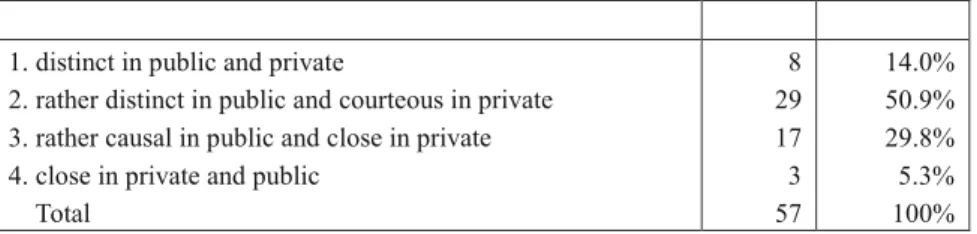
in private, very strong guanxi. The results were in Table 11. As expected, the privileged,
those with very strong guanxi is very small in proportions.
10 Table 11: The frequency of distribution on guanxi
1. distinct in public and private
2. rather distinct in public and courteous in private 3. rather causal in public and close in private 4. close in private and public
Total
8 29 17 3 57
14.0%
50.9%
29.8%
5.3%
100%
5. Dependent variables & control variable Intensions to stay
The employment of managers is basically based on fixed-term contracts. During the term leaving the organization is the breach of the contact. Managers are less likely to leave the organization even if they have available alternatives. Previous continuous commitment literature assumes no legal bound situations (ex. Allen & Meyer, 1990), which is not the case for the sampled managers. This study asked how long they wish to extend the next contract when the present one expires. The results are in Table 12.
Despite that Haier is one of the most internationalized Chinese firms, over 80 percent of the managers did not wish to extend the contract over 5 years.
Table 12: The frequency of distribution on intensions to stay
N %
1 year 1-3 years 3-5 years More than 5 years Until retirement Total
1 21 24 4 7 57
1.8%
36.8%
42.1%
7.0%
12.3%
100%
Willingness to contribute
A manager suggested that China is in the time of turbulence. Many sampled managers
expressed great concerns about the future. It is unstable and unpredictable. The existing
values may turn upside down over night. Many managers suggested that they have to
survive in difficult times on their own, which is quite hard. In this circumstance, it is
nonsense to ask whether they have psychological attachments to the organization as
found in affective commitment literature (ex. Allen & Meyer, 1990). They have to care
about themselves first and it is the most and only important. For organizations, the
important thing is to make sure that managers contribute to the organization by their
performances. It does not matter whether their contributions are due to their
11
psychological attachments to the organization or for their own sake. This study asked the managers whether they are willing to work hard for the success of the organization.
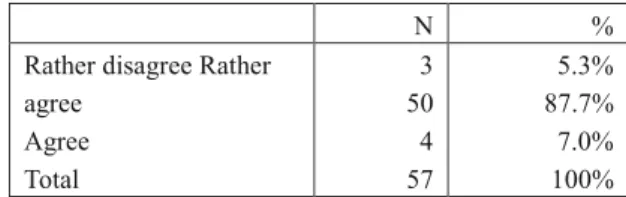
The results are in Table 13. "Rather agree” occupied the dominant proportion (87.7%).
This is interpreted as follows. If I have to decide, I definitely not disagree but not so much so.
Table 13: The frequency of distribution on willingness to contribute
N %
Rather disagree Rather agree
Agree Total
3 50 4 57
5.3%
87.7%
7.0%
100%
Control variable
According to classical Becker’s side-bet theory (1960), one accumulates side-bets or investment over time in an organization. The side-bets involve length of employment, organization specific skills and corporate pension plans (Meyer et al., 1993). Becker suggest that the more one accumulates side-bets, the more one has to lose by leaving the organization and hence the greater the commitment to the organization. This study treats length of service as a control variable.
6. Analyses
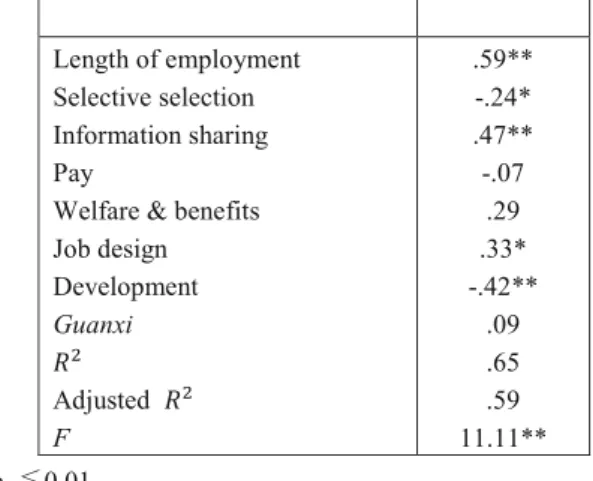
Table 14 shows the regression analysis of intensions to stay. Selective selection negatively related to intensions to stay (β=-.24, p<.05). Those who experienced more selection processes were less likely to stay in the organization. Experiencing more selection processes would indicate weaker guanxi in the organization and hence, less opportunities to move up in the organization.
Information sharing in their own department positively related to the intensions to stay (β=.47, p<.01). However, significant relationships were not observed in information on other departments, the whole plant. It is inferred that the observed loyalty is not to the organization, but to familiar working groups.
Development (off the job training) is negatively related to intensions to stay (β=-.42,
p<.01). Off the job training would simply increase the market value of individual. It
would increase the opportunities to find better jobs outside the organization. These
tendencies would be especially strong for those who receive training outside the
organization on their own account. We also found significant positive correlation
12
between the number of received off-the-job training and guanxi (t = .371, p <.01). Who will receive off-the–job training is based on superiors’ recommendation. Guanxi works in the selection of the trainees.
Table 14: The regression analysis of Intensions to stay Length of employment
Selective selection Information sharing Pay
Welfare & benefits Job design Development Guanxi 𝑅𝑅2
Adjusted 𝑅𝑅2 F
.59**
-.24*
.47**
-.07 .29 .33*
-.42**
.09 .65 .59 11.11**
*p ≦0.05, ** p ≦0.01
Table 15 shows the regression analysis of willingness to contribute to the organization.
Pay is negatively related to willingness to contribute to the organization (β=.55, p<.01).
In the Haier compensation system, those who are satisfied with the level of pay are inferred to be high performers. In the current system they would regard their compensation as the one obtained by their own efforts. The present compensation system would facilitate individual competition and allow managers to pursue self-interests, but less likely to engender willingness to contribute to the success of the organization.
In contrast, welfare and benefits positively related to willingness to contribute to the organization (β=.42, p<.05). The company welfare and benefits are the ones awarded by the company irrespective of the performance, which is regarded as a token of organization’s concern for employees’ well-being. According to the exchange theory, employees take the message and show loyalty to the organization in return (Eisenberger, Huntington, Hutchison, & Sowa, 1986)
Guanxi is positively related to willingness to contribute to the success of the organization (β=.37, p<.01). Due to good guanxi, he or she may be thankful for obtaining good positions in such a good company as Haier and is willing to work hard for the success of the organization. The observed positive relationship would not be so.
He or she may be thankful to the specific superiors who backed him/her up, but not to an ambiguous concept of an organization. Guanxi is based on reciprocal obligations.
Now it is his/her turn to pay back. He/she is expected to work hard for the superiors in
13
return. As a result the superiors may get promoted and then he/she would also get promotion. This is not simply psychological attachments, but rather calculative conducts.
Table 15: The regression analysis of willingness to contribute
Step 1 Step 2
Length of employment Selective selection Information sharing Pay
Welfare & benefits Job design Development Guanxi Guanx x pay
Guanxi x Welfare & benefits 𝑅𝑅2
Adjusted 𝑅𝑅2 F
-.11 -.04 -.32 -.55**
.42*
.02 .09 .37**
.30 .15 2.21*
-.07 -.03 -.19 -.32*
.30*
.08 .05 .27**
-.04*
.23*
.52 .41 4.90**
*p ≦0.05, ** p ≦0.01
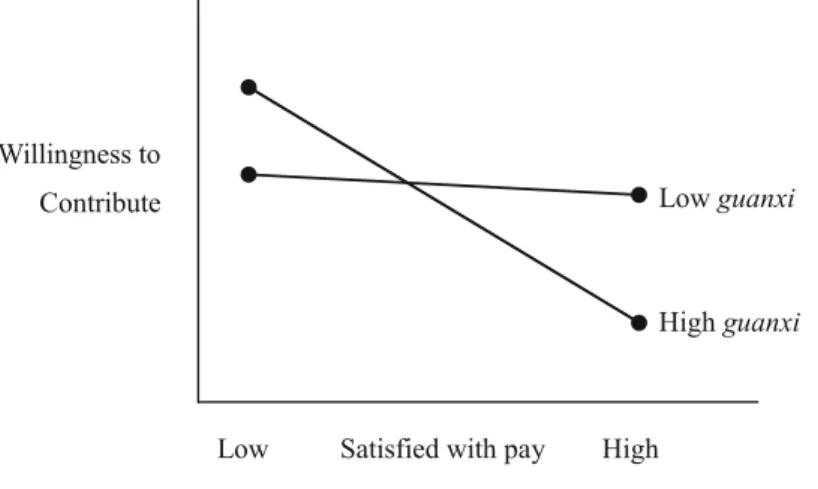
Guanxi may buffer the negative effect of pay on the willingness to contribute to the organization. While pay is negatively related to the willingness to contribute to the organization, the strength of this relationship may weaken as the level of guanxi increases. To examine this relationship, the interaction between the level of guanxi and importance of pay was conducted (Step 2).The interaction revealed significance (β=-.04, p<.05). Figure 1 plotted the interactions.
Figure 1: The interaction between the guanxi and importance of pay
Willingness to
Contribute Low guanxi
High guanxi
Low Satisfied with pay High
14
Contrary to the expectation, high guanxi showed steeper negative line than the low guanxi, indicating that guanxi does not buffer the negative effect of pay on the willingness to contribute to the organization, but rather strengthens the negative relationship.
7. Conclusion
At Haier among seven HR practices official information sharing mechanisms have not been introduced on purpose but happened spontaneously. Empowerment, that is the delegation of decision-making is not occurred and probably won’t at least for the time being. The introductory trainings were implemented intensively but the off-the-job training opportunities were very limited. Compensation systems were strictly based on individual performance. Selective recruitment practices looked to be employed, but the reality is that the obtained results are the product of guanxi influences. The managerial jobs are tough and demanding, especially in a rapidly expanding firm like Haier.
Information sharing, and interesting and stimulating job contents were positively related to intensions to stay, which is consistent with other research. Off-the-job training experiences and selective recruitment were negatively related to intensions to stay, which is also not surprising.
Pay was negatively while welfare and benefits were positively related to willingness to work hard. Considering the current compensation structures, the results could be expected.
T
he guanxi influences in recruitment selection, job assignments, and off-the-job training opportunities. Haier management systems are regarded as fair, open and pure merit system. Despite of these general understandings, the guanxi’s influences appeared in every important aspect of organizational decisions and the appearance was very implicit.
Guanxi certainly exists and spreads over within the organization, but it is a network which is independent of the organization.
Acknowledgement: We thank the senior HR manager at Haier for her cooperation with
the project, and Professor Tong at Dokkyo University for his variable comments, and
Miss Zhuāng for her translations.
15
Reference
Ahmad, S. & Schroeder, R. G. (2003) The impact of human resource management practices on operational performance: recognizing country and industry differences.
Journal of Operations Management. 21 1 19-43.
Akhtar, S., Ding, Z.D. & Ge, G. (2008) Strategic HRM Practices and Their Impact on Company Performance in Chinese Enterprises. Human Resource Management, 47 1 15–32.
Allen, J.N. & Meyer, P.J. (1990) Organizational socialization tactics: a longitudinal analysis of link to newcomers’ commitment and role orientation. Academy of Management Journal 33 3 847-858.
Arthur, J.B. (1994) Effects of Human Resource Systems on Manufacturing Performance and Turnover. Academy of Management Journal 7 670–687.
Bae, J. & Lawler, J.J. (2000) Organizational and HRM Strategies in Korea: Impact on Firm Performance in an Emerging Economy. Academy of Management Journal 43 502–517.
Becker, H. S. (1960) Note on the concept of commitment. American Journal of Sociology 66 32-40.
Cappelli, P. & Neumark, D. (2001) Do ‘High Performance’ Work Practices Improve Establishment-level Outcomes? Industrial and Labor Relations Review 54 737–775.
Chen, C.C. (1995) New Trends in Rewards Allocation Preferences: A Sino-US Comparison. Academy of Management Journal 38, 2, 408–428.
Cunningham, L.X. (2010) Managing Human Resource in SMEs in a Transition Economy:Evidence from China. International Journal of Human Resource Management 21 2120–2141.
Delaney, J.T. & Huselid, M.A. (1996) The Impact of Human Resource Management Practices on Perceptions of Organizational Performance. Academy of Management Journal 39 919–969.
DeNisi, A. & Griffin, R. (2001) Human Resource Management. Boston: Houghton Mifflin Company.
Eisenberger, R., Huntington, R., Hutchison, S. & Sowa, D. (1986) Perceived Organizational Support. Journal of Applied Psychology 71 3 500-507.
Fu, Y. & Kamenou, N. (2011) The impact of Chinese cultural values on human resource
policies and practices within transnational corporations in China. International Human
Resource Management 22, 16 3270-3289.
16
Fukuyama, F. (1995) Trust: The social virtues and the creation of prosperity. New York:
the Free Press.
Guest, D. & Hoque, K. (1994) The Good, the Bad and the Ugly: Employee Relations in New Non-union Workplaces. Human Resource Management Journal 5 1–14.
Guest, D.E., Michie, J., Conway, N. & Sheehan, M. (2003) Human Resource Management and Corporate Performance in the UK. British Journal of Industrial Relations 41 291–314.
Guerrem
, S. &Barraud-Didier
, V. (2004)High-involvement practices and performance of French firms. International Journal of Human Resource Management 151408-1423 Guthrie, D. (1998) The declining significance of guanxi in China's economic transition.
China Quarterly 154 254-282.
Guthrie, J. P. (2001) High-involvement work practices, turnover, and productivity:
Evidence from New Zealand. Academy of Management Journal 44 1 180-190.
Hoque, K. (1999) Human Resource Management and Performance in the UK Hotel Industry. British Journal of Industrial Relations 37 419–443.
Hofstede, G. H. (1980) Culture and organizations. International Studies of Management
& Organization 10 4 15-41.
Hofstede, G.H. (2001) Culture’s Consequences, Comparing Values, Behaviours, Institutions, and Organizations across Nations. 2nd ed. Thousand Oaks CA: Sage.
Ichniowski, C., Shaw, K. & Prennushi, G. (1997) The Effects of Human Resource Management Practices on Productivity. American Economic Review 87 291–313.
Jackson, S. E. & Schuler, R. S. (1995) Understanding human resource management in the context of organizations and their environments. Annual Review of Psychology 46 1 237-264.
Liang, X., Marler, J. H., Cui, Z. (2012) Strategic Human Resource Management in China: East Meets West. Academy of Management Perspectives 26 2 55-70.
Lin, T. (2005) Effective OEC Management Control at China Haier Group. Strategic Finance 86 11 39-45.
Lovett, S., Simmons, L. C. & Kali, R. (1999) Guanxi versus the Market: Ethics and Efficiency. Journal of International Business Studies
Mizuno, I (2009) Management system of Haier group in China, Annual Report, Institute of Economic and Political Studies in Kansai University 91-100.
30 2 231-47
Meyer, P.J., Allen, J. N. & Smith, A.C. (1993) Commitment to organizations and occupations: extensions and test of a three-component conceptualization. Journal of Applied Psychology 78 4 538-551.
Pfeffer, J. (1998) Seven Practices of Successful Organizations. California Management
17
Review 40, 96–124.
Rodwell, J. J., Kienzle, R., & Shadur, M. A. (1998) The Relationships Among Work-Related Perceptions, Employee Attitudes, and Employee Performance. Human Resource Management 37 3 277-293.
Schmidt, C. (2011) The battle for China's talents. Harvard Business Review 89 3 25-27.
Su, Z-X. & Wright, M. P. (2012) The effective human resource management system in transitional China: a hybrid of commitment and control practices. International Journal of Human Resource Management 23 10 2065–2086.
Tian, X. (2007) Managing International Business in China, Cambridge: Cambridge University Press.
Tung, R. & Baumann, C. (2009) Comparing the attitudes toward money, material possessions and savings of overseas Chinese vis-a-vis Chinese in China: convergence, divergence or cross-vergence, vis-a-vis 'one size fits all' human resource management policies and practices. International Journal of Human Resource Management 20 11 2382-2401.
Wong, Y-T., Wong, S-H., & Wong, Y-W. (2010) A study of subordinate-supervisor guanxi in Chinese joint ventures. International Journal of Human Resource Management 21 12 2142-2155.
Wood, S.J., and Wall, T.D. (2007) Work Enrichment and Employee Voice in Human Resource Management-Performance Studies. International Journal Human of Resource Management 18 1335–1372.
Xu, F. & Kunifuji, S. (2003) Human Resource Development in Haier, The Japan Society for Science Policy and Research Management 135-138.
Xu, Q., Zhu, L., Zheng, G. & Wang, F. (2007) Haier’s Tao of innovation: a case study of the emerging Total Innovation Management model. Journal of Technology Transfer 32 27–47
Yan, Y. (1996) The Flow of Gifts: Reciprocity and Social Networks in a Chinese Village. Stanford: Stanford University Press.
Yang, Y-C. (2012) High-involvement human resource practices, affective commitment, and organizational citizenship behaviors. The Service Industries Journal 32 1209–1227.
Yoshiwara, H. & Hua, O-Y. (2002) Market economy model of Chinese management - case of Haier. Discussion paper Research Institute for Economics & Business Administration Kobe University.
Yu, J. (2008) A study of Haier's HRM theory, i.e. "Horse races without horse experts":
the characteristic about the motivation of blue-collar workers, The Japanese
Association of Administrative Science 191-196.
18