INTRODUCTION
The ultimate goal of antihypertensive therapy is not only to normalize the blood pressure level but also to prevent end-organ damage, such as cardiac hypertro- phy and renal dysfunction, and to prevent the cardio- vascular disease, such as stroke and myocardial infarc- Received June 30, 2015;accepted July 17, 2015
Reprint requests to:Toshihiko Ishimitsu, M.D.
Department of Cardiology and Nephrology Dokkyo Medical University Mibu, Tochigi 321-0293, Japan
Protective Effects of Olmesartan and Azelnidipine against Cardiovascular Organ Injuries in Spontaneously
Hypertensive Rats
Takeaki Honda, Masahito Furuichi, Yoshiki Murayama, Hiroshi Satonaka, Toshihiko Ishimitsu
Department of Cardiology and Nephrology, Dokkyo Medical University, Mibu, Tochigi 321-0293, Japan
SUMMARY
In the treatment of hypertension, care should be taken for preventing of hypertensive organ injuries as well as lowering blood pressure to the adequate level in order to reduce the risk of cardiovascular diseases.
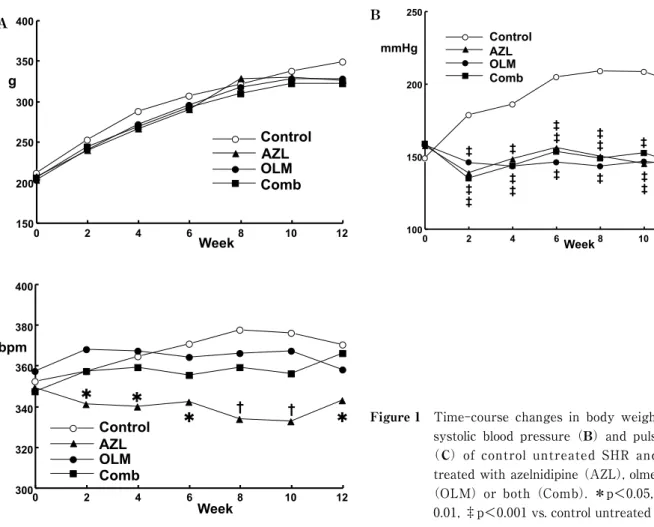
The purpose of this study is to examine the effects of angiotensin II receptor blockers (ARB), calcium chan- nel blockers (CCB) and their combination on the development of cardiovascular organ injuries in spontane- ously hypertensive rats (SHR). Four groups of male 8-week-old SHR (n=9 each) were given vehicle(con- trol), 10 mg/kg azelnidipine (AZL), 10 mg/kg olmesartan (OLM, n=9), or the combination of AZL and OLM(5 mg/kg each)for 12 weeks, and their effects on cardiovascular organ injuries were evaluated. Tail- cuff blood at 12 weeks was similarly lowered by AML, OLM and the combination therapy(148, 143 and 143 mmHg, respectively)as compared with the control SHR (198 mmHg). Pulse rate was significantly less in the AZL group but not in the OLM group or the combination therapy group than in the untreated con- trol group (−27, −12, +6 bpm, respectively). The cardiac ventricular weight (AZL −12%, OLM −15%, combination −18% vs. control) and aortic thickness (AZL −17%, OLM −16%, combination −19% vs. con- trol) were reduced by similar extents in the three groups given antihypertensive treatments. Regarding the myocardial fibrosis, left ventricular hydroxyproline content was reduced in the OLM and the combination groups but the change was not significant in the AZL group (AZL −14%,OLM −30%, combination −27
% vs. control). In the echocardiographic evaluation of cardiac function, the index of left ventricular diastolic function is significantly improved in the OLM and the combination groups but not in the AZL group, while the index of systolic function was not different between the four groups. It is suggested that the antihyper- tensive therapy including ARB is superior to the monotherapy by CCB in preventing the myocardial fibro- sis and preserving the left ventricular diastolic function.
Key Words: hypertension, spontaneously hypertensive rat, angiotensin II receptor antagonist, calcium channel blocker, left ventricular hypertrophy, arteriosclerosis
Original
tion. Therefore, the efficacy of antihypertensive drugs on inhibition of hypertensive tissue injuries and preser- vation of cardiovascular organ function has to be taken into consideration in order to achieve maximal im- provement of long-term prognosis of hypertensive pa- tients. In the real world clinical practice, angiotensin II receptor antagonists (ARB) and long-acting calcium channel blockers (CCB) are widely used for the treat- ment of hypertensive patients because these classes of antihypertensive drugs have few chances to cause ad- verse effects. In addition, CCB exerts consistently cer- tain hypotensive effects by dilating arteries directly and ARB is expected to have protective effects against the cardiac and the renal injuries partially by the mechanism independent of blood pressure lowing
1,2). Thus, it is obviously important to collect the informa- tion as to the effects of CCB and ARB on the develop- ment and the progression of hypertensive injuries in cardiovascular organs such as the heart, the kidneys and the arteries.
It should be also kept in mind that generally only one third of hypertensive patients achieve the blood pressure level lower than 140/90 mmHg with a single antihypertensive agent irrespective of the class of drug used and two thirds of patients require a combination of two or more drugs in order to obtain adequate blood pressure reduction
3,4). Therefore, it is also a matter of concern to delineate the therapeutic efficacy of combi- nation therapy especially with ARB and CCB in terms of protecting cardiovascular organs from hypertension.
In this experimental study, the efficacies of CCB, ARB and their combination therapy were examined and compared focusing on the inhibition of cardiovascular organ injuries in spontaneously hypertensive rat
(SHR)which is assumed to be an appropriate animal model of human essential hypertension.
METHODS Treatment of rats
Male 8-week-old SHR (n=36) were purchased from Charles River Japan (Atsugi, Kanagawa, Japan). They were fed standard chow and tap water, and were housed in a temperature- and light-controlled room throughout the study period. They were divided into 4 groups of 9 SHR each. As a dihydropyridine deriva- tive CCB, 10 mg/kg azelnidipine (AZL) suspended in
0.5 ml of 0.5% methyldellulose was given once daily by gastric tube in morning hours to 9 rats. As an ARB, 10 mg/kg olmesartan (OLM) was given in the similar way to another 9 rats. In addition, 5 mg/kg AZL and 5 mg/kg OLM were simultaneously given in 9 rats of the combination therapy group, and 9 rats of the con- trol group were given vehicle.
The treatments were continued for 12 weeks and the systolic blood pressure was measured biweekly during the study period using the tail-cuff method. At the end of 12-week period, the rats were evaluated for the physiological, biochemical and histological evalua- tions described below. The experiments were per- formed in accordance with the institutional guide for care and use of laboratory animals, and the study pro- tocol was approved by the institutional animal research committee.
Echocardiography
After 12 weeks, transthoracic echocardiographic studies were performed under light anesthesia with in- traperitoneal injection of ketamine HCl(10 mg/kg)and xylazine (10 mg/kg). Two-dimensional echocardiogra- phy and M-mode tracing were recorded at the level of the papillary muscles using a Toshiba(Tokyo, Japan)
SSH-260A unit with a 7.0 MHz transducer placed on the shaved left hemithorax of the rats in the left decu- bitus position. M-mode measurements included left ventricular end-systolic and end-diastolic diameters
(LVDs, LVDd), end-diastolic left ventricular posterior wall thickness ( PWT), and interventricular septal thickness ( IVST). Midwall fractional shortening
(mFS) was calculated as follows
5,6):mFS=[(LVDd+
IVST/2+PWT/2)−{(LVDd+IVST/2+PWT/2)
3− LVDd
3+LVDs
3}
1/3]/(LVDd+IVST/2+PWT/2). The values of mFS were multiplied by 100 and expressed as % values.
Pulsed-wave Doppler spectra of mitral inflow veloci-
ties were recorded from the apical 4-chamber view
with the sample volume placed near the tips of the mi-
tral leaflets and adjusted to the position where the ve-
locity was maximal and the flow patterns were lami-
nar. The Doppler spectra were recorded on paper at
100 mm/s and analyzed off-line to determine peak ear-
ly diastolic filling velocity(E)and peak filling velocity
at atrial contraction(A). The heart rate was main-
tained around 300 bpm with the anesthesia during the recording, which enabled the separation of E and A wave peaks in each rat. Measurements represent the mean of at least 3 consecutive cardiac cycles, and the E/A ratio was used for the evaluation of left ventricu- lar diastolic function
7).
Biochemical Assay
After performing the echocardiogram, blood samples were drawn from the inferior vena cava, transferred into ice-cooled tube containing 1 mg/ml EDTA and centrifuged at 4℃ to obtain plasma. Plasma renin activ- ity and concentrations of angiotenisin II and aldoste- rone were measured by respective radioimmunoassays using the commercial kits(SRL, Inc., Tokyo, Japan).
A portion of the left ventricular free wall tissue was homogenized in ten equivalent volumes of saline. A 0.5 mL aliquot of the homogenate was then mixed with 36% hydrochloride and heated to 100℃ for 20 hours.
Next, the mixture was centrifuged at 1 , 5 0 0 g for 30 minutes, and a 0.1 mL aliquot of the supernatant was
mixed with 1.5 mL of 0.3 N hydroxylithium. Hydroxy- proline content in the reaction product was determined by high-performance liquid chromatography, and the value was expressed relative to tissue weight
8).
Histological Examination
The cardiac ventricles and descending thoracic aorta were excised and weighed. The weight of cardiac ven- tricles was corrected with the body weight and the weight of aorta was expressed as weight per unit area.
The upper half of cardiac ventricles were fixed in neu- tral-buffered 8% formaldehyde solution and embedded in paraffin. The 2-mm sections were cut for histologi- cal examination which was conducted in a blind man- ner. The sections were stained with Masson trichrome and the fibrosis of the left ventricular wall was evalu- ated. The area stained in blue with aniline was quanti- fied in ten randomly-selected high-power fields
(x200)using a computer system(Image Quest, Hama- matsu Photonics;Hamamatsu and MacScope, Mitani Co., Fukui, Japan), and the average percent value was Control
OLM AZL Comb
12 10
8 6
4 2
150 0 200 250 300 350 400
Week g
A Control
AZL OLM Comb
12 10 8 6 4 2 1000 150 200 250