Japanese-speaking Children's Interpretation of the Focus Particle 'even': Grammatical
Restrictions and Implicatures
Masuyo Ito
*Abstract
This paper examines how young Japanese-speaking children interpret sentences containing the focus particle sae 'even' in terms of its scope and implicatures by conducting two types of experiments. The results show that that the children seem to be insensitive to the existential and scalar implicatures of sae. The children's non-adult responses stem from their inability to judge infelicitous sentences as infelicitous. No specific evidence was found that Japanese children are sensitive to the syntactic scope of sae.
I discuss two possibilities which lead to the children's poor perfor- mance: the peculiar properties of implicatures which sae conveys and children's deficient knowledge of pragmatics. I also suggest that the difficulty children have with existential and scalar implicatures stems from their failure to form a reference set of potentially alternative variables.
This is partially in accordance with Paterson et al.'s (2003) basic idea that
*
Associate Professor, Faculty of Humanities, Fukuoka University
children neglect the "contrast set," a set of alternatives with which a focused element is contrasted. Reinhart (1999, 2004) also discusses the reference-set computation, but in terms of the processing cost involved.
The results, however, did not constitute evidence specifically supporting Reinhart's idea of processing cost.
Key words: Japanese focus particles; Even; existential implicatures; scalar implicatures; pragmatics
1. Introduction
How young children interpret sentences containing quantifying expressions has received considerable attention in the language acquisition field (Inhelder & Piaget, 1964; Roeper & de Villiers, 1993; Philip, 1995, among others). Quantification involving the focus particle only has also attracted many researchers. For example, Crain, Philip, Drozd, Roeper, &
Matsuoka (1992) and Crain, Ni, & Conway (1994) report that young
English-speaking children have difficulty with the scope of only, because
they are insensitive to grammatical restrictions on the scope of the focus
particle only. According to them, some children assign an interpretation
such as 'Only the cat is holding a flag' to the context 'The cat is only holding
a flag.' Paterson, Liversedge, Rowland, & Filik (2003) suggest that
children's non-adult interpretation can be accounted for by assuming that
children neglect the "contrast set" of members which is contrasted with the
member focused by only. Concerning the construal of the Japanese focus
particle dake 'only,' Endo (2004) found that Japanese-speaking children
have difficulty interpreting sentences in which the subject is attached to dake 'only' rather than those in which the object is attached to dake.
In this paper, I examine how young Japanese-speaking children interpret sentences containing the focus particle sae 'even' in terms of its scope and implicatures.
1To my knowledge, there has been no study which deals with children's construal of sentences containing even in English or its corresponding counterparts in other languages. The specific goals of this paper are to answer the following questions:
2(1) a. Are children sensitive to the syntactic scope of the focus particle sae when interpreting sentences containing sae?
b. Are Japanese children sensitive to the two types of implicatures that sae is supposed to carry?
c. Does the replacement of sae by another scalar term made 'even,' which functions in almost the same way as sae does except in one respect, affect children's interpretation in terms of (1a) and (1b) above?
In order to attain these goals, two types of experiments were conducted (section 3). Results showed that Japanese-children's construal of sae was partially congruent with Paterson et al. (2003). No specific evidence was
1
Throughout this paper, I use 'implicature' instead of 'presupposition' (used by Rullman, 1997; Wilkinson, 1996, for example). The content of this paper does not hinge on the choice of terms.
2
In this study, we do not consider cases such as (i) below, in which sae can take scope over the clause it appears in:
(i) It is hard for me to believe that Bill can understand even SYNTACTIC STRIC- TURES.
(Karttunen &Peters, 1979, pp. 25-27)
The sentence in (i) is ambiguous in two ways, depending on whether the focus
particle sae takes matrix scope or embedded scope. The two reading are truth-
conditionally different.
found that Japanese children are sensitive to the syntactic scope of sae. It was found that the children seem to be insensitive to the existential and scalar implicatures of sae. The findings in Crain et al. (1992, 1994) and Endo (2004) were not confirmed in this study. In fact, the Japanese children did not always seem to assign an interpretation caused by taking the wrong scope, and they seemed to have the same amount of difficulty with the object sae sentences as with the subject sae sentences. It was also found that the children's construal of made resembled their construal of sae: the children were insensitive to the syntactic scope of made and the two implicatures made carries. I suggest in section 4 that children's poor performance comes from both the peculiar properties of implicatures which sae conveys and children's deficient knowledge of pragmatics. I also suggest that the difficulty children have with existential and scalar implicatures stems from their failure to form a reference set of potentially alternative variables. This is partially in accordance with Paterson et al.'s (2003) basic idea that children neglect the "contrast set," a set of alternatives with which a focused element is contrasted. Reinhart (1999, 2004) also discusses the reference-set computation, but in terms of the processing cost involved. The results, however, did not constitute evidence specifically supporting Reinhart's idea of processing cost.
2. The semantics of sae
In this section, I first review the semantics of even and then summarize the semantics of sae 'even' in Japanese.
According to Karttunen & Peters (1979), even is a focus particle that
does not affect the truth condition of the clause in which it appears, but
only serves to introduce two implicatures. (For a summary of even in English, see also Rooth, 1985; Kay, 1990; Wilkinson, 1996, among others.) Consider sentence (2a):
(2) a. Even Bill likes Mary. (Karttunen & Peters, 1979, p. 12)
b. Bill likes Mary. (assertion, target proposition) The target proposition of (2a) is (2b), the sentence in (2a) but without the focus particle even. The semantics of even requires that the context in which it is interpreted evokes a set of alternative propositions for a contextually-defined specific set. This is shown in (3):
(3) x likes Mary. (alternative proposition):
{ Ken likes Mary, Ben likes Mary, Mark likes Mary, etc.}
Sentences such as (2a) evoke the two implicatures in (4) below with respect to the relationship between the target proposition in (2b) and the alterna- tive proposition(s) in (3):
3(4) a. There are other x under consideration besides Bill such that x likes Mary.
(existential implicature; cf. Karttunen & Peters, 1979, (37)) b. For all x under consideration besides Bill, the likelihood that x likes Mary is greater than the likelihood that Bill likes Mary.
(scalar implicature; cf. Karttunen & Peters, 1979, (40))
3
According to Karttunen & Peters (1979), even expresses the relation that holds
between the focus element 'Bill' and the property of being an individual that likes
Mary. Such a relation is captured by the comparison of two sets. The set of 'boys
who like Mary' exhausts the contextually defined set of 'boys' and 'Bill' is periphe-
rally present in terms of the property of 'liking Mary.' In this paper, I reformulate
a relation between two sets as a relation that holds between the target proposition
(2b) and the alternative proposition(s) (3).
However, because the implicatures of the focus particle sae have the following peculiar properties, both implicatures in (4) are debated. For example, Francescotti (1995) observes that as regards the existential implicature, it is not always the case that among the contextually defined set of propositions, all the alternative propositions are true and that the target proposition is also true, as exemplified in (5):
(5) Even Granny tried the chili. (Francescotti, 1995, p. 158) Sentence (5) is felicitously used in a context in which some members in the contextually determined set have not tried the chili. With respect to the scalar implicature, (6) is also felicitous in a situation in which the target proposition is not necessarily the least likely:
(6) Even Albert failed the exam. (Francescotti, 1995, p. 161) To see this, suppose a situation in which Mary, another student, is actually the best student and was the least likely to fail the exam and Albert is the second best student in the class. Examples (5) and (6) show that the condition of the "least likelihood" in (4b) is not required for conveying the scalar implicature of even.
Moreover, Kay (1990) questions whether or not "likelihood" itself is a required notion for the scalar implicature of even, as shown in (7):
(7) A: It looks as if Mary is doing well at Consolidated Widget.
George [the second vice president] likes her work.
B: That's nothing. Even BILL [the president] likes her work.
(Kay, 1990, p. 84)
The use of even in this example does not indicate that the president is less
likely to 'like Mary's work' than the second vice president is. Based on this
observation, Kay (1990) argues that the notion of "informativeness" is responsible for the scalar implicature of even rather than the notion of
"likelihood." In the same vein, Herburger (2000, p. 120) argues that the scalar implicature of even is captured more appropriately in terms of
"noteworthiness."
The implicatures above, which even is supposed to carry, also apply to sae 'even' in Japanese.
4The Japanese counterpart of (2a), (8) below, a conventional example of sae, evokes exactly the same types of implicatures, existential implicature and scalar implicature in (4). (See Numata, 1986;
Teramura, 1991, among others, for the semantics of sae.) (8) Bill-sae Mary-o kiniitteiru.
5Bill-even Mary-ACC like 'Even Bill likes Mary.'
Close examination, however, reveals that as in the case of even, there are some cases which cannot be captured by conventional notions of existential and scalar implicatures. For example, the context in which (9) is used does not provide any (set of) alternative propositions.
(9) sono basyo-ni-wa hokani taberu mono-ga nakatta-node,
4
This study is strictly limited to cases in which only NPs are the focus of sae, as in Karttunen & Peters (1979). I also exclude cases in which sae takes scope over an entire proposition that represents an event. The reason for the exclusion is that in such cases sae can be attached to any constituent: the subject NP, the object NP, and the entire VP. See Aoyagi (1999) for details.
Even in English can also take scope over an entire sentence representing an event, as shown in (i):
(i) (What happened in 1969 that was so exciting? Brady was finally located! Men landed on the moon! Tiny Tim got married!) Why, Harvard even held a pep rally.
(Fraser, 1971, p. 166)
5
Case markers of sae-attached NP, such as ga (NOM) and o (ACC), can be phonologi-
cally null. When the relevant NP is overtly case-marked, sae can either follow or
precede the case marker.
That place-in-TOP other than eat thing-NOM not exist-because Kondo-wa nezumi-sae tabeta.
Kondo-TOP mice-even ate
'Since there was nothing to eat other than mice, Kondo ate even
mice.' (Sakahara, 1985, p. 144)
Existential implicature is not even evoked (see Sakahara, 1985; Yamanaka, 1995; Yagi 1997). Regarding scalar implicature, as in the case of even, the notion of the "(un)likelihood" does not cover the entire range of sae examples, as shown in (10B), a Japanese example corresponding to the English example in (7B)
(10) A: It looks as if Tomoko is doing well at Consolidated Widget.
George [the second vice president] likes her work.
B: (That's nothing.) Yamada-syatyo-sae kanozyo-no sigoto-o hyookasiteru yo.
Yamada-president-even her work-ACC like Particle 'Even president Yamada likes her work.'
We are now ready to examine Japanese children's interpretation of sae.
In my analysis of children's construal of scalar implicatures, I do not use terms such as "informativeness" and "noteworthiness" in place of
"(un)likelihood" and for convenience I continue to employ the conventional
term "(un)likelihood." (I will return to this point in section 4.) I assume
that sae sentences prototypically provide existential and scalar
implicatures.
3. The Study
Two types of experiments were conducted to investigate Japanese- speaking children's interpretation of sentences which contain the focus particle sae. Experiments 1 and 2 were conducted in different sittings, each taking approximately 20 minutes. A warm-up session preceded each experiment to familiarize children with the task. Each child was inter- viewed individually in a quiet room in their nursery school.
3.1. Experiment 1 3.1.1. Background
The first experiment was conducted to investigate questions (1a) and (1b). Two types of sentences were used: 1) sentences whose subject was attached to sae (subject sae) and 2) sentences whose object was attached to sae (object sae). This allowed us to determine if children are sensitive to the syntactic position of the NP to which sae attaches (cf. (1a)). Furthermore, in the stories told to children, which preceded the presentation of test sentences, it was ensured that the target proposition was the least likely among all the possible set of propositions in the context.
6Therefore, test sentences were infelicitous when the context did not provide a set of alternative propositions except for the target proposition. The design of the stories allowed us to test whether or not the children are sensitive to the existential and scalar implicatures of sae.
6
Note that the experiment provided prototypical felicitous contexts for sae,
although, as seen in section 2, existential implicature is not necessarily required, and
the notion of (least) likelihood can be replaced by others.
3.1.2. The subjects
Twenty-four Japanese mono-lingual children, consisting of six 4-year-olds (4;0-4;11, mean 4;5), nine 5-year-olds (5;0-5;10, mean 5;4), and nine 6-year-olds (6;0-6;11, mean 6;5), participated in this experiment. Six adults (all undergraduate students) served as a control group.
3.1.3. The method
Each child went through four main experimental trials and two fillers.
The method used was an appropriateness judgment task (cf. Crain and Thornton 1999 for the Truth Value Judgment Task).
7For each trial, two experimenters told one story for each trial by using props and puppets.
After each story was presented, the main puppet, which did not see or hear the story, asked a second puppet what happened in his absence. After the second puppet briefly told what happened, the main puppet said a stimulus sentence which contained sae. The children's task was to judge whether the main puppet produced ii kotae 'an appropriate/good answer' or hen'na kotae 'a weird answer.' by feeding the main puppet either 'a piece of cake' or a 'green pepper,' respectively. Children could hear the stories again if they were not sure what happened. The scenario for one of the four main-test trials is given in (12).
8(See Appendix A for all the stimulus sentences used in the session.)
7
Even is not a truth-conditional particle; that is, its use does not affect the truth value of a sentence containing it. The task here is assessing whether or not a given sentence is interpreted as felicitous in a particular context. For this reason, the children were asked to judge whether the main puppet produced ii kotae 'an appropriate/good answer' or hen'na kotae 'a weird answer.' I refer to the method as an appropriateness judgment task.
8
In (12), some portion of the actual dialogue has been written in narrative form, so
the example dialogue is somewhat shorter than that used in the experiment.
(12) A squirrel, which really loves animals, went to a park. There he met Mama Rabbit, Brother Rabbit, and Sister Rabbit. Their fur looked so soft and fluffy that the squirrel wanted to touch them.
(The squirrel touches Brother Rabbit and then Sister Rabbit.)
Squirrel: Wow, so soft and fluffy. But look at Mama Rabbit. Her fur must be fluffier. It will be so comfy. (Mama Rabbit starts to leave but returns.) Mama Rabbit looks nice. Well, I decided to touch her. (The squirrel touches her.) Wow, it's so fluffy.
9(The main puppet, Anpan-man, or 'bean-paste-bun man,' who was sick in bed, gets up while yawning.)
Main Puppet: I slept so well. Hey, Monkey [another puppet], what happened?
Monkey: Let me tell you. The squirrel touched all the rabbits.
Main Puppet: Well, then, Risu-kun-sae okaasan-usagi-o sawatta n'da ne.
(infelicitous) squirrel-even Mama-Rabbit-ACC touched Particles 'Even the squirrel touched Mama Rabbit.'
In this context, the stimulus sentence is not felicitous. It is true that the squirrel touched Mama Rabbit, but given the context in which this sentence
9
Notice that the squirrel does not seem to be able to touch Mama Rabbit at first, but
touches her in the end. This twist of the story is intended to satisfy the "plausible
dissent" condition of yes/no questions (see Crain et al., 1996; Crain & Thornton,
1998).
is used, the sae sentence provides no set of alternative propositions like 'x touched Mama Rabbit,' with 'x' replaced by the variable of a possible 'toucher,' because only the squirrel was the 'touching agent.' Moreover, the sentence does not provide the least likelihood of the squirrel touching Mama Rabbit (rather than Brother Rabbit and Sister Rabbit). (A felicitous sae sentence in this context is 'The squirrel touched even Mama Rabbit.') If Japanese children are sensitive to the syntactic scope of sae and the implicatures which sae gives rise to, they should judge the sae sentence in (12) as infelicitous.
3.1.4. The results
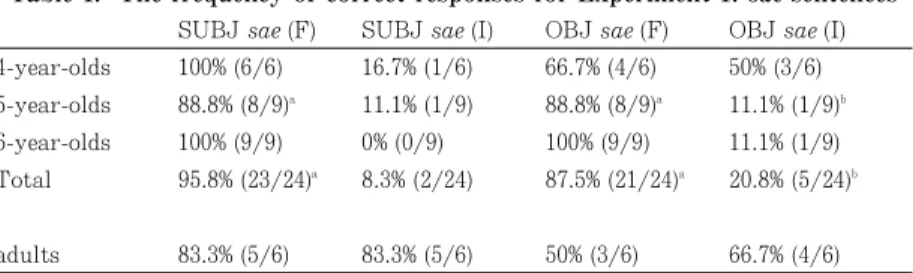
The results are summarized in Table 1. The F or I notations in parentheses denote whether a given sentence is intended to be felicitous or infelicitous. The numbers in parentheses are the number of items judged correctly vs. the total number of test items.
The overall percentage of correct interpretations was 53.1%. The subject sae sentences and the object sae sentences were interpreted correctly 52.1% (25 instances correct out of 48) and 54.2% (26 instances correct out of 48) of the
Table 1. The frequency of correct responses for Experiment 1: sae sentences SUBJ
sae(F) SUBJ
sae(I) OBJ
sae(F) OBJ
sae(I) 4-year-olds 100% (6/6) 16.7% (1/6) 66.7% (4/6) 50% (3/6) 5-year-olds 88.8% (8/9)
a11.1% (1/9) 88.8% (8/9)
a11.1% (1/9)
b6-year-olds 100% (9/9) 0% (0/9) 100% (9/9) 11.1% (1/9) Total 95.8% (23/24)
a8.3% (2/24) 87.5% (21/24)
a20.8% (5/24)
badults 83.3% (5/6) 83.3% (5/6) 50% (3/6) 66.7% (4/6)
a
One response 'I don't know' is counted as 'incorrect.'
b
Two responses 'I don't know' are counted as 'incorrect.'
time, respectively. No significant difference in the frequency of correct responses was observed between the subject sae and object sae sentences (p = .608 for felicitous sentences; p = .415 for infelicitous sentences: Fisher's exact probability test). The children correctly interpreted felicitous sae sentences in most cases. Only 4.2% of the felicitous subject sae sentences and only 12.5% of the felicitous object sae sentences were incorrectly judged as infelicitous. However, the children did have difficulty correctly inter- preting infelicitous sae sentences, as shown by the scores for the infelici- tous subject sae and object sae sentences, 8.3% and 20.8%, respectively.
10The difference in the frequency of correct responses was significant between felicitous and infelicitous sentences (p < .001 for both subject sae and object sae sentences). The children's non-adult responses come mainly from their inability to judge infelicitous sentences as infelicitous. These results appear to indicate that with respect to infelicitous sae sentences, the children take the wrong scope of sae and that the existential and scalar implicatures to which sae gives rise are not computed.
11Note that the adults' responses were not as perfect as expected. I will return to this in section 4.
10
We assume that when children cannot accept or reject a test sentence, their chance of correct performance is 50 %, that of random chance (Grodzinsky & Reinhart, 1993).
Therefore, the extremely low percentage of correct responses to the infelicitous subject-sae and object-sae sentences seems to indicate that the children judged the infelicitous sentences as felicitous.
11
We do not consider these findings to be the result of the "yes bias" since we found
that the children were able to provide a 'no' response to sentences in warm-up trials
and filler items. However, we cannot rule out the possibility that the children had a
bias for producing "yes" responses when they were not certain about their answers.
3.2. Experiment 2 3.2. Background
The results from Experiment 1 appear to show that the children are insensitive to the existential and scalar implicatures of sae. To confirm that they are insensitive to this, we must establish that the children are not necessarily insensitive to the syntactic scope of sae. If the children freely take the scope of sae irrespective of the position of the sae-attached NP, it is impossible to determine what set of alternative propositions children are forming for the computation of existential and scalar implicatures.
Although the data did not show whether the children were sensitive to implicatures or syntactic restrictions on the scope of sae, the assumption is that their poor performance in Experiment 1 is related to how they compute implicatures which arise from the focus particle. The question is whether one or both of the implicatures, scalar and existential, are responsible. Experiment 2 was designed to determine whether the existential implicature poses any difficulty for children's interpretation of sae.
Because of the property of the scalar implicature that sae carries, no attempt was made to determine if it causes any trouble for children's construal of sentences containing sae.
12As reviewed in Section 2, scalar implicature that sae provides does not require the "least likelihood" for the
12
The following experiment might be helpful to determine whether or not the scalar
implicature is responsible for the difficulty children have with sentences containing
sae. After presenting a story which provides a clearly defined set of propositions
(including the target and alternative propositions), one tests whether or not children
judge the target proposition with sae attached as felicitous, and also tests whether or
not the children judge (one of) the alternative proposition(s) with sae attached (the
more likely outcome) as infelicitous. This is part of my on-going study.
target proposition when it is compared with the alternative propositions.
For scalar implicature, notions like "informativeness" (Kay, 1990) or
"noteworthiness" (Herburger, 2000) may be more relevant to peripheral cases of sae than "likelihood" (cf. section 2). As long as "informativeness" or
"noteworthiness" or another relevant notion is conveyed, sae sentences will be interpreted felicitously. As Herburger (2000, p. 120) puts it, scalar implicature is "relativized to the speakers' belief." Therefore, whatever experiment may be done to learn whether children access the prototypical construal of scalar implicature that sae provides, they might only end up accepting the test sentences as peripheral cases of sae. Accordingly, our second experiment was restricted to determining whether existential implicature interferes with children's interpretation of sae.
The children were tested to see if their performance improved when another focus particle, made, was used instead of sae. The reason for this approach is as follows: In Experiment 1 the children judged sae-infelicitous sentences as felicitous (cf. 3.1.4). This result suggests that the children tested are insensitive to the existential implicature of sae (cf. (4a)).
However, existential implicature is not necessarily required for the
interpretation of sae; as observed in section 2, there are cases in which sae
is felicitously used even though some member(s) of the contextually defined
set do(es) not satisfy the alternative proposition or even though there is no
single alternative proposition evoked (cf.(9)). Given these properties of sae's
existential implicature, testing children to see if their performance
improved when another focus particle, which does require existential
implicature, was used helps determine if the children's non-adult interpre-
tation of sae sentences comes from the optionality of the existential
implicature which sae evokes.
The focus particle made 'even' introduces existential implicature and scalar implicature, but is different from sae in that its existential implicature is a required condition (see Mitsui, 1997; Ito, 1997; Mogi, 1999 and others). Consider (14) (modified from (9)). The cross-hatch (#) indicates that the marked sentence is incompatible with the indicated context.
(13) (Since there was nothing to eat other than mice),
#Kondo-wa nezumi-made tabeta.
Kondo-Top mice-even ate 'Kondo ate even mice.'
The sentence in (14) sounds strange, since the use of made necessarily evokes (an) alternative proposition(s), requiring that there be a thing or things Kondo ate other than mice. From this, we can expect that if the children who participated in Experiment 1 are asked to interpret sentences containing made, there are two possible outcomes:
(14) a. If the children's performance improves, it suggests that they have knowledge of made's existential implicature. Therefore, their poor performance in Experiment 1 can be attributed to the fact that the existential implicature is not a required condition for sae's use.
13b. If the children's performance does not improve, it suggests that they do not have knowledge of made's existential implicature, and their poor performance in Experiment 1 cannot be attrib-
13
Of course, their poor performance cannot be attributed only to the properties of the
existential implicature. It might also have something to do with their computation
of scalar implicature.
uted to the fact that the existential implicature is not a required condition for sae's use. It might be that the children are not sensitive to the existential implicature the focus particles sae and made provide irrespective of its optionality and obligatori- ness.
143.2.2. The subjects
Five 4-year-olds (4;0-4;10, mean 4;5) and nine 5-year-olds (5;0-5;10, mean 5;4), the same 4- and 5-year-old children who participated in Experiment 1, participated in Experiment 2.
15A control group of seven adults (all undergraduate students) was not the same as that in Experiment 1.
3.2.3. The Method
The method used in Experiment 2 was that used in Experiment 1: an appropriateness judgment task.
16To ensure that nothing other than the focus particle in question could affect the children's interpretation, exactly the same stories, props and puppets, experimental sentences, and proce- dures used in Experiment 1 were used in Experiment 2, except that the focus particle made was used in the test sentences. To be sure that the same stories, toy animals, and sentences did not bore the children, we waited for
14
As mentioned in note 13, it is also possible that lack of sensitivity to scalar implicature is also the cause of this.
15
One 4-year-old child was absent on the day Experiment 2 was conducted. There was a four-month interval between Experiments 1 and 2. The 6-year-olds were not available because they had left school. Note that the subjects' ages and months are given as the same, even though they were four months older when Experiment 2 was administered.
16
Experiment 2 as well as Experiment 1 is designed to assess whether or not the
experimental sentences are judged as felicitous, rather than whether the sentences
are judged as true or false.
four months before doing Experiment 2.
In the test trials, after a story was told, children were asked to judge an experimental sentence as 'The main puppet produced an appropriate/
good answer' or 'The main puppet produced a weird answer' by feeding the main puppet 'a cake' or 'a green pepper,' respectively. In Experiment 2, children were asked four stimulus sentences (2 subject-made and 2 object- made sentences) and two fillers. Children could hear the stories again when they were not sure what happened. Experiment 2, including the pre-test session, took approximately 20 minutes.
3.2.4. The results
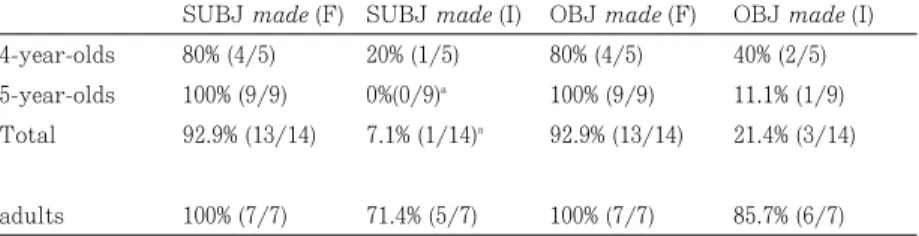
The results from Experiment 2 are summarized in Table 2. The F or I notations in parentheses denote whether a given sentence is intended to be felicitous or infelicitous. The numbers in parentheses are the number of items judged correctly vs. the total number of test items.
The overall percentage correct is 53.6% (30 items correct out of 56 items).
The percentages correct for the subject made and object made sentences are 50% (14 items correct out of 28 items) and 57.1% (16 items correct out of 28 items), respectively. There was no difference found in terms of the
Table 2. The frequency of correct responses: made sentences SUBJ
made(F) SUBJ
made(I) OBJ
made(F) OBJ
made(I) 4-year-olds 80% (4/5) 20% (1/5) 80% (4/5) 40% (2/5) 5-year-olds 100% (9/9) 0%(0/9)
a100% (9/9) 11.1% (1/9) Total 92.9% (13/14) 7.1% (1/14)
a92.9% (13/14) 21.4% (3/14)
adults 100% (7/7) 71.4% (5/7) 100% (7/7) 85.7% (6/7)
a
One response 'I don't know' is counted as 'incorrect.'
syntactic position involved (p = 1.000 for felicitous sentences; p = 0.595 for felicitous sentences).
With respect to the sensitivity to the existential implicature that made evokes, a comparison of the results in Table 1 and Table 2 reveals no significantly improved performance for made sentences, indicating that the children were insensitive to the fact that the use of made always evokes the existential implicature of the alternative propositions. This was the case especially when they judged made-infelicitous sentences as felicitous, but not when they judged made-felicitous sentences as felicitous.
17The difference in the frequency of correct responses was significant between felicitous and infelicitous sentences (p < .001 for both subject and object made sentences). These findings are similar to those of Experiment 1. It was not the case that the children correctly judged made-felicitous and made-infelicitous sentences some of the time and incorrectly at other times.
Table 2 shows that the children's poor performance is caused by their failure to judge made-infelicitous sentences as infelicitous.
This observation therefore leads us to consider the predicted scenarios which were given in (14). Because substituting made for sae caused no improvement in the children's performance, it is likely that the peculiar properties of sae's existential implicatuure are not solely responsible for the fact that the children do not judge sae-infelicitous sentences as infelicitous.
Thus, children were seen to be insensitive to the difference in the optionality versus obligatoriness of existential implicature between sae and made sentences.
17
We do not consider these findings to be caused by a "yes bias" because the children
were able to provide a 'no' response to warm-up trials and filler items. Cf. note 11.
Adults' responses generally improved in Experiment 2; the few cases in which they responded incorrectly were limited only to those in which they judged made-infelicitous sentences as felicitous.
4. Discussion
The results show that children do not correctly interpret sentences containing sae in terms of its implicatures. In Experiment 1, it was found that the Japanese children were not necessarily insensitive to syntactic restrictions on the scope of sae; if they had been, they would have incor- rectly judged sae-felicitous sentences as infelicitous roughly 50% of the time. However, only 4.2% (specifically, 1 out of 24 instances) of the felicitous subject-sae sentences and only 12.5% (3 out of 24 instances) of the felicitous object sae sentences were incorrectly judged. Experiment 2 revealed that the children are also insensitive to the obligatoriness of the existential implicature which made carries. This suggests that the cause of the children's insensitivity to sae-infelicitous sentences was not that sae's existential implicature is an optional condition and that the children are insensitive to the existential implicature itself that made and sae provide, whether obligatory or optional. In Experiment 1, the adults' performance was not 100% correct, especially in the case of sae-infelicitous sentences.
However, their improved performance in Experiment 2 clearly shows that:
1) the distinction between the existential implicature of sae and made is real, and 2) the peculiar properties of sae's existential implicature sway adults' judgment.
The findings do not agree with those in the studies cited in the
Introduction. Contrary to Endo's (2004) observations, there was no
improved performance for the object sae, compared with that of the subject sae. Unlike Crain et al. (1992, 1994), I observed that children had some sensitivity to the syntactic scope. However, a reformulation of Paterson et al.'s (2003) idea of the "contrast set" may have some bearing on the findings in this study. A reformulation of their "contrast set" (which only intro- duces) in terms of alternative (and contrastive) propositions can account for the fact that the children seemed to neglect the existential implicature of alternative propositions which sae and made have.
18The children's insensitivity to sae-infelicitous sentences may be partly attributable to their failure to perceive the existential implicature which sae conveys. No experiment was conducted in the present study to assess children's sensitivity to the scalar implicature of sae, in particular, mainly because the relevant notion of scalar implicature is captured not only by the (least or less) likelihood of the target proposition compared with that of the alternative propositions, but also peripherally by "noteworthiness" and
"informativeness."
Note that whatever experiment may be designed to assess children's (in)sensitivity to the scalar implicature, the existential and scalar implicatures which sae sentences evoke are basically inseparable. Consider a typical sae sentence, such as 'Even Bill likes Mary' (cf. (2a)). The scalar implicature that sae gives rise to compares the target proposition with a set of alternative propositions in terms of (un)likelihood; the presence of alternative propositions is essentially assumed. Therefore, it is possible to
18
If this reformulation is done, however, it raises the question why only felicitous
sae- and made-sentences were judged correctly as felicitous, without a set of
alternative propositions formed. I will return to this later in this section; see also
note 26.
assume that the children's poor performance is in fact related to their being unaware of both existential and scalar implicatures which the focus particle sae provides.
There are three plausible explanations for the children's non-adult performance: the peculiar properties of sae's implicatures, the children's lack of an adult system of pragmatics, and high processing cost.
First, I argue that the children's poor performance partly stems from the two peculiar properties of sae's implicatures (cf. section 2). They are: 1) the existential implicature is not a required condition for sae's use or correct interpretation, and 2) for its scalar implicature, the felicitous use of sae only requires "informativeness" (Kay, 1990) or "noteworthiness"
(Herburger, 2000), although in prototypical cases its scalar implicature is evoked through the relation between the target proposition and the alternative propositions in terms of (un)likelihood. It is possible that the children responded to the noteworthiness or informativeness of the target proposition, since they accepted the test sentences as felicitous most of the time.
19 20The focus particle sae also possesses the property of "scope extension"
(Yagi, 1997, pp. 639-641; see also Numata, 1986; Aoyagi, 1999): this property might also explain the children's misjudging of (what were intended to be)
19
This line of analysis may be promising since it is assumed that children have a tendency to accept what the experimenter says as true (Grimshaw & Rosen, 1990). I do not consider this tendency to say 'yes' strong enough to override their knowledge of grammar (cf. Crain & Thornton, 1999) or the truth value of sentences. However, this bias may be able to override their ability to judge whether a sentence is felicitous or not.
20
Another possibility is that children respond to the (un)likelihood of an event
represented by an entire proposition, even though the experiment was designed so
that a story's context excludes such an interpretation (cf. note 4).
sae-infelicitous sentences. The following examples show how "scope extension" works:
(15) a. (I got up just now.) Mada kao-sae aratteinai. (adapted from Yagi, 1997, p. 639, (31)) yet face-even have not washed
'I haven't washed even my face.'
b. (I got up just now.) Mada kao-o aratte-sae (i)nai.(adapted from Yagi, 1997, p.640, (31')) yet face-Acc wash-even not
'I haven't even washed my face.'
In (15a) sae syntactically ("overtly") takes scope only over the object 'face.' However, the alternative propositions evoked in the given context do not necessarily have a form such as 'I haven't washed my x.' Rather, their form is something like 'I haven't [
VPx ].' Given that sae, like other focus particles, is usually located immediately after the constituent over which it takes scope, this form of alternative proposition is evoked by a sentence like (15b). Notice that in (15b) the focus particle immediately follows the VP. In fact, in the context in which (15a) is used, (15b) can also be used.
21Although syntactically sae has scope only over the object NP, its scope extends over the entire VP 'wash my face.'
The experimental sentences used in the present study were prepared so as not to be affected by sae's properties: In sentences intended to be felicitous, the contextual information provided in the stories made the relevant alternative propositions and the unlikelihood of the target proposition clearly available to children. In sentences intended to be infelicitous, this was not done (cf. 3.1.3). But the fact that the semantics of
21
In colloquial Japanese, sae attached to the NP sounds the more natural. Sae
attached to the VP (cf. (15b)) sounds archaic or stilted.
sae does not always require isomorphism between (overt) syntax and semantics, as we saw in (15), may cause some children difficulty in interpreting sae.
Whether the scope expands (cf. (15a)) or not depends strictly on the pragmatics. The context in which the relevant sentence is used determines whether or not the scope is taken syntactically over the constituent adjacent to the focus particle. For example, the syntactically overt scope over the object in (15a) is not expanded if the context suggests that the speaker's job is to wash many things like 'dishes, clothes, vegetables, and so on.' Taking the scope of focus particles may be affected by the development of pragmatic knowledge. Given that children have a deficient knowledge of pragmatics at younger ages (Chien & Wexler, 1990; Thornton & Wexler, 1999), the poor performance our children showed may stem from their as yet undeveloped pragmatics system.
Given the learnability issue, this explanation for their performance is
more likely. At later stages of language development children do not have
to unlearn things adult grammar does not have (such as the wrong scope)
or learn that the semantics of sae introduces implicatures. We can assume
then that in both the adults' and children's system of semantics, the context
in which a sae sentence is used provides existential implicature (alternative
propositions) and scalar implicature (the relationship between the target
proposition and alternative propositions in terms of (un)likelihood or
noteworthiness or informativeness). The results obtained in this study can
be accounted for by the late development of a pragmatics system, which
causes young children to have difficulty computing scalar implicatures in
the pragmatic sense. (See Smith (1980), Noveck (2001), Chierchia et al.
(2001), Papafragou & Mousolino (2003), among others, for the difficulty children have in the construal of scalar implicatures.) If lack of a developed pragmatics system is the reason young children have difficulty interpre- ting existential and scalar implicatures, then we can make the following prediction:
(16) Children who are insensitive to implicatures provided by context will be more sensitive to the truth value of the target proposition (i.e. a test sentence with the focus particle sae removed) until their knowledge of pragmatics develops.
In terms of truth value, all the test sentences are naturally true since they are propositions provided in the story. Tables 1 and 2 show that children accepted both felicitous and infelicitous sentences as felicitous,
22which suggests the possibility that they are responding to the truth value of the sentences (and therefore, that of the target propositions).
23The overall frequency at which the children may have incorrectly judged the truth value of the sae sentences (that is, the frequency at which children correctly and incorrectly judged sae sentences as infelicitous) was only 11.5
% (11 out of 96 sentences), which seems to support the prediction in (17).
2422
The cause is not the "yes bias"(cf. notes 11 and 17).
23
It is doubtful that children can freely detach and therefore neglect the focus particle when interpreting the relevant sentences. What makes this explanation plausible is the idea of the "plausible dissent." "Plausible dissent," which was incorporated into the experiments' design (cf. note 9), might have created in the children some bias towards judging the test sentences as felicitous: the outcome of the story, which could have turned out otherwise, might have made the children focus so intently on the target proposition that it overrode their knowledge of the syntax and semantics of sae.
24
Noveck (2001) presents similar results and analysis. He reports that French
Our experiments were designed to elicit children's judgment regarding whether the main puppet produced 'an appropriate/good answer' (i.e.
felicitous) or 'a weird answer' (i.e. infelicitous) instead of whether what the puppet said 'matches the story' (i.e. true) or 'does not match the story' (i.e.
false). If the prediction in (16) is correct, the design of the experiment was not enough to elicit children's judgment regarding the felicity for the semantics of sae.
25 26If we accept that (16) is true, we must reconsider what we said about children's being somewhat sensitive to the syntactic position of the NP attached to sae. If the children are insensitive to the syntactic position, they can be expected to misjudge sae-felicitous sentences as infelicitous roughly 50% of the time, and in fact they did make some misjudgments.
However, the percentage of incorrect judgments was only 4.2% for the
children have difficullty with the scalar implicatures of 'some' in French, and attributes this difficulty to the late development of pragmatics. He further argues that children can correctly reject "overinformative" sentences, but not
"underinformative" sentences. He proposes that children come to compute scalar implicatures after logical but "underinformative" interpretations are well estab- lished. The scale Noveck discusses is different from that of this paper, but his idea about information strength fits the observation made in this study: the children were not able to judge underinformative sae-sentences as infelicitous. Further research is needed to learn whether or not his idea can be extended to the study of focus particles.
25
Cf. Papafragou & Musolino (2003) for some improvement in children's judgment after some training sessions for felicity. See also Chierchia et al. (2001).
26
The question arises as to whether children in fact respond only to the truth value
of the test sentences, i.e. that of the target proposition with sae ignored. An
examination of Paterson et al.'s (2003) data on only suggests that they do to some
degree. Their child subjects almost always misjudged only sentences in which the
target proposition was false, although they did not necessarily accept only sentences
in which the target proposition was true. (See Paterson et al. for their data.)
However, unlike sentences containing sae, sentences containing only are concerned
with the truth values. If the statement in (16) is correct, then children should
correctly judge sentences containing only. Yet, Goro, Minai, & Crain (2005) report
that children correctly judged only sentences in terms of their implicatures.
felicitous subject sae sentences and only 12.5% for the felicitous object sae sentences. If lack of pragmatic knowledge is causing the children to respond only to the truth value of sae sentences with the focus particle removed, the argument that children have some sensitivity to the syntactic position is not tenable, based on the observation that the children almost always correctly responded to felicitous sentences.
The final approach to explain the results of the study is "processing cost." Starting from Grodzinsky & Reinhart (1993), Reinhart (1999, 2004) has argued that children's non-adult comprehension of sentences comes not from a deficit in their grammar but from their limited processing ability.
She then argues that whenever the processing cost of comprehension goes beyond the children's processing ability, a guessing pattern emerges in their responses, resulting in a performance level no better than random chance. According to Reinhart, the processing cost is high for stress-shift, scope-taking, scalar implicatures, and pronoun identification and others, since all involve the reference-set computation. Reinhart claims that the random chance performance level (50%) indicates that the children have difficulty with the relevant constructions, because reference-set computa- tion is needed.
She further claims that the chance level performance needs to be tested
on a child-by-child basis, not in a group. I examined the data obtained in
Experiment 1 on a child-by-child basis to determine whether or not each
child performed in the 50% range when interpreting sentences containing
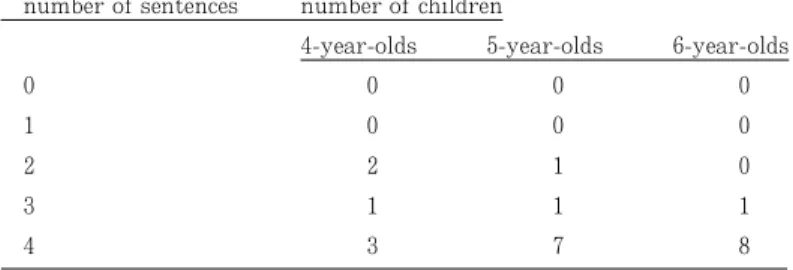
sae. The results are shown in Table 3. The column of numbers under each
age bracket represents the number of children who judged sae-sentences,
whether felicitous or infelicitous, as felicitous.
As shown in the individual performance in Table 3, the child subjects almost always judged both sae-felicitous and sae-infelicitous sentences as felicitous. Because there were four test items, then on the assumption that the children are guessing, it was expected that most of them would accept approximately two items as felicitous, per Reinhart's analysis. This did not happen. A majority of the children accepted all the items. Because the results do not fit Reinhart's analysis, we can conclude that the children are not merely guessing, but somehow avoiding the reference-set computation, although in the adult system, the interpretation of sentences containing sae requires a reference-set computation. One way to avoid the computation is simply to respond to the truth value of the target proposition (see also note 19).
It is worth noting that in comprehension tasks involving sae, the hearer needs to consider the target proposition and alternative proposition(s) the statement includes for expressing the intended meaning and that Reinhart argues this is what requires a reference-set computation.
Although the results from this study did not show any evidence supporting Reinhart's idea of processing limitation, acquisition studies report that the computation involved in this kind of process is difficult for young children,
Table 3. The number of acceptances: sae sentences in Experiment 1 number of sentences number of children
4-year-olds 5-year-olds 6-year-olds
0 0 0 0
1 0 0 0
2 2 1 0
3 1 1 1
4 3 7 8
as mentioned above (see Reinhart, 2006 for a summary). Our adults experienced similar difficulty, as shown in Experiment 1. Further research is needed to determine whether or not a processing account like Reinhart's applies to the interpretation of the focus particle sae in terms of implicatures and felicitousness.
275. Conclusion
In this paper, I experimentally examined Japanese children's interpre- tation of sentences containing sae. The major findings from two experi- ments are as follows:
1) Japanese children are not necessarily insensitive to the syntactic position of the NP attached to the focus particle sae, but there was no evidence that they are truly sensitive to the syntactic position of the sae-attached NP.
2) Japanese children seem to be insensitive to the existential and scalar implicatures that the focus particle sae and made provide.
3) Japanese children's interpretation of sae sentences is characterized by
27
While Reinhart (in a series of her work) argues that an approximately 50 percent performance level is a diagnostic for the ambiguity children are confronted with in comprehension, it seems also plausible that children's response is characterized by the acceptance of test sentences. Crain & Wexler (1991, p. 393) state, "the language processing system attempts to identify a linguistic analysis that makes [a given]
sentence true." According to them, when a child's grammar makes multiple
representations available for a sentence, the parser attempts to resolve the
ambiguity by resorting to real-world knowledge or by ensuring that the given
sentence matches the event of the discourse context. Note that in Crain & Wexler's
analysis, the above sort of nonlinguistic factors are only relevant "when children
(and adults) are confronted with sentences that are structurally ambiguous." This
line of analysis may apply to the children's apparent unawareness of infelicitous
sentences in the present study, because it is characterized by their acceptance of test
sentences (cf. note 19).
an inability to judge infelicitous sae sentences as infelicitous, while being able to judge felicitous sae sentences as felicitous.
(The second and third findings render the first finding inconclusive.) The results suggest that the children may be responding only to the truth value of the target proposition because of the difficulty they have computing existential and scalar implicatures. There are three plausible explanations for the children's non-adult performance. They are the peculiar properties of sae, the children's lack of developed system of pragmatics, and process- ing cost. However, none of the evidence supports any one specific explana- tion.
Acknowledgements
This paper was presented at the Linguistic Society of Japan annual meeting, November 2005 and appears in the proceedings of the LSJ 131. I would like to thank the audience of the LSJ meeting 2005 for comments and Steven Sabotta for proofreading the manuscript. I am also grateful for the children and teachers at Fukuoka nursery school for letting me conduct the experiment. My thanks also go to Kei Hirose for helping me with statistic analysis of the data. This research is partially funded by Japan Society for the Promotion of Science, Grant-in-Aid for Scientific Research #16520269.
Appendix A. The test sentences used in Experiments 1 and 2
In English translation, the entire list of the stimulus sentences used in the experiments are as follows:
Experiment 1
subject sae Even Mama Bear patted the dog. (felicitous)
Even the squirrel touched Mama Rabbit. (infelicitous) object sae The tiger bought even a banana (felicitous)
The tiger ate even lunch. (infelicitous)
Experiment 2 (The stimulus sentences used in Experiment 2 are the same as those of Experiment 1, sae replaced by made.)
Appendix B Experiment B: dono-NP mo 'every' B. 1. Background
Experiment 1's results partly resembled those of Crain et al. (1992, 1994): children appear to take the wrong scope for the focus particle. In the case of (12), an example of the infelicitous subject-sae sentence, the children assigned the interpretation 'The squirrel touched even Mama Rabbit' to the sentence 'Even the squirrel touched Mama Rabbit.' Endo (2004) observes a higher frequency of correct responses for the object NPs to which the focus particle dake 'only' is attached than for the corresponding subject NPs;
28no such result was obtained in Experiment 1. The children's performance (although limited to cases in which infelicitous sentences were interpreted as felicitous) resembles the phenomenon of "quantifier spreading" as discussed in Phillip (1995), Takahashi (1991), Roeper and de Villiers (1993), and others.
29Philip (1995) and others found, for example, that English children interpret universally quantified sentences such as 'Every farmer is
28
Recall that Endo (2004) and Crain et al. (1992, 1994) study the focus particle only (cf.
section 1).
29
Whether this phenomenon is real or not is under debate. For example, Crain et al.
(1996) argue that the relevant non-adult responses are attributable to the fact that the relevant experiments do not satisfy the felicity condition of yes/no questions (cf.
note 9).
feeding a donkey' as 'Every farmer is feeding every donkey," with the scope of the universal quantifier every spread or extended to the object position.
Experiment B was conducted to determine if the children's incorrect responses to infelicitous sae sentences seen in Experiment 1 stems from the factor responsible for "quantifier spreading." The results about sae and
"spreading" should be separated; even if the children in this study are not
"spreading" the scope of the universal quantifier, they might be extending the scope of the focus particle sae or vice versa. However, we can at least see whether or not the children have a tendency to "spread" the scope of sae by investigating whether or not they tend to take the wrong scope for every in a experiment which employs a story similar to that employed in Experi- ment 1 in relevant respects (see note 9). This investigation replicates Crain et al. (1996) with Japanese-speaking children.
B. 2. The subjects
The subjects who participated in Experiment 1 also participated in this experiment.
B. 3. The method
Each child first underwent pre-test trials. The trials served to determine whether or not the children have a basic understanding of dono-mo 'every.' A experimenter (the main puppet) told a story while showing a picture. The children were then asked to judge two pre-test sentences as True or False by feeding the main puppet 'a piece of cake' or a 'green pepper.'
30 31Those who did not pass the pre-test did not participate in
30
Unlike sae sentences, sentences containing every bear on the truth value of the
the main session of Experiment B. Four 4-year-olds (4;0-4;7, mean 4;4), nine 5-year-olds (5;0-5;10, mean 5;4), and eight 6-year-olds (6;0-6;11, mean 6;5) passed the pre-test. All the adults passed it.
The main-test session in Experiment B employed the Truth Value Judgment Task (Crain and Thornton 1998). Puppets and props were used to tell a story; at the end of the story, children were asked to judge if what the main puppet said was True or False by giving the puppet either 'a piece of cake' or a 'green pepper.' Children could hear the stories again when they were not sure what happened in the stories. Two experimental sentences in which 'every' modified the subject NP and two in which 'every' modified the object NP were used.
32Two fillers were interspersed among the four experimental sentences. The following is one of the four sets of experiment scenarios:
33(B1) One day three bears went on a picnic. They were Mama Bear, Brother Bear, who was wearing blue pants, and Sister Bear, with a ribbon in her hair. They went so far that the three got tired. (A big sigh and they look exhausted.) Brother Bear suggested they take a rest and they decided to stop there and rest for a while. Mama Bear took 4 apples out of her backpack and puts them on the grass.
propositions.
31
In English translation, the pre-test sentences were as follows:
(i) a. Every rabbit is eating an apple. (T) b. Every girl is holding a ball. (F)
32
All the four test sentences were designed to be True, given that fact that the children tested in Philip (1995) and others, with the relevant pictures presented to them, tended to say 'no.'
33
Some portion of what was in fact the dialogue is described in the narrative form in
(B1) and therefore, the example is somewhat shorter than that used in the experi-
ment.
Mama Bear: (eating one of the apples) Oh, it is delicious.
Brother Bear: Now I'm thirsty, so I will have juice. I don't want an apple.
Mama Bear: Oh, I forgot to bring juice.
Brother Bear: All right, then. I will have an apple. (He has a bite.) Oh, it is good.
Sister Bear: Give me an apple too. (She has a bite.) So good, really good, isn't it.
(One apple is placed beside each bear; one apple is left untouched.)
Monkey: It was a long story, isn't it. What happened?
Main Puppet: (Well,) dono-kuma-san-mo ringo-o tabeta n'da (T) every bear-also apple-ACC ate Particle 'Every bear ate an apple.'
If children have a tendency to "spread" 'every,' the test sentence in (B1) will be incorrectly judged as false because one apple is left uneaten.
B.4. The results
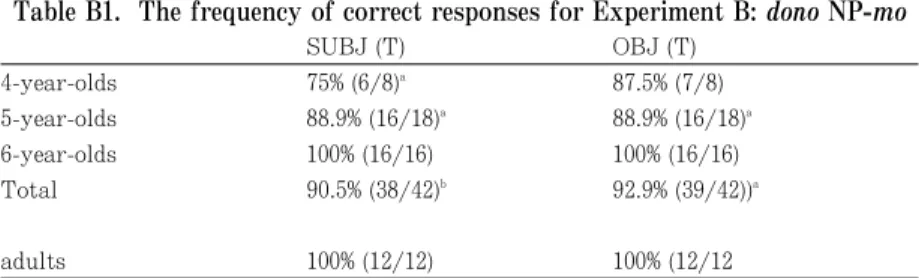
The results of Experiment B are summarized in Table B1.
Table B1 shows that with one exception for one subject sentence, the children correctly interpreted dono NP-mo 'every' and its scope most of the time. The adults interpreted them correctly every time.
The results show that 21 out of 24 children who participated in Experiment 1 do not have a tendency to "spread" the scope for quantifica- tion, and therefore, it can be assumed that they do not have a tendency to
"spread" the domain for focus. As mentioned in B.1, while the children may not be spreading the scope of the universal quantifier, they might be extending the scope for focus, or vice versa. Therefore, it is not certain that the "quantifier spreading" phenomenon is entirely unrelated to the Japanese children's failure to take the correct scope of sae (in infelicitous sentences). If Japanese children are taking the wrong scope of sae by some mechanism related to "quantifier spreading," then they should judge felicitous sentences as infelicitous roughly 50% of the time (i.e. not better than random chance; cf. note 10. However, in Experiment 1, the same children correctly judged felicitous sae sentences as felicitous most of the time: only 4.2% of the felicitous subject sae sentences and only 12.5% of the
Table B1. The frequency of correct responses for Experiment B: dono NP- mo
SUBJ (T) OBJ (T)
4-year-olds 75% (6/8)
a87.5% (7/8)
5-year-olds 88.9% (16/18)
a88.9% (16/18)
a6-year-olds 100% (16/16) 100% (16/16)
Total 90.5% (38/42)
b92.9% (39/42))
aadults 100% (12/12) 100% (12/12
The numbers in parentheses are the number of items judged correctly vs. the total number of test items.
a
One response 'I don't know' is counted as 'incorrect.'
b