• 検索結果がありません。

response: lessons from nerve growth factor-dependent neurons

N/A
N/A
Protected

Academic year: 2021

シェア "response: lessons from nerve growth factor-dependent neurons "

Copied!
59
0
0

読み込み中.... (全文を見る)

全文

(1)

European Journal of Neuroscience

Neurobiology of pain, interoception and emotional

response: lessons from nerve growth factor-dependent neurons

Yasuhiro Indo

Department of Pediatrics, Kumamoto University Hospital, Honjo 1-1-1, Chuou-ku, Kumamoto 860-8556, Japan

Keywords: congenital insensitivity to pain with anhidrosis, hereditary sensory and autonomic neuropathy, NTRK1, polymodal receptor, TrkA

Correspondence: Dr Y. Indo, as above.

E-mail: [email protected]

Running title: Neurobiology of pain and NGF-dependent neurons

(2)

Abstract

Although nerve growth factor (NGF) is a well-known neurotrophic factor, it also acts as a mediator of pain, itch and inflammation. Congenital insensitivity to pain with anhidrosis (CIPA) is an autosomal recessive genetic disorder caused by loss-of-function mutations in NTRK1, the gene encoding a receptor tyrosine kinase for NGF, TrkA. Mutations in NTRK1 cause the selective loss of

NGF-dependent neurons in otherwise intact systems. NGF-dependent primary afferents are thinly myelinated Aδ or unmyelinated C-fibers that are dependent on the NGF–TrkA system during development. In CIPA, the lack of pain and the presence of anhidrosis (inability to sweat) are due to the absence of both

NGF-dependent primary afferents and sympathetic postganglionic neurons,

respectively. These peripheral neurons form an interface between the nervous

system and the ‘body-proper’ and play essential roles in the interoception and

sympathetic regulation of various tissues or organs. Patients with CIPA also

show mental retardation and characteristic behaviors and are probably

neuron-deficient within the brain. However, the functions of NGF-dependent

neurons in the brain are controversial, both in animal and human studies. This

review focuses on various brain regions that express TrkA mRNA, based on data

from the Allen Human Brain Atlas, and discusses putative neuronal networks

related to these brain regions in humans. A better understanding the distribution

of NGF-dependent neurons in the brain will provide a framework for further

studies to investigate pain, interoception and emotional responses. Furthermore,

strategies targeting the molecular mechanisms through which the NGF–TrkA

system functions may provide hope for the development of novel analgesics.

(3)

Introduction

Pain is an unpleasant sensory and emotional experience associated with actual or potential tissue damage. However, the ability to feel pain is important in that it protects us and maintains bodily homeostasis. Various types of congenital insensitivity to pain provide opportunities to consider the physiology of pain and its underlying mechanisms in humans. Children born without the ability to feel pain are unable to prevent injuries from innumerable small and occasionally large physical threats (Melzack & Wall, 1982). They have severely reduced quality of life due to multiple injuries and often die young. Thus, the mediation of pain by the nervous system is considered to be an integral part of the body’s defense and homeostatic control.

Nerve growth factor (NGF) is a prototype neurotrophin and the first growth factor to be identified [(Levi-Montalcini, 1987); see also (Cattaneo, 2013) for historical perspective]. NGF plays pivotal roles in controlling the survival and differentiation of the nervous system during embryonic and early postnatal stages (Reichardt, 2006). Genetic defects of NGF–TrkA signal transduction in animals lead to the failure of survival of various NGF-dependent neurons, as these are not maintained due to apoptosis during development (Crowley et al., 1994; Smeyne et al., 1994). NGF-dependent neurons are defined as neurons in the peripheral nervous system (PNS) or central nervous system (CNS) that are dependent on the NGF–TrkA system during development. NGF thus supports the survival of various NGF-dependent neurons, including nociceptive neurons, autonomic sympathetic neurons and some neurons of the CNS.

NGF is also a peripheral pain mediator, particularly in inflammatory pain states (for a review, see Pezet & McMahon, 2006). NGF also alters the response properties of itch-signaling neurons (Ikoma et al., 2006). The NGF–TrkA system is involved in acute inflammation and contributes to peripheral sensitization to pain or itch. Thus, NGF plays critical roles as a significant mediator and modulator of pain, itch and inflammation (Indo, 2010).

NGF-dependent neurons in the PNS include primary nociceptive afferent

neurons and sympathetic postganglionic neurons. NGF-dependent primary

afferent neurons with thin fibers (NGF-dependent primary afferents) are defined

(4)

as primary afferent neurons with a small-diameter, thinly myelinated Aδ-fibers, or unmyelinated C-fibers that depend on the NGF–TrkA system during

development (Indo, 2010). These neurons not only detect noxious stimuli but also transmit sensation from the body’s interior; this is known as interoceptive sense (Craig, 2002, 2009). NGF-dependent primary afferents are also referred to as ‘interoceptive polymodal receptors’ (Indo, 2009). NGF-dependent primary afferents are thus responsible for both nociceptive and homeostatic afferent pathways.

Autonomic sympathetic postganglionic neurons are involved in the

regulation of various tissues or internal organs, including skin appendages. The sympathetic nervous system enables unconscious maintenance of bodily

homeostasis, including the regulation of blood pressure and body temperature.

In contrast, emotion is a strong feeling characterized by various complex

physical reactions closely related to activities of the sympathetic nervous system.

The ‘fight-or-flight’ response illustrates a strong emotional state associated with an excitation of the sympathetic nervous system. Thus, the sympathetic nervous system underlies both homeostasis and emotional responses.

NGF-dependent primary afferents (or interoceptive polymodal receptors) report the physiological status of various tissues or organs to the brain, which subsequently maintains homeostasis of the whole body along with autonomic, neuroendocrine and behavioral mechanisms (Craig, 2002, 2009; Roosterman et al., 2006).

Congenital insensitivity to pain with anhidrosis (CIPA) is an autosomal recessive genetic disorder due to loss-of-function mutations in NTRK1, the gene encoding TrkA. TrkA is a receptor tyrosine kinase for NGF (Indo et al., 1996;

Indo, 2001, 2012). CIPA is also known as hereditary sensory and autonomic neuropathy type IV (Axelrod et al., 2006). Defects in NGF–TrkA signal transduction cause a lack of NGF-dependent neurons in patients with CIPA, leading to characteristic phenotypes, including insensitivity to pain and

anhidrosis (the inability to sweat). In CIPA, the lack of pain and the presence of anhidrosis are due to the absence of NGF-dependent primary afferents and sympathetic postganglionic neurons, respectively. Patients with CIPA are

mentally retarded and show characteristic behaviors. However, the mechanisms

(5)

that produce the CIPA phenotype remain to be characterized.

It has been shown in animal studies that neurons in several brain regions express TrkA mRNA (Gibbs & Pfaff, 1994; Sobreviela et al., 1994; Holtzman et al., 1995). Some of these neurons are probably NGF-dependent neurons, as they are absent in TrkA gene-knockout mice (Smeyne et al., 1994; Fagan et al., 1997). Studies in gene-knockout or conditional gene-knockout mice have

suggested functions for some TrkA-expressing neurons in the brain (Muller et al., 2012; Sanchez-Ortiz et al., 2012). However, in contrast to those in the PNS, most NGF-dependent neurons in the brain remain uncharacterized.

Traditional animal studies on pain using electrophysiology, pharmacology and/or molecular biology have yielded valuable insights into the molecular basis of pain perception (Basbaum et al., 2009; Mogil, 2009). In addition, lesion

experiments in animals and observations in brain-damaged humans have been utilized to study the functions of specific parts of the nervous system. Together, these approaches have revealed an association between the normal function of the lesioned or damaged structures and the symptoms that ensue. However, the interpretation of such associations may not be straightforward, as a lesion may destroy not only neurons originating in that area but also fibers that are passing through the area.

Genetic studies using gene-knockout animals can be an alternative approach to understand the function of neurons related to a specific gene and complement lesion experiments in animals. Nevertheless, animal studies inevitably leave room for speculation whenever the results of such studies are compared to those seen in human studies. A rare human genetic disorder associated with loss of specific neurons as a result of loss-of-function gene mutations can provide opportunities to explore the normal functioning of those neurons in humans. CIPA is considered to be such a rare genetic disorder.

Loss-of-function mutations in the human NTRK1 gene cause the selective loss of a defined cell population, i.e. NGF-dependent neurons, in the nervous system.

This gives us a rare opportunity to analyze in vivo the functions of

NGF-dependent neurons and the neural circuits in which they are located, in what is an otherwise intact system.

Recently, the complete transcriptional architecture of the human brain has

(6)

been characterized and reported. This provides important information for understanding the impact of genetic disorders on different functional circuits within various brain regions (Hawrylycz et al., 2012). It would also provide an opportunity to understand the putative effects of NTRK1 mutations on the brain, and may therefore enable us to elucidate the neuronal networks that are directly or indirectly connected to peripheral NGF-dependent neurons in humans. It is conceivable that neurons of central circuits expressing TrkA mRNA play an important role in pain and ‘emotion’ arising from the pain system. However, the TrkA-positive neurons may contribute to other brain functions that are not related to the pain system. In either case, it would be intriguing to conduct

neuroanatomical studies of TrkA mRNA-expressing neurons in human brains and to investigate their connectivity in known neuronal systems of the CNS.

These studies may provide some clues to further investigate and characterize putative neuronal networks or pathways underlying the neuronal basis of pain, interoception and emotional responses in humans. Alternatively, they may reveal unique functions of TrkA mRNA-expressing neurons in the brain that are currently unknown.

This review briefly summarizes the function of NGF-dependent neurons in the PNS and the pathophysiology of CIPA. I subsequently discuss brain regions that express TrkA mRNA, according to data from the Allen Human Brain Atlas (Hawrylycz et al., 2012). Further, this review focuses on the putative functions of neurons in brain regions that express TrkA mRNA and discusses the putative neuronal networks related to pain, interoception and emotional responses.

NGF-dependent neurons in the PNS

The NGF-dependent neurons in the PNS, including NGF-dependent primary afferents and sympathetic postganglionic neurons, are considered to form an interface between the nervous system and the body-proper (Fig. 1) (Indo, 2012).

The body-proper refers to the organism minus the neural tissues (the central and

peripheral components of the nervous system; Damasio, 1994). Thus, these

peripheral neurons mediate the reciprocal communication between the brain and

the body-proper.

(7)

NGF-dependent primary afferents include two classes of neurons:

peptidergic and nonpeptidergic. Nonpeptidergic neurons initially express TrkA, but later switch off TrkA and express Ret, another receptor tyrosine kinase for glial cell-derived neurotrophic factor (GDNF) (Silos-Santiago et al., 1995;

Molliver et al., 1997; Snider & McMahon, 1998). Both peptidergic and

nonpeptidergic neurons are thus considered to be NGF-dependent neurons.

NGF-dependent primary afferents innervate all tissues of the body, including skin, muscle, joints, teeth, blood vessels and visceral tissue. The cell bodies of NGF-dependent primary afferents are located either in the dorsal root ganglia alongside the spinal cord or in the trigeminal ganglion (Indo, 2010). A subset of primary afferent neurons in the glossopharyngeal nerve and the vagus nerve are most likely NGF-dependent neurons and transmit visceral afferent information to the brain from the head and neck, and from the thoracic and abdominal cavities, respectively.

NGF-dependent primary afferents also mediate transmission of pain and itch, as well as playing essential roles in interoception (Indo, 2010).

NGF-dependent primary afferents terminate in lamina I of the spinal dorsal horn and trigeminal nucleus and conduct information on numerous types of

physiological conditions through intervening pathways (such as the

spinothalamic tract) to the brain. NGF-dependent primary afferents probably include primary pruriceptive neurons, which were recently characterized in mice (Mishra & Hoon, 2013), as well as primary somatosensory neurons responsible for allergic host defenses, in which anticipatory responses are elicited to

promote the avoidance of suboptimal environments (Palm et al., 2012). The latter study has proposed that allergic reactivity may provide an important defense mechanism to protect the host from noxious environmental factors.

Neutral environmental stimuli perceived through visual, olfactory and gustatory

systems can be temporally associated with the stimulation of somatosensory

pathways, resulting in Pavlovian conditioning of neutral cues (such as sight,

smell and taste) with the antigen-specific response to allergens (Palm et al.,

2012). These somatosensory pathways probably involve NGF-dependent

primary afferents. Thus, NGF-dependent primary afferents constitute a part of

the homeostatic afferent pathways carrying information on the physiological

(8)

status of all tissues of the body; they are fundamental components of the interoceptive pathway (Craig, 2002, 2009).

Sympathetic postganglionic neurons, whose cell bodies are located in the sympathetic ganglia, are also NGF-dependent neurons. In the skin, these neurons are involved in the regulation of blood vessels and lymphatic function, as well as in the regulation of skin appendages, including sweat glands,

apocrine glands and hair follicles (Roosterman et al., 2006). The sympathetic nervous system plays critical roles in maintaining homeostasis of body

temperature by regulating sweat gland functions and vasoconstriction. Sweating is particularly important for the regulation of body temperature in humans.

Sympathetic postganglionic neurons also regulate many other target organs and tissues in the body and constitute a part of the homeostatic efferent pathways.

In addition, NGF-dependent neurons play critical roles in mediating cross-talk between the three ‘super-systems’: the brain, and immune and

endocrine systems (Indo, 2012). The brain and immune system are essential for homeostatic regulation and survival (Elenkov et al., 2000). The endocrine

system coordinates and controls complex responses of the brain and immune system. For instance, various triggering factors, including immune and hormonal activity and mast cell activation, stimulate NGF-dependent primary afferents (interoceptive polymodal receptors) directly or indirectly. Upon stimulation, these neurons, as well as sympathetic postganglionic neurons, influence inflammation by secreting pro-inflammatory or anti-inflammatory substances at the sites of inflammation (Indo, 2010). The term ‘neurogenic inflammation’ refers to signs of inflammation (e.g., tumor, rubor, calor and dolor) that develop upon neuronal activation and the consequent release of a neuronal mediator (Holzer, 1998).

Axon reflex is an efferent function of the NGF-dependent primary afferents (Indo, 2010). Patients with CIPA lack the axon reflex responsible for neurogenic

inflammation. This suggests that neurogenic inflammation does not occur without NGF-dependent neurons. In accordance with the concept of

‘super-systems’, NGF-dependent neurons in the PNS are considered to form communication routes between the brain, and immune and endocrine systems.

Together, NGF-dependent neurons in the PNS constitute homeostatic

afferent and efferent pathways. In response to the interoceptive polymodal

(9)

inputs through NGF-dependent primary afferents, the brain regulates various functions of target organs and tissues through autonomic sympathetic

postganglionic neurons. Thus, NGF-dependent neurons in the PNS play critical roles in the neural networks responsible for interoception and homeostasis.

In humans (as well as in many other animals), systemic responses of the sympathetic nervous system often accompany emotional responses. Activation of the various target tissues or organs through sympathetic outflows and

integrated feedback from the entire body through NGF-dependent primary afferents probably contribute to emotional responses. Emotion is a strong feeling characterized by various complex reactions, with both mental and physical manifestations closely related to activities of the sympathetic nervous system.

The ‘fight-or-flight’ response illustrates a strong emotional state associated with an extreme excitation of the sympathetic nervous system. However, most emotional responses in daily life occur with varying degrees at a subconscious level.

The autonomic sympathetic nervous system is crucial for achieving the appropriate modification of physical parameters in the body that generate bodily states characterizing certain emotions. A sympathetic skin response (SSR) has been used as an index for monitoring bodily state. A definition of the term

‘emotion’ is ‘a collection of changes occurring in both brain and body, usually prompted by a particular mental content’ (Damasio, 1994: p270 in Penguin Books 2005). ‘Feeling’ is the perception of those changes (Damasio, 1994: p270 in Penguin Books 2005). Interoceptive polymodal receptors, conveying visceral signals and signals from the body’s internal milieu to the brain, play critical roles in ‘feelings’ (Damasio, 2003).

Emotional responses contribute to the prevention of danger or trauma.

When humans are exposed to danger or trauma, the stimuli or contexts associated with the danger or trauma become learned triggers that unleash emotional responses (LeDoux, 1996, 2000). These emotional experiences subsequently induce the ‘fear conditioning’ by pairing the stimuli or contexts with danger or trauma. The pathophysiology of CIPA strongly suggests that

NGF-dependent neurons in the PNS are indispensable for emotional responses.

When taken together, the evidence suggests that NGF-dependent neurons

(10)

in the PNS play essential roles in ‘emotions and feelings’, as well as in the interoception (including pain) and homeostasis of the body.

Congenital insensitivity to pain with anhidrosis

Loss-of-function mutations in NTRK1 lead to an absence of functional TrkA protein in patients with CIPA (Indo et al., 1996; Indo, 2001, 2012). Defects in NGF–TrkA signal transduction cause the failure of various NGF-dependent neurons to survive, due to developmental apoptosis (Indo, 2002). As a result, patients with CIPA lack all NGF-dependent neurons, including NGF-dependent primary afferents and sympathetic postganglionic neurons. They consequently lack pain and itch sensations and neurogenic inflammation as well as

sympathetic functions (Indo, 2010).

Patients with CIPA lack all pain sensations, including visceral pain (Indo, 2002). Touch, vibration and position senses are normal. Motor functions are also normal, although repeated trauma can induce secondary dysfunction in the motor system. Patients with CIPA tend to develop hyperthermia in hot environments due to their inability to sweat. They also tend to suffer from hypothermia in cold environments. Clinical and behavioral studies also suggest that patients with CIPA lack interoception and sympathetic regulation of various target tissues, including internal organs (Indo, 2009). For instance, patients with CIPA show symptoms characteristic of an absence of sympathetic innervation of the head: dry skin (anhidrosis), constricted pupils (miosis) and drooping of the upper eyelid (ptosis) (Indo, 2002). The ensuing symptoms can be understood based on the effects of sympathetic fibers on the skin and the eye. Dry skin is caused by lack of sweat secretion. Miosis and slight ptosis are due to paralysis of the pupillary dilator and the smooth tarsal muscle, respectively. This

constellation of symptoms is known as ‘bilateral Horner’s syndrome’.

Patients with CIPA have variable degrees of mental retardation and exhibit

learning deficits. Hyperactivity and emotional lability are common. Affected

children show defects in conceptual thinking, abstract reasoning and social

behavior and exhibit symptoms of moderate to severe emotional disturbance

(Swanson, 1963; Pinsky & DiGeorge, 1966). Behaviors of children with CIPA are

(11)

often characterized as labile, hyperactive and erratic. Assessments of cognitive and adaptive behavior have suggested that many children with CIPA exhibit mental retardation (or learning disabilities) and symptoms of severe

attention-deficit-hyperactivity disorder (Levy Erez et al., 2010).

In an autopsy study, the tract of Lissauer (dorsolateral fasciculus) could not be identified at any level of the spinal cord in a patient with CIPA (Swanson et al., 1965). The spinothalamic tracts could not be specifically identified, but the lateral and ventral columns of the spinal cord appeared normal. It is likely that patients with CIPA lack some neurons in the brain. However, in the above case, no

obvious gross abnormalities of the brain were recognized (Swanson et al., 1965).

The corresponding gene-knockout mice lack basal forebrain cholinergic neurons (BFCNs) and striatal cholinergic neurons (Smeyne et al., 1994). Neither BFCNs nor striatal cholinergic neurons mature fully in knockout mice in the absence of NGF–TrkA signaling (Fagan et al., 1997). These studies have indicated that BFCNs and striatal cholinergic neurons are NGF-dependent neurons in the rodent. Taken together, it is therefore conceivable that mental retardation and characteristic behaviors observed in patients with CIPA may be related to defects of BFCNs and other NGF-dependent neurons in the brain.

Regions that express TrkA mRNA in the human brain

In patients with Alzheimer’s disease, a decrease in TrkA mRNA is observed in BFCNs (Boissiere et al., 1997; Mufson et al., 2003). Growing evidence suggests that an imbalance in the expression of NGF and TrkA is a crucial factor

underlying BFCN dysfunction in Alzheimer’s disease (Mufson et al., 2008). A Phase I clinical trial has been undertaken to examine the utility of ex vivo NGF gene therapy for Alzheimer’s disease. This trial has shown promise and

warrants additional clinical trials (Tuszynski et al., 2005). In addition, significant down-regulation of TrkA expression has been demonstrated during the

development of Alzheimer’s disease (Ginsberg et al., 2006). This suggests that

the dysfunction of TrkA-expressing neurons in the brain may be related to the

deterioration of cognitive or other functions observed in patients with Alzheimer’s

disease. Thus, it would be interesting to analyze the location of TrkA-expressing

(12)

neurons in putative neural network in humans. In this regard, a comprehensive expression profile of NTRK1 in the human brain would be informative, as it may provide clues to the localization of TrkA mRNA expressing neurons and the neuronal circuits in which they are embedded.

Recently, the complete transcriptional architecture of the human brain has been characterized and reported, providing important information for

understanding the impact of genetic disorders on different brain regions and on various functional circuits (Hawrylycz et al., 2012). The Allen Human Brain Atlas is a multimodal atlas of gene expression anatomy comprising a comprehensive

‘all genes-all structures’ array-based dataset of gene expression and

complementary in situ hybridization gene expression studies targeting selected genes in specific brain regions (Shen et al., 2012). The Atlas includes

data-mining resources that enable researchers to uncover connections between structure, function and molecular biology. Thus, the Atlas integrates structure, function and gene expression data to accelerate basic and clinical research of the human brain in normal and disease states. Due to normal variations in brain size and morphology, the number of samples per structure varies across brains.

Microarray heat-map displays of z-score or log

2

expression values allow simultaneous visualization of multiple genes and probes across all structures and across brains.

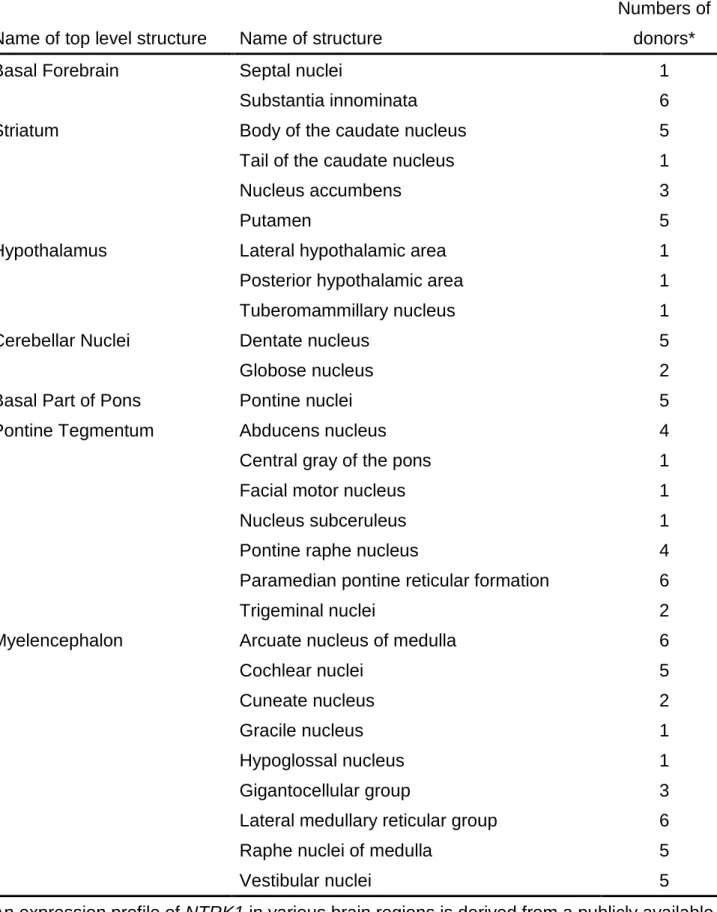
Data on NTRK1 expression profile in various brain regions have been retrieved from a publicly available online resource of gene expression information of the human brain (Allen Human Brain Atlas:

http://human.brain-map.org/). From this whole brain microarray data, various brain regions have been selected where the expression z-score of NTRK1 is higher than 1.0 with two probes (A_23_P34804 and A_24_P265506) in at least one of the brains of six donors. Thus, brain regions possessing a relatively high expression of TrkA mRNA have been selected and are shown in Table 1

(Supporting information Table S1 is also available).

Human brain regions or structures that show relatively high expression of

TrkA mRNA are as follows: the basal forebrain (the septal nuclei and the

substantia innominate); the striatum [the body and tail of the caudate nucleus,

the nucleus accumbens (NAc) and the putamen]; the hypothalamus (the lateral

(13)

hypothalamic area, the posterior hypothalamic area and the tuberomammillary nucleus); the cerebellar nuclei (the dentate nucleus and the globose nucleus);

the basal part of the pons (the pontine nuclei); the pontine tegmentum [the abducens nucleus, the central gray of the pons, the facial motor nucleus, the nucleus subceruleus, the pontine raphe nucleus, the paramedian pontine reticular formation (PPRF) and the trigeminal nuclei]; the myelencephalon (the arcuate nucleus of the medulla, the cochlear nuclei, the cuneate nucleus, the gracile nucleus, the hypoglossal nucleus, the gigantocellular group, the lateral medullary reticular group, the raphe nuclei of the medulla and the vestibular nuclei).

Functions of neurons in brain regions that express TrkA mRNA

In the following description, general information on the structure and function of the human brain and the nomenclature used are based on a textbook (Brodal, 2010) and on NeuroNames (Bowden, 2002,

http://braininfo.rprc.washington.edu/), respectively.

The basal forebrain (septal nuclei and substantia innominate)

The septal nuclei and substantia innominate belong to the basal forebrain. The basal forebrain contains four partially overlapping cell groups (the medial septal nucleus, the nucleus of the vertical limb of the diagonal band, the nucleus of the horizontal limb of the diagonal band and the nucleus basalis of Meynert), where cholinergic and non-cholinergic neurons are intermingled with each other

(Mesulam et al., 1983; Mesulam, 2004). The term ‘nucleus basalis’ is used to designate the cholinergic as well as non-cholinergic components in this nucleus.

According to the description in the Allen Human Brain Atlas, the substantia

innominate includes the nucleus basalis of Meynert, the nucleus of the vertical

limb of the diagonal band, the nucleus of the horizontal limb of the diagonal band,

the nucleus of the anterior commissure, the nucleus of stria terminalis and the

olfactory tubercle.

(14)

In the human brain, BFCNs provide the major cholinergic innervation to the hippocampus, amygdala and neocortex (Mesulam, 2004). The septal nuclei and the diagonal band send fibers primary to the hippocampal formation, whereas the basal nucleus projects to the rest of the cerebral cortex and the amygdala (Mesulam et al., 1983; Mesulam, 2004). The septal nuclei and the diagonal band of Broca are particularly important for memory (presumably because of their connections with the hippocampus), whereas the basal nucleus is more

concerned with maintaining and perhaps focusing attention (Brodal, 2010). The basal nucleus provides the major source of cholinergic input to the amygdala, which is involved in mediating the influences of emotional arousal and stress on learning and memory. The cholinergic activation of the amygdala by the basal nucleus probably contributes to the modulation of memory consolidation

(McGaugh et al., 2002). Consistent with this, recent studies have indicated a role for cholinergic neurons in attention and memory mechanisms (McGaugh et al., 2002; Mesulam, 2004; Sarter et al., 2005, 2006; Hasselmo & Sarter, 2011).

TrkA gene-knockout mice lack BFCNs (Smeyne et al., 1994). These

neurons do not mature fully in the absence of NGF–TrkA signaling (Fagan et al.,

1997). A recent study on a forebrain-specific conditional TrkA knockout mouse

line has demonstrated that TrkA has a key role in establishing the basal forebrain

cholinergic circuitry (Sanchez-Ortiz et al., 2012). In addition, the anatomical and

physiological deficits caused by a lack of TrkA signaling in BFCNs selectively

impact cognitive activity. Another study has also confirmed that NGF–TrkA

signaling supports the survival of a small proportion of cholinergic neurons

during development (Muller et al., 2012). However, in contrast to the former

study, the latter suggests that NGF–TrkA signaling is not required for trophic

support or connectivity of the remaining BFCNs. Moreover, behavioral analysis

of young adult and intermediate-age mice lacking NGF–TrkA signaling has

demonstrated that this signaling is dispensable for both attention behavior and

various aspects of learning and memory (Muller et al., 2012). The discrepancy

between these two studies may be attributed to a difference in the genetic

backgrounds of the mice, or to a difference in the conditional knockout strategies

used to ablate a target gene, with different neuronal promoters targeted in the

two studies. These studies may also suggest that there is a structural and

(15)

functional heterogeneity among the population of BFCNs.

It is likely that patients with CIPA lack these cholinergic neurons.

Assessments of cognitive and adaptive behavior have suggested that many children with CIPA exhibit mental retardation (or learning disabilities) and symptoms of severe attention deficit hyperactivity disorder (Levy Erez et al., 2010). Thus, at least some symptoms related to cognitive and adaptive

behaviors in CIPA may be caused by the role of cholinergic neurons in attention and memory mechanisms.

The striatum (body of the caudate nucleus, tail of the caudate nucleus, NAc and putamen)

The basal ganglia consist of evolutionarily conserved motor nuclei that form recurrent circuits critical for motor planning (Kreitzer, 2009). An intriguing hypothesis suggests that the vertebrate basal ganglia have evolved as a centralized selection device, specialized to resolve conflicts over access to limited motor and cognitive resources (Redgrave et al., 1999). Recent studies have indicated that the basal ganglia also play a role in cognitive functions (Grahn et al., 2008). Further, the most ventral parts of the basal ganglia

contribute to the control of motivation and emotions (Grahn et al., 2008; Kreitzer, 2009).

The striatum is composed of the caudate nucleus and putamen. The ventral striatum is the ventral conjunction of the caudate and putamen that merges into and includes the NAc and striatal portions of the olfactory tubercle (Zhou et al., 2002). The striatum receives three major sources of afferents: the cerebral cortex, the intralaminar thalamic nuclei and dopamine-containing cell groups in the mesencephalon (Kreitzer, 2009). In addition, quantitatively minor afferents to the striatum come from the serotonergic raphe nuclei in the brain stem, which probably targets cholinergic interneurons (Bonsi et al., 2007). Serotonin released by serotonergic fibers originating in the raphe nuclei has a potent excitatory effect on striatal cholinergic interneurons.

The striatum is the primary input nucleus of the basal ganglia and a key

neural substrate for procedural learning and memory (Kreitzer, 2009).

(16)

Acetylcholine is released into the extracellular space by cholinergic interneurons, which constitute approximately 2% of striatal neurons. Cholinergic mechanisms in the striatum may contribute to the acquisition of learned movements and to other forms of learning (Zhou et al., 2002). In vivo, cholinergic interneurons exhibit tonic low-frequency activity that is transiently inhibited in response to visual or auditory cues associated with movement tasks, suggesting that this pause in cholinergic interneuron firing may be associated with behaviorally significant cues (Kreitzer, 2009). The tonically active cholinergic neurons

respond (i.e., pause) to unexpected conditioned stimuli that predict rewards, but they also respond to unexpected noxious airpuffs and other unexpected stimuli (Zhou et al., 2002). The pause response of the cholinergic neurons may signal the start of an important event sequence. The pause appears to require

coordinated synaptic inputs from both the substantia nigra compacta and intralaminar thalamic nuclei, although the precise mechanisms have yet to be determined (Kreitzer, 2009).

The ventral striatum is composed of the NAc and portions of the olfactory tubercle. It is thought to be phylogenetically older than other parts of the striatum and is primarily related to the limbic structures. The NAc receives afferents from the hippocampal formation, the amygdala, the orbitofrontal cortex and parts of the temporal lobe (Zhou et al., 2002). The NAc also sends efferent fibers to the hypothalamus, the mesencephalic reticular formation and the pedunculopontine nucleus (Brodal, 2010). The NAc projects to the BFCNs, providing a pathway for the NAc to affect cortical arousal, attention and cognitive function (Zhou et al., 2002). The NAc, an important component of the mesolimbic dopaminergic reward system, is also implicated in pain modulation, such as pain-induced analgesia (Gear et al., 1999).

The NAc also receives dopaminergic fibers from the ventral tegmental area (VTA) and sends reciprocal efferent fibers to the VTA (Zhou et al., 2002).

Recently, a study on VTA neurons, combining optogenetics with structural imaging and electrophysiology, has been reported in mice (Brown et al., 2012).

This study showed that GABA (γ-aminobutyric acid)-releasing neurons of the

VTA that project to the NAc inhibit accumbal cholinergic interneurons to enhance

stimulus-outcome learning (Brown et al., 2012). The VTA and NAc are essential

(17)

for learning about environmental stimuli associated with motivationally relevant outcomes. The task of signaling such events, both rewarding and aversive, from the VTA to the NAc has largely been ascribed to dopaminergic neurons.

However, this intriguing study has shown that forcing accumbal cholinergic interneurons to pause in behaving mice enhances discrimination of a

motivationally important stimulus that had been associated with an aversive outcome (Brown et al., 2012). These results indicate that VTA GABA projection neurons, through their selective targeting of accumbal cholinergic interneurons, provide a novel route through which the VTA communicates saliency to the NAc.

Considering that the ventral striatum is a phylogenetically conserved structure, these VTA GABA projection neurons may therefore have similar functions in humans. We learn such conditioned aversive behaviors based on the emotional impact elicited when experiencing various pains. These behaviors are components in the physiology of pain and are critical for our survival. Thus, the connections of the NAc probably play an important role for behavior that is governed by emotions.

TrkA gene-knockout mice lack striatal cholinergic neurons (Smeyne et al., 1994). These neurons do not mature fully in the absence of NGF–TrkA signaling (Fagan et al., 1997). In humans, the striatum also contains cholinergic neurons that express TrkA mRNA and a decrease in TrkA mRNA is also observed in the ventral striatum and in the putamen of patients with Alzheimer’s disease

(Boissiere et al., 1997).

Patients with CIPA probably lack these cholinergic neurons, although histological studies on the brains of patients have not yet been reported.

Patients with CIPA do not show primary motor deficits, although they can suffer from secondary motor dysfunction associated with traumatic injuries. This may suggest a functional significance of the striatal cholinergic neurons in other neuronal function(s) that are not directly related to motor control. Thus, mental retardation (or learning disabilities) and characteristic behaviors (such as

symptoms of severe attention deficit hyperactivity disorder) observed in patients with CIPA may be related to defects of NGF-dependent neurons in the striatum.

In summary, TrkA-expressing neurons in the basal ganglia and in particular

the striatum may contribute to cognitive and emotional processing in addition to

(18)

motor control.

The hypothalamus (lateral hypothalamic area, posterior hypothalamic area, and tuberomammillary nucleus)

A central task of the hypothalamus is to coordinate autonomic, endocrine and somatic motor responses to behavior that is appropriate for the immediate needs of the body; its overall aim is to maintain bodily homeostasis (Brodal, 2010).

Distinct sets of neuronal populations in the hypothalamus innervate sympathetic preganglionic neurons. Neurons in the lateral hypothalamus that diffusely project to the cerebral cortex are likely to be important in arousal, and electrical

stimulation of the lateral hypothalamus elicits a ‘defense reaction’ that has been described by Cannon (Saper, 2002).

The hypothalamus receives information about ambient temperature from thermoreceptors in the skin and initiates peripheral responses to increase heat production or heat loss. NGF-dependent primary afferents and sympathetic postganglionic neurons play critical roles in thermoreception and peripheral responses, respectively. Because patients with CIPA lack these neurons, they tend to develop hyperthermia in hot environments and hypothermia in cold environments. In this regard, the posterior hypothalamus is considered to be important in controlling shivering (Nagashima et al., 2000).

In humans, the tuberomammillary nucleus of the hypothalamus contains approximately 64 000 histamine-producing neurons that innervate all of the major parts of the cerebrum, cerebellum, posterior pituitary and spinal cord (Haas & Panula, 2003). Neurons of the tuberomammillary nucleus in mammals send projections to the cerebellar cortex, including the Purkinje cell and the granular cell layers (Schweighofer et al., 2004). These histaminergic systems in the brain hold a key position in the regulation of basic bodily functions, including the sleep–waking cycle, energy and endocrine homeostasis and synaptic

plasticity and learning (Haas & Panula, 2003).

Thus, some neurons in the human hypothalamus express TrkA mRNA. In

addition, an animal study has indicated that TrkA-immunoreactive neurons are

observed in the periventricular hypothalamus (Sobreviela et al., 1994).

(19)

Hypothalamic neurons expressing the TrkA receptor are likely to perform a critical physiological function.

The cerebellar nuclei (dentate nuclei and globose nucleus) and the basal part of the pons (pontine nuclei)

As a general rule, the cerebellum sends signals to the same regions from which it receives afferents. Studies in primates have revealed that the regions of the cerebellar cortex that receive input from the primary cerebral motor cortex (M1) are the same as those that project to M1 (Kelly & Strick, 2003). Similarly, the regions of the cerebellar cortex that receive input from cerebral area 46 are the same as those that project to area 46 (Middleton & Strick, 2001; Kelly & Strick, 2003). These studies suggest that multiple closed-loop circuits represent a fundamental architectural feature of cerebro-cerebellar interactions (Kelly &

Strick, 2003).

Cortico-ponto-cerebellar projections form part of a closed loop system with the cerebral cortex, in which the cerebellum reciprocates projections to the cerebral cortex through the thalamus (Ramnani, 2006). The afferents to the pontine nuclei arise primarily in the cerebral cortex, forming the corticopontine tract. The pontine nuclei project to the cerebellum. In humans, the largest number of cerebellar afferent fibers arises in the pontine nuclei (Brodal, 2010).

The pontine nuclei are believed to process information from the cerebral cortex and forward it to the cerebellar cortex.

The fundamental unit of information processing in the cerebellar cortex is the Purkinje cell, which integrates information from two primary pre-cerebellar relay stations: the pontine nuclei and the inferior olive (Ramnani, 2006). Purkinje cells in the cerebellar hemispheres project to the dentate nucleus, whereas Purkinje cells in the intermediate zone project to the interposed nuclei, including the globose nucleus (Brodal, 2010). Signals from the cerebellar hemispheres pass primarily to the motor cortex through the intracerebellar nuclei and the thalamus and there also exists anatomical and physiological evidence of

connections from the dentate nucleus (through the thalamus) to the dorsolateral

prefrontal cortex (Ramnani, 2006). In humans, the ventral dentate

(20)

(interconnected with the prefrontal cortex) is larger than the dorsal dentate (interconnected with the motor cortex). Such connections may suggest the importance of cerebellar influences on cognitive tasks. Indeed, the largest contribution of cortico-pontine fibers comes not from the cortical motor area but from the frontal cortex in the human brain. This suggests that the cerebellum has a more important role in processing information from the prefrontal cortex: an area in which neurons code information at a more abstract level than in the cortical motor areas. There is also anatomical and physiological evidence of connections from the dentate nucleus (through the thalamus) to the dorsolateral prefrontal cortex (Ramnani, 2006).

The concept of internal models in the cerebellum proposes that, through a learning process, the cerebellum forms an internal model to reproduce the dynamics of a body part (Ito, 2008). According to this concept, the intricate neuronal circuitry of the cerebellum encodes an internal model, which is formed and adjusted as a movement is repeated. The internal model ultimately helps the brain to perform the movement precisely, without the need to refer to feedback from the moving part. Recent studies have indicated that the cerebellum may also encode internal models that reproduce the essential properties of mental representations in the cerebral cortex (Ito, 2008). The internal model hypothesis for the control of mental activities predicts that there should be co-activation of the cerebellar hemisphere with the prefrontal and temporo-parietal cortices during the performance of mental tasks, a hypothesis that has been confirmed by recent neuroimaging studies (Ito, 2008).

With regard to pain, when a subject receives an unexpected painful heat stimulus on the left hand, the hippocampus and the most lateral part of the cerebellum get activated simultaneously with the superior frontal and superior parietal gyri (Ploghaus et al., 2000). This study implicates the cerebellum in associative learning relating to pain, which represents an important behavior.

The cerebellum and basal ganglia receive many projections from various

regions of the cerebral cortex. The striatum and pontine nuclei are input stages

of the basal ganglia and the cerebellum, respectively. It has been a longstanding

question as to how and where cerebellar circuits interact with basal ganglia

circuits. A study in macaques has found a disynaptic pathway that links an

(21)

output stage of the cerebellum, the dentate nucleus, with an input stage of the basal ganglia, the striatum (Hoshi et al., 2005). This disynaptic pathway is probably mediated by intralaminar nuclei and/or ventroanterior/ventrolateral thalamus. This pathway thus enables the output stage of cerebellar processing to have a direct influence over the input stage of processing within the basal ganglia.

The cerebellum also receives a third type of afferent that originates in the hypothalamus or in other brainstem structures, which contains various amines or neuropeptides (Schweighofer et al., 2004; Ito, 2008). The projection to the cerebellum from the tuberomammillary nucleus in the hypothalamus is described above. The pontine nuclei also receive connections from parts of the

hypothalamus and limbic structures, notably the mammillary bodies and the cingulate gyrus and these connections may form the basis of cerebellar

contributions to certain cognitive tasks (Brodal, 2010). In addition, corticopontine connections from limbic structures may contribute to the ability of motivation and emotions to influence movements.

It is likely that patients with CIPA lack some neurons in the pontine nuclei and cerebellar nuclei that express TrkA mRNA. However, histological studies on the brains of CIPA patients have not yet been reported. Patients with CIPA do not show apparent neurological signs that indicate deficits in cerebellar motor

function and some patients with CIPA can learn to handle an electrical

wheelchair skillfully if necessary (Indo Y., unpublished observations). This kind of

handling is usually difficult for patients who suffer from neurovascular diseases

in the cerebellum. This suggests that neurons expressing TrkA mRNA in the

pontine or cerebellar nuclei may have a physiological function not directly related

to motor control. In addition, mental retardation (or learning disabilities) and

characteristic behaviors observed in patients with CIPA may be caused by

defects of putative NGF-dependent neurons in these brain regions. Thus,

putative NGF-dependent neurons that form part of the cortico-cerebellar loop

system may provide a clue to understand the currently unknown functions of this

system.

(22)

The pontine tegmentum (abducens nucleus, central gray of the pons, facial motor nucleus, nucleus subceruleus, pontine raphe nucleus, PPRF and trigeminal nuclei)

Abducens nucleus

The abducens nucleus contains the motoneurons that innervate the ipsilateral lateral rectus muscle and so-called internuclear neurons, which project onto the medial rectus motoneurons of the opposite side (Brodal, 2010). Expression of the three Trk receptors, including TrkA, TrkB and TrkC, has been reported in the oculomotor system of the adult cat (Benitez-Temino et al., 2004). The three receptors are present in all neuronal populations investigated, including

abducens motoneurons and internuclear neurons, medial rectus motoneurons of the oculomotor nucleus and the trochlear motoneurons. Two or three Trk

receptors are likely to colocalize in a large number of neurons, suggesting that the adequate maintenance of these neurons in the adult may depend on several neurotrophins. The expression of multiple Trk receptors suggests that their associated neurotrophins exert an influence on the normal operation of the oculomotor circuitry. Studies have indicated that the multiple Trk receptors on individual neutrons may act in concert with each other to regulate distinct functions of the oculomotor circuitry (Benitez-Temino et al., 2004).

With regard to NGF–TrkA system, the expression of TrkA receptor in feline or human extraocular motoneurons suggests a role for NGF in their normal operation. However, neurological examinations have not revealed abnormal findings on the ocular motor system in patients with CIPA. Thus, the NGF–TrkA system may regulate multiple aspects of neuronal physiology during the normal operation of these oculomotor neurons.

Central gray of the pons (or pontine central gray)

A lesion study showed that connections between the pontine central gray and

the ventromedial hypothalamus are essential for the display (lordosis behavior)

of sexual receptivity in female rats (Hennessey et al., 1990). Recent studies

(23)

have indicated that brain stem circuits in the periaqueductal gray and the pontine micturition center play critical roles in mediating reflex micturition (Griffiths &

Fowler, 2013; de Groat & Wickens, 2013). The most important afferents for initiating micturition are those passing in the pelvic nerve to the sacral spinal cord. These afferents are small myelinated (Aδ) and unmyelinated (C) fibers, which convey information from receptors in the bladder wall to second-order neurons in the spinal cord (de Groat & Wickens, 2013).

Functional brain imaging has identified many forebrain regions that respond with altered neuronal activity to bladder filling or voiding and which therefore form part of the brain–bladder control network. These regions may constitute part of a general ‘homeostatic afferent brain network’ that governs the

processing of sensation and generates appropriate outputs for many different organ systems (Griffiths & Fowler, 2013).

It is not clear whether the expression of TrkA mRNA in central gray of the pons is related to micturition in adult humans. Patients with CIPA seem to be able to control micturition. They usually do not have symptoms related to micturition, such as urinary incontinence, except for those who have suffered from traumatic spinal cord injuries. The possible functions of TrkA-expressing neurons in central gray of the pons are interesting.

Facial motor nucleus

The facial motor nucleus of a human volunteer expresses NTRK1. This appears

to be unexpected, because spinal motor neurons that innervate skeletal striated

muscles are not NGF-dependent neurons. However, facial expressions of

humans, as well as animals, often reveal emotions. Facial expressions of

emotions, such as sorrow and pleasure, arise independent of conscious will

(Brodal, 2010). Furthermore, it is known that lesions of the pyramidal tract do not

abolish spontaneous facial expressions. Thus, exploring the expression of

NTRK1 in the facial nucleus appears to be interesting.

(24)

Nucleus subceruleus

The brainstem noradrenergic (and adrenergic) centers include several groups (A1–A7) of neurons. The A6 noradrenergic center is located in the nucleus ceruleus of the dorsolateral pontine tegmentum, while the A6 subceruleus is situated in the ill-defined nucleus subceruleus (Naidich et al., 2009).

The nucleus subceruleus may be related to the generation of rapid eye movement (REM) sleep (Simon et al., 2012). It receives glutamatergic input, which may be involved in the activation of neurons during REM sleep. In contrast, spinal motoneurons are inhibited by the brainstem during REM sleep. This

inhibition, known as muscle atonia, is most likely exerted by noradrenergic neurons close to the locus coeruleus (the subceruleus).

With regard to REM sleep, the microinjection of NGF into the rostral pontine tegmentum of adult cats rapidly induces long-lasting episodes of REM sleep and TrkA receptors are present in neurons located in mesopontine regions (Yamuy et al., 2000). NGF may thus modulate the electrical activity of neurons in the rostral pontine tegmentum that are responsible for the generation of REM sleep.

However, it is not certain whether these neurons include those within the nucleus subceruleus. From this point of view, further investigation into sleep in patents with CIPA is intriguing.

Pontine raphe nucleus

Recent studies have suggested the presence of anatomical and functional diversities among the serotonergic systems that innervate forebrains, which are therefore involved in the control of physiological and behavioral responses, including the control of emotional states (Hale & Lowry, 2011). An immunological study in cats has revealed that TrkA-immunoreactive neurons exist in the

pontine raphe nucleus (Yamuy et al., 2000). The raphe nuclei contain primarily serotonergic neurons and are located within the reticular formation. The

serotonergic neuron clusters in the brainstem may be divided into two groups,

rostral and caudal, on the basis of their distribution and primary projections

(Hornung, 2003). The rostral group is confined to the mesencephalon and rostral

(25)

pons, with major projections to the forebrain. The caudal group extends from the caudal pons to the caudal portion of the medulla oblongata, with major

projections to the caudal brainstem and spinal cord.

The pontine raphe nucleus probably belongs to the rostral group and can be observed between the decussation of the superior cerebellar peduncle and the medial longitudinal fasciculus (Shibata et al., 2012). The pontine raphe nucleus sends serotonergic fibers to the cerebellar hemisphere through the middle cerebellar peduncle (Naidich et al., 2009). The functional properties of serotonergic neurons within the pontine raphe nucleus remain unclear. It

remains unclear whether TrkA-expressing neurons in the pontine raphe nucleus are serotonergic or not.

Paramedian pontine reticular formation

An immunological study has revealed that TrkA-immunoreactive neurons exist in the PPRF of cats (Yamuy et al., 2000). The PPRF, located close to the abducens nucleus on each side, refers to a functionally defined area in the pontine reticular formation that is involved in the coordination of conjugate horizontal eye

movements (Brodal, 2010). Several types of neurons that show horizontal

saccade-related activity are found in the PPRF and medulla (Sparks, 2002). The PPRF sends fibers to the abducens and oculomotor nuclei and coordinates their activities. The PPRF receives signals directly and indirectly from the vestibular nuclei, the superior colliculus and the frontal eye field (Brodal, 2010). Clinically, neurological examinations of patients with CIPA have not revealed deficits of horizontal eye movements.

Trigeminal nuclei

The trigeminal nuclei of the pontine tegmentum probably include the principal

sensory trigeminal nucleus, which receives thick myelinated fibers (Aβ) of the

trigeminal nerve from the skin (Brodal, 2010). These fibers are considered to

convey touch sensations from orofacial regions. Animal studies have revealed

that the principal sensory nucleus of the trigeminal nucleus contains TrkA mRNA

(26)

in rats (Gibbs & Pfaff, 1994). TrkA-immunoreactive neurons are also present in the mesencephalic trigeminal nucleus of rats (Sobreviela et al., 1994) and cats (Yamuy et al., 2000).

Despite this progress, these studies have not revealed whether the spinal trigeminal nucleus contains TrkA-expressing neurons. The spinal tract of the trigeminal nerve is joined by somatic afferent fibers that have followed the glossopharyngeal and vagus nerves peripherally. The spinal trigeminal nucleus also receives sensory fibers from the intermediate nerves as well as the

glossopharyngeal and vagus nerves (Naidich et al., 2009). The spinal tract continues down into the upper cervical segments and corresponds to the zona terminalis (bundle of Lissauer) in the cord (Brodal, 2010). Fibers of the spinal tract of the trigeminal nerve are believed to convey sensations of pain and temperature from the orofacial regions.

Patients with CIPA lack all pain sensations, including visceral pain, although their touch sensations seem to be intact. Thus, the function of TrkA mRNA expressing neurons in the trigeminal nuclei of the pontine tegmentum is intriguing in this regard.

The myelencephalon (arcuate nucleus of the medulla, cochlear nuclei, cuneate nucleus, gracile nucleus, hypoglossal nucleus, gigantocellular group, lateral medullary reticular group, raphe nuclei of the medulla and vestibular nuclei)

Arcuate nucleus of the medulla

The arcuate nucleus of the medulla belongs to the pontine nuclei (Naidich et al., 2009). The pontine nuclei are described above.

Cochlear nuclei

Two cochlear nuclei, the dorsal and ventral nuclei, receive fibers of the cochlea

nerves. From the cochlear nuclei, auditory signals are transmitted to the inferior

colliculus through the lateral lemniscus (Brodal, 2010). The reticular formation

(27)

receives collaterals from the ascending auditory pathways and such connections mediate the sudden muscle activity provoked by a strong, unexpected sound;

that is, a startle response (Brodal, 2010). This leads to the movement of the head and eyes and even the body, in the direction of an unexpected sound and often accompanies emotional responses of the body.

Both TrkA mRNA and TrKA protein have been detected within cells located in the cochlear nucleus of rats (Gibbs & Pfaff, 1994; Burette et al., 1997). In addition, neurons of the human cochlear nuclei express TrkA mRNA. Patients with CIPA do not have apparent deficits in the auditory system, because they are capable of learning a language. The physiological function of TrkA-expressing neurons in the cochlear nuclei is interesting.

Cuneate nucleus and gracile nucleus

The dorsal column nuclei, the gracile and the cuneate, are secondary sensory neurons located in the medulla. The dorsal column–medial lemniscus pathway is important for the perception of touch, pressure, vibration and kinesthesia, but it is of primary importance for the discriminatory aspects of sensation (Brodal, 2010).

Animal studies have indicated that some neurons of the dorsal column nuclei project to a region of the ventral pontine reticular formation that contains neurons involved in pain processing, cardiovascular regulation, respiratory control and arousal (Van Bockstaele et al., 1993). This region of the ventral pontine reticular formation receives inputs from a variety of nuclei involved in somatosensory, auditory and autonomic function and may contribute to the integration of exteroceptive and interoceptive sensory inputs.

The dorsal columns also contain some descending axons that form synaptic

contacts in the dorsal horn of rats (particularly in lamina V, containing neurons

excited by signals from nociceptors) (Masson et al., 1991). Thus, the dorsal

column nuclei are part of a neuronal network that, by way of descending

connections, controls the flow of sensory information from the spinal cord. The

projection of the dorsal column nuclei to the brainstem reticular formation may

(28)

contribute to the integration of exteroceptive and introceptive sensory inputs, while the projection of dorasal column nuclei to the spinal cord may be involved in coordinating these sensory inputs at the level of spinal cord.

A recent study has characterized motor control ability in patients with CIPA.

The grip force during the object grasp–lift–holding task is significantly greater in patients with CIPA than in control subjects, albeit with less reproducibility and greater fluctuation in the acceleration of the object (Kawashima et al., 2012).

Moreover, some patients show an absence of temporal coupling between the grip and load force. This is the first study to characterize motor control ability in patients with CIPA and has suggested that anticipatory modulation of grip force is partially impaired in such patients. Alternatively, this impairment of grip force may be related to an aberrant integration of exteroceptive (touch) and

interoceptive (pain) sensory inputs in the CNS.

It is remains uncertain whether neurons of dorsal column nuclei express TrkA receptor in rodents. Furthermore, the function of neurons expressing TrkA mRNA in human dorsal column nuclei is not known.

Hypoglossal nucleus

The hypoglossal nucleus consists of the cell bodies of the motor fibers that form the hypoglossal nerve. The hypoglossal nerve is the motor nerve of the tongue.

Reflex movements of the tongue occur in swallowing (and vomiting) and are activated through the brainstem reflex centers located in the reticular formation (Brodal, 2010). Expression of TrkA receptor in the hypoglossal nucleus has not been described in animal studies and the function of hypoglossal neurons expressing TrkA mRNA in humans is not known.

Brainstem neurons in the perihypoglossal regions are considered to relay

information from the inner ear and vestibular apparatus to the cerebellum and

tectum. Neurons of the prepositus hypoglossal nucleus are responsive to NGF in

rats (Sukhov et al., 1997), and animal studies have indicated that these neurons

express TrkA mRNA (Gibbs & Pfaff, 1994; Holtzman et al., 1995) or TrkA protein

(Sobreviela et al., 1994; Holtzman et al., 1995; Sukhov et al., 1997). However,

(29)

data on the expression of TrkA mRNA in the prepositus hypoglossal nucleus are not available in the Allen Human Brain Atlas.

The reticular formation (gigantocellular group, lateral medullary reticular group and raphe nuclei of the medulla)

In the pons and medulla, the medial two-thirds of the reticular formation consist of many large cells and the lateral one-third contains almost exclusively small cells. In general, the lateral part receives inputs, whereas the medial part is efferent (executive) (Brodal, 2010). The efferents convey the influence of the reticular formation to higher centers, such as the thalamus and lower centers, such as the spinal cord.

According to NeuroNames, the medullary reticular formation consists of the central medullary reticular group and the lateral medullary reticular group

(Bowden, 2002, http://braininfo.rprc.washington.edu/). The former group includes the gigantocellular reticular nucleus, the lateral paragigantocellular reticular nucleus, the dorsal paragigantocellular reticular nucleus and the ventral reticular nucleus. The latter group includes the lateral reticular nucleus and the parvicellular reticular nucleus.

The raphe nuclei together form a narrow plate of neurons in the midline of the medulla and are considered part of the reticular formation (Brodal, 2010). As described above for the pontine nuclei, serotonergic neuron clusters may be allocated, on the basis of their distribution and primary projections, into two groups: rostral and caudal. The caudal group, including the raphe magnus nucleus (RMg), raphe obscurus nucleus (ROb), raphe pallidus nucleus (RPa) and parts of the adjacent lateral reticular formation, extends from the caudal pons to the caudal portion of the medulla oblongata, with major projections to the caudal brainstem and spinal cord (Hornung, 2003).

The efferent projections of the caudal group terminate in the visceral and

somatic motor nuclei and in the lateral reticular formation in the brainstem. They

descend through two parallel pathways in the spinal cord (Hornung, 2003). The

dorso-lateral pathway originates primarily in the RMg and terminates in the

dorsal horn. The ventro-medial pathway originates in part in the ROb and RPa

(30)

and terminates in the intermediate and ventral horn (Hornung, 2003). The RMg is involved in descending control of the transmission of nociceptive messages (Fields et al., 2006).

The afferent projections to the anterior part of the caudal group (RMg, rostral RPa, and parts of the adjacent lateral reticular formation) originate in several hypothalamic nuclei, the dorsolateral periaqueductal gray, the central nucleus of the amygdala, the bed nucleus of the stria terminalis and the

medullary reticular formation (Hornung, 2003). RMg and rostral RPa also receive direct catecholaminergic inputs. There are also converging inputs onto RMg, ROb and RPa from visceral sensory afferents and ventrolateral periaqueductal gray matter (PAG) (Hornung, 2003).

Recent studies have shown that noxious thermal stimuli activate

serotonergic neurons in the lateral paragigantocellular reticular (LPGi) and the RMg nuclei in rats (Gau et al., 2009; Gau et al., 2013). Serotonergic neurons of the LPGi are responsible for inhibition of the cardiac baroreflex induced by strong thermal noxious stimuli in rats (Gau et al., 2009). The LPGi serotonergic neurons respond to noxious mechanical stimulation (such as pinch), but do not respond to light mechanical or innocuous thermal stimulation (Gau et al., 2013).

Similarly, non-serotonergic neurons of the LPGi and RMg also respond to noxious thermal stimuli, but not to innocuous thermal stimulation. Serotonergic neurons of the LPGi and RMg are probably involved in descending control of nociceptive messages. The LPGi and RMg receive major afferent projections from the dorsal PAG and the ventral PAG, respectively. According to the different roles that the ventral PAG and dorsal PAG play in nociceptive responses, it has been suggested that the LPGi serotonergic neurons are key players in both analgesia and cardiac vascular activation, characterizing an active defense reaction induced by strong noxious stimuli. In contrast, the RMg serotonergic neurons may intervene mostly in circumstances other than acute nociception, such as intense fear or inescapable pain, which induce passive coping behavior with immobility, decreased cardiac activity and strong analgesia (Gau et al., 2013). Thus, it is likely that LPGi and RMg serotonergic cells play an important but contrasting role in the serotonin-mediated modulation of the cardiac

baroreflex and transmission of nociceptive messages occurring under intense

(31)

noxious conditions.

It is also known that descending projection neurons from the raphe nuclei of the medulla to the spinal cord are a mixed population of serotonergic and

non-serotonergic neurons (Hornung, 2003). This dual projection probably contributes to complementary functions. Similarly, a mixed population of

serotonergic and non-serotonergic neurons in the LPGi and RMg may contribute to complementary functions.

In humans, neurons of gigantocellular and lateral medullary groups, as well as the raphe nuclei of the medulla, express TrkA mRNA. The gigantocellular and perigigantocellular neurons in the medullary reticular formation express TrkA mRNA in rats (Gibbs & Pfaff, 1994). A previous study of dual-stained sections from rats has revealed that 45%of the serotonergic neurons of the raphe nuclei coexpress TrkA immunoreactivity (Sobreviela et al., 1994). The majority of these dual-labeled neurons are seen in the median raphe nucleus, ROb, and RMg.

The reticular formation, including the raphe nuclei, receives all kinds of sensory information through the collaterals of secondary sensory neurons (Brodal, 2010). Thus, signals from a vast array of receptors can influence neurons of the reticular formation. Whenever a receptor is stimulated, the signals reach not only the cortical areas important for the perception of the stimulus but also the reticular formation. Efferent connections of the reticular formation reach most parts of the CNS (from the spinal cord to the cerebral cortex), while afferents bring diverse sensory information. Thus, the reticular formation seems to be built for integration and attends primarily to tasks involving the nervous system and the organism as a whole (Brodal, 2010).

These tasks are probably important for homeostatic control.

Thus, it is likely that TrkA-expressing neurons in the gigantocellular and lateral medullary groups, as well as in the raphe nuclei of the medulla, contribute to homeostatic bodily control in humans.

Vestibular nuclei

Afferents from the vestibular apparatus in the inner ear end in the vestibular

nuclei in the upper medulla and lower pons. From there, signals flow in three

Tabel 1. Expression profile of NTRK1 in various human brain regions

参照

関連したドキュメント

[11] Karsai J., On the asymptotic behaviour of solution of second order linear differential equations with small damping, Acta Math. 61

Keywords: continuous time random walk, Brownian motion, collision time, skew Young tableaux, tandem queue.. AMS 2000 Subject Classification: Primary:

Kilbas; Conditions of the existence of a classical solution of a Cauchy type problem for the diffusion equation with the Riemann-Liouville partial derivative, Differential Equations,

This paper develops a recursion formula for the conditional moments of the area under the absolute value of Brownian bridge given the local time at 0.. The method of power series

Then it follows immediately from a suitable version of “Hensel’s Lemma” [cf., e.g., the argument of [4], Lemma 2.1] that S may be obtained, as the notation suggests, as the m A

To derive a weak formulation of (1.1)–(1.8), we first assume that the functions v, p, θ and c are a classical solution of our problem. 33]) and substitute the Neumann boundary

Our method of proof can also be used to recover the rational homotopy of L K(2) S 0 as well as the chromatic splitting conjecture at primes p > 3 [16]; we only need to use the

In this paper we focus on the relation existing between a (singular) projective hypersurface and the 0-th local cohomology of its jacobian ring.. Most of the results we will present