The Art of Medicine in an Age of Science : Reductionism, Holism, and the Doctor‑Patient Relationship in the United States, 1890?1960
著者(英) John Harley Warner
journal or
publication title
Senri Ethnological Reports
volume 120
page range 55‑91
year 2014‑09‑05
URL http://doi.org/10.15021/00000868
The Art of Medicine in an Age of Science: Reductionism, Holism, and the Doctor-Patient Relationship in the United States, 1890 1960
John Harley Warner
Yale University
At the end of the nineteenth century, precisely the time when the embrace of biomedical reductionism grew ardent, a plea to recover the art of medicine in the new age of medical science emerged from within the medical mainstream.
The Americans who most prominently first took up the banner of art tended to be elite physicians based at the sturdiest bastions of the new scientific medicine.
They adopted the new experimental sciences but fashioned an alternative vision for medicine that they hoped would temper the dehumanizing potential of reductionism, the depersonalization of the doctor-patient relationship, and the larger fragmentation of modern medicine and modern life alike. By the interwar years this lament often was expressed as a call for recovering in the doctor-patient relationship a more holistic approach to healing. Increasingly, members of the public and of the medical profession voiced a nostalgic longing for return to some of the values and interpersonal relationships of the imagined medical world they had lost. By the 1940s, though, holistic yearnings took on a distinctly reactionary character, and in the public arena apprehension about the doctor-patient relationship was transformed into a political commodity. The growing sense of a crisis in the doctor-patient relationship that ensued played an important role in the seachange medical culture would undergo in the 1960s and 1970s.
1 Introduction
2 The New Scientific Medicine and the Quest for a Virtuous Modernity 3 The Patient as a Whole during the Interwar Years
4 The Doctor-Patient Relationship in the Early Cold War 5 Conclusion
1 Introduction
In the history of American health care, the term “healing alternatives” usually brings to mind unorthodox plans of practice and self-help. Here, though, I want to
suggest that the most robust alternative — and in some ways the most consequential for patients and doctors alike — arose at the turn of the twentieth century as a reaction against the shortfalls of the newly ascendant version of scientifi c medicine.
My focus here is a healing alternative that fi rst emerged from within the medical mainstream at precisely the time that the embrace of biomedical reductionism and its social and moral correlates grew ardent, namely, the plea to recover the art of medicine in the new age of medical science.
The Americans who most prominently fi rst took up the banner of art tended to be elite physicians based at the sturdiest bastions of the new scientifi c medicine.
They adopted the new experimental sciences but fashioned an alternative vision for medicine that they hoped would temper the dehumanizing potential of reductionism, the depersonalization of the doctor-patient relationship, and the larger fragmentation of modern medicine and modern life alike. By the interwar years this lament often was expressed as a call for recovering in the doctor-patient relationship a more holistic approach to healing. Increasingly, members of the public and of the medical profession voiced a nostalgic longing for return to some of the values and interpersonal relationships of the imagined medical world they had lost. By the 1940s, though, as I will argue, holistic yearnings took on a distinctly reactionary character, and in the public arena apprehension about the doctor-patient relationship was transformed into a political commodity.
I will close by suggesting that the growing sense of a crisis in the doctor- patient relationship that ensued would merge in the 1960s and 1970s with larger anti-establishment cultural currents to help propel the ethical critique of high-tech biomedicine, a reinvigorated discourse among physicians on the art of medicine and medical humanism, an impulse for lay Americans to retake control of their own bodies and their own health care, and renewed public interest in alternative sources of health care such as homeopathy and naturopathy that seemed to hold out the promise of holistic health care that biomedicine had failed to provide.
2 The New Scientifi c Medicine and the Quest for a Virtuous Modernity
During the fi nal decades of the nineteenth-century, particularly as more and more Americans traveled to German centers to study the new experimental laboratory sciences and clinical specialties — some 15,000 of them between 1870 and 1914 — many returned consecrated to the vision of a new kind of scientifi c medicine (Bonner 1963; Warner 1998a: 291 329). The laboratory, as they depicted it, stood for exactness, rigor, precision, and standardization. And these ideals informed a plan to free medicine from its tedious attention to the idiosyncrasies of individual patients. The “exact method” — an allegiance to reductionism, mechanical objectivity, and self-abnegation as an epistemic virtue — would, they hoped, make
clinical medicine an exact science. The ascendency of the new laboratory sciences was, in the words of the New York physician William Draper, “the signal for a revolution in the practice of medicine” (Gray 1874: 165).
A cardinal allegiance to science, proponents of this new plan asserted, would also offer a value-free arbiter of social and moral issues — doing away, for example, with longstanding rules that sought to sustain professional integrity by prohibiting orthodox and homeopathic practitioners from meeting with one another in consultation. As one proselytizer of the new program put it, “Science, once embraced, will conquer the whole” (Flexner 1910: 161). Professional legitimacy, in turn, was to be rooted more in a foundational allegiance to science and less in the interactions with patients and other practitioners that had long been the touchstone of the practitioner’s identity and rectitude alike. This new faith, its proponents asserted, would transform medical knowledge, practice, identity, and social relations (Warner 1998b; Warner 1999).
To understand how radical this new program was and how it threatened many American medical practitioners, it is essential to recognize the place of personal judgment and individuation in earlier nineteenth-century understandings of the relationship between doctor and patient that it threatened to unravel. Practice was governed by the principle of specifi city (or individualism), the conviction that the physician must give close attention to the idiosyncratic characteristics of individual patients and to the physical, social, and epidemiological peculiarities of their environments. Treatment, for example, had to be sensitively fi tted not to a disease entity, but to such individual characteristics of the patient as ethnicity, race, age, gender, social class, and habits, and of place as climate, topography, region, and population density. As one physician had put it at midcentury, “Individualism, not universalism, attaches therefore to all our therapeutic measures” (H[arrison] 1848:
122). Accordingly, the good physician had to command a holistic understanding of both the peculiarities of place — a privileging of local knowledge — and the specifi c peculiarities of each individual patient — a privileging of knowledge that could be acquired only through the personal interaction between doctor and patient (Warner 1986, 1990).
In stark contrast, the new reductionist program promised to make clinical medicine an exact science. The Americans who proselytized for the new version of scientifi c medicine took their lead in part from the kind of vision that the French scientist Claude Bernard had set forth in his Introduction to the Study of Experimental Medicine, where he insisted that “only by basing itself on experimental determinism can it become a true science, i.e. a sure science” (Bernard 1865: 139).
In the new medical order, the rigid laws of scientifi c determinism rather than the uncertainties of individual clinical observation would direct behavior at the bedside. Regrounded on experimental physiology and the other laboratory sciences,
one American physician predicted in 1885, “the practice of medicine will take its place among the sciences which are called exact” (Whittaker 1885: 559). What was new was the aspiration to liberate medicine from the doctor’s individual observation and personal judgment. A primary allegiance to the laboratory and its dictates held out the prospect of fi xed laws, clinical certainty, and freedom from the vagaries of the personal equation (Warner 1986: 291 329; Warner, 1991)1).
The individuating factors that had once been so key to medical practice were to forfeit their earlier signifi cance, enabling practitioners to redirect their attention to disease entities and pathophysiological processes. Urging that the once cardinal clinical virtues of experience and observation give way to the deductions of experiment, outspoken advocate of experimental therapeutics Roberts Bartholow proclaimed that “to this end we should direct our best efforts, and rest satisfi ed with no less certainty than that which belongs to the exact sciences, until we have attained to such a degree of perfection that, the disease being given, the remedy follows” (Bartholow 1881: 114). Universal rules promised by reductionist science in principle would make medical practice a simple, certain endeavor. “I believe in time,” one medical student enthusiastic about the promise of the laboratory wrote to his mother, “that the Physician[‘]s task will be almost as easy and irresponsible as that of the Engineer on Rail Roads or Pilot on a Boat” (Thompson 1866).
The most distinctive hallmarks of the reductionist program for a new scientifi c medicine — allegiance to the laboratory, reliance on diagnostic instruments, and the reorganization of the profession into specialties — all embodied the kind of trust in experts, their institutions, and their tools that late nineteenth-century Americans increasingly came to esteem, especially during the Progressive Era. By the turn of the century specialism had become an established feature of urban medicine, evident both in the elite physicians who were in practice as specialists and in the proliferation of successful national specialty organizations, while at the same time the role of the general practitioner was beginning to be questioned (Stevens 1999; Weisz 2006). A Kansas City medical professor in 1898 voiced a growing perception that “ere long the generalist would ebb out into the sea of oblivion, whilst astride the crest of the topmost incoming wave of public sentiment the different specialists ride triumphantly past the breakers into the harbor of ease, plenty and affl uence” (quoted in Stevens 1999: 78). Specialists in particular linked their identity to the new instruments of precision, the most visible emblems of experimental science in clinical medicine. From the sphygmograph through the X-ray, each new instrument of precision introduced into the clinic as a diagnostic tool garnered praise for, as one physician tellingly put it in 1897, “eliminating the personal equation of the observer” (Leonard 1897: 1157).
This program was contested by critics who put forward their own alternative visions of the medical future. Some older doctors, for example, denounced such a
plan as “egotistical materialism,” charging that it was not only simplistic but dangerous. (Stillé 1884: 337). Voicing a common line of criticism, one New York physician cautioned against “the innumerable instruments of precision, which promise to substitute mathematical accuracy for vague guesses and which are too often used, not to supplement but to supplant other and valuable methods of investigation.” He went on to warn of danger in “all the ‘scopes,’ all the ‘graphs,’
and all the ‘meters’” for which clinical authority increasingly was being claimed, especially by specialists (Diadama 1884: 22). And, as one Philadelphia physician protested, “There is an art of medicine [that] completely eludes, or fl atly contradicts science, by means of empirical facts, and gives the palm to sagacity and common sense over laws formulated by experiment” (Stillé 1884: 335).
But more than this, they bemoaned the way that tests performed in the laboratory and measurements using precision instruments at the bedside were leading physicians who embraced the new scientifi c medicine to distrust reliance on their unaided senses, personal observation, and exercise of judgment honed by individual experience. In part this was a concern that in narrowing attention to the scientifi c aspects of a case, specialists too often sacrifi ced an understanding of the patient as a whole. “I will not say that all such specialists are bad or stupid men,”
a professor at the Medical College of Virginia quipped in 1897; “I would rather say that they are misguided men, that they are contracted men, that they are narrow men” (quoted in Stevens 1999: 76 77). Critics worried that excessive enthusiasm for reductionist science and the promise of clinical certainty, particularly by specialists, was leading the profession astray by undercutting an appreciation of the individual physician’s educated senses and clinical judgment. “The greater part of the diagnostics of to-day really belongs to the sphere of art and not to science,” a New York physician concerned by what he called “the fetich of science” to which he believed his professional brethren were falling prey urged in 1905. “Even the foremost of diagnosticians would not claim that his special branch was a perfect science,” he argued, calling for greater attention to the “faculties which make the artist” like unmediated touch, hearing, and sight. “He is fully aware how much depends on the personal equation” (Stern 1905: 1536, 1538).
The proposition that the new scientifi c medicine would make practice simple, certain, and mechanical, a prospect celebrated by its enthusiasts, was condemned by other physicians for discounting the importance of the art of medicine. Pointing to the ongoing “subdivision of labor” that in industry meant “mechanics or workman become almost like machines,” a New York physician warned those gathered for a meeting of the American Academy of Medicine in 1899 that “this has unfortunately been the tendency of specialism in medicine.” He went on to warn that “there is a great danger, then, that the modern development of specialism will tend to produce a narrower type of medical men, who, like the mechanics, will
know only their own department” (Bulkley 1899: 174 175). The specialist elite, according to this line or reasoning, were at risk of becoming mere technicians.
But the concern was not just with the emerging body of specialists: it extended equally to a new lament about the passing of the general practitioner or family doctor that was to grow more strident during the ensuing decades. “The rising wave of specialism,” one Philadelphia physician asserted as early as 1899, had “almost submerged the regular profession” (Morris 1899: 183). Voicing what would become a common complaint, he went on to say that “the old-fashioned practitioner, the family adviser, the friend of the old and young alike, the trusted man, to whom every one looked with respect, has become all too rare among us” (Morris 1899:
186).
It was in part their privileging of the individual physician’s personal judgment and the individuated relationship between doctor and patient that accounts for the extraordinary popularity in the United States of English painter Luke Fildes’s canvass titled The Doctor (Figure 1). Commissioned by Henry Tate, the painting was fi rst exhibited in 1891 at the Royal Academy in London. Depicting a patrician doctor in a rustic working class cottage sitting in vigil over a young child laid out on two chairs, with the child’s parents posed in the background, The Doctor for many physicians and patients alike seemed to embody the virtues attached to both the fi gure of the family doctor and the physician gentleman (Barilan 2007; Gifford 1973)2). Depicted in the home rather than the hospital, and with no medical technology in sight, the composition made a stark contrast to the reductionist aesthetic so widespread in visual images of medical modernism. More than a
Figure 1 After English painter Luke Fildes fi rst exhibited his sentimental painting The Doctor in London in 1891, more than a million prints and engravings quickly appeared in American doctors’ waiting rooms and parlors (courtesy Dittrick Medical History Center, Case Western Reserve University, Cleveland, Ohio).
million engravings quickly appeared in American doctors’ waiting rooms and parlors; it was recreated in tableaux vivant; and in 1911, it was the subject of a Thomas Edison fi lm (Lederer and Rogers 2000: 496).
Unorthodox healers were another source of criticism regarding the enthusiastic claims made for the new scientifi c medicine. Homeopathic medical schools incorporated the new experimental sciences into their curricula, for example, yet leading homeopaths remained wary of the idea that the individual doctor’s judgment could ever by supplanted by universal rules, and of the proposition that clinical practice could be rendered an exact science, obviating the need to individuate therapy. One homeopath cautioned colleagues to remain “practitioners of the healing art and not merely scientists,” for, as he reminded them, “there is no greater laboratory than that of clinical observation and experience” (quoted in Rogers 1998: 49). Another quipped that “to call oneself scientifi c sounds very nice,”
but that patients demanded skilled healers more than chemists, microscopists, or physiologists (quoted in Rogers 1998: 48). There was a persistent call to value the broad vision the general practitioner and to not succumb to the narrow vision of the specialist.
More consequential, though, was a particular alternative vision that emerged from within the medical mainstream, namely, a reaffi rmation by elite clinicians of the cardinal importance of the art of medicine. The antireductionism and clinical holism that characterized this position often resonated with the anxieties expressed by the rank and fi le of the profession — including the lament of general practitioners alienated from the emerging medical order — but this championing of the healing art was voiced instead by some of the most eminent leaders of the profession, who welcomed rather than resisted the new scientifi c medicine. Seeking to accommodate the new sciences while preserving older values, and often depicting the doctor as a humanist, in their clinical holism these elite clinicians most closely resembled the British “patrician clinicians” of the late-nineteenth and early-twentieth centuries that historian Christopher Lawrence has so insightfully described. Intent on the primacy of the individual physician’s bedside observation and exercise of cultivated judgment, they cautiously embraced the new cognitive and materials tools that the new scientifi c medicine offered while resolutely insisting that the clinical art could never be reduced to an applied science (Lawrence 1985, 1998; Rosenberg 1998).
In the United States, at the very same medical institutions where the new version of scientifi c was most prominently entrenched, such as the Johns Hopkins University School of Medicine, some leading doctors began to warn that the allegiance to science driving the profession’s technical and cultural success was also endangering humanistic values fundamental to professional identity, the art of medicine, and cultural cohesion. They recognized that both technically and
culturally, Western medicine was more powerful than ever before, but at the same time they warned that it was at serious risk of cultural crisis. The unmistakable and mounting success of the reductionist program in reshaping medical knowledge, institutional arrangements, and work prompted these leading clinicians to worry that the epistemological and technical gains of the new science may have been bought at a very high price. A newly urgent celebration of the art of medicine expressed their anxieties about reductionist hubris (Puschmann 1889; Huisman and Warner 2004; Burnham 1998; Fee and Brown eds. 1997; Bröer 1999).
The eminent Johns Hopkins clinician William Osler was only one of the physicians who spearheaded this movement, yet both at the time and even more in later memory he often was made to stand for the whole. From the very outset of his time at Hopkins, Osler with others founded a medical history club and incorporated medical history in his clinical instruction. Exhibiting the kind of valuation of tradition and humanism — sometimes tinged with nostalgia — that often went hand in hand with this cultivation of the clinical art, Osler was a passionate collector of old medical books — the material relics of a cultured medical past. The clinical elite that Osler represented and inspired depicted medical history and book collections as a partial antidote to excessive reductionism, specialization, and cultural disintegration, and cultivated an ideal of the “gentleman- physician” well versed in the classic liberal arts. They looked to medical history as vehicle for re-humanizing modern medicine, a counterbalance the splintering tendencies of reductionism and of an increasingly specialized medical world (Bliss 1999; Huisman and Warner 2004; Warner 2011).
These currents in the decades before the First World War were aptly captured by Osler in what would be the last address of his life, “The Old Humanities and the New Science.” That lecture embodied the larger themes of cultural narrowness and breadth, fragmentation and wholeness, isolation and connectedness that preoccupied many of the cosmopolitan doctors who would go on to advocate for art in the new age of science. Osler was speaking in 1919, just after the end of the First World War and a year after the German sociologist Max Weber had gloomily proposed that science, as historian Anne Harrington has characterized it, was
“systematically stripping the world of all spiritual mystery, emotional color, and ethical signifi cance and turning it into a mere ‘causal mechanism,’” leading to what he famously called “the disenchantment of the world” (Harrington 1996: xv; Weber 1918: 155; Mayer 2000). “The extraordinary development of modern science may be her undoing,” Osler warned. “Specialism, now a necessity, has fragmented the specialties themselves in a way that makes the outlook hazardous” (Osler 1920: 49).
He asserted that “the salvation of science lies in recognition of a new philosophy,”
a “new humanism” rooted in history (Osler 1920: 54, 55; Sarton 1924: 17). It was an elite clinician’s protest against the numbing potential of specialization — the
insistence that expert knowledge was no substitute for judgment informed by humanistic generalism (Lawrence 1998; Mayer 2000). This was a very bookish kind of elite, homosocial professionalism. Clubbish and exclusively male, the gentlemanly gatherings that cultivated this bibliophilic, literary humanism forged links between the physician’s identity and liberal education, civility, and moral wisdom.
This was an alternative vision of the medical future, a virtuous modernity that welcomed the new sciences while resisting the too exclusive embrace of mechanistic reductionism and the tendency to make medicine merely an applied science (Lawrence 1998; Mayer 2000). There is a distinct resonance here with what was to emerge as the wider interwar movement for holism, even the program for cultural reintegration mounted under the banner of Wholeness (Lawrence and Weisz eds.
1998a; Harrington 1996). Not least of all, it was a plan to reenchant the art of healing in an age of medical science.
3 The Patient as a Whole during the Interwar Years
During the decades after the First World War, the public face of American medicine was increasingly imbued with an image of medical modernism that is widely familiar to us today: the gleam of new technologies; medical students in laboratories with the instruments of precision of the experimental sciences, posed with factory-like regimentation; or hospital charts that, unlike earlier wordy documents, favored numbers, graphs, and pictures. Possibly no medical “image”
circulated so widely in America as Wilhelm Roentgen’s pioneering 1895 German X-ray of his wife’s hand — quintessentially stripped-down. It would later be expressed in the sleek, straight lines of hospital architecture, increasingly styled as the clinician’s laboratory, and in Hollywood fi lms such as Arrowsmith (1931), depicting the medical researcher as a new kind of American hero, and Men in White (1934) (Hansen 2009; Warner 2009).
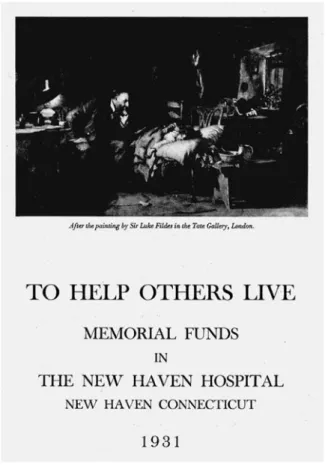
Yet, there were important counter-images, largely overlooked by historians, which celebrated the virtues of a less reductionist medicine and a more personal, individuated doctor-patient relationship. Hospitals, for example, often used The Doctor in their fundraising campaigns, as in the 1931 New Haven Hospital brochure in Figure 2, implicitly pledging the kind of unmediated, devoted, personal attention depicted in Luke Fildes’s painting. At the Chicago World’s Fair in 1933, which was renowned for its modernist architectural design, the Petrolagar pharmaceutical company exhibited its life-size diorama of the scene Fildes had created in The Doctor. The souvenir brochure (Figure 3) told visitors that it celebrated “the ideal relationship between physician and patient — ‘The Human Touch.’” The outside of the exhibit was styled after an English thatched-roof cottage, evocative of an earlier age. The exhibit then went on tour around the
country, viewed by at least 5 million people (Sculpticolor of Fildes’s Masterpiece
“The Doctor” Goes to Rosenwald Museum 1938: 1116). During the Depression, the painting appeared widely in popular media lamenting the passing of the family doctor. “Ideally,” the New York Times commented in 1932, “the family physician is a somewhat godlike person, impressively dignifi ed, yet radiating sympathy;
serenely aware of his power over ills, his suave word a mystical benediction, his very presence brings hope and confi dence…. Such is the central fi gure in the famous painting, ‘The Doctor’” (Robbins 1932).
Some physicians worried that the art of medicine was being forgotten in the enthusiasm for reductionist science, and that the new generation of medical students were being trained to place little stock in the importance of individual observation and personal judgment. “During the past decade, it has become a rather popular diversion among too many of our teachers of medicine and surgery to decry the
Figure 2 During the interwar years, hospitals widely used The Doctor in their fundraising literature, as in this brochure from the Yale University affi liated New Haven Hospital from 1931 (courtesy Historical Medical Library, Harvey Cushing/
John Hay Whitney Medical Library, Yale School of Medicine, New Haven, Connecticut).
‘art,’” Nebraska physician Irving Cutter told those gathered for the 1923 Annual Congress on Medical Education convened by the Association of American Medical Colleges. Medical schools reconstructed after the blueprint for medical education that Abraham Flexner had put forward in his 1910 Report on Medical Education in the United States and Canada sought to train doctors as medical scientists, placing laboratory instruction at the core of their professional formation. Like other critics of the emergent plan for training doctors, he charged that “too little do we teach that the patient is not made up along of tissue structures but is a personality functioning in a given environment,” and urged that “the apotheosis of pure science must give way to the larger conception of the conscientious care of the sick.” Taught to concentrate on laboratory fi ndings and objective signs derived through instruments, new medical graduates distrusted their own observation and clinical acumen. As Cutter pointedly charged, “They fail to look squarely at the patient”
(Cutter 1923: 1011).
Figure 3 Two pages from the souvenir brochure for the Petrolager pharmaceutical company’s exhibit on The Doctor at the 1933 Chicago World’s Fair (original in author’s possession).
The public appeal of a nostalgic image of the general practitioner or family doctor who knew the whole person was perhaps nowhere so evident as in the huge popular success of Kansas physician Arthur Hertzler’s bestselling 1938 book The Horse and Buggy Doctor. “Nothing so individual as the practice of medicine can ever be standardized,” Hertzler had asserted in a 1934 address to colleagues.
Understanding the whole of a patient’s life was “the very foundation of the art of medicine,” as he put it. “It is the failure to appreciate the human touch that makes of medicine a business and a business can be made of medicine only in so far as it is an exact science but medicine will always remain in large part an art” (Hertzler 1934). Horse and Buggy Doctor was, in Hertzler’s words, “a record of the old country doctor,” a depiction of practice in which the relationship between the individual doctor and individuated patient was key — a relationship that valued rather than banished what he tellingly called “the personal equation” (Hertzler 1938: ix, 208). “The intimate contact between doctor and patient as here set forth is passing,” Hertzler told his readers (Hertzler 1938: 306); yet, as he insisted, “the practice of medicine is an art, no matter how profound the scientifi c knowledge”
(Hertzler 1938: 53).
The rise of specialism and the lament over the passing of the family doctor gave holism new and intensifi ed meaning. And during the 1920s, elite specialists also came more explicitly to identify the art of medicine with holism. Harvard medical professor Francis Peabody, for example, writing for his peers, urged that
“in the trend toward specialism the pendulum is swinging too far” (Peabody 1930:
25). “The truth of the matter,” Peabody insisted, “is that the practice of medicine is intensely personal and no system or machine can be substituted for the personal relationship” (Peabody 1930: 23 24), and he encouraged his colleagues to resist a reductionist “clinical picture” in favor of what he called “an impressionistic painting of the patient surrounded by his home, his work, his relations, his friends, his joys, sorrows, hopes, and fears” (Peabody 1930: 23 33). It was this more holistic understanding of the doctor-patient relationship that he called upon his fellow doctors to recover. “The practice of medicine in its broadest sense includes the whole relationship of the physician with his patient,” Peabody urged. “It is an art, based to an increasing extent on the medical sciences, but comprising much that still remains outside the realm of any science” (Peabody 1930: 29).
Osler’s mantle largely fell to his student Harvey Cushing — Hopkins educated, professor fi rst at Harvard and then at Yale, and the leading neurosurgeon in the country. All across the interwar years Cushing stood as avatar and spokesman for the position maintaining that despite exhilarating gains, medicine was losing something important in a too ardent embrace of the experimental sciences, over- specialization, and styling of the doctor as scientist. He instead extolled the virtues of a carefully cultivated, gentlemanly generalism. “I don’t for a moment mean to
imply that we should go back, for there’s no going back,” Cushing told the Congress of Physicians and Surgeons in 1933 (Cushing 1933: 1572); but “the practice of medicine is an art and can never approach being a science.” Cushing noted critically that “there has been much idle talk … regarding scientifi c medicine and the modern scientifi c doctor who with his ingenious appliances and mathematical exactitude has come to supplant the old fashioned ‘practical’ doctors” (Cushing 1933: 1571). He lamented that in teaching medical students, “from fi rst day, . . . the prevailing system points toward that very thing which we now decry — overspecialization” (Cushing 1933: 1573). Cultivation of the art of medicine, which Cushing associated with “a more humanistic attitude,” would, he hoped, “check the present trend toward a machine-made and -operated civilization”
(Cushing 1935: 143, 138).
Like Osler, Cushing saw books and medical history as one vehicle for developing an elite, humanistic, homosocial professionalism that was to be a partial antidote to cultural fragmentation, overzealous reductionism, and narrow specialism.
In 1929, two major medical history libraries opened, the Osler Library at McGill University in Montreal (which had at its core Osler’s own collection of rare medical books) and the Welch Library at Hopkins, and Cushing’s comments at the Baltimore dedication are especially revealing. He chose as his topic, “The Binding Infl uence of a Library on a Subdividing Profession.” “Medicine has become so scattered and subdivided,” Cushing told the gathering, “there is crying need for someone to lead it from the wilderness and again bind it together” (Cushing 1930: 30). He envisioned the library as a workplace “where an interest in the history of our great profession will so fl ourish as to permeate into all departments of a much-divided [medical]
school” (Cushing 1930: 41 42). As he asked the gathering, “In the modern development of the physician into a scientist, have we not lost something precious that may without risk of pedantry be brought back to Medicine? Not only has the art of healing … come more and more to be lost sight of as the doctor arrives at his diagnosis in the laboratory rather than at the bedside, but less and less does he care to be reminded that poetry, history, rhetoric and the humanities once had close kinship with natural philosophy when Doctores Medicinae took the lead among the Artisti” (Cushing 1930: 38).
Several years later, returning by train to New Haven from Montreal, where he had revisited the Osler library, Cushing came up with the plan of joining with two other physician-book collectors to create a similar medical historical library at Yale.
It was to be a space with a distinctive look — what Cushing called “a certain humanistic fl avor” (Cushing 1939: 48; Pennoyer and Walker 2009: 249 251). The Historical Medical Library was dedicated in 1941, and by mid-century, virtually every North American medical school had at least a medical history room, usually built around doctors’ bequested private collections. At Yale’s history of medicine
library, the reading room was a distinctly themed space where some imagined English gentleman of an earlier era might have felt at home. Just as it was to be a cultural antidote to excessive reductionism, specialization, and cultural fragmentation, it was to be a counterpoint to a reductionist aesthetic — a space that leads away from our most engrained images of stripped down medical modernism.
Here again, in bricks and mortar, we see early elite strivings to re-enchant the art of healing in the age of medical science.
During the 1920s and 1930s, myriad experiments in clinical education sought to expand medical students’ vision to encompass what often was expressed as “the patient as a whole.” Among the most ambitious and prominent of such curricular initiatives was undertaken by George Canby Robinson, a Johns Hopkins graduate and biomedical researcher who spent his career teaching at leading medical schools and who in the 1920s became increasingly absorbed with the direction of American medical education. “In their devotion to science,” Robinson maintained, “leaders of medicine have had little time or energy for the consideration of the patient as a person, as a unit in a complex society and as an organism subjected to many stains and stresses from his environment” (Robinson 1939: 9; Brown 1998). One result was an overreliance on “measurements, calculations, controlled experiments and data that can be treated statistically,” at the expense of attention to knowing each patient as an individual in ways that often did “not allow strict objectivity”
(Robinson 1939: 2). “The art of medicine,” as he conceived of it, was what mediated between a universal medical science and the specifi c needs of the individual patient (Robinson 1938: 65).
Neglect of attention to the patient as a whole, Robinson lamented — “regard for the particular characteristics of the individual and for the total situation of which he is the center” — was undermining the doctor-patient relationship (Robinson 1939: 414). “Those familiar with the relationship of doctor and patient, which in the popular mind was an outstanding feature of medicine in the days of the family doctor, express regret that the sort of medical service which he rendered can no longer be obtained” (Robinson 1939: 2). Robinson was in no way disparaging a reliance on the high-tech medicine, but he was calling for a re-embrace of the personal equation as a valuable ingredient in good medical care and for the resurrection of holistic understandings of the individual. It was an approach to “the relationship of doctor and patient” that celebrated rather than denied what he called
“the human side of medical practice” (Robinson 1938: 65).
The task at hand for medical educators, Robinson urged, was “resurrecting the family physician in a modern form” (Robinson 1938: 71). At the 1938 annual meeting of the Association of American Medical Colleges, Robinson spoke on “The Study of the Patient as a Whole,” an address that called for holistic understanding of the patient as an individual, including personality, environment, and social
setting. To this end, the plan he promoted turned upon introducing medical students to the importance of “knowledge of the patient as a total individual” on the hospital wards and setting up visits by them to patients’ homes, which pressed students during a formative stage in their professional training “to consider the patient as a total individual and to learn to appreciate the signifi cance of social and environmental problems as part of medical care” (Robinson 1938: 390; Robinson 1939: 66). In 1939, building on his efforts over two decades to cultivate an intimate doctor-patient relationship and to help students in developing the art of medicine in their approach to medical work, Robinson published as a capstone to his career the revealingly titled monograph The Patient As a Person.
The interwar celebration of the art of medicine, the virtues of generalism, the individuality of each doctor and each sick individual, and a holistic approach to the doctor-patient relationship was in no way anti-science. But it did constitute an alternative vision of the medical enterprise. It was an alternative that sought a middle path between exhilaration over medical progress rooted in reductionist experimental science and the gloom that preyed on so many Western thinkers after the First World War. In this, it clearly resonated with a larger interwar fascination with cognitive and cultural holism (Lawrence and Weisz eds. 1998b). It was deeply embroiled with wider anxieties about social disintegration and what cultural critic Lewis Mumford called “the rise of the machine and the fall of man” (Mumford 1944: 391). Writing in 1944, Mumford charged that “modern man is the victim of the very instruments he values most. We have sought to achieve perfection by eliminating the human element.” Instead, looking ahead to the end of the end of World War II, he proposed that “we must reassert once more the primacy of the person” (Mumford 1944: 393). Envisioning a postwar path consecrated to “not the specialist but the whole man,” Mumford concluded that “his education, his discipline, his daily routine must tend toward this wholeness” (Mumford 1944: 419).
4 The Doctor-Patient Relationship in the Early Cold War
Historians have characterized the years immediately after the Second World War as the Golden Age of American medicine — the zenith of public confi dence in the power of reductionist medical science, esteem for the physician as scientist, investment by government and philanthropies in research laboratories, and cultural authority of the profession. Public expectations of medical progress stemming from laboratory research, which had been bolstered by the development of the sulfa drugs in the 1930s, intensifi ed in the 1940s with the lionization of penicillin by the media as a “wonder drug.” In Hollywood fi lms, which often glossed over the distinction between the medical researchers and practicing doctors, the portrayal of laboratory researchers as cultural heroes both drew on and promoted an image of the physician as biomedical scientist. Just after the war, mass crusades against
disease, such as the March of Dimes against polio, introduced the “poster child” as a vehicle for cementing in the public mind the expectation that faith in (and funding for) biomedical research would inevitably lead to the conquest of diseases like polio. Public confi dence reached new heights in the 1950s when Jonas Salk announced a vaccine against polio: no medical discovery before or since was covered as intensively by the popular media.
And yet, I would argue, here again the mystique of a Golden Age rooted in the clinical and cultural power of reductionist biomedical science, so celebrated in the mass media at the time and so dominant in later historical accounts, has made it diffi cult for historians to recognize important countercurrents, including both public dissatisfaction with the headlong embrace of reductionism, specialism, and high-tech medicine, and alternative visions for the medical future that found advocates within the mainstream medical profession and receptive audiences in the American public. “The man on the street is down on doctors,” one physician refl ected in 1947, in words that ran counter to our most engrained images of the Golden Age. “You can hear him on the train or bus, or in the barber shop. … There is considerable resentment that the old-time family doctor is not to be found when needed” (Stubbs 1947: 135). He went on to argue that “as the specialist narrows his fi eld he pays the price of becoming merely a high-grade technician in the eyes of his critics” (Stubbs 1947: 136). He concluded by suggesting that “doctors are realizing more and more that there has been a preoccupation with the treatment of diseases which has interfered with treating the patient as a whole” (Stubbs 1947:
136 137).
As the post-war era opened, then, beneath the jubilation over biomedical triumphs was a pervasive undercurrent of concern that the doctor-patient relationship was troubled. “The scientifi c attainments of medical science have advanced greatly in this generation,” one surgeon refl ected before a gathering of urologists; but, he went on to assert, “the art of the practice of medicine has not kept pace” (Barnes 1954: 192). As another physician echoed, “The art of the practice of medicine seems at times to be forgotten and the patient-physician relation relegated to the background,” adding that “it must never be lost sight of that the physician-patient relation is a personal one” (Luce 1952: 784). Thus a Columbia medical professor could observe that “in spite of the scientifi c triumphs over disease, . . . the physician himself is today in danger of losing the faith and the affection of the people and his time-honored position in society” (Severinghaus 1954: 418).
This pivot upon which this declentionist discourse turned was fragmentation — both the reductionism of modern medicine and splintering of practice into increasingly discrete specialties. Such anxiety was longstanding, but by the middle of the twentieth century the apprehensions that had fi rst emerged toward the end of the nineteenth century had become the cognitive and social
realities of modern medical practice. “Something has been lost, and both doctors and patients are anxious to see it returned,” a Michigan doctor asserted. “It is the close personal bond of trust and confi dence which rewards the true family physician who not only treats the outward manifestations of disease disclosed by his stethoscope and otoscope, but who knows the family history and the home background, and who understands from his own personal observation in the home, the hereditary, environmental and emotional factors contributing to the disease picture.” The challenge was for the practitioner to “keep uppermost in his mind that it is the human being who has come to him for help — and not the human being’s separate parts” (Deetar 1951: 102). Echoing calls from professional leaders and medical educators to retrieve “the personal physician-patient relationship” (Barnes 1954: 192), the editor of the New York Times urged in 1946 that medical schools should reorient the training of physicians to emphasize “the treatment of the ‘whole man’” (quoted in Johnson 1946: 2).
It was in this context that the fi gures of the family physician and the “horse- and-buggy doctor” prominently reemerged, invoked in part nostalgically as symbols of a fading medical past but more especially as embodiments of a holistic doctor-patient relationship to be emulated in the present. “In the days of the ‘horse and buggy doctor’ there was an intimate physician-patient relationship,” one California physician typically asserted; “the family doctor was a friend of everyone in the community; he was admired, loved and respected” (Barnes 1954: 192). The specialist, on the other hand, one medical educator noted, was criticized chiefl y as one who “has lost the human touch and is no longer interested in the patient as a person. For this he is brought into sharp and unfavorable contrast with the general practitioner or the ‘house and buggy’ family doctor of yesteryear” (Severinghaus 1954: 418). The solution, he continued, was not a retreat from specialism, but emulation of earlier more holistic, more intimate practice “to develop or foster in the student a better appreciation of human values, an interest in the patient as a person, and an awareness of the importance of the social and environmental factors that surround the patient and infl uence his health and disease” (Severinghaus 1954:
420). Tellingly, physicians frequently cited Osler’s words from a half century earlier, celebrating the family doctor as the heart and soul of the medical profession, as being more relevant than ever before (e.g. Johnson 1946: 4).
Let me offer in detail just one concrete example of how the organized medical profession publicly portrayed a holistic doctor-patient relationship as an embodiment of what it stood for. Between 1943 and 1950, the U.S. Congress debated a series of bills that would have established national health insurance and the American Medical Association (AMA) — the leading professional body — mounted an aggressive lobbying campaign against that move (Blumenthal and Morone 2009;
Campion 1984: 128 151; Engel 2001: 275 309; Poen 1979). To stand for everything
that would be lost if the state were impose what they called “socialized medicine,”
they selected Fildes’s painting The Doctor. In 1947 that image appeared on a U.S.
postage stamp to commemorate the centenary of the AMA, shown in Figure 4 (The Doctor 1947; The centennial stamp 1947), and then in pamphlets (such as the one in Figure 5), posters in doctors’ waiting rooms, print advertisements, and, at medical conventions, on gigantic banners, all with the slogan, “Keep politics out of this picture” (Warner 2011; Warner 2013; Warner 2014)3).
The scene captured in The Doctor fl ew in the face of what historians have identifi ed as the reigning imagery of the Golden Age — reductionist high-tech medical science pursued by white-coated researchers in laboratories and practiced by white-coated specialists in the temples of science, the modern hospital. Here, instead, was a depiction of the doctor-patient relationship that conjured up the professional virtues associated with both the family doctor and the physician-
Figure 4 U.S. postage stamp issued in 1947, featuring The Doctor, to commemorate the centenary of the American Medical Association.
Figure 5 Whitaker and Baxter circulated millions of copies of The Doctor with the caption “Keep politics out of this picture,” as in this pamphlet from 1949 (courtesy American Medical Association Archives, Chicago, Illinois).
gentleman. The setting is a small cottage, not a hospital; this is quintessentially the solo general practitioner, not one among a team of specialists; and there is time.
But there was a profoundly important shift here in the social and cultural meaning of this alternative to reductionist biomedicine. Capitalizing on the public’s anxieties and fears, the AMA transformed the alternative, holistic image of medicine that co-emerged with the rise of reductionist biomedicine into a political commodity, and that was new. For half a century, holism had fi gured in mainstream medicine chiefl y as a discourse of defi ciency, a lament about what had been lost and pleas for its recovery. This new depiction of a holistic doctor-patient relationship was instead mustered as a warning, raising a frightening specter of what would happen to American health care if politics were not kept out of this picture. State intrusion into the doctor-patient relationship, AMA leaders charged, not only would lead to socialized medicine but also would be the entering wedge for the larger socialization of American society — the slippery slope to communism. Displayed at midcentury, the relationship captured in Fildes’s painting was an enticing cultural fantasy, a comforting fi ction that bore little resemblance to the relationship between most American doctors and patients but that captured contemporary yearnings while playing on apprehensions that many Americans shared. The image of a personal doctor-patient relationship at risk, appropriated for this political campaign during the early years of the Cold War, preyed upon the American public’s worst fears about modern medicine while tapping into their larger fears about socialism, communism, and the unraveling of the American way of life.
To sell its message, late in 1948 the AMA created the National Education Campaign and engaged the Whitaker and Baxter public relations fi rm to take its case to the American people. Since the mid-1940s, Clem Whitaker and Lenore Baxter, a husband and wife team of political consultants, had been fi ghting against compulsory health insurance for the California Medical Association (Kelly 1956;
Lepore 2012; Hunton 1947)4). “Your profession is in the front lines in one of the most critical struggles in the history of this Nation,” Whitaker told California doctors: “This is a cold war, right here in America” (Whitaker 1948).
For the AMA, they went on to launch one of the great public relations campaigns of modern American politics, with The Doctor as its centerpiece — circulated in newspapers, magazines, press releases, and direct mail;
discussed on radio and in exhibits. “There is something in that picture,” Baxter told AMA leaders, “which represents one of the most priceless possessions you men of medicine have in your whole fi ght against assembly line medicine. In that doctor’s face there is compassion, there is a personal concern for the welfare of his patient, there is personal loyalty to the patient as a human being” (Baxter 1949: 696).
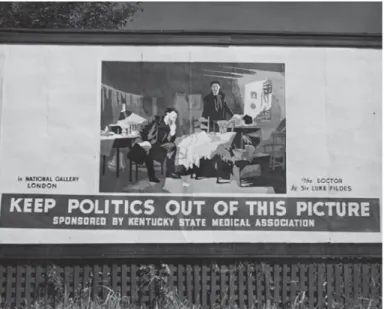
This was a massive campaign — at the time the most expensive lobbying effort in American history. Whitaker and Baxter placed The Doctor on roadside
billboards, like the one in Figure 6, along with the ubiquitous message, “Keep politics out of this picture.” They acted as a news service, providing thousands of newspapers with ready-made feature stories, templates for editorials, and political cartoons. They had county medical societies distribute vast supplies of pamphlets, instructing doctors to keep them in their waiting rooms, and provided stamps and stickers carrying their message for doctors to use on correspondence and bills, lobbying their patients (see Figure 7). They provided scripts for radio “interviews”
with doctors, written in a way that would sound like they were taking questions from an audience. And they also worked through Women’s Auxiliaries
— organizations affi liated with state and local medical societies and chiefl y made up of doctors’ wives — to sponsor lectures, to see that poster versions of The Doctor were displayed in hospitals, and to hold dinner parties at which a copy of the pamphlet was placed on each plate. By the end of 1949, they had produced 100 million pieces of literature, and persuaded tens of thousands of businesses
— restaurants, car dealers, and especially retail drug stores — to buy advertising space for them in local papers (Whitaker and Baxter 1949; National Education Campaign 1949a; Plan of Campaign for 1950; National Education Campaign 1950;
Whitaker and Baxter 1950a; Whitaker and Baxter [1951]).
When the AMA annual convention was held that year in Atlantic City, Whittaker and Baxter could claim plausibly that the poster version of the “The
Figure 6 Billboards depicting The Doctor along with the caption “Keep politics out of this picture” appeared on highways across the United States, as in this Kentucky example, launched as part of the Whitaker and Baxter campaign and sponsored by the state medical society (courtesy California State Archives, Sacramento, California, Whitaker and Baxter Papers, box 10, folder 19).
Doctor” was on display in more than 100,000 doctors’ offi ces. “‘The Doctor’
arrived,” one Ohio physician reported to them in his hand-written thank you note.
“He is in my waiting room witnessing effectively against the socialization of the practice of medicine” (Shumaker 1949). The painting was on billboards lining the highways into the city and along the renowned ocean-front Boardwalk. The backdrop to the Convention Hall stage was a huge reproduction of the painting — 7 meters tall. “The Fildes painting,” a convention press release declared, “portrays a relationship between doctor and patient which would be destroyed by politically- controlled medicine” (National Education Campaign [1949b]).
Other visual images that had been circulated as part of the larger AMA campaign reinforced a particular reading of The Doctor and what it stood against.
“Often human life depends upon a physician’s skill — shall he be made subservient to politicians?” read one newspaper advertisement (Natrona County Medical Society 1945). Cartoons tellingly featured images of doctors reduced to mere technicians — depicted as puppets or as robots5). These were images of standardization, impersonality, fragmentation, mechanization, and routinization.
So too, the patient became a nameless unit on a factory assembly line, a machine, not a person — mechanistic reductionism run amuck. The Doctor in Fildes’s picture would not have the time, commitment, or option of lingering watchful at his patient’s side. “Politically-controlled medical practice,” one AMA offi cial warned,
Figure 7 The American Medical Association’s National Education Campaign, directed by Whitaker and Baxter, distributed millions of pieces of literature in their battle against national health insurance, here in a booth at the Catholic Press Association Convention in 1950 (courtesy California State Archives, Sacramento, California, Whitaker and Baxter Papers, box 10, folder 19).
“would result from government-herding of patients and doctors into assembly-line medical mills [and] would lower the standards of healthy America to those of sick, regimented Europe” (Henderson n.d.).
The Doctor promised the public a clear alternative, standing for holism, connectedness, and a personal, unmediated doctor-patient relationship. “Because the practice of medicine, if it is to be performed faithfully and effectively, is essentially a personal service,” the President of the California Medical Association told the public in a radio address, “the personal physician-patient relationship is a most important ingredient in medical care. The modern personal physician — in just the same way as the old-fashioned family doctor of the horse-and-buggy days — takes care of the whole man” (MacLean 1951). The campaign tapped into the public’s yearnings for connectedness, wholeness, and individuation, just as it incited its fears about the depersonalization of modern medicine, the replacement of the general practitioner by teams of anonymous specialists, and the breakdown of the doctor-patient relationship. The letters that poured in from lay men and women testifi ed to just how successful the AMA had been in equating national health insurance with state intrusion into and eventual destruction of a personal, intimate, holistic doctor patient relationship. As a woman who had served as an Army nurse during the Second World War wrote to President Truman just after the end of the confl ict, echoing AMA polemics, “Is it possible that while our boys were at the front giving their legs, arms or life for freedom and liberty, the people we left in charge of affairs in Washington have lost faith and the land of opportunity and freedom has taken steps toward a totalitarian state — please don’t let us down — or could it be that we have fought this war in vain?” (Bearss 1946).
There were physicians — a minority — who objected to the use of The Doctor to represent their profession — those who saw it as a nostalgic celebration of the doctor-patient relationship that masked over the social and technological realities of modern medicine and the economic problems of health care distribution. “In creating the great bogey of government interference in the doctor-patient relationship, the AMA has succeeded in impairing a still more important relationship — the faith of the American people in the disinterested guidance and leadership of the medical profession,” Ernst Boas, leader of the oppositional Physicians Forum, charged (Head of AMA Scorned by Physicians Forum 1949; Boas 1950; Brickman 1994). “We agree, of course, that the picture is ‘dated,’ if viewed literally,”
Whittaker replied in a private letter to one such North Carolina physician who objected to such an antiquated, nostalgic picture; “but on that basis a great many things are ‘dated,’ including the Hippocratic oath [and] the Bible. ... The Fildes painting of ‘The Doctor,’ even though it is old fashioned, portrays something which is beyond value to the medical profession. ... ‘The Doctor’ isn’t just an out-dated painting. It is a vivid portrayal of the vitally important physician-patient relationship
which has made doctors something more than medical technicians. And that relationship is out-dated only in countries which have adopted socialized medicine”
(Whitaker 1950b).
The AMA’s main rejoinder to critics, however, was red baiting. These years marked the height of fears about communist infl uence on American institutions, the heyday of McCarthyism and hearings conducted by the House Un-American Activities Committee. The new AMA president put things this way in his 1950 inaugural radio broadcast: “American medicine has become the blazing focal point in a fundamental struggle which may determine whether America remains free, or whether we are to become a Socialist State, under the yoke of a Government bureaucracy.” The coming congressional debate over “socialized medicine” was to be “The Battle of Armageddon — the decisive struggle which may determine not only medicine’s fate, but whether State Socialism is to engulf all America”
(American Medical Association 1950; Henderson [1949]).
It matters that in choosing an emblem of American medicine at midcentury, the AMA eschewed images that celebrated the triumphs of modern, high-tech, reductionist biomedicine in favor of an alternative image of healing that invoked a holistic doctor-patient relationship. At the height of the Golden Age, this was the single image of doctor and patient that was most widely circulated and seen, an image that marked a distinct counterpoint to aesthetic modernism. It was an unrealistic portrayal of either the realities or possibilities of modern American medicine, but the fi ctive healing alternative it displayed was powerful, enticing, and consequential.
5 Conclusion
By the early 1950s the AMA had succeeded in defeating national health insurance. In the process it had also powerfully impressed on the public mind the image of a personalized, holistic doctor-patient relationship that stood in sharp contrast to the cognitive, technical, and social realities of modern biomedicine. That image of a holistic alternative to the detached, impersonal, hyperspecialized physician-scientist was politically compelling, just as its promise was comforting to many American men and women. But I would suggest that it also inadvertently set up dangerously infl ated expectations of the doctor-patient relationship that, when unmet (as they inevitably were), led not only to disappointment but also to resentment. “We have developed and fostered the concept of dedication until it has become a vulnerable point for attack,” one physician would refl ect in 1964, in a letter to the editor published in the Journal of the American Medical Association.
“The picture of the tireless physician remaining at the patient’s bedside, such as portrayed in Fildes’ great painting, ‘The Doctor,’ is cherished by the public as a nostalgic reminder of the unpressured, free, and leisurely atmosphere of the past.
The dedication of the physician is a part of that longed-for past, and anything that adversely affects the image will bring resentment” (Popkin 1964: 154).
And so it did. Popular disaffection with the doctor-patient relationship, incited by the undeliverable promises implicit in the Whitaker and Baxter campaign, was already evident by the late 1940s and early 1950s — clearly legible, for example, in the letters that lay Americans sent to the key parties orchestrating the debate over national health insurance — such as Whitaker and Baxter, legislators, and President Harry Truman. They wanted the kind of devoted, personal attention they saw displayed in the ubiquitous posters, pamphlets, and billboards depicting Fildes’s The Doctor, but by and large this is not what they experienced in their own health care.
In 1950, the California Medical Association responded to the growing sense that the doctor-patient relationship was in trouble by hiring psychologist and marketing expert Ernest Dichter to undertake a study of “the doctor-patient relationship.” Dichter, regarded as the “father of motivational research” and a leading expert on consumer behavior in the marketplace, concluded on the basis of extensive interviews with patients and doctors that, as he put it, “the ideal doctor is gone” (Dichter 1950: 6). One 26 year old insurance agent, for example, complained that “they turn these doctors out now on a belt system. It is mass production. … They are more like robots now. … they become automatic and lose their humaneness. They forget that the people they are treating are human beings and not animals” (Dichter 1950: 6). As another respondent put it, “A good doctor requires more than good training. A good doctor must be able to apply his knowledge to the individual patient. The problem is for a doctor to be able to apply the same knowledge to different patients according to the peculiarities of each patient. Each patient calls for a different approach. It is perhaps something intangible that I am trying to describe” (Dichter 1950: 26). And, looking back nostalgically at earlier times, one general practitioner told Dichter that “the doctor has to treat the entire patient — the patient as a whole. That dammit is why I’m a general practitioner yet, and not in limited specialty, because I feel that the general practitioner is the ideal person to — to see the patient as a whole” (Dichter 1950:
20).
And what were the consequences? First of all, this I believe helps us to better understand what happened in the 1960s and 1970s, with the decline in the cultural authority of the medical profession that conventionally has been taken to mark the end of the Golden Age. Historians recognize how the wider anti-establishment movements of those decades, such as the Civil Rights movement and protests against the war in Vietnam, encouraged distrust of medical expertise and established medical authority. The challenge to biomedical authority and death of deference was expressed in cultural phenomena ranging from the women’s health
movement to the patients’ rights movement to anti-psychiatry, with a call for people to retake control of their own bodies and their own health care. “De-humanization”
became a key watchword in the radical assault on the medical establishment, one ingredient in the larger cultural critique of established authority; and this in turn, involved a new, skeptical attitude toward the role and worth of science in medicine (Warner 1985, 1995, 2004).
But the politicization of the doctor-patient relationship by the medical establishment in the 1940s and early 50s, and in particular the concerted political deployment of an alternative, holistic model of healing, also set the profession up for a fall. It had fostered infl ated, unrealistic expectations that, when disappointed, helped turn the public against the biomedical establishment. In a sense, I would suggest, the strategic deployment of the image of a holistic alternative to reductionist biomedicine was a catalyst that transformed concerns about the doctor-patient relationship that had fi rst been articulated at the start of the century into a crisis, with the widespread agreement that the doctor-patient relationship was breaking down.
For patients, increasingly restyled as health care consumers, disappointed expectations led people to seek the holistic healing they could not fi nd in biomedicine in other medical alternatives, such as homeopathy and naturopathy. It was in part the medical profession’s somewhat cynical, clearly political promotion of an image of a holistic doctor-patient relationship that, when disappointed, impelled the American public to other iterations of holistic healing alternatives.
There was a popular resurgence of alternative healing, usually under the broader umbrella of holistic healing, which seemed to meet the demand of American men and women for something more than biomedicine alone could deliver. “’Holistic medicine,’” Anne Harrington observes, “coined in the 1970s, functioned above all as a political statement of commitment to healing the whole person in clear opposition to an increasingly vilifi ed reductionist medicine” (Harrington 2008: 244;
Johnston ed. 2004; Rosenberg 1998; Whorton 2002). This was the moment when healing alternatives with claims to holism such as homeopathy, naturopathy, and a whole host of self-help programs gained renewed prominence in American life, offering the public what appeared to be lacking in high-tech, reductionist biomedicine. The turn to alternative and complimentary therapy that was such a prominent part of American health culture during this period — the promise of holistic, individuated, personalized health care — was most certainly informed by the wider suspicion of established, establishment authority; but, at the same time (and largely unrecognized), it was also a response to the appropriation at midcentury of an image of a holistic doctor-patient relationship for political purposes and the successful infusion of that image into the American consciousness.
For mainstream doctors, the impossibility of delivering the holistic alternative
that professional leaders had advertised coupled with rising assaults on the ethical shortfalls of high-tech, reductionist biomedicine would prompt formal maneuvers to coopt the radical potential of the new public engagement with holistic alternative medicine by the creation of bodies such as the Offi ce for Complementary and Alternative Medicine at the National Institutes of Health. But more fundamentally, it reinvigorated the discourse of defi ciency that had fi rst arisen late in the nineteenth century as one response to the rise of the new scientifi c medicine. “If people were ever industrial robots, they might need no more than technological medicine. But actually they are not,” one physician told a New York gathering in 1961. “It is because they are aware of this that older people look back wistfully to the horse and buggy doctor” (Fox 1962: 534). The emergence of biomedical ethics in the 1960s and the coalescence of a medical humanities movement offered an internal critique and, at the same time, a shield against external attack. The Society for Health and Human Values (Fox 1985; Rothman 1991: 141 142), for example, was established in 1969 to “identify explicitly the human values that are lacking or inadequately represented in the study and practice of medicine and to begin to remedy the defi cit” (quoted in Fox 1985: 334). What drew its members together was the conviction that biomedical science and the technology it informed could strip medicine of important dimensions of healing. Their aim was to instill in medical practitioners the “human values” they held to be wanting. As in the turn to history at the start of the century by physicians like Osler, the “medical humanities” were portrayed partly as an antidote to mechanistic reductionism, with the aim of fostering empathic patient care (Bylebyl 1982; Dolan 2010; Cook 2010).
Indeed, the American Osler Society had its inception in the late 1960s, rooted in concern among some physicians about “the growing sterility induced by the prevailing emphasis on science in medical education.” As one founding member later explained, “the concern was not a reaction against science but rather with the apparently concomitant loss of humanity and humaneness in our profession”
(Roland 2000: 1). Taking Osler as a humanist role model, another founder said at the inaugural meeting, was “the reinstatement of humanism in medicine and the breeding of cultured, learned and devoted gentlemen” (Henderson 1971: 344). This was the cultural current that later would lead physicians who placed themselves in an Oslerian tradition to urge the cultivation of a “nostalgic professionalism” (Bryan 2013: 97).
By the mid-1970s, medical ethicist and educator Edmund Pellegrino could rightly assert that “medical humanism has achieved the status of a salvation theme, which can absolve the perceived ‘sins’ of modern medicine” (Pellegrino 1976: 9)6). He warned fellow doctors to heed the charge that “we neglect the teaching of human values and the art of medicine; that in our zeal for science we ignore liberal studies; and, most telling of all, that the patient care we provide in our teaching