Restyling the Milieu : On Milieu Making Practices around Tuberculosis Treatment Projects in Southern Ghana
著者(英) Akinori Hamada
journal or
publication title
Senri Ethnological Reports
volume 143
page range 141‑161
year 2017‑12‑01
URL http://doi.org/10.15021/00008654
Restyling the Milieu: On Milieu Making Practices around Tuberculosis Treatment Projects in Southern Ghana
1)Akinori Hamada
Kansai University
This paper explores the dynamic nature of the milieu by describing the situation of tuberculosis (TB) in Southern Ghana. Using Foucault’s analytical concepts of the milieu, the dispositive and self-government, it discusses how what anthropologists call ‘context’ is constructed through and restyled by the milieu making practices of multiple actors.
Regarding tuberculosis in Southern Ghana, the largest milieu making actors are the tuberculosis project supported by international agencies and NGOs, which has built on and rearranged the existing national health infrastructure.
This large-scale project aims to govern the actions of tuberculosis and patients by deploying a wide range of things and humans such as pharmaceuticals, patient cards, money, health workers. However, actors such as tuberculosis, patients and family members also try to make their lives better and act through different logics from that of the tuberculosis project.
The aim of milieu-making of this project is ultimately to place TB bacteria in a particular milieu. That is the body which maintaining a fixed circulating concentration of drugs. If during the long period of treatment, however, the circulating concentration of drugs consecutively drops below the required amount, TB bacteria will survive and develop resistance to the drug. Such a change in the subject of the project then radically changes the character of the milieu itself. Efforts to keep a steady circulating concentration become meaningless. By adapting, the bacteria escape from the dispositive that was created to control its behavior. It should be emphasized that this resistant tuberculosis is a product of antibiotics and thus premise and incorporate the existence of tuberculosis treatment project and at the same time, the characteristics of the TB project also already incorporate various characteristics of the TB bacteria. There is a kind of mutual inclusion.
To understand the context of tuberculosis patients, we need to know about milieu making of patients and their family too. Through looking closely the case of Ako who is woman in 50’s and her family member, this paper will reveal the dependent nature of milieu making practices and mutual interference of these practices.
This paper shows how context in which biomedicine work continuously
restyling through multiple milieu making practices of multiple actors. The milieu which canalizes the actions of different actors is not determinately constructed by a single actor, but constantly rearranged by multiple actors. It is formed in the interference of restyling practices.
1. Policy as Milieu-making
2. The TB Project as Milieu-making 3. Adaptation as Milieu-making 4. Ako’s Story
5. Ako’s Milieu-making
6. Conclusion: Restyling the Milieu
“I didn’t use the lorry fee they gave me for a lorry.”
Ako
2)was one of my closest friends during my fieldwork in a rural town in southern Ghana. She was approaching 50 at the time and stood out for being particularly thin, but she was friendly and loved by many. She made this confession to me in July of 2007. Like any other statement, the true meaning and intent behind her confession cannot be understood from a simple reading of the text. Ako’s statement was made within a particular context, and we must understand this context before we can make any probable interpretations. In keeping with conventional anthropological procedure, I intend to contextualize Ako’s statement in this paper. My objective, however, is not to ‘reconstruct’ social context in writing. It is an impossible task for anthropologists to fully understand a social context, and it therefore follows that we cannot reconstruct something we do not understand. Instead, this paper focuses on the milieu-making practices of multiple actors to explore the context of people’s lives and biomedicine in Africa.
Accordingly, exploring tuberculosis and tuberculosis-treatment projects, this paper will demonstrate the importance of non-human actors (Kirksey and Helmreich 2010) and a particular type of relationship between the government of others and the government of self (Foucault 1988; 2008a; 2008b).
1. Policy as Milieu-making
The notion of milieu I use in this paper is from Foucault’s influential lecture series
about governmentality. Foucault describes milieu as a realm created through the
deployment of things, rules, and people within the natural environment (Foucault 2004). Foucault himself uses the term “milieu” to organize these characteristics:
“What is the milieu? It is what is needed to account for action at a distance of one body on another. …The apparatuses (dispositives) of security work, fabricate, organize, and plan a milieu.… The milieu is a set of natural givens – rivers, marshes, hills – and a set of artificial givens – an agglomeration of individuals, of houses, etcetera” (Foucault 2004: 20-21).
To depict a more concrete image, let’s look at what Foucault has to say about the physiocratic theory on how to deal with food shortages (Foucault 2004: 29-53) According to Foucault, the 18th century physiocrats were critical of past policies that kept grain prices low at all times. They argued for lifting the restrictions on price, grain stock, imports and exports, and arable land. The only solution to scarcity was to keep prices up during good harvests, to which end a new system should be established to provide export incentives and increase import taxes.
If grain prices were kept high during good harvests, farmers would not lose money in the event of price reductions, and farmers who produced more grain would also make more profit. Individual farmers would therefore be induced to expand their cropland, and this in turn would tie into reducing the probability of grain shortages. At the same time, trade promotion policies aimed at keeping grain prices high would also prevent sudden price increases in times of poor harvest.
Merchants would likely try to preserve their own profits by holding back until grain prices went up again, but they would also have to consider the possibility of imports from abroad to determine the timing of sale. Thus, grain prices would stop at a certain point and not rise rampantly as they had before.
By abolishing the old rules and introducing a new ones, the physiocrats were in effect calling for a restyling of the milieu in which farmers and merchants lived.
A restyled milieu would guide the actions of farmers and merchants in a whole new direction and ultimately prevent uncapped shortages of food. This example of the phsyiocrats illustrates how the milieu is constantly rearranged by policy. It also hints at an interesting characteristic of the milieu. For example, the existence of uncultivated land and a rise in import taxes are not directly tied together by the movement of things or people, nor is there any reason why they would need to be.
Although they may appear to be two unrelated elements, by being part of the
milieu of farmers and merchants, they lead to the expansion of farmland. The
phenomenon of two mutually unrelated elements collaborating to bring about some
transition in circumstances applies not only to the physiocratic presumption of the
farmer, but as I will argue, to the people of Ghana as well.
2. The TB Project as Milieu-making
Let’s return to Ako’s statement at the beginning of this article: “I didn’t use the lorry fee they gave me for a lorry.” Here, “they” refers to the nurses at a large health center in the mid-sized city of Kade, about 15 kilometers from the rural town where Ako was living. Providing bus fare to Ako was part of their duty in cooperating with the tuberculosis (TB) project. To understand Ako’s statement, we need to look at how the milieu was formed by this tuberculosis project, that is, by policy. Although efforts to fight tuberculosis in Ghana started to gain momentum in the 1990s (GHS n.d.), one of the catalysts for the current policy was the TB Emergency Declaration in Africa issued by the WHO in August of 2005. In Ghana, the tuberculosis treatment project was launched with the support of NGOs such as STOP TB and the Global Fund. The WHO declaration itself took place within a particular milieu and that milieu had in turn been modified by earlier actions. Although it is difficult to describe the whole story of tuberculosis in Ghana, I will next offer a brief summary.
One of the world’s deadliest infectious diseases, tuberculosis is still rampant in Sub-Saharan Africa. WHO estimates for 2012 cited approximately 8.6 million new cases of TB and approximately 1.3 million deaths (WHO 2013: 1). Thanks to the development of streptomycin in the 1950s and the currently widely used rifampicin in the 1960s, tuberculosis went from fatal disease to curable disease
3). Other than having fatal complications with HIV/AIDS
4), there are two explanations for why TB continues to be such a major threat. First, TB is intertwined in a negative spiral with poverty. The biggest contributor to the drop in TB death tolls was not the development of antibiotics or vaccines, but rather the improvement of nutritional conditions and unsanitary environments (McKeown 1988). This hints at the likely fact that patients who develop TB have poor nutrition to begin with. In the rural areas of southern Ghana where Ako lives, nutritional conditions are directly tied to poverty. The production of primarily cacao, palm, and oranges can hardly be called self-sufficient. Very few households provide breakfast for their children, who instead buy porridge, rice, or banku
5)to eat at food stands on their way to school.
Meat, fish, tomatoes and okra used for dishes at dinner are also store-bought. In other words, nutritional conditions depend entirely on how much money people have to spend on food. TB requires a comparatively long treatment period, and patients normally have to complete at least six months of medication. During this time, the disease continues to depress the body and steal its strength. People who are too weak to cultivate their crops fall deeper into poverty and their nutritional conditions worsen. Poverty gives way to TB, which in turn drives people further into poverty.
The second reason for the continued prevalence of tuberculosis is that some
tuberculosis bacteria have developed resistance to drugs. As in the case of all pathogens, when selection pressure increases through medication, only drug- resistant form of bacteria can survive in the body. If there is too much of an interval between drug doses, resistant bacteria will grow and perhaps spread through direct infection from person to person. This process repeats itself until a completely resistant TB bacterium emerges to defy and complicate the usual methods of treatment
6).
In rural area of southern Ghana, TB cases are usually discovered through outpatient health centers and hospitals. TB is suspected if a person comes in for treatment with long-lasting cough, but since a definitive diagnosis cannot be made at a health center, he or she is sent to get smear cultures and x-rays done at an equipped hospital. Since it is not easy for poor patients to make the trip to distant hospitals, Ghana’s TB project provides for transportation fare. Patients who are officially diagnosed by a doctor then return to their local health center to begin treatment under an assigned community health nurse (CHN). The pseudo-adopted course of treatment is known as the Direct Observed Treatment Short course (DOTS), in which health workers visually confirm that patients take their medication. It has become the worldwide standard as the best method of treatment for TB
7).
Patients first receive an explanation of the course of their treatment from their CHN: “You must take your medication every day without fail for the next six months
8). You must mark whether you took your medication on the card you will receive later. You must do this every day. Here is your medication for the initial week, so please come back after one week
9). If you feel ill after taking your medication, do not hesitate to contact us. You must try to avoid hard exercise as much as possible. If you sleep in the same room as your children, you must sleep separately from now on. You should eat a lot of bananas, oranges, pineapple and other fruit if you can. After two months you will need to go to the hospital again for testing.”
So begins half a year of life under treatment. If no TB bacteria are detected after two months, five months, and again at six months, treatment is concluded. If bacteria are found in the phlegm, however, patients are considered to have resistant TB and are put on a two months course of treatment using a different antibiotics.
Since medication in this case is administered intravenously and not orally, patients have to be hospitalized or move close to a hospital.
What kind of milieu and in what way has this milieu been created by the TB
project? The latter question is easier to answer. The TB project, like the
physiocratic policy, creates a milieu by restyling the existing dispositive in some
way. Elements such as hospitals, health centers, doctors, nurses, and x-ray
equipment all existed prior to the introduction of the TB project. But the TB
project has changed how patients are handled in these institutions, and has deployed new things such as drugs, medication cards and subsidized transportation.
In answering the former question, we should focus on how the TB project creates the milieu through its emphasis on controlling patient behavior. Let’s compare it to the campaign against malaria, which is likewise a major health issue in southern Ghana. One of the most important differences between TB and malaria is that the former is a disease spread from person to person while the latter is not directly infectious and can only be transmitted through a certain kind of mosquito. The emphasis in malaria is to prevent mosquitoes from stinging people, that is, to control the behavior of the mosquito. To this end, mosquito nets for babies are distributed at health centers and mosquito nets are sold for adult use. The importance of mosquito control is preached and it is through the words that people become part of the dispositive. They drain pools of water and clear the streets of empty cans to deprive the mosquitoes from any breeding ground, and they hang up nets in their houses. In one sense, the malaria campaign creates a milieu for canalizing human behavior. But it is done mainly through words, urging people to participate in the disposition of “things” meant to shut out malaria. Although free mosquito nets are distributed, they are only for babies and there is limited supply.
No other equipment is being handed out to have people drain puddles or clean up the streets. That is, not many things have been put in place to direct how people behave.
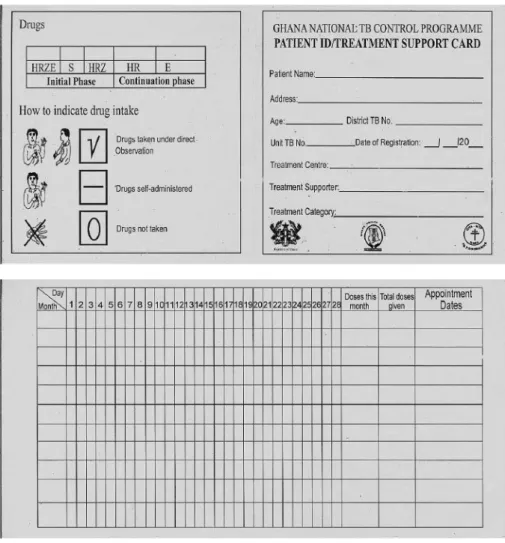
The TB project, in contrast, puts in place more ‘things’ to control how people behave over a much longer period of time and with much more precision. To ensure that patients take their medication regularly, they are given a small “Patient ID/Treatment Support Card” (Figure 1) when they first receive medication from the CHN. The card lists the patient’s name, address, and age, along with a chart for marking whether medication is taken under observation, self-administered, or forgotten. The chart is to be marked every day, and patients must supply their own pen or other writing instrument.
The intent behind making this card and having patients keep records every day is to prevent the all-too-common mistake of forgetting to take medication. We all sometimes forget what we should do, and it is not easy to prevent such slips of mind. But since the treatment of TB requires medication to be taken regularly and precisely, simple mistakes must be prevented by controlling patients through the dispositive of things and acts.
Unfortunately, the dispositive is not functioning at its best in Ghana. As
discussed earlier, direct visual observation by health workers has been
recommended as the standard method for the administration of TB medication. Yet,
as I have implied, this is not strictly practiced in Ghana. Patients stay in their own
homes and may be far from staffed health centers and hospitals. Patients are
fundamentally responsible for recording their medication use themselves or with the aid of a caregiver, and they are not under the direct supervision of any health workers. I myself never saw a medication management card that properly recorded direct observation, self-administration, or missed doses; instead, TB related documents always reported medication being administered under direct medical supervision
10).
While it is easy to point out these deficiencies in the project, it is important to remember that in fact they originate in the characteristics of milieu-making. As when I referenced Foucault’s analysis of physiocracy, to create a milieu is not to create a 1 from a 0. Rather, it is a rearrangement or restyling of the existing milieu. This is why transitions in the TB project are limited by the locations of
Figure 1 TB medication management card
Source: Photograph taken by author on December 10th, 2012
hospitals and health centers, the number of nurses, residential patterns and the range of places in which patients live, the funds available for disbursement, and other elements of the existing milieu.
By creating a milieu, the TB project aims to impede the proliferation of TB bacteria and to reduce the number of TB patients by guiding their behavior in a particular direction. At the same time, we should note that the TB project is not the only actor involved in the creating this milieu. TB bacteria and TB patients are also agents of their own milieu-making.
3. Adaptation as Milieu-making
The aim of milieu-making in the dealing with TB is ultimately to place TB bacteria in a particular milieu, that is, the body in which there is a fixed circulating concentration of drugs. This is the objective behind finding untreated TB patients, carefully deploying things and actions around them, and having them take their drugs regularly every day. TB bacteria will gradually die out by being placed in this milieu. If during the long period of treatment, however, the circulating concentration of drugs consecutively drops below the required amount, TB bacteria will survive and develop resistance to the drug. This is the resistant bacteria. It should be emphasized that this resistant tuberculosis is a product of antibiotics and thus is premised on and incorporated into the existence of the tuberculosis treatment project. We might say there is a kind of mutual inclusion (Mol 2002).
While the milieu contains the bacteria, the bacteria also contains the milieu and the project.
Such a change in this subject of the milieu then radically changes the character of the milieu itself. The drug is powerless to stop the bacteria’s growth. Efforts to keep a steady circulating concentration become meaningless. By adapting, the bacteria escapes from the dispositive that was created to control its behavior.
However, this escape is not as radical as it may seem. The TB project predicated the existence of resistant bacteria and is prepared to contain it. Two months, five months, and six months after commencing drug treatment, phlegm samples are taken to confirm whether the drugs are working or not. If the treatment seems to be ineffective, doctors assume the presence of resistant bacteria and move on to the next step. Patients are then treated intravenously and at the hospital. DOTS is implemented in its full intended form, since of course, patients cannot administer shots to themselves. Although the success rate for treatment drops below that for non-resistant bacteria cases, complete recovery is still possible. Not everyone can be cured, but what is important is the ability to cope with the problem and the matter of what percentage of people can be saved (Foucault 1997: 239-264; 2004:
55-86). Thus, the behavior of TB bacteria has been woven into the TB project.
Such preparedness for predicted resistant bacteria reminds me of the Red Queen hypothesis in evolutionary biology (Ridley 1993). We might say that TB bacteria and humans are engaged in a vicious circle (Iversen 2001), but we as humans change ourselves only unconsciously through the evolutionary mechanism of reproduction, and it is not as if we confront TB directly. Yet we have consciously mobilized far more ‘things’ in comparison to the competition between say, cheetah (predator) and gazelle (prey) or flea (parasite) and cheetah (host). These things consist of technologies external to our bodies such as drugs and medical record cards. As I have already stated, we are able to change not only our genetics, but also the very milieu in which we live.
This means that the characteristics of the TB project, as a human activity, already incorporate various characteristics of the TB bacteria. Or perhaps we can say that the TB project is being thrust forward by the ever-changing TB bacteria.
The TB project not only tries to place TB bacteria within a specific milieu, but has continued to be oriented by a milieu in which TB bacteria exist. For the TB project, milieu-making has been an important means of competing with TB. By its nature, the TB project must consider not only the behavior of bacteria, but also that of patients. It is an even more difficult task to calculate for human behavior, in other words, to shape a milieu which guides various human actions. If DOTS is the most effective method to treat TB, it is because it does away with any need to predict patients’ behavior.
If our milieu is what guides how we live, it should be of significant interest not only to policymakers but to the various subjects as well. In his later years, Foucault gave lectures for two consecutive years on the subject of “Government of Self and Others” (Foucault 2008a; 2008b). In these lecture series, he developed the interesting idea that government of self and government of others have the same form and are both achievable by using the same methods. As in the example of physiocracy, and again in this famous lecture on governmentality (Foucault 2004:
87-114), it is demonstrated that government of others is possible through the disposition of things, rules, and people
11). If the self is indeed governed by the dispositive of things, rules, and people, then we ought to be able to cultivate government of self by deploying things, rules, and people around ourselves. In his later years, Foucault cited the fact that ancient sovereigns were advised to surround themselves with apparatuses such as philosophers and diaries, and thus hinted at the possibility of government of self in similar form to the government of others (e.g. Foucault 2001: 125-167; 2008a: 131-147; 2008b: 1-22).
The TB project I described is just one of many milieu-making practice, as is
the adaptation of TB bacteria. There are countless milieu-making practices for
better life. We thus finally arrive at the understanding that the milieu is constantly
rearranged by multiple actors. It is far too complicated to describe fully. To
understand Ako’s statement in the midst of these processes of milieu-making, we need to know the process of how she herself restyles her world. What was her life like, who was she living with, and how was she making a living? Certainly, Ako has many difficulties and her life does not move the way she would have hoped.
This is because the milieu is created only through the interference of multiple milieu-making practices by other many actors.
4. Ako’s Story
Ako was born in 1960 shortly after Ghana’s independence in a rural town in southern Ghana. Her mother was the youngest of five siblings, and the three older brothers (Ako’s uncles) were all hard-working men with a fair amount of income.
It was through their ample support that Ako was able to spend her childhood without any trouble and graduate from both elementary and junior high school.
At the age of 19, Ako gave birth to a girl but did not marry the father. She married the father of her second daughter and subsequent children when she was 23 years old. The family moved somewhat far away to his village near Suhum, but they returned to her home town after about two years. Ako gave birth to nine children over the years including the last-born twins she had at age 34. Ako’s life of having children out of wedlock, moving after marriage, returning with her family to her hometown, and giving birth to so many children may seem unique, but if anything it was typical in this town. After returning to home town with her family, Ako lived in a house built by her maternal uncle. In Akyem, couples do not necessarily live together; it is not unusual for husbands and wives to live in different villages, or to live in different houses in the same village. But in principle the idea is for the man to build a new house in which he and his wife live together. Living at Ako’s uncles’ home may not have been the ideal situation for her husband. In 1999, the husband said that he was going to divorce Ako to marry a new woman from the same town. Ako was left to raise the children on her own.
Although divorce is not that unusual, it was not common to see divorces between couples with so many children. It was also unusual that Ako took custody of all of her children, who even now do not speak well of their father. They say that he abandoned Ako for a younger woman, he provided almost no support for schooling, when his own daughter had a child he gave her only enough money to pay for a meal, and yet he lived just minutes away on foot.
When my exchanges with Ako first began in 2006 (Figure 2), she was living in a house with her older maternal cousins Ama (●
2) and Belinda (●
3). Both Ama and Belinda were married but lived separately from their husbands in the town.
Their children were also divided between the father’s house and mother’s house.
Ako therefore lived with seven of her children, two of her grandchildren, Ama and
her one child and one grandchild, and Belinda and one her child.
At the time, Ako had just stopped growing maize and was instead running a grocery she had built right next to her house. I found out later that Ako’ health had started to decline around 2005 and that she had been struggling to keep up with her farm. She arranged to have tenant farmers tend the cornfields she had inherited from her mother. At the same time, with the support of a daughter who was living comfortably in Accra, she decided to open the grocey because it would allow her to work at living house. At first, the business seemed to be doing well for having started up with 80 Ghana Cedi
12)in capital. She also sold water and kerosene on the side. She worked as manager of a public water spot for the small-scale waterworks service. Tap water was sold for 0.05 Cedi per bucket, and the money gathered was used to maintain services. Since Ako’s house was right next to the water spot, she was well suited to act as manager while keeping shop all day. She seemed to be doing well, and I did not realize that she was having problems at the time.
In June of 2007, however, Ako was coughing heavily. Her business appeared to be doing poorly. Two of the oldest children who had been living with her had left the town. Yaa (●
7), the oldest daughter, had taken her children to live with her husband in the neighboring mid-sized city of Kade. Ako’s third daughter Akosu (●
9) had acquired seamstress skills from an apprenticeship and had started a new life on the outskirts of Accra with the help of Ako’s second daughter, Afia (○
8), and a maternal relative named Maggie (○
16). Another daughter, Phylisia (●
12), had been taken in by the minister of the church that Ako attended. Ako was left with only four children and one grandchild, yet still she confided how hard it was to feed so many children on her own. Ako began to ask her youngest child, Maataa (●
14), to help out. At dusk, children in the town can be seen walking around from
(The ash marks indicate persons living with Ako) Figure 2 Ako’s family tree and housemates in 2006
Source: Author’s field study
house to house shouting and selling tomatoes, okra, and smoked fish piled on a round board that they carry on their heads. Ako had Maataa do this after she got home from school to increase sales at the store.
On July 19th, 2007, because her cough had gotten worse over the previous two months, Ako went to the Health Center in the town and was told to go to the bigger health center in Kade (“Kade HC”). She went to Kade HC the next day and was instructed to get chest x-rays at St. Dominic’s Hospital in Akwatia. Ako later explained to me that the nurses at Kade HC had provided bus fare to Akwatia.
Being a Friday, however, it was market day, and although Ako did not explain this specifically, in the end she decided not to go to Akwatia and instead used the bus fare to buy stock for her shop.
On the 21st, Ako suddenly told me during one of our usual conversations that she was ill. I knew that she had been coughing, and I asked her if was going to go to the health center. Ako said that she had gone to Kade HC and had been told to get x-rays taken in Akwatia, and that she had begged for the fare to Akwatia (at the time, Ako was hiding the fact that she had gotten money from the nurses). As a friend and as a medical anthropologist interested in medical facilities outside the town, I decided to go with Ako to Akwatia. On July 23rd, we visited St. Dominic’s Hospital in Akwatia and Ako learned for the first time that x-rays would cost the considerable sum of 4.6 Ghana Cedi. This was enough money to feed an adult for four days, but I was prepared to cover Ako’s expenses for transportation and otherwise. Actually, any expenses related to treatment for suspected TB should have been exempted, but the radiologist and staff at the hospital did not seem to be aware of such a system (or perhaps they were distracted by my presence). Ako took her x-ray results back to Kade HC and was diagnosed with TB by the doctor in charge of the local district for the Ghana Health Service (GHS).
On the following day, the 24th, Ako registered as a patient at Health Center of her town. Ako filled out an information card and had her weight measured. 37 kg.
Much too light. The assigned CHN told Ako to 1) take her medication at the same
time every day, 2) eat lots of pineapple, oranges, bananas and other fruit, 3) avoid
heavy exercise, and 4) sleep in a separate room from her children. Ako listened
with a grave expression. She initially received the drugs for a week. Ako said she
would pick up the second week’s medication on Monday since she might go to the
market on Tuesday. Ako’s problems were not limited to TB. She did not have
enough funds to run her shop and she had to completely stop sales in the latter
half of July. Ako seemed to be in distress, but she was able to get by with help
especially from her close relatives Abena (○
5) and Akua (○
6) and from myself and
others. During the summer school holiday, Ako seemed to be somewhat relieved
since her children living in Kade and Accra came to visit her with gifts, and at the
same time her other children went to stay in Kade and Accra for the summer.
About two weeks after having started treatment, Ako told me that immediately after taking her medicine, 1) she got tired and sleepy, and 2) she got hungry and wanted to eat even though she had just eaten. The explanation provided by Ako’s CHN was that “It is nature of medicine”. After about one month on medication, Ako was cutting the grass around her yard and cleaning up the stones around the water faucet, and she seemed to be slowly recovering her health. The walking to the Health Center that had been so difficult in July seemed to be less trying. In September, Ako’s children returned from their holiday in Accra and Kade to begin the new school year. Just this timing, one of Ako’s daughters, Mary (●
10), delivered a baby girl. On September 19, eight weeks into her treatment, Ako had her weight measured at the health center. 38 kg. Although she had gained some weight, 1 kg was not much. Perhaps it worried Ako, because she asked me on our way home if I had ever seen a pineapple. Although she had been instructed to actively consume bananas, oranges, pineapple and other fruit, she did not have the luxury of putting this into practice. The orange prices in particular were going up little by little. Ako asked me to buy some pineapple if I went to Kade. People casually beg for money and goods, but other than the bus fare to Akwatia, this was only the second time that Ako had asked me for something specific. Ako clearly seemed to be bothered by her lack of weight gain.
Around the end of September, Ako appeared to be doing much better physically. At the same time, however, she was reduced to poverty. The children fought or cried almost every day over food and money, and they could not go to church because they had nothing to give to the collection. The minister saw what was happening and brought over money on Sunday morning before church. One of the reasons for this hardship was that Ako’s daughter, Mary (●
10), had been unable to do any substantial work before she gave birth, and in southern Ghana, women generally do only laundry and other light work and stay out of public sight for one to three months postpartum. Newborns mean various expenses. Clothing be handed down from the older children, but expendables have to be purchased new. Ako also seemed to be giving priority to Mary for food. The father of Mary’s child was a young man from a village along the road to Kade. He gave Mary 15 Ghana Cedi in support, which is a comparatively small amount for the area.
In mid-October the rainy season ended and it no longer rained every day. The number of mosquitos went up with the amount of still water, and there was a breakout of malaria around the end of October and the beginning of November.
Ako seemed like she had gotten malaria and appeared to be very ill. Her TB also intensified and she continued to be in bad shape through the middle of November.
But after six months of medication, Ako was told that her TB had been cured.
However, even after 2008, she was still coughing, although less frequently. In the
meantime, Mari (●
10) went to live with her child’s father, and Joh (▲
11) was able
to make an independent living doing palm oil processing work. In addition to this, her daughter Phylisia (●
12) was taken in by the minister, Ata (▲
13) was sent to live with a comparatively well off shopkeeper nearby and Maataa (●
14) was sent to a relative on Ako’s mother’s side, Adwoa (○
4), who was an elementary school principal. Ako looked after only her granddaughter Dora (●
15), whose expenses were paid by Ako’s second daughter Afia (○
8: Dora’s mother). In 2009, Ako went to live with her oldest daughter Yaa (●
7) in Kade, and only Joe, Phylisia, Ata and Maataa remained in the town. Ako’s granddaughter Dora went to live with her mother in Accra. In the summer of 2010, Ako fainted while cooking at home in Kade and was hospitalized for three and a half months at St. Dominic’s Hospital in Akwatia, the most well-equipped facility in the area. Ako said that she received shots every day, suggesting that she had probably had a relapse of resistant TB.
After being released from the hospital, Ako returned to live again in her home town.
5. Ako’s Milieu-making
Ako’s life story is at the same time the story of the process of milieu-making, as Ako’s livelihood changed along with the people by whom she was surrounded.
After having been engaged in farming, Ako found a new way to make a living as her health began to deteriorate. It was not so much by choice as by force of circumstance, since it had become difficult for her to tend to her crops, and it is likely that TB was already interwoven into the milieu in which she was living. But there was another reason that Ako chose to open a grocery as her means of making a living. All farmers in rural area of southern Ghana are latent traders as well, and it is not uncommon for people to engage in farming and business at the same time.
Ama, an older cousin who was living with Ako, grew plantains and cassava and also sold small amounts of a distilled palm alcohol in the house. In this sense, for Ako to stop farming and start her own business was not as dramatic of a turn as one might assume. When most of the occupational options available to women are limited to service jobs like teaching, nursing, hairdressing, or dressmaking that require training, or jobs like palm oil production and restaurant or food stall operation that require physical labor, running a produce shop was one of the few choices Ako had. It was not as if she could create a milieu within a world where she was completely free to do whatever she wanted.
But Ako did not exactly a good trader. Far from making a profit and increasing her capital, she was chipping away at what funds she had to make ends meet.
Although I visited Ako to buy produce and prepare and eat a comparatively proper
meal with her once a week, I wondered how she managed to feed herself
otherwise. It must have been a big help to receive money from her second
daughter in exchange for taking care of her granddaughter. Thus the milieu
restyled by Ako was not necessarily the result of independent choices she made;
rather, it was a rearrangement of the milieu in which Ako found herself and which directed the actions she took. Ako’s decision to run a grocery had a number of effects on her TB treatment. Her choice of livelihood was closely tied with her choice not to pick up her medications at the health center on Tuesdays and Fridays, because they were market days
13), and, as she confessed in the quote at the beginning of this paper, her choice to use the bus fare she had been given to instead buy stock for her shop.
Even more fundamental to Ako’s rearrangemet of her milieu were the people she chose to live with. There is no doubt that marriage had a decisive impact on Ako’s life. She had many children, got divorced early and was responsible for raising her family. But Ako’s ex-husband had very little influence by the time Ako began her medical treatment. What changed most in the process of treating her TB were the relationships Ako had with her children. She started out living with seven of her children and two grandchildren, while at the lowest point, she was living in Kade with just one daughter and two grandchildren. This was not necessarily the result of choice, but it is clear that Ako was depending on others to support her.
Ako’s oldest daughter Yaa (●
7) and third daughter Akosu (●
9) moved to another town in 2006 and were living independently. Since there are not too many ways for women to earn their own living in the rural town, jobless young people are constantly moving to the big city. Only the comparatively successful can afford to return for Christmas and Easter. Akosu did not come back to her home town for four years, until Christmas 2010. Once Ako’s treatment for TB began, three daughters Phylisia (●
12), Ata (▲
13), and Maataa (●
14) were sent to be raised by friends and relatives over the course of 2007 and 2008. This sort of fostering out of children does not happen frequently, but neither is it especially unusual. However, not just anyone can be asked to take on such a responsibility; the arrangements that Ako made with friends and family were made possible because of the relationships she and her children had cultivated in their past milieu-making. At the same time, the decision on the part of friends and relatives to accept Ako’s request can also be understood as milieu-making. There was no guarantee that Ako’s request would be accepted, so it was a fragile overture that could always be rejected. The decision to take in a child was made in the same sphere in which Ako was creating her own milieu.
At the same time, as we can see with Mary’s (●
10) pregnancy, Ako’s milieu-
making did not necessarily serve to ease her burdens. Mary’s delivery of her baby
was part of the milieu she and her partner created and it took place in the same
domain where Ako’s milieu was restyled. As these various milieu-making practices
interfered with each other, Ako continued her fight with TB. It may seem that there
is a difference between Ako’s milieu-making, which is altered by the milieu-
making of those around her, and the globally connected, nationally scaled TB project’s making of a dispositive with such clear intent and purpose. Although there are in fact differences in the amount and scale of people and things deployed, in both cases, the existing milieu is only being rearranged. The TB project is not immune to interference from the construction of various other milieu-making practices, as evidenced by Ako’s confession to having used the TB project’s bus fare for her own purposes. But her actions were directed by a milieu that was the result of interference of the making of the milieu-making practices of multiple actors.
6. Conclusion: Restyling the Milieu
In this paper, I have described policy, TB bacteria and human practices from the perspective of milieu-making through the example of TB in a rural town in southern Ghana. I wanted to present a view on human nature in which our actions are steered in directions laid down by the milieu that is restyled in the interference of the milieu-making practices of multiple actors.
I have addressed the three types of milieu-restyling practices: the TB project as policy, resistant bacteria as adaptation, and Ako’s survival strategies as human practices. In the realm of policy, the TB project aims to rearrange the milieu by assigning new roles to already-existing hospitals, health centers, nurses, and medical equipment, and to thereby treat TB patients and prevent the spread of disease. TB bacteria, however, may render this milieu ineffective by building up anti-biotic resistance under selective pressure over the long course of treatment.
Such adaptation occurs not necessarily as a mere mechanism of evolution.
Although I did not clearly discuss the idea, Ako’s transformation from farmer to shopkeeper was a move that completely changed her milieu, especially in relation to the land. Ako’s various living situations also meant that her own milieu- restyling practices and those of the people around her mutually interfered with each other in the same plane. Although there are differences between these milieu- making practices regarding scales and mechanisms, I would like to emphasize the similarity of various practice of human and non-human actors which have an ability to restyle a milieu aligned with multi-species ethnography (Kirksey and Helmreich 2010; Tsing 2014) and vital discussion about anthropocene (Latour 2014; Haraway 2015).
By thinking of the relationship between government of others and government of self in terms of mutual interference in the manipulation of the milieu, I attempt to adopt Foucault theories on government in a form compatible with anthropology.
As Hakoda skillfully summarizes, despite a well-mentioned assumption that there
is a disconnect between early and later Foucault, a thorough reading of his lectures
reveals a consistency centered around the key term of government (Hakoda 2013;
Hamada 2013). As I mentioned above, Michel Foucault in his later years gave a lecture entitled “The Government of Self and Others” over two consecutive years.
The majority of his analysis focused on technologies of the self in ancient Greece and Rome, but he also announced that he would debate the relationship between government of self and government of others (Foucault 2008a; 2008b).
Foucault draws on Kant because of the diversity of ways in which government of self and government of others is distributed, but he also appears to approve of Kant’s argument that government of others enables government of self (Foucault 2008a). We might assume that Foucault himself supported an integrated model which the self-governing self is made through the government of others. But this would mean that Foucault’s analyses of technologies of the self could be included in his earlier analyses of technologies of power (Foucault 1988). If we consider technologies of the self and technologies of power to be distinctive topics as Foucault insisted, and if, despite this, we acknowledge a continuity between Foucault’s analysis of power and his analysis of self, then the relationship between government of self and government of others must be explained by some different model. Or, if we are particular about Foucault’s choice of words in the
“distribution” of government of self and government of others, we might arrive at a dichotomous model of conflict between government by others and government by self. This model, however, would be inconsistence with Foucault’s thoughts on statecraft involving the coexistence of multiple governments (Foucault 2004).
One hint in understanding Foucault’s arguments consistently is the word
“government.” Foucault stressed how in government human behavior is steered in a particular direction through the dispositive of things and people (Foucault 2004).
In regard to government of the self, he likewise emphasizes the dispositive of people and things, specifically, learning from teachers and philosophers and writing down the day’s events (Foucault 2008a; 2008b). Assuming that government is conducted through the deploying people and things, there must be a shift from a direct, ‘causal model’ on the relationship between government of self and others in which the self-governing self is created through the government of others, or a
‘dichotomous model’ in which government of self and government of others are at odds, to a ‘practical and realm-mediated model’ in which the multiple governments (of self and other) as milieu-making practice exists in the same domain. If multiple governments are implemented within the same domain, then inevitably these multiple governments will interfere.
In this paper, I have described government of self and government of others as
actors in molding the milieu and focused on interference by multiple governments
(schematically, sections 3 and 4 discuss government of others while sections 5
through 7 are related to government of self) in the analysis of milieu-making
practices. By describing how government of self makes a part of the elements of government of others and government of others makes a part of the elements of government self, it also shed light on the inseparability of government of self and government of others through concrete description, that is, by describing what is seen and heard in the field. This is what I mean by the inheritance and development in this paper of Foucault’s theories on government in a form compatible with anthropology.
14)Notes
1) This work was supported by JSPS KAKENHI Grant Numbers JP15H05387, JP16H03530, JP25884095, JP10J01823, and JP08J03437.
2) Pseudonyms are used for all individuals in this paper.
3) According to a 2013 WHO report, it is estimated that treatment was successful for 87%
of new tuberculosis cases diagnosed in 2011 (WHO 2013: 28).
4) According to a 2013 WHO report, in 2012 there were an estimated 1.1 million tuberculosis patients infected with HIV, and 75% were patients in Africa. 320,000 HIV infected tuberculosis patients were estimated to have died (WHO 2013: 6, 68).
5) Banku is a relatively cheap dish eaten in southern Ghana that consists of grated cassava and ground corn heated over a fire and made into a paste.
6) Multi-drug resistant tuberculosis refers to tuberculosis that is resistant to isoniazid and rifampicin, the top two drugs that are said to be effective in the treatment of tuberculosis. According to a 2013 WHO report, data from 107 countries indicated that 48% of multi-drug resistant tuberculosis patients were successfully treated in 2010. In Africa, 17% of patients died during treatment (WHO 2013: 56-57).
7) Currently WHO refers to DOTS to mean not only the Direct Observed Treatment Short Course but also to tuberculosis control strategy at large. The five main components are 1) government commitment, 2) sputum smear microscopy for patients with symptoms, 3) management of patients on a standardized short term chemotherapy regimen, 4) probable provision of TB drugs, test kits, and other supplies, and 5) evaluation of results based on a standardized recording and reporting system (WHO 2013; n.d.). The Direct Observed Treatment Short Course in its narrow sense falls under “management of patients” in the third component.
8) In Ghana, first time TB patients are prescribed a combination drug that combines the five chemical susbtances of isoniazid, rifampicin, pyrazinamide, ethambutol, and streptomycin in a single pill.
9) This illustrates how the treatment of TB in rural area in Ghana for the most part does not involve direct supervision of medication by healthworkers and therefore differs from DOTS in a strict sense.
10) WHO recognizes direct observation by persons other than healthworkers (WHO n.d.), but this is not common practice in Ghana. Although I have no intention of criticizing the Ghanaian government, I question the accuracy of the Ghana Health Service’s claim that DOTS achieved 100% diffusion in 2000 (GHS n.d.).
11) Agamben’s “What is an apparatus?” essay also states: “It is a heterogeneous set that
includes virtually anything, linguistic and nonlinguistic, under the same heading;
discourses, institutions, buildings, laws, police measures, philosophical propositions, and so on. The apparatus itself is the network that is established between these elements”
(Agamben 2009). Although deviating somewhat from the scope of this paper, see also Bussolini’s summary of Foucault, Deleuze, Agamben on the lineage of apparatus theory (2010) and Nakagawa’s discussion of how apparatus theory has developed in the field of anthropology (2009).
12) The currency unit in this paper is the Ghana Cedi, which was introduced after redenomination in Ghana between July and December of 2007. The exchange rate in 2007 was approximately 0.8 Ghana Cedi to 1 US Dollar.
13) On the other hand, had Ako continued to farm, she probably would have gone to pick up her medicine on a Tuesday, the day of rest according to the rules of ancestor worship.
14) A reading of Foucault that focuses on the question of government is also in line with Tetsu Hakoda’s excellent analysis in Foucault’s Struggle: Birth of the Subject of Government (Hakoda 2013). He convincingly explains the need to shift from a power and subject dualism to government monism and opens the door to new understandings of Foucault.
There is a small difference between Hakoda’s understanding of Foucault and my own in this paper. It relates to Hakoda’s repeated assertion that “government of self and others”
means not “government of self and government of others,” but the government of “self and others.” This assertion is likely the result of rightly concentrating on Foucault’s focus on the role of truth and spirituality, but it also seems to emphasize an immediate unity of the government of self being at the same time the government of others, and the government of others being also the government of self. In his explanation of the difference between rule and government, however, Hakoda seems to find his own proposal to be somewhat stiff (Hakoda 2013: 205-211) as he presents a dichotomous model similar to one of conflict between government by others and government by self.
Part of the discrepancy may be due to the fact that I see Foucault not necessarily as a subject to be correctly understood, but rather as a means of creating context as an anthropologist. At least in regard to myself as an anthropologist, the subject I strive to convey truthfully is what I have observed in the field and not any particular thinker or theory.
References
Agamben, Giorgio
2009 What is an Apparatus and Other Essays, translated by David Kishik and Stefan Pedatella. Stanford: Stanford University Press.
Bussolini, Jeffrey
2010 What is a Dispositive? Foucault Studies 10: 85-107.
Foucault, Michel
1988 Technologies of the Self. In Luther H. Martin, Huck Gutman, and Patrick H. Hutton (eds.) Technologies of the Self: A Seminar with Michel Foucault, pp. 16-49.
London: Tavistock Publications.
1997 Society Must Be Defended: Lectures at the Collège de France 1975-1976, Michel
Foucault Lecture Collection V. 6, translated by David Macey. London: Picador.
2001 The Hermeneutics of the Subject: Lectures at the Collège de France 1981-1982, Michel Foucault Lecture Collection V. 11, translated by Graham Burcjell. London:
Picador.
2004 Security, Territory, Population: Lectures at the Collège de France 1977-1978, Michel Foucault Lecture Collection V.7, translated by Graham Burcjell. New York:
Palgrave Macmillan.
2008a The Government of Self and Others: Lectures at the Collège de France 1982-1983, Michel Foucault Lecture Collection V. 12, translated by Graham Burcjell. London:
Picador.
2008b The Courage of Truth: Lectures at the Collège de France 1983-1984, Michel Foucault Lecture Collection V. 13, translated by Graham Burcjell. London:
Picador.
Hakoda, Tetsu
(箱田徹)2013
『フーコーの闘争―〈統治する主体〉の誕生』東京:慶應義塾大学出版会。(Foucault’s
Struggle: Birth of the Subject of Government. Tokyo: Keio University Press.) Hamada, Akinori
(浜田明範)2013
「ドキュメントを通じた統治の連鎖―ガーナ南部のヘルスセンターを事例として」『日本文化人類学 会 第 47 回 研 究 大 会 』 東 京:慶 應 義 塾 大 学。