and Farm Workers : Hai//om and Ju/ hoansi San and their Neighbors in Namibia in the 20th and 21st Centuries
著者(英) Robert K. Hitchcock journal or
publication title
Senri Ethnological Studies
volume 94
page range 269‑290
year 2016‑12‑08
URL http://doi.org/10.15021/00008299
269
Edited by Kazunobu Ikeya and Robert K. Hitchcock
Hunter-Gatherers, Herders, Agropastoralists and Farm Workers: Hai//om and Ju/’hoansi San and their Neighbors in Namibia in the 20
thand 21
stCenturies
Robert K. Hitchcock
University of New Mexico
ABSTRACT
The history of the Hai//om and the Ju/’hoansi San of Namibia over the past century has been a constant series of challenges -- from the state, the environments in which they live, and from their San and non-San neighbors. Both Hai//om and Ju/’hoansi experienced removals from their ancestral lands in the 20
thand 21
stcenturies at the hands of the colonial and post-colonial states. More recently, they have had to cope with incursions of other groups moving into what remained of their traditional areas.
Today, the Hai//om, the largest and most widely distributed of the San of Namibia, are largely landless. Substantial numbers of Hai//om are farm workers and their families, some of them working for Ovambo, Herero, Kavango, Germans, and Afrikaaners. Progress has been made in recent years (2007-present) in providing commercial farms for Hai//om settlement by the San Development Office of the Office of the Deputy Prime Minister with financial assistance from international donors. The Hai//om resettlement farms, which are adjacent to Etosha National Park, are in the process of being occupied, with several hundred people having moved there from the park. Other groups, including Herero and Europeans, own some of the neighboring farms, and they have provided assistance to the Hai//om on the resettlement farms including giving technical advice and livestock.
The interactions between the Hai//om and their neighbors and the Namibian government could potentially change as a result of a collective action lawsuit filed in October, 2015 seeking rights to the benefits from Etosha National Park.
In the case of the Ju/’hoansi San of Nyae Nyae, the second largest group of
San in Namibia, interactions with neighboring groups, such as the Herero, are
more recent, occurring especially in the 20
thand 21
stcenturies, although they had
dealt with Herero since the 19
thcentury, largely assisting them as herders and
domestic workers. The Nyae Nyae Ju/’hoansi recently experienced what they
considered an invasion of their land by 32 Herero with 1,300 head of cattle, who
cut the “Redline” veterinary cordon fence in 2009 and entered the Nyae Nyae area
As a result, relationships between the two groups have not been as cordial as they
were in the past. Ju/’hoansi-Herero relationships became even more complicated in July, 2015 when legal charges were laid against four illegal Herero grazers in the Nyae Nyae Community Forest.
This article explores the complex relationships between the Hai//om and Ju/’hoansi and their neighbors, with particular reference to the Herero. It is argued that resolution of the many outstanding issues on land, water, and natural resources will require negotiations and decisions by state, non-government organizations, community-based organizations, and Traditional Authorities about how best to handle competing demands.
INTRODUCTION
The histories of the Hai//om and the Ju/’hoansi San in Namibia have involved both challenges and opportunities. Although it is sometimes assumed that both groups had only recent contact with non-San peoples, this assumption is incorrect.
Archaeological, oral history, and genetic data reveal the presence of other groups
GrootfonteinHAI//OM
!XUN
JU/’HOANSI KAO//’AESI
Johannesburg Windhoek
Grootfontein
Cape Town
Pretoria
Maputo Francistown
Maun Lusaka
Ghanzi HAI//OM
!XUN
JU/’HOANSI
//AU//EISI TSHWA G/UI-G//ANA NARO!XOO
=KHOMANI
//XEGWI Z I M B A B W E
NAMIBIA BOTSWANA
S O U T H A F R I C A
LESOTHO SWAZILAND
Z A M B I A
T A N Z A N I A D E M O C R A T I C R E P U B L I C
O F C O N G O
A N G O L A
MOZ AMBI QUE
Major San language groups
Northern San distribution
!XOO
Figure 1 Southern African San Distribation showing Locations of Hai//om and Jul’hoansi
in the areas of northern and central Namibia and the north eastern parts of Namibia that are occupied today by the Hai//om and the Ju/’hoansi (see Figure 1).
Some of these groups arrived in the southern Africa region with livestock, crops, ceramics, and metal tools as far back as 2,000 or more years ago (Robbins et al.
2009; Kinahan 2011; Mitchell 2013; Barbieri et al. 2014).The Hai//om and the Ju/’hoansi were trading goods such as meat, salt, ochre, copper, and iron ore with Bantu-speaking groups, such as the Ovambo, Kavango, and Herero by the 16
thcentury. This trading saw transfers of goods among the various groups and was a means of providing both sets of groups with materials, information, and sources of energy and food in the case of livestock.
Although both the Hai//om and the Ju/’hoansi have had contacts for the past two millennia with groups pursuing other kinds of livelihoods, the intensity and impacts of these connections increased substantially in the late 19
thcentury with the colonization of South West Africa by Germany in 1884. Some of the earliest acts of the German colonizers were to set aside large areas of the country for commercial farming by Europeans and Afrikaaners and, in the early-20
thcentury, as game reserves (Aitken 2007; Dieckmann 2007: 12, 17, 22, 57, 74, 77, 133, 145–147, 186, 191, 241, 337, 341; Wallace 2011: 115–154). By the middle of the 20
thcentury, over 43% of the country (356,700 km
2) had been set aside as commercial farms for Germans and Afrikaaners and approximately 14% (116,000 km
2) of the country had been declared as protected areas.
When the Germans arrived in South West Africa, the Hai//om and the Ju/’hoansi were already playing significant roles in trade, exchange, mining, and livestock-related labor. As Gordon and Douglas (2000: 11) put it, “Bushmen emerge as one of many indigenous peoples operating in a mobile landscape, forming and shifting their political and economic alliances to take advantage of circumstances as they perceived them.” The San were described as ‘hotshot traders’ engaged in the exchange of high-value items such as copper, which they mined themselves (Lee 1979: 76; Gordon and Douglas 2000: 11, 25–28, 54). The San were also engaged in the commercial exploitation of wildlife, the products of which (meat, skins, ivory, feathers, and horn) they traded to neighboring groups for goods that they desired.
Throughout the 20
thand 21
stcenturies, the Hai//om had many types of interactions with neighboring groups, including agropastoralists such as the Ovambo, crop farmers such as the Kavango, and cattle-keeping pastoralists like the Herero. These interactions took a number of forms. Hai//om in the area of northern Namibia known formerly as Ovamboland herded cattle for Ovambo in exchange for milk and sometimes cash. They also worked as agricultural laborers in Ovambo fields, and women and girls did domestic work in Ovambo homes (Dieckmann 2014).
ǂAkhoe Hai//om, in the southern part of Ovamboland (in the Ohangwena,
Oshana, and Oshikoto regions), had extensive interactions with Ovambo, to whom
they even extended surname relationships (Widlok 1999: 193–212; Takada 2015:
30). Whether the Hai//om had institutionalized delayed reciprocal exchanges of goods with the Ovambo is unknown at present, but some Ovambos and Hai//om maintain that they did (Hitchcock, field notes, 2012, 2015).
Many Hai//om served as farm workers, doing various tasks for farm owners, including herding, watering, milking, dehorning, branding, veterinary care for livestock, and fence construction and repair. Hai//om whose families were with them on commercial farms saw family members pressed into service as caregivers for small stock (sheep and goats), and women and girls worked in the homes of the ranch owners, in effect as domestic servants. In exchange for this farm labour, the Hai//om received milk, bags of maize meal, clothing, tobacco, and other goods. Cash was not given regularly to farm workers until the mid-to late-20
thcentury, although it is commonplace on commercial farms in Namibia today, thanks to government farm labour legislation.
THE HAI//OM, THE STATE, AND THEIR NEIGHBORS
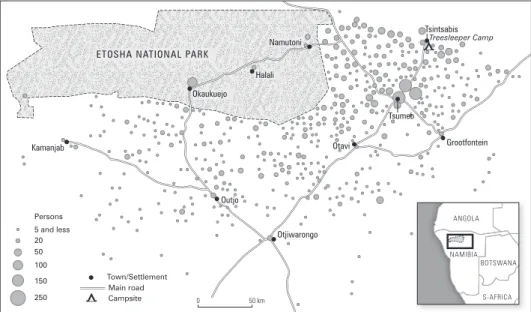
Numbering some 12–15,000 people, the Hai//om are among the most widely distributed San people in the country. They are found primarily in north-central and central regions of Namibia, stretching from the Oshikoto Region, in the north, south to Outjo and beyond to areas around Otjiwarango (Figure 2). Most Hai//om who have lost their lands now reside on commercial farms and serve as farm workers or domestic servants, while others have become trackers, game scouts, and laborers in the game reserves, some of them employed by the Department of Nature Conservation (now the Ministry of Environment and Tourism).
ANGOLA
NAMIBIA
S-AFRICA BOTSWANA Kamanjab
Okaukuejo Halali
Namutoni
Outjo
Otavi Grootfontein
Tsumeb Tsintsabis
Otjiwarongo ETOSHA NATIONAL PARK
Treesleeper Camp
0 50 km
Main road Campsite Town/Settlement Persons
5 and less 20 50 100 150 250
Figure 2 Map of Cendral Namibia Showing Hai//om Population Distribution in 1982
The Hai//om had extensive interactions with the Ovambo, Kavango, and Herero, as well as with other San groups including the !Xun and the Ju/’hoansi in the 19
thcentury. On 14 October, 1898, Fritz Aribib, a Hai//om leader, signed a treaty with a German district commander in Outjo that ceded the entire area stretching from Outjo up to the vicinity of Grootfontein and covering all of Etosha Pan and south to the “northernmost kraals of the Herero” in exchange for security and protection (Dieckmann 2007: 65–67; Friederich 2014: 51–56). The Hai//om were allowed to remain in the area and to collect veld (plant) foods. Aribib was put to death on the orders of Nchale in 1904 for killing Hereros at Naumutoni on the eastern edge of Etosha during the German-Herero war (Dieckmann 2007: 65).
For decades, the Hai//om had used Etosha as a sanctuary, often entering the area to avoid Administration and police patrols. In the Game Reserve, their presence was tolerated by the Germans until the end of their colonial domination, in 1915, and by South Africa governmental administrators until the early 1950s (Dieckmann 2011, 2013; Friederich 2014: 60–69). The Hai//om were allowed to hunt and gather in the reserve, to possess bows and arrows and other hunting weapons, at least until 1928, when they were no longer allowed to carry weapons (Friederich 2014: 60), to bury their dead and hold ceremonies there. Many Hai//
om archaeological sites are still to be found in Etosha (Vogelsang 2005).
Pressures increased after the Second World War for the South West African administration to exert greater control over Etosha. One concern of the administration had to do with livestock in the reserve. Regulations were passed in 1948 to impose limits on the numbers of livestock that could be kept by the Hai//
om and other groups (5 cattle and 10 goats per person) (Friederich 2014: 61).
Road construction in the reserve expanded, and some Hai//om were employed as road workers, while others worked in some of the camps of the Department of Nature Conservation and lived there along with their families. Some of the Hai//
om who lived in the park were provided with maize meal, sugar, salt, and tobacco.
They also were able to get meat from some of the wild animals that were culled by Nature Conservation.
In 1949, the South West African government appointed a Commission for the Preservation of the Bushmen which was aimed at addressing the future of the Bushmen in South West Africa. This occurred after it was alleged by the government that the Hai//om and the Herero were keeping livestock in the reserve and after a new policy had been put in place in 1947 regarding what the South West African administration termed ‘Bushpeople’ who were to receive greater protection and improvements in their living conditions (Taylor 2012: 66; Friederich 2014: 62). The new committee, which was eventually chaired by a former Stellenbosch University professor, P.J. Schoeman, began carrying out investigations and doing interviews between January, 1950 and 1952.
P.J. Schoeman had also been appointed the Chief Game Warden in Etosha,
South West Africa’s most significant protected area. In spite of his being the game
warden of Etosha, Schoeman did not live there, residing instead in Otjivarango
(Berry 1997: 4). Schoeman, through his writings, including Hunters of the Desert Land ( Jagters van die Woestylnland), helped popularize stereotypes of San as pristine hunter-gatherers and as people capable of surviving in marginal environments (Schoeman 1951; Gordon 2007). Schoeman noted that there were some 500 Hai//om in Etosha at the time he was the game warden and engaging in wildlife management and culling operations there (Schoeman 1953; Berry 1997: 4).
Schoeman and the Bushman commission produced an interim report in September, 1951 in which two “Bushmen” reserves were recommended: one for Khaung (!Kung, now known as Ju/’hoansi) and another for the “Heikom” (Hai//
om). When the final report came out, in 1953, however, there was only one Bushman reserve recommended by the country’s white politicians, that of
“Bushmanland” which was where the Ju/’hoansi lived (now Tsumkwe District in Otjozondjupa Region). The Hai//om, though they were the largest San population in the country, were not allocated any land for a reserve.
In the early 1950s the Department of Nature Conservation (DNC) had decided to seek to move the estimated 400 to 500 Hai//om who had been living in the bush in the reserve to places outside of the area. This resettlement was viewed as necessary in part because, according to Nature Conservation officials, the Hai//om were guilty of begging from tourists and disturbing game at water-holes in Etosha.
The Hai//om, for their part, were benefitting from the presence of tourists, showing them how they used their bows and arrows and demonstrating their tracking and dancing skills (Kadison //Khomob, personal communication, 2012).
In 1954, all but 12 Hai//om families who worked for Nature Conservation were informed that they must leave the Etosha game reserve (Dieckmann 2007:
189–190). The Native Commissioner of Ovamboland told the Hai//om that they
“had to leave the reserve for the sake of the game,” and would be allowed to return only if they were in possession of a permit” (Hitchcock 2015a). Oral historical evidence suggests that, until recent times, Hai//om continued to visit Etosha quietly after their removal from the park (Dieckmann 2007; Lawry and Hitchcock 2011; Friederich 2014). They went into the park to see relatives and friends, to collect wild resources, and to visit graves of relatives and friends.
Ceremonies were sometimes conducted, reinforcing, they said, links with their ancestral land.
The Hai//om were relocated to places south of the reserve, and some of them moved to Outjo and Otjivarango where they lived on the peripheries of the towns and did short-term jobs for people residing there. Many Hai//om moved north to Ovamboland where some of them resided in communities close to Ovambo homesteads for whom they provided herding, agricultural and domestic labor.
Others relied on foraging, some of whom sold meat to other groups. There were
occasional disagreements over alleged stock theft, but in general Ovamboland
native administration reports record friendly relations between the Hai//om and
Ovambo (Dieckmann 2007: 161–165; Dieckmann 2014). Some Hai//om moved as
far south as Windhoek, where they lived in some of the townships around the city
and did a variety of jobs, some of them in the formal sector of the South West African economy. The numbers of Hai//om living and working on commercial (freehold) farms increased in the 1950s, 1960s, 1970s, and 1980s. Namibian independence in March, 1990 initiated a new era in which labor laws were requiring better pay and working conditions for farm laborers, one result of which was the reduction in the numbers of Hai//om and other farm workers on commercial farms, many of whom moved to the peripheries of towns such as Outjo and Otjivarango where they did odd jobs and engaged in small-scale entrepreneurial activities.
In January, 1997, as part of the land struggle, which is part of on-going identity revitalization, some Hai//om demonstrators blocked the entrances to two gates into Etosha National Park, and 73 people were arrested. This incident attracted international attention to the issue of Hai//om land rights (Dieckmann 2001: 125; Suzman 2004: 221–222; Harring and Odendaal 2006: 3, 11, 50). These actions underscored the desire of the Hai//om to claim rights to their ancestral land. These events led eventually to the filing of a class-action lawsuit against the Government of Namibia on behalf of the Hai//om by the Legal Assistance Centre, an NGO, in August, 2015 (Menges 2015).
Partly in response to this Hai//om activism, as well as to pressure within Namibia by activists and by politicians to treat its citizens fairly, especially those who had been disadvantaged by the apartheid (separate development) policies of the South West African government, the government of Namibia appointed a Hai//
om Traditional Authority, David //Khamuxab, in April, 2004 after a contested electoral process. The following year, in 2005, the Government of Namibia set up a San Development Office in the office of the Deputy Prime Minister, to help not just San but also other marginalized groups including Ovatjimba (Himba) and Ovatuve (Dieckmann et al. 2014).
In 2007, the Government of Namibia decided to purchase a set of eight commercial farms directly south of Etosha National Park, in order to resettle Hai//
om who had been living in the park, some of whom were working for the Ministry of Environment and Tourism and Namibia Wildlife Resorts (NWR). Over the next nine years (2007–2016), the government, with the assistance of the Hai//
om Traditional Authority, the Ministry of Environment and Tourism, and the Ministry of Lands and Resettlement (MLR) has been involved in the resettlement of several hundred Hai//om to these newly purchased commercial farms.
The Government of the Republic of Namibia had said previously that the
340–450 Etosha Hai//om would not be required to move out of the park
involuntarily. The Minister of Environment and Tourism made this promise
explicitly in a telephone discussion in November, 2011, with a group of Hai//om
led by the late Kadison //Khomob, a leader of the Hai//om in Etosha. The Minister
said that (1) any moves of Hai//om out of the park would be totally voluntary, and
(2) the people working currently for MET and NWR would be allowed to remain
in the park, should they so choose. This policy is in line with international
indigenous rights declarations, such as the Declaration on the Rights of Indigenous Peoples (UNDRIP) and with the policies of international organizations like the World Bank, the International Finance Corporation, the European Union, and the Organization of Economic Cooperation and Development (OECD).
However, in March, 2012, the Ministry of Environment and Tourism announced that those Hai//om not employed in the park or directly related to a current employee would have to move out of Etosha National Park. The Ministry said that it would support those families and individuals who moved out by providing housing materials, including corrugated iron sheets (known as “zincs” in Namibia), and wood for frames, doors, and windows for construction of homes on the resettlement farms (Lawry, Begbie-Clench, and Hitchcock 2012).
S. James Anaya, the Special Rapporteur on the human rights and fundamental freedoms of indigenous people, visited Namibia in September, 2012. While expressing appreciation for ‘innovative arrangements’ on the part of the Namibian government with San ‘through which they have been able to increase their control over management of land areas and derive some substantial benefits,’ he observed that there were problems regarding security of tenure for Hai//om at Oshivelo who had been evicted from Etosha in the 1950s (Anaya 2012: 2). He went on to say,
More needs to be done to identify adequate lands for resettlement and to develop land use planning arrangements, in consultation with the affected San communities, as well as to provide support for the sustainable development of resettled communities (Anaya 2012: 2).
Although Anaya admitted that the purchase of the resettlement farms ‘was a step in the right direction’ to provide redress for their removal from the park, he pointed out that close consideration needed to be given to the unresolved claims of the Hai//om people within the national park (Anaya 2012: 2).
As of January, 2016, fewer than 400 Etosha Hai//om households had made the move to the resettlement farms. Assistance was being provided to the resettlement households by the Namibian-German Special Initiative Programme (NGSIP) of the Office of the Prime Minister and by the Hai//om Traditional Authority, which has some development funds. Some contributions had been made by livestock owners in the area, including those belonging to the Outjo Cattle Farmers Association. Herero, German and Afrikaaner farmers on neighboring commercial farms were providing advice, technical assistance, and some cattle, including several prize bulls, to the Hai//om on the newly established commercial farms (Lawry, Begbie-Clench, and Hitchcock 2012).
For the Hai//om, having a choice about where they live is an important
human rights issue. From the government perspective, the allocation of
commercial farms to the Hai//om for resettlement purposes is an example of a
humanitarian gesture, one involving equitable treatment of Namibian citizens
(Hitchcock 2015a). Tensions remain between the office of the Hai//om Traditional
Authority, David//Kamaxaub, who was appointed to the position by the Namibian government in 2004, and some members of the Hai//om community. These tensions revolved around the composition of the membership of an association with significant rights to a tourism concession related to the Etosha National Park.
The association was to be based at one of the resettlement farms and would have access to the !Gobaub water hole, an important locality for the Hai//om. The economic returns would be significant were it to be put in place. Thus far, however, the government has been unable to purchase the key commercial farm which would serve as the place for the tourism lodge (Hitchcock 2015a).
On September 7, 2012, at the first meeting of the !Gobaub Community Association, only one member of the Hai//om Traditional Authority was elected to the management committee of the new association. The Etosha Hai//om believed that they should have representation in the association, something that neither government nor the Traditional Authority supported. As some Hai//om pointed out, failure to allow Etosha residents to be part of the !Gobaub Community Association unless they moved out of the park could be seen as a form of coercion on the part of the Government of Namibia, something that Namibia, as a democracy, would not want to be seen as being responsible for. As of February, 2016, these issues remained unresolved, with dozens of Hai//om still living in Etosha National Park and refusing to resettle. This has contributed to the desire of the Hai//om to file a class action lawsuit against the government of Namibia; some Hai//om, however, have opted not to go along with the lawsuit. There are Hai//om on some of the Namibian government’s resettlement farms such as Namatanga who prefer to get on with their farm-related work (see Photo 1) and not engage in politics or land claims.
Photo 1 Hai//om san and Herero branding cattle.
THE JU/’HOANSI, THE STATE AND NEIGHBORING PASTORALISTS The Ju/’hoansi of the Nyae Nyae Region (Figure 3) represent the second largest group of San peoples in Namibia (Dieckmann et al. 2014: 23). Their experience with neighboring pastoral and farming groups has been somewhat less intense than the case of the Hai//om. Whereas Ovambo, Kavango, and other groups had traded with the Ju/’hoansi in the mid to late 19
thcentury (Guenther 2005), the interethnic relationships were mainly economic. The Ju/’hoansi in the Nyae Nyae Region had more interactions with Herero pastoralists than they did with other groups (Marshall 1976: 13, 60–61; Biesele and Hitchcock 2013). Some Herero had moved into Ju/’hoan lands in 1904–1907, as a result of massive displacement due to the German-Herero-Nama wars, which both the Herero and Nama consider to be the first genocide of the 20
thcentury (Sundermeier 1997;
Gordon and Douglas 2000; Gordon 2009). There were also groups of Herero who expanded into Nyae Nyae in search of grazing in the 1920s (Biesele and Hitchcock 2013: 8).
In the 20
thcentury, some Ju/’hoansi lived and worked on the freehold farms in the Grootfontein block, many of which were owned by Germans and Afrikaaners. In the communal areas to the east and north of the Grootfontein farms and in northern Botswana, there were Ju/’hoansi who resided on cattle posts (called meraka in Setswana). Generally, these cattle posts were remote stations
Baraka N/oaq!’osi Dobe Tsumkwe Djxokhoe
Tambotistad Makuri
!Ukoarama /Aotca Nhoma
//Xa/oba
Kaptaina Pos /Xoan’hoba Aasvoëlnes Mangetti
Dune Kakudi
Mequietnu Naorube Kandu
Kameelwoud Grashoek Roodagliek
Khaudum Game Park
N y a e N y a e
O M A H E K E
BOTSWANA
K A V A N G O
19o45’19o15’19o30’
20o00’ 20o30’ 20o45’ 21o00’
19o00’ 19o15’
Kanovlei
Luhebo
N!om/xom
G!aq!oma Don’ui
Xamsa
!’obaho //Auru
N!aici /Uidinsi N a - J a q n a
Kramatartxao Klein Dobe
Xinni Xuri
Khaudum Game Park
Kandu Kameelwoud
Kanovlei
Luhebo
Nhoma
Xinni Xuri
//Xa/oba
N!om/xom
G!ao!omaDen/ui
Tsumkwe N/oaq!’osi Baraka
Xamsa Djxokhoe
Tambotistad
!’Obaha //Auru
N!aici Kremetartkop Makuri
!Ukoarama /Aotca
/Uidinsi Kapteins Pos
/Xoan’hoba Grashoek
Rooidaghek
Mangetti Dune Kakudi
Mequietnu
Naorube Aasvoëlnes
K A V A N G O
N = a J a q n a N y a e N y a e
O T J O Z O N D J U P A
O M A H E K E
BOTSWANA
Klein Dobe
20o15’20o00’19o45’19o30’19o15’19o00’
19o00’ 19o15’ 19o30’ 19o45’ 20o00’ 20o15’ 20o30’ 20o45’ 21o00’
Protected area Conservancy Veterinary fence Region International border Main road District road Track Main river Minor river Towns & settlements Airstrip Campsite Lodge Camp Gate
The N=a Jaqna and Nyae Nyae Conservancies
0 20 km N
Figure 3 Map of N≠a Jaqna and Nyae Nyae Regions
where livestock was kept by pastoral groups, including Batswana, Mbanderu and Herero. In exchange for their labor, people received cash, milk, grain products, and other goods (Marshall 1976: 60–71; Lee 1979: 13–14, 234–235, 401–408, 2013, 2016; Wilmsen 1989: 86, 95, 140, 239–244; Pennington and Harpending 1993: 12–15, 47–57, 70–75, 200–204, 212–224; Widlok 2000). In some cases, the Hai//om and the Ju/’hoansi appropriated the livestock of other groups without permission, something that did not endear them to their pastoral, farming, and commercial livestock-keeping neighbors.
Livestock raiding, especially by Nama, had been a major factor in the mid 19
thcentury, and was a major cause of Herero stock losses. This raiding, combined with droughts and livestock disease, resulted in a reversion to hunting and gathering by some Herero groups, who became what Herero described as
‘Ovatjimba’ (Henrichsen 2013: 203–208). In the 19
thcentury, some Herero were able to accumulate large herds through cattle raiding, careful herd management, and exchange with other groups. In some cases, richer Herero provided poor Herero with livestock to manage, thus forming alliances and facilitating herd build-ups among the poor, while spreading risk for the well-to-do herders. This process was seen, for example, in the Herero heartland of Okahandja and Otjivarango. The expansion of herd sizes, combined with the growth in the Herero population, led to the expansion of Herero into new areas of Namibia, some of which were already occupied by Ju/’hoansi, such as the Omaheke.
The Herero were not the only group with whom the Ju/’hoansi of eastern Namibia had complex interactions. For example, Joachim Helmuth Wilhelm, a big-game hunter and explorer, lived on a farm at Outhituo, in northern Namibia, approximately 40 km east of Grootfontein, from 1914 to 1919. Much of Wilhelm’s labor force consisted of Ju/’hoansi San (who he called !Kung), the numbers of whom ranged between 50 in the wet season and 100 or more in the dry (Guenther 2006: 98). Wilhelm explored areas in what was then called the ‘Kaukauveld’, roughly equivalent to the Nyae Nyae – Dobe-/Xai/Xai Region, going as far as Gautscha where the Marshall family would eventually established their first camp, in 1951 (Marshall 1976: 3, 6–7, 18, 60–61, 71–73, 139–140, 157, 197; Lee 1979:
52). Wilhelm’s (1954) monograph, published posthumously in Germany, provides insights into the complicated interactions between the Ju/’hoansi, the Hai//om, the Germans, and the Herero during the early 20
thcentury.
The interactions between the Ju/’hoansi and other groups ranged from symbiotic to co-operative, and from peaceful to aggressive (Guenther 2005).
Earlier interactions included exchanges of products such as ostrich eggshell beads
made by the Ju/’hoansi with their neighbors who valued them highly (Wilhelm
1954: 138–141). Ovambo and Mbukushu provided the Hai//om and the Ju/’hoansi
with metal spear points, knives and clay pots, while Ovambo, Mbukushu,
Batswana, and Caucasians provided them with wooden bowls, glass beads,
clothing, enamel dishware, brass wire, tobacco, dagga (Cannabis sativa), and
sometimes guns and ammunition (Wilhelm 1954: 140–145). Not all interactions
were friendly. Wilhelm notes, for example, that the Ju/’hoansi were on ‘a war footing’ with the neighboring Hai//om (Wilhelm 1954: 112). Ju/’hoansi would disappear into the bush when they heard of the presence of other people or police patrols in their areas.
The Herero population expanded in the 1950s as people moved out of the Sehitwa and other areas around the Okavango Delta to avoid outbreaks of tsetse fly (Glossina morsitans) (Pennington and Harpending 1993: 201–202). Some Herero returned across the border into South West Africa and established themselves at /Gam in the southern Nyae Nyae Region in the mid-1950s. Some Herero moved into Gautscha with their herds in 1956, where they were seen by the Marshall family during their expeditions (Marshall 1976: 60). This incursion by Herero into the Nyae Nyae region was one of many that had occurred since the 19
thcentury. There were groups of Herero who came into the Nyae Nyae area in the 1862–1870 period as a result of the Nama-Herero Wars, and Herero who survived the German-Herero war of 1904–1907 entered Nyae Nyae after the battle of Waterberg. Many of the interactions between the Ju/’hoansi and the Herero were friendly; food and other goods were exchanged, Ju/’hoansi were engaged as cattle herders, and some Ju/’hoansi were employed in the households of Herero.
In 1964, at the time of the Odendaal Commission, which divided Namibia into commercial and communal areas and ethnic “homelands,” /Gam was given to the Herero by the South West African administration, on the basis of two Herero who lived there (Thomas 2006: 294–295). Some of the traditional lands of the Ju/’hoansi were also allocated to the Kavango as part of the Odendaal Commission. Thus, what had been a Ju/’hoan ancestral area of 90,000 km
2was reduced to an area of some 25,000 km
2.
The expansion of other groups, combined with the setting aside of land for commercial ranching, resulted in displacement of some Ju/’hoansi and incorporation of others into the commercial ranching systems that became so pervasive in Namibia in the early to mid-20
thcentury. In addition, some Ju/’hoan lands were set aside as game reserves and national parks, notably Kaudum (Khaudum), which resulted in the resettlement of some Ju/’hoansi families in the run-up to independence, in 1989. The Ju/’hoansi had successfully fought off the transformation of Nyae Nyae itself into a game reserve in the early 1980s (Marshall and Ritchie 1984; Biesele and Hitchcock 2013: 17–18). They were also successful in getting the new Namibian government to support them in requiring a group of Herero who had moved into Nyae Nyae from Botswana and set up outposts in 1991 to leave the area with their livestock.
After independence, in March, 1990, the new government of Namibia began
addressing the land and resource needs of its historically disadvantaged citizens,
not only establishing resettlement farms for San in various parts of the country
(e.g. in the Omaheke, Cunene and Otjozondjupa regions), but also allocating rights
to wildlife in communal areas under what came to be known as the “conservancy
system” (Weaver et al. 2010; Biesele and Hitchcock 2013: 206–212; Gargalo
2015). Several hundred Herero crossed the border from Botswana to Namibia after independence, some of them moving into the /Gam and southern Nyae Nyae regions. The Nyae Nyae Development Foundation of Namibia sought the assistance of the President of Namibia, Sam Nujoma, who declared the Ju/’hoan lands around Nyae Nyae as theirs, and the Herero were required to withdraw to /Gam and what in the past was Hereroland to the south of Nyae Nyae.
Several thousand Ju/’hoansi live in the Omaheke region to the south of Nyae Nyae, where Herero were in the majority (nearly 40%), and Ju/’hoansi represented a sizable minority (7.2%) (Dirkx and Thiem 2014). Sylvain (2001: 719) pointed out that 4,000 of 6,500 farm workers were on Afrikaaner farms in the Omaheke.
Some Ju/’hoansi also resided and worked on the farms of Herero in the Omaheke region in the 1990s and in the new millennium. In exchange for their work the Ju/’hoansi received milk, meat, tobacco, maize meal, and sometimes cash (Suzman 2000; Sylvain 2001; Hitchcock, field data, August, 2015).
In 1998, the Nyae Nyae area was declared the first communal conservancy in Namibia. In Namibia, conservancies are locally planned and managed multipurpose areas on communal land in which land users have pooled their
Map Namibia Osire Tsumkwe Etosha Namibia Namatanga Branding map of Namibia showing Tsamkwe Disthct, Etosha Pan and Oside Refuglie Camp
resources for wildlife conservation, tourism, and wildlife use (Weaver et al. 2010).
Conservancy members are granted wildlife resource rights under an amendment to the Nature Conservation Amendment Act of 1996. Conservancy formation in Namibia requires a formal legal constitution, a representative conservancy committee elected by the members, a land use and management plan, a map of the area, and legally defined boundaries. In 2015, there were some 82 communal conservancies in Namibia (Gargallo 2015; www.nasco.org.na, accessed 15 October, 2015). The Nyae Nyae Conservancy, which covers 8,992 km
2, is the second largest communal conservancy in Namibia, and one of two that is San controlled (Hitchcock 2012, 2015b; Hays, Thiem, and Jones 2014).
A major threat to the Ju/’hoan people and the habitat of Nyae Nyae was the presence of Herero livestock owners and their herds, who entered the Nyae Nyae Conservancy from /Gam in late April, 2009 (Hays 2009; Hitchcock 2009; Biesele and Hitchcock 2013: xxiv; Hitchcock 2015b). Thirty-two Herero farmers from /Gam cut the veterinary cordon fence (the Red Line) and came in to Nyae Nyae with some 1,300 head of cattle. The numbers of Herero in Tsumkwe increased from the original 32 to nearly 300 in early 2014, although some Herero returned to /Gam and areas to the south owing to the death of their chief. Although some Herero cattle were initially confiscated by the police, the Herero continued to keep large numbers of horses, donkeys and small stock within the Tsumkwe Municipality and in the surrounding conservancy. As a result, Ju/’hoansi living in both the Tsumkwe municipal area and in some of the 36 villages in the Nyae Nyae Conservancy faced resource depletion and competition for grazing, water and bush foods.
Efforts were made by the Ju/’hoansi to obtain government support to remove the illegal herders from the area, and some were jailed by the Namibia Police, but were released subsequently. The Ju/’hoan Traditional Authority, the Nyae Nyae Conservancy and the Nyae Nyae Community Forest, which had been established in 2012, sought legal assistance and support to require the livestock owners and their herds to vacate the Nyae Nyae area.
The situation in Nyae Nyae became more complicated in 2012, when Kxao Moses ≠ Oma, the Member of Parliament from Otjozondjupa, a party whip for SWAPO (the South West African Peoples Organization, the ruling party in Namibia), and the brother of Tsamkxao ≠Oma, the Ju/’hoan Traditional Authority, died suddenly. An election was held in the Otjozondjupa Region for Kxao’s replacement, which was won by a Herero, Selma Shaanika, who then became the Administrator for the Otjozondjupa Regional Council. The Ju/’hoan Traditional Authority, Tsamkxao ≠Oma, was asked by the Otjozondjupa Regional Governor in March, 2012 to allocate a portion of the Nyae Nyae Conservancy to the Herero for grazing purposes. He did not do so, and the land and grazing issues remained unresolved.
In May, 2012 two members of the Nyae Nyae Conservancy were among four
San who attended the Eleventh annual meetings of United Nations Permanent
Forum on Indigenous Issues (UNPFII), in New York. One was Leon Tsamkxao, the son of the Ju/’hoan Traditional Authority, Tsamkxao ≠Oma. The other was Kxao Ghauz, the former head of the Nyae Nyae Conservancy who is now an informal advisor to Tsamkxa ≠Oma. The Ju/’hoansi and two San from Botswana met unofficially with Namibian and Botswanan government officials while they were in New York, and they have continued to press for removal of the illegal grazers from Nyae Nyae.
Ju/’hoan-Herero relationships became even more complicated in July, 2015 when charges were laid against four illegal grazers in the Nyae Nyae Community Forest (Hitchcock 2015b; Nyae Nyae Development Foundation and Nyae Nyae Conservancy meeting minutes, August-September, 2015). Although the cases have yet to go to court, the Ju/’hoansi and Herero are attempting to negotiate over access to grazing and water in Tsumkwe and in the Nyae Nyae Conservancy and Community Forest. The Ju/’hoansi and the Herero both are seeking legal counsel and are sending letters and petitions to regional and central government authorities. At the local level in Nyae Nyae, some Ju/’hoansi work for Heroro as herders and as employees of small businesses, including shebeens (drinking establishments, also known as cuca shops) and therefore are reluctant to go against them. A sizable number of Ju/’hoansi are now in debt to Hereros living in the Nyae Nyae area, an undesirable situation that many of them would like to change.
CONCLUSIONS
A comparative analysis of the Hai//om and the Ju/’hoansi and their neighbors over time shows that the relations are complex and continue to evolve. A summary of the findings is presented in Appendix 1. Both the Etosha Hai//om and the Nyae Nyae Ju/’hoansi are facing pressures from other groups and the State. The Hai//om of Etosha must deal with commercial farm owners of various backgrounds in the areas surrounding the seven Hai//om resettlement farms. The government would like to purchase additional farms, at least one of which is owned by a Herero family, and another by an Afrikaaner family that runs a charcoal operation and employs a sizable number of local people including Hai//om, Herero, Kavango, and Ovambo (Lawry, Begbie-Clench, and Hitchcock 2012; Hitchcock 2015a). The government’s San Development Office claims that it does not have the funds to purchase additional commercial farms.
In the case of Nyae Nyae, pressures for the Ju/’hoansi come not just from the Herero who moved from Gam in 2009 and who have expanded in numbers over time, but also from other groups, including Kavango and Ovambo, who have established themselves in the N/a Jaqna Conservancy to the west and have constructed fences and built watering points (Biesele and Hitchcock 2013: viii-xi;
Dieckmann et al. 2014; Hitchcock 2012, 2015b). There have been environmental
threats to the watering points from elephants that compete with people and
livestock for access to the boreholes. This problem has largely been solved, thanks
to the construction of fences around the watering points consisting of railway ties, cement and stones (Hitchcock 2015b).
There are both similarities and differences between the Hai//om and the Ju/’hoansi in the ways they interact with their neighbors. Both groups have had symbiotic relationships with other people, depending on them for work opportunities, food, and other goods. Hai//om have had a longer history of interactions with other groups than have the Ju/’hoansi. Hai//om have worked more often as farm laborers, herders and field hands. Fewer Ju/’hoansi worked on the Grootfontein Farms and other commercial farms because they were able to reside on their own ancestral land, even though it was reduced substantially by South West African government decisions. Most interactions between Ju/’hoansi and Hereros in Nyae Nyae were short-term; rarely did they last for generations, as they often did with the Hai//om. The Ju/’hoansi retain, from their perspective, greater connections to the land and to their cultural heritage.
The Hai//om are going through a cultural resurgence, part of which is associated with a set of social movements aimed at re-invigorating themselves culturally, gaining a greater say in decision-making, and participating in public in policy-making. This has culminated in the filing in October, 2015 of a class action lawsuit to recover their lands (Menges 2015). There have also been discussions about forming communal conservancies and establishing at least one commercial conservancy, which currently number 22 in Namibia (Ryan Klataske, personal communication, 2016).
Both the Hai//om and the Ju/’hoansi want to maintain good working relations with their pastoral and farming neighbors. In a number of cases, they wish to continue to work with their neighbors in herding, farming, hunting, and healing.
They share information, equipment, goods, and knowledge about ways to adapt to the environment in which they live. Some Hai//om and Ju/’hoansi wish to become at least part-time pastoralists (Bollig 2013), like some of their neighbors. In order to do that, people maintain, they must work with neighbors cooperatively, rather than compete with them for livestock, land, water, and natural resources.
The Hai//om and the Ju/’hoansi, like their neighbors, prefer not to have to resettle as a result of Namibian government decisions. Both groups want to benefit from industries that are established in their areas, including those relating to tourism, mineral extraction, forestry, and high value plant collection. The Hai//om and the Ju/’hoansi want Namibian government policies which are beneficial to all people in the country, not just those who have land and resources. And last but by no means least, both want to have greater representation at the regional and central government levels in Namibia so that they can make a real difference not just among the Hai//om and the Ju/’hoansi, but for all Namibians.
ACKNOWLEDGMENTS
Support for the research on which this paper is based was provided by the
Ford Foundation, the U.S. Agency for International Development, the Millennium Challenge Account-Namibia, and Brot für die Welt (Germany). I thank also the Hai//om Traditional Authority, the Ju/’hoan Traditional Authority, the !Gobaub Community Association, the Nyae Nyae Conservancy Management Committee, the Nyae Nyae Development Foundation of Namibia, Tsamkxao ≠Oma, /Angn!ao (Kievit), Xoan//an Xoois, Kallie Nannie, Khao Ghauz, Leon Tsamkxao, Gabriel Hipandulwa, Kahepako Kakujeha, Bandu //Khomob, the late Kadison //Komob, Brian Jones, Lara Diez, Wendy Viall, Loretta Kirkpatrick, Ben Begbie-Clench, Steve Lawry, Richard Lee, Willem Odendaal, John Hazam, Maria Sapignoli, Ronald Niezen, Ute Dieckmann, James Suzman, Peter Watson, Megan Biesele, Ryan Klataske, Stasja Koot, Jennifer Hays, Megan Laws, Beatrice Sandelowsky, and Kazunobu Ikeya for their assistance and advice. I wish to express my appreciation to the government of Namibia for permission to conduct this research.
I also want to thank the Hai//om and Ju/’hoansi people whose efforts to seek social justice and to promoie their rights and wellbeing have been so important in Namibia and southern Africa.
REFERENCES
Aitken, R.2007 Looking for Die Besten Boeren: The Normalisation of Afrikaner Settlement in German South West Africa, 1884–1914. Journal of Southern African Studies 33(2):
343–360.
Anaya, S. J.
2012 Statement of the Special Rapporteur on the rights of indigenous peoples, James Anaya, upon concluding his visit to Namibia from 20–28 September 2012, 28 September 2012. Geneva: Special Rapporteur on the Rights of Indigenous Peoples, Human Rights Council.
2013 Report of the Special Rapporteur on the rights of indigenous peoples, James Anaya. The Situation of Indigenous Peoples in Namibia. Human Rights Council, 24th Session, Annex 3. A/HRC/24/47. Geneva: Human Rights Council.
Barbieri C., M. Vicente, S. Oliveira, K. Bostoen, J. Rocha, M. Stoneking, and B. Pakendorf 2014 Migration and Interaction in a Contact Zone: mtDNA Variation among Bantu-
Speakers in Southern Africa. PLoS ONE 9(6): e99117. doi:10.1371/journal.
pone.0099117.
Berry, H. H.
1997 Historical Review of the Etosha Region and its Subsequent Administration as a National Park. Madoqua 20(1): 3–12.
Biesele, M. and R.K. Hitchcock
2013 The Ju/’hoan San of Nyae Nyae and Namibian Independence: Development, Democracy, and Indigenous Voices in Southern Africa. Paperback edition. Oxford and New York: Berghahn Books.
Bollig, M.
2013 Socio-Ecological Change and Institutional Development in a Pastoral Community in North-western Namibia. In M. Bollig, M. Schnegg, and H-P. Wotzka (eds.).
Pastoralism in Africa: Past, Present, and Future, pp.316–340. Oxford and New
York: Berghahn Books.
Dieckmann, U.
2001 ‘The Vast White Place’: A History of the Etosha National Park in Namibia and the Hai//om. Nomadic Peoples 5(2): 125–153.
2007 Hai//om in the Etosha Region: A History of Colonial Settlement, Ethnicity, and Nature Conservation. Basel: Basler Afrika Bibliographien.
2011 The Hai//om and Etosha: A Case Study of Resettlement in Namibia. In K. Helliker and T. Murisa (eds.) Land Struggles and Civil Society in Southern Africa, pp.155–
190. Trenton, New Jersey: Africa World Press.
2013 Land, Boreholes, and Fences: The Development of Commercial Livestock Farming in the Outjo District, Namibia. In M. Bollig, M. Schnegg, and H-P. Wotzka (eds.) Pastoralism in Africa: Past, Present, and Future, pp.257–288. Oxford and New York: Berghahn Books.
2014 Kunene, Oshana and Oshikoto Regions. In U. Dieckmann, M. Thiem, E. Dirkx, and J. Hays (eds.) “Scraping the Pot”: San in Namibia Two Decades after Independence, pp.173–232. Windhoek: Legal Assistance Centre and Desert Research Foundation of Namibia.
Dieckmann, U., M. Thiem, E. Dirkx, and J. Hays (eds.)
2014 “Scraping the pot”: San in Namibia Two Decades after Independence. Windhoek:
Legal Assistance Centre and Desert Research Foundation of Namibia.
Dirkx, E. and M. Thiem
2014 Omaheke Region. In U. Dieckmann, M. Thiem, E. Dirkx, and J. Hays (eds.)
“Scraping the Pot”: San in Namibia Two Decades after Independence, pp.39–92.
Windhoek: Legal Assistance Centre and Desert Research Foundation of Namibia.
Friederich, R.
2014 Etosha: Hai//om Heartland: Ancient Hunter-Gatherers and their Environment.
Horst Lempp (ed.) Windhoek: Namibia Publishing House.
Gargallo, E.
2015 Conservancies and Contested Lands: The Case of Namibia’s Communal Conservancies. Journal of Contemporary African Studies 33 (2): 213–231.
Gewald, J-B.
1999 Herero Heroes: A Socio-political History of the Herero of Namibia, 1890–1902.
Oxford: James Currey.
2003 Colonization, Genocide, and Resurgence: The Herero of Namibia 1890–1933. In M.
Bollig and J-B. Gewald (eds.) People, Cattle, and Land: Transformations of a Pastoral Society in Southwestern Africa, pp.187–226. Koln: Rudiger Koppe Verlag.
Gordon, R. J.
2007 Covering the Tracks with Sand: P. J.Schoeman and Public Anthropology. Historia 52: 98–126.
2009 Hiding in Full View: The “Forgotten” Bushman Genocides in Namibia. Genocide Studies and Prevention 4(1): 29–57.
Gordon, R. J. and S. S. Douglas
2000 The Bushman Myth: The Making of a Namibian Underclass. Second Edition.
Boulder, Colorado: Westview Press.
Guenther, M. (ed.)
2005 Kalahari and Namib Bushmen in German South West Africa: Ethnographic Reports by Colonial Soldiers and Settlers. Koln: Rudiger KoppeVerlag.
Harring, S.L. and W. Odendaal
2006 ‘Our Land They Took’: San Land Rights under Threat in Namibia. Land, Environment and Development (LEAD) Project. Windhoek: Legal Assistance Center.
Hays, J.
2009 The Invasion of Nyae Nyae: A Case Study in On-going Aggression against Hunter- gatherers in Namibia. In Forum Conference on Indigenous Peoples 2009: Violent Conflicts, Ceasefires, and Peace Accords Through the Lens of Indigenous Peoples.
Report. Tromso: Forum for Development Cooperation with Indigenous Peoples.
pp.25–32.
Hays, J., M. Thiem, and B.T.B. Jones
2014 Otjozondjupa Region. In U. Dieckmann, M. Thiem, E. Dirkx and J. Hays (eds.)
“Scraping the Pot”: San in Namibia Two Decades after Independence, pp.93–172.
Windhoek: Legal Assistance Centre and Desert Research Foundation of Namibia.
Henrichsen, D.
2013 Establishing a Precolonial ‘Modern’ Cattle and Gun Society: (Re-) Pastoralisation, Mercantile Capitalism and Power amongst Herero in Nineteenth Century Central Namibia. In M. Bolling, M. Schnegg, and H-P. Wotzka, (eds.) Pastoralism in Africa: Past, Present, and Future, pp.201–229. Oxford and New York: Berghahn Books.
Hitchcock, R. K.
2009 Genocide and Indigenous Peoples, or, The Reasons for the Escalation of Violent Conflicts between Hunter-gatherers and Pastoralists in Eastern and Southern Africa. In Forum Conference on Indigenous Peoples 2009: Violent Conflicts, Ceasefires, and Peace Accords Through the Lens of Indigenous Peoples. Report, pp.33–47. Tromso: Forum for Development Cooperation with Indigenous Peoples.
2012 Refugees, Resettlement, and Land and Resource Conflicts: The Politics of Identity among !Xun and Khwe San of Northeastern Namibia. African Study Monographs 33(2): 73–132.
2015a Authenticity, Identity, and Humanity: The Hai//om San and the State of Namibia.
Anthropological Forum: A Journal of Social Anthropology and Comparative Sociology 25(3): 262–284.
2015b Improving the Viability and Sustainability of the Nyae Nyae Conservancy and the N≠a Jaqna Conservancy: A Mid-Term Evaluation of an NNDFN/Brot für die Welt Project in Namibia. Windhoek: Nyae Nyae Development Foundation of Namibia and Berlin: Brot für die Welt
Kinahan. J.
2011 From the Beginning: The Archaeological Evidence. In M. Wallace and J. Kinahan (authors). A History of Namibia: From the Beginning to 1990, pp.15–42. New York: Columbia University Press.
Lawry, S. and R.K. Hitchcock
2011 Hai//om Resettlement Farms Land Use Plan and Livelihoods Support Strategy.
Windhoek: Ministry of Environment and Tourism and Millennium Challenge Corporation,
Lawry, S., B. Ben Begbie-Clench, and R.K. Hitchcock
2012 Hai//om Resettlement Farms: Strategy and Action Plan. Windhoek: Ministry of Environment and Tourism and Millennium Challenge Corporation.
Lee, R.B.
1979 The! Kung San: Men, Women, and Work in a Foraging Society. Cambridge:
Cambridge University Press.
2013 The Dobe Ju/’hoansi. Fourth Edition. Independence, Kentucky: Cencage.
2016 ‘In the Bush the Food is Free’: The Ju/’hoansi of Tsumkwe in the 21st Century. In B.
Codding and K. Kramer (eds.) Why Forage: Hunting and Gathering in the 21st Century, pp.61–87. Albuquerque: University of New Mexico Press.
Marshall, L.
1976 The! Kung of Nyae Nyae. Cambridge: Harvard University Press.
Marshall, J. and C. Ritchie
1984 Where Are the Ju/Wasi of Nyae Nyae? Changes in a Bushman Society: 1958–
1981. Communications No. 9, Centre for African Area Studies, University of Cape Town. Cape Town: University of Cape Town.
Menges, W.
2015 Hai//om Sue for Rights Over Etosha. Namibian 19 October, 2015, pp.1–2.
Mitchell, P.
2013 Southern African Hunter-Gatherers of the Last 25,000 Years. In Peter Mitchell and Paul Lane (eds.) The Oxford Handbook of African Archaeology, pp.473–488.
Oxford: Oxford University Press.
Pennington, R. and H. Harpending
1993 The Structure of an African Pastoralist Community: Demography, History, and Ecology of the NgamilandHereros. Oxford: Clarendon Press.
Robbins, L.H., A.C. Campbell, M.L. Murphy, G.A. Brook, A.A. Mabuse, R.K. Hitchcock, G.
Babutsi, M. Mmolawa, K.M. Stewart, T.E. Steele, R.G. Klein, and C.C. Appleton 2009 Mogapelwa: Archaeology, Palaeoenvironment and Oral Traditions at Lake Ngami,
Botswana. South African Archaeological Bulletin 64 (189): 13–32.
Schoeman, P.J.
1951 Jagters van die Woestylnland (Hunters of the Desert Land). Cape Town: Timmins.
1953 Report of the Commission on the Study of the Bushmen. Windhoek: South West Africa Administration.
Sundermeier, T.
1997 The Mbanderu, as told to Theo Sundermeier by H. Tjituka, H. Hangari, A. Kajovi, P. Katjivikua, & E. Ketjipotu. A-M. Heywood, Translator. Windhoek: Star Binders and Printers.
Suzman, J.
2000 ‘Things from the Bush’: A Contemporary History of the Omaheke Bushmen. Basel:
P. Schwettwein Publishing.
2004 Etosha Dreams: An Historical Account of the Hai//om Predicament. Journal of Modern African Studies 42(2): 221–238.
Sylvain, R.
2001 Bushmen, Boers, and Baasskap: Patriarchy and Paternalism on Afrikaner Farms in the Omaheke Region, Namibia. Journal of Southern African Studies 27 (4):
717–737.
Takada, A.
2015 Narratives on San Ethnicity: The Cultural and Ecological Foundations of Lifeworld among the !Xun of North-Central Namibia. Kyoto: Kyoto University Press and Melbourne: Trans Pacific Press.
Thomas, E.M.
2006 The Old Way: A Story of the First People. New York: Farrar, Straus, Giroux.
Vivelo, F.R.
1976 The Entry of the Herero into Botswana. Botswana Notes and Records 8: 39–46.
Vogelsang, R.
2005 The Past of the Etosha National Park: Oral History and Archaeological Evidence.
NyameAkuma 63: 2–4.
Wallace, M.
2003 ‘Making Tradition’: Healing History, and Ethnic Identity among Otjiherero- speakers in Namibia, c. 1850–1950. Journal of Southern African Studies 29 (2):
355–372.
2011 A History of Namibia (with J. Kinahan). New York: Columbia University Press.
Widlok, T.
1999 Living on Mangetti: ‘Bushman’ Autonomy and Namibian Independence. Oxford:
Oxford University Press.
2000 On the Other Side of the Frontier: Relations between Hereros and ‘Bushmen’. In M.
Bollig and J-B. Gewald (eds.) People, Cattle, and Land: Transformations of a Pastoral Society in Southwestern Africa, pp.479–522. Köln: Rudiger Köppe Verlag.
Wilhelm, J.H.
1954 The !Kung Bushmen. Jahrbuch des Stadischen Museums fur Volkerkundezu Leipzig 12.
Wilmsen, E.N.
1989 Land Filled with Flies: A Political Economy of the Kalahari. Chicago: University of Chicago Press.
Appendix 1. Comparison of Hai//om and Ju/’hoansi and their Neighbors in Namibia
Hai//om San Nyae NyaeJu/’hoansi
Total Population: 11,000–15,000 Total Population: 9,500 (Namibia) Hai//om in Cunene, Ovamboland, Etosha 8,992 km2, 36 villages, 2,400 people Protected Area: Etosha National Park, founded as a
game reserve 1907, 1958 declared a national park, 22,912 km2
Protected Area: Kaudum National Park, founded 1989 as a nature reserve, declared national park in February, 2007, 3,481 km2
Land Status: communal, commercial (freehold) Land Status: communal Homeland not recommended by the Commission on
the Preservation of the Bushmen (1949–1953)
Homeland recommended by the Commission on the Preservation of the Bushmen (1949–1953)
Odendaal Commission: Etosha Odendaal Commission: Bushmanland, some parts declared as Hereroland
!Gobaub Community Association, !Gobaub Concession
Nyae Nyae Conservancy, Nyae Nyae Community Forest
Date of establishment: September 2012 Date of Establishment: February, 1998 Traditional authority: David //Khamuxab (April,
2004 appointment)
Traditional Authority: Tsamkxao ≠Oma (June, 2000 appointment)
Ethnic Groups present: Hai//om, Herero, Himba, Kavango, Ovambo, Europeans
Ethnic groups present: Ju/’hoansi San, Herero, Kavango, !Xun, Khwe, Europeans
Resettlement: 1954 and currently planned Resettlement: attempted 1983–84 but not carried out, some moved from Khaudum National Park in the early part of the new millennium
Government: San Development Office Government: San Development Office NGOs assisting: church-based groups from Outjo NGOs assisting: Nyae Nyae Development
Foundation of Namibia, Legal Assistance Center, World Wildlife Fund-Namibia
Employment: farms, Ministry of Environment and Tourism, Namibia Wildlife Resorts (NWR)
Employment: NNC, government, SMJ Safaris Development encouraged, done in association with
government and with Hai//om San Development Community Trust
Development encouraged, done in conjunction with communities and the Conservancy Management Committee
Conflicts: chief versus Etosha Hai//om, tensions with other Hai//om in the region, collective action lawsuit against the government of Namibia, October 2015
Conflicts: Herero incursion April 2009, still present in Tsumkwe and Nyae Nyae; legal cases filed against 4 illegal graziners in July 2015
No community forest Nyae Nyae Community Forest was gazetted in July,
2012 giving greater control over grazing and timber Tourism: no formal operations in resettlement farms;
Treesleeper Camp is tourism operation
Tourism: Living Culture Foundation of Namibia (LCFN), Nyae Nyae Conservancy
Not allowed to hunt Subsistence hunting allowed
Limits on all animals – no hunting in park, only in resettlement farms
Limits on types of animals to be hunted Quota set by Ministry of Environment and Tourism
(MET) Quota set by MET, NNC for safari hunting, and
MET for subsistence hunting No current plans for safari hunting to be done with
a concession-holder
Some safari hunting done with concession-holders Resource management by Hai//om Traditional
Authority and by !Gobaub Association management committee
Resource management by Nyae Nyae Conservancy (NNC) and local n!ore kxaosi (Ju/’hoan territorial overseers)