• 検索結果がありません。

福島県立医科大学 学術機関リポジトリ

N/A
N/A
Protected

Academic year: 2021

シェア "福島県立医科大学 学術機関リポジトリ"

Copied!
6
0
0

読み込み中.... (全文を見る)

全文

(1)

Fukushima Medical University

福島県立医科大学 学術機関リポジトリ

This document is downloaded at: 2021-11-07T23:07:04Z

Title A case of gastric lipoma resected by endoscopic submucosa dissection with difficulty in preoperative diagnosis

Author(s)

Ichinose, Mizue; Hikichi, Takuto; Kanno, Yukiko; Gunji, Naohiko; Fujita, Masashi; Kuroda, Masahito; Terashima, Kumiko; Sato, Yoshinori; Kawana, Satoshi; Hashimoto, Yuko;

Ohira, Hiromasa; Miyata, Masayuki

Citation Fukushima Journal of Medical Science. 63(3): 160-164

Issue Date 2017

URL http://ir.fmu.ac.jp/dspace/handle/123456789/669

Rights © 2017 The Fukushima Society of Medical Science

DOI 10.5387/fms.2016-19

Text Version publisher

(2)

Vol. 63, No. 3, 2017

[Case Report]

A case of gastric lipoma resected by endoscopic submucosa dissection with difficulty in preoperative diagnosis

Mizue Ichinose

1)

, Takuto Hikichi

2)

, Yukiko Kanno

1,3)

, Naohiko Gunji

1,3)

, Masashi Fujita

1,3)

, Masahito Kuroda

1)

, Kumiko Terashima

1)

, Yoshinori Sato

1)

, Satoshi Kawana

4)

, Yuko Hashimoto

4)

, Hiromasa Ohira

3)

and Masayuki Miyata

1)

1)

Department of Internal Medicine and Gastroenterology, Japanese Red Cross Fukushima Hospital, Fu- kushima

-

City, Fukushima, Japan,

2)

Department of Endoscopy, Fukushima Medical University Hospital, Fukushima

-

City, Fukushima, Japan,

3)

Department of Gastroenterology, Fukushima Medical University School of Medicine, Fukushima

-

City, Fukushima, Japan,

4)

Department of Diagnostic Pathology, Fuku- shima Medical University School of Medicine, Fukushima

-

City, Fukushima, Japan

(Received December 13, 2016, accepted August 1, 2017)

Abstract

A 66

-

year

-

old man was referred to our hospital with an increasing subepithelial lesion in the gastric antrum. Using esophagogastroduodenoscopy, a tumor with a steep, 20

-

mm

-

high rise protruding in the lumen was observed. The mucosal surface of the tumor was reddish, with ulcers forming at the base. Moreover, the tumor was mobile and soft. A biopsy specimen was taken from the ulcer, but tumor tissue was not collected from the submucosa. Endoscopic ultrasonography (EUS) showed a high echoic mass in the submucosa. However, because the mucosal surface of the ulcer- ation was red, the mesenchymal tumor with internal bleeding was inferred to be lipoma. Addition- ally, because the tumor was small, flexible, and soft, collecting tumor tissue under EUS

-

guided fine

-

needle aspiration was inferred as difficult. We were unable to make a final diagnosis because the lesion showed a small tumor with atypical macroscopic morphology. Therefore, endoscopic submu- cosa dissection (ESD) was chosen for the diagnostic treatment. Sodium hyaluronate sufficient for separation from the muscular layer was injected into the submucosa. Then submucosal dissection was performed just above the muscle layer. Results demonstrate the possibility of removing the tumor reliably without perforation. Pathological evaluation of the ESD specimen indicated a diag- nosis of gastric lipoma.

Key words : endoscopic resection, endoscopic submucosal dissection, endoscopic ultrasonography, gastric lipoma, subepithelial lesion

Introduction

Lipomas occur commonly in the colon and with lower frequency in the stomach (approximately 5%)

1)

. Gastric lipoma is often yellowish. It might ulcerate and bleed, but it does so only rarely

1,2)

.  This report describes a case of gastric lipoma re- sected by endoscopic submucosa dissection (ESD) with difficulty in preoperative diagnosis because the lesion showed a small tumor with atypical macro- scopic morphology.

Case report

Based on results of esophagogastroduodenos- copy (EGD) performed at another clinic 10 years prior, a 66

-

year

-

old man was diagnosed as having a subepithelial lesion (SEL) in the gastric antrum. 

He had been followed up annually thereafter by EGD. 

At age 50, after he was diagnosed with a gastric ulcer, he underwent Helicobacter pylori eradication therapy. 

From the age of 56 years, he received treatment for type 2 diabetes and dyslipidemia. Because the SEL Corresponding author : Takuto Hikichi, M.D., Ph.D. E

-

mail : [email protected]

https://www.jstage.jst.go.jp/browse/fms http://www.fmu.ac.jp/home/lib/F

-

igaku/

160

(3)

161 Gastric lipoma resected by ESD

diameter increased to 15

-

20 mm, he was admitted to our hospital. No abdominal symptom was observed at presentation. His respective height and body weight were 167 cm and 110 kg (39.4 BMI). Blood tests revealed no evidence of anemia or other abnor- mality, except for a high HbA1c level of 7.3%. No increase in tumor markers was observed.

At the clinic described above, EGD performed 2 months prior revealed a 20

-

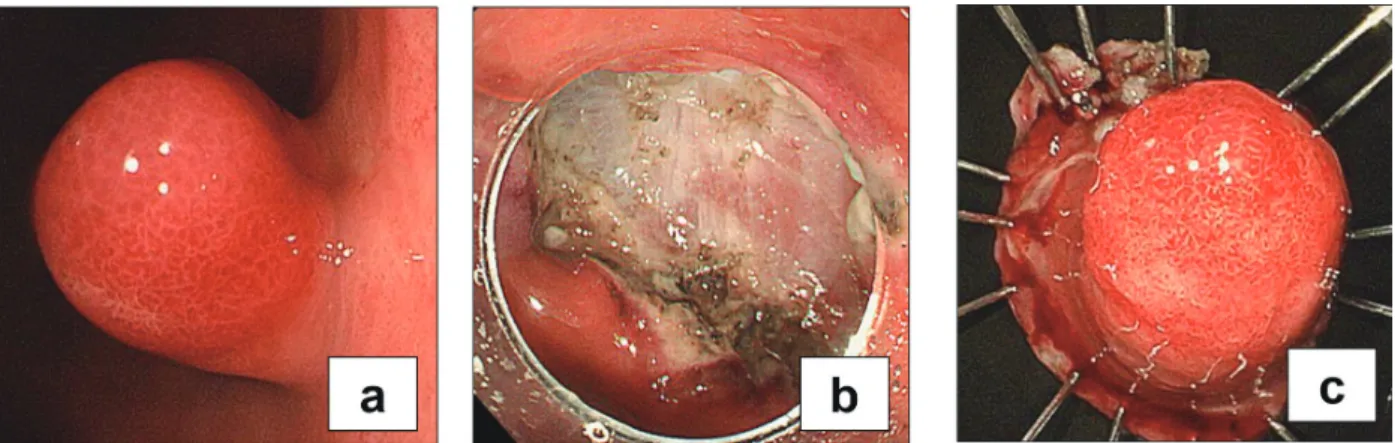
mm movable SEL in the posterior wall of the gastric antrum (Fig. 1). More- over, EGD performed at our hospital on admission revealed an enlarged tumor with reddish mucosal

surface and ulcer formation on the side (Fig. 2a). 

No cushion sign was detected. He had taken no non

-

steroid anti

-

inflammatory drug or anti

-

throm- botic drug. Gastric mucosa showed an endoscopic image that Helicobacter pylori had been eradicated. 

Two biopsy specimens were obtained from the ulcer, revealing aggregates of spindle cells with no coexis- tence of atypical cells. By immunostaining, these spindle cells were partially positive for CD34 (Fig.

2b) and negative for c

-

kit and S

-

100. A plain ab- dominal CT scan revealed mucosal thickening in the posterior wall of the gastric antrum, which could not Fig. 1. Endoscopic image showing a subepithelial le-

sion in the posterior wall of the gastric antrum.

Fig. 2. a) Endoscopic image taken before treatment, showing a tumor with ulcer formation in the periphery and a reddish surface. b) Magnified image (400×) of a section of a biopsy specimen immunostained for CD34, show- ing aggregates of spindle cells partially positive for CD34.

Fig. 3. Endoscopic ultrasonography image showing a

hyperechoic mass located mainly in the submuco-

sa.

(4)

be confirmed as an SEL. Endoscopic ultrasonogra- phy (EUS) using an electronic radial type ultrasound endoscope revealed a homogeneous, hyperechoic le- sion located mainly in the submucosa (Fig. 3). The tumor diameter found by EUS was 13 mm. These findings suggest a lipoma or liposarcoma, but neither hemorrhagic gastrointestinal stromal tumor (GIST) nor ectopic gastric mucosa could be ruled out. 

EUS

-

guided fine

-

needle aspiration biopsy (EUS

-

FNA) was considered, but it was not used because it was considered difficult to collect a sample from the movable and small, 13

-

mm

-

diameter SEL. How- ever, using EUS, the tumor was localized in the sub- mucosa, apparently with no continuity with the mus- cular layer. Therefore, it was thought possible to resect by ESD if submucosal dissection were per-

formed immediately above the muscular layer after injecting sufficient solution into the submucosa. 

Consequently, ESD was performed as a diagnostic treatment procedure after informed consent was ob- tained.

Endoscopic images taken during ESD showed the apparently healed ulcer (Fig. 4a). After suffi- cient sodium hyaluronate (Mucoup ; Johnson &

Johnson K.K., Tokyo, Japan) was injected into the submucosa for separation from the muscular layer, the tumor was subjected to en bloc resection using an IT Knife 2 (Olympus Corp., Tokyo, Japan) and a Splash M Knife (Hoya Pentax, Tokyo, Japan) (Figs.

4b and 4c). Although the submucosa had a scar

-

like appearance, the tumor was separated from the muscle layer and was removed carefully for dissec-

Fig. 4. a) Endoscopic images taken during endoscopic submucosal dissection, showing the healed ulcer on the tumor side and the tumor, although it remained entirely reddish in color. b) The post

-

resection ulcer base was not per- forated. c) The tumor was resected en bloc.

Fig. 5. a) Image of the resected specimen taken through a magnifying glass. The tumor was 12×9×12 mm. Scarring

was observed in the area in which an ulcer was present. b) Magnified image (400×) of a section stained with hematox-

ylin and eosin, showing mature adipocytes of various sizes.

(5)

163 Gastric lipoma resected by ESD

tion just above the muscle layer. No perforation occurred. The resected specimen had a yellowish cut surface, with 12×9×12 mm tumor size (Fig.

5a). Histopathologic analysis revealed that the tu- mor included mature fat tissue with a clear border (Fig. 5b). Regional fibrosis was observed in the area of the ulcer. Adipocytes differed in size, with no coexisting atypical interstitial cells or atypical li- poblasts. The adipocytes were also negative for CDK4 and MDM2 by immunostaining. These find- ings suggested a diagnosis of gastric lipoma. The patient had an uneventful postoperative course.

Discussion

This report describes a case of gastric lipoma resected by ESD with difficulty in preoperative diag- nosis because the lesion showed a small tumor with atypical macroscopic morphology. A lipoma is a be- nign tumor characterized by proliferation of mature adipocytes in the submucosa ; gastric lipomas ac- count for 1

-

3% of all benign gastric tumors

1,3)

. Li- pomas occur most commonly in the colon, although those occurring in the stomach, as in the present case, are uncommon

3)

. Gastric lipomas, which commonly affect middle

-

aged to elderly people in their 50s to 70s, occur slightly more often in women than in men

2)

. Most cases are asymptomatic.  

They are discovered incidentally during endoscopy or X

-

ray procedures performed as part of a medical check

-

up. Consistent with this, in the present case, the patient had no symptoms such as gastric pain or discomfort. Ten years earlier, the tumor had been discovered incidentally by EGD.

A gastric lipoma is identified endoscopically as a yellowish, non

-

pedunculated or pedunculated SEL with a smooth surface. Other characteristic fea- tures include the “cushion sign” and the “naked fat sign”

3)

. A gastric lipoma with thick mucosal epithe- lium might not be visible as a yellowish lesion. It requires differentiation from a GIST, a myogenic tu- mor, or a neurogenic tumor. Differentiating imag- ing features include hyperechogenicity on EUS, hy- podensity on a CT scan, and hypointensity on fat

-

suppressed MRI. The tumor in the present case was hyperechoic on EUS, consistent with lipoma. 

However, this diagnosis was not confirmed endo- scopically because of the presence of ulcer formation and a reddish surface. Reports on gastric lipomas with ulcer formation

1,2,4-9)

describe that the increased tumor size engenders ischemia of the mucosal epi- thelium and that the mechanical stimulus of food and the effects of drugs are involved in the ulcer forma-

tion process

9,10)

. Ulcerated gastric lipomas are gen- erally large : more than 40 mm

1,2,8,9,11-13)

. An ulcer is likely to be formed on the top of the tumor

8,9)

.  However, in the present case, the ulcer was located on the side of the tumor. The final tumor diameter was only 12 mm. This discrepancy might be attrib- utable to the tumor growth rate and to the mechani- cal stimulus.

Gastric lipomas are often regarded as small be- nign tumors. Asymptomatic cases can be managed without treatment as long as the diagnosis is con- firmed. In contrast, a gastric tumor that cannot be diagnosed as a lipoma or which is accompanied by a hemorrhagic ulcer, as in the present case, and those which are difficult to differentiate from a GIST or other SELs, can be removed surgically

12)

. Although gastric lipomas have generally been treated using partial gastrectomy

7-9,13,14)

, an increasing number of reports describe the use of ESD, as in the present case

11,15-17)

. Lee et al.

15)

used ESD in 4 of 5 cases of gastric lipoma subjected to diagnostic treatment. In Japan, Douhara et al.

16)

and Kobara et al.

17)

reported ESD for the treatment of gastric lipoma. For endo- scopic treatment of an SEL, if the tumor is located in the submucosa without invasion into other layers, en bloc resection by ESD is feasible by separating the tumor from the muscle layer under direct vision ; close pathological evaluation can be conducted as well. We devised the following measures against ESD in this case. First, marking was performed at 5 mm or greater distance from the margin of the le- sion to obtain a sufficient margin to penetrate into the submucosa at the time of dissection. Secondly, sufficient sodium hyaluronate was injected into the submucosa as a high

-

viscosity solution. The tumor was separated from the muscle layer. Finally, sub- mucosal dissection was performed above the muscle layer to remove the tumor reliably without perfora- tion.

The present case demonstrated the effective- ness of diagnostic treatment by ESD for treatment of a gastric lipoma that underwent ulcer formation and healing.

Acknowledgement

We wish to express our deep appreciation to all

endoscopy staff of the Japanese Red Cross Fukushi-

ma Hospital for their assistance with endoscopic

procedures.

(6)

Conflicts of interest

The authors declare that they have no conflict of interest, financial or otherwise, in relation to this study.

References

1. Thompson WM, Kende AI, Levy AD. Imaging characteristics of gastric lipomas in 16 adult and pediatric patients. Am J Roentgenol, 181 : 981

-

985, 2003.

2. Kamata T, Mochizuki Y, Koshikawa K, et al. A case of gastric lipoma presenting as gastrointesti- nal hemorrhage. J Jpn Surg Assoc, 70 : 2682

-

2685, 2009 (in Japanese, abstract in English).

3. Taylor AJ, Stewart ET, Dodds WJ. Gastrointesti- nal lipomas : a radiologic and pathologic review. 

Am J Roentgenol, 155 : 1205

-

1210, 1990.

4. Maderal F, Hunter F, Fuselier G, et al. Gastric li- pomas – An update of clinical presentation, diagno- sis, and treatment. Am J Gastroenterol, 79 : 964

-

967, 1984.

5. Palmer ED. Benign intramural tumors of the stomach. Review with special reference to gross pathology. Medicine, 30 : 81

-

181, 1951.

6. Park SH, Han JK, Kim TK, et al. Unusual gastric tumors : radiologic

-

pathologic correlation. Ra- diographics, 19 : 1435

-

1446, 1999.

7. Ciraldo A, Thomas D, Schmidt S. Gastric lipoma presenting as gastrointestinal bleeding : a case re- port. Int J Emerg Intens Care Med, 4 : 1

-

4, 1999.

8. Ramdass KJ, Mathur S, Seetahal

-

Maraj P, et al. 

Gastric lipoma presenting with massive upper gas- trointestinal bleeding. Case Rep Emerg Med, 2013 : 50610, 2013.

9. Yamai H, Hamaguchi N, Yamamoto Y, et al. A case of gastric lipoma with hemorrhagic ulcer, which grew up during two years follow up period. Jpn J Gastroenterol Surg, 40 : 377

-

381, 2007 (in Japa- nese, abstract in English).

10. Zirpe D, Wani M, Tiwari P, et al. Duodenal lipo- matosis as a curious cause of upper gastrointestinal bleed : A report with review of literature. J Clin Diagn Res, 10 : PE01

-

PE04, 2016.

11. Lee KJ, Kim GH, Park do Y, et al. Endoscopic re- section of gastrointestinal lipomas : a single

-

cen- ter experience. Surg Endosc, 28 : 185

-

192, 2014.

12. Agrawa K, Soubam PS, Vaiphei K. Two cases of rare benign mucosal lesions of the stomach. BMJ Case Rep, 2013. doi : 10.1136/bcr

-

2013

-

009506.

13. Zameer M, Kanojia RP, Rao KLN, Menon P, Samujh R, Thapa BR. Gastric lipoma. J Indian Assoc Pediatr Surg, 15 : 64

-

66, 2010.

14. Al Shammari JO, Al

-

Shadidi N, Abdulsalam AJ, et al. Gastric lipoma excision during a laproscopic sleeve gastrecomy : A case report. Int J Surg Case Rep, 24 : 128

-

130, 2016.

15. Lee JS, Kim GH, Park DY, et al. Endoscopic sub- mucosal dissection for gastric subepithelial tu- mors : A single

-

center experience. Gastroenter- ol Res Pract, 2015 ; ID425469, 1

-

9, 2015.

16. Douhara A, Mitoro A, Furukawa M, et al. A case of gastric lipoma diagnosed by endoscopic submu- cosal dissection. Gastroenterol Endosc, 54 : 3141

-

3147, 2012 (in Japanese, abstract in English).

17. Kobara H, Mori H, Rafiq K, et al. Indications of

endoscopic submucosal dissection for symptomatic

benign gastrointestinal subepithelial or carcinoid

tumors originating in the submucosa. Mol Clin

Oncol, 1 : 1002

-

1008, 2013.

Fig. 3. Endoscopic ultrasonography image showing a  hyperechoic mass located mainly in the  submuco-sa.
Fig. 4. a) Endoscopic images taken during endoscopic submucosal dissection, showing the healed ulcer on the tumor  side and the tumor, although it remained entirely reddish in color

参照

関連したドキュメント

So far, most spectral and analytic properties mirror of M Z 0 those of periodic Schr¨odinger operators, but there are two important differences: (i) M 0 is not bounded from below

In our case, manifold may be regarded as a homogeneous space of “the group” of all transformations, and the category of invariant sheaves is regarded as an equivariant sheaf

A nonempty binary tree can also be regarded as a rooted directed tree graph (arborescence) where the outgoing arcs of each node are labeled by distinct labels from the set { L, R

The explicit treatment of the metaplectic representa- tion requires various methods from analysis and geometry, in addition to the algebraic methods; and it is our aim in a series

We have avoided most of the references to the theory of semisimple Lie groups and representation theory, and instead given direct constructions of the key objects, such as for

Bipartite maps (also called hypermaps, or dessins d’enfants ) : vertices are either black or white, and monochromatic edges

Actually it can be seen that all the characterizations of A ≤ ∗ B listed in Theorem 2.1 have singular value analogies in the general case..

Sterling Blue ® can be applied when plants are dormant as an undiluted spot treatment directly to the soil or as a Lo-Oil basal bark treatment using an oil-water emulsion solution. •