Automatic Classification of Semantic Relations between Facts and Opinions
Koji Murakami† Eric Nichols‡ Junta Mizuno†‡ Yotaro Watanabe‡
Hayato Goto† Megumi Ohki† Suguru Matsuyoshi† Kentaro Inui‡ Yuji Matsumoto†
†Nara Institute of Science and Technology
‡Tohoku University
{kmurakami,matuyosi,hayato-g,megumi-o,matsu}@is.naist.jp {eric-n,junta-m,inui}@ecei.tohoku.ac.jp
Abstract
Classifying and identifying semantic re- lations between facts and opinions on the Web is of utmost importance for or- ganizing information on the Web, how- ever, this requires consideration of a broader set of semantic relations than are typically handled in Recognizing Tex- tual Entailment (RTE), Cross-document Structure Theory (CST), and similar tasks. In this paper, we describe the con- struction and evaluation of a system that identifies and classifies semantic rela- tions in Internet data. Our system targets a set of semantic relations that have been inspired by CST but that have been gen- eralized and broadened to facilitate ap- plication to mixed fact and opinion data from the Internet. Our system identi- fies these semantic relations in Japanese Web texts using a combination of lexical, syntactic, and semantic information and evaluate our system against gold stan- dard data that was manually constructed for this task. We will release all gold standard data used in training and eval- uation of our system this summer.
1 Introduction
The task of organizing the information on the In- ternet to help users find facts and opinions on their topics of interest is increasingly important as more people turn to the Web as a source of important information. The vast amounts of re- search conducted in NLP on automatic summa- rization, opinion mining, and question answer- ing are illustrative of the great interest in mak- ing relevant information easier to find. Provid- ing Internet users with thorough information re-
quires recognizing semantic relations between both facts and opinions, however the assump- tions made by current approaches are often in- compatible with this goal. For example, the existing semantic relations considered in Rec- ognizing Textual Entailment (RTE) (Dagan et al., 2005) are often too narrow in scope to be directly applicable to text on the Internet, and theories like Cross-document Structure Theory (CST) (Radev, 2000) are only applicable to facts or second-hand reporting of opinions rather than relations between both.
As part of the STATEMENT MAP project we proposed the development of a system to sup- port information credibility analysis on the Web (Murakami et al., 2009b) by automatically sum- marizing facts and opinions on topics of inter- est to users and showing them the evidence and conflicts for each viewpoint. To facilitate the de- tection of semantic relations in Internet data, we defined a sentence-like unit of information called the statement that encompasses both facts and opinions, started compiling a corpus of state- ments annotated with semantic relations (Mu- rakami et al., 2009a), and begin constructing a system to automatically identify semantic rela- tions between statements.
In this paper, we describe the construction and evaluation of a prototype semantic relation iden- tification system. We build on the semantic rela- tions proposed in RTE and CST and in our pre- vious work, refining them into a streamlined set of semantic relations that apply across facts and opinions, but that are simple enough to make automatic recognition of semantic relations be- tween statements in Internet text possible.Our semantic relations are [AGREEMENT], [CON-
FLICT], [CONFINEMENT], and [EVIDENCE].
[AGREEMENT] and [CONFLICT] are expansions of the [EQUIVALENCE] and [CONTRADICTION]
relations used in RTE. [CONFINEMENT] and [EVIDENCE] are new relations between facts and opinions that are essential for understanding how statements on a topic are inter-related.
Our task differs from opinion mining and sen- timent analysis which largely focus on identify- ing the polarity of an opinion for defined param- eters rather than identify how facts and opinions relate to each other, and it differs from web doc- ument summarization tasks which focus on ex- tracting information from web page structure and contextual information from hyperlinks rather than analyzing the semantics of the language on the webpage itself.
We present a system that automatically iden- tifies semantic relations between statements in Japanese Internet texts. Our system uses struc- tural alignment to identify statement pairs that are likely to be related, then classifies seman- tic relations using a combination of lexical, syn- tactic, and semantic information. We evaluate cross-statement semantic relation classification on sentence pairs that were taken from Japanese Internet texts on several topics and manually an- notated with a semantic relation where one is present. In our evaluation, we look closely at the impact that each of the resources has on semantic relation classification quality.
The rest of this paper is organized as follows.
In Section 2, we discuss related work in summa- rization, semantic relation classification, opinion mining, and sentiment analysis, showing how existing classification schemes are insufficient for our task. In Section 3, we introduce a set of cross-sentential semantic relations for use in the opinion classification needed to support informa- tion credibility analysis on the Web. In Section 4, we present our cross-sentential semantic re- lation recognition system, and discuss the algo- rithms and resources that are employed. In Sec- tion 5, we evaluate our system in a semantic rela- tion classification task. In Section 6, we discuss our findings and conduct error analysis. Finally, we conclude the paper in Section 7.
2 Related Work
2.1 Recognizing Textual Entailment
Identifying logical relations between texts is the focus of Recognizing Textual Entailment, the task of deciding whether the meaning of one text is entailed from another text. A major task in the RTE Challenge (Recognizing Tex-
tual Entailment Challenge) is classifying the se- mantic relation between a Text (T) and a Hy- pothesis (H) into [ENTAILMENT], [CONTRA-
DICTION], or [UNKNOWN]. Over the last sev- eral years, several corpora annotated with thou- sands of (T,H) pairs have been constructed for this task. In these corpora, each pair was tagged indicating its related task (e.g. Information Ex- traction, Question Answering, Information Re- trieval or Summarization).
The RTE Challenge has successfully em- ployed a variety of techniques in order to rec- ognize instances of textual entailment, including methods based on: measuring the degree of lex- ical overlap between bag of words (Glickman et al., 2005; Jijkoun and de Rijke, 2005), the alignment of graphs created from syntactic or se- mantic dependencies (Marsi and Krahmer, 2005;
MacCartney et al., 2006), statistical classifiers which leverage a wide range of features (Hickl et al., 2005), or reference rule generation (Szpek- tor et al., 2007). These approaches have shown great promise in RTE for entailment pairs in the corpus, but more robust models of recognizing logical relations are still desirable.
The definition of contradiction in RTE is that T contradicts H if it is very unlikely that both T and H can be true at the same time. However, in real documents on the Web, there are many pairs of examples which are contradictory in part, or where one statement confines the applicability of another, as shown in the examples in Table 1.
2.2 Cross-document Structure Theory Cross-document Structure Theory (CST), devel- oped by Radev (2000), is another task of rec- ognizing semantic relations between sentences.
CST is an expanded rhetorical structure analy- sis based on Rhetorical Structure Theory (RST:
(William and Thompson, 1988)), and attempts to describe the semantic relations that exist between two or more sentences from differ- ent source documents that are related to the same topic, as well as those that come from a single source document. A corpus of cross- document sentences annotated with CST rela- tions has also been constructed (The CSTBank Corpus: (Radev et al., 2003)). CSTBank is organized into clusters of topically-related ar- ticles. There are 18 kinds of semantic rela- tions in this corpus, not limited to [EQUIVA-
LENCE] or [CONTRADICTION], but also includ- ing [JUDGEMENT], [ELABORATION], and [RE-
Query Matching sentences Output キシリトールは虫歯予防に効果
がある
キシリトールの含まれている量が多いほどむし歯予防の効果は高いようです 同意 The cavity-prevention effects are greater the more Xylitol is included. [AGREEMENT].
キシリトールがお口の健康維持や虫歯予防にも効果を発揮します 同意 Xylitol is effective at preventing
cavities.
Xylitol shows effectiveness at maintaining good oral hygiene and preventing cavities. [AGREEMENT] キシリトールの虫歯抑制効果についてはいろいろな意見がありますが実際は効
果があるわけではありません
対立
There are many opinions about the cavity-prevention effectiveness of Xylitol, but it is not really effective.
[CONFLICT]
還元水は健康に良い
弱アルカリ性のアルカリイオン還元水があなたと家族の健康を支えます 同意 Reduced water, which has weak alkaline ions, supports the health of you and your family.
[AGREEMENT] 還元水は活性酸素を除去すると言われ健康を維持してくれる働きをもたらす 同意 Reduced water is good for the
health.
Reduced water is said to remove active oxygen from the body, making it effective at promoting good health.
[AGREEMENT]
美味しくても酸化させる水は健康には役立ちません 対立 Even if oxidized water tastes good, it does not help one’s health. [CONFLICT] イソフラボンは健康維持に効果
がある
大豆イソフラボンをサプリメントで過剰摂取すると健康維持には負の影響を与 える結果となります
限定
Isoflavone is effective at maintaining good health.
Taking too much soy isoflavone as a supplement will have a negative effect on one’s health
[CONFINEMENT]
Table 1: Example semantic relation classification.
FINEMENT]. Etoh et al. (Etoh and Okumura, 2005) constructed a Japanese Cross-document Relation Corpus, and they redefined 14 kinds of semantic relations in their corpus.
CST was designed for objective expressions because its target data is newspaper articles re- lated to the same topic. Facts, which can be ex- tracted from newspaper articles, have been used in conventional NLP research, such as Informa- tion Extraction or Factoid Question Answering.
However, there are a lot of opinions on the Web, and it is important to survey opinions in addition to facts to give Internet users a comprehensive view of the discussions on topics of interest.
2.3 Cross-document Summarization Based on CST Relations between Sentences Zhang and Radev (2004) attempted to classify CST relations between sentence pairs extracted from topically related documents. However, they used a vector space model and tried multi-class classification. The results were not satisfactory.
This observation may indicate that the recog- nition methods for each relation should be de- veloped separately. Miyabe et al. (2008) at- tempted to recognize relations that were defined in a Japanese cross-document relation corpus (Etoh and Okumura, 2005). However, their tar- get relations were limited to [EQUIVALENCE] and [TRANSITION]; other relations were not tar- geted. Recognizing [EVIDENCE] is indispens- able for organizing information on the Internet.
We need to develop satisfactory methods of [EV-
IDENCE] recognition.
2.4 Opinion Mining and Sentiment Analysis
Subjective statements, such as opinions, have recently been the focus of much NLP re- search including review analysis, opinion ex- traction, opinion question answering, and senti- ment analysis. In the corpus constructed in the Multi-Perspective Question Answering (MPQA) Project (Wiebe et al., 2005), individual expres- sions are tagged that correspond to explicit men- tions of private states, speech event, and expres- sive subjective elements.
The goal of opinion mining to extract expres- sions with polarity from texts, not to recognize semantic relations between sentences. Sentiment analysis also focus classifying subjective expres- sions in texts into positive/negative classes. In comparison, although we deal with sentiment in- formation in text, our objective is to recognize semantic relations between sentences. If a user’s query requires positive/negative information, we will also need to extract sentences including sen- timent expression like in opinion mining, how- ever, our semantic relation, [CONFINEMENT], is more precise because it identifies the condition or scope of the polarity. Queries do not neces- sarily include sentiment information; we also ac- cept queries that are intended to be a statement of fact. For example, for the query “Xylitol is effective at preventing cavities.” in Table 1, we extract a variety of sentences from the Web and recognize semantic relations between the query and many kinds of sentences.
3 Semantic Relations between Statements
In this section, we define the semantic relations that we will classify in Japanese Internet texts as well as their corresponding relations in RTE and CST. Our goal is to define semantic relations that are applicable over both fact and opinions, mak- ing them more appropriate for handling Internet texts. See Table 1 for real examples.
3.1 [AGREEMENT]
A bi-directional relation where statements have equivalent semantic content on a shared topic.
Here we usetopicin a narrow sense to mean that the semantic contents of both statements are rel- evant to each other.
The following is an example of [AGREE-
MENT] on the topic ofbio-ethanol environmental impact.
(1) a. Bio-ethanol is good for the environment.
b. Bio-ethanol is a high-quality fuel, and it has the power to deal with the environ- ment problems that we are facing.
Once relevance has been established, [AGREEMENT] can range from strict logi- cal entailment or identical polarity of opinions.
Here is an example of two statements that share a broad topic, but that are not classified as [AGREEMENT] becausepreventing cavitiesand tooth calcificationare not intuitively relevant.
(2) a. Xylitol is effective at preventing cavities.
b. Xylitol advances tooth calcification.
3.2 [CONFLICT]
A bi-directional relation where statements have negative or contradicting semantic content on a shared topic. This can range from strict logical contradiction to opposite polarity of opinions.
The next pair is a [CONFLICT] example.
(3) a. Bio-ethanol is good for our earth.
b. There is a fact that bio-ethanol further the destruction of the environment.
3.3 [EVIDENCE]
A uni-directional relation where one statement provides justification or supporting evidence for the other. Both statements can be either facts or opinions. The following is a typical example:
(4) a. I believe that applying the technology of cloning must be controlled by law.
b. There is a need to regulate cloning, be- cause it can be open to abuse.
The statement containing the evidence con- sists of two parts: one part has a [AGREEMENT] or [CONFLICT] with the other statement, the other part provides support or justification for it.
3.4 [CONFINEMENT]
A uni-directional relation where one statement provides more specific information about the other or quantifies the situations in which it ap- plies. The pair below is an example, in which onestatementgives a condition under which the other can be true.
(5) a. Steroids have side-effects.
b. There is almost no need to worry about side-effects when steroids are used for lo- cal treatment.
4 Recognizing Semantic Relations In order to organize the information on the Internet, we need to identify the [AGREE-
MENT], [CONFLICT], [CONFINEMENT], and [EVIDENCE] semantic relations. Because iden- tification of [AGREEMENT] and [CONFLICT] is a problem of measuring semantic similarity be- tween two statements, it can be cast as a sen- tence alignment problem and solved using an RTE framework. The two sentences do not need to be from the same source.
However, the identification of [CONFINE-
MENT] and [EVIDENCE] relations depend on contextual information in the sentence. For ex- ample, conditional statements or specific dis- course markers like “because” act as important cues for their identification. Thus, to identify these two relations across documents, we must first identify [AGREEMENT] or [CONFLICT] be- tween sentences in different documents and then determine if there is a [CONFINEMENT] or [EV-
IDENCE] relation in one of the documents.
Furthermore, the surrounding text often con- tains contextual information that is important for identifying these two relations. Proper handling of surrounding context requires discourse analy- sis and is an area of future work, but our basic detection strategy is as follows:
1. Identify a [AGREEMENT] or [CONFLICT] re- lation between the Query and Text
2. Search the Text sentence for cues that iden- tify [CONFINEMENT] or [EVIDENCE]
3. Infer the applicability of the [CONFINE-
MENT] or [EVIDENCE] relations in the Text to the Query
4.1 System Overview
We have finished constructing a prototype sys- tem that detects semantic relation betweenstate- ments. It has a three-stage architecture similar to the RTE system of MacCartneyet al.(2006):
1. Linguistic analysis 2. Structural alignment
3. Feature extraction for detecting [EVIDENCE] and [CONFINEMENT]
4. Semantic relation classification
However, we differ in the following respects.
First, our relation classification is broader than RTE’s simple distinction between [ENTAIL-
MENT], [CONTRADICTION], and [UNKNOWN];
in place of [ENTAILMENT] and [CONTRA-
DICTION, we use broader [AGREEMENT] and [CONFLICT] relations. We also consider cover gradations of applicability of statements with the [CONFINEMENT] relation.
Second, we conduct structural alignment with the goal of aligning semantic structures. We do this by directly incorporating dependency align- ments and predicate-argument structure informa- tion for both the user query and the Web text into the alignment scoring process. This allows us to effectively capture many long-distance alignments that cannot be represented as lexical alignments. This contrasts with MacCartney et al. (2006), who uses dependency structures for the Hypothesis to reduce the lexical alignment search space but do not produce structural align- ments and do not use the dependencies in detect- ing entailment.
Finally, we apply several rich semantic re- sources in alignment and classification: extended modality information that helps align and clas- sify structures that are semantically similar but divergent in tense or polarity; and lexical simi- larity through ontologies like WordNet.
4.2 Linguistic Analysis
In order to identify semantic relations between the user query (Q) and the sentence extracted from Webtext(T), we first conduct syntactic and semantic linguistic analysis to provide a basis for alignment and relation classification.
For syntactic analysis, we use the Japanese dependency parser CaboCha (Kudo and Mat-
!"#$%&'!
"#$!%&'()*'+$! ()*!
,'-!.-'/'0+1!#$)23#!
+,-!
$4$50*$!./!
%&!
#$%&' (()* ++,- ./
6! 7!
!"#$%&'!
"#$!%&'()*'+$! 01234!
'&3$'.'-'&%&!
567!
*)-%'8&! 897:;!
&85#!)&!9!3-$)3/$+3!
<=>?@A/!
#)&!:$$+!&#';+! ()BC-!
B! C!
!
"#
85#!)&
<=
#)&
5
*) ()B
&8 0 '&
& 9 85# )&
&8
?! )!
5! :!
J!
3'!#)*$!!
#$)23#!)..2%5)0'+&!
C! J!
J!
B!
B! C!
Figure 1: An example of structural alignment sumoto, 2002) and the predicate-argument struc- ture analyzer ChaPAS (Watanabe et al., 2010).
CaboCha splits the Japanese text into phrase-like chunks and represents syntactic dependencies between the chunks as edges in a graph. Cha- PAS identifies predicate-argument structures in the dependency graph produced by CaboCha.
We also conduct extended modality analysis using the resources provided by Matsuyoshi et al. (2010), focusing on tense, modality, and po- larity, because such information provides impor- tant clues for the recognition of semantic rela- tions betweenstatements.
4.3 Structural Alignment
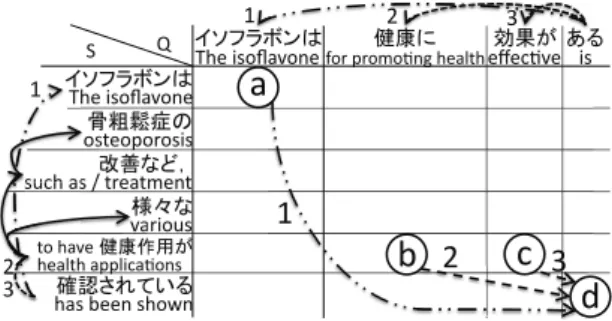
In this section, we describe our approach to structural alignment. The structural alignment process is shown in Figure 1. It consists of the following two phases:
1. lexical alignment 2. structural alignment
We developed a heuristic-based algorithm to align chunk based on lexical similarity infor- mation. We incorporate the following informa- tion into an alignment confidence score that has a range of 0.0-1.0 and align chunk whose scores cross an empirically-determined threshold.
• surface level similarity: identical content words or cosine similarity of chunk contents
• semantic similarity of predicate-argument structures
predicates we check for matches in predi- cate entailment databases (Hashimoto et al., 2009; Matsuyoshi et al., 2008) consid- ering the default case frames reported by ChaPAS
arguments we check for synonym or hy- pernym matches in the Japanese WordNet (2008) or the Japanese hypernym collec- tion of Sumidaet al.(2008)
>?@???????????????????AB?C????DEF)!
>?'???????????????????AB?C????GHF)! I! T :!
H :!
(field) (in)!(agricultural chemicals) (ACC)! (use)!
(field) (on)!(agricultural chemicals) (ACC)!(spray)!
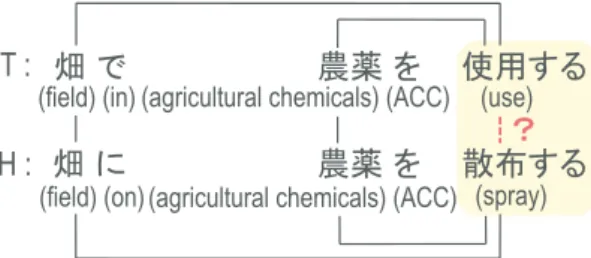
Figure 2: Determining the compatibility of se- mantic structures
We compare the predicate-argument structure of the query to that of the text and determine if the argument structures are compatible. This process is illustrated in Figure 2 where the T(ext)
“Agricultural chemicals are used in the field.” is aligned with the H(ypothesis) “Over the field, agricultural chemicals are sprayed.” Although the verbs used andsprayedare not directly se- mantically related, they are aligned because they share the same argument structures. This lets up align predicates for which we lack semantic re- sources. We use the following information to de- termine predicate-argument alignment:
• the number of aligned children
• the number of aligned case frame arguments
• the number of possible alignments in a win- dow ofnchunk
• predicates indicating existence or quantity.
E.g.many,few,to exist, etc.
• polarity of both parent and child chunks us- ing the resources in (Higashiyama et al., 2008; Kobayashi et al., 2005)
We treat structural alignment as a machine learning problem and train a Support Vector Ma- chine (SVM) model to decide if lexically aligned chunks are semantically aligned.
We train on gold-standard labeled alignment of 370 sentence pairs. This data set is described in more detail in Section 5.1. As features for our SVM model, we use the following information:
• the distance in edges in the dependency graph between parent and child for both sentences
• the distance in chunks between parent and child in both sentences
• binary features indicating whether each chunk is a predicate or argument according to ChaPAS
• the parts-of-speech of first and last word in each chunk
• when the chunk ends with a case marker, the case of the chunk , otherwisenone
• the lexical alignment score of each chunk pair
4.4 Feature Extraction for Detecting Evidence and Confinement
Once the structural alignment system has iden- tified potential [AGREEMENT] or [CONFLICT] relations, we need to extract contextual cues in the Text as features for detecting [CONFINE-
MENT] and [EVIDENCE] relations. Conditional statements, degree adverbs, and partial negation, which play a role in limiting the scope or degree of aquery’s contents in thestatement, can be im- portant cues for detecting the these two semantic relations. We currently use a set of heuristics to extract a set of expressions to use as features for classifying these relations using SVM models.
4.5 Relation Classification
Once the structural alignment is successfully identified, the task of semantic relation classi- fication is straightforward. We also solve this problem with machine learning by training an SVM classifier. As features, we draw on a com- bination of lexical, syntactic, and semantic infor- mation including the syntactic alignments from the previous section. The feature set is:
alignments We define two binary function, ALIGNword(qi, tm) for the lexical align- ment and ALIGNstruct((qi, qj),(tm, tk)) for the structural alignment to be true if and only if the node qi, qj ∈ Qhas been seman- tically and structurally aligned to the node tm, tk∈T.QandT are the (Q)uery and the (T)ext, respectively. We also use a separate feature for a score representing the likelihood of the alignment.
modality We have a feature that encodes all of the possible polarities of a predicate node from modality analysis, which indicates the utterance type, and can be assertive, voli- tional, wish, imperative, permissive, or in- terrogative. Modalities that do not repre- sent opinions (i.e.imperative,permissiveand interrogative) often indicate [OTHER] rela- tions.
antonym We define a binary function AN T ON Y M(qi, tm) that indicates if the pair is identified as an antonym. This information helps identify [CONFLICT].
Relation Measure 3-class Cascaded 3-class ∆ [AGREEMENT] precision 0.79 (128 / 162) 0.80 (126 / 157) +0.01 [AGREEMENT] recall 0.86 (128 / 149) 0.85 (126 / 149) -0.01
[AGREEMENT] f-score 0.82 0.82 -
[CONFLICT] precision 0 (0 / 5) 0.36 (5 / 14) +0.36 [CONFLICT] recall 0 (0 / 12) 0.42 (5 / 12) +0.42
[CONFLICT] f-score 0 0.38 +0.38
[CONFINEMENT] precision 0.4 (4 / 10) 0.8 (4 / 5) +0.4 [CONFINEMENT] recall 0.17 (4 / 23) 0.17 (4 / 23) -
[CONFINEMENT] f-score 0.24 0.29 +0.05
Table 2: Semantic relation classification results comparing 3-class and cascaded 3-class approaches negation To identify negations, we primar-
ily rely on a predicate’s Actuality value, which represents epistemic modality and existential negation. If a predicate pair ALIGNword(qi, tm) has mismatching actu- ality labels, the pair is likely a [OTHER].
contextual cues This set of features is used to mark the presence of any contextual cues that identify of [CONFINEMENT] or [EVI-
DENCE] relations in a chunk . For example,
“ので(because)” or “ため(due to)” are typ- ical contextual cues for [EVIDENCE], and “ とき(when)” or “ならば(if)” are typical for [CONFINEMENT].
5 Evaluation
5.1 Data Preparation
In order to evaluate our semantic relation clas- sification system on realistic Web data, we con- structed a corpus of sentence pairs gathered from a vast collection of webpages (2009a). Our basic approach is as follows:
1. Retrieve documents related to a set number of topics using the Tsubaki1search engine 2. Extract real sentences that include major sub-
topic words which are detected based on TF/IDF in the document set
3. Reduce noise in data by using heuristics to eliminate advertisements and comment spam 4. Reduce the search space for identifying sen- tence pairs and prepare pairs, which look fea- sible to annotate
5. Annotate corresponding sentences with [AGREEMENT], [CONFLICT], [CONFINE-
MENT], or [OTHER]
1http://tsubaki.ixnlp.nii.ac.jp/
Although our target semantic relations in- clude [EVIDENCE], they difficult annotate con- sistently, so we do not annotate them at this time. Expanding our corpus and semantic re- lation classifier to handle [EVIDENCE] remains and area of future work.
The data that composes our corpus comes from a diverse number of sources. A hand sur- vey of a random sample of the types of domains of 100 document URLs is given below. Half of the URL domains were not readily identifiable, but the known URL domains included govern- mental, corporate, and personal webpages. We believe this distribution is representative of in- formation sources on the Internet.
type count
academic 2
blogs 23
corporate 10 governmental 4
news 5
press releases 4 q&a site 1 reference 1
other 50
We have made a partial release of our corpus of sentence pairs manually annotated with the correct semantic relations2. We will fully release all the data annotated semantic relations and with gold standard alignments at a future date.
5.2 Experiment Settings
In this section, we present results of empiri- cal evaluation of our proposed semantic rela- tion classification system on the dataset we con- structed in the previous section. For this experi- ment, we use SVMs as described in Section 4.5
2http://stmap.naist.jp/corpus/ja/
index.html(in Japanese)
to classify semantic relations into one of the four classes: [AGREEMENT], [CONFLICT], [CON-
FINEMENT], or [OTHER] in the case of no re- lation. As data we use 370 sentence pairs that have been manually annotated both with the cor- rect semantic relation and with gold standard alignments. Annotations are checked by two na- tive speakers of Japanese, and any sentence pair where annotation agreement is not reached is discarded. Because we have limited data that is annotated with correct alignments and semantic relations, we perform five-fold cross validation, training both the structural aligner and semantic relation classifier on 296 sentence pairs and eval- uating on the held out 74 sentence pairs. The figures presented in the next section are for the combined results on all 370 sentence pairs.
5.3 Results
We compare two different approaches to classi- fication using SVMs:
3-class semantic relations are directly classified into one of [AGREEMENT], [CONFLICT], and [CONFINEMENT] with all features de- scribed in 4.5
cascaded 3-class semantic relations are first classified into one of [AGREEMENT], [CON-
FLICT] without contextual cue features. Then an additional judgement with all features de- termines if [AGREEMENT] and [CONFLICT] should be reclassified as [CONFINEMENT] Initial results using the 3-class classifica- tion model produced high f-scores for [AGREE-
MENT] but unfavorable results for [CONFLICT] and [CONFINEMENT]. We significantly im- proved classification of [CONFLICT] and [CON-
FINEMENT] by adopting the cascaded 3-class model. We present these results in Table 2 and successfully recognized examples in Table 1.
6 Discussion and Error Analysis
We constructed a prototype semantic relation classification system by combining the compo- nents described in the previous section. While the system developed is not domain-specific and capable of accepting queries on any topic, we evaluate its semantic relation classification on several queries that are representative of our training data.
Figure 3 shows a snapshot of the semantic re- lation classification system and the various se- mantic relations it recognized for the query.
Baseline Structural
Upper-bound Alignment
Precision 0.44 0.52 0.74 (56/126) (96/186) (135/183) Recall 0.30 0.52 0.73 (56/184) (96/184) (135/184) F1-score 0.36 0.52 0.74
Table 3: Comparison of lexical, structural, and upper-bound alignments on semantic relation classification
In the example (6), recognized as [CONFINE-
MENT] in Figure 3, our system correctly identi- fied negation and analyzed the description “Xyl- itol alone can not completely” as playing a role of requirement.
(6) a. キシリトールは虫歯予防に効果がある
(Xylitol is effective at preventing cavi- ties.)
b. キシリトールだけでは完全な予防は出 来ません
(Xylitol alone can not completely prevent cavities.)
Our system correctly identifies [AGREE-
MENT] relations in other examples about re- duced water from Table 1 by structurally align- ing phrases like “promoting good health” and
“supports the health” to “good for the health.”
These examples show how resources like (Matsuyoshi et al., 2010) and WordNet (Bond et al., 2008) have contributed to the relation clas- sification improvement of structural alignment over them baseline in Table 3. Focusing on sim- ilarity of syntactic and semantic structures gives our alignment method greater flexibility.
However, there are still various examples which the system cannot recognized correctly.
In examples on cavity prevention, the phrase
“effective at preventing cavities” could not be aligned with “can prevent cavities” or “good for cavity prevention,” nor can “cavity prevention”
and “cavity-causing bacteria control.”
The above examples illustrate the importance of the role played by the alignment phase in the whole system’s performance.
Table 3 compares the semantic relation classi- fication performance of using lexical alignment only (as the baseline), lexical alignment and structural alignment, and, to calculate the maxi- mum possible precision, classification using cor- rect alignment data (the upper-bound). We can
Figure 3: Alignment and classification example for the query “Xylitol is effective at preventing cavities.”
see that structural alignment makes it possible to align more words than lexical alignment alone, leading to an improvement in semantic relation classification. However, there is still a large gap between the performance of structural alignment and the maximum possible precision. Error anal- ysis shows that a big cause of incorrect classifi- cation is incorrect lexical alignment. Improving lexical alignment is a serious problem that must be addressed. This entails expanding our cur- rent lexical resources and finding more effective methods of apply them in alignment.
The most serious problem we currently face is the feature engineering necessary to find the op- timal way of applying structural alignments or other semantic information to semantic relation classification. We need to conduct a quantita- tive evaluation of our current classification mod- els and find ways to improve them.
7 Conclusion
Classifying and identifying semantic relations between facts and opinions on the Web is of ut- most importance to organizing information on the Web, however, this requires consideration of a broader set of semantic relations than are typi- cally handled in RTE, CST, and similar tasks. In this paper, we introduced a set of cross-sentential semantic relations specifically designed for this task that apply over both facts and opinions. We
presented a system that identifies these semantic relations in Japanese Web texts using a combina- tion of lexical, syntactic, and semantic informa- tion and evaluated our system against data that was manually constructed for this task. Prelimi- nary evaluation showed that we are able to detect [AGREEMENT] with high levels of confidence.
Our method also shows promise in [CONFLICT] and [CONFINEMENT] detection. We also dis- cussed some of the technical issues that need to be solved in order to identify [CONFLICT] and [CONFINEMENT].
Acknowledgments
This work is supported by the National Institute of Information and Communications Technology Japan.
References
Bond, Francis, Hitoshi Isahara, Kyoko Kanzaki, and Kiyotaka Uchimoto. 2008. Boot-strapping a wordnet using multiple existing wordnets. InProc.
of the 6th International Language Resources and Evaluation (LREC’08).
Dagan, Ido, Oren Glickman, and Bernardo Magnini.
2005. The pascal recognising textual entailment challenge. In Proc. of the PASCAL Challenges Workshop on Recognising Textual Entailment.
Etoh, Junji and Manabu Okumura. 2005. Cross- document relationship between sentences corpus.
InProc. of the 14th Annual Meeting of the Associa- tion for Natural Language Processing, pages 482–
485. (in Japanese).
Glickman, Oren, Ido Dagan, and Moshe Koppel.
2005. Web based textual entailment. InProc. of the First PASCAL Recognizing Textual Entailment Workshop.
Hashimoto, Chikara, Kentaro Torisawa, Kow Kuroda, Masaki Murata, and Jun’ichi Kazama.
2009. Large-scale verb entailment acquisition from the web. In Conference on Empiri- cal Methods in Natural Language Processing (EMNLP2009), pages 1172–1181.
Hickl, Andrew, John Williams, Jeremy Bensley, Kirk Roberts, Bryan Rink, and Ying Shi. 2005. Recog- nizing textual entailment with lcc’s groundhog sys- tem. InProc. of the Second PASCAL Challenges Workshop.
Higashiyama, Masahiko, Kentaro Inui, and Yuji Mat- sumoto. 2008. Acquiring noun polarity knowl- edge using selectional preferences. InProc. of the 14th Annual Meeting of the Association for Natu- ral Language Processing.
Jijkoun, Valentin and Maarten de Rijke. 2005. Rec- ognizing textual entailment using lexical similar- ity. InProc. of the First PASCAL Challenges Work- shop.
Kobayashi, Nozomi, Kentaro Inui, Yuji Matsumoto, Kenji Tateishi, and Toshikazu Fukushima. 2005.
Collecting evaluative expressions for opinion ex- traction. Journal of natural language processing, 12(3):203–222.
Kudo, Taku and Yuji Matsumoto. 2002. Japanese dependency analysis using cascaded chunking. In Proc of CoNLL 2002, pages 63–69.
MacCartney, Bill, Trond Grenager, Marie-Catherine de Marneffe, Daniel Cer, and Christopher D.
Manning. 2006. Learning to recognize fea- tures of valid textual entailments. In Proc. of HLT/NAACL 2006.
Marsi, Erwin and Emiel Krahmer. 2005. Classifi- cation of semantic relations by humans and ma- chines. InProc. of ACL-05 Workshop on Empiri- cal Modeling of Semantic Equivalence and Entail- ment, pages 1–6.
Matsuyoshi, Suguru, Koji Murakami, Yuji Mat- sumoto, and Kentaro Inui. 2008. A database of re- lations between predicate argument structures for recognizing textual entailment and contradiction.
In Proc. of the Second International Symposium on Universal Communication, pages 366–373, De- cember.
Matsuyoshi, Suguru, Megumi Eguchi, Chitose Sao, Koji Murakami, Kentaro Inui, and Yuji Mat- sumoto. 2010. Annotating event mentions in text with modality, focus, and source information. In Proc. of the 7th International Language Resources and Evaluation (LREC’10), pages 1456–1463.
Miyabe, Yasunari, Hiroya Takamura, and Manabu Okumura. 2008. Identifying cross-document re- lations between sentences. InProc. of the 3rd In- ternational Joint Conference on Natural Language Processing (IJCNLP-08), pages 141–148.
Murakami, Koji, Shouko Masuda, Suguru Mat- suyoshi, Eric Nichols, Kentaro Inui, and Yuji Mat- sumoto. 2009a. Annotating semantic relations combining facts and opinions. InProceedings of the Third Linguistic Annotation Workshop, pages 150–153, Suntec, Singapore, August. Association for Computational Linguistics.
Murakami, Koji, Eric Nichols, Suguru Matsuyoshi, Asuka Sumida, Shouko Masuda, Kentaro Inui, and Yuji Matsumoto. 2009b. Statement map: Assist- ing information credibility analysis by visualizing arguments. In Proc. of the 3rd ACM Workshop on Information Credibility on the Web (WICOW 2009), pages 43–50.
Radev, Dragomir, Jahna Otterbacher,
and Zhu Zhang. 2003. CSTBank:
Cross-document Structure Theory Bank.
http://tangra.si.umich.edu/clair/CSTBank.
Radev, Dragomir R. 2000. Common theory of infor- mation fusion from multiple text sources step one:
Cross-document structure. InProc. of the 1st SIG- dial workshop on Discourse and dialogue, pages 74–83.
Sumida, Asuka, Naoki Yoshinaga, and Kentaro Tori- sawa. 2008. Boosting precision and recall of hy- ponymy relation acquisition from hierarchical lay- outs in wikipedia. InProc. of the 6th International Language Resources and Evaluation (LREC’08).
Szpektor, Idan, Eyal Shnarch, and Ido Dagan. 2007.
Instance-based evaluation of entailment rule acqui- sition. InProc. of the 45th Annual Meeting of the Association of Computational Linguistics, pages 456–463.
Watanabe, Yotaro, Masayuki Asahara, and Yuji Mat- sumoto. 2010. A structured model for joint learn- ing of argument roles and predicate senses. InPro- ceedings of the 48th Annual Meeting of the Associ- ation of Computational Linguistics (to appear).
Wiebe, Janyce, Theresa Wilson, and Claire Cardie.
2005. Annotating expressions of opinions and emotions in language. Language Resources and Evaluation, 39(2-3):165–210.
William, Mann and Sandra Thompson. 1988.
Rhetorical structure theory: towards a functional theory of text organization.Text, 8(3):243–281.
Zhang, Zhu and Dragomir Radev. 2004. Combin- ing labeled and unlabeled data for learning cross- document structural relationships. InProc. of the Proceedings of IJC-NLP.