Developing National Frameworks for Inclusive Sustainable Development Incorporating Lifestyle Factor Importance
Andrew Chapman
1*, Yosuke Shigetomi
21
International Institute for Carbon Neutral Energy Research (I2CNER). Kyushu University, Fukuoka, Japan.
2
Graduate School of Fisheries and Environmental Sciences, Nagasaki University, Nagasaki Japan.
*Corresponding Author: [email protected]
I2CNER Building, 412, 744 Motooka, Nishi-Ku, Fukuoka 819-0395, Japan Abstract
Sustainable development is an important United Nations agenda, and the determination of which of the sustainable development goals (SDGs) should be prioritized is left up to each participating nation. Stakeholder engagement including all members of society can engender a nationally representative priority SDG set. This research investigates inclusive sustainable development which incorporates an approach to stakeholder engagement. The study assesses precedential scholarship of stakeholder engagement and sustainability evaluation, identifying a gap in terms of the inclusion of householder perceived importance of lifestyle related factors in sustainable development policy making and evaluation. Utilizing a case study of the aging, shrinking population of Japan, a representative, national survey of householders is undertaken, demonstrating that lifestyle relevant factors of sustainability approximate jurisdictionally important United Nations SDGs and help to identify priority targets within these goals. Perceived importance variety across household generations is also identified, providing guidance for policy makers in terms of age-relevant policy making and jurisdictionally important cultural factors. The framework proposed has applications in the case-study nation and is also readily applicable to other jurisdictions and for use in comparative studies.
Keywords: sustainable development, lifestyle, survey, perceived importance.
1. Introduction
In order to support our lifestyles, we consume a number of resources, some of which are limited, and through our consumption, impact upon the environment. Although priorities vary from nation to nation, at the global level we are made aware of some top-level priorities which include protection of the environment and the preservation of limited resources, addressing climate change, economic growth, improving social equity and maintaining quality of life. These priorities fall under the agenda for sustainable development, incorporating 17 Sustainable Development Goals (SDGs;
United Nations, 2018a).
With sustainable development as our ultimate goal, and the need for an inclusive approach to policy making, two key issues are raised as the motivation behind this research: 1) What are the necessary criteria to evaluate sustainable development from a lifestyle perspective? and, 2) How important are these criteria within the assessed jurisdiction(s)?
The SDGs are not legally binding, however the United Nations (UN) expects that governments will establish national frameworks for their achievement (United Nations, 2018b). As part of the development of a framework which can consider solutions to these critical issues within sustainable development, stakeholder engagement is likely to play a role in enabling a quantitative, nationally, socially and culturally appropriate evaluation mechanism. Not only will the relevance of indicators (including the SDGs) vary from nation to nation, so will their perceived importance and the identification of a national ideal.
Using a case study of the aging, shrinking population of Japan, the aim of this paper is to explore the perceived importance of lifestyle factors, establish appropriate weightings for future quantitative analysis, and to identify culturally important trends (extolled as missing pillars of sustainable development; Burford et al., 2013; Hawkes, 2001). This study proposes stakeholder engagement through a national survey, which can be adapted for use in multiple jurisdictions to provide singular or comparative assessments of lifestyle-conscious sustainable development in a quantitative and inclusive manner. The contribution of this work is in the detailing of the identified missing pillars of sustainable development through stakeholder engagement and their application to inclusive SDG framework design and complementary lifestyle-cognizant policy making.
This paper begins with a detailed literature review of concepts critical to our methodology and analysis of results in section 2. Section 3 details our methodology incorporating a national survey of Japan. Section 4 details the results of our survey and provides analysis of generational and cultural preferences within lifestyle factors. Section 5 discusses our results, specifically for the Japanese case study and generally in terms of applications toward policy making promoting sustainable development. We also outline replicability considerations and the limitations of our approach before detailing conclusions in section 6.
2. Background and Literature Review
In establishing sustainable development and sustainability evaluations which are cognizant of social and lifestyle factors, previous scholarship has made strides toward integrating stakeholder engagement and perceived importance in a number of ways. For example, the linking of stakeholder engagement and sustainable development has been explored within the literature, ranging from the effect of end-consumer influence on corporate behavior in terms of climate change or environmental awareness. Haddock-Fraser and Tourelle identified that corporations which were close to their consumers were more likely to be active in climate change and management processes when compared to corporations further from customers (2010). Although there are not always cost- reduction benefits associated with these activities, it appears that reputation is an important business motivator as seen in Environment, Society, and Governance (ESG) and Global Reporting Initiatives (GRI) in recent years – suggesting that consumer choice plays an important role in environmental outcomes. Further, when considering differences between developed and developing nations, an empirical study showed that stakeholder influences is one factor behind corporate environmental responsibility practices and that market stakeholder influences are more pronounced in developed countries (Dogl and Behnam, 2015).
In terms of lifestyle factor importance on sustainability outcomes, precedential scholarship has identified the link between various environmental burdens resultant from lifestyles and household consumption due to its large influence (Ivanova et al., 2016). Dominant among these analyses is the consideration of household carbon footprints due to consumption, a proxy of our lifestyles (Zhang et al., 2015; Wiedenhofer et al., 2018). More detailed analysis of household environmental footprints based not only on consumption expenditure but also considering factors of householder age and income distribution have also been undertaken to establish the impacts of these factors on environmental footprints, utilizing an extended environmental input-output analysis approach (Chitnis et al., 2014; Wiedenhofer et al., 2017). In addition to these national level assessments, recent scholarship has identified the differences between younger and older households, and their differing use of energy and services. For example, it was identified that older people tend to consume more heat energy than their younger counterparts as they spend more time in their houses.
For younger people, private vehicles, communications and information spending tends to be higher than for older people due to their prioritization of convenience (Kronenberg, 2009; Shigetomi, 2014).
Further, the impact of household composition, geography and differing lifestyles on household footprints has also been explored (Jones and Kammen, 2014; Gill and Moeller, 2018) along with a consideration of the changing shape of society in terms of householder age and population trends toward the generation of public bads and societal burden (Chapman and Shigetomi, 2018). These studies each consider the lifestyle impact toward environmental burdens as well as the impact of specific factors upon their derivation. In line with the approach taken in this study, the “footprint family” proposes a combined analysis of more than one indicator in order to derive interdisciplinary, sustainable policy measures (Fang et al., 2014).
Often sustainable development and energy concerns go hand-in-hand, and stakeholder
engagement in these matters is often contentious, as community stakeholders may oppose actions
which they perceive as environmentally unfriendly, while seeking to balance low cost energy
provision and the conservation of the environment. A pertinent example is given by Epstein and Widener through the development of a sustainable development framework to inform energy policy in Wyoming and decision making about gas drilling and energy provision. Using a willingness to pay (WTP) framework, they discuss tradeoffs between the perceived importance of convenience and wildlife and environmental preservation (2011). When considering energy transitions, particularly from fossil fuels to renewable energy approaches, stakeholder engagement with energy policy experts was undertaken in Australia to determine a priority retirement schedule for black and brown coal fire power stations. This investigation of both policy priorities (as identified by experts) in order to determine critical sustainability criteria and to identify the co-benefits of climate change mitigation considering key stakeholder (local residents) social equity and energy justice outcomes and which indicators most significantly influence these outcomes, leading to policy development processes which better consider the gamut of stakeholder’s socio-economic status (Chapman et al, 2018).
Urban planning, including public transport decision making can also incorporate stakeholder engagement, promoting the goals of economic development, sustainability and livable communities, as in the example of the USA where it is contended that the success of planning efforts relies on consensus between not only key project stakeholders but also the general public. Through a series of surveys, interviews and focus groups, benefits of access to passenger rail, such as increased tourism, retail, office and residential development were identified along with issues and obstacles such as convenience and competing funding priorities. Due to the inclusive nature of stakeholder engagement employed, it is expected that outcomes will provide guidance to transportation planners in the development of railway networks (Rangarajan, 2013). Another example of urban planning investigates the social equity impacts of mega-solar siting in Japan, detailing the interaction between local governments, private industry, landowners and residents through surveys and case studies (Fraser and Chapman, 2018). This study identifies that although local governments and their residents hope for improvements in amenity, social equity, and seek compensation the leverage available to communities with regard to mega-solar is significantly lower than that for centralized power plants of the past due to the abundance of cheap, suitable land for deployment.
The outcomes of such jurisdiction-specific investigations may be useful for ex ante sustainable development decision making. With regard to sustainable energy strategy development, the impacts of a participatory approach were explored through two case studies in Canada, demonstrating how stakeholder input and resultant policy recommendations are addressed by government (Adams et al., 2011). The stakeholder engagement approach included identification of stakeholders, including the energy utilities and the establishment of principle goals and objectives.
This was followed up by the development and elaboration of scenarios and the interaction with
stakeholders through formal dialogue and opinion surveys. The final outcomes, in terms of policy
recommendations were fed back to stakeholders before ultimate submission as recommendations
to government. The inclusion of a broad group of stakeholders is thought to improve the
transparency of decision making, as well as improving the resilience and adaptability to future
conditions (such as shifting political priorities) of energy policy.
In terms of generational approaches to stakeholder engagement and sustainability, Anderson et al.
consider intergenerational equity using the approach of retrospective assessment to inform future stakeholder engagement (2012). By considering the bequests of the past, our response and considering the nature of our current stewardship in terms of sustainability stakeholders, it is proposed that we can begin to understand how future generations will judge the current generations decisions. Additionally, when considering a broad group of stakeholders and the evaluation or weighting of sustainability indicators, it has been highlighted that the information needs, priorities and expectations of each stakeholder group needs to be considered, in order that a common understanding of indicators and perceptions can be achieved (Mascarenhas et al., 2014).
Considering sustainable development and the SDGs from an international point of view, it is expected that developing and developed nations will undertake their own processes to establish policies for national development planning. In order to achieve fit-for-purpose national frameworks, a number of scenario modelling tools are available to nations aspiring to sustainable development.
Allen et al. provide a review of 80 scenario modelling tools available toward this end, identifying a range of approaches including input-output, macro-econometric, computable general equilibrium (CGE), top-down, bottom up and hybrid approaches (2016). Within these approaches, they found that the majority of models (67%) employed address the sustainable development dimensions of the environment and economy, with only 19% addressing all three sustainability tenets of the economy, environment and society. Across the models investigated, coverage of SDGs varied, with only one example covering all 17 of the goals (Allen et al, 2016).
With regard to addressing SDGs comparatively, across nations, Xiao et al. take the approach of producer social risk and consumer social risk footprints – specific to the gender equality, mother and child health, governance and access to clean water goals (2017). They extol the virtues of using good quality available data and establishing frameworks which can ensure that SDGs are being met, while also suggesting that policies can be developed to encourage sharing of know-how and technologies from developed to developing nations, to assist in the achievement of SDGs.
In terms of the establishment of national frameworks for achievement of the SDGs, as
conceptualized by the UN, the Organization for Economic Cooperation and Development (OECD)
provides a review of OECD nations’ distance to the SDG targets, identifying gaps in national
approaches and future challenges toward 2030 (OECD, 2017). The report is cognizant of the fact
that global priorities will be different, and not all SDGs will apply to each nation, and that countries
may need to develop additional indicators specific to internal and trans-boundary impacts. Work
has been undertaken to track individual nations’ progress against a selection of sustainable
development factors, for example in South Africa using a ‘safe and just space’ framework, to monitor
and communicate a manageable set of environmental and social priorities and to prompt public
debate to refine and improve such a framework (Cole et al., 2014). Additionally, Montenegro has
taken a proactive stance toward monitoring and reporting on SDG indicators, using a consultative
approach between experts and government ministries and the legislature. By assigning specific
responsibility for SDG reporting to individual institutions, it is expected that by 2019 that
Montenegro will be able to report against a majority of SDG indicators under their official adoption
of the National Strategy for Sustainable Development (NSSD 2030; Galli et al., 2018). Recognizing that a sound indicator framework can utilize the SDGs to enable management of sustainable development implementation strategies, Allen et al., investigated the conceptual framework and approach used in the Arab region (2017), incorporating 22 countries under the auspices of the Arab Sustainable Development Report (ASDR; UNESCWA, 2015). The selection of sustainable development indicators for the development of their framework was undertaken including consultation with experts and stakeholders to ensure regional applicability.
Considering the recent literature which combines stakeholder engagement with the achievement of sustainable development and the SDGs, we observe examples of consumer preferences impacts on business behavior, energy system and public transport planning, intergenerational concerns, single nation and comparative studies. From our analysis of the literature, we find that no comprehensive study exists which considers lifestyle factors cognizant of generational and cultural preferences, readily applicable to multiple nations.
This study builds on existing academic contributions, utilizing a national survey of Japan as a demonstrative case study, undertaken in March 2018, to identify the importance of broad lifestyle factors, specific sub factors, and also to test for the emergence of factors which have not been considered to date, or aspects which are culturally significant. As the literature suggests, there are many models for scenario building and SDG achievement evaluation, and the selection of an appropriate model or framework may be influenced by the nature of the jurisdiction to be assessed.
Further, the preferences and perceived importance of factors by stakeholders will likely influence the selection of appropriate SDGs and the establishment of their priority.
3. Methodology
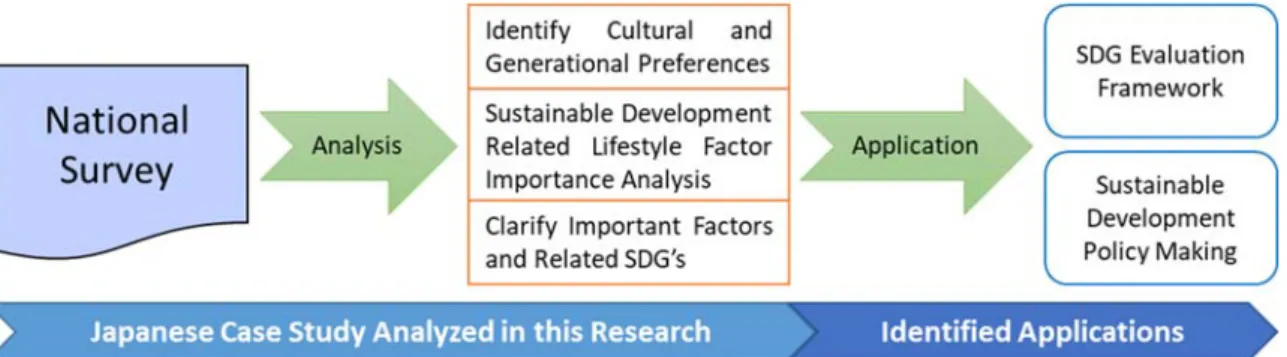
Our methodology is outlined using a case study in Japan and has three parts: 1) A survey to detail the perceived importance of lifestyle related factors of sustainability, 2) Analysis of survey results to determine generational preferences and identify cultural trends, and, 3) application of these outcomes to sustainable development related policies and evaluation processes (largely explored in the discussion section of this paper) including inter-jurisdiction replication. Figure 1 describes the methodology, analysis and potential applications of this research.
Figure 1. Research Methodology Schematic
3.1 Survey
A national survey of 6,634 respondents was undertaken in March 2018 in Japan. The survey was conducted via the internet. Respondents were drawn from the 8 regions of Japan, covering all 47 prefectures. The sample is representative in terms of the number of respondents drawn from each region, balance of male and female respondents, distribution of ages and respondent incomes throughout Japan (summarized in Appendix A).
To frame the survey for the respondents, in terms of lifestyle choices and their impact on the environment, limited resources, distribution of burdens and sustainability, a guidance section prior to the questions was included, which read:
“In order to sustain our convenient lifestyles, we need to use energy. Some examples of the direct use of energy in our lifestyles include gasoline, electricity, kerosene and gas. Most of the resources that we consume come from fossil fuel sources, and their consumption imparts a burden on the environment. Additionally, the mining and transport of resources, as well as the processes associated with the disposal of created goods also impact upon the environment. Bearing in mind the relationship between sustaining our lifestyles and environmental issues, please answer the following questions”
The survey was designed to measure the importance of 6 general lifestyle factors including environmental protection, addressing climate change, preserving limited resources, healthy economy, convenient lifestyle and equitable society, each drawn from precedential research identified in the background and literature review sections. Within these 6 factors, 4 additional detailed sub factors were also measured for importance, giving a total of 30 (6 general and 24 specific) factors evaluated, detailed in the results section. Importance was measured using a 7-point Likert-type scale (with 1 used to express no importance, 4 neither important or unimportant, and 7 representing extreme importance).
In addition to the weighting of pre-defined factors in the survey, respondents were asked to assess the comprehensiveness of factors offered, and to identify any additional factors which were important to them and relevant to their lifestyle.
3.2 Factor Analysis
Additional analysis is then undertaken using cross tabulation to identify the generational trends in
terms of importance of lifestyle factors and to identify any differences between generational
priorities of households in their 20’s, 30’s 40’s, 50’s and 60’s and above. These trends are analyzed
for each of the main and sub-factors in the survey. Further, the additional lifestyle factors identified
through our evaluation are summed and grouped according to priority. Duplicates are cleansed from
the sample and factors which may be quantified and those which are qualitative (generally topical
or cultural factors) are discussed in the Japanese context.
4. Results
First, the responses to the survey are tabulated, and average importance levels reported by all respondents for each of the general and sub-factors are detailed, as shown in Table 1.
Table 1. Average Importance Scores for General Lifestyle and Detailed Sub Factors (n=6,634).
General Factors Importance Sub Factors Importance
Environmental Protection
5.54 Reducing GHG
Reducing PM
2.5Reducing Waste
Reducing Industrial Pollution
5.41 5.64 5.63 5.80 Addressing
Climate Change
5.20 Controlling Temperature Rise Maintaining Food Production Sea-rise/Desertification Control
Controlling the Increase of Wild Weather and Natural Disasters
5.50 5.80 5.58 5.64 Preserving
Limited Resources
5.52 Water Resources Fossil Fuels
Rare Metals/Rare Earths Land Resources
6.18 5.41 5.02 5.43 Healthy Economy 5.54 Social Security
Employment
GDP Growth and Positive Trade Balance Increased Income
5.99 5.77 5.10 5.40 Convenient
Lifestyle
4.58 Modern Communications (WiFi, SNS etc.) Private Transport
Public Transport
Physical Environment (shopping, leisure, public services etc.)
5.01 4.58 5.31 5.41 Equitable Society 5.51 Equitable Participation (Freedom of Expression)
Reduction of Income Disparity
Equitable Opportunity (Education, Employment, Work-Life Balance etc.)
Equitable Tax Burden for Public Expenditure
5.29 5.11 5.37 5.32
When considering all respondent’s preferences, environmental protection and a healthy economy (5.54) are considered the most important of the general factors, followed closely by preserving limited resources (5.52) and an equitable society (5.51). There is negligible difference between the top four responses, which are followed by addressing climate change (5.20) and the lowest scoring response of a convenient lifestyle (4.58).
Assessing the sub factor responses, reducing industrial pollution is considered most important for
environmental protection, while maintaining food production is most important in terms of
addressing climate change. Water is considered the most important among limited resources and
social security the most important aspect within a healthy economy. In terms of a convenient
lifestyle, shopping leisure and public services are paramount, while equitable opportunity in terms
of education, employment and work life balance is given the highest priority in an equitable society.
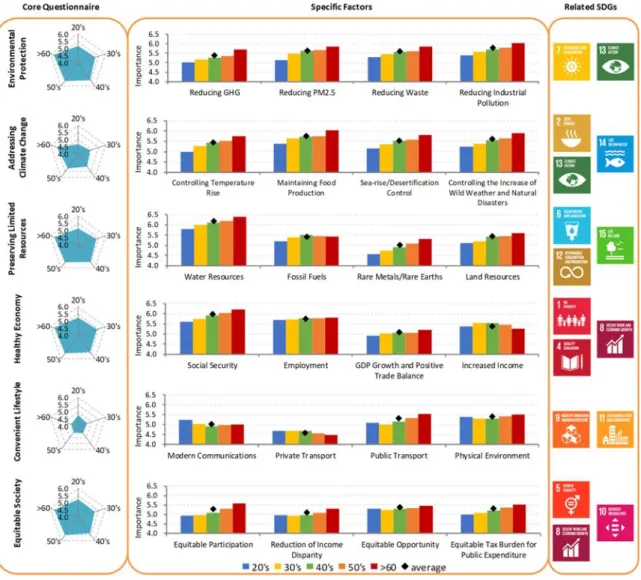
Next, the generational impact upon lifestyle factors is investigated, using cross tabulation analysis, the importance of the general and sub-factors is assessed for each age group, with results shown in Figure 2.
Figure 2. Lifestyle Factor Importance by Generation and SDG Overlap (n=6,634)
In almost all cases, on average, older households place greater importance on each of the factors explored. This trend is reversed only for convenient lifestyle, modern communications and private transport where younger generations express a higher level of importance. Employment is considered relatively evenly across the generations, as is the physical environment and equitable opportunity. Figure 2 also demonstrates where the lifestyle factors tested in our survey share aspects with 14 out of 17 established SDGs.
In addition to weighting and generational importance of factors as described above, respondents
were asked to identify their opinion on the comprehensiveness of lifestyle related factors supplied,
and to identify any other factors or issues which were important to their lifestyle. A total of 6,890 responses were received, with some respondents providing multiple responses.
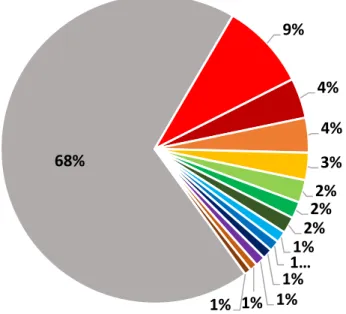
Approximately 68% of respondents identified the existing factors as comprehensive or reported factors which had already been investigated within the survey, confirming their importance.
Responses were grouped into the categories as shown in Figure 3.
Figure 3. Responses to Additional Important or Lifestyle Relevant Factors (6,890 responses) After no additional factors and factors already covered – an aging, shrinking population was selected as the most important lifestyle relevant factor, accounting for approximately 9% of all responses.
This was followed by health and social welfare comprehensiveness and human relations and helping each other out (each representing approximately 4% of all responses received). A meaningful life and reduced stress accounted for 3%, while sound politics, government and policy, safety and security and human rights issues accounted for 2% each.
68%
9%
4%
4%
3%
2%
2%
2%
1… 1%
1%
1% 1%
1%
No Additional Factors / Already Covered Aging, Shrinking Population
Health (Lifespan) / Social Welfare (Medical & Welfare Services) Human Relations (Family, Friends), Helping Eachother Out
Meaningful Life / Reduced Stress Safety and Security
Sound Politics, Government and Policy Human Rights Issues
Morals and Ethics Protection of Culture, Religion & Old Technology
Status Quo / Accepting Inconvenience Individual Values / Lifestyle Transformation International Cooperation / Peace Media & Media Literacy