NUMERICAL ASYMPTOTIC STABILITY OF THE FINITE ELEMENT SCHEME FOR A SYSTEM OF NONLINEAR
PARABOLIC EQUATIONS ARISING IN CHEMICAL REACTIONS
By Kazuo IsHIHARA
(Received Nov. 14, 1983)
1. Introduction
This paper is concerned with the finite element solutions of the initial boundary value problem for the system of nonlinear parabolic equations:
(1.1)
== dl Zlu -- blunivn2, xE 9, tÅr O, 0u ot
== d2Av- b2untvn2, xG 9, tÅr O, Ov at
u(x, t)==O, v(x, t)==O, xGL tÅrO,
u(x, O) :uo(x), v(x, O)=vo(x), xG9.
Here x =(xi, x2,..., x.), 9 is a bounded convex domain in the n-dimensional Euclidean
n
space R", the boundary T of 9 is piecewise smooth, A js the Laplace operator (A == 2 02/
i= 1
Ox7• ), ni, n2 are positive integers, di, d2, bi, b2 are positiVe constants, and given functions
uo(x), vo(x) are continuous and nonnegative, and uo(x), vo(x) satisfy the boundary conditions. Systems of this type arise, for example, in chemical engineering [4, 12, 14, 15]. In such cases, u,v represent the chemical concentrations, so that u, v are required to be nonnegative. Pao [14] established the uniqueness, existence and asymptoticbehavior forthe nonnegative solution {u(x, t), v(x, t)} of (1.1), and showed that there exist positive constants ri, r2 such that
O5 u(x, t) S r, exp ( --- di ptit), O S. v(pe, t) S r2 exp (- d2"i t), xe si, tÅr O,
where pti ÅrO is the least eigenvalue of the eigenvalue problem
(1.2) IA!fr+pt!fr=O, in sii,
(W=O, on L
2 Kazuo lsHiHARA
Recently, the finite element method has become more wjdely recognized as one of the most powerfu1 methods for obtaining numerical solutions of the initial boundary value problems. In [1, 7, 17], it is shown that the finite element solution converges to the exact solution for a single equatien of parabolic type.
The aim of this paper is to study the asymptotic stability of numerical solutions for (1.1). We can show that the asymptotic behavior of the finite element solution is similar to the one of the continuous problem, under appropriate assumptions. Finally, a nu- merical example is given to indicate the validity of our results.
For the finite element approximations to the Dirichlet problem of nonlinear elliptic equations, we refer to [9, 10, 11].
2. Weak form and finite element scheme
For simplicity, we assume that 2 is a polyhedral domain of R". We use the Sobolev space Hi(9) which consists of real-valued functions which together with their generalized derivatives belong to L2(9). Here L2(9) denotes the space of square integrable functions on 2. Let CO(n) be the space ofcontinuous functions on n=2ur. We also set (2. 1) Gi :: max {uo(x); xe di} ). O, G2 E max {vo(x); xe n} IO,
,r == {V e Hi(9) ; ut =O on r} ,
(ip, w)o= j.di(x)w(x)dx, a(ip, ut)= tn.,(oD.ip, , oO.ut, ),•
Now, in order to construct the finite element scheme, we introduce a weak form for (1.1) in the following way:
Find {u(x, t), v(x, t)}eY'xV", tÅrO such that
(2.2)
(OoUt , W), +dia(u, ut)= --bi(u"iv"2, W)o forall Wec)e",
(OoVt , W),+d2a(v, W)=-b2(u"iv"2, W)o forall Weie",
u(x, O) == uo(x), v(x, O) =vo(x), xG 9.
Firstly, we triangulate the polyhedral domain 9 in such a way that n= Ti U T2 U ••• U TJ, where T,, 1SgSJ are nondegenerate closed n-simplices whose interiors are pairwise disjoint. By Pi, ISi.SN (or Pi, N+IS.i-SN+M), we denote the vertices of the tri- angulation which belong to 9 (or T). For an n-simplex T,, let P6q), PSg),...,PÅíP) be its vertices and let coSq)(x),OS.j.Sn be the barycentric coordinates of a point xET, with respect to PSq). Define
hq rdiameter of T,, h=max{h,;1$q=ÅqJ},
fi,=min {dist (PSq), the (n --- 1)-face of T, not containing PS•q)); OS.J' Åq= n}, a,= max {cos (7 tuS•g), 7caS•g)); O$iÅqj Åq= n} ,
fi = min {fi,; 1 S. qgJ}, a== max {a,; 1 S. q S. J} , with
Vcoi•g)==(0o`O.S'l) ,••., 0o`O.S.") )•
We say that a triangulation ,9-h is of acute type if a50.
Remark 1. When n=2, ,/67'h is of acute type if and only if all the angles of the tri- angles are less than or equal to z/2 [3, 6].
Further, we define the lumped mass region ca(Pi) corresponding to the vertex Pi with respect to ,9'h. The barycentric subdivision Bg• of T, corresponding to Pi which is the vertex of T, with the barycentric coordinate tuÅqoq)(x) is given by
Bg• == A {xE T,; co6q)(x)lcoS•q)(x)}•
j=1 '
Then st(Pi) is defined aS follows (see Fig. 1):
va(Pi) :v {Bg; T,E ,9"h such that Pi is a vertex of T,} .
q
t Ny -ee t N-.-- t
/l...ttt;:':vailS/i(iSi:t).:g.. /t
-r
,
t{t i tt
fttttt' i1 lh : t}ttl "s'.... :, Pi'rxh-N :,,""'tx S"Sr -- .- -! ttl
1 N. tt l i, 's.. Ae' '"
t tt ---- - ) t 'sl
I tt
Fig.1. Lumpedmassregion.
Let dii, dii, 1 S. i5N+M be the finite element basis such that (t)iG CO(si), ipi is linear on each T,,
ipi(pJ)==(61 I:ll di,(x)-(81 X.gva.((P.'])', iEi,JsN+M.
4 Kazuo lsHiHARA
Define finite element spaces which are finite dimensional subspaces as follows:
Xh == span [di- i, di-2,. . ., ip-N . .] c L2(S2) ,
Y" =span [ipt, ip2,..., ip...]cH'(S2), 7/'"={Vhe Yh; Wh=O on T}cY'.
Let Yh be the iumping operator given by
- rv+M
y,: CO(S[2)-Xh, Y,ut = 2 W(P,)di,.
i=1
By TÅrO, we denote a time increment which is pre-assigned.
We now formulate the finite element scheme for (2.1) in the following way:
Find {uh,k, vh,k}e '}eCi'hÅ~ ')ei'h at time t=kT (k=1, 2,...) such that
(2.3)
( Yh(Uh,kiUh,k-i)-, YhWh)o+dla(Uh,k-1, Wh)
=-bl((Yhuh,k-1)"i(Yhvh,k-1)"2, YhWh)o foratt WheV"h, ( :2f'h(Vh,kT-Vh,k-1) , YhWh)o +d2a(Vh,k-1, ut-h)
= -' b2((YhUh,k-i)"'(Yhvh,k-i)"2, Yhil7h)o for all Ql7hE (yfr'"h,
rv+M rv +M uh,o= 2 uo(Pi)ipi, vh,o= 2 vo(Pi)q5i•
i=1 i=1
Set
(2.4) aij----'a(ipj, dii), ISiÅq=N, 1=ÅqJ'5N+M,
(2.5) mi=(dii, dii)oÅrO, ISi5N.
If we seek the solution of (2.3) in the form
N+M N+M
u,,,= .2 C,,k(l),, v,,,== 2 4,,,ip,,
l=1 i=1
with
(i,k == Uh,k(P,), 4,,, = v,,,(P,), 1 -Åq. i .S N, lc =O, 1, 2,...,
sti,k=:4i,k=O, N+IS.iSN+M, k=O,1,2,..,,
then (2.3) may be written as
(2.6)
mi SY i,k - T4 i,k"i + di ,l .N
i aii s: j, k- i = :( -- bimie Y• }k -'i 4 7• ?k -i,
miinIZ- {-ki iSt.i.E=!st,k gt,k i-+d2jN.iai,•4j,k-.t=--b2mi4/11;k-i4:•'3k-i,
forlSiÅq=N,k=1,2,..,. Here ' t,
(2•7) ei,o=uo(Pi)IO, 4i,o=vo(Pi)IO, 15iEN•
We 'note that (2.6) is the explicit scheme. • .
, In the sequel, we make the following assumptions.
Assumption 1. The triangulation ,/`7`h is of acute type.
Assumption 2. The time and space increments T, fi satisfy
IZ2 ,
OÅq T5 (n + 15 max {d,, d,} + fi2 max {biG?i-'Gg2, b2G:'Gg2-'} '
For the study of the asymptotic behavior of (2.6), we use matrix notations. Given an n' Å~ m- matrix B =(bij), BlO (or BÅrO) means that bi,-lO (or bijÅrO), 1Sign-, 1 S.jÅq.. hi.
Let Xi, 1Ei.S n- be eigenvalues of an fi Å~'i-t matrix B. The spectral 'radius ofB is defined by
p(B)=max {IAil; 1S ;S h} •
Following Ciarlet [2], an NÅ~(N+M) matrix B=(b,j) is said to be of generalized non- negative type if B has the following three properties:
(a) b,,ÅrO, b,j .S O, i i, j, 1Si Åq,. N, 1 Sj Åq,,,, N+ M, . (b) B is diagonally dominant [16, p. 23],
(c) B=:(bi,•),1;!l i, .i .;.fN is irreducibly diagonally dQminant [-16, p. 23]. '
Remark 2. Ciarlet and Raviart [3] showed that under Assumption 1, the matrix
e- aT/a:tty')'ofifh3S'dNis},ie'f,jmS'aN.i,.Iu)lmOS,(,?fi2).piiSe.Ofgeneraiizednonnegativetypetoinsurethe
We end this section by stating some general results on matrices, which are usefu1 later.
LEMMA 1 [16, p. 85]. Let B==(bi,•) be qn irreducibly diagonally dominant n-Å~n- matrix with b,iÅrO, bi,• :;O, i\j, IEI i,j-s{; fi. Then, the inverse B-i exists and B'iÅrO.
The following lemma is the Perron-Frobenius resuit.
LEMMA2 [16, p. 30]. Let B be an i-txn- matrix, Suppose either that BÅrO, or that B)O is irreducible. Then, B has a positive real eigenvalue equal to p(B), and p(B) is a simple eigenvalue of B, and to, p(B) there corresponds an eigenvector zÅrO.
in this section, we shaii inve3s`tigaAtSeY!hlPetOatsiyCmbgeoatVjicO' rbehavior of (2.6). Fof ('2.4) and
(2.5), we define matrices '
A=(a,j), 1Si,j.S..N, D=ditig(mi,•••',mN)• '
6 Kazuo lsmHARA
Consider the matrix eigenvalue problem
Since A, D are real, symmetric and positive definite, (3.1) has N positive eigenvalues OÅqZiSa2$•••:$2N and N corresponding eigenvectors yi,y2,...,yN. We begin with some lemmas.
LEMMA 3 [3, 6]. Under Assumption 1, the coejeicien ts aij, mi, I S. i .S-. N, 1 .Åq,j S.
N+M of (2.4), (2.5) satisfy
aiiÅrO, aij.SO, i#j, 1,Åq,,,i"SN, 1,Åq.,J'S.N+M, ",2:.\a,j=o, oÅq a.,fs".+.,1, lsi.sN.
LEMMA 4. Under Assumption 1, the eignevector yi of (3.1) corresponding to ZiÅrO can be chosen such that yi ==(Bi, /92,..., 6N)TÅrO, where T denotes the transpose.
PRooF. Since A is irreducibly diagonally dominant (Remark 2), we have A-iÅrO, by using Lemmas 1 and 3. Thus, A-'DÅrO. From (3.1) it fo11ows that
A-iDyi= :cl-:, yi, 1siÅq.,,,N•
Hence, an application of Lemma 2 to A- iD leads to p(A-iD) =: fi7 , y, =: (fi,,•••, B.)TÅrO•
This completes the proof.
LEMMA 5. For any positive numbers d, Z, e, it holds that dz År (1 - exp ( -- dze))le.
PRooF. By putting f(x) = x --- 1 + exp ( - x), we easily obtain
f(x)ÅrO, for xÅrO.
Thus, substituting dZeÅrO to x, we find
dzÅr(l -exp(-- dze))le. '
Therefore, the proef is complete.
LEMMA 6. Let d, e be positive constants such that
O Åq e .Åq.. fi2/(d(n + 1)). -
Sup. pose that wi,k, 15i.,Åq" N, k= OÅr 1, 2,.-.. satisfy , i -
mi Wi'k -eW i' k-1 +d jN= i aijwj,k-i S. O, IEi -S N, k= : 1, 2,••• •
Then, we have
WkOa)x ll Wfu'a)x l'l '•' ll Wftkix')lWfaka)xl''',
where
wkj.).=max {wi,j; 1Si-g N}, J' ----:O, 1, 2,....
PRooF. From Lemma 3 and the hypotheses, we get
wi,k $ wi,k- i - Sl/l- jN. i aijwJ•,k- i
= (i -- dll/zii)w,,,-,- ke j"., aijwj,k-i
jsi
S (1 '- -Sl/t j"., aij)wfuki,i) s.wfaki.i), k=:1, 2,....
Here we used the fact that 1-deaiilmiÅr.,O, -aij2-O (i \j). Therefore, Wftka)x S Wfakix '), k = 1, 2, •• •,
This completes the proof.
LEMMA 7. Let d, e be positive constants such that oÅqes fi2/(d(n + 1 )) .
For initial values wi,o, 1 S. iS. N, let {wi,k} be the solution of
mi Wi'k--eWi'k-i +djN.,iai,•wj,kdi=O, 15iS.N, k :1,2"••
Then, there exists a positive constant C such that
-C exp ( -- dAiek) S. wi,k ;.S C exp ( •-- dZiek), 1 S. i Åq.,, N, k=: O, 1,.2,... ,
where Zi ÅrO is the least eigenvalue of (3.1).
RRooF. From Lemma 4, we can choose a positive constant C such that -C6,S.w,,,SC6,, 1S.iÅq,.,IV.
Putting zi,k : wi,k - eBi exp ( --- dliek), we have
8 - KazuolsHiHARA
mi Zi'k'eZi'k-1 +djN.,1aiJ'Zj,k-1
=miWi,k--S!li,k-i +djN..iaijwj,k--i
+ (i6,m, exp (- dz,e(k -i)) (1- eXPS-L!ltl !,ie)H - dA,)
SO, ISiSN, k :1, 2,... ,
from (3.1) and Lemma 5. Thus an application,of Lemma 6 yields
max {zi,k; 1 S. i Åq= N} Emax {zi,o; 1 S. i Åq., N} S. O, k= 1, 2,... .
This implies that
wi,k S. C6i exp (- dZiek), 1 s. i Åq.,, N, k=o, 1, 2,... . Similarly, we obtain
wi,k ). -- C6i exp (- dZiek), 1 S• i Åq.., N, k= O, 1, 2,... . Therefore, by putting ,C=C max {6i; 1Si Åq= N}, we get
-- C exp (- dZtek) :.f wi,k :.f C exp ( -- dAiek), 1 S. i Åq= N, k == O, 1, 2,... .
This completes the proof.
We now have the following proposition.
PRoposiTioN 1. Under Assumptions '1 and 2, the solution of (2.6) satisLfies O-Åq--4,,,5G. OS.C,,,S.G,, 1-Åq.iÅq,,.N, k=O,1,2,....
PRooF. From (2.1), (2.7), it is clear that
OS.4,,,SG,, OS.4,,,S.G,, IS.i-SN.
Assume that
(3.2) OS.4,,j-gG,, OS.4,,j-S-;-G,, IS.i-SN, OS.J'ntSk-1,
From Assumption 2, (2.6) and (3.2), it follows that OÅqT :.f k21((n+ 1) max {di, d2}) ,
mi 4i,k -Te i, k-i + d, jN= , aisj,k -, == - b, mi4 r• lk - ,47• ?k -, E O, 1 .Åq,. i5 N,
mi gi,k '--T4 i, k-i + d2 jN.i ai,• 4j,k-1 = - b2 mi4 r• 3k -iCr• lk -i i:S O, 1 ;$ i ;:S N• , •
By applying Lemma 6 to the above equations, we obtain
(3•3) 4kk2xS-efikix"5'''S-4fiOa'xS-Gi, 4fuka'xS-4fakix"S"''S'4fiOa'xS'G2, where st .( j,). =: max {4i,j; 1 S. iS N}, 4faj.). = max {Ci,j; I S. i -S N}. Th us, from Lemma 3, Assumption 2 and (3.3), it follows that
(3.4) 1-T( d; /9i.tt +b,ci7•},--i,cr•,2,-,) ll;o, 1-T( d; 19iii + b,(g:},-,4r•i,=i,) llO•
Using (2.6), Lemma 3, (3.2),,(3.3) and (3,4), we obtain ,
G, lll 4i,, : (1 - -IIL{Stil ti --- Tb,e}i: ,=i ,4 ;•' ?, -,) ei, k-, -- [ dl ,i i2: 1 aij4j, k- i ll;; O,
jt'
G,l.ii:4,,, =(i-!dmt9.ii -Tb24r•}k-,4:•ti,=i,)4i,knyi- Tmd,2. j=N,. ai,•gj,k-iliO,
jte
for IS.iSN. Hence (3.2) holds with k--1 replaced by k. Therefore, by mathematical induction, the proof is complete.
We are now in a position to prove the main result.
THBoREM 1. Let {4i,k, 4i,k}, IS.i.S-N, k==O, 1, 2,... be the solution of (2.6). Under Assumptions 1 and 2, there exist positive constants Ci and C2 such that
O;S ei,k :S Ci exp (-diAiTk), O;:il Ci,k ::S C2 exp (- d2ZiTk), ,1 S. i Åq= N, k = O, 1, 2,... ,
where Ai ÅrO is the least eigenvalue of (3.1).
PRooF, For initial values wi,o == 4i,o, 1 ;:S i ;.S N, let wi,k be the solution of
(3.s) miWi•k-'- Yi•k-l +dljN..1ai,.wj,k-1==o, 1;:$iÅq,.N, k=l,2,,...
Put zi,k=Ci,k-wi,k. Then, from (2.6), (3.5) and Proposition 1, we have
mi Zi'k-TZi'k-i +dij".,iaijz,•,k"i=--bimi4r•3k-S73k-iSO, 1Si-SN, k=1,2,••••
Hence an application of Lemma 6 leads to
max {4i,k-wi,k; 1 S. i Åq= rv} S. max {ei,o-wi,o; 1 S. i Åq.. N} == O, k= 1, 2,,,. .
Therefore by using ProPosition 1 and Lemma 7, there exists a positjve constant Ci such that
O;-Sei,k;-Swi,k;-SCtexp(-diAiTk), 1s.i--Åq.-N, k:o,1,2,...,
where ZiÅrO is the least eigenvalue of(3.1). Similarly, there exists a positive constant C2
such that
10 Kazuo tsHiHARA
OS- C,,k S- C2 eXp ( -• d,Z,Tk), 1Si Åq.,, N, k== O, 1, 2... .
This completes the proof.
Remark 3. In [8], we showed that Zi--År"i ash.O, where Ai, pti are the least eigen- values of (3.1), (1.2), respectively.
4. Numericalexperiment
We shall show here numerical results in the two dimensional case. Let 9 be a square domain of R2 given by
9={(x, y)ER2; OÅqxÅq1, OÅqyÅq1}.
By L we denote the boundary of S2. We consider the following problem.
Problem:
OoU t ==Au--uv, in g, tÅro,
StV =Av-uv, in g, tÅro,
u:v==O, on L tÅrO,
u(x, y, O) =uo(x, y), v(x, y, O)=vo(x, y), in n.
Here
uo(x, y)=
vo(x, y) ==
y, if y.Åq-.xS.1-y, y).O, 1---x, if 1-xS.y;.Sx, x51, 1--y, if 1-ySxS.y, yS.1, x, if x;.Sy:!1-x, xi.llO, 4y-1, if yS.x;.fl-•-y, y).1!4, 3-4x, if 1-x;.Sy.Åq.,x, xÅq.,3/4, 3-4y, if 1-yi:;lxS.y, y:ll314,
4x -- 1, if x;;Sy;.Sl-- x, x).. 114,
O, otherwise.
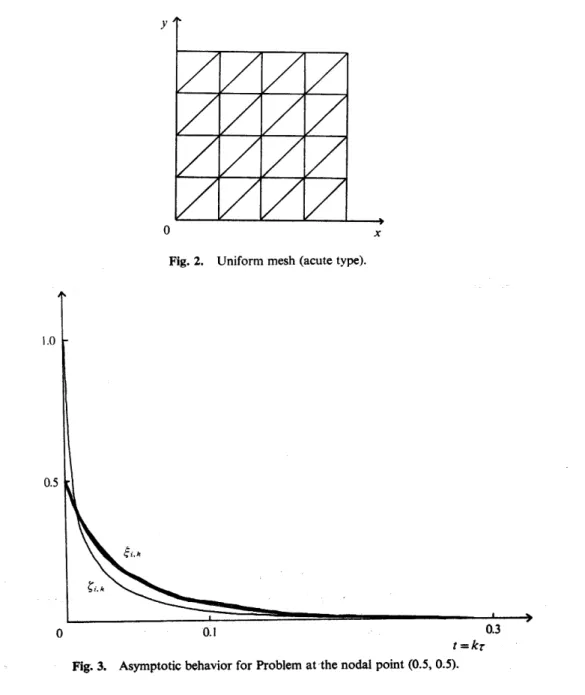
We divide 9 into uniform mesh with right isosceles triangles as shown in Fig. 2
(k=V2!8) and employ r= O.Ol, so that Assumptions 1 and 2 are satisfied. Thus, from
Theorem 1, it follows that
lim4,,,=:lim4,,,=:O, 1S.iÅq,,,.N.
k-co k..co
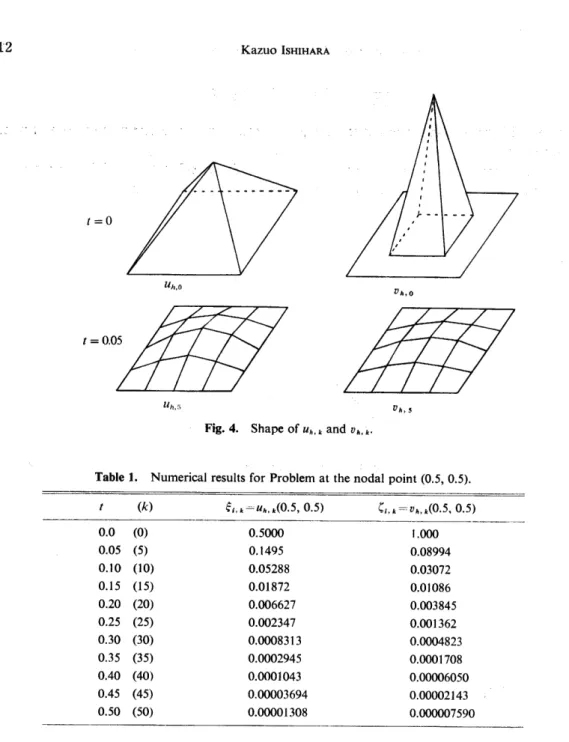
Table 1, Figures 3 and 4 present the numerical results, which demonstrate the validity of our results.
All computations were carried out on the MELcoM-CosMo 800III computer at
Kyushu Institute of Technology with the aid of single-precision arithmetic.
y
Fig. 2. Uniform mesh (acute type).
1.0
O,5
t=kT
Fig; 3. Asymptotic behavior for Problem at'the nodal point (O.5, O.S).
12 KazuolsHiHARA '
ttt