著者名(英) Makiko Tanaka journal or
publication title
言語教育研究
volume 20
page range 289‑305
year 2009‑11
URL http://id.nii.ac.jp/1092/00000491/
Kanda University Pre-ser vice Teacher Training Program for Teaching English to Children: Curriculum Design and Evaluation
Makiko Tanaka
Abstract
Kanda University of International Studies (KUIS) developed its own pre-service teacher-training program and implemented it in the year 2005. Some 70 students have completed the 9 subject, 32 credit courses since the 2007 academic year, and an increasing number of students is pursuing the program as more attention is being paid to elementary school English education as ever before. In March 2008, an official announcement was made by the Ministry of Education, Culture, Sports, Science, and Technology (MEXT) to introduce English language into the elementary school curriculum in the year 2011 from the 5
thgrade. With the social needs and movement toward officially incorporat- ing English into the elementary school curriculum, the attempts were made to improve the overall program since it was first developed and implemented in the KUIS English department curriculum. This paper first briefly introduces the program content and requirements, which then is followed by the evaluation by the students.
1. Introduction
Kanda University of International Studies (KUIS) has designed and developed
the pre-service teacher-training program for teaching English to children in
2003 and 2004, which was then implemented in 2005 into the English department
curriculum. KUIS acknowledges and has long been in support of early childhood
and elementary school English education, and so developing the program was an
important contribution KUIS made to promote and enhance English education in
elementary schools.
In 2007, three years after the program was implemented, 26 students graduated completing all the courses offered in the program, and the present researcher set forth with the help of the teaching practicum teachers to investigate if the program was successfully carried out in terms of both the needs of the students who completed the courses and objectives of the program.
Just as the present research started in March 2008, the Ministry of Education,
Culture, Sports, Science, and Technology (MEXT) made an official announcement
that it is going to introduce English language into the public elementary school
curriculum in the 2011 academic year starting from the 5th grade. The elementary
school teachers now have to teach English once a week for 45 minutes throughout
the year (35 class hours in total). The reason for officially implementing English is
that more than 97% of elementary schools in Japan as of 2007 are engaging in some
kind of English activities since the MEXT first enabled elementary schools to
engage in English language teaching in 2002 (MEXT), and there are wide gaps in
both quality and quantity of English language teaching between those schools that
are actively involved in teaching and those that are incorporating it because many
other schools are doing it. In terms of quantity, some schools are more eager than
others about English education and spend more than a class hour (45 minutes) a
week in English language teaching, while others may offer it just once a month. In
terms of quality, elementary school teachers’ ability to teach English varies
because they are not qualified English teachers. Besides that, the number of avail-
able ALTs (Assistant Language Teachers, proficient non-Japanese English lan-
guage teachers), who are employed to support homeroom teachers to teach
English, also depends on the municipal and prefectural subsidies. The 2008 official
announcement by the MEXT was to address these inbalances, and in its transitional period between 2009 and 2011, the elementary schools are required to prepare and adjust their school curriculum, although the MEXT has not been extending much support for both the teachers and the elementary schools in terms of pedagogical issues and hiring policy.
Considering the perspective of the MEXT on official introduction of English into elementary school curriculum, the current pre-service teacher-training program was reviewed so as to reflect the society’s needs and the language policy of the MEXT and produce the kinds of English language teachers required in elementary schools. The current research is ongoing, and the changes made by the program organizer may soon be re-revised, but in the current ambivalent situation about elementary school English education, the university’s mission is to do what it can do for the best of the students and society.
In the following sections, the background of the pre-service teacher-training program is first described. Then the program overview is introduced, which then is followed by the purposes, methods, and results of the research.
2. Background
In 2003, when the investigation was conducted to determine how many univer-
sities throughout Japan were offering courses or programs to train students to be
English language teachers for young children, there were virtually very few
universities that offered programs for elementary school teacher education. This
is no surprise because there is no “English education” in public elementary
schools, and there was (still is) controversy as to whether there are any benefits
of starting English education in elementary schools. Some people show strong
opposition against teaching foreign languages at such an early stage as elementary schools. Others are concerned about the busy elementary school curriculum and overworked elementary school teachers, in addition to the lack of English teacher training for elementary school teachers. Still others are worried about the mixture of all of these. Because there is no position for graduating students to work as an English teacher in elementary schools, a program such as the pre-service teacher- training program was of little value in the society. Elementary school teachers do not need to teach English at school, and the university program does not offer courses for students to be elementary school English teachers. When the program organizer first attempted to design and develop a pre-service teacher-training pro- gram at KUIS for teaching English to children, she could not find any program to model it after.
Although the society’s demand for English teachers for elementary school children was not yet widely discussed as is now, KUIS had positive perspectives about teaching English to children and had always foreseen the need to train stu- dents to be qualified English teachers when the time comes in elementary schools to start English education. Just as the investigation of courses and programs started, the MEXT announced in 2003 “an Action Plan to Cultivate ‘Japanese with English Abilities.’” The Action Plan states that the MEXT “has formulated various measures such as the revision of the Ministry’s Courses of Study with a further focus on cultivating students’ basic and practical communication abilities” (March, 2003, MEXT). The Action Plan aimed to establish a system for cultivating
“Japanese with English abilities” in 5 years, and to clarify “the goals and directions
for the improvement of English education to be achieved by 2008 and the measures
that should be taken by the government to realize these goals.” (The announce-
ment made in March 2008 by the MEXT to introduce elementary school English education starting in the year 2011 was thus a conclusion they drew after 5 years of the government efforts to improve English education in Japan.)
In section 5 of the Action Plan, “Support for English conversation activities in elementary schools,” the MEXT states that it will support elementary schools by locating “personnel such as foreign teachers, those who are proficient in English and junior high school English teachers” to help elementary schools to successfully engage in “English conversation activities.” The MEXT enabled elementary schools to introduce English as “English conversation activities” when the new Course of Study was implemented in 2002. “English conversation activities” take place in the Period for Integrated Study, which was established in the official curriculum as “part of education for international understanding”
(March 2003, MEXT). The MEXT at this time must have had in mind to officially introduce English into the elementary school curriculum. It would not, otherwise, have publicized its intention to support elementary schools in the Action Plan. The attitude of the MEXT toward English language education confirmed for the present researcher that creating a pre-service teacher-training program for teaching children will become of great value in the near future.
3. Theoretical perspective
Perspectives may influence and be influenced by the program developer’s views of reality. What approach to choose in developing a curriculum depends in part on how the developers formulate problems. If we formulate problems as building skills, then the curriculum will emphasize aspects that need to build skills.
The program developer has adopted behavioral perspectives in designing the
teacher-training program. “Behavioral perspectives conceive of curricula as the specific destinations or targets toward which education is aimed” (Posner, 2004, p.64). The central question is what the learners should be able to do at the completion of the curriculum. The behavioral perspective encourages curriculum developers to decide what the successful graduates should be able to do. The program developer’s job then is to identify their prerequisite skills, provide opportunities for students to practice each skill, and evaluate the students’
performance. This theoretical perspective was chosen in the current program development to ensure that students graduate with the skills they need to have when start working as English teachers for children.
4. Program overview and descriptions about the required courses
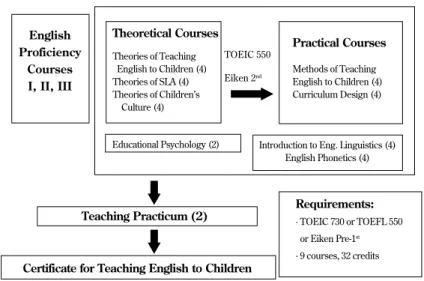
Table 1 shows the overview of the program. Kanda University Pre-Service Teacher Training Program for Teaching English to Children is composed of three theoretical and two practical courses. Theories of Teaching English to Children is an introductory course that covers basic concepts of language teaching for children. Theories of Second Language Acquisition (SLA) deals with issues in second language acquisition. Theories of Children’s Culture explores children’s world from various perspectives. Two practical courses are Methods of Teaching English to Children and Curriculum Design for Teaching English to Children.
Students who are pursuing the program must first fulfill the requirement for the
theoretical courses before registering for the practical courses . Students also have
to take Educational Psychology, which is a required course for students who wish
to be junior or senior high school teachers, Introduction to English Linguistics,
and English Phonetics. These last two courses are introductory courses for
students at KUIS who are pursuing English language studies.
Students are also required to have an official score of TOEIC 550 or above, or Eiken 2
ndgrade in order to advance to the practical courses. The practical courses are intended for those who are willing to complete the program and not just take courses on how to teach games and activities to children. Students also need to have theoretical knowledge or know the rationale behind activities before they actually engage in games and activities. When all the required subjects are completed, the students go to elementary schools to do a teaching practicum. Both theoretical and practical courses are offered twice a week for a whole semester.
The program, therefore, requires attendance of about 220 hours for each course.
As for the teaching practicum, students are required to be present at their designated elementary schools for a full day from 8 a.m. to 5 p.m. once a week for a whole semester. The students, therefore, spend about 117 hours in total at an elementary school. Students also have to come to the three classes for a pre- conference before they actually start the teaching practicum.
Nine courses, 32 credits, are required for students to complete the course work,
but the program also requires that the students successfully score certain levels of
English proficiency to get a certificate: TOEFL 550, TOEIC 730, or Eiken Pre-1
stgrade. These levels were set in accordance with the requirement that the MEXT
postulated in the Action Plan for junior and senior high school English teachers to
aim at. The program developer accepted these scores as a reasonable standard for
the future teachers to aim at to teach English to children as well.
Teaching practicum
The teaching practicum is the last course where students actually experience teaching English to elementary school children. This is where students are expected to exert the skills and knowledge they have acquired while attending courses at KUIS. At the beginning of the teaching practicum are pre-conferences for 3 class hours in total, where students are given general guidelines about elementary schools, and they learn responsibilities, and expectations by hearing a talk of a supervisor from the municipal board of education with which KUIS collaborates. Detailed information about the elementary schools that KUIS stu- dents are designated to do the teaching practicum is also given to students at this time.
TABLE 1 Overview of KUIS Pre-Service Teacher Training Program for Teaching English to Children
▼
▼
▼
English Proficiency
Courses I, II, III
Theoretical Courses Theories of Teaching English to Children (4) Theories of SLA (4) Theories of Children’s Culture (4)
TOEIC 550 Eiken 2
ndPractical Courses Methods of Teaching English to Children (4) Curriculum Design (4)
Educational Psychology (2)
Teaching Practicum (2)
Certificate for Teaching English to Children
Introduction to Eng. Linguistics (4) English Phonetics (4)
Requirements:
· TOEIC 730 or TOEFL 550 or Eiken Pre-1
st· 9 courses, 32 credits
Elementary school teaching structure (style)
The teaching practicum is conducted in collaboration with a municipal board of education. The elementary schools under the supervision of the municipal board of education have been the MEXT’s “designated schools” since 2007, and the elementary schools follow the curriculum developed by the board of education.
The board of education has also developed its own teaching materials for the elementary schools, and elementary school teachers are required to use the material. Aims and objectives of the board of education are to teach English skills to elementary school children so that they will enhance their basic communicative skills. While the MEXT’s policy strictly forbids teaching linguistics forms, such as the grammar of English, the “designated schools” are given leeway as to what to teach and how to teach them.
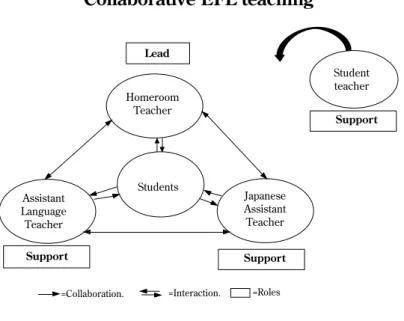
As Fig. 1 shows, the elementary schools engage in three-person collaborative English teaching. The board of education encourages homeroom teachers (HRTs) to take the lead and assistant language teachers (ALTs) and Japanese assistant teachers (JATs) to support the HRTs. In reality, however, the ALTs take the lead, and the HRTs and JATs support the ALTs, as HRTs are not qualified English teachers, and their English abilities and skills for teaching English are generally low. KUIS students participate in the three person collaborative teaching as sup- porters of HRTs, ALTs, and JATs. Therefore, four teachers (including KUIS student teachers) engage in teaching classes of about 30 elementary school students.
KUIS students are sent to elementary schools through the system called
“Learning Supporter” system. This is a learning support system the board of
education adopts to help special needs students and students with learning
disabilities. Supporters also help slow learners individually. The teaching practicum usually requires student teachers to experience teaching, but because there is no official “English class” in the current elementary school educational system, both KUIS and the board of education take advantage of such a system.
That is, this system allows KUIS students to participate in English classes and help teach children English, while the elementary schools can benefit from having young people who are proficient in English to help elementary school students learn English. Because no one is capable of advising student teachers, KUIS teaching practicum instructors visit each elementary school to give direct advice to KUIS students.
Fig. 1 Collaborative EFL teaching at elementary schools
▲
▲
▲
▲
▲
▲
▲
▲
▲
▲
▲ ▲ ▲
▲ ▲