Correctional Institution
*1Yumiko Kamise
2Naoya Takahashi
Emi Yano
Abstract
This study focuses on two questionnaire surveys that were conducted about the adoption of the Private Finance Initiative (PFI prison) method in Japan as a new correctional system. For study 1, a Web questionnaire was administered to residents of within a 30 km zone of Tokyo as well as those in Yamaguchi Prefecture to determine familiarity and resistance to the PFI prison systems. For study 2, a questionnaire survey was administered to residents of a neighborhood near a PFI prison in Mine city. The results showed that the attitudes toward the PFI prison were more positive in this area. Furthermore, contact with the correctional systems promoted resi- dents’ acceptance of prisoners and former prisoners. Finally, we discuss social and institutional support and contact with social systems to promote social inclusion.
Introduction
In this study, we focused on the opening of a new correctional institution in Mine City, Yamaguchi Prefecture through a public finance initiative (PFI).
We conducted two surveys, in order to determine how the adoption of a new
social system for correctional treatment changed the attitude of the local resi-
dents toward the correctional institution, inmates, and former inmates. Based
on the survey results, we considered the issues of social and institutional
support and contact in social policies aimed at social inclusion.
Yumiko Kamise Naoya Takahashi Emi Yano
Reducing stereotypes and biases, and social inclusion
In research on stereotypes and biases, the issue of how the strong negative emotions and severe discriminatory behavior toward a specific group of people can be reduced and changed has drawn much interest in recent years (Hodson & Hewstone, 2013). A string of research efforts on social exclusion such as Baumeister & Leary (1995) has contributed to the accumulation of knowledge showing that the social exclusion of specific people leads to the deterioration of society overall (Ura, 2009). This research indicates that it is important not only to prevent stigmatization and discriminatory behavior, but also to actively consider ways of ensuring social inclusion for people that tend to be discriminated against and excluded. Social inclusion is a concept that is the opposite of social exclusion, and has become the new principle in social welfare policy that aims to resolve the problem of social exclusion by fostering social acceptance of those that have been excluded from society as members of society (Nihanda, 2007). Social inclusion has even been iden- tified as a policy approach that could overcome the structures and factors behind social exclusion (Cabinet Office, 2011).
Judging from the findings of research on stereotyping and biases, social inclusion has important implications as a social policy. In the context of inter- group contact, social and institutional support has been identified as effective in reducing negative stereotypes and biases (Allport, 1954; Hodson, 2008).
Social and institutional support refers to the unambiguous and consistent endorsement of appropriate inclusion policies by those in authority (for ex- ample, the school head-teachers and their staff, the politicians implementing new legislation, and the judges monitoring its administration) (Brown, 2010).
Brown (2010) points out that this social and institutional support is import- ant for the promotion of greater contact between groups, because those in authority can be penalized and rewarded as they work to meet the goal of reducing prejudice; peoples’ prejudiced beliefs can be changed to avoid dis- sonance caused by forced contact; and over the long term, it leads to a new social climate in which more tolerant norms can emerge. However, while the provision of social and institutional support has been described as one of the essential conditions for effective contact, there is very little empirical research in this area (Brown, 2010). In fact, it is not fully understood what productive social and institutional support is, nor how it relates to contact in terms of reducing stereotypes and prejudice.
注意!
Background to the establishment of correctional institutions employing PFI
The current study focuses on private finance initiative correctional institutions (PFI prisons), as a case study for social policy attempting to promote social inclusion. The PFI prison method was launched in 2007 under the govern- ment’s new criminal justice policy. We consider the impact that the opening of such a prison has had. Japan’s conventional correctional institutions have been primarily run by government employees. However, PFI prisons repre- sent a new approach in which prison guards, who are government employees, and private-sector employees cooperate together. In the past, Japan’s prisons have not actively disclosed any information on their operations or internal af- fairs, which gave the general public biased images and led to the assumption that they were “unwanted facilities” (Nishida, 2012). This negative attitude toward prisons was one factor that prevented social inclusion for former inmates (Nishida, 2012). In response, the government carried out various re- forms aimed at ensuring correctional institutions are open to, understood and supported by the general public. One of these reforms was the opening of the first PFI prison (Ministry of Justice, 2003). In recent years, the Japanese government has tried to make various administrative initiatives easier for the public to understand and more transparent (Cabinet Office, 2014). The ap- proach of a correctional institution opens to and understood by the public, based on the principle of PFI prisons, is a way to make the current conditions and initiatives for correctional treatment more transparent.
Social inclusion is part of the principle behind PFI prisons. In line with this principle, inmates are actively given support so they can reintegrate into society. For example, inmates receive education by earning qualifications and are given support in finding employment after their release. This sets PFI prisons apart from general prisons. In addition, PFI prisons strive to coexist harmoniously with the local community through initiatives such as employ- ing local residents and using local crops. This is intended to erase the image of prisons as unwanted facilities.
The potential to change attitudes through contact
Until now, whether or not opening PFI prisons actually affects the attitude of
residents toward the institution and toward inmates and former inmates has
not been confirmed. However, the findings of social psychology suggest that this policy would change residents’ attitude toward correctional treatment.
One reason for this is that opportunities to interact with the institution are provided after it is established. At PFI prisons, various initiatives are taken so that residents have many opportunities for direct contact with the insti- tution, compared to conventional correctional institutions (Nishida, 2012;
University of Shimane PFI Research Group, 2009). Each institution has dif- ferent characteristics, but all PFI prisons conduct programs to encourage the local community to actively interact with the institution. This includes em- ployment of local residents as private-sector employees in the prison, opening the hospital, cafeteria and other facilities inside the prison to the public, and holding tours and sports events, also open to the public. Moreover, in places where the local government attracted a PFI prison, the local government’s newsletters and local newspapers actively provide information on the insti- tution’s events.
The findings of research into stereotypes and prejudice show that direct and indirect contact with stigmatized groups provides opportunities to realize that the stereotype and reality do not match and thereby reduce bias (Brown, 2010). It is difficult for citizens and inmates to have direct contact in a cor- rectional institution, and considering approaches to contact in PFI prisons in a way that is in line with previous research is also difficult. However, it is possible to provide information on the correctional institution to residents via facility tours and employing private-sector employees, thereby giving cit- izens opportunities to confront the mismatch between their stereotypes and reality. Given this, contact with the institutions in various forms is expected to change residents’ attitudes about the institutions in a positive way. Moreover, if the relationship between residents’ contact with institutions after they were opened and their attitude can be elucidated, we can posit the need to establish a system, in other social inclusion policies, for residents to interact with the institution after it is opened.
The potential of orientation programs to change attitudes
Another reason that opening PFI prisons is expected to change residents’ at-
titudes toward correctional treatment is that when PFI prisons are attracted
by the local government, the national and local (city) governments regularly
hold orientation sessions for the local residents, and the process leading up to the opening and the significance of the opening are broadly disclosed to residents (Nishida, 2012). These orientations, where the city and national governments with authority explain the intended policy unambiguously and consistently to the residents, play a role in demonstrating social and institu- tional support—a factor discussed in contact theory.
Moreover, it is also important to note that these orientation sessions are intended to explain the administration’s decision-making process and the intention behind the policy. In research on social policy, “the availability of information to the general public and clarity about government rules, regulations, and decisions” (Asian Development Bank, 1995) is known as
“transparency,” and is a requirement of democratic governments (Hood, 2006). Grimmelikhuijsen & Welch (2012) explain administrative transpar- ency in three dimensions: decision making, policy information, and policy outcome. In the case of research on Japan’s administration such as Kim (2014) and Aoki (2005), the importance of transparency in administrative activities has been demonstrated in specific cases. Aoki (2005) states, in a case study focusing on local cooperation in public projects, that residents’
evaluations of information disclosure on projects and the appropriateness of the government’s response are related to the extent to which residents’ accept the public project.
Social and institutional support is a prerequisite to the occurrence of
contact, but thus far its relationship with contact has not been adequately
discussed. This is likely related to the fact that much of the previous research,
such as Lucker, Rosenfield, Sikes, & Aronson (1976), examining the effect of
contact was modeled on cooperative learning within the classroom, in which
teachers facilitate student contact. However, in the example of PFI prisons
that we examined in this study, the administration could not mandate that
residents interact, and contact did not necessarily begin at the launch of the
system. That said, this study hypothesized that, even in these conditions, resi-
dents’ contact with the institution would be encouraged if orientation sessions
gave them an understanding of the institution’s policy and they felt that the
institutional support was clear. Based on this hypothesis, this study identified
the residents’ evaluation of the orientation sessions as one of the factors en-
couraging contact after the institution’s opening and examined the relevant
correlations.
Impact on attitude toward inmates and generalized former inmates
Improving the approaches of correctional institutions alone is not enough to ensure the social inclusion of former inmates. This requires that civilians agree with the provision of job training to inmates to support their social re- habilitation and accept former inmates as members of their community.
Research on stereotypes and prejudice has identified cases in which changes in the stereotypes that occur due to direct and indirect contact with a stigmatized person can be generalized to other members of the stigma- tized group as well (Kamise, Oda, Miyamoto, 2002; Yamauchi, 1996). As a result, changes in the attitude of local residents toward prisons, prompted by the opening of a PFI prison, may change the attitudes of local residents to inmates and former inmates (hereafter, “(former) inmates”) positively in general. If this correlation could be clearly shown, it would show that the social significance of PFI prisons lies not only in their ability to coexist with the local community, but also in their effectiveness in promoting the social inclusion of (former) inmates.
Objective of this study
Based on the aforementioned issues, this study focused on the Mine Rehabilitation Program Center in Mine City, Yamaguchi Prefecture, which is Japan’s first PFI prison. A questionnaire was given to neighboring residents on their attitudes toward the institution before and after opening. The first objective of this study was to clarify whether the actual opening of the PFI prison changed residents’ attitudes toward the institution.
Our second objective was to consider how residents’ evaluation of the ori- entation sessions given by the administration and contact with the institution after opening affected their attitudes toward the institution and generalized (former) inmates.
The general public’s attitude toward PFI prisons, including its aware-
ness, has not been adequately studied previously. By determining the extent
to which neighboring residents knew of the Mine Rehabilitation Program
Center and identifying the general awareness and level of aversion to the
institution as a baseline, we would be able to more accurately understand the
impact of the PFI prison in the region. To this end, we conducted an online
survey of people living within 30 kilometers of Tokyo, where there are no PFI
prisons in residential areas, and people in Yamaguchi prefecture, excluding Mine City, to determine awareness and aversion (Study 1). Subsequently, we carried out a survey of residents living near the PFI prison and carried out a comparative analysis of the surveyed items (Study 2).
Study 1
The objective was to identify awareness and aversion to PFI prisons in areas other than those near PFI prisons. The survey targeted residents in Yamaguchi Prefecture, excluding the region targeted in the Study 2 survey (Mine City) and residents in the Tokyo metropolitan area, where no PFI prisons are located.
Method Participants
The online survey targeted men and women from the ages of 20 to 69 living within 30 kilometers of Tokyo and in Yamaguchi Prefecture (excluding Mine City) from among monitors registered with survey services (INTAGE Inc.
and Yahoo! Research; the number of registered monitors totaled 953,039 as of January 2010). A total of 3,513 requests with survey questionnaires were sent out after allocating evenly across the region, gender, and age. Among the 1,383 responses collected (a response rate of 39.4%, compared to the number of requests), 1,356 responses (from 639 men and 717 women) were analyzed after excluding incomplete responses and responses from prison officers.
Looking at respondent profiles, 47.1% were men and 52.9% were women, while 20.2% were in their 20s, 19.5% in their 30s, 19.8% in their 40s, 21.1%
in their 50s and 19.3% in their 60s. 52.5% were from the Tokyo metropolitan area and 47.5% were from Yamaguchi Prefecture.
Survey period
The survey was carried out from January 28 to February 1, 2010.
Survey questions
In addition to basic attributes, the following items were included in the questionnaires. Since all four of the current PFI prisons are known as “reha- bilitation program centers,” the subject institution was called a “rehabilitation program center” in our questionnaires.
1. Awareness of the institution
Respondents were asked whether they had ever heard of a national institution called a “rehabilitation program center,” to which they replied “yes” or “no.”
2. Aversion to the institution
Respondents were given a brief explanation of rehabilitation program cen- ters, and were asked to indicate their level of aversion to the construction of rehabilitation program centers in Japan generally, and to the prospect of a center being constructed in their own neighborhood, by indicating one of four levels: “strong resistance,” “moderate resistance,” “low resistance” or
“no resistance.”
Results and discussion
When asked whether they had heard of rehabilitation program centers, 19.5% of respondents in Tokyo had, and 30.4% of respondents in Yamaguchi Prefecture had. There was a gap between the regions (χ
2(1)=21.65 p<.001), but overall recognition was only 20–30%. When asked whether they felt aversion, when combining those who felt “strong resistance” and “moderate resistance,” about 30% of respondents felt aversion about their construction in Japan (34.1% for Tokyo and 28.0% for Yamaguchi Prefecture; χ
2(1)=6.02
p<.05). About 50% felt aversion about the prospect of the construction of acenter in their neighborhood (56.5% and 46.4%, respectively; χ
2(1)=13.63
p<.001).4Given these results, we can conclude that PFI prisons are not well known in regions in which these institutions have not been built and that about half of the respondents feel aversion to the thought of a center opening up in their neighborhood.
Study 2
In Study 2, people living around the Mine Rehabilitation Program Center
were given questionnaires with the objective of determining how their atti- tude toward the center changed before and after it was opened. In this study, aversion to the center was the focus as a representative indicator for attitudes, and changes in aversion before and after opening were compared. The second objective was to consider how their evaluation of the orientation sessions and their contact with the center after opening affected their present attitude toward the center and generalized (former) inmates in general.
In line with these objectives, in this study, respondents were asked whether they were aware of the Mine Rehabilitation Program Center to determine the level of awareness in the surrounding area, and those who were aware were asked about their aversion when they first heard that the center would be opened (level of aversion before opening). They were then asked about their present level of aversion to the center (level of aversion after opening) to compare the two.
Respondents were asked about their awareness of regional revitalization, their evaluation of the center’s opening and security worries, and awareness of risks to measure their present attitude toward the center, irrespective of aversion. Questions about their attitude toward generalized (former) inmates were also set. There were also questions about their evaluation of the orienta- tion sessions and their contact with the center, since these factors could also have an impact. The correlations were then analyzed. Their evaluation of the orientation sessions was measured by asking whether the respondents felt that the national and local (city) governments had provided adequate briefings before the center was opened and whether they had been able to adequately understand the briefing. This is in line with the discussion of transparency dimensions by Grimmelikhuijsen & Welch (2012) and Aoki’s survey items (2005).
Contact with the center after opening was measured by asking whether the
respondent had experienced direct contact such as tours, indirect contact with
information via the media, and interaction with a person involved outside of
the center—covering three forms of contact. Since the correlation between
the factors was not clear enough initially, we performed an exploratory anal-
ysis of the correlation by ordering the factors chronologically, with aversion
to the center before opening coming first, followed by the evaluation of the
orientation sessions, contact with the center after opening, attitude toward
the center after opening, aversion to the center after opening, and attitudes
toward generalized (former) inmates.
Existing research on residents’ attitudes toward institutions involving risks has indicated that the background of receptivity to the institution dif- fers depending on how far away they live from the institution (Kimura and Furuta, 2003; Okamoto and Miyamoto, 2004). In our research on PFI prisons, differences in the respondents’ proximity to the institution may have affected their attitudes toward the center and changes in their attitude. As a result, when analyzing the responses of neighboring residents, we compared resi- dents in Toyotamae district, where the center was opened, to residents in the Omine district, which is adjacent to the Toyotamae district.
Method Procedures
Study 2 was carried out with a paper questionnaire distributed individually and returned by mail.
1. Regions surveyed and participants
The survey region comprised Toyotamae district, where the Mine Rehabilitation Program Center was built, and the Omine district, which is ad- jacent to the Toyotamae district. The survey was addressed to the head of the household and his/her spouse in households in these districts (480 households in Toyotamae and 3,173 households in Omine). All of the heads of household identified by the Local Resident Section of the Mine City Hall were targeted for this survey. The questionnaire for the spouse was enclosed with the ques- tionnaire for the head of household.
2. Survey method
Using Mine City’s Public Relation system, an envelope containing the ques- tionnaires for the head of household and the spouse and return envelopes was distributed. The head of household and spouse were asked to return their questionnaires in separate envelopes (they were mailed to a survey company in Tokyo). If the head of household was not married, he or she was asked to enclose a blank survey with the head of household’s survey and mail it back.
We published an article on Mine City’s newsletter released on the first day of
the survey period asking that residents cooperate with the survey.
3. Survey period
The survey was conducted from January 15 to January 30, 2010.
4. Number of responses
The number of survey responses totaled 1,608 for heads of household and 1,540 for spouses. When excluding blank surveys, the return rate was 40.1%.
5. Number of respondents targeted for analysis
A total of 2,643 responses from 1,486 heads of household and 1,157 spouses were analyzed, after excluding responses from former public employees working at the center and incomplete responses. Looking at respondent pro- files, 45.9% of respondents were men, 52.5% were women and 1.6% were gender unspecified. By age, 9.3% were from people in their 30s or younger, 10.6% from people in their 40s, 19.0% from people in their 50s, 28.5% from people in their 60s, 31.0% from people in their 70s or above, and 1.6% were age unspecified. By residential area, 14.0% were from Toyotamae district, 82.0% were from Omine district and 4.0% were other or unspecified.
Survey questions
In addition to attributes, the survey included the following questions.
51. Awareness of the institution
Respondents were asked whether they had ever heard of the “rehabilitation program center” in Toyotamae district, Mine City to which they replied “yes”
or “no.”
2. Aversion to the institution before opening
First, respondents were asked whether they had resided in the region since before February 2006, when preparations had begun for the opening of this center. Second, those who replied they had lived there were then asked to indicate their level of aversion when they had first heard that a rehabilitation program center would be opened in Mine City, by indicating one of four levels from “strong resistance” to “no resistance.”
3. Evaluation of orientation sessions
Respondents were asked about the city government’s and center’s (national
government’s) measures in the period leading up to the opening of the institu- tion in three items—“the city government’s prior explanation to residents was adequate,” “the center’s prior explanation to residents was adequate” and “I understood the location of the center before it was opened.” They were asked to respond with one of four answers, from “I agree” to “I do not agree.”
4. Direct and indirect contact with the institution after it was opened
Respondents were given five items—“I read the information on the center provided to residents,” “I toured the center,” “I have used the cafeteria and martial arts dojo in the center,” “I have been to the Mine Center’s exhibition and sale of products” and “I have seen news on the center in the newspaper, television and/or magazines”—and were asked to select all of the items that applied to them.
5. Personal interaction with a person involved outside of the institution Respondents were asked whether family members or acquaintances worked at a job or was involved in activities related to the center, by selecting any of six items that applied to them, such as “an acquaintance is/was a govern- ment employee at the center” and “an acquaintance is/was a private-sector employee at the center.”
66. Aversion to the institution at present (after opening)
Respondents were asked to indicate their level of aversion they felt now about the Mine Rehabilitation Program Center, by selecting one of four an- swers from “strong resistance” to “no resistance.”
7. Perceived regional activation
Respondents were asked about any changes in the region they experienced after the center’s opening, by selecting any of three items that applied to them: “the local population has increased,” the number of students at the local elementary and middle schools has increased,” and “job opportunities for local people have increased.”
8. Evaluation of the institution opening and worries
Respondents were asked to choose any of the 12 items that describe their cur-
rent thoughts about the institution, including “thanks to the center, there has
been progressing in inmates’ social rehabilitation,” and “I am worried that an inmate might escape.”
9. Perceived risk
Respondents were asked to indicate the level of risk (danger) they feel the Mine Rehabilitation Program Center could cause to their own and their fam- ilies’ health and safety, by selecting one of four answers that most closely matched their feelings, from “very dangerous,” “dangerous,” “somewhat dangerous,” to “virtually no danger.” Respondents were asked to choose “I don’t know” if they could not choose any of these four answers.
10. Attitude toward generalized (former) inmates
Eight items designed to assess the respondents’ attitude toward generalized (former) inmates were given, including “It is difficult for former inmates to find a job” and “When inmates are released, the national government should actively help them find work.” Respondents were asked to choose from four answers, from “I agree” to “I do not agree.”
Results
Awareness of the institution
Awareness of the center was 98.7% (N=2,458), with 99.7% awareness in Toyotamae and 98.5% in Omine (χ
2(1)=3.415 p<.1). This is high compared to awareness in Tokyo (19.5%) and Yamaguchi (30.4%) in Study 1.
Changes in the level of aversion to the institution
If we look at the aversion to the institution before opening, we find that 51%
of respondents felt aversion (total of those who felt strong resistance and
moderate resistance), and 48.9% did not feel aversion (total of those who
felt low resistance and no resistance), which is about evenly divided. This is
a significant difference when compared with the results in Study 1, in which
56.5% in Tokyo and 46.4% in Yamaguchi felt aversion toward the prospect
of the construction of an institution in their neighborhood (χ
2(2)=13.720
p<.001). However, after residual analysis, the levels in the Mine region werenot significant.
At the same time, the aversion group fell sharply to 13.6% after opening (present). The score was added up by assigning one point for “no resistance”
and four points for “strong resistance” (and two and three points for the an- swers in between), and the difference of the average score was calculated by totaling both districts to determine the gap from before and after the center was opened. This showed that points were significantly lower (t (2176)=42.94
p<.001) after opening (M=1.75 SD=0.77) than before opening (M=2.48 SD=0.91).
When we look at this by district, we find that aversion was significantly higher in Toyotamae both before (Toyotamae M=2.73
SD=1.03; Omine M=2.43 SD=2.43; t(381.111)=4.781 p<.001) and after (Toyotamae M=1.86 SD=0.87; Omine M=1.73 SD=0.74; t(446.700)=42.63 p<.001) the centerwas opened.
Evaluation of orientation sessions
The responses to the three items assessing the government’s orientation ses- sions were quantified by giving four points to the answer “4. I agree” and one point to “1. I disagree” (and three and two points to the answers in between).
The simple sum of the answers to the three items was the score for “evalu- ation of orientation” (α=.841). The average of the total of both districts was
M=7.83 and SD=3.06, with the median exceeding six points. A comparisonof the gap by district shows that the score (t (2142)=2.86 p<.01) was signifi- cantly higher for Toyotamae (M=8.28, SD=2.91) than for Omine (M=7.75,
SD=3.05).Direct and indirect contact with the institution after opening
When asked about contact with the center, the responses were as follows:
“I have seen news on the center in the newspaper, television and/or maga- zines” (71.8%), “I read the information on the center provided to residents”
(32.2%), “I toured the center” (23.4%), “I have been to the Mine Center’s
exhibition and sale of products” (15.1%) and “I have used the cafeteria and
martial arts dojo in the center” (14.0%). Of these, the number of times “news-
letter” and “news” were selected was designated as the score for “indirect
contact” and the number of times “tours,” “center use” and “exhibition and
sale” were selected was designated the score for “direct contact.” The gap by
district was significantly higher for the Toyotamae in the case of direct contact (Toyotamae
M=1.17 SD=1.12; Omine M=0.41 SD=0.79; t(425.803)=1.59 p<.001). There was no significant difference between the districts in termsof indirect contact (Toyotamae M=1.02
SD=0.73; Omine M=1.05 SD=0.68;t(2456)=0.73 ns).
Personal interaction with a person involved outside of the institution
Responses about whether family members or acquaintances worked at a job or were involved in activities related to the center were as follows: “A family member is/was a government employee at the center” (1.3%), “an acquain- tance is/was a government employee at the center” (4.7%), “a family member is/was a private-sector employee at the center” (4.7%), “an acquaintance is/
was a private-sector employee at the center” (28.2%), “a family member is/
was an educator/volunteer at the center ” (2.5%), and “an acquaintance is/
was an educator/volunteer at the center” (13.8%). The number of responses to these six items was the score for “personal interaction with a person in- volved.” A review of the gap between scores by district shows that the score (t(460.003)=6.62 p<.001) was significantly higher for Toyotamae (M=0.82
SD=0.82) than for Omine (M=0.51 SD=0.71).Perceived regional activation
When asked about local changes, a higher percentage (33.8%) agreed that
“the number of students at the local elementary and middle schools has increased,” followed by “the local population has increased” (32.3%) and
“job opportunities for local people have increased” (30.4%). The number of respondents who agreed with these three items was the score for “aware- ness of regional revitalization.” A comparison of the gap between districts showed that the score (t(477.001)=9.46 p<.001) was significantly higher for Toyotamae (M=1.49 SD=1.14) than for Omine (M=0.88 SD=1.07).
Evaluation of the institution opening and worries
When using mathematical quantification theory class III to classify the 12
items that describe respondents’ current evaluation and security worries, the
responses can be divided into three groups. The first group consists of five
items such as “I want the center to keep the same acceptance criterion (only first-time offenders with light crimes)” (54.4%) and “I want the benefits ob- tained by the city and prefecture as a result of the center’s opening to be shared more with the local community” (38.4%).
7This group of items con- cerns ways in which residents want the center to improve so that they can coexist more easily, and was given the name “requests for better coexistence with the institution.” The second group consists of four items: “the center contributes to the country and society” (31.2%), “I want the center to con- tinue operating” (26.1%), “the center is a better place to rehabilitate inmates than a regular prison” (22.3%), and “the social rehabilitation of inmates has been promoted thanks to the center” (11.5%). These items indicate “per- ceived contribution to society.” The third group consists of the three items: “I am worried about inmates escaping” (16.2%),” “I am concerned that people who disturb the public order are coming into our community” (15.2%) and
“I am concerned that having the center here hurts the community’s image”
(8.2%). This group is called the “anxious about security situation” group.
The number of responses to the item in each group was added up to produce group scores for “requests for better coexistence,” “perceived contribution to society” and “anxious about security situation.”
A review of the gap between group scores by district showed that the score for “requests for better coexistence” (t (2456)=5.00 p<.001) was significantly higher for Toyotamae (M=1.86 SD=1.26) than for Omine (M=1.51 SD=1.20).
There was no significant difference in the scores for “anxious about secu- rity situation” (Toyotamae M=0.467
SD=0.88; Omine M=0.39 SD=0.77;t(462.110)=1.59 ns) and “perceived regional activation” (Toyotamae M=0.89 SD=1.16; Omine M=0.92 SD=1.21; t
(2456)=0.42 ns).
Perceived risk
When asked about the center’s risk in four levels from 4, “very dangerous”
to 1, “virtually no danger,” the results were M=1.47
SD=0.74,8excluding an optional response of “I don’t know.” There was no significant difference between districts (Toyotamae M=1.50
SD=0.84; Omine M=1.47 SD=0.73;t(385.021)=0.583 ns).
Attitude toward generalized (former) inmates
The eight items designed to assess the respondents’ attitude toward general- ized (former) inmates were quantified by assigning four points to the answer
“I agree” and one point to “I disagree” (and three and two for the answers in between). We carried out a factor analysis (maximum likelihood method) for these eight items and identified two factors by looking at a scree plot and interpreting the factors. The total variance explanatory rate for the two factors before rotation is 53.2%. As a result of pattern matrix after Promax rotation, we determined that the items that had a high load on the first factor were items expressing acceptance of inmates and former inmates, such as
“when inmates are released, the national government should actively help them find work” and “the public should accept former inmates without look- ing at them differently.”
9As a result, we named the first factor “receptive attitude toward generalized (former) inmates.” The items that had a high load on the second factor were “it is difficult for former inmates to find a job”
and “former inmates tend to repeat similar crimes after they are released,”
and this factor was named “negative attitude toward generalized (former) in- mates.”
10Using the items with absolute values for loads of 0.40 or higher for each factor, two scales were created through the simple sum of the responses:
“receptive attitude” (five items, α
=.69) and “negative attitude” (three items, α
=.71). When examining the difference between the averages of the district, we did not find any significant difference for either the receptive attitude (Toyotamae M=14.70 SD=2.85; Omine M=14.81 SD=2.78; t (2329)=0.635
ns) or the negative attitude (Toyotamae M=9.75 SD=1.68; Omine M=9.97 SD=1.77; t(2405)=0.845 ns).Analysis of correlations between factors
We carried out a covariance structure analysis to determine how other factors
affected attitudes toward the institution after opening and attitudes toward
generalized (former) inmates. When carrying out the analysis, aversion to the
institution before opening was given precedence, followed by the evaluation
of the orientation sessions, contact with the institution after opening, attitudes
toward the institution after opening (perceived regional activation, requests
for better coexistence, perceived contribution to society, anxious about secu-
rity situation, perceived risk), aversion to the institution after opening, and
attitude toward generalized (former) inmates in general (receptive attitude, negative attitude).
11A covariance structure analysis using AMOS was carried out on the premise that the chronologically prior factors would affect all of the subsequent factors.
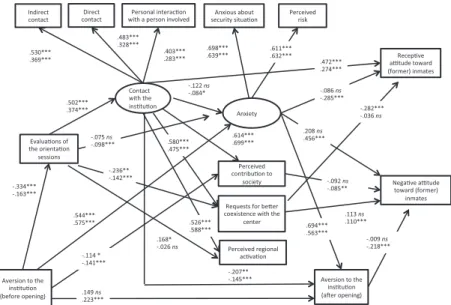
12, 13At this point, we set a latent variable that we called “contact with the institution,” consisting of “direct contact,” “indirect contact” and “personal interaction with a person involved” for contact with the institution after open- ing. Since “anxious about security situation” and “perceived risk” measure similar trends, a latent variable consisting of these two was designated gener- ally as “anxiety.”
The results of analysis thus far had indicated attitudes toward the institu- tion differ depending on the district, so a covariance structure analysis was carried out by district. We repeated analysis in which we eliminated paths that were not significant for either district in order to raise the model’s relevance.
Figure 1 shows the results of the analysis. For both districts, the “eval- uation of orientation sessions” showed a positive path to “contact with the institution” and a negative path to “requests for better coexistence.” Then,
“contact with the institution” showed a positive path to “perceived contri- bution to society,” “requests for better coexistence” and “perceived regional activation,” and it indicated a negative path to “aversion after opening” and a positive path to “receptive attitude.”
If we look at the key differences between districts, we find that the sig- nificant differences observed in the Omine district alone showed a positive path from “aversion before opening” to “aversion after opening,” a negative path from “aversion after opening” to a “negative attitude,” a negative path from “evaluation of orientation sessions” and “contact with the institution”
to “anxiety,” a negative path from “anxiety” to “receptive attitude,” a positive path from “anxiety” to “negative attitude,” a positive path from “requests for better coexistence” to “negative attitude,” and a negative path from “per- ceived contribution to society” to “negative attitude.”
The significant difference observed in the Toyotamae district alone was a
positive path from “evaluation of orientation sessions” to “perceived regional
activation” and a negative path from “requests for better coexistence” to “re-
ceptive attitude.”
14Fig. 1 Backdrop to attitude toward generalized (former) inmates and PFIcorrectional institution (covariance structure analysis using AMOS)
Top path coefficient values are for Toyotamae district where the center was opened (N=268), and the bottom path coefficient values are for Omine district adjacent to the district where the center was opened (N=1665).
Toyotamae; χ2(52)=78.290, p< .05, GFI=.958, AGFI=.926, CFI=.956, RMSEA=.044, AIC=
156.290, CAIC=335.339
Omine; χ2(52)=253.600, p< .001, GFI=.977, AGFI=.961, CFI=.941, RMSEA=.048, AIC=
331.600, CAIC=581.886
* p < .05 ** p < .01 *** p < .001
Discussion
Current status of awareness of PFI prisons
This study focused on the example of PFI prisons as one kind of social policy aimed at promoting social inclusion, and considered the impact of their opening.
The general awareness of PFI prisons has not been previously studied, but
we discovered that, in regions that did not have PFI prisons locally, aware-
ness was only 20–30% (Study 1). Even in Yamaguchi Prefecture, where the
Mine Rehabilitation Program Center is located, awareness was low in places
far from the district in which it was opened, which indicates that the gen- eral public is not yet very familiar with this policy, which was launched in 2007. However, awareness was over 90% in neighboring districts (Study 2), confirming that the existence of the institution is well known among resi- dents. Moreover, 70% of residents had encountered media information about the center, and 20% had toured the center, which confirms that residents ob- tained information on the institution both directly and indirectly. Moreover, the percentage of respondents who indicated “an acquaintance is/was a private-sector employee at the center” or “an acquaintance who is/was an educator/ volunteer at the center” was 30% and 10%, respectively, showing that they had many opportunities to interact with people involved with the institution, even outside of the institution. In addition, the score for the eval- uation of the government’s orientation sessions exceeded the median value.
These results show that, with the opening of a PFI prison, an attempt to make the current status of remediation and initiatives more transparent has had a certain amount of impact in neighboring areas.
Changes in aversion to PFI prisons
One goal of this study was to demonstrate whether the opening of a PFI prison changed neighboring residents’ attitude toward the institution. In Study 2, we considered changes with a focus on aversion. The results showed that about half of respondents felt aversion to the institution before open- ing. This was about the same as the percentage of respondents from the area with no such institution who indicated aversion when asked about the pros- pect of a PFI prison opening in their neighborhood (Study 1). Although the Mine Rehabilitation Program Center was opened because it was attracted by Mine City, our results show that the initial aversion was not markedly lower compared to the other region. At the time of the survey two years after the institution had opened, however, only about 10% of respondents indi- cated aversion. Therefore, we conclude that the residents’ attitude toward the institution changed in a more positive direction after it was opened. One qualification we must report is that this study assessed aversion to the insti- tution before opening using the recall method, which may have affected the results. Future research should include longitudinal and other studies that track changes in attitude over time.
Background of changes in attitude toward the institution and generalized
(former) inmates
The second objective of this study was to consider the impact that the evaluation of the administration’s orientation and contact with the institution after opening had on present attitudes toward the institution and generalized (former) inmates. The results of the covariance structure analysis showed that a good evaluation of the orientation encouraged contact with the insti- tution after opening, and also that this contact led to a reduction in present aversion to the institution as well as a more receptive attitude toward general- ized (former) inmates. Based on contact theory, we predicted that stereotypes and prejudice toward prison and (former) inmates would be reduced when a social policy aiming for social inclusion set the contact. Overall, this study confirmed the expected effect of contact along with social and institutional support.
Approach to social and institutional support and theoretical position
Up until this point, there has not been adequate consideration of the questions of how social and institutional support can be conveyed in social policy, or how a clear expression of support is related to contact. The current study po- sitions the orientation sessions as the forum in which social and institutional support is expressed in social inclusion policy regarding PFI prisons. A good evaluation of this orientation promoted contact with the institution, which indicates that holding this orientation and explaining the decision process and intentions is one way of conveying social and institutional support.
In theoretical research on contact thus far, the focus has been on situations in which an authority figure has significant influence, as in a cooperative learning situation, but mandating contact is difficult in actual social policy.
This study has social significance in that it shows a practical example of social and institutional support in a real situation where contact cannot be compensated or mandated. The result showed that the provision of social and institutional support could bring people into contact with objects of preju- dice and actually reduce their stereotypes and prejudice. Moreover, there is theoretical significance even in laying out the process by which social and institutional support encourages contact, which has not been adequately con- sidered in contact theory.
In the context of social policy research thus far, the transparency of ad-
ministrative procedures and results disclosure has been widely discussed, and
in recent years Japan’s national government has stressed the need to make its administrative initiatives transparent by communicating more succinctly with the public. However, the results of this study suggest that even when the administration uses orientations to disclose information and thus ensure transparency and residents gain understanding, this alone is not enough to change residents’ attitudes. When building new social systems to promote social inclusion, the administration’s initiatives must not only be made trans- parent and social and institutional support made clear; the new social system itself must also always include mechanisms that involve the general public.
However, the current study did not elucidate the psychological processes by which the demonstration of social and institutional support promotes con- tact. It did, however, identify a good evaluation of the orientation sessions as a factor that encouraged contact and considered this correlation. Still, in future research, it will be important to consider the process by which, de- pending on the policy approach, social and institutional support subsequently modifies the effect of mandatory contact. We believe that the relationship be- tween social and institutional support and contact in social inclusion policies should be considered in a multifaceted way.
Effect and limits of contact
The results of the correlation analysis show a direct path in which contact with the institution reduces aversion to the institution and leads to a more receptive attitude toward generalized (former) inmates. The reason that the direct impact was strong, regardless of other attitude factors, may have been that aversion to the institution before opening was based on a lack of knowl- edge about correctional treatment. The general public was unfamiliar with this type of correctional institutions. Learning more about it via tours and the media directly reduced aversion to the institution and encouraged a more receptive attitude toward generalized (former) inmates. However, this point has to be confirmed in conjunction with changes in the amount of knowledge.
At the same time, contact made people more aware of the institution’s
contribution to society and its role in regional activation. Contact with the
institution deepened understanding about the policy’s intent. However, we
did not find that perceived contribution to society and perceived regional
activation had a significant impact on aversion to the institution and atti-
tudes toward the generalized (former) inmates. Frequently, when opening
risk-related institutions, the merits to the region are stressed in convincing the public. However, this study suggests that stressing these positive effects is unlikely to change individuals’ stereotypes and prejudices. In particular, anxiety is closely related to aversion to such institutions, which means that the approach to contact should take into consideration approaches for reduc- ing anxiety. Regarding the limits to contact indicated in this study, they may be related to individual problems with this case study, so a detailed analysis involving a comparison to another PFI prison opened in another region, is essential.
In addition, our research suggested the negative aspects of contact with PFI prisons. The contact led to stronger requests for better coexistence with the institution, which heightened the residents’ negative attitude toward (former) inmates and reduced their receptive attitude. Contact stimulated res- idents’ interest in a symbiotic relationship with the institution, but the feeling that the institution is responsible for ensuring a smooth coexistence may have made them more resistant to changes in attitude. When considering effective contact in social policy, future research should elucidate the effect of social and institutional support, but also relationship factors such as equal status and cooperation, which have been considered in previous studies on contact theory, and how they impact the relationship between the administration and residents.
Differences by district
A comparison of the psychological process causing changes in attitude by
district revealed partial discrepancies. This confirmed that when attempting
social inclusion as a social policy, it is important to keep in mind that effective
processes differ depending on the region. For example, in the Omine district,
which is adjacent to the institution, aversion to the institution before opening
determined aversion after opening. We believe this is because in the Omine
district overall, evaluation of the orientation sessions and contact with the
institution were low overall. There is room to consider techniques to improve
direct and personal contact and ways to demonstrate social and institutional
support using means other than orientations with residents living far from
the institution. In the Toyotamae district, good impressions of the orientation
and contact did not result in a path to reduced anxiety. Moreover, the paths
from anxiety to a receptive attitude toward generalized (former) inmates and
to a negative attitude were not significant. The approach to orientations and contact should be adjusted so that they mitigate the anxiety felt by residents living closer to the institution and lead to a change in attitude toward inmates and former inmates.
15Limitations of this study and future issues
In this research, we attempted to broadly consider anything that could be seen as contact with the institution. For this reason, we included not only contact requiring voluntary action on the part of residents, such as center tours, in the types of contact we measured, but also activities that were more passive, such as watching news on television, and activities affected by the activity of people other than the individual concerned, such as contact with acquaintances who worked at the institution as private-sector employees.
Future research is needed to elucidate the properties of these contacts. Also, it is necessary to clarify the relationship between these properties of contact, social and institutional support, and attitude change in more detail.
In closing, we would like to note that this effort toward greater transpar- ency around correctional institutions has only just begun in Japan with the opening of a few PFI prisons. Even in the case of conventional correctional institutions whose information disclosure and coexistence harmoniously with the community have not yet been examined, there is room to discuss the possibility of improving transparency and enhancing contact in the future.
Also, the social integration of former inmates relates to the total correctional system including institution and process, such as offender rehabilitation fa- cilities. It requires consideration of the integration process after release as it relates to the provision of social and institutional support and contact.
Notes
* This paper is a translation of “Kanminkyodo keimusho kaisetu niyoru shakaiteki housetsu sokusin no kento” by Yumiko Kamise, Naoya Takahashi, Emi Yano (2017) (The Japanese Journal of Psychology, Volume 87, No. 6, 579-589). It has gotten consent for translation and publishing from the Japanese Psychological Association and all authors. When it was translated, the person cited in the ac- knowledgement was changed from original article, and a new key word (contact
hypothesis) was added.
1. Study 1 was conducted as a part of the intramural joint research project “The relationship between worries to risk facilities and stereotypes towards offenders”
by Edogawa University in 2009. Part of Study 1 was reported at the 77th Annual Convention of the Japan Association of Applied Psychology in 2010. Study 2 was conducted as a part of the project “Gender Equality and Multicultural Conviviality in the Age of Globalization” by the School of Law Tohoku University GCOE program. Part of Study 2 was reported at the 51th Annual Conference of The Japanese Society of Social Psychology in 2010.
2. When carrying out the survey for Study 2, we received cooperation from the citizens in Mine City and others involved. We also benefited significantly from the assistance provided by Professor Minoru Saito at Kokugakuin University, Fumiya Tezuka, former warden of the Mine Rehabilitation Program Center, and Satoshi Yoshino of the Ministry of Justice’s Correction Bureau. We would like to take this opportunity to express our sincere gratitude for their assistance.
3. “The Rehabilitation Program Center is a correctional institution run with pri- vate-sector cooperation in which government employees work together with private-sector employees. It is also known as a ‘private finance initiative prison (PFI prison).’ The first such institution was opened in Mine City, Yamaguchi Prefecture in 2007, followed by institutions in Hyogo Prefecture, Tochigi Prefecture, and Shimane Prefecture.”
4. The breakdown of the group of people feeling aversion to the construction of PFI prisons throughout Japan is as follows. In Tokyo, 4.1% felt “strong resistance”
and 30.1% felt “moderate resistance.” In Yamaguchi, 1.2% felt “strong resis- tance” and 26.7% felt “moderate resistance.” The breakdown of the group of people feeling aversion to the construction of PFI prisons in the region in which they live is as follows. In Tokyo, 11.1% felt “strong resistance” and 45.4% felt
“moderate resistance.” In Yamaguchi, 7.5% felt “strong resistance” and 39.0%
felt “moderate resistance.”
5. Before these survey questions were prepared, in August 2009 we held a semi-structured interview with four neighboring residents, four private-sector employees, and four government employees, requesting their thoughts on the Mine Rehabilitation Program Center, and we reflected the results in preparing the questions.
6. We also asked about the respondent’s own contact (such as “I am/was a pri- vate-sector employee at the center”), but the percentage to which this applied was less than 5% in all cases and thus was excluded from the scope of analysis for this study.
7. In addition, “the inmates’ life at the center is too comfortable” (33.2%), “I want the inmates to contribute to the community outside of the center as well, for ex- ample by cleaning and gardening in the city” (17.2%) and “ interaction between the center and the community should be more active” (13.6%).
8. 3.2% of the number of effective responses (N=72)
9. Other items that had a high load on the first factor were: “the majority of inmates reflect deeply on their own crimes,” “former inmates do not repeat their crime if they can find a job after being released,” and “job training for inmates is a waste of money” (reverse-scored item). Other items that had a high load on the second factor were: “it is difficult for former inmates to find a job,” “public opinion is biased against people who have been in prison” and “former inmates tend to repeat similar crimes after they are released.”
10. The correlation in the scoring for “receptive attitude” and “negative attitude”
was r(2398)=−.110 (p<.001). There was a negative correlation, but the value was low, which suggests that different aspects are measured, rather than that the aspects that “receptive attitude” and “negative attitude” measure are contrasting.
Clarifying the structure of attitudes toward generalized (former) inmates is a topic for future research.
11. In order to confirm that an increase or decrease in evaluations of the orienta- tion sessions encouraged to contact, the overall group was separately divided into those with low evaluation and those with high evaluation of the orientation, based on the average evaluation score of the orientation, and a t-test was carried out to look for differences in the average of the contact score (simple sum of the direct contact score, indirect contact score, personal interaction with a person in- volved). This showed that the group with the high assessment had a significantly higher contact score at the 0.1% level.
Also, we divided the group based on the average of contact score into those with low contact and those with high contact. We carried out 2 (evaluation low vs. high) × 2 (contact low vs. high) ANOVA for each of the scores measuring the attitude toward the center after opening. The results did not indicate any sig- nificant interaction effect between evaluation and contact. Nevertheless, when looking at the two districts separately, we found a significant interaction in the 5% level in the Toyotamae district for “requests for better coexistence with the center” and “negative attitude.” The post-hoc tests showed that when evaluation of the orientation sessions was low and contact was high, requests for better co- existence with the institution were higher, and when evaluation and contact were both high, negative attitudes toward generalized (former) inmates were lower.
As noted in the discussion, a consideration of the process in which social and institutional support adjusts the effect of contact is an issue for the future.
12. “Awareness of the institution” was excluded from the factors, since over 90% of respondents were aware of it.
13. The sense of aversion to the institution after opening could be thought of in a wider sense as part of the attitudes toward the institution after opening. However, we thought that the overall aversion to the institution is being expressed after evaluating various aspects of the institution including the anxiety and per- ceived regional activation. Therefore, we presumed that the attitude toward the
institution after opening (perceived regional activation, requests for better co- existence with the institution, perceived contribution to society, anxious about security situation, perceived risk) preceded the aversion to the institution after opening.
14. In this research, hypotheses about how district differences regarding changes in attitude would manifest were not made in advance. Therefore, we carried out covariance structural analyses by district and focused on the relations between factors in each district. However, in regards to Figure 1, when carrying out multiple group structural equation modeling and testing the difference between parameters (the model fit when combining both districts is χ2(104)=331.992 p<.001, GFI=.975, AGFI=.956, CFI=.945, RMSEA=.034, AIC=487.992), we found a significant difference (5% level) in multiple path coefficients (aversion before opening to evaluation of orientation, evaluation of orientation to contact with the institution, evaluation of orientation to perceived regional activation, contact with the institution to perceived contribution to society, contact with the institution to requests for better coexistence with the institution, contact with the institution to perceived regional activation, anxiety to receptive attitude toward generalized (former) inmates, anxiety to negative attitude toward generalized (former) inmates, and requests for better coexistence with the institution to re- ceptive attitude toward generalized (former) inmates)). In this research, we did not carry out a comparative analysis of the path coefficient by district, but we believe that the model’s precision, including district gaps, was enhanced by these results.
15. In the Omine region, low aversion to the institution after opening also lowered the negative attitude toward generalized (former) inmates. A negative attitude toward generalized (former) inmates included statements asking about social bias against former inmates. The more that a respondent felt aversion to the in- stitution, the more likely he/she was to answer that the struggles of the (former) inmate were that inmate’s own responsibility and that social biases were not related. However, this relation was not observed in the Toyotamae district. The measurements of the negative attitude and the context for the differences in these districts must be further examined.
References
Asian Development Bank (1995, August). Governance: Sound development manage- ment. Asian Development Bank. Retrieved from http://www.adb.org/sites/default/
files/institutional-document/32027/govpolicy.pdf
Allport, G. (1954). The nature of prejudice. Cambridge, MA: Addison-Wesley.
Brown, R. (2010). Prejudice: Its social psychology (2nd ed.). West Sussex, UK:
Wiley-Blackwell.
Aoki, T. (2005). An empirical study on fair process effect. Journal of Japan Society of Civil Engineers, 12, 1–8.
Baumeister, R. F., & Leary, M. R. (1995). The need to belong: Desire for interper- sonal attachments as a fundamental human motivation. Psychological Bulletin, 117, 497–529.
Grimmelikhuijsen, S. G., & Welch, E. W. (2012). Developing and testing a theoreti- cal framework for computer-mediated transparency of local governments. Public Administration Review, 72, 562–571.
Hodson, G. (2008). Interracial prison contact: The pros for (social dominant) cons.
British Journal of Social Psychology, 47, 325–351.
Hodson, G., & Hewstone, M. (2013). Advances in intergroup contact. New York:
Psychology Press.
Hood, C. (2006). Transparency in historical perspective. In C. Hood & D. Heald (Eds.), Transparency: The key to better governance? (pp.3–23). Oxford, UK:
Oxford University Press.
Ministry of Justice (2003, December 22). Recommendations from Administrative Reform Council: Toward correctional facilities understood and supported by the public. Retrieved from http://www.moj.go.jp/content/000001612.pdf
Kamise, Y., Oda, K., & Miyamoto, S. (2002). Changing stereotypes of visible disabil- ities: An experiment with E-mail communication, Bulletin of Edogawa University (Information and Society), 12, 91–100.
Kim, G. (2014). A political and administrative analysis on conflict management of local governments: Case studies of general waste incineration facilities of Suginami ward and Musashino city in Tokyo. Sociotechnica, 11, 55–69.
Kimura, H. & Furuta, K. (2003). What factors affect decision for or against nuclear policy?: Comparative analysis focusing on region and knowledge. Sociotechnica, 1, 307–316.
Lucker, G. W., Rosenfield, D., Sikes, J., & Aronson, E. (1976). Performance in the interdependent classroom: A field study. American Educational Research Journal, 13, 115–123.
Cabinet Office (2014). Promoting ‘visibility’ of the status of women’s activity in com- panies. Kyodo Sankaku, 66, 2–7.
Nishida, H. (2012). New Form of Prison: PFI Prisons Take Up the Challenge of Creating the Future. Shogakukan-Shueisha Productions Co., Ltd.
Nihanda, S. (2007). Social Inclusion and Human Rights Policy. In Japan Social Inclusion Promotion Association (Eds.), Social inclusion: Prescription for an un- equal society (pp. 2–14). Chuohoki Publishing Co., Ltd.
Okamoto, K., & Miyamoto, S. (Eds.) (2004). Public opinion on nuclear power after JCO accident. Nakanishiya Shuppan.
University of Shimane PFI Research Group (Eds.) (2009). New initiative with PFI correctional facilities: Challenges and issues for Shimane Asahi Rehabilitation
Center. Seibundoh.
Prime Minister of Japan and his Cabinet (2011, May 31). Basic approach to promoting social inclusion measures: Basic policies. Retrieved from http://www.kantei.go.jp/
jp/singi/housetusyakai/kettei/20110531honbun.pdf
Ura, M. (2009). Behavioral science of social exclusion and acceptance: Isolation created by society and emotions. SAIENSU-SHA Co., Ltd.
Yamauchi, T. (1996). Psychology of prejudice resolution. Nakanishiya Shuppan.