• 検索結果がありません。

The  renal  distal  tubule  is  composed  of  the  distal  convoluted  tubule(DCT),  the  connecting  tubule

N/A
N/A
Protected

Academic year: 2021

シェア "The  renal  distal  tubule  is  composed  of  the  distal  convoluted  tubule(DCT),  the  connecting  tubule"

Copied!
6
0
0

読み込み中.... (全文を見る)

全文

(1)

Introduction

The  renal  distal  tubule  is  composed  of  the  distal  convoluted  tubule(DCT),  the  connecting  tubule

(CNT), and initial part of collecting tubule(ICT;

Fig. 1). 1)  Furthermore,  the  DCT  in  rodents  and  humans, but not in rabbits, is divided into the early

(DCT1)and  late  segments(DCT2). Both  these  DCT  segments  contain  a  uniform  population  of  principal cells. 1) 3)  On the other hand, the CNT in- cludes both principal cells and two types of interca- lated  cells. 1) 3)  Many  kinds  of  ion  channels  and  transporters(for Na

, Ca

2+

, Mg

2+

, and so on)regu- lated  by  individual  molecular  mechanisms  are  re- gionally  expressed  in  the  renal  distal  tubule(see  Fig. 1). 2) 6)  Consequently,  the  distal  tubule  exqui- sitely  tunes  cation  metabolism. This  article  re- views  the  functional  characteristics  and  molecular  mechanisms  of  cation  transports  in  the  distal  tubule. 

Na

 transport in the distal tubule

Na

  transport  in  the  distal  tubule  is  important  for Na

 reabsorption via the renal epithelia, result- ing  in  controlling  Na

  homeostasis,  body  fluid  volume,  and  blood  pressure. As  shown  in  Figure  2A, a two step process is involved in the Na

 trans-

port  in  the  distal  tubule; 1)Luminal  Na

  enters  into  the  tubular  cell  through  Na

  transporters  in  the  apical  membrane. 2)Intracellular  Na

  is  ex- creted  into  the  vessel  side  via  Na

,K

ATPase

(NKA)in  the  basolateral  membrane. The  major  apical  Na

  transporters  of  the  DCT  and  CNT  are  the thiazide sensitive Na

Cl

 cotransporter(NCC)

and  the  amiloride sensitive  epithelial  Na

  channel

(ENaC),  respectively. 1) 4) 6)  The  NCC  is  a  member  of the solute carrier family(SLC12A3)and its loss of function  mutation  causes  Gitelman’s  syn- drome, an autosomal recessive tubulopathy charac- terized  by  mild  renal  Na

  wasting,  hypocalciuria,  hypomagnesemia, and hypokalemic alkalosis. 7)   On  the other hand, the NCC activity requires appropri-

The Role of Sodium, Calcium, and Magnesium Transport in the Renal Distal Tubule

Toshiki Y AMADA , Satomi K ITA , Takuya I YODA , Shintaro Y AMAMOTO  and Takahiro I WAMOTO

Department of Pharmacology, Faculty of Medicine, Fukuoka University

Abstract:The renal distal tubule, which includes the early distal tubule(i.e., the distal convo- luted  tubule)and  the  late  distal  tubule(i.e.,  the  connecting  segment  and  initial  collecting  tu- bule),  plays  an  important  role  in  regulating  ion  homeostasis,  body  fluid  volume,  and  blood  pressure. These tubular segments regionally express many kinds of ion channels and transport- ers  permeable  to  Na

,  Ca

2+

,  and  Mg

2+

,  which  are  exquisitely  tuned  by  several  regulatory  mechanisms.  Recent  molecular  biological  and  electrophysiological  studies  revealed  the  physio- logical  functions  and  regulatory  mechanisms  of  Na

,  Ca

2+

,  and  Mg

2+

  transports  in  the  distal  tubule. This  short  review  presents  the  recent  advance  in  the  understanding  of  the  roles  of  the  distal tubule in regulating cation metabolism.

Key words:Renal distal tubule, Ion channel, Ion transporter, Mg

2+

 transport

Correspondence to:Takahiro I WAMOTO , Ph.D.

Department  of  Pharmacology,  Faculty  of  Medicine,  Fukuoka  University, 7 45 1 Nanakuma,  Jonan ku,  Fukuoka 814 0180, Japan

Tel:+81 92 801 1011 Fax:+81 92 865 4384 E mail:[email protected] u.ac.jp

(2)

ate  Cl

  excretion  across  the  basolateral  membrane

(Fig. 2A), which is physiologically mediated by ClC K2(the  rodent  ortholog  of  human  ClC Kb). 8) 9)  

Thiazide diuretics specifically inhibit NCC, thus re- sulting  in  an  enhanced  renal  Na

  excretion.   Fur-

thermore,  thiazide  diuretics  are  known  to  affect  the  Ca

2+

  and  Mg

2+

  balance,  inducing  hypocalciuria  and  hypomagnesemia,  respectively. 10)  Consequent- ly,   thiazides  are  frequently  used  in  the  treatment  of idiopathic hypercalciuria and nephrolithiasis, as 

Fig. 1. Distributions  of  Na

,  Ca

2+

,  and  Mg

2+

  transporters  in  the  distal  tubule. Shadings  of  bars  indicate  relative  changes  of  the  abun- dance  of  these  transporters  along  the  segments. Abreviations  are exhibited in the text.

Fig. 2. Schematic  diagrams  of  ion  transports  in  the  distal  tubule.  Na

  trans-

port  of  the  distal  tubule  is  mediated  by  apical  Na

  transporters  and  the 

basolateral Na

, K

ATPase(NKA). Na

 entry in the apical membrane of 

DCT  and  CNT  are  mainly  mediated  by  the  thiazide sensitive  NCC  and 

ENaC,  respectively.  Ca

2+

  transport  of  the  distal  tubule  is  mainly  medi-

ated by apical TRPV5 channel and basolateral NCX1.  Mg

2+

 entry of the 

DCT  is  meditated  by  apical  TRPM6  channel. On  the  other  hand,  baso-

lateral  Mg

2+

  excretion  is  assumed  to  be  mediated  by  Na

/Mg

2+

  exchanger 

and Mg

2+

ATPase.

(3)

well as in the treatment of arterial hypertension. 10)

The ENaC is formed by the combination of three  structurally  related  subunits,  the  α ,  β  and  γ subunits. 11) 13)  Functional  ENaC  exhibits  high  so- dium selectivity(>1/20)with a small conductance

(<5 pS)and   is   inhibited   by   submicromolar  amiloride. 13)   ENaC  is  hormonally  upregulated  by  aldosterone  and  vasopressin. 13) 15)  The  ENaC  ac- tivity is also controlled by several intra  and extra- cellular  factors  such  as  proteases(prostasin  and  elastase),  the  extracellular  and  intracellular  Na

  concentration,  and  mechanical  stress. 13) 16) 18)   These  findings raise the possibility that ENaC is a sensor  and modulator for renal Na

 metabolism. Gain of function  mutations  in  the β  and γ  subunits  of 

ENaC have been identified in patients with Liddle’s  syndrome,  a  disorder  characterized  by  volume  ex- pansion  and  hypertension. 19) 20)  In  contrast,  its  loss of function  mutations  have  been  identified  in  patients  with  type  Ⅰ  pseudohypoaldosteronism,  a  disorder  characterized  by  volume  depletion,  hy- potension,  and  hyperkalemia. 21)  These  findings  confirm that ENaC plays a critical role in the regu- lation  of  body  fluid  volume  and  blood  pressure  in  humans. However,  ENaC  has  actually  been  dis- missed  as  a  target  for  antihypertensive  treatment,  because  of  the  weak  efficacy  of  the  ENaC  antago- nist, amiloride.

Ca

2+

 transport in the distal tubule

Ca

2+

  homeostasis  in  the  body  is  tightly  con- trolled  by  three  mechanisms,  including  bone  re- sorption  and  formation,  intestinal  absorption,  and  renal  reabsorption. In  the  kidney,  approximately  85% of filtered Ca

2+

 in the glomerulus passively en-

ters  the  proximal  tubule  and  the  thick  ascending  limb. The  Ca

2+

  absorption  in  these  segments  is  not  systemically  regulated. On  the  other  hand,  Ca

2+

  transport  mediated  by  the  transient  receptor  potential  vanilloid  5(TRPV5)and  Na

/Ca

2+

  ex- changer 1(NCX1)in the DCT and CNT are finely  regulated,  thus  finally  resulting  in  the  control  of  the renal Ca

2+

 excretion. 5) 22) 23)

Ca

2+

 transport of the distal tubule is a three step  process; 1)Ca

2+

 entry is primarily mediated by the  TRPV5 channel  in  the  apical  membrane. 2)En- tered  Ca

2+

  binds  an  intracellular  carrier  protein, 

calbindin D

28k

,  and  it  diffuses  to  the  basolateral  membrane. 3)Ca

2+

 excretion is mediated by NCX1  and  the  plasma  membrane  Ca

2+

ATPase  type  1b(PMCA1b)in  the  basolateral  membrane(Fig. 

2B). 5) 22)   The TRPV5, a member of the TRP channel  superfamily, works as an epithelial Ca

2+

 channel. 22) 23)  

Calbindin D

28k

,  a  vitamin  D

dependent  Ca

2+

  bind- ing  protein,  is  definitely  expressed  in  the  principal  cells  of  the  distal  tubule  and  plays  a  role  in  facili- tating  the  intracellular  Ca

2+

  diffusion  in  the  tubular cells. 24)  In addition, calbindin D

28k

 translo- cates  to  the  TRPV5 and  directly  associates  with  the channel protein under the low intracellular Ca

2+


conditions. 25)  NCX1  exchanges  Ca

2+

  and  Na

  in  a  1:3 stoichiometric  ratio  and  accounts  for 70%  of  the  Ca

2+

  excretion  in  the  basolateral  membrane  of  the  DCT  and  CNT. 5) 26) 27)  The  benzyloxyphenyl  derivatives(KB R7943,  SEA0400,  SN 6,  and  YM 244769)have  recently  been  developed  as  specific  NCX inhibitors. 28)  However, the effects of NCX in- hibitors  in  physiological  renal  function  have  not  been  examined  in  detail. The  Ca

2+

 reabsorption  in  the  kidney  is  all  under  the  control  of  the  calcio- tropic  hormones  that  are  released  upon  a  demand  for  Ca

2+

. These  calciotropic  hormones  affect  sys- temic  Ca

2+

  reabsorption,  which  is  controlled  by  TRPV5, calbindin D

28K

, NCX1, and PMCA1b. 29)


Mg

2+

 transport in the distal tubule  

Mg

2+

  is  abundant  in  the  body  and  an  important  divalent  cation  in  biological  systems  such  as  cellu- lar  energy  metabolism,  ion  channel  activity,  and  enzyme  activity. Mg

2+

  homeostasis  primarily  de- pends on the balance between intestinal absorption  and  renal  excretion. Intestinal  absorption  mainly  occurs  in  the  small  intestine  via  active  transcellu- lar and paracellular passive transport. In the kid- ney,  〜80%  of  the  total  serum  Mg

2+

  is  filtered  in  the  glomeruli  with  >95%  being  reabsorbed  along  the  nephron. Although  only 5 10% of  the  filtered  Mg

2+

 is reabsorbed in the DCT, this segment exqui- sitely regulates renal Mg

2+

 excretion. 6) 29) 31)

Mg

2+

 transport in the DCT is assumed to be three step process; 1)Mg

2+

 entry is primarily mediated 

by  the  transient  receptor  potential  melastatin 6

(TRPM6)channel in the apical membrane. 2)En-

tered  Mg

2+

  binds  an  intracellular  carrier  protein 

(4)

and  diffuses  into  the  basolateral  membrane. 3)

Mg

2+

 excretion may be mediated by a Na

/Mg

2+

 ex- changer and Mg

2+

ATPase in the basolateral mem- brane(Fig.  2C). 6) 29)  TRPM6,  a  member  of  the  TRP channel superfamily, exhibits strong outward  rectification  with  a  high  affinity  for  Mg

2+

. 32)  Hu- man mutations in TRPM6 are responsible for hypo- magnesemia  with  secondary  hypocalcemia. 33) 34)  

Parvalbumin  and  calbindin D

28K

  are  assumed  to  be  intracellular  Mg

2+

  binding  proteins,  since  these  proteins  are  co localized  with  TRPM6 in  the  DCT. 32)  On  the  other  hand,  Mg

2+

  transporters  in  the basolateral membrane have not been identified. 

Na

/Mg

2+

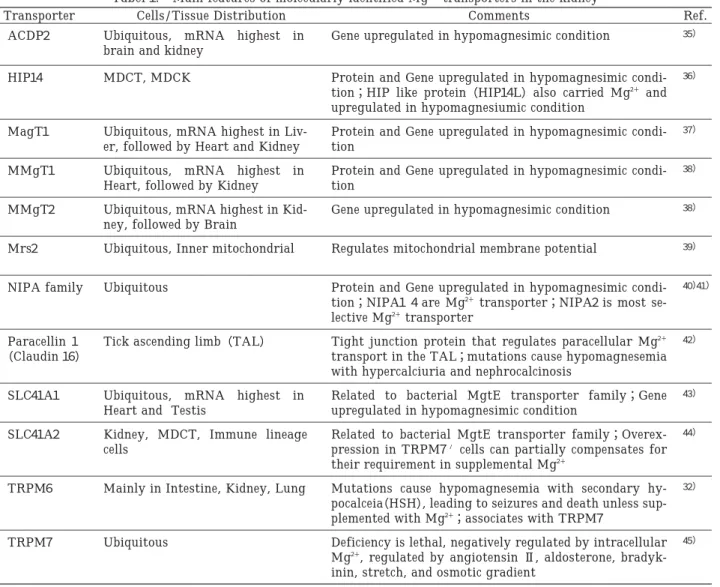
 exchangers have been shown to be inhib- ited  by  quinidine  and  imipramine. 6)  However,  there  is  little  information  about  the  renal  actions 

of  these  inhibitors. Recent  molecular  biological  and  electrophysiological  analyses  found  several  functional  Mg

2+

  transporters  in  an  immortalized  DCT  cell  line(Table  1). 35) 47)  Although  these  transporters  are  considered  to  be  involved  in  Mg

2+


influx or efflux in the DCT, further studies are nec- essary to clarify their physiological functions.

Conclusions

Numerous  studies  have  revealed  that  several  ion  channels  and  transporters  permeable  to  Na

,  Ca

2+


and Mg

2+

 are regionally expressed in the renal dis- tal tubule and these ion transports may play an im- portant  role  in  regulating  ion  homeostasis,  body  fluid  volume,  and  blood  pressure. However,  the 

Tabel 1.   Main features of molecularly identified Mg

2+

  transporters in the kidney

Ref.

Comments Cells/Tissue Distribution

Transporter  

Gene upregulated in hypomagnesimic condition 35)

Ubiquitous,  mRNA  highest  in  brain and kidney

ACDP2

Protein  and  Gene  upregulated  in  hypomagnesimic  condi- 36)

tion;HIP  like  protein(HIP14L)also  carried  Mg

2+

  and  upregulated in hypomagnesiumic condition

MDCT, MDCK HIP14

Protein  and  Gene  upregulated  in  hypomagnesimic  condi- 37)

tion Ubiquitous, mRNA highest in Liv- er, followed by Heart and Kidney MagT1

Protein  and  Gene  upregulated  in  hypomagnesimic  condi- 38)

tion Ubiquitous,  mRNA  highest  in  Heart, followed by Kidney MMgT1

Gene upregulated in hypomagnesimic condition 38)

Ubiquitous, mRNA highest in Kid- ney, followed by Brain

MMgT2

Regulates mitochondrial membrane potential 39)

Ubiquitous, Inner mitochondrial Mrs2

40) 41)

Protein  and  Gene  upregulated  in  hypomagnesimic  condi- tion;NIPA1 4 are  Mg

2+

  transporter;NIPA2 is  most  se- lective Mg

2+

 transporter

Ubiquitous NIPA family

Tight  junction  protein  that  regulates  paracellular  Mg

2+

  42)

transport in the TAL;mutations cause hypomagnesemia  with hypercalciuria and nephrocalcinosis

Tick ascending limb(TAL)

Paracellin 1

(Claudin 16)

Related  to  bacterial  MgtE  transporter  family;Gene  43)

upregulated in hypomagnesimic condition Ubiquitous,  mRNA  highest  in 

Heart and  Testis SLC41A1

Related  to  bacterial  MgtE  transporter  family;Overex- 44)

pression  in  TRPM7

/

 cells  can  partially  compensates  for  their requirement in supplemental Mg

2+

Kidney,  MDCT,  Immune  lineage  cells

SLC41A2

Mutations  cause  hypomagnesemia  with  secondary  hy- 32)

pocalceia(HSH), leading to seizures and death unless sup- plemented with Mg

2+

;associates with TRPM7

Mainly in Intestine, Kidney, Lung TRPM6

Deficiency is lethal, negatively regulated by intracellular  45)

Mg

2+

,  regulated  by  angiotensin  Ⅱ,  aldosterone,  bradyk- inin, stretch, and osmotic gradient

Ubiquitous TRPM7

Information  is  based  on  data  from  Touyz 46)   and  Schmitz  et  al. 47)  ACDP,  ancient  conserved  domain  protein;HIP, 

huntingtin interacting  protein;MagT,  magnesium  transporter;MMgT,  membrane  magnesium  transporter;NIPA, 

noninprinted in Prader Willi/Angelman;SLC, solute carrier;TRPM, transient receptor potential melastatin.

(5)

molecular  mechanisms  of  basolateral  Mg

2+

  trans- ports  in  the  distal  tubule  still  remain  to  be  elucidated. Further work is therefore required, es- pecially  to  define  the  potential  role  of  Mg

2+

  trans- port,  in  both  experimental  models  and  human  diseases.

References  

1)Reilly  RF,  Ellison  DH:Mammalian  distal  tubule:

physiology,  pathophysiology,  and  molecular anato- my. Physiol Rev 80:277 313, 2000.

2)Loffing  J,  Kaissling  B:Sodium  and  calcium  trans- port pathways along the mammalian distal nephron:

from rabbit to human. Am J Physiol Renal Physiol  284:F628 F643, 2003.

3)Loffing J, Loffing Cueni D, Valderrabano V, Klausli  L, Hebert SC, Rossier BC, Hoenderop JG, Bindels RJ,  Kaissling  B:Distribution  of  transcellular  calcium  and  sodium  transport  pathways  along  mouse  distal  nephron. Am  J  Physiol  Renal  Physiol 281:F1021 F1027, 2001.

4)Loffing  J,  Vallon  V,  Loffing Cueni  D,  Aregger  F,  Richter  K,  Pietri  L,  Bloch Faure  M,  Hoenderop  JG,  Shull GE, Meneton P, Kaissling B:Altered renal dis- tal tubule structure and renal Na

 and Ca

2+

 handling  in  a  mouse  model  for  Gitelman’s  syndrome. J  Am  Soc Nephrol 15:2276 2288, 2004.

5)Boros  S,  Bindels  RJ,  Hoenderop  JG:Active  Ca

2+

  re- absorption  in  the  connecting  tubule. Pflugers  Arch  458:99 109, 2009.

6)Xi Q, Hoenderop JG, Bindels RJ:Regulation of mag- nesium  reabsorption  in  DCT. Pflugers  Arch 458:89 98, 2009.

7)Simon  DB,  Nelson Williams  C,  Johnson  Bia  M,  Elli- son D, Karet FE, Molina AM, Vaara I, Iwata F, Cush- ner  HM,  Koolen  M,  Gainza  FJ,  Gitelman  HJ,  Lifton  RP:Gitelman’s variant of Bartter's syndrome, inher- ited  hypokalaemic  alkalosis,  is  caused  by  mutations  in  the  thiazide sensitive  Na Cl  cotransporter. Nat  Genet 12:24 30, 1996.

8)Jentsch  TJ:Chloride  transport  in  the  kidney:les- sons  from  human  disease  and  knockout  mice.  J  Am  Soc Nephrol 16:1549 1561, 2005.

9)Capasso  G,  Rizzo  M,  Garavaglia  ML,  Trepiccione  F,  Zacchia  M,  Mugione  A,  Ferrari  P,  Paulmichl  M,  Lang  F,  Loffing  J,  Carrel  M,  Damiano  S,  Wagner  CA,  Bianchi  G,  Meyer  G:Upregulation  of  apical  so- dium chloride  cotransporter  and  basolateral  chloride  channels  is  responsible  for  the  maintenance  of  salt sensitive hypertension. Am J Physiol Renal Physiol  295:F556 F567, 2008.

10)Nijenhuis T, Vallon V, van der Kemp AW, Loffing J,  Hoenderop  JG,  Bindels  RJ:Enhanced  passive  Ca

2+


reabsorption  and  reduced  Mg

2+

  channel  abundance  explains  thiazide induced  hypocalciuria  and  hypo- magnesemia. J Clin Invest 115:1651 1658, 2005.

11)Canessa CM, Horisberger JD, Rossier BC:Epithelial  sodium  channel  related  to  proteins  involved  in  neurodegeneration. Nature 361:467 470, 1993.

12)Canessa  CM,  Schild  L,  Buell  G,  Thorens  B,  Gautschi  I,  Horisberger  JD,  Rossier  BC:Amiloride sensitive  epithelial  Na

  channel  is  made  of  three  homologous  subunits. Nature 367:463 467, 1994.

13)Garty  H,  Plmer  LG:Epithelial  sodium  channels:

function, structure, and regulation. Physiol Rev 77:

359 396, 1997.

14)Butterworth  MB,  Edinger  RS,  Frizzell  RA,  Johnson  JP:Regulation  of  the  epithelial  sodium  channel  by  membrane  trafficking. Am  J  Physiol  Renal  Physiol  296:F10 F24 2009.

15)Snyder  PM:Minireview:regulation  of  epithelial  Na

  channel  trafficking.  Endocrinology 146:5079 5085, 2005.

16)Rossier  BC:The  epithelial  sodium  channel:activa- tion by membrane bound serine proteases. Proc Am  Thorac Soc 1:4 9, 2004.

17)Collier DM, Snyder PM:Extracellular protons regu- late human ENaC by modulating Na

 self inhibition. 

J Biol Chem 284:792 798, 2009.

18)Fronius  M,  Clauss  WG:Mechano sensitivity  of  ENaC:may the(shear)force be with you. Pflugers  Arch 455:775 785, 2008.

19)Hansson JH, Nelson Williams C, Suzuki H, Schild L,  Shimkets  R,  Lu  Y,  Canessa  C,  Iwasaki  T,  Rossier  B,  Lifton  RP:Hypertension  caused  by  a  truncated  epithelial  sodium  channel  gamma  subunit:genetic  heterogeneity of Liddle syndrome. Nat Genet 11:76 82, 1995.

20)Snyder  PM,  Price  MP,  McDonald  FJ,  Adams  CM,  Volk  KA,  Zeiher  BG,  Stokes  JB,  Welsh  MJ:Mecha- nism  by  which  Liddle ’ s  syndrome  mutations  increase  activity  of  a  human  epithelial  Na

  channel.  Cell 83:

969 978, 1995.

21)Chang  SS,  Grunder  S,  Hanukoglu  A,  Rosler  A,  Mathew PM, Hanukoglu I, Schild L, Lu Y, Shimkets  RA, Nelson Williams C, Rossier BC, Lifton RP:Mu- tations  in  subunits  of  the  epithelial  sodium  channel  cause salt wasting with hyperkalaemic acidosis, pseu- dohypoaldosteronism type 1. Nat Genet 12:248 253,  1996.

22)Vennekens  R,  Hoenderop  JG,  Prenen  J,  Stuiver  M,  Willems  PH,  Droogmans  G,  Nilius  B,  Bindels  RJ:

Permeation and gating properties of the novel epithe- lial Ca

2+

 channel. J Biol Chem 275:3963 3969, 2000.

23)Hoenderop  JG,  Nilius  B,  Bindels  RJ:Calcium  ab- sorption  across  epithelia. Physiol  Rev 85:373 422,  2005.

24)Bronner  F:Renal  calcium  transport:mechanisms 

(6)

and  regulation   an  overview. Am  J  Physiol 257:

F707 F711, 1989.

25)Lambers TT, Mahieu F, Oancea E, Hoofd L, de Lange  F, Mensenkamp AR, Voets T, Nilius B, Clapham DE,  Hoenderop  JG,  Bindels  RJ:Calbindin D

28K

  dynami- cally   controls   TRPV5 mediated   Ca

2+

   transport. 

EMBO J 25:2978 2988, 2006.

26)Iwamoto  T,  Kita  S:Hypertension,  Na

/Ca

2+

  ex- changer, and Na

, K

ATPase. Kidney Int 69:2148 2154, 2006.

27)Lambers  TT,  Bindels  RJ,  Hoenderop  JG:Coordi- nated control of renal Ca

2+

 handling. Kidney Int 69:

650 654, 2006.

28)Iwamoto  T:Sodium calcium  exchange  inhibitors:

therapeutic  potential  in  cardiovascular  diseases.   Fu- ture Cardiol 1:519 529, 2005.

29)Konrad  M,  Schlingmann  KP,  Gudermann  T:In- sights  into  the  molecular  nature  of  magnesium  homeostasis. Am J Physiol Renal Physiol 286:F599 F605, 2004.

30)Quamme  GA,  de  Rouffignac  C:Epithelial  magne- sium transport and regulation by the kidney. Front  Biosci 5:D694 D711, 2000.

31)Satoh  J,  Romero  MF:Mg

2+

  transport  in  the  kidney. Biometals 15:285 295, 2002.

32)Voets T, Nilius B, Hoefs S, van der Kemp AW, Droog- mans  G,  Bindels  RJ,  Hoenderop  JG:TRPM6 forms  the Mg

2+

 influx channel involved in intestinal and re- nal Mg

2+

 absorption. J Biol Chem 279:19 25, 2004.

33)Schlingmann  KP,  Weber  S,  Peters  M,  Niemann  Nejsum  L,  Vitzthum  H,  Klingel  K,  Kratz  M,  Haddad  E,  Ristoff  E,  Dinour  D,  Syrrou  M,  Nielsen  S,  Sassen  M,  Waldegger  S,  Seyberth  HW,  Konrad  M:Hypo- magnesemia  with  secondary  hypocalcemia  is  caused  by mutations in TRPM6, a new member of the TRPM  gene family. Nat Genet 31:166 170, 2002.

34)Walder RY, Landau D, Meyer P, Shalev H, Tsolia M,  Borochowitz  Z,  Boettger  MB,  Beck  GE,  Englehardt  RK,  Carmi  R,  Sheffield  VC:Mutation  of  TRPM6  causes  familial  hypomagnesemia  with  secondary  hypocalcemia. Nat Genet 31:171 174, 2002.

35)Goytain  A,  Quamme  GA:Functional  characteriza- tion of ACDP2(ancient conserved domain protein), a  divalent metal transporter.  Physiol Genomics 22: 382 389, 2005.

36)Goytain  A,  Hines  RM,  Quamme  GA:Huntingtin interacting  proteins,  HIP14  and  HIP14L,  mediate  dual  functions,  palmitoyl  acyltransferase  and  Mg

2+


transport. J Biol Chem 283:33365 33374, 2008.

37)Goytain  A,  Quamme  GA:Identification  and  charac- terization  of  a  novel  mammalian  Mg

2+

  transporter  with channel like prpperties. BMC Genomics 6 :48,  2005.

38)Goytain  A,  Quamme  GA:Identification  and  charac- terization of a novel family of membrane magnesium  transporters,  MMgT1 and  MMgT2. Am  J  Physiol  Cell Physiol 294:C495 C502, 2008.

39)Zsurka G, Gregan J, Schweyen RJ:The human mito- chondrial  Mrs2 protein  functionally  substitutes  for  its  yeast  homologue,  a  candidate  magnesium  transporter. Genomics 72:158 168, 2001.

40)Goytain A, Hines RM, El Husseini A, Quamme GA:

NIPA1(SPG6),  the  basis  for  autosomal  dominant  form of hereditary spastic paraplegia, encodes a func- tional Mg

2+

 transporter. J Biol Chem 282: 8060 8068,  2007.

41)Goytain  A,  Hines  RM,  Quamme  GA:Functional  characterization  of  NIPA2,  a  selective  Mg

2+

  trans- porter. Am  J  Physiol  Cell  Physiol 295:C944 C953,  2008.

42)Simon  DB,  Lu  Y,  Choate  KA,  Velazquez  H,  Al Sab- ban  E,  Praga  M,  Casari  G,  Bettinelli  A,  Colussi  G,  Rodriguez Soriano J, McCredie D, Milford D, Sanjad  S,  Lifton  RP:Paracellin 1,  a  renal  tight  junction  protein  required  for  paracellular  Mg

2+

  resorption. 

Science 285:103 106, 1999.

43)Goytain  A,  Quamme  GA:Functional  characteriza- tion  of  human  SLC41A1,  a  Mg

2+

  transporter  with  similarity  to  prokaryotic  MgtE  Mg

2+

  transporters. 

Physiol Genomics 21:337 42, 2005.

44)Sahni  J,  Nelson  B,  Scharenberg  AM:SLC41A2 en- codes  a  plasma membrane  Mg

2+

  transporter.  Bio- chem J 401:505 513, 2007.

45)Schmitz C, Perraud AL, Johnson CO, Inabe K, Smith  MK,  Penner  R,  Kurosaki  T,  Fleig  A,  Scharenberg  AM:Regulation  of  vertebrate  cellular  Mg

2+

  homeo- stasis by TRPM7. Cell 114:191 200, 2003.

46)Touyz  RM:Transient  receptor  potential  melastain  6 and 7 channels,  magnesium  transport,  and  vascu-

lar  biology:implications  in  hypertension. Am  J  Physiol Heart Circ Physiol 294:H1103 H1118, 2008.

47)Schmitz C, Deason F, Perraud AL:Molecular compo- nents  of  vertebrate  Mg

2+

homeostasis  regulation. 

Magnes Res 20:6 18, 2007.

(Received on July 10, 2009, 

Accepted on September 9, 2009) 

Fig. 1. Distributions  of  Na + ,  Ca 2+ ,  and  Mg 2+   transporters  in  the  distal  tubule. Shadings  of  bars  indicate  relative  changes  of  the   abun-dance  of  these  transporters  along  the  segments. Abreviations  are exhibited in the text.
Tabel 1.   Main features of molecularly identified Mg 2+   transporters in the kidney

参照

関連したドキュメント

As in the previous case, their definition was couched in terms of Gelfand patterns, and in the equivalent language of tableaux it reads as follows... Chen and Louck remark ([CL], p.

The only thing left to observe that (−) ∨ is a functor from the ordinary category of cartesian (respectively, cocartesian) fibrations to the ordinary category of cocartesian

An easy-to-use procedure is presented for improving the ε-constraint method for computing the efficient frontier of the portfolio selection problem endowed with additional cardinality

(Construction of the strand of in- variants through enlargements (modifications ) of an idealistic filtration, and without using restriction to a hypersurface of maximal contact.) At

It is suggested by our method that most of the quadratic algebras for all St¨ ackel equivalence classes of 3D second order quantum superintegrable systems on conformally flat

Kilbas; Conditions of the existence of a classical solution of a Cauchy type problem for the diffusion equation with the Riemann-Liouville partial derivative, Differential Equations,

By the algorithm in [1] for drawing framed link descriptions of branched covers of Seifert surfaces, a half circle should be drawn in each 1–handle, and then these eight half

This paper develops a recursion formula for the conditional moments of the area under the absolute value of Brownian bridge given the local time at 0.. The method of power series