Side Effects of Praziquantel in the Treatment of Urinary Schistosomiasis in Kenya
Eisaku KIMURA1, G. M. KAMAU2, F. M. KILIKU3, N. D. MUHOHO3, P. G. WAIYAKI3, Masaaki SIMADA
and Yoshiki AOKI1
Abstract: Side effects of praziquantel in a single‑dose treatment of urinary schistosomiasis at 40 mg/kg were studied on 174 subjects by means of questioning clinical manifestations before and 24 hr after treatment. The numbers of abdominal pain/discomfort, nausea/vomiting and dizziness/lassitude increased after treatment at a statistically significant level. "Possible" side reactions, defined as clinical manifestations developed newly or in‑
creased their degree of severity after treatment, were experienced by 55.7% of the treated people. Females suffered more nausea/vomiting than males, and people of age 16‑20 years had reactions more frequently than the other ages. With a few exceptions, the adverse ef‑
fects were mild and disappeared within 11 hr after their onset.
Key words: Schistosoma haematobium, Praziquantel, Side reaction, Kenya
^Department of Parasitology, 1一'nstitute of Tropical Medicine, Nagasaki University,
1‑12‑4 Sakamoto, Nagasaki 852,
2Kinango Hospital, Kinango, Kwale District, Coast Province, Kenya
^Centre for Microbiology Research, Kenya Medical Research Institute, P. O. Box 54840, Nairobi, Kenya
INTRODUCTION
Praziquantelissaidtobethebestantischistosomaldrugeverknownintermsoftheef‑
ficacy,safetyandeaseintreatingpatients,i.e.,asingleoraldoseissufficientlyeffective againstthethreecommonspeciesofschistosomeinfectingman,Schistosomahaematobium,S.
japonicumandS.mansoni(Davisetal,1979;Katzefalt1979;Santos^^.,1979).Therate ofparasitologicalcureoftenexceeded90%(McMahonandKolstrup,1979;McMahon.1983;
Kardmanetal,1983).Therewerenotoxiceffectssuchasteratogenicity,mutagenicity,or carcmogemcity(FrohbergandSchencking,1981).
Sideeffectsexperiencedinthetreatmentwithpraziquantelweremildandtransient.
Theeffectsonlaboratorybiochemistry,haematologyandelectrocardiogramswerealso negligible(Davisetal,1979;Katzetal,1979;Santosetal,1979;Ishizakietal,1979;Biaset Received for Publication August 20, 1992.
Contribution No. 2712 from the Institute of Tropical Medicine, Nagasaki University.
al, 1982). However, relatively severe reactions (neuro‑psychiatric, cardiovascular, hepatic, der‑
matological and delayed reactions) were reported in the treatment of S. japonicum in China (Minggang et al, 1983). A report from Zaire revealed an unusually high occurrence of bloody diarrhoea among S. mansoni patients (Polderman et al, 1984). The facts indicate a possibility that unexpected severe adverse effects might be encountered in different areas. We in‑
vestigated the side effects of praziquantel in the treatment of S. haematobium infection, as there has been no such report in Kenya.
MATERIALS AND METHODS
The present study was carried out at Mwachinga, Kwale District, Coast Province, Kenya. About 900 people were examined for eggs in the urine using a Nuclepore membrane filtration method in June!July, 1986. The egg count was expressed as the number of eggs per total volume of urine excreted in an hour (Shimada et al., 1986). After a month, praziquantel was administered at a dosage of 40 mg!kg of body weight up to a maximum of 2.4 mg per one dose. Side effects produced by the treatment were studied on 224 subjects of age 13 years old and upwards. They were questioned on the existence, seventy, onset and duration of clinical signs and symptoms (abdominal pain!discomfort, diarrhoea, nausea/vomiting, sense of fever, skin rash, headache, dizziness!lassitude, cough, dysuria, haematuna and others) before and 24 hr after treatment. A total of 174 paired answers (male 96, female 78) could be utilized for analyses, of which egg counts were available for 74 persons.
For statistical analysis, chi‑square test was employed.
RESULTS AND DISCUSSION
The occurrence of clinical manifestations was compared before and 24 hr after treat‑
merit (Table 1). Abdominal pain!discomfort, nausea!vomiting and dizziness!lassitude increased in number after treatment at a statistically significant level (p<0.01), suggesting that the manifestations were side reactions caused by the treatment. The numbers of sense of fever, cough, dysuria and haematuria decreased significantly (p<0.01). If the decreases resulted from immediate effects of praziquantel was not certain from the present study. No Dif‑
ferences were seen in diarrhoea, skin rash and headache.
The occurrence of "possible side reactions, which were defined as clinical manifesta‑
tions developed newly or increased their degree of severity after treatment, was analyzed by sex (Table 2). Of 174 patients of both sexes, 97 (55.7%) had the reaction (s), among which diz‑
zmess!lassitude was the commonest (27.6%), followed by nausea!vomiting (25.9%) and ab‑
dominal pain!discomfort (23.6%). Females had significantly more nausea!vomiting than males
(p<o.o5). The reason was not known. Headache was observed in relatively high percentages
of the treated males (16.7%) and females (12.8%). Several previous studies also reported
headache after treatment (Davis et al, 1979; Katz et al, 1979; Kardman et at, 1983). Skin
rash, fever and diarrhoea were rare,
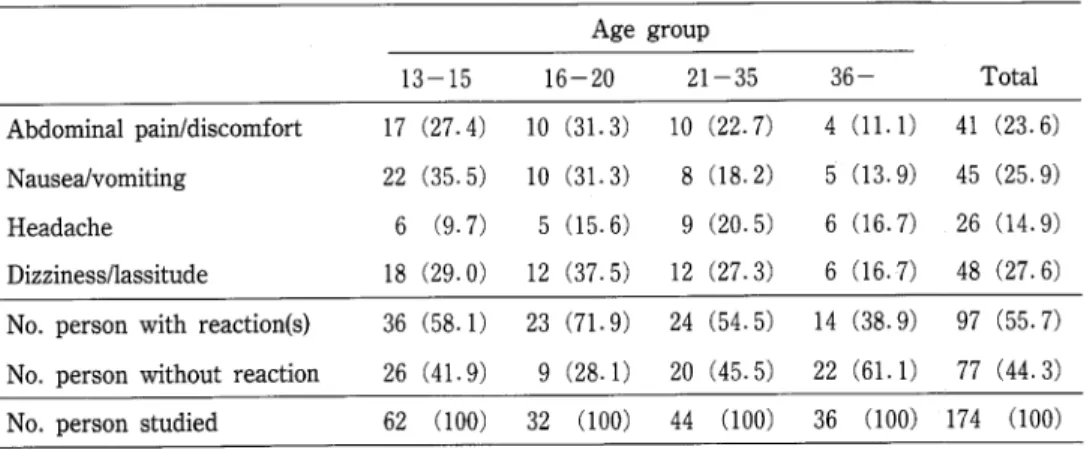
The occurrence of "possible" reactions was further analyzed by age (Table 3) and pre―
treatment egg count (Table 4). The age group 16‑20 years had reactions more frequently (pく 0.05), and the age group 36 years and upwards had them less frequently (p<0.05) compared with the other age groups. Also, nausea!vomiting was found to be more common under 21 years old (p<0.05). The tendency of having more side reactions under 21 years than in
Table 1. The number of clinical manifestations reported before and 24 hr after treatment with praziquantel
Pre ‑treatment Post‑treatment Abdominal pain!discomfort 19 (10. 9) 42 (24. 1) Diarrho e a
Naus e a!vomiting Sense of fever Skin rash Headache D izziness/lass itude Cough
Dysuria Haematuria
6 (3.4) 6 (3.4) 5 (2.9) 48 (27.6) 20 (ll.5
9 (5.2〕
70 (40.2 50 (28.7〕
28 (16.1) 71 (40.8) 87 (50.0)
3 〔1.7〕 **
5 (2.9 65 (37.4) 77 (44.3) * ll (6.3) 30 (17‑2) 44 (25.3〕 **
No. person studied 174 (100) 174 〔100)
( 〕
*
**
Percentage of the total number of persons studied.
Increase significant at l% level.
●
Decrease significant at l% level.
●Table 2. The occurrence of "possible" side reactions analyzed by sex Male Female Total Abdominal pain!discomfort 24 (25. 0')
Diarrhoea Nausea!vomiting Sense of fever Skin rash Headache Dizziness/lassitude
2 (2.1〕
19 (19.8) 0 (0.0) 1 Cl.O〕
16 (16.7) 27 (28.1)
17 (21.8) 41 (23.6〕
3 (3.8) 5 (2.9〕
26 (33.3) 45 (25.9) 1 (1.3) 1 (0.6) 1 (1.3 2 (1.1〕
10 (12.8) 26 (14.9)
21 (26.9) 舶(27.6)
No. person with rection(s) 53 (55.2〕 44 (56.4) 97 (55‑7) No. per印n without reaction 43 (44.8) 34 (43.6) 77 (44.3) No. person studied 96 (100) 78 (100) 174 (100)
〔 〕 Percentage of the total number of persons studied.
Table 3. The occurrence of "possible side reactions analysed by age group Age group
13‑15 16―20 21―35 36― Tota
Abdominal pain!discomfort 17 (27.4〕 10 (31.3 Nausea!vomiting 22 (35.5) 10 (31.3) Headache 6 (9‑7) 5 (15.6J Dizziness/lassitude 18 (29. 0) 12 (37. 5)
10 (22.7) 4 (ll.1 41 (23.6) 8 (18.2) 5 (13.9) 45 (25.9) 9 (20.5) 6 (16.7) 26 (14.9) 12 (27.3) 6 (16.7) 48 (27.6) No.personwithreaction(s) 36 (58.1) 23 (71.9) 24 (54.5) 14 (38.9) 97 (55.7) No.personwithoutreaction 26 (41.9) 9 (28.1) 20 (45.5) 22 (61.1) 77 (44.3) No.personstudied 62 (100〕 32 (100) 44 (100) 36 (100) 174 (100)
( ) : percentage of the total number of persons studied.
Table 4. The occurrence of "possible 'side reactions analysed by egg count Pre‑treatment egg count紅r
‑10 11‑100 101‑500 501‑ Total
Abdominal pain!discomfort Nausea!vomiting
Headache Dizziness!lassitude
3 (14.3) 6 (27.3) 5 (23.8) 8 (36.4) 3 (14.3) 4 (1臥2) 8 (38.1) 4 (18.2)
1 (6.7) 2 (12.5) 12(16.2) 5 (33.3) 4 (25.0) 22 (29.7) 3 (20.0) 3 (18.8) 13 (17.6〕
4 (26.7) 2 (12.5) 18 (24.3) No.personwithreaction(s) 10 (47.6) 17 (77.3) 7 (46.7〕 7 (43.8) 41 (55.4〕
No.personwithoutreaction ll (52.4) 5 (22.7) 8 (53.3) 9 (56.3) 33 (44.6) No.personstudied 21 (100) 22 (100) 15 (100) 16 (100) 74 (100)
( 〕 : Percentage of the total number of persons.
Table 5. The onset (min. after drug administration) and duration of "possible 'side reactions Onset (min) Duration(mm) No. person Average Range Average Range Abdominal pain!discomfort
Nausea Vomiting
Headache Dizziness/lassitude
39* 98.9 37 126. 6 188.0
18*審 244.5
47* 145.0
1‑360 207. 4 20=660
1―480 10‑420
60‑360 vomited 1‑2 times 1‑600 198. 3 30‑600
1‑540 161.2 10―600
In another three persons, the pain persisted for more than 23 hr・
=
In another five persons, the headache persisted for more than 15 hr.
In another person, the symptom persisted for more than 23 hr.
the older ages could not be attributed to a higher average egg count among young patients,
because no association was found between the level of pre‑treatment egg count and the fre―
quency of reactions (p<0.10). Similar observation was made in Tanzania by McMahon and Kolstrup (1979).
The onset of reactions (min after drug administration) and their duration (min) were set out m Table 5. Most of the reactions disappeared without particular treatment within ll hr after their appearance. Out of 155 cases with data on the duration, 9 (5.8%) experienced
reactions (headache, abdominal pain or dizziness) which persisted for more than 15 hr. In the
treatment of S japonicum in China, long‑lasting adverse effects, which incapacitated 0.1 1% of the treated patients for up to more than 12 months, were reported (Minggang et al, 1983).
In the present study, the side effects recorded were mostly mild. Only two persons (1.1%
of the treated) complained severe reactions, i. e., abdominal pain and headache in one person, and headache in the other.
The side effects of praziquantel in the treatment of urinary schistosomiasis were found
=
to be very common but mild and short‑lasting, which disappeared without particular treaト ment. The drug could be administered with more confidence of safety in the future control of schistosomiasis in this area.
A CKNOWLEDGEMENTS
This study was carried out under the Joint KEMRI!JICA Schistosomiasis Project. The authors are indebted to many Japanese and Kenyan researchers of Kenya Medical Research Institute. Special thanks are due to Ms. Wakio and Mr. Mageto of Kinango Hospital for their assistance in the field,
This paper is published with the permission of the Director, Kenya Medical Research
Institute.
REFERENCES
1 ) Davis, A., Biles, J.E. & Ulrich, A.‑M. (1979): Initial experiences with praziquantel in the treatment of human infections due to Schistosoma haematobium. Bull. WHO, 57 (5), 773‑779.
2) Bias, L.C.S., Pedro, RJ. & Deberaldini, E.R. (1982): Use of praziquantel in patients with schistosomiasis mansoni previously treated with oxamniquine and!or hycanthone: resistance of
●
Schistosoma mansoni to schistosomicidal agents. Trans. Roy. Soc. Trop. Med. Hyg., 76 (5), 652‑659.
3 ) Frohberg, H. & Schencking, M.S. (1981): Toxicological profile of praziquantel, a new drug against cestode and schistosome infection. Drug Research, 31 (1), 555‑565.
4 ) Ishizaki, T., Kamo, E. & Boehme, K. (1979): Double‑blind studies of tolerance to praziquantel in Japanese patients with Schistosoma japonicum infections. Bull. WHO, 57 (5), 787‑791.
5 ) Kardman, M.W., Amin, M.A., Fenwick, A., Cheesmond, A.K. & Dixon, H.G. (1983): A field trial us‑
mg praziquantel (BiltricideR) to treat Schistosoma mansoni and Schistosoma haematobium infection in
Gezira, Sudan. Ann. Trop. Med. Parasit, 77 (8), 297‑304.
96
6 ) Katz, N.. Rocha, R. S. & Chaves, A. (1979): Preliminary trial with praziquantel in human infections due to Schistosoma mansoni. Bull. WHO, 57 (5), 781‑785.
7 ) McMahon, J. E. & Kolstrup. N. (1979): Praziquantel. a new schistosomicide against Schtstosoma haematobmm. Br. Med. J., 1, 1396‑1399.
8 ) McMahon, J. E. (1983): A comparative trial of praziquantel, metrifonate and nindazole against Schistosoma haematobium. Ann. Trop. Med. Parasit, 77 (2), 139‑142.
9 ) Minggang, C., Sui, F., Xiangjin, H. & Huimin, W. (1983): A retrospective survey on side effects of praziquantel among 25,693 cases of schistosomiasis japonica. Southeast Asian J. Trop. Med. Pub. HI
thリ14 (4), 495―500.
10) Polderman, A. MリGryseels, B., Gerold, J. L., Mpamila, K. & Manshande, J. P. (1984): Side effects
of praziquantel in the treatment of Schistosoma押mnsom in Maniema. Zaire. Trans. Roy. Soc. Trop.
Med. Hygリ78, 752‑754―
11〕 Santos, A. TリBias, B. L., Nosenas, U. S., Portillo, G. PリOrtega, 0. M・, Hayashi, M. & Boehme,
K. (1979): Preliminary clinical trials with praziquantel in Schistosoma japomcum infections in the
Philippines. Bull. WHO, 57 (5), 793―799.
12〕 Shimada, M., Hirata, MリSato, KリWambayi, EリOuma, J. H. & Aoki, Y. (1986): Egg count m urine