Analyzing Japanese university students'
English summaries and task representations as a possible source of plagiarism
著者(英) Yoshimura Fumiko, Adams Keith journal or
publication title
Journal of Institute for Research in English Language and Literature
number 43
page range 53‑78
year 2018‑03‑15
URL http://id.nii.ac.jp/1204/00023981/
English Summaries and Task Representations as a Possible Source of Plagiarism
Fumiko Yoshimura and Keith Adams
Abstract
Recently, summary writing has regained its importance as a subskill for writing with citations. Though the importance of writing a summary “in the writer’s own words” are emphasized in majority English-speaking countries, it has seldom been perceived as an important characteristic of summary writing in Japan. This was first validated through reviewing literature in English- speaking countries and in Japan. Then, empirical research was conducted.
Specifically, Japanese university students’ English summary samples and their survey answers were analyzed. In summary text analysis, the copy rate and the relationship between it and three kinds of evaluations (i.e. grammatical ac- curacy, content appropriateness, and the holistic impression) were investigated.
In survey analysis, the students’ task representations were inferred from their answers to open-ended questions. The results show a wide variance between individuals in terms of copy rate and their task representations of summarizing and writing in the writer’s own words, some of which may lead to inappropriate language borrowing behaviors which may be called plagiarism in English- speaking countries.
Keywords: L2 summary writing, task representations, plagiarism, Japanese university students
Introduction
Summary writing is one of the most common writing tasks in schools.
The task is utilized not only in language classes but also in other classes in or- der to promote learning of content or checking comprehension. Summarizing is so common that we take it for granted and rarely reflect on what it means or entails. Recently, however, especially in majority English-speaking countries, such as the United States, its importance has been recognized as a sub-skill for writing with citations (e.g., Axelrod, R.B., Cooper, C.R., & Warriner, A.M., 2008 ; Cimasko, 2014 ; Shaw & Pecorari, 2013), and particularly in the con- text of avoiding plagiarism.
Keck (2006, 2010, 2014), for example, investigated different degrees of paraphrasing in students’ summaries in a series of experiments and pointed out the danger of being accused of plagiarism in cases of insufficient paraphrasing. Summary writing is often used in research because language borrowing occurs more frequently in writing summaries than in other types of writing such as opinion papers (Shi, 2004). Inappropriate language borrowing is often found in ESL writing. Keck (2006) compared summaries by L1 and L2 writers and argued that language proficiency might account for ESL writ- ers’ insufficient paraphrasing in summarizing.
Another source of insufficient paraphrasing in summary tasks may be the writer’s task representations of summarizing. Task representations are how a writer perceives a task and it is believed to exert a significant effect on the subsequent process and final product (e.g., Flower, Stein, Ackerman, Kantz, McCormick, & Peck, 1990). In Japan, though it is one of the most frequently assigned tasks, a definition of summarization is rarely thoroughly explained to students and they seldom receive instruction on how to write a summary. On the other hand, in English-speaking countries, summarization is clearly de- fined and the skills of the task are more frequently taught. Furthermore, rel- evant materials can be found in textbooks and academic writing webpages.
Therefore, it cannot be assumed that task representations of summary writing in Japan are the same as those in English-speaking countries.
This study was designed to explore Japanese university students’ task representations of summarizing by reviewing literature about summary writing in Japan and by analyzing Japanese students’ summary samples and their sur- vey answers. Little research has been conducted on Japanese students’ sum- mary performance and task representations of summary writing so far.
Therefore, the findings from this research are potentially revealing for the Jap- anese context. Plagiarism cases by L2 learners in English-speaking coun- tries are often reported and various causes are suggested such as cultural val- ues (Bloch, 2008), educational background (Pennycook, 1996), and the learners’ English proficiency (Keck, 2006). However, we suspect that in some Japanese university students’ cases, their task representations of sum- marizing may be responsible. We would like to explore this possibility and other related matters.
Literature review
What task representations are and why exploring students’ task repre- sentations is important
Researchers (e.g., Flower et al., 1990) have shown the important influ- ence of task representations on the writing process. Task representations are mental representations about a given task a writer creates for himself or herself. Flower et al. (1990) perceive it as multidimensional, made up of a set of “goals, strategies, and criteria” (p. 21). Since it is constructed from an in- dividual writer’s unique experience, schema, and interpretation of the rhetori- cal context, different writers may create different task representations toward the same task (p. 21).
For example, the task of summarizing can be perceived differently and ap- proached through various strategies by different writers (Flower et al., 1990 ; Hidi & Anderson, 1986 ; Sarig, 1993). Flower et al. (1990) gave ex- amples from Flower’s informal experiments as follows : (a) “the gist and list strategy” (p. 44) in which the writer finds key words and lists them in order to shorten the text ; (b) “using the reading as a springboard to trigger their own
ideas or response to the topic in general” (p. 45), where the content of the source is no longer important ; (c) “the review and comment method,” in which the writer reviews the source and gives his or her comments (p. 46- 47) ; and (d) “synthesizing ideas around a controlling concept” (p. 47-50), in which the writer finds a concept that unifies the information in the source and organizes his own text around it. This last approach requires much deeper understanding of the source text than others and is often expected in academic writing. Unfamiliarity with professors’ representations or expectations of summary tasks can cause unsatisfactory performance of university students.
While professors expect a summary to demonstrate a student’s thorough com- prehension or interpretation of the text, the student may just summarize the main ideas by referring to the text (Basham, Ray, & Whalley, 1993, p. 304).
Thus, because the task representations a writer constructs will exert great influence on the reading and writing process and the resultant perfor- mance, it is important to investigate how students actually represent a task, instead of relying solely on inference based upon their performance in the fin- ished products.
How summary writing is explained in textbooks and online resources in English-speaking countries
Though “task representation is subject to many influences” (Flower et al., 1990, p. 36), the description of the task given by an instructor or found in the textbook is arguably the most critical factor in shaping students’ represent- ations. In order to explore what summarization means in English-speaking countries, we analyzed some academic writing textbooks and online sources for L1 Anglosphere university undergraduate and graduate students.
What most of the textbooks and online resources reviewed in this study included are a definition and explanation of the act of summarizing, the func- tions it serves, and the steps to write a summary. Axelrod, Cooper, and War- riner (2008) provide a typical definition : “A summary is a relatively brief statement, primarily in the reader’s own words, of the reading’s main ideas” (p.
608). The definitions found in the current analysis consistently included (a)
reading the source text, (b) selecting important information from the text, and (c) restating it in the summary writer’s own words. Though some differences were found in the descriptions, the act of summarizing was well articulated in terms of its definition, features, formats, functions, and processes. In relation to the current research, all emphasized the importance of summary writer’s using their own words. However, “writing in the writer’s own words” is an elusive and difficult concept to understand. It usually means to avoid copying verbatim. However, it can also mean to present how the writer interprets the source text or what the writer thinks is the central idea of the source text. In the latter cases, how should we consider borrowed expressions that are used as building blocks for showing the writer’s comprehension? In order to pro- mote writing in the writer’s own words, Kennedy and Smith (2006) recom- mend that writers create “a graphic overview” (p. 58) in order to show the writer’s comprehension of the overall text structure, Howard (2010) recom- mends that writers summarize the source text “without looking at the source”
(p. 119) in order to avoid depending on the source text, and Hunter (as cited in Yamada, K., 2003) recommends that writers “should speak about the text at a different level of abstraction” (p. 254) which indicates packing and unpacking of text meanings according to the writer’s purpose.
How the task of summarizing is discussed in research articles in Eng- lish-speaking countries
Since summary explanations found in writing textbooks may be based on relevant research, research articles are reviewed in this section. The task demands and cognitive operations of summarization were investigated mainly in the 1980s and 90s (e.g., Brown & Day, 1983 ; Hidi & Anderson, 1986 ; Joh- nes & Mayes, 1990 ; Kirkland & Saunders, 1991 ; Sarig, 1993), and the find- ings include the cognitive operations involved in the task, its subjectivity to various factors, and developmental differences in the writers.
For example, Hidi and Anderson (1986) produced a comprehensive review of the research on summary tasks and revealed that characteristics of the source text (e.g., length, genre, and complexity), the task procedure (e.g., pres-
ence versus absence of the source text while summarizing), and type of sum- mary the writer needs to produce (e.g., a writer-based versus reader-based summary) exert great influence on the cognitive operation of the task and the resultant products. They also explained developmental differences in terms of the task representations, and the abilities to (a) identify important informa- tion, (b) condense the source text by combining information or replacing infor- mation in the text with more abstract concepts, (c) find or create a topic sen- tence for each paragraph and (d) use metacognitive skills. In general, as students grow older, they tend to use more sophisticated strategies (Brown &
Day, 1983), to be capable of condensing information more effectively (Brown &
Day, 1983 ; Hidi & Anderson, 1986), and even to transform the source text into “a tight conceptual representation of the underlying logical structure”
(Sarig, 1993, p. 172). Brown and Day (1983) found less verbatim copying and more drastic formal change in the resultant summaries of older students.
However, they also found immature summarizing strategies used by older stu- dents and they argued that partially adequate summarization strategies such as copy-delete or knowledge-telling impede progress of the skill and need to be rejected (p. 13). In the copy-delete strategy, the writer deletes unimportant text parts and copies the remaining parts verbatim (p. 2) and in the knowledge- telling strategy, the writer tells what they know about the topic without consid- ering the purpose of the text (p. 13). Sarig (1993) asserts that improvement of summary skills does not come naturally but requires explicit instruction.
Two other lines of research related to the current study are research on academic discourse (e.g., Carson & Leki, 1993 ; Flower et al., 1990) and em- pirical research on the effects of paraphrasing or self-explanation on reading comprehension (e.g., Karbalaei & Amoli, 2011 ; Katims & Harris, 1997 ; Mc- Namara, 2004). Research on academic discourse reveals that the expectation in university-level summary tasks is to “move beyond summarization” to
“translation” (Basham, Ray, & Whalley, 1993, p. 304), where students are ex- pected to reshape the reading by creating their own interpretation of the text and their own purpose of writing. Empirical research on the effects of para- phrasing on reading comprehension generally shows positive effects of restat-
ing the content in the writer’s own words on text comprehension and support the importance of using the writer’s own words in a summary task (Karbalaei
& Amoli, 2011 ; Katims & Harris, 1997 ; McNamara, 2004).
In sum, research from various viewpoints on summarization and the relat- ed studies in English-speaking countries reveal that using the writer’s own words is emphasized in academic writing textbooks as an important character- istic of a good summary, and has been shown, through empirical research, to be beneficial for learning.
How summary writing is taught in Japanese education
In order to investigate how summarization is taught in Japanese schools, we first analyzed ten Japanese academic writing books for university students.
The analysis showed that a focus is placed on teaching direct quotations and only brief descriptions can be found on summarization. All ten books empha- size the importance of acknowledging the sources in order to avoid plagiarism or infringement of copyrights. According to these books, the difference be- tween an appropriate and inappropriate citation is whether the source is ac- knowledged or not. The issue of language borrowing is rarely mentioned and only three books out of the ten investigated advise students to use their own words in summarizing a source. Next, we reviewed the standard courses of study in elementary, middle, and high schools as outlined by the Ministry of Education in 1999, and MEXT (2010). Our purpose was to assess students’
background knowledge and experience in primary and secondary education.
The first main finding from the review is that students are exposed to instruc- tion regarding summarization skills in Japanese language subjects from ele- mentary to high school as an aid to reading comprehension but not specifically as a writing skill. Furthermore, while identifying the gist or the important points of texts was emphasized, what expressions a writer should use in writ- ing a summary was not mentioned.
How summarization is discussed among Japanese researchers
In Japan, summarizing is defined as “a kind of language act trying to ex-
press something with fewer words without changing the gist of the source”
(Sakuma, 1994, p. 4). Though, an agreement was reached regarding the char- acteristics of summary in the symposium of the Society of Expression-Forma- tion Studies held in 1992, the issue of language borrowing was not mentioned there (Yamada, A., 1997). While most teachers focus on the inclusion of im- portant ideas, few instruct writers to use their own words in writing a summary. Thus, language borrowing in summaries has rarely been regarded as problematic in the Japanese context.
However, the issue of language borrowing in summarization in Japanese has been addressed in a few empirical studies. For example, Muramoto (1992) conducted a series of experiments using Japanese university students.
First, the students were asked to write a summary of a text and their summary samples were analyzed under two conditions : the referring-text condition (summarizing while referring to the source) and the referring-memory condi- tion (summarizing without referring to the source). The result suggests that the availability of the source text exerted a significant influence on partici- pants’ performance. Individuals in the referring-text condition summarized by either copying or modifying the source text, while summary samples in the referring-memory condition showed more variety and included unique or even mistaken information. The summary samples were also evaluated by other students and the results showed that samples in the referring-text condition were evaluated more highly than those in the referring-memory condition.
The researcher attritubed this finding to the existence of fewer mistakes and the inclusion of main points directly from the source in the referring-text condition. Muramoto’s study (1992) seems to indicate that copying is seen as a summary strategy and not necessarily perceived negatively and that the in- clusion of correct and relevant information matters in Japanese students’ sum- mary evaluations but using the writer’s own words does not. Machida’s em- pirical study (2008), which uses Muramoto’s classification, further shows Japanese students’ tendency to use the referring-text types rather than the re- ferring-memory types.
Based on these studies, it appears that Japanese university students’ task
representations of summarizing may differ from those of students in English speaking countries. Specifically, using the writer’s own words is rarely con- sidered as an important characteristic of good summaries in the Japanese con- text, and the issue of inappropriate language borrowing has only received mini- mal attention and discussion. The current study was conducted to explore these tendencies further by examining Japanese university students’ English summaries and task representations.
Method Research questions
In order to analyze Japanese university students’ English summaries and explore their representations of the task, the following four research questions were examined :
(a) Does verbatim copying occur in English summaries by Japanese universi- ty students? If copying occurs, what are the copy rates?
(b) What is the relationship between copy rate and summary performance?
(c) What are Japanese university students’ task representations of “summa- rizing”?
(d) What are Japanese university students’ task representations of “writing in the writer’s own words”?
Participants
The participants were eighty-one third and fourth year undergraduate students in the English department of a private university in north-eastern Japan. They were all native speakers of Japanese, studying English as a for- eign language (EFL) and their English proficiency was approximately at a low- intermediate level. They were given the following task as an in-class activity in an applied linguistics class.
Task and procedure
Participants were first given a brief definition of summarizing in compari-
son with retelling and paraphrasing, where they learned that English summa- ries should be written in the writer’s own words. Next, they were asked to read a 230-word English expository text on “school uniforms” and given 30 minutes to write a 70-word summary of the text. Previous research has sug- gested that low reading proficiency and limited vocabulary represent major problems for ESL students when writing summaries in English (e.g., McDon- ough, Crawford, & Vleeschauwer, 2014). In order to eliminate these possible difficulties, a short easy text was chosen as the source material and students were allowed to use a dictionary when reading the text and writing their summaries. After that, students were asked to turn over their summaries and respond to the following three questions : Q1. Did you pay attention to particular points in writing a summary? If you did, what were they? Q2. Did you make conscious efforts in order to write your summary in your own words? If you did, what did you do? Q3. Did you look at the source text while you were writing a summary? The questions, presented and responded to in Japanese, were open-ended and students were asked to write their an- swers freely. After students wrote their answers on the backside of the sum- maries, the papers were collected.
Q1 was asked in order to investigate what Japanese students think is im- portant in writing a summary and assess task representations of “summarizing.”
Q2 was asked to investigate whether students think it important to use their own words in writing a summary and what “writing in the writer’s own words”
means to them. Q3 was asked to examine whether students looked at the source text or not while writing their summaries. This question was included because some academic writing textbooks in English-speaking countries ad- vise students to do so as a copy-avoiding strategy (e.g., Callaghan & Dobyns, 2007 ; Howards, 2010).
Data collection and analysis procedure
The data for this study consist of English summary samples Japanese uni- versity students produced and their answers to three survey questions about their perceptions and behaviors during the summary writing task.
In order to handle the collected data anonymously, the collected summa- ries and the back pages were assigned ID numbers, and only the summary pages (without the answers to the three questions on the back page) were photocopied. Two sets of photocopies were made for each summary. To one set of summaries, the first author added underlines to words consisting of at least three consecutive strings copied from the source, counted the number of words in each copied string, and computed the percentage of the number of copied words out of the total number of words in each summary. Regarding how many consecutive strings is considered as a case of plagiarism, “three words in a row” may be a heuristic (Drum, 1986, p. 242). Punctuation, indi- vidual words, and word strings consisting of two consecutive words shared with the original text, were not counted as examples of copying. Words which were changed into another word class (e.g., changing an adjective into the noun form) were also not considered copies. The copy rates and different kinds of evaluations were correlated to investigate the relationships between the two (Refer to Table 2).
The other set of summaries were kept intact and given to the second au- thor, who is a native speaker of English and an experienced EFL instructor, to make three evaluations of the summaries according to grammatical correct- ness, the appropriateness of content, and a general impression of the clarity and cohesiveness of the summaries.
In Evaluation 1, the samples were rated according to the number and type of errors, which were categorized into three groups : major, minor or awkward.
A major error, see (1a) below, had serious errors that interfered with reader comprehension, such as sentence structure weakness or confusing connec- tions between ideas. Minor errors included subject-verb agreement, spelling mistakes, or omissions of an article (1b) Finally, an ‘awkward’ sentence might have contained a poor or incorrect word choice or form — using for the use of (1c) ; however, these types of error did not seriously inhibit understanding or clarity of the writer’s point.
(1) a. Second, their homes where storage space is good streamline the wardrobe.
b. First, school uniform is a great time-saver.
c. I agree with using school uniforms.
Evaluation 2 focused on the quality of the sample as a summary of the original text. Were all main points in the original covered in the student summary? Was information condensed effectively or were non-essential de- tails or information from outside the source included at the expense of key ide- as in the text or a word count excessively beyond the 70-word limit? In con- trast to the specific areas of the first two evaluations, the third evaluation was of a more holistic nature. Although certain elements of the first two evalua- tions underlie the ratings of samples in Evaluation 3, the main criterion here was the ‘readability’ of a sample. That is, the sample might have some lan- guage errors or might not have included one or more of the main points of the original, but overall was it well organized and clear? That is, was the sample coherent or disjointed in terms of the flow of discourse?
The students’ answers to the Survey Questions 1-3 were first tran- scribed, and then categorized according to similarity of content. Students’
task representations of “summarizing” and “writing in the writer’s own words”
were inferred from the students’ answers to these questions.
Results Results of text analysis
The number of summary samples with different copy rates can be seen in Table 1. This shows a clear variance in the degree of expressions borrowed from the source, with an average copy rate of 38%, a minimum of zero and a maximum of 100%. The number of words in each copied string show that some students borrow short strings and some borrow long strings, and that some borrow copied words many times and some only borrow a few times.
The average number of words per copied string is 8.6, with the minimum of 3 and the maximum of 36.
Evaluations of the summary samples
Three sets of evaluations are given in Table 1. The minimum score is 1 and the maximum score is 10. The larger numbers show better performance in terms of grammatical accuracy (Evaluation 1), content appropriateness (Evaluation 2), and holistic evaluation (Evaluation 3).
Table 2 shows the correlation matrix for copy rate and three sets of evaluations. There is a positive relationship between copy rate and Evalua- tion 1, which measures students’ performance in terms of language accuracy, r=.50, p<.01. In addition, Evaluation 1 is significantly correlated with Evalu- ation 3, which shows the holistic evaluation of students’ summaries, r=.56, p<.01. On the other hand, copy rate seems not to be related to Evaluation 2, which measures appropriateness of the content, r=−.13, p>.05.
In Table 3, the ten rating bands in Table 1 were grouped into three broad bands and the average ratings were calculated in order to find a general ten- dency of the results of Table 1. In Table 3, the wide gap in the language accu-
Table 1 The numbers of summary samples and the average ratings in different bands of copy rate
Copy Rate 0-10% 11-20% 21-30% 31-40% 41-50% 51-60% 61-70% 71-80% 81-90% 91-100%
Sample number 17 10 11 7 11 6 6 6 3 4
EV1 (Grammar) 4.1 5.0 6.0 5.7 6.5 5.2 7.2 6.2 7.3 9.3
EV2 (Content) 6.5 6.8 6.8 7.9 6.7 4.0 6.0 5.8 7.7 5.8
EV3 (Holistic) 6.6 7.6 7.3 6.7 8.1 6.2 8.2 6.7 9.0 7.8
Table 2 Correlation matrix for copy rate & different kinds of evaluations
Copy rate EV 1 EV 2 EV 3
Copy rate 1.00
EV1 (Grammar) .50** 1.00
EV2 (Content) −.13 .19 1.00
EV3 (Holistic) .20 .56** .16 1.00
Note. **Correlation is significant at the 0.01 level (two- tailed).
racy ratings for the lowest and highest copy rate groups (4.4-6.8) was greatly narrowed in the holistic evaluation (7.0-7.4).
Survey results
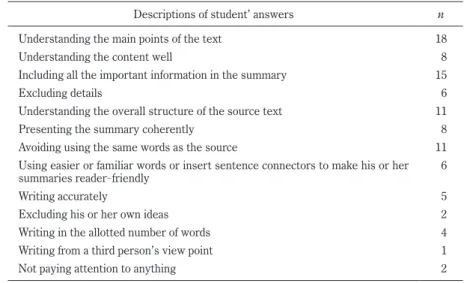
Table 4 shows what students paid attention to in writing their summaries.
It should be noted that some students gave multiple answers which were cate- gorized into different groups, so the total number of answers to this question exceeds the number of students. Many students attempted to understand the
Table 3 Average ratings for three broader bands of copy rate
Copy Rate 0-20% 21-50% 51-100%
Sample number 27 29 25
EV1 (Grammar) 4.4 6.1 6.8
EV2 (Content) 6.6 7.0 5.6
EV3 (Holistic) 7.0 7.4 7.4
Table 4 What students paid particular attention to in writing their summary
Descriptions of student’ answers n
Understanding the main points of the text 18
Understanding the content well 8
Including all the important information in the summary 15
Excluding details 6
Understanding the overall structure of the source text 11
Presenting the summary coherently 8
Avoiding using the same words as the source 11
Using easier or familiar words or insert sentence connectors to make his or her
summaries reader-friendly 6
Writing accurately 5
Excluding his or her own ideas 2
Writing in the allotted number of words 4
Writing from a third person’s view point 1
Not paying attention to anything 2
main points (n=18, 22%), or content of the source text (n=8, 10%), to select important information (n=15, 19%) or to exclude details (n=6, 7%), and to pay attention to the overall structure (n=11, 14%) or to present it coherently (n=8, 10%). While some students paid attention to paraphrasing, some of them attempted to do so in order to avoid copying (n=11, 14%) and some in order to make it easier for readers to understand (n=6, 7%).
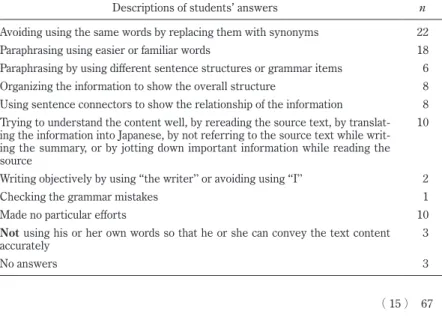
Table 5 reveals what efforts students made in order to explain the content in their own words, including whether they made such efforts or not. Many students tried to paraphrase the expressions by using synonyms (n=22, 27%), by using easier or familiar words (n=18, 22%), or by using different structures or grammar items (n=6, 7%). Some tried to show the overall structures (n=8, 10%) or relationship of the information (n=8, 10%). Some tried to un- derstand the content better, using various techniques such as rereading, trans- lating, annotating, or avoid looking at the source text (n=10, 12%). On the other hand, some students did not make any efforts to write their summaries in their own words (n=10, 12%) and 3 students (4%) answered that they tried
Table 5 Efforts students made in order to explain the content in their own words
Descriptions of students’ answers n
Avoiding using the same words by replacing them with synonyms 22
Paraphrasing using easier or familiar words 18
Paraphrasing by using different sentence structures or grammar items 6
Organizing the information to show the overall structure 8
Using sentence connectors to show the relationship of the information 8 Trying to understand the content well, by rereading the source text, by translat- ing the information into Japanese, by not referring to the source text while writ- ing the summary, or by jotting down important information while reading the source
10
Writing objectively by using “the writer” or avoiding using “I” 2
Checking the grammar mistakes 1
Made no particular efforts 10
Not using his or her own words so that he or she can convey the text content
accurately 3
No answers 3
not to use their own words on purpose.
According to Table 6, 62 students (77%) reported that they had written their summaries by referring to the source text, with 19 students (23%) claim- ing they did not refer to the source or only did so rarely. A comparison of copy rates between students who referred to the source while writing their summaries and those who did not shows that the average copy rate of students who used a referring-text strategy is 44%, while that of students who used a referring-memory strategy is 17% [t (62)=5.6, p<.01, r=.58].
Discussion
In this section, study results are discussed in accordance with research questions (a)-(d). Regarding research question (a), whether Japanese stu- dents copy verbatim from the source text even after they learned that English summaries should be written in the writer’s own words, the findings suggest it depends on individual students. The text analysis demonstrates a wide vari- ance in copy rate from zero to 100%. While some students successfully avoided copying, some borrowed expressions from the source text in different degrees. If we refer to the comparison of the copy rates between the refer- ring-text and referring-memory groups, the lower percentages of copying by the referring-memory group suggest that advising students not to look at the text while summarizing is effective as a copy-avoiding strategy. However, this may not necessarily lead to a better performance in their summaries as discussed below.
Regarding research question (b), what effects copying has on students’
summary performance, correlations of copy rate and different kinds of summa- Table 6 Whether or not students looked
at the source text while writing a summary
Yes 77% (n = 62)
No or rarely 23% (n = 19)
ry evaluations suggest that the more students copied from the source, the bet- ter they were able to write their summaries in terms of language accuracy (Evaluation 1), which in turn may have contributed to higher holistic evalua- tions of their summaries (Evaluation 3). The scores in the holistic ratings be- tween the lowest and the highest groups in Table 3, however, may also suggest that the students in the lower accuracy bands were able to utilize some strate- gies to produce acceptable summaries with less verbatim copying than the oth- er groups. From a pedagogic perspective, these results might also indicate that although the students’ language inaccuracy may simply be part of their L2 development, many attempted to follow the requirements of appropriate bor- rowing from the source by minimizing copying. This may further suggest that the principles of western task representations of summarizing do not in- herently present a conceptual or cultural barrier for the students.
The answer to research question (c), what Japanese students’ task repre- sentations of “summarizing” are, can be inferred from their answers to Q1 (Ta- ble 4), which asked what Japanese students paid particular attention to in writ- ing their summaries. Though what they think they did may not always show what they actually did, we can at least gain insight into what they consciously did in writing their summaries. As Tables 4 indicates, students’ answers to this question vary from individual to individual. While some students paid at- tention to individual words or expressions, others focused on the holistic struc- ture of the text. Similar variation can be seen as some students attended to understanding the content, with others choosing to place priority on paraphras- ing the source text. Finally, some paraphrased in order to avoid using the same words while some students did so in order to make it more reader- friendly. These contrasts in the students’ answers may reveal a diversity of representations regarding “summarizing.” It should be noted that “writing in the writer’s own words” was included in some students’ task representations of “summarizing” but not in others’.
Regarding research question (d), what Japanese university students’ task representations of “writing in the writer’s own words” are, we can infer their views from answers to Q2 (Table 5). It should be pointed out that answers to
this question may or may not overlap with students’ answers to Q1. Stu- dents’ answers to Q2 reveal what they consciously did in order to use their own words even though they did not prioritize it in writing their summaries.
Students gave various answers to this question, which may suggest a wide variation in students’ task representations of “writing in the writer’s own words.” However, to many students “writing in the writer’s own words”
means changing the language forms by replacing words with synonyms. In addition, some students did not attempt to use their own words so that they could present the source content faithfully. On the other hand, some students showed sophisticated interpretation of “writing in the writer’s own words.”
For example, words were changed to easier or more familiar words, which can be interpreted as an act of considering the reader, which is different from me- chanically replacing words with synonyms. In other cases, certain rhetorical organization or sentence connectors were used, which can be interpreted as an act of presenting the writer’s understanding of the overall structure or the re- lationship between pieces of information. Finally, some students made an ef- fort to understand the source text better by employing various strategies. In order to write in their own words, these students forced themselves to search for deeper understanding of the source text, which may be in accordance with what is suggested in Kennedy and Smith (2006), Howard (2010), and Hunter (as cited in Yamada, K., 2003).
Conclusion
The purpose of this study was to analyze Japanese university students’
English summaries and explore their task representations as a possible source of plagiarism. We began with a review of literature in English-speaking coun- tries and in Japan that revealed an important difference. While university textbooks and research articles in English-speaking countries unanimously emphasize the importance of writing a summary “in the writer’s own words”, those in Japan rarely did.
This led us to conduct an analysis of students’ summary samples and sur-
vey answers regarding their representations of “summary writing” and “writ- ing in the writer’s own words.” Text analysis revealed that copy rates varied between individual students and that some Japanese students tended to de- pend on source text expressions excessively. If we use Keck’s taxonomy of paraphrase type (Keck, 2014), the average of 38% of overlap falls into Minimal Revision and the average number of words per copied string of 8.6 falls into Near Copy (p. 9), which tends to be judged as plagiarism in English-speaking countries (Keck, 2010, p. 213). The specific reasons for the dependency were not identified in the current research. However, the relationships between copy rate and evaluation scores provide insight into a possible reason : copying can help students avoid language errors, which in turn helps them gain better evaluations. Considering that they have rarely been penalized for borrowing expressions in writing Japanese summaries, it is natural for them to depend on the source text for English expressions. On the other hand, we should not forget that a third of the students produced summaries free from copying.
Survey results also show what Japanese students paid conscious attention to in writing their summaries, what “writing in the writer’s own words” meant to them, and whether they referred to the source text in writing their summaries. Quite naturally, there were notable differences in the students’
thoughts and choices, some of which are in accordance with what is expected in summary writing in English-speaking countries while others deviate from those standards which may, as a result, lead to inappropriate language borrow- ing.
Some limitations must be noted in interpreting the results of the analysis.
First, participants in this study were told that English summaries should be written in the writer’s own words before they wrote their summaries. There- fore, they may not be representative samples of Japanese university students.
This kind of explicit explanation is rarely given in Japan. Additionally, this prior explanation may have influenced the students’ task representations of summarizing. However, due to the explanation, we were able to elicit how Japanese university students would interpret “writing in the writer’s own words” when they were told to do so. Second, the participants were allowed
to use whatever dictionaries they might have had in order to reduce difficulties.
However, dictionaries may have influenced their performance and caused un- expected variability. Third, we can only infer students’ task representations of “summarizing” and “writing in the writer’s own words” from answers to the open-ended questions. This type of questioning can only elicit students’ im- pressions of their behavior. As such, actual choices and actions during the writing process may not be accurately reflected in their answers.
Despite these limitations, this study is valuable because Japanese stu- dents’ summary performance and their task representations of summarizing have rarely been explored or reported in previous research and because it may explain Japanese students’ inadvertent plagiarism. The causes of ESL stu- dents’ copying have been discussed among researchers from the viewpoint of plagiarism and so far various factors have been identified such as students’ lack of language proficiency (Keck, 2006), cultural values (Bloch, 2008), and educa- tional background (Pennycook, 1996 ; Shi, 2006). However, the possibility of copying caused from task representations of summarizing has not been consid- ered in previous research. Wheeler (2014) presented empirical data which show Japanese students’ representations of plagiarism and argues against cul- ture as a major cause of plagiarism. Our contention is that Japanese students’
plagiarism occurs inadvertently as a side-effect of their task representations of English summary writing. Our empirical data show a wide variation in our students’ task representations and performance in summary writing. We be- lieve that the data combined with the findings from the literature review sup- port the assertion that faulty task representations of “summarizing” and/or
“writing in the writer’s own words” may result in language borrowing that is perceived as ‘in appropriate’ by English teachers following western educational norms. Even students who use their own words in expressing their own ide- as may borrow the source author’s words in summarizing a text written by someone else, as shown in Shi (2004). Because summary writing is a unique task where reading and writing meet and the source author’s words and the summary writer’s words also come together, summary writers are faced with various choices such as the following. Whose voice should be given promi-
nence, the source author’s or the summary writer’s? Which should be given higher priority, accurate reporting of the source information or summary writ- er’s interpretations of the source information? Thus, summary writers may create various representations of the task.
A pedagogical implication that can be drawn from this study is that in- structors should make efforts to clarify what they see as appropriate represen- tations of a summary task for their students. One way to do so is to give clear, focused explanations of what summarization in English entails, what pro- cedures students are expected to follow in a summary task, and why it is im- portant to use their own words in writing an English summary. Another way is to place a summary task in a specific context. In writing with citations, which is a typical task in academic writing, summarization skills are used to in- troduce other sources with the view of constructing the writer’s own argument (e.g., Show & Pecorari, 2013, p. A2). In this context, it may be easier for the instructor to persuade students that they should internalize the content of the source texts fully so that they can explain it with words of their own.
Hirvela and Du (2013) emphasize the importance of writing in the writer’s own words by stating that students need to exhibit “the ability to find a new way to capture the gist of what was stated in the original passage” so that they can be accepted as a member of an academic community (p. 88). Though writing a summary in the writer’s own words is considered very important in academic communities in English-speaking countries, it is not always commu- nicated to EFL students such as Japanese university students. In addition, it is a concept difficult to understand and implement. If students are told to avoid copying, some may place highest priority on changing the language form rather than trying to understand the content thoroughly. Even if instructors use creative methods to help students avoid copying as shown in Kennedy and Smith (2006) or Howard (2010), they may not feel the necessity of using such methods since they have been successful in the past with the “copy-delete”
strategy (Brown & Day, 1983, p. 13). Therefore, some incentives or punish- ments should be used to encourage students to reject the strategy. One vehi- cle to accomplish this goal is to offer students specific evaluation criteria for
summary tasks, with particular attention given to alternatives to direct or indi- rect copying.
Acknowledgement
Some data from this research were presented at Symposium on Second Language Writing which was held at Arizona State University on October 20- 22, 2016. We are grateful for valuable comments from anonymous reviewers.
References
Axelrod, R.B., Cooper, C.R., & Warriner, A.M. (2008). Reading critically writing well : A reader and guide (8th ed.), New York, NY : Bedford/ St. Martin’s.
Basham, C., Ray, R., & Whalley, E. (1993). Cross-cultural perspectives on task represen- tation in reading to write. In J.G. Carson, & I. Leki (Eds), Reading in the composi- tion classroom : Second language perspective (pp. 299-314). Boston, MA : Heinle
& Heinle.
Bloch, J. (2008). Plagiarism across cultures : Is there a difference? In C. Eisner & M.
Vicinus (Eds), Originality, imitation, and plagiarism : Teaching writing in the digital age (pp. 219-230). Ann Arbor, MI : The University of Michigan Press.
Brown, A.L., & Day, J.D. (1983). Macrorules for summarizing texts : The development of expertise. Journal of Verbal Learning and Verbal Behavior, 22, 1-14.
Callaghan, P., & Dobyns, A. (2007). A meeting of minds : strategies for academic inquiry and writing (2nd ed.). New York : Pearson Education.
Carson, J.G., & Leki, I. (1993). Reading in the composition classroom : Second language perspective (pp. 299-314). Boston, MA : Heinle & Heinle.
Cimasko, T. (2014, September 2). Purdue OWL : Paraphrasing and summary. Retrieved from https://owl.english.purdue.edu/owl/resource/976/01/
Drum, A. (1986). Responding to plagiarism. College Composition and Communication, 37(2), 241-243.
Flower, L., Stein, V., Ackerman, J., Kantz, M.J., McCormick, K., & Peck, W.C. (1990).
Reading-to-write : Exploring a cognitive and social process. New York, NY : Oxford University Press.
Hidi, S., & Anderson, V. (1986). Producing written summaries : Task demands, cognitive operations, and implications for instruction. Review of Educational Research, 56(4), 473-493.
Hirvela, A., & Du, Q. (2013). “Why am I paraphrasing?” : Undergraduate ESL writers’
engagement with source-based academic writing and reading. Journal of English for Academic Purposes, 12, 87-98.
Howard, R.M. (2010). Writing matters : A handbook for writing and research. New York, NY : McGraw-Hill.
Jones, A.M., & Mayes, P. (1990). An analysis of summary protocols of university ESL students. Applied Linguistics, 11(3), 253-271.
Karbalaei, A., & Amoli, F.A. (2011). The effect of paraphrasing strategy training on the reading comprehension of college students at the undergraduate level. Asian EFL Journal, 13(3), 229-244.
Katims, D.S., & Harris, S. (1997). Improving the reading comprehension of middle school students in inclusive classrooms. Journal of Adolescent & Adult Literacy, 41(2), 116-123
Keck, C. (2006). The use of paraphrase in summary writing : A comparison of L1 and L2 writers. Journal of Second Language Writing, 15, 261-278.
Keck, C. (2010). How do university students attempt to avoid plagiarism?: A grammati- cal analysis of undergraduate paraphrasing strategies. Writing & Pedagogy, 2(2), 193-222.
Keck, C. (2014). Copying, paraphrasing, and academic writing development : A re-exam- ination of L1 and L2 summarization practices. Journal of Second Language Writing, 25, 4-22.
Kennedy, M.L., & Smith, H.M. (2006). Reading and writing in the academic community (3rd ed.). New Jersey, NJ : Pearson Prentice Hall.
Kirkland, M.R., & Saunders, M.A. (1991). Maximizing student performance in summary writing : Managing cognitive load. TESOL Quarterly, 25(1), 105-121.
Machida, Y. (2008). Examination of tendency in university student’s summary production.
Annual Bulletin : Graduate School of Education : Tohoku University, 57(1), 241-252.
McDonough, K., Crawford, W.J., & Vleeschauwer, J.D. (2014). Summary writing in a Thai EFL university context. Journal of Second Language Writing, 24, 20-32.
McNamara, D.S. (2004). SERT : Self-explanation reading training. Discourse Processes, 38, 1-30.
Ministry of Education a. (1999). Syogakko Gakusyu Shido Yoryo Kaisetsu Kokugohen [A supplement to the course of study for elementary schools : Japanese language].
Tokyo, Japan : Toyokan.
Ministry of Education b. (1999). Cyugakko Gakusyu Shido Yoryo Kaisetsu Kokugohen [A supplement to the course of study for middle schools : Japanese language]. To- kyo, Japan : Tokyo Shoseki.
MEXT (2010) Kotogakko Gakusyu Shido Yoryo Kaisetsu Kokugohen [A supplement to the course of study for high schools : Japanese language]. Retrieved from http://www.
mext.go.jp/component/a_menu/education/micro_detail/_icsFiles/afieldfile/2010/
12/28/1282000_02.pdf
Muramoto, T. (1992). The variety of summaries : Strategies of summary production and the goodness of summaries. Japanese Journal of Educational Psychology, 40, 213- 223.
Pennycook, A. (1996). Borrowing others’ words : Text, ownership, memory, and plagiarism. TESOL Quarterly, 30, 201-230.
Sakuma, M. (1994). Yoyakubun no Hyogenruikei : Nihongo Kyoiku to Kokugo Kyoiku nota- meni [Patterns of summaries : For Japanese education as L1 and L2]. Tokyo, Japan : Hitsuji Shobo.
Sarig, G. (1993). Composing a study-summary : A reading/ writing encounter. In J.G.
Carson & I. Leki (Eds.), Reading in the composition classroom : Second language perspective (pp. 161-182). Boston, MA : Heinle and Heinle.
Shaw, P., & Pecorari, D. (2013). Source use in academic writing : An introduction to the special issue. Journal of English for Academic Purposes, 12, A1-A3.
Shi, L. (2004). Textual borrowing in second-language writing. Written Communication, 21, 171-200.
Shi, L. (2006). Cultural backgrounds and textual appropriation. Language Awareness, 15, 264-282.
Yamada, A. (1997). Dokkai Niokeru Nihongo Bogowashato Nihongo Gakushusha No Yoyaku Katei [Summarization process in reading by Japanese native and non-native learners]. The Chugoku-Shikoku Kyoiku Gakkai Kyouikugaku Kennkyu Kiyo [Bul- letin of the Chugoku-Shikoku Society for the Study of Education], 43(2), 441-446.
Yamada, K. (2003). What prevents ESL/EFL writers from avoiding plagiarism?: Analyses of 10 North-American college students. System, 31, 247-258.
Wheeler, G. (2014). Culture of minimal influence : A study of Japanese university stu- dents’ attitudes toward plagiarism. International Journal of Educational Integrity 10(2), 44-59.
Appendix A
Textbooks and online sources on academic writing in English speaking countries reviewed in the current study
Axelrod, R.B., Cooper, C.R., & Warriner, A.M. (2008). Reading critically writing well : A reader and guide (8th ed.). Boston, MA : Bedfort/St. Martin’s.
Bauer-Ramazani, C. (2006). Guideline for writing a summary with in-text citations. Re- trieved from http://academics.smcvt.edu/cbauer-ramazani/AEP/EN104/summary.
htm
Bazerman, C. (1995). The informed writer : Using sources in the disciplines (5th ed.).
Boston, MA : Houghton Mifflin.
Behrens, L., & Rosen, L.J. (2005). Writing and reading across the curriculum (9th ed.).
New York : Pearson/ Longman.
Callaghan, P., & Dobyns, A. (2007). A meeting of minds : strategies for academic inquiry and writing (2nd ed.). New York : Pearson Education.
Discoll, D.L., & Brizee, A. (2013, February 15). Purdue OWL : Quoting, paraphrasing, and summarizing. Retrieved from https://owl.english.purdue.edu/owl/resource/
563/1/
Freeman, L. (2012). Reading to write : Summarizing. Retrieved from http://www.writ ing.utoronto.ca/advice/reading-and-researching/summarize
Harvard guide to using sources. (n.d.). Summarizing, paraphrasing, and quoting. Re- trieved from http://isites.harvard.edu/icb/icb.do?keyword=k70847&pageid=icb.
page350378
Howard, R.M. (2010). Writing matters. New York, NY : McGraw Hill.
Jamieson, S. (1999). Resources for writers : Summary writing. Retrieved from http://
users.drew.edu/~sjamieso/summary.html
Kennedy, M.L., & Smith, H.M. (2006). Reading and writing in the academic community (3rd ed.). New Jersey, NJ : Pearson Prentice Hall.
Reiking, J.A., & von der Osten, R. (2005). Strategies for successful writing : A rhetoric, re- search guide, reader, and handbook (7th ed.). Upper Saddle River, NJ : Pearson.
Spatt, B. (2011). Writing from sources (8th ed.). Boston, MA : Bedford/St. Martin’s.
The Odegaard Writing & Research Center (n.d.). How to write a summary. Re- trieved from https://depts.washington.edu/owrc/Handouts/How%20to%20 Write%20a%20Summary.pdf
University of Southern Mississippi, University Libraries. (n.d.). How to avoid plagiarism : Paraphrasing and summarizing. Retrieved from http://www.lib.usm.
edu/legacy/plag/paraphrasing.php
Appendix B
Japanese textbooks on academic writing reviewed in the current study Ando, K. (1999). Wakariyasui Ronbun Repoto no Kakikata [How to write an academic pa-
per that is easy to understand]. Tokyo, Japan : Jitsugyo no Nihonsha.
Hamada, M., Hirao, T., & Yui, K. (1997). Daigakusei to Ryugakusei notameno Ronbun workbook [Workbook on academic papers for Japanese university students as L1 and L2]. Tokyo, Japan : Kiroshio Shuppan.
Hosaka, H. (1978). Ropoto Shoronbun Sotsuron no Kakikata [How to write an academic paper, an academic essay, & a graduate thesis]. Tokyo, Japan : Kodansha.
Kinoshita, K. (1994). Repoto no Kumitatekata [How to construct an academic paper].
Tokyo, Japan : Chikuma Shobo.
Kono, T. (2002). Ropoto Ronbun no Kakikata Nyumon [Introduction to academic writing].
Tokyo, Japan. Keio Gijuku Daigaku Shuppankai.
Sasaki, K. (2014). Ronbun Zeminaru [Seminar on academic writing]. Tokyo, Japan : Tokyo, Japan : Daigaku Syuppankai.
Shirai, T. & Takahashi, I. (2013). Yokowakaru Sotsuron no Kakikata [How to write a grad- uate thesis that is easy to understand]. Kyoto, Japan : Mineruba Shobo.
Takigawa, Y. (2014). Sotsugyo ronbun Shushi ronbun sakuseino Yotenseiri Jissen Manual [Practical manual that summarizes essentials in writing a senior paper and a master thesis]. Tokyo, Japan : Zeimu Keiri Kyokai.
Yamauchi, H. (2013). Kopipe to iwarenai repoto no kakikata kyoshitsu : 3 steps [3 steps to avoid copy & paste in write an academic paper]. Tokyo, Japan : Shinyosha.
Yoshida, K. (1997). Daigakusei to Daigakuinsei notameno repoto ronbun no kakikata [How to write an academic paper for undergraduate and graduate students] (2nd ed.). To- kyo, Japan : Nakanishiya Shuppan.