INVITED SURVEY PAPER
A Survey of the Research on Future Internet and Network Architectures
Toru HASEGAWA†∗a),Senior Member
SUMMARY The Internet was designed for academic use more than 40 years ago. After having been used commercially, many unpredictable re- quirements have emerged, including mobility, security and content distribu- tion. In addition, the Internet has become so ossified that fulfilling new re- quirements is difficult. Instead of developing ad-hoc solutions, re-designing clean-slate Internet architectures has become a key research challenge in networking communities. This survey paper addresses key research issues and then introduces ongoing research projects from Japan, the United States and the European Union.
key words: New Generation Network, future Internet, clean-slate design
1. Introduction
The Internet, originating fromAdvanced Research Projects Agency Network(ARPANET), was born about 40 years ago.
TheNetwork Control Programof ARPANET was replaced withTCP/IPprotocol suites in 1983 and then the Internet, which was originally used as an academic network, was commercialized in 1988. The Internet has been so success- ful that a number of applications includingWeb,Voice over IP(VoIP), and streaming have been deployed over it.
Despite the success, the current Internet is soossified as not to be able to keep up with current and future require- ments. The ossification of the Internet is criticized from many aspects. First,the end-to-end principle, which is one of the most important design principles of the current In- ternet, might not hold [1] because the increasing processing speed and memory space of routers’ hardware would en- able nodes in the Internet to do more than just forwarding packets. Second, many new network functions proposed to fulfill requirements from new applications are not widely (commercially) deployed over the Internet because they re- quire changes in routers and host software. Such network function examples include mobility and multicast. Third, since security was not originally built in, the Internet has suffered from various security attacks such asDenial of Ser- vice(DoS) attacks and computer viruses.
About 10 years ago, [1] proposed a rethink of the Internet architecture from the ground up. Researchers in networking communities have come to re-think and re- invent the Internet architecture to overcome the ossifica- tion.Clean-slatearchitecture designs have been proposed to
Manuscript received August 13, 2012.
Manuscript revised January 30, 2013.
†The author was with KDDI R&D Labs. Inc., Fujimino-shi, 356-0003 Japan.
∗Presently, with Osaka University, Suita-shi, 565-0871 Japan.
a) E-mail: [email protected] DOI: 10.1587/transcom.E96.B.1385
build the future Internet. TheNational Science Foundation (NSF) in the United States started a research program called as Future Internet Design(FIND) [2] to fund architectural projects related to clean-slate solutions. Besides NSF started a testbed initiative for validating new architectures called GENI (Global Environment for Network Innovations) [3].
These programs motivated communities in other countries and regions and research projects have started under theNew Generation Networkprogram [4], [5] of Japan and the 7th Framework Program of the European Union.
Most programs ask the research communities to con- sider what the requirements should be for a future network in 15 years’ time as the FIND program does. The question is “how would we build such a network if we were not con- strained by the current Internet — if we could design it from scratch. (Cited from [2])”. At the initial phase, many topics have been studied across the broad areas of network archi- tectures, principles, mechanism designs and so forth.
The research topics include principles of rethinking the narrow waist, new architectures including theContent Cen- tric Networking (CCN) and service centric architectures, integration of mobility/security/management functions that were not originally built into the Internet, experimental testbeds and network virtualization as their base technology and network science foundation for future Internet/network architectures.
After the initial phase when each research topic was undertaken independently, large-scale research projects that focus on total architectures have come to be funded. The Future Internet Architecture (FIA) program [6] of NSF is such a funding program and the four large projects includ- ingNDN[7],MobilityFirst[8],NEBULA[9] andXIA[10]–
[12] are on-going. In Japan, the multi-institutional project AKARI [13] is developing an initial specification [14] for achieving the New Generation Network. In the European Union, many projects including4 WARD[15] andSAIL [16]
are on-going.
As researches on future network architectures have been progressing, international workshops focusing on them have been held.ReArch,VISA, FutureNet, NOMENandICN workshops are such examples. Articles on future Internet architectures [17]–[19] have been published by magazines.
Among them, [18] provides a series of survey articles and one of the articles [19] surveys the above research projects.
In Japan,IEICE has published the three special sections re- lated to the New Generation Network [20]–[22].
This paper surveys research challenges in terms of ar- Copyright c2013 The Institute of Electronics, Information and Communication Engineers
chitectures and protocols for the future Internet/ network architectures. (The words Internet and network are inter- changeably used in this paper.) The rest of paper is orga- nized as follows. Section 2 discusses the host and informa- tion centric models as the narrow waist of the future Internet.
In Sect. 3, the IP layer which is the core of internetworking is re-thought. Section 4 discusses theInformation Centric Networking(ICN) which proposes the narrow waist of nam- ing layer. Section 5 discusses mobility issues of the future Internet focusing on MobilityFirst project [8]. Section 6 dis- cuss security issues of the future networks. Sections 7 and 8 discuss network management functions and service cen- tric architectures focusing on how flexible new services are developed. In Sect. 9, network virtualization and its appli- cation to experimental testbeds are discussed. In Sect. 10, other issues including cloud networking architectures, net- work sciences and substrate technologies are briefly sum- marized.
2. Narrow Waist
The current Internet protocol stack has a layered architec- ture and resembles an hourglass. Its center is a universal network layer, i.e., theInternet Protocol(IP) layer, which implements the minimal functionality necessary for global interconnectivity. Some studies consider that the ossifica- tion of the Internet architecture, which does not support new applications well, originates from the current narrow waist of the IP layer [1], [23], [24]. [25] addresses the IP layer’s limitations in terms of flexibility in forwarding, data distri- bution and so forth. Having to introduce caches and proxies in the middle of the Internet is a limitation example. It pro- poses using HTTP because HTTP is a de-facto protocol for emerging content delivery services.
The narrow waist issue is related to drawbacks coming from location dependent IP addresses. The location depen- dency causes the IP layer to fail to build in mobility, multi- homing, multicast and security. There are two approaches that address this issue. The first approach is the loca- tor/identification separationscheme [26]–[33] which solves such drawbacks in the host-centric model which the current Internet adopts. The basic idea behind the separation is as follows: An IP address in the current Internet is used as a session identifier in TCP, as well as a locator for routing.
This coupling leads to problems. It breaches the indepen- dence between the layers. Mobility and multi-homing are not well supported because an IP address is bound to a phys- ical location.
The second approach is the information-centric model known asICN [34], [35],CCN [36] and theNamed Data Networking(NDN) [7]. (We call architectures based on the information-centric model ICN hereafter.) ICN proposes a different model that replaces where with what. In this model, named contents such as Web pages and videos are transferred to hosts requesting them. Content names do not have location information that would be required for end-to- end packet delivery. ICN takes a more general approach and
Fig. 1 Names, identifiers and locators of host and information centric models.
regards the naming layer as the narrow waist.
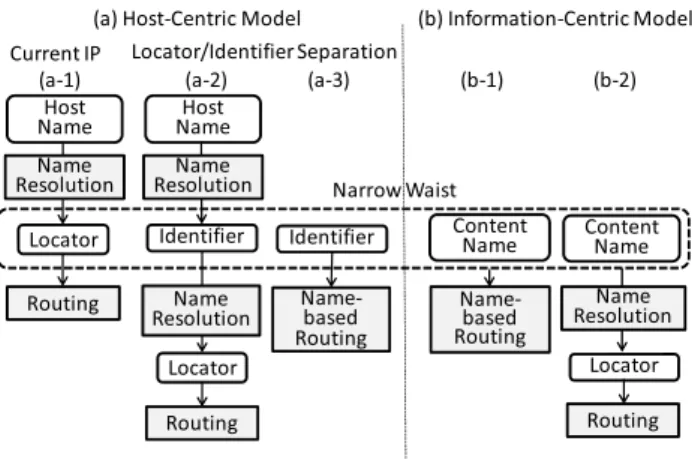
The narrow waits of host and information-centric mod- els correspond to the IP layer and the naming layer, respec- tively. Figure 1 shows how names, identifiers and locators are handled in the two models. In the current IP layer, a human-readable host name is resolved to an IP address as a locator byDomain Name System(DNS) and the IP layer delivers packets to the locator by the routing service (a-1).
In locator/identifier separation, a human-readable host name is resolved to a location independent identifier by a DNS-like name resolution system. Then the identifier is re- solved to the locator and the packet is routed based on the lo- cator (a-2). In some cases, a packet is directly routed based on the identifier itself. In this case, the identifier is not re- solved to the locator (a-3).
On the contrary, there are two approaches to forward- ing packets in the information-centric model. In the first approach, a packet is directly routed by the content name (b-1). (This is called name-based routing.) In the second approach, the content name is resolved to a locator and the locator is used by routing the packet.
Developing future networks based on the above ap- proaches raises various issues such as scalability, mobility and security. Sections 3 and 4 discuss scalability issues in the both models, respectively. Sections 5 and 6 discuss mo- bility and security issues, respectively.
3. Internetworking Architectures
3.1 Overview
This section addresses two challenges in the host-centric model. The first challenge is overcoming the location de- pendency of IP addresses. The second challenge is achiev- ing scalability and source routing that have not been well provided.
3.2 Locator/Identifier Separation
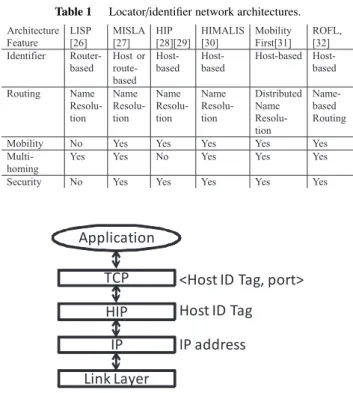
Table 1 summarizes locator/identifier separation network ar-
Table 1 Locator/identifier network architectures.
Fig. 2 HIP sublayer within the TCP/IP stack.
chitectures. The architectures are classified by how to assign an identifier to a host. A router-based scheme assigns an identifier that specifies a network endpoint though which a host is connected to the network [26], [27]. Identifiers can be aggregated to achieve scalability in routing; however, this causes this scheme fail to naturally support mobility [26].
On the contrary, host-based scheme [28]–[33] assigns a flat identifier that identifies the host. A flat identifier is usually a self-certifying address [37] and thus provides ac- countability. Accountability means that who (or which host) sent this packet is validated by un-forgeable ways. There are two approaches for forwarding packets as shown in Fig. 1 of Sect. 1: (a-2) name resolution and (a-3) name-based routing.
Routing based on flat identifiers is discussed in Sect. 3.3.2.
Table 1 also summarizes how mobility, multi-homing and security are supported by the individual architectures. In the rest of the section, individual architectures are described.
Since mobility and multi-homing are not built into the Internet, ad hoc solutions have been developed such asMo- bile IP[38] andShim6[39]. These solutions introduce shim layers between the IP and TCP layers instead of recreating the IP layer. Locator/identification separation proposes a more elegant solution by re-thinking the role of IP address.
The Host Identity Protocol(HIP) [28], [29] is an in- cremental solution and introduces HIP sublayer within the TCP/IP stack as illustrated in Fig. 2. HIP introduces a new namespace of identifiers calledHost Identity(HI). HI is a 128-bit long public key based value called Host ID Tag (HIT). HITs are translated into IP addresses in kernels of the host. HIP discovers and authenticates bindings between public keys and IP addresses. In order to support mobil- ity, rendezvous servers that map HITs to IP addresses are
Table 2 Proposals of routing protocol extension.
prepared. Before sending a packet, a host sends a request asking the current IP address of the mobile host to the ren- dezvous server. Thus HIP is based on an end-to-end ap- proach that does not require any change in routers.
Some proposals follow a core-edge separation ap- proach [26], [27] wherein the separation is achieved in routers instead of hosts. Despite Locator/Identifier Sepa- ration Protocol(LISP) [26] not introducing any changes to the stack of hosts, it does not support mobility due to their router-based identifiers.
Inspired by these anticipatory studies, many future In- ternet/network architectures have adopted locator/identifier separation using flat identifiers. There are two issues for im- plementing it. One issue is scalability in routing. Some stud- ies on name resolution [28]–[31] address how an identifier is mapped to a locator in a scalable manner. Since an identifier is defined in a flat name space, such flat name spaces make it difficult to establish a hierarchy in name spaces. On the con- trary, [32] proposes name-based routing without using name resolution. This issue is discussed in Sect. 3.3 and it is revis- ited in Sect. 5 since it is related to mobility support. Another issue is how the accountability of packets is achieved using public key based addresses as identifiers. The security issue is revisited in Sect. 6.
3.3 Routing
Scalable inter-domain routing is still a challenge for the cur- rent Internet as well as locator/identifier separation schemes.
First, in the workshop held in fall 2006 by theInternet Ar- chitecture Board (IAB), scalability and stability of routing in the Internet were discussed [40]. TheBorder Gateway Pro- tocol(BGP) [41], the de-facto inter-domain routing proto- col, suffers from many problems such as route oscillations, instabilities [42] and slow convergence [43]. In addition, BGP does not provide multi-path and user controlled rout- ing. Thus there are two series of researches addressing scal- ability [44], [45] and multi-path/user control source routing [46]–[48].
Second, although these studies focus on location de- pendent IP addresses, scalability is an important research issue for routing based on flat identifiers in locator/identifier separation schemes [32], [33]. The proposals for such rout- ing issues are summarized in Table 2.
3.3.1 Routing on Location Dependent IP Addresses Hybrid Link State Path-Vector(HLP) [44] is a step forward to re-think BGP. HLP assumes that routing events are prop-
Fig. 3 AS hierarchy in HLP.
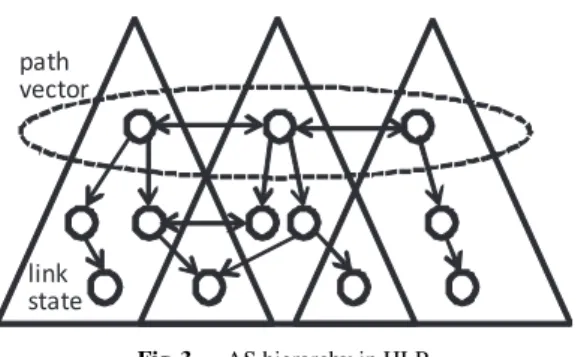
agated as Autonomous System (AS) path vectors to all ASes in BGP and this leads to poor scalability. Leveraging peer- ing, customer provider relationships between ASes, HLP proposes a hierarchical routing structure as shown in Fig. 3.
It is a hybrid link-state and path-vector protocol. The exper- iments show that HLP reduced the churn-rate of route up- dates by a factor 400 compared to that of BGP. (The churn rate is the rate of routing announcements received by a given router.) On the contrary, Routing Control Platform(RCP) [45] focuses oniBGPscalability, i.e., full-mesh communica- tion among iBGP routers, and proposes a centralized routing control. The main idea is separating the routing state from the routers and it introduces robustness, scalability speed and so forth.
Another important issue is tussles in the Internet [49].
Since the Internet has become an infrastructure of the soci- ety, different stakeholders participate in it. In some cases, stakeholders have different interests from each other and such a process is called a tussle. A typical example is a tussle between users’ requirements to control the end-to- end path and operators’ policies to optimize their networks.
Some studies [46]–[48] propose a source-controlled multi- path routing.
Pathletrouting [46] proposes a source-controlled mul- tipath routing. Networks, i.e. Autonomous Systems (ASes), advertise pathlets that are fragments of end-to-end paths along which they are willing to route. A sender concate- nates such pathlets into a full end-to-end source route. A pathlet is contained in each packet and routers forward the packet based on the pathlet and thus source-controlled mul- tipath routing is achieved.New Inter-domain Routing Archi- tecture(NIRA) [47] offers multiple paths, too, but it allows only valley-free [50] paths and has some assumptions about the network topology.
A project in NeTS FIND proposes a “PostModern In- ternet Architecture” [48] which addresses a tussle between users and operators at the IP layer. The key idea of this architecture is to separate the policy plane from the data plane. The IP layer is redesigned so that diverse func- tions can support diverse policies. This architecture adopts source-controlled routes as pathlet and NIRA do. Recently, the new projectChoiceNet[51] has been funded by the FIA program and it focuses on choices more generally than user controlled routing.
3.3.2 Routing on Flat Identifiers
The flat identifier raises a scalability issue because it causes routing protocols to fail to use the hierarchy of location de- pendent addresses which is used for achieving scalability in routing by current routing protocols such as BGP and OSPF.
The scalability has been addressed in both name reso- lution and name-based routing. First, many studies use cen- tral servers that map an identifier to a locator [26]–[30] such as LISP and HIP. HIMALIS uses a name resolution mecha- nism slightly different from the rendezvous servers of HIP.
Its name registries are organized in two groups to store static and dynamic mapping information separately so that it can facilitate faster name resolution as well as update of the dy- namic mapping records in the mapping registries.
Some studies [31] applyDistributed Hash Table (DHT) [52] to achieve distributed resolution.SEATTLE[53], which does not focus on location/identifier separation, provides name resolution from an IP address to a MAC address using DTH.DMap[31] provides a fast global dynamic name res- olution service based on DTH focusing mobility. This issue is revisited in Sect. 5.3.
On the contrary,Routing on Flat Labels (ROFL)[32]
applies DHT to a physical network rather than to an overlay network and routes a packet directly using a flat identifier.
It assigns identifiers to all hosts and routers and wraps these identifiers to create a circular name space as inChord[52].
However, such a DHT-based name routing suffers from the problem that the stretch, which is defined as the ratio of route length to the shortest path length, tends to become high. Achieving shorter stretches in the flat name space is still an open question. Some studies [33] address this issue by applying compact routing [54].
4. Information Centric Networking
4.1 Overview
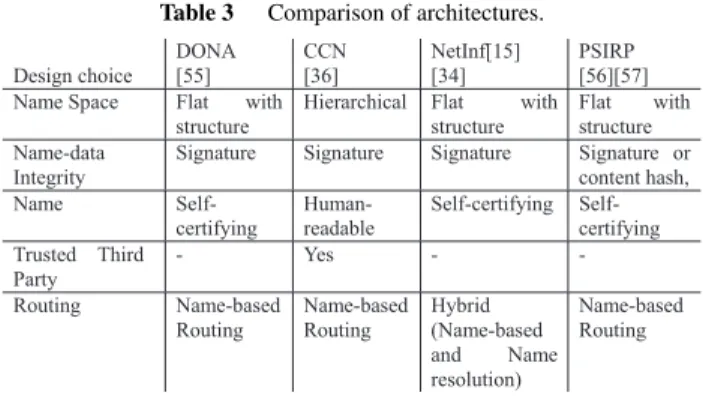
ICN architectures adopt a different model from the cur- rent host-centric model. It addresses location dependent addresses and content distribution dominant in future net- works. Table 3 summarizes the principal architectures such asData-Oriented Network Architecture (DONA)[55], CCN [36],NetInf [15], [34] andPSIRP/PURSUIT[56]–[58] from the design choices described in Sect. 4.3. After describing background and CCN as an ICN architecture example in Sects. 4.1 and 4.2, respectively, Sect. 4.3 describes the ar- chitectures in detail from the design choices.
4.2 Content Delivery
Although the primary usage of the Internet was host-to-host communication in the past, the Internet has come to be dom- inated by content distribution and retrieval. As incremental approaches, Content Delivery Networks(CDNs) andPeer- to-Peer(P2P) networks have become deployed widely. In
Table 3 Comparison of architectures.
a CDN network such as AKAMAI [59], contents such as images and videos are cached at thousands of edge servers around the world to improve performance. In a P2P network [60], peers (or hosts) share contents among themselves to mitigate the load on servers. Despite their success, they do not solve all problems due to their overlay approach. Over- lay networks have no controls of physical networks and thus inefficient usage network resources are quite often in many overlay networks.
ICN is proposed to natively support efficient content distribution. But it is more than that and it becomes a com- mon concept of several future Internet architectures.
4.3 Content Centric Networking (CCN)
In this section, CCN [36] is explained as reference archi- tecture. CCN is a proposal to switch from host-oriented to content-oriented networking to meet data-intensive applica- tion needs. This means that although in the current Internet, accessing content and services requires mapping from what users care about to the network, future network architectures take content as a primitive to decouple location from iden- tity, security and access, and retrieve content by name.
There are pioneering architectural studies includingi3 [61],TRIAD and DONA [55]. DONA proposes to replace DNS names with flat, self-certifying names [37] and a name based anycast primitive.
Inspired by the architectures, CCN [36] proposes that the narrow waist is changed from the IP layer to con- tent or data distribution, i.e., the name layer, as shown in Fig. 4. (CCN is the core concept of Named Data Networking (NDN) project [7] in the NeTS FIA project.) CCN adheres to the following principles.
(1) It adopts an hour glass architecture where the nar- row waist is content or naming layer as shown in Fig. 4.
(2) It builds security into the architecture despite the fact that the current Internet does not.
(3) It retains the end-to-end principle of the current In- ternet and expands this principle.
(4) It adopts routing and forwarding plane separation as many future Internet studies do.
The main difference from the host-to-host communi- cation of the current Internet is that the name of the con- tent (data) is used to specify the communicating entity. In-
Fig. 4 Hour glasses of the host and information-centric models.
Fig. 5 Forwarding process at a CCN node.
stead in the current Internet, the host that serves the content is specified. (Such host identifiers of the current Internet and HIP are the IP address and the Host ID Tag, respec- tively.) Thus communication in CCN is receiver-oriented as follows: To receive data, a receiver sends out anInterest packet, which carries a name that identifies the desired data.
A router remembers the interface from which the request comes in, and then forwards the Interest packet by look- ing up the name in itsForwarding Information Base(FIB).
Once the Interest reaches a node that has the requested data, a Data packet is sent back. CCN uses routing protocols similar to the current Internet, i.e., BGP and OSPF. Con- tent names are aggregated to prefixes and the prefixes are propagated to FIBs of CCN nodes by BGP and OSPF-like routing protocols.
As shown in Fig. 5, a CCN node (router) consists of Faces(Interfaces), FIB which is a name-based routing ta- ble,Pending Interest Table(PIT) which records tentatively Interest packets and Content store which caches contents.
This name and cache-based forwarding naturally supports multicast, mobility, multi-homing which are not inherently supported by the current Internet.
4.4 Design Choices
There are several important design choices of ICN.
(1) Naming Scheme
ICN gives contents (objects in ICN) unique names that are independent of locations and hosts. An important role is
to establish a verifiable binding between the content and its name so that a receiver can authenticate the content. The authenticity is beneficial to prevent Denial of Service (DoS) attacks.
Names play a crucial role in routing and thus names may reflect a hierarchical structure or include embedded lo- cation information in order to assist routing. Two naming schemes are proposed: the hierarchical name space [36] and the flat name space [34], [55]–[58] with the self-certifying name.
The hierarchical name space has a similar structure to currentUniform Resource Locators (URLs). A packet of CCN consist of the hierarchical name like a URL, the content and the digital signature information. It provides content-based security[62], which means that CCN authen- ticates the binding names and content by letting all contents have digital signatures based on public key cryptography.
COPSS[63] extends the CCN naming scheme to enable ef- ficient large-scale dissemination of contents.
The hierarchical name space has the following advan- tages over the (flat) self-certifying name. First, such names are human-readable. Second, they provide better routing scalability through name-prefix aggregation. On the con- trary, one drawback of adopting human-readable names is that the architectures should have a trusted third party like a PKI infrastructure.
The self-certifying name allows direct verification of the binding between the name and the content. [34], [55]–
[58] use the self-certifying name in the flat name space as the name of the information (content, data). For example, the name of DONA has the formP:Lwherein P is the glob- ally unique identifier that contains the cryptographic hash of the information owner’s (publisher’s) public key and L is the unique label of the information. Self-certification is achieved by binding the hash of content and its name (iden- tifier) and its benefit is that there is no need to have either a public key infrastructure or other trusted third parties.
Which one between the two approaches is better re- mains controversial [64]. [62] advocates the hierarchical name space claiming that flat/opaque names in the flat name space requires an indirection architecture similar to today’s DNS and that the location independent flat name makes it difficult to construct an efficient mechanism to retrieve a nearby copy of content. [64] compares the two name spaces and concludes that there would be no instinct differences be- tween them.
(2) Routing
Achieving scalability is an important issue in both name- based routing and name resolution. In name-based routing, nodes holding copies of named content are found to route request packets, i.e., Interest packets of CCN. In name reso- lution, a path from a requesting node to such nodes holding copies is found.
First, name-based routing is used both in a hierarchical name space like CCN and in a flat name space. In CCN, a requester asks for a content by sending Interest packets.
Interest packets are forwarded to upstream (CCN) nodes that hold a copy or an original of the content as shown in Fig. 5.
Names of contents can be aggregated as prefixes in a FIB.
However, the number of name prefixes would be far larger than that in the current BGP routing tables because the number of contents would be far larger than that of hosts.
This raises a scalability issue. Besides [65] shows that FIB lookup based on the longest-prefix matching of the name- based routing is the most critical bottleneck of CCN routers.
This is because CCN routers should look up content names in a huge FIB by longest prefix matching, which requires seeking the longest matching prefix through all candidate prefix lengths. [65] studies the feasibility of the Bloom filter based FIB for CCN routers and [66] proposes distributing a FIB to many line cards. Designing high performance CCN routers is still an open issue.
Second, name resolution used in a flat name space is similar to that of locator/identifier separation described in Sect. 3.3.2. In the flat name space, a content name need be mapped to a locator of the original content or locators of its copies. A name resolution service which stores binding from content (object) names to locations pointing to stor- ages containing copies or originals of contents is needed for obtaining the location (i.e., the IP address) of the self- certifying flat name. How scalability is achieved in name resolution is a challenge because hierarchy of names can- not be utilized. PRISP [56] uses a name resolution server called a rendezvous point. It adopts source routing using a Bloom filter. NetInf adopts a hybrid approach of name- based routing and name resolution. It proposes a distributed name resolution system calledMulti-level Distributed Hash Table(MDHT) [67] which provides a nested, hierarchical DHT for scalable distributed name resolution and efficient anycast routing.
(3) In-Network Cache
Nodes in ICN naturally support in-network storage to cache contents. Content is cached at nodes on a path from a re- questing host to nodes holding the content or its copies. On the contrary, nodes in ICN can cache contents on nodes that are not on such paths by announcing cached contents in a name-based routing protocol or a name resolutions service [15].
Although caching is an old issue, its reality in actual environments is a hot topic [68], [69] in ICN research. These studies show that the current router implementation tech- nology enables replacement of cached chunks at line speed.
Since the caching capacity is smaller than the amount of forwarded contents and central management of cache place- ment is not feasible, caching techniques in a decentralized manner has been drawing attention. Thebreadcrumbs[70], [71] propose an implicit, transparent, and best-effort ap- proach towards caching. A breadcrumb, which is a minimal piece of information, stores the direction in which a content was sent in the past, thus tying content routing with content location and caching. [72] focuses on caching chunks of a content. Some studies [73], [74] quantitatively analyze the
performances of caching techniques.
(4) Mobility
No session is established between hosts and no concept of session helps ICN build in mobility. Two types of mobility should be supported in ICN in the following way. Mobility of a client, i.e., a host requesting content, is naturally sup- ported [75]. Wherever the requesting host is, the requestor can access the content or its copy only by sending an In- terest packet. Mobility support requires scalability and re- sponsiveness in name-based routing and name resolution as described in (2) of this section. On the contrary, when con- tent moves, new routing information is propagated in name- based routing or a new locator is registered in a name resolu- tion server. NetInf addresses this mobility support for con- tent [76], but it is an open issue. For example, how mobility is supported to contents identified by hierarchical names is not well addressed.
(5) Other Issues
This subsection summarizes other issues including transport protocol, host-to-host communication and availability.
First, transport protocol functions including flow (con- gestion) control and reliability is different from end-to-end control of the host-centric model. ICN provides hop-by-hop congestion control based on interest packets.
[77], [78] propose link layer transport protocols im- plementing an additive increase and multiplicative decrease similar to TCP congestion control algorithms.
Second, how (conventional) host-to-host communica- tion is supported is an issue and [79] proposes a solution for VoIP (Voice-over IP). Third, there are still challenges about inter-domain routing [57] including routing policies [80] and incentives [81]. Fourth, availability issues, i.e., se- curity issues, have started to be addressed including cache pollution [82] and prefix hijack [83].
Finally, one study [68] is skeptical about the value of CCN. The two questions, “what benefits do we think ICN designs offer, and are ICN designs the best way to achieve those benefits?(cited from [68])” are raised.
5. Mobility
5.1 Overview
Mobility was not inherently built into the current Internet.
Locator/identifier separation schemes described in Sect. 3.2 and ICN described in Sect. 4 are candidate solutions and they naturally support mobility. Focusing on mobility sup- port in a locator/identification scheme, this section describes MobilityFirst, a well-known architecture which addresses many design issues while focus on mobility.
There are two research challenges. One research chal- lenge is scalability in identifier resolution mapping a host identifier to a (current) location. The current resolution techniques used by Mobile IP [38] and HIP [28] and dy- namic DNS [84] are not so scalable to be used in highly dy-
namic environments. Another challenge is mobility support in challenged networks.
5.2 Challenged Networks
Challenged network studies [85], [86] focus on networks where end-to-end connectivity is not assured, contrary to that the current Internet implicitly assumes that hosts are continuously connected. Examples of such networks in- clude wireless ad-hoc/sensor networks, vehicular networks, post-disaster networks [87] and so forth. Many future network architectures use techniques developed by chal- lenged network studies because accommodating vehicular networks and sensor networks is one of the future network objectives.
In challenged network environments, which are called as Delay Tolerant Network (DTN) environments, connec- tivity is intermittent due to node failures, mobility, limited powers, disconnected links and so forth. In DTN studies, the end-to-end principle is re-defined. The bundle layer [85], [88] is introduced to provide a store-and-forward service as an overlay [88]. When a DTN node receives (accepts) a bun- dle, it is responsible for delivering the bundle. Since bundles should be stored at nodes’ buffers until they are delivered to receiver hosts, they tend to be stored for a long time. The custody transferof bundle protocol lets the nodes delete (re- lease) the bundles from their buffers.
Routing in a DTN is an important research issue [89].
While routing in deterministic contexts where it is known beforehand when and where nodes or hosts contact each other is relatively easy, the routing under random conditions is difficult. Anepidemic routing[90] scheme is designed to forward bundles to all nodes except the one on which the message arrived. Please see the survey of routing protocols in DTNs [91].
5.3 MobilityFirst
Inspired by DTN, a network architecture based on the cache- and-forward paradigm, which is called Postcards from the edge[92], is proposed. This architecture is a transport layer solution that operates in a hop-by-hop store-and-forward manner with large files (chunks). It exploits the decreasing cost and increasing capacity of storage devices to provide unified and efficient transport services to hosts that may be wireless.
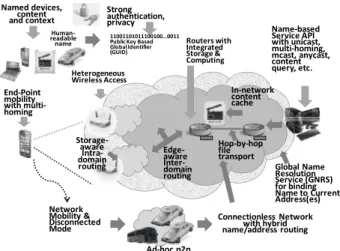
MobilityFirst[8], [93] is one of the network architec- tures that deals with many design issues while focusing on mobility. It is mainly inspired by the locator/identifier sep- aration scheme and the cache-and-forward paradigm. The design goals of MobilityFirst are mobilityas the norm with dynamic host and network mobility, robustness with respect to intrinsic properties of wireless medium, trustworthiness and privacy, usability features such as support for context- aware pervasive mobile services(cited from [93]).
It consists of key components as illustrated in Fig. 6.
Actually some of challenges such as scalability in name
Fig. 6 Architecture of MobilityFirst (cited from [8]).
resolution are similar to those of ICN described in Sect. 4.
MobilityFirst takes the locator/identifier separation scheme, wherein the host identifier is a self-certifying public key and the locator is a network address. A host identifier is a self- certifying public key network address that supports authen- tication and security. A key research challenge is the fast global dynamic name resolution service. DMap [31] dis- tributes names to address mappings among routers using an in-network single-hop hashing technique. [94] compares the performances of the name resolution of DMap with those of name based routing of CCN.
MobilityFirst provides generalized delay-tolerant rout- ing [95]. It proposes the concept of storage aware routing (STAR), which gives routers the option to temporarily store data as a routing decision. This implies that transport is con- ducted in a link-by-link fashion contrary to (conventional) end-to-end flow/retransmission controls in TCP [96]. This significantly decreases the role of the end-to-end control.
6. Security
6.1 Overview
The current Internet does not build in security and it suf- fers from source spoofing, denial-of-service, route hijack- ing, and route forgery. Thus most future network architec- tures take security as one of the goals. Table 4 summa- rizes approaches of the architectures. As shown in the ta- ble, although built-in security is a fundamental requirement to future networks, issues other than accountability are not enthusiastically studied. Some new future network archi- tectures such as MobilityFirst [8] and XIA [10] focus on trustworthiness in networks; however, trustworthy network research is still in an early stage.
6.2 Accountability
The current Internet is prone to various attacks includ- ing source spoofing, denial-of-service, route hijacking, and route forgery. The vulnerabilities are caused by the lack of
Table 4 Security approaches of network architectures.
Fig. 7 Structure of AIP address.
accountability. On the contrary, real-world security depends on accountability (imagine, if you will be in a world where all actions are anonymous(cited form [97]).)
Accountable Internet Protocol (AIP) [97] provides ac- countability as a first-order property and proposes a hierar- chy of self-certifying addresses like [37]. The AIP address is 160 bit long and includes this self-certifying address, i.e., a 144 bit public key hash as shown in Fig. 7. Such self- certifying addresses are assigned for both domains and hosts and they allow domains and hosts to prove they have the address they claim to have without any trusted third party.
And thus AIP follows the principle of locator/identifier sep- aration. [98] takes an incremental approach and uses only self-certifying AS identifier with the help ofDNSSEC.
Many new network architectures adopt accountability as one of their major design principles. The adoptions are classified into host-based identifiers and content-based iden- tifiers. In the host-centric model, an identifier of a host is a hash of host’s public key [8], [10], [27], [28], [30]–[32]. On the contrary, in the information-centric model, an identifier of the content is self-certified [15], [55]–[57]. An advantage of self-certifying addresses and identifiers is that there is no need of trusted third party like a PKI infrastructure. On the contrary, content-based security [36], [62] of CCN needs a trusted third party to let all contents have digintal signatures.
6.3 Privacy and Trustworthiness
Protecting privacy is an important research issue because fu- ture networks/Internet inherently support mobility in a wire- less environment as MobilityFirst [8] does. Although pro- tecting privacy is a design principle, there are not many stud- ies in this area. The main research motivation is that con- cealing endpoints’ information from all routers and hosts unless they need the information to perform their assigned network functions. A research project in NeTS FIND initia- tive [99] proposes a solution by using encrypted addresses.
Anonymity communication such as tor [100] is another so- lution. [101] proposes a lightweight anonymous commu- nication protocol and shows that it can be built into future network architectures.
6.4 Security Policy
Security policy management is studied in XIA [10] and Secure Architecture for the Networked Enterprise(SANE) [102]. SANE provides a centralized network security pol- icy management in an administrative domain. However, it focuses on enforcing security policies in an enterprise net- work and its control is strict. A SANE network consists of switches that are not capable of IP routing and all communi- cations between hosts in the SANE network are controlled by the domain controller. The domain controller constructs a spanning tree rooted at it. However, the scalability at the Internet scale is not well addressed in SANE.
7. Network Management
7.1 Overview
The Internet began with a few hundreds of nodes and has become a massive distributed system consisting of millions of nodes. Since management of such a large system is much more complex than the original Internet, a new management framework leveraging knowledge [103], self-management and evolvability are required.
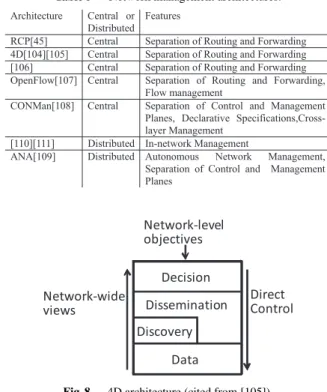
The complexity originates because forwarding, rout- ing control and management planes are tightly coupled in the current Internet and thus many studies re-consider net- work management architectures focusing on the complex- ity. Some network management architectures [45], [104]–
[107] focus on the separation of routing and forwarding, others [108], [109] focus on that of control and management planes. Some network architectures [45], [104]–[108] adopt a centralized approach and thus the scalability at the Internet scale is not still well addressed. Others [109]–[111] adopt a decentralized or autonomous approach. Table 5 summarizes the features of such network management architectures.
7.2 Routing Management
Routing in the current Internet is an important issue among many other issues including security, bootstrapping and fail- ure recovery. The problem originates because the Internet bundles control logic and packet handling into the individ- ual routers [45], [104]. For example, the path-computation logic is governed by distributed routing protocols. They let the routers learn about the topology as well as select paths.
Another example is load-balancing implemented by care- fully tuning OSPF link costs.
4Darchitecture [104], [105] proposes a clean slate ap- proach to data-network control and management, contrary to the current distributed routing control. It is based on three principles: Network level-objectivesare the goals or objec- tives for the network. For example, a reachability policy objective could be stated as “do not allow hosts in subnet B to access the accounting servers in subnet A.(cited from [104])” Anetwork-wide viewis a coherent snapshot of the
Table 5 Network management architectures.
Fig. 8 4D architecture (cited from [105]).
state of each network component. Direct controlmeans the ability to manage all states in the data plane so as to direct packet forwarding.
The control plane is decomposed to achieve the direct control as illustrated in Fig. 8. Thedissemination planepro- vides a robust and efficient communication substrate that connects routers and switches with decision elements. (In this sense, the control and data planes are independent like circuit switch networks.) The discovery plane discovers the physical components in the network and creates logi- cal identifiers to represent them. Replacing today’s manage- ment plane, thedecision planemakes operations in real time on a network-wide view and makes all decisions driving net- work control to achieve network-level objectives. Thedata planeis responsible for forwarding packets.
There are several studies that adopt a centralized solu- tion for routing management such as 4D. RCP [45] is simi- lar to the 4D architecture; however, it is incremental (back- wards compatible) and focuses on scalability in i-BGP full- meshes. [106] extends RCP and proposes a routing architec- ture wherein the routers act like forwarders while the routing computation is performed centrally.
7.3 Management Model
Complexity Oblivious Network Management (CONMan) [108] recognizes the complexity of the control and man- agement planes, too, and restructures them inspired by the 4D architectures’ discovery plane. Not restricting it to just routing management, CONMan provides self-configuration, abstraction, and declarative specification for more general network management. For example, self-configuration of
networks contributes to decreasing humans’ configuration errors because configuration errors are a major reason for IP backbone failures [112].
Thus in CONMan, protocols are abstracted as mod- ules and network configuration is represented by piping the modules so that the management plane can understand the potential of the underlying network and configure it with- out dealing with the details of the protocol/devices. CON- Man also covers important network design choices: declara- tive specifications for routing management [113], [114] and the database and interfaces for the cross-layer management [115].
[110], [111] propose an in-network management paradigm that builds management functions into the net- work and network elements. The goals are evolvability, self-management and so forth. Autonomous management enables management systems to be independent of any ex- ternal technical interference and do self-management.ANA [109] also proposes a generic architectural framework for autonomic systems composed of autonomic devices includ- ing autonomic network management.
7.4 Flow Management
Centralized management is the current trend of network management for enterprise, data center and Internet man- agement, too. Ope nFlow [107] takes a centralized approach by which a centralized controller manage all flows (paths) among all hosts in an administrative domain. Software De- fined Network(SDN) takes a similar approach to Ope nFlow.
Although many centralized solutions have been proposed, most solutions focus on routing/path management in a single administrative domain. Thus studies on other management functions in interdomain environments are desired.
8. Service Centric Architecture
8.1 Overview
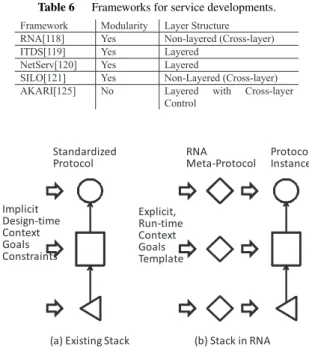
In the 1970’s, one goal of the Internet was to have a sim- ple packet-switched communication and the end-to-end ar- gument has dominated the current Internet design. The In- ternet itself is kept simple and most of the complexity is implemented on end-systems. However, although commer- cialization of the Internet introduces diverse service require- ments, the end-to-end design lacks flexibility to adapt to new service requirements [1]. Inspired by this discussion, skep- ticism has been raised regarding protocol implementations based on the layered architecture. Thus frameworks for flex- ibly implementing end systems and services have been pro- posed. These frameworks raise issues of modularity and a layer structure to achieve the flexibility. Table 6 summarizes the approaches to the two issues adopted by the frameworks.
8.2 Modularity
Modular implementation is a solution for achieving the flex-
Table 6 Frameworks for service developments.
Fig. 9 Existing stack and stack in RNA (cited from [118]).
ibility and thus modular frameworks supporting protocol implementations based on the layered structure have been studied such as x-Kernel[116] and theClick router [117].
On the contrary, addressing the ossification caused by the layered architecture, many network architectures propose a modular framework for providing a new service and a new protocol stack in a flexible way, avoiding the ossification of the current Internet, mapping service requirements to low layer protocol implementations and so forth. The basic idea of the architectures is how a service is formed by combining elementary blocks in a network.
RNA[118] supports non-layered protocol implementa- tions contrary to [116], [117]. It is a framework wherein protocols may be dynamically composed depending on the context relative to the layers below and above. The idea is to provide a meta-protocol, i.e., a single protocol that is instan- tiated and customized at different layers of a protocol stack as illustrated in Fig. 9.
Several service centric frameworks [119]–[121] are proposed to flexibly develop a service using building blocks, too. [119] defines a service architecture, calledInformation Transfer and Data Service (ITDS), which bases communica- tion abstractions on the transfer of information rather than the process of sending data(cited from [119]). The separa- tion of communication and processing enables to provide various information transfer patterns. ITDS uses router- based functionality to implement services on nodes in the network. The key idea is to help nodes decide where to as- sign the processing task across them in the network.
NetServ[120] proposes a modular framework wherein functions and resources on a node are divided into reusable building blocks.
SILO [121] proposes a service-oriented architecture aiming at a non-layered approac. The fundamental build-
ing blocks are services. A service is a self-contained oper- ation that is relevant to a specific communication task such as packet fragmentation and encryption. SILO allows any set of services to be selected dynamically for a task contrary to that the existing frameworks [116] for realizing protocols take the layered approach.
8.3 Cross-Layer Design
The above frameworks adopt modular building blocks to provide flexibility and some [118], [121] adopt a non- layered structure that enables cross-layer design. In wireless networks, protocols according to the layered architectures may not always provide good performance due to the highly variable nature of wireless links and the resource nature of (mobile) hosts [122]. Cross-layer feedback wherein the upper-layer utilizes the under-layer’s performances as hints is proposed to improve performances [123], [124]. Cross- layer design is one of the main goals of AKRAI project [125].
Thus a cross-layer design is supported by some frame- works [118], [121]. SILO [121] aims at a cross-layer de- sign to optimize performances and [126] proposes a cross layer negotiation mechanism that sets up a complete stack of connection-oriented protocols of which multiplayer pro- tocols perform a handshake. However, cross-layer design frameworks require further research.
9. Network Virtualization and Testbeds
9.1 Overview
It is difficult to deploy and evaluate new technologies and protocols in realistic size testing environments. There is a growing interest in virtualized networks as a means of en- abling experimental evaluation of new network architectures on a realistic scale. Network virtualization provides efficient methods for resource sharing by multiple concurrent exper- iments on the same testbed.
Inspired by the success of early testbed facilities [127], [128], network virtualization architectures are expected to play an important role as testbeds as well as commercial network infrastructure. The challenges of network virtual- ization are classified into isolation, security, scalability, pro- grammability, performance and management [129], [130].
Isolation of resources is one of the most important chal- lenges to which most network virtualization architectures give importance. Security and privacy issues specific to network virtualization must be identified. For example, programmability increases vulnerability without secure pro- gramming models. Scalability is the number of slices how many architectures a testbed can support.
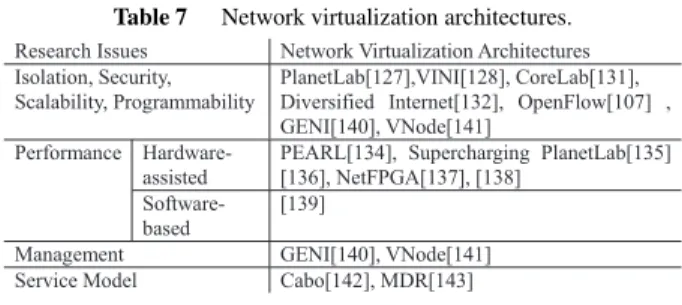
Table 7 summarizes how network virtualization archi- tectures handle these research issues.
Table 7 Network virtualization architectures.
9.2 Network Virtualization 9.2.1 Early Testbed
PlanetLab[127] andVINI[128] are early testbed facilities that effectively mimic the scale of the Internet. In these testbeds, Internet nodes run Linux virtual software to vir- tualize its resources to allocate isolated resources to indi- vidual distributed applications/protocols which are concur- rently under experimentation. Experiments are allocated a slicethat is composed of multiple slivers spanning multiple sites. Inspired by its success, network virtualization archi- tectures and their application to testbeds for future network architectures are being studied.CoreLab[131] incorporates flexibility and code-usability to PlanetLab by employing the hosted virtual machine monitor.
9.2.2 Network Virtualization Architectures
Most virtualization network architectures proposed so far focus on isolation, security, scalability and programmabil- ity. [132] proposes to make network virtualization as a core capability of a future diversified Internet with the objectives of isolation and fairness. The fundamental abstractions for a virtualized network aresubstraterouters, which are con- nected to each other by physical links, and metarouters, which are hosted on substrate routers and are connected to each other by virtualmetalinkscarried over physical links.
Programmability for packets as well as for flows [107]
is an important issue inspired by the active network re- searches [133]. Most virtualization architectures provide programmability for packets and some of them provide fast path data processing. Performance and management among the above challenges and service models (business models) are important so that such architectures can be applied com- mercially in the future.
Performance, which virtualization based on the over- lay network approach sacrifices, is an important challenge [134]. Routers supporting virtualization (virtual routers) should provide good performance of the data plane with maintaining isolation among slices especially in the case that the number of slices increases. [135] proposes a super- charged PlanetLab platform that implements separate slow and fast paths for packet processing and forwarding. The slow path is chosen for application specific processing while the fast path is optimized for line-rate packet forwarding.
[136] proposes a virtualized data plane based on the pro- grammable network processing hardwareNetFPGA[137].
[138] uses programmable Network Interface Cards (NICs) for high performance. [139] considers implementing a high performance router on commodity hardware.
Management issues must be resolved in order to oper- ate testbeds as well as commercial networks wherein thou- sands of slices are used in the experiment. Some testbed projects based on network virtualization network architec- tures start developing management tools/frameworks such as GENI [140] andVnode [141].
9.2.3 Service Model
Network virtualization may change the conventional model ofInternet Service Providers(ISPs) in the current Internet.
It may decouple infrastructure providers who maintain net- work equipment from service providers who offer end-to- end services.Concurrent Architectures are Better than One (Cabo) [142] uses network virtualization to allow a service provider to simultaneously run multiple end-to-end services over different infrastructure providers. This decoupling may raise problems in the confidentiality ofService Providers (SPs). [143] addresses the problem that routing informa- tion of SP is leaked toInfrastructure Providers(IPs) if the IPs are competitors to the SP. It proposes aMinimum Dis- closure Routing(MDR) that hides the routing information of the SP to underlying IPs. The solution is based on secure multi-party computation and applies it to distributed routing.
9.3 Testbed Projects
Developing future network architectures requires large- scale testbeds and thus many testbeds suchGENI[3], New Generation NetworkTestbed JGN-X[144] and Future Inter- net Research and Experimentation (FIRE) [145] have been constructed. These testbeds are based on network virtual- ization. Among them GENI is one of the first testbeds based on network virtualization. The key idea of GENI is to build multiple slices out of the substrate for resource sharing and experiments. It consists of physical network substrates and a global control and management framework. The research projects developing the testbeds try challenges related to large-scale hardware, software, distributed system tests and maintenance, security and robustness, coordination, open- ness, and extensibility.
10. Other Issues
This paper surveys mainly clean-slate proposals related with the network layer and the above. This section discusses other issues such as evolvability, clould networking archi- tectures and network science.
10.1 Evolvability
The first issue is the debate between clean-slate versus evo- lutionary (incremental) approaches [146]. Many clean-slate
designs surveyed in this paper impose no restrictions or as- sumptions on the current Internet/network architectural de- signs. Even if they are revolutionary, they should be evo- lutionary so as to accommodate legacy networks including the Internet and circuit networks as well as to handle new requirements.
Either approach raises an issue of how to support evolavbility. We cannot predict how the Internet would be used 50 years hence and thus the future Internet should be evolvable to keep up with the progress of substrate technolo- gies and applications.
Some studies [10], [23] address this issue. [147] pro- poses a model to mathematically analyze how layer struc- tures are evolved and implies that the narrow waist of the future Internet would be above the current IP layer. Shad- owNet [148] which is based on network virtualization, is designed to accelerate network evolution. The idea is that the infrastructure is connected to, but functionally separated from a production network, thus enabling realistic testing.
(Network virtualization is discussed in Sect. 9.)
eXpressive Internet Architecture (XIA) [10]–[12] con- siders that today’s incremental deployment has the draw- back. Such a deployment hides new functionalities usually implemented by tunnels and overlays from the underlying IP network. XIA proposes to incorporate expressiveness and evolvality into the network layer (i.e., the IP layer). The key element is the abstraction of aprincipalthat is a receiver of a packet such as a host and an application. Each type of prin- cipal is associated with a different contract with the network and applications are able to specify their intent by choosing the appropriate principal types. This expressiveness enables evolvability.
10.2 Cloud Networking Architecture
Cloud computing based on data centers is rapidly becoming popular and many could services includingInfrastructure as a Service(IaaS) andSoftware as a Service(SaaS) are com- mercially available. Although this computing model offers significant economic advantages of scale by sharing hard- ware among applications, the network architectural consid- eration is missing. And thus cloud networking architectures becomes a hot research topic and they take an evolutionary approach.
NEBURA [9] proposes a future cloud networking ar- chitecture that interconnects data centers and connects users to their data. It addresses the three challenges: (1) it is in- trinsically more secure, (2) it provides flexibility for further applications, (3) it provides a viable path for migration and deployment that is conscious of technical feasibility, eco- nomics, and regulation. The architecture consists of the data plane protocol for establishing policy-compliant paths, the control plane providing access to application-selectable ser- vices and the core that redundantly interconnects data cen- ters.
10.3 Network Science
Network science takes the most clean-slate approach for the future Internet/networks. Over the past forty years, com- puter networks especially the Internet have changed in terms of size (the number of nodes) andQuality of Service(QoS).
The networks have become more complex than the con- ventional theoretical and mathematical techniques can han- dle. Thus deep, new scientific understanding about their complexity is required for their future design. In recogni- tion of the importance of this area, the United States has launched a research program called as Network Science and Engineering (NetSE) [149] and in Japan, IEICE has pub- lished the special sections related to network science [150].
Research issues include routing [151]–[154], biology [154]
or brain [155] inspired network control, autonomous algo- rithms [156], [157] for dealing with complexity in the future Internet/networks and socio-technological issues.
Among the issues, routing has been well studied.
Greedy Routing on Hidden Metrics (GROH) [151] is an innovative approach. The study assumes that the scala- bility problem would not be due to large storage space in routers, but due to the churn as a result of routing updates.
GROH proposes a greedy forwarding based on a hidden metric spaceby leveraging the small world phenomena in the Internet. The idea behind that is “Nodes in complex net- works exist in some spaces that underlie the observable net- work topologies (called as hidden metric spaces (Cited from [151]))”. Routing control messages become unnecessary due to such an observable network topology. However, the study itself is in an early stage. This study follows greedy routing in wireless sensor and ad-hoc networks wherein geo- graphical information such as virtual coordinate information is used to reduce routing control messages [152], [153].
10.4 Miscellaneous Issues
Other important issues are energy efficiency (energy saving) [158] and substrate technology innovations in wireless [159]
and optical networks [160]. The papers [158]–[160] explain the current trends in these research areas.
11. Conclusion
This paper surveys clean-slate future Internet/network archi- tectures in terms of architectures and protocols. Subjects discussed include the narrow waist in the future, naming, se- curity, mobility, service, network virtualization and so forth.
The idea behind this discussion is how ossification of the Internet can be resolved and how the functions that the cur- rent Internet lacks such as security and mobility can be built into future Internet/networks. Many architectures and pro- tocols have been proposed and their deployment and eval- uation over large-scale testbeds have just begun. However, there are many challenges to be tackled in achieving future Internet/networks. It is hoped that this paper will encourage
young researchers to take on such research challenges.
References
[1] M. Blumenthal and D. Clark, “Rethinking the design of the Inter- net: The end-to-end arguments vs. the brave new world,” ACM Trans. Internet Technology, vol.1, no.1, pp.70–109, Aug. 2001.
[2] NSF NeTS FIND Initiative, http://www.nets-find.net/
[3] GENI (Global Environment for Network Innovations), http://
www.geni.net/
[4] http://forum.nwgn.jp/english/
[5] T. Aoyama, “A new generation network: Beyond the Internet and NGN,” IEEE Commun. Mag., vol.47, no.5, pp.82–87, May 2009.
[6] NSF Future Internet Architecture Project, http://www.nets-fia.net/ [7] Named Data Networking Project, http://www.nameddata.net [8] MobilityFirst Future Internet Architecture Project, http://
mobilityfirst.winlab.rutgers.edu/
[9] NEBULA Project, http://nebula.cis.upenn.edu
[10] eXpressive Internet Architecture Project, http://www.cs.cmu.edu/
˜xia/
[11] D. Han, A. Anand, F. Dogar, B. Li, H. Lim, M. Machado, A.
Mukundan, W. Wu, A. Akella, D. Andersen, J. Byers, S. Seshan, and P. Steenkiste, “XIA: Efficient support for evolvavle internet- working,” USENIX Symposium on NSDI’12, April 2012.
[12] A. Anand, F. Dogar, D. Han, B. Li, H. Lim, M. Machado, W. Wu, A. Akella, D. Andersen, J. Byers, S. Seshan, and P. Steenkiste,
“XIA: An architecture for an evolvable and trustworthy Internet,”
Proc. ACM HotNets’11, Nov. 2011.
[13] http://akari-project.nict.go.jp/eng/index2.htm
[14] H. Harai, K. Fujikawa, V.P. Kafle, T. Miyazawa, M. Murata, M.i Ohnishi, M. Ohta, and T. Umezawa, “Design guidelines for new generation network architecture,” IEICE Trans. Commun., vol.E93-B, no.3, pp.462–465, March 2010.
[15] B. Tarnauca and S. Nechifor, eds., “Netinf evaluation,” EC FP7- ICT-4WARD Project, Deliv. D-6.3, June 2010 (http://www.4ward- project.eu).
[16] http://www.sail-project.eu/
[17] K. Gammon, “Networking: Four ways to reinvent the Internet,”
Nature, vol.463 no.7281, pp.602–604, Feb. 2010.
[18] R. Jain, A. Durresi, and S. Paul, eds., “Future Internet architec- ture: Design and deployment perspectives,” IEEE Commun. Mag., vol.49, no.7, pp.24–25, July 2011.
[19] J. Pan, S. Paul, and R. Jain, “A survey of the research on future Internet architectures,” IEEE Commun. Mag., vol.49, no.7, pp.26–
36, July 2011.
[20] M. Murata, ed., “Special section on new generation network to- wards innovative future society,” IEICE Trans. Commun., vol.E93- B, no.3, pp.435–550, March 2010.
[21] T. Hasegawa, ed., “Special Section on new generation mobile and sensor networking and future networks,” IEICE Trans. Commun., vol.E94-B, no.6, pp.1525–1629, June 2011.
[22] M. Murata, ed., “Special section on new/next generation pho- tonic networking and future networks,” IEICE Trans. Commun., vol.E95-B, no.3, pp.695–754, March 2012.
[23] J. Turner and D. Taylor, “Diversifying the Internet,” Proc. IEEE Globecom’05, pp.755–760, Dec. 2005.
[24] T. Anderson, L. Peterson, S. Shenker, and J. Turner, “Overcoming the Internet impasse through virtualization,” IEEE Comput. Mag., vol.38, no.4, pp.34–41, April 2005.
[25] L. Popa, A. Ghodsi, and I. Stoica, “HTTP as the narrow waist of the future Internet,” Proc. ACM Hotnets’10, Nov. 2010.
[26] http://en.wikipedia.org/wiki/Locator/Identifier Separation Protocol [27] J. Pan, R. Jain, S. Paul, and C. So-in, “MILSA: A new evolu- tionary architecture for scalability, mobility, and multihoming in the future Internet,” IEEE J. Sel. Areas Commun., vol.28, no.8, pp.1344–1362, Aug. 2010.
[28] R. Moskowitz, P. Nikander, and P. Jokela, “Host identity protocol