PAPER
Recovering Transitive Traceability Links among Various Software Artifacts for Developers ∗
Ryosuke TSUCHIYA†a), Kazuki NISHIKAWA††,Nonmembers, Hironori WASHIZAKI††, Yoshiaki FUKAZAWA††,Members, Yuya SHINOHARA††, Keishi OSHIMA†,andRyota MIBE†,Nonmembers
SUMMARY Traceability links between software artifacts can assist in several software development tasks. There are some automatic traceability recovery methods that help with managing the massive number of software artifacts and their relationships, but they do not work well for software artifacts whose descriptions are different in terms of language or abstrac- tion level. To overcome these weakness, we propose the Connecting Links Method (CLM), which recovers transitive traceability links between two ar- tifacts by intermediating a third artifact. In order to apply CLM for general use without limitation in terms of software artifact type, we have designed a standardized method to calculate the relation score of transitive traceabil- ity links using the scores of direct traceability links between three artifacts.
Furthermore, we propose an improvement of CLM by considering software version. We evaluated CLM by applying it to three software products and found that it is more effective for software artifacts whose language type or vocabulary are different compared to previous methods using textual simi- larity.
key words: traceability link recovery, transitive, connecting link, version
1. Introduction
Traceability in software development is the ability to trace relationships between software artifacts (e.g., requirements, designs, source code, and test cases). We call these rela- tionships “traceability links.” Grasping traceability links is instrumental in several software development tasks, such as impact analysis, program comprehension, and reuse of ex- isting software[2]–[4].
However, most software development projects have difficulty managing traceability links because of the mas- sive number of possible combinations between software ar- tifacts. Therefore, developers are often forced to expend significant effort and cost to perform the aforementioned tasks without traceability links. To solve this problem, vari-
Manuscript received October 1, 2018.
Manuscript revised February 8, 2019.
Manuscript publicized June 7, 2019.
†The authors are with the Research & Development Group, Center for Technology Innovation - Systems Engineering at Hitachi, Ltd., Yokohama-shi, 244–0817 Japan.
††The authors are with the Dept. Computer Science at Waseda University, Tokyo, 169–8555 Japan.
∗This paper is an extended version of a paper presented at the 31st IEEE International Conference on Software Maintenance and Evolution[1]. We have added some detailed descriptions that ex- plain how to determine and prepare intermediate artifacts and di- rect links in Sects. 2 and 3. Moreover, we propose an improve- ment of CLM by considering software version. We also conducted experiments using two additional software products, including an industrial one.
a) E-mail: [email protected] DOI: 10.1587/transinf.2018EDP7331
ous methods to automatically recover traceability links have been developed[13]–[27].
These methods utilize textual similarity among soft- ware artifacts to recover the traceability links between them, and they work quite well in recovering links between soft- ware artifacts whose language type and vocabulary are the same. However, if there are differences, these methods do not work well. Some assistive technologies have been pro- posed to improve the accuracy of link recovery in such situ- ations, but they are often limited to certain types of software artifacts or require specific preconditions. Therefore, devel- opers cannot easily apply them for general use.
To overcome these problems, we propose the Connect- ing Links Method (CLM), which recovers transitive trace- ability links between two artifacts by intermediating a third artifact. This method is based on the idea that traceabil- ity links can be recovered transitively by tracking links among multiple software artifacts. For example, if there is a requirement “Reserve tickets” and a source code file
“RSVTCT.java” for implementing the requirement, it is dif- ficult to recover links between the two using only their tex- tual information because the name of the source code file is an abbreviation of the requirement. However, if there is a third artifact, such as a design document that includes infor- mation about both the requirement and the source code file, a traceability link can be recovered transitively after pass- ing from the requirement to the design document and then from the design document to the source code file. In this work, we have designed a standardized method to recover links transitively among three sets of software artifacts.
This paper addresses the following research questions.
RQ1 What kind of software artifacts can CLM be applied for effectively?
RQ2 What benefits and drawbacks does the proposed scor- ing design give for accuracy of transitive links?
RQ3 Can consideration of software version improve the ac- curacy of CLM?
We conducted three experiments using three software prod- ucts to investigate these questions and confirmed that CLM is effective for use with software artifacts whose language type or vocabulary are different. We also observed and clar- ified the relationships between the score of links recovered transitively and the reliability of these links. Finally, we proposed and evaluated an improvement of CLM by consid- ering software version.
The contributions of this study are:
Copyright c2019 The Institute of Electronics, Information and Communication Engineers
• We propose a transitive traceability recovery method, CLM, without the limitation of software artifact types.
• We evaluate the kind of software artifacts to which CLM can be effectively applied, the impact on accu- racy by the scoring design of CLM, and the effective- ness of considering software version for CLM.
Section 2 of this paper provides background infor- mation. Section 3 describes our approach, and in Sect. 4 we evaluate it experimentally. Section 5 discusses related works. We conclude in Sect. 6 with a brief summary and mention of future work.
2. Background
2.1 Traceability Link Recovery
To improve the efficiency of software development tasks, traceability links between various kinds of software artifacts need to be recovered. Software artifacts consist mainly of two elements: one, a word in natural language, and two, a symbolic token that is part of a programing language. The composition ratio is different depending on the type of ar- tifact. For example, most of the requirement specification documents are written in natural language, while source code files typically consist of symbolic tokens (except for comments). There are some artifacts in which words and to- kens coexist: API documents, bug reports, commit logs, and so on. The difference of the composition ratio makes it diffi- cult to recover traceability links between different software artifacts.
Traceability links between software artifacts are di- vided broadly into two categories: probabilistic links and deterministic links.
Probabilistic links are constructed by scoring the de- gree of some kind of relationship between software arti- facts. The most common degree of relationship is textual similarity, which has been adopted by most of the previ- ous traceability recovery methods[13],[15],[16],[18],[19], [21]–[27]. These methods calculate textual similarity be- tween software artifacts by using Natural Language Pro- cessing (NLP) techniques such as the Vector Space Model (VSM)[9],[10], Latent Semantic Indexing (LSI)[11], and word embedding[12]. Therefore, when recovering links be- tween software artifacts that contain a lot of natural lan- guage words, the probabilistic links are reliable with high accuracy. However, if language type and vocabulary are dif- ferent between artifacts, these methods can barely construct the probabilistic links.
Deterministic links are constructed by tracking the ref- erences to identifiers. Source code files written in a pro- gramming language refer to each other and the reference is clearly described (e.g., call relationships). Other examples contain a reference to source code files or various internal elements (e.g., class, method, and field): commit logs, API documents, bug reports, application execution logs, and so on. Compared to probabilistic links, these reference rela- tionships are clear and deterministic. Therefore, most of the
previous studies utilize deterministic links to improve the reliability of probabilistic links[14]–[19],[21]–[24].
2.2 Problems
As mentioned above, the accuracy of recovering prob- abilistic links depends on the commonality of language type and vocabulary between artifacts. If developers need to grasp traceability links between artifacts that do not share common words, assistive technologies are re- quired. Previous studies (discussed in more detail in Sect. 5) have proposed several assistive technologies, including structural[15]–[19], [23], repository-based[14],[21]–[24], feedback-based[19], [23], [25], and version-based[18], [20]–[22]approaches. However, developers can apply these technologies only to projects that fulfill their prerequisites for target software artifacts or the way to manage artifacts.
Furthermore, even in similar approaches, there are some key differences in the way to utilize the assistive technologies among the previous studies; in other words, the usage is not standardized. This makes it a bit difficult for developers to decide which usage should be adopted for their projects.
Therefore, we have aimed to develop a technology that has few limitations and is standardized to minimize the influ- ence from diversity of target software artifacts.
2.3 Motivating Example
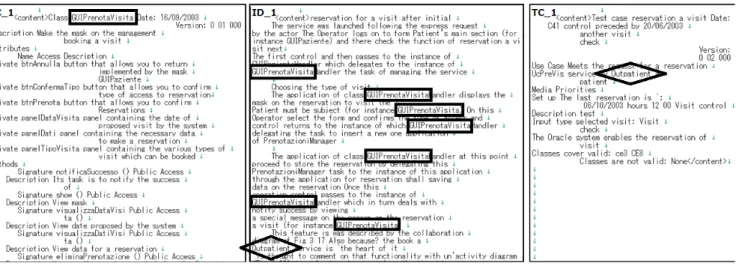
As shown in Fig. 1, there are three types of software artifacts in the EasyClinic software product: descriptions of source code classes, descriptions of the interaction diagram, and test cases. CC 1 located on the left is a description of the class “GUIPrenotaVisita,” and TC 1 located on the right is a test case for “reservation a visit Date.” According to docu- ments that record the traceability links of EasyClinic, CC 1 links to TC 1. However, if developers want to recover the link by using textual similarity, it becomes difficult because they do not share characteristic words (e.g., “GUIPreno- taVisita” emphasized in CC 1 and “Outpatient” emphasized in TC 1). The word “reservation,” which is shared between CC 1 and TC 1, is not effective for calculating textual simi- larity because it is used in EasyClinic universally.
On the other hand, ID 1 (located at the center of Fig. 1) is a description of the interaction diagram of applications including the class “GUIPrenotaVisita.” As the emphasized words in Fig. 1 show, ID 1 contains both the characteristic words of CC 1 and TC 1. Therefore, there is a possibility of recovering the links between CC 1 and ID 1, TC 1 and ID 1 by using textual similarity. Developers can guess that there are relations between CC 1 and TC 1 by applying the transitive rule to these two links. This example forms our motivation to study the approach to recover traceability links using the transitive rule.
Fig. 1 Motivating example.
3. Approach 3.1 Key Ideas
Our basic idea is that traceability links can be recovered transitively by tracking links among multiple software ar- tifacts. We call a link recovered transitively a “transitive link” and a link recovered directly between two artifacts a
“direct link.” An example of the transitive link is given in Fig. 2. There are three sets of software artifacts. First Target Artifact (FTA) and Second Target Artifact (STA) are sets of artifacts that are targets of transitive link recovery, and In- termediate Artifact (IA) is a set of artifacts that are used as intermediates when recovering transitive links between FTA and STA. FTA, STA, and IA are defined as FTA={fta 1, fta 2, . . . , fta l}, STA={sta 1, sta 2, . . . , sta m}, and IA= {ia 1, ia 2, . . . , ia n}. The suffixes l, m, and n are the number of artifacts in each set. There are direct links between fta 3 and ia 3, sta 3 and ia 3, so a transitive link between fta 3 and sta 3 can be identified by tracking the direct links.
If we limit the types to FTA, STA, IA, and the direct links between them, developers cannot utilize this approach to recover transitive links in general use scenarios. There- fore, we only specify that direct links are deterministic links or probabilistic links with a relation score; we do not place any restrictions on how to prepare or recover the direct links.
Thus, our approach can be applied for several targets.
When considering transitive traceability recovery, it is necessary to discuss the reliability of transitive links. In par- ticular, when the category of direct links is probabilistic, for both of the direct links between FTA and IA, STA and IA, high reliability (i.e., high relation score) is required.
There is another factor that can affect the reliability of transitive links: the number of transitive paths between FTA and STA. For example, if there are some artifacts of IA that are directly linked with fta 3 and sta 3 the same as ia 3—in other words, if there are multiple transitive paths between fta 3 and sta 3—we can assume that the reliability of the
Fig. 2 Transitive link.
transitive link is higher than that of the single transitive path.
3.2 Connecting Links Method (CLM)
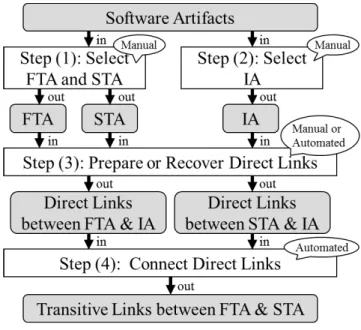
In light of the above considerations, we have designed the Connecting Links Method (CLM) to recover transitive links among various software artifacts. An overview of CLM is provided in Fig. 3. CLM consists of four steps, described in the following.
3.2.1 Step (1): Select FTA and STA
As shown in Fig. 3, this step is performed manually with software artifacts of the development project as input and it outputs FTA and STA as a result. When developers want to recover transitive links, first, they select two sets of software artifacts that are targets of transitive link recovery: FTA and STA.
CLM does not limit which types of FTA and STA can be used, but if the difference of language type and vocabu- lary between FTA and STA is small, we recommend recov- ering direct links between them using textual similarity, like the previous methods. If not, CLM can be used to recover links more accurately.
Fig. 3 Overview of CLM.
3.2.2 Step (2): Select IA
As shown in Fig. 3, this step is performed manually with software artifacts of the development project as input and it outputs IA. After execution of Step (1), the developers select a set of software artifacts that is used as intermediates of transitive recovery: IA.
We recommend choosing IA that has deterministic links with FTA or STA. For example, if FTA or STA are source code files, artifacts that have references to the source code files are suitable for IA (commit logs, API documents, and so on). We also recommend choosing IA that contains characteristic words of FTA and STA.
3.2.3 Step (3): Prepare or Recover Direct Links
As shown in Fig. 3, this step is performed manually or auto- matically with FTA, STA, and IA as inputs. Then, this step outputs direct links between FTA and IA, STA and IA. Af- ter execution of Steps (1) and (2), the developers prepare or recover the direct links.
CLM allows any method of recovering direct links only if the recovered links are deterministic or probabilistic links with a relation score. Examples of methods that can be used include manual recovery, tool-assisted recovery (e.g., Trace- Lab[5]–[8]), and applying a conventional traceability recov- ery method.
3.2.4 Step (4): Connect Direct Links
As shown in Fig. 3, this step is performed automatically with two sets of direct links as input and it outputs transitive links between FTA and STA. After execution of Step (3), the tran- sitive links are automatically recovered with a relation score by connecting the direct links as in the following process.
First, the relation score of the direct link be- tween artifacts a1 and a2 is normalized and defined as {DScore(a1,a2) ∈R|0 ≤DScore≤1}. If the category of the direct links is deterministic, the DScore is specified as 1. If the category is probabilistic, the original relation score OScore(a1,a2) between artifactsa1anda2 is normalized to DScore, as
DScore(a1,a2)= OScore(a1,a2)−OScoremin
OScoremax−OScoremin
, (1)
where OScoremaxand OScoreminare the maximum and min- imum values of OScore, respectively. The original rela- tion score OScore is respectively defined and calculated by each traceability recovery method adopted in Step (3).
For example, if developers recover direct links using VSM, OScore(a1,a2) between artifactsa1anda2 is calculated us- ing the cosine similarity. The similarity is obtained as the cosine of the angle between the two document vectors.
Therefore, OScore(a1,a2) is calculated as OScore(a1,a2)= →−v1→−v2
→−v1→−v2, (2)
where→−v1is the document vector ofa1and→−v2is the document vector ofa2. Although the document vector can be derived in various ways, we explain the most basic way, called Bag- of-Words (BoW), as follows. Here, Drepresents a set of documents andT presents a set of terms. For a document dx(∈ D) containingS valid terms [i.e.,t1,t2,· · ·,tS(∈ T)], w(tp,dx) (0≤p ≤S) is the number of appearances oftpin dx. Consequently,dxcan be represented byS-dimensional vector→−vxas
−
→vx=(w(t1,dx),w(t2,dx),· · ·,w(tS,dx)). (3) Then, the relation score of the transitive link between artifactsa1 anda2 is defined as{TScore(a1,a2) ∈ R|0 ≤ TScore≤1}. When recovering transitive links betweenf tai
and staj (f tai ∈ FTA,staj ∈ STA), TScore(f tai,staj) is calculated as
TScore(f tai,staj)
=
n
k=1
DScore(f tai,iak)∗DScore(staj,iak) (4) whereiakis an intermediate artifact (iak ∈ IA) andnis the number of intermediate artifacts. As mentioned in Sect. 3.1, the reliability of transitive links depends on the reliability of both direct links. Therefore, our design stipulates that TScore be calculated by multiplying each DScore. Further- more, the multiplied score is summed to reflect the number of transitive paths.
This simple scoring design makes it possible for devel- opers to calculate the relation score of the transitive link in a universal way for any software artifacts. In other words, the usage of CLM is standardized except for free choice of IA and calculation methods of OScore. For example, if there
are three sets of software artifacts for which published trace- ability recovery tools using VSM (e.g., TraceLab) are appli- cable, developers can recover transitive links between them easily by executing the tools and tracing the above formulas with OScore output by the tools.
3.3 Improvement by Considering Software Version CLM has the potential to be improved by cooperating with various assistive technologies (described further in Sect. 5).
The version-based approach is particularly effective in com- pensating for the main weakness of CLM, which is the ex- plosive increase in the number of combinations of software artifacts. When recovering direct links between FTA and STA, the number of combinations that are evaluated is l*m, while when recovering transitive links, the number is l*n*m.
Too many combinations causes noise that interferes with the score evaluation and link recovery.
Therefore, if FTA, STA, and IA are separately managed for each software version, transitive links should be recov- ered between the artifacts that belong to the same software version. This reduces the number of combinations and im- proves the accuracy of CLM. The CLM improved by con- sidering software version is named “verCLM.”
4. Evaluation
4.1 Evaluation Purposes
In Sect. 3.2.1, we suggested considering the difference of language type and vocabulary when developers decide whether to adopt CLM. Therefore, we have to evaluate and clarify whether these characteristics of software artifacts af- fect the applicability of CLM and the previous methods us- ing text similarity.
In Sect. 3.2.4, we described how to calculate the rela- tion score of transitive links considering the reliability of both direct links and the number of transitive paths. There- fore, we have to evaluate what benefits and drawbacks the scoring design gives for the accuracy of transitive links.
In Sect. 3.3, we proposed verCLM, which improves CLM by considering software version. Therefore, we have to evaluate whether verCLM actually improves CLM.
On the basis of the above, we set the following research questions.
RQ1 What kind of software artifacts can CLM be ap- plied for effectively?
RQ2 What benefits and drawbacks does the proposed scoring design give for accuracy of transitive links?
RQ3 Can consideration of software version improve the accuracy of CLM?
4.2 Experimental Setup
We carried out three experiments using three software ap- plications to answer the research questions. In these exper- iments, precision, recall, and F-measure, which take values from 0 to 1, are used as the metrics to determine the accu- racy of recovering links. They are defined as
precision=extracted corret links
all extracted links , (5)
recall= extracted corret links
all correct links , (6)
F−measure=2∗ precision∗recall
precision+recall. (7) 4.2.1 Experiment (1): PAT
The first target software is PAT, which is a program analy- sis tool developed by a Japanese company. It contains two requirements written in Japanese, 251 source code files writ- ten in JavaR†, and 97 test cases written in Japanese. There are direct links prepared between the requirements and the test cases and between the source code files and the test cases. The direct links between the requirements and the test cases were recovered by developers manually. The di- rect links between the source code files and the test cases were recovered by referring to execution logs that record source code modules executed in test cases. Therefore, both of the direct links are deterministic.
Developers want to recover links between requirements and source code files. Therefore, we recovered direct links by applying a traceability recovery approach using textual similarity and recovered transitive links by CLM.
We adopted VSM as the NLP technique to calculate textual similarity because it is the most common approach adopted as basic technology in many previous methods.
Moreover, there is a traceability recovery tool called Trace- Lab using VSM, which is published and available to anyone.
In CLM, we selected the requirements as FTA, the source code files as STA, and the test cases as IA. Then, we use direct links between FTA and IA, STA and IA, which are mentioned above.
In this experiment, we compared the accuracy of two approaches to determine whether the difference of language type between software artifacts affects applicability of the approaches. The total number of correct links, prepared in advance by developers, is 65.
4.2.2 Experiment (2): EasyClinic
The second target software is EasyClinic, which is an open source software designed to manage a medical practitioner’s office. It contains 30 use cases, 20 descriptions of interac- tion diagrams, 47 descriptions of source code classes, and
†JavaR is a registered trademark of Oracle and/or its affiliates.
63 test cases. The Center of Excellence for Software & Sys- tems Traceability (CoEST)[29], which is a “community of researchers and practitioners working together since 2002 to achieve scalable, effective software and systems traceability solutions”, provided correct links between the four artifacts.
In this experiment, we investigated whether CLM can recover links more accurately for software artifacts for which the direct traceability recovery approaches using tex- tual similarity do not work well. Therefore, we recovered di- rect links between the four artifacts using VSM (TraceLab) and then recovered transitive links for all combinations of the artifacts using the direct links. Then, we compared the accuracy of the direct and transitive links.
4.2.3 Experiment (3): Andlytics
The third target software is Andlytics, which is an AndroidTM†application to collect statistics from the Google PlayTM†† developer console. We utilized five versions (ver2.1, ver2.2, ver2.3, ver2.4, and ver2.5). All told, ver2.1 includes four requirements, 74 pull requests, and 169 source code files; ver2.2 includes eight requirements, 130 pull re- quests, and 176 source code files; ver2.3 includes ten re- quirements, 115 pull requests, and 185 source code files;
ver2.4 includes three requirements, 76 pull requests, and 189 source code files; and ver2.5 includes five requirements, 107 pull requests, and 200 source code files.
Direct links were prepared between the requirements and the pull requests and between the source code files and the pull requests. The direct links between the requirements and the pull requests were recovered by TraceLab, so they are probabilistic links with a relation score. The direct links between the source code files and the pull requests were re- covered by referring to information of the modified source code files that is recorded in pull requests. Thus, these links are also probabilistic links with a relation score calculated by weighting according to the number of modified lines of code.
In this experiment, we compared the accuracy of four approaches: VSM (an approach that calculates textual sim- ilarity by VSM), verVSM (VSM improved by considering software version), CLM, and verCLM by recovering links between requirements and source code files. In CLM, we specified the requirements as FTA, the source code files as STA, and the pull requests as IA. Then, we used direct links between FTA and IA, STA and IA, which are mentioned above. VSM and CLM were applied to artifacts of all soft- ware versions in bulk, while verVSM and verCLM were ap- plied to artifacts of each software version separately. The total number of correct links for evaluation is 22. These correct links were prepared between the requirements and the source code files of all software versions manually. All of the links were constructed between the requirements and the source code files, which were contained in same version,
†AndroidTMis a trademark of Google Inc.
††Google PlayTMis a trademark of Google Inc.
Table 1 Accuracy of traceability recovery in PAT.
Table 2 Accuracy of traceability recovery in EasyClinic.
because the software artifacts related to each other were up- dated synchronously in Andlytics.
4.3 Results
4.3.1 Experiment (1): PAT
Table 1 lists the accuracy of traceability recovery between requirements and source code files in PAT. VSM in the “Ap- proach” column indicates the traceability recovery approach that calculates textual similarity by VSM. VSM and CLM respectively extracted 38 and 148 links with scores, where a sentence “with scores” means having relation scores greater than 0. Table 1 also shows the values of extracted correct links, precision, recall, and F-measure when extracting all links with scores. CLM could extract about twice as many correct links as VSM.
4.3.2 Experiment (2): EasyClinic
Table 2 lists the accuracy of traceability recovery in Easy- Clinic, where UC refers to Use Cases, ID to descriptions of Interaction Diagrams, CC to descriptions of source Code Classes, and TC to Test Cases. The column “Target Arti- facts” indicates artifacts that are targets of traceability re- covery. The column “Link Type” indicates the type of trace- ability link: direct or transitive. The column “IA” indicates the IA that is used as an intermediary of transitive links. For
Fig. 4 F-measure of traceability recovery in EasyClinic.
example, line No. 1 indicates the accuracy of direct links between UC and ID, and line No. 2 indicates the accuracy of transitive links between UC and ID recovered by inter- mediating CC. We show accuracy with highest F-measure in Table 2 to compare the maximum performance among links in terms of the balance between precision and recall.
As shown in the table, all direct links exceeded the corre- sponding transitive links in the terms.
Figure 4 shows six graphs detailing the transition of F- measure according to the number of extracted links in Easy- Clinic, where vertical axis indicates the value of F-measure and horizontal axis indicates the number of extracted links.
Each legend corresponds to the link of each row in Table 2.
For example, the top-left graph shows the transition of Nos.
1, 2, and 3 in Table 2. To make the comparison of the early stages easier to see, each graph shows the transition until the F-measure of direct links peaks. After the peak, each
F-measure gradually decreased and superiority or inferior- ity between the direct link and the transitive links did not change. While most direct links exceeded the corresponding transitive links, some transitive links (Nos. 3, 9, 15, and 18) continuously exceeded the corresponding direct links when the number of extracted links was small.
4.3.3 Experiment (3): Andlytics
Figures 5 and 6 show the precision and recall of recovering links between requirements and source code files in Andlyt- ics. Vertical axis indicates the value of precision or recall, and horizontal axis indicates the number of links retrieved by each approach. The links were retrieved in descending order of relation score. The results of applying four ap- proaches are shown: VSM, verVSM, CLM, and verCLM.
CLM and verVSM had higher recall and precision than
Fig. 5 Precision of traceability recovery in Andlytics.
Fig. 6 Recall of traceability recovery in Andlytics.
VSM, especially when the number of retrieved links was small. However, the larger the number of retrieved links, the smaller the difference of accuracy of the three approaches.
verCLM had the highest recall and precision of the four ap- proaches regardless of the number of retrieved links.
4.4 Discussion
4.4.1 RQ1: What Kind of Software Artifacts Can CLM be Applied for Effectively?
In experiment (1), VSM extracted only 38 links with scores.
In PAT, the requirements are written in Japanese and the source code files are composed of symbolic tokens based on English and a few Japanese comments, which enabled VSM to extract 38 links. However, there are a lot of source code files that contain no Japanese comments at all. In this case, VSM could not extract links for the source code files without Japanese comments. This is why VSM extracted a small number of links compared with the number of target artifacts. In contrast, CLM was not affected by the differ- ences of language type because it utilized direct determinis- tic links with test cases. Therefore, CLM could extract links for the source code files without Japanese comments. As a result, CLM extracted more correct links than VSM.
In experiment (2), all direct links exceeded correspond- ing transitive links in accuracy with highest F-measure. We assume this is because all artifacts contain natural language words written in the same language (English), and CLM
adopted direct probabilistic links. However, some transitive links (Nos. 3, 9, 15, and 18) exceeded the corresponding direct links when the number of extracted links was small.
The common point between these transitive links is to me- diate the direct links of which the highest F-measure is over 0.60 (i.e., Nos. 4, 10, and 13). These results show that the accuracy of transitive links depends upon the accuracy of the mediated direct links.
In conclusion, CLM can be effectively applied for re- covering links between software artifacts whose language type and vocabulary are different. Furthermore, the exis- tence of IA with deterministic or highly reliable probabilis- tic direct links is favorable for applying CLM.
4.4.2 RQ2: What Benefits and Drawbacks Does the Pro- posed Scoring Design Give for Accuracy of Transi- tive Links?
In multiple cases in experiments (2) and (3), the accuracy of transitive links exceeded that of direct links when the num- ber of retrieved links was small; in other words, when the relation score of links was high. In contrast, transitive links with a low relation score were outperformed by direct links.
We conclude that this is because CLM calculates a score by summing the scores of all transitive paths. If the direct links mediated are probabilistic links, low scores of transitive paths, which are low reliability paths, are also summed. This adversely affects the accuracy of transitive links.
The scoring design that considers the number of transi- tive paths may preferentially recover reliable transitive links supported by multiple transitive paths with a high score.
However, it needs to be improved to reduce the impact of summing low scores of transitive paths.
4.4.3 RQ3: Can Consideration of Software Version Im- prove the Accuracy of CLM?
In experiment (3), we confirmed that verCLM can recover transitive links more accurately than CLM. Furthermore, verCLM exceeded VSM regardless of the number of re- trieved links. As a result of reducing the combinations of ar- tifacts by considering software version, transitive paths with low score are also reduced. This contributes to the improve- ment of accuracy. However, if the correct links contain links between different versions, it may have affected the results because verCLM and verVSM cannot recover links between different versions. Such links may exist in a project where the update status of each set of software artifacts is not syn- chronized. Therefore, in practice, we should consider the existence of links between different versions when applying version-based approaches.
4.5 Threats to Validity
We have discussed and evaluated transitive traceability re- covery between three sets of software artifacts. However,
Table 3 Prerequisites and weak points of assistive or alternative approaches for textual traceability recovery approaches.
we have not examined situations involving recovery across more than four sets of artifacts. In other words, we have not examined situations where multiple sets of artifacts are used as IA serially or in parallel. This is a threat to external validity because the number of software artifact types varies from software to software and there is not always IA that has direct links with both FTA and STA. Therefore, we need to investigate how the number of serial or parallel transitions affects the accuracy of transitive links in the future.
In PAT and Andlytics, we often manually prepared di- rect links or correct links for evaluation. This is a threat to internal validity because the accuracy of the manual re- covery could affect the evaluation results. Furthermore, in each experiment, we evaluated only one product. This is also a threat to external validity. In the future, we should provide additional evaluation, for example, using a product that contains a combination of other different languages, or a product that provides correct links for evaluation in mul- tiple combinations of software artifacts, or a product that has been developed in parallel by branching to multiple ver- sions.
5. Related Work
M¨ader et al. conducted a controlled experiment with 52 par- ticipants performing real maintenance tasks on two third- party development projects where half the tasks were with traceability and the other half were without[4]. They found that, on average, participants with traceability performed 21% faster and created 60% more correct solutions. Their empirical study affirms the usefulness of traceability links.
Traceability recovery approaches using textual similar- ity have been proposed in several previous methods[13], [15],[26],[27]. Antoniol et al. proposed an approach us- ing VSM[13] that formed the basis of later studies. Ap- proaches to improve the accuracy of calculating textual sim- ilarity have also been studied. These approaches utilize more advanced NLP technologies considering semantics, such as LSI[15]and word embedding[27]. However, if the language type of software artifacts is different (e.g., natural language vs. programming language, English vs. Japanese),
these approaches do not work well. CLM has been proposed as an alternative in these situations.
Various structural approaches[15]–[19], [23] have been proposed to improve the accuracy of the textual ap- proaches mentioned above. They utilize structural informa- tion such as call relationships of methods in source code files to filter false positives or suggest additional links. There are also several repository-based approaches[14], [21]–[24], which utilize software repository information to recover links between software artifacts. In our own previous stud- ies[21]–[23], we proposed a method to recover links be- tween requirements and source code files by referring to modification logs in software repositories. Both structural and repository-based approaches consider certain transitive rules. However, they have been designed for specific types of software artifacts. CLM can apply transitive rules to any types of artifacts.
Information about the software version is also utilized to improve accuracy in version-based approaches[18],[20]–
[22]. The idea used here is that traceability links between software artifacts belonging to different software versions tend to be false positives. CLM particularly benefits from version-based approaches, as mentioned in Sect. 3.3 and evaluated in Sect. 4.3.3.
Feedback-based approaches[19], [23],[25] have im- proved traceability recovery by means of user feedback. In our own previous study[23], we proposed a method to re- cover links between requirements and source code files by utilizing user feedback along with structural information of source code files. Hayes et al. proposed a method to re- cover links between high and low level requirements by ap- plying relevance feedback analysis to improve the perfor- mance of information retrieval algorithms[25]. In this pa- per, while we have not evaluated the combined use of CLM and feedback-based approaches, we do have some hypothe- ses about the combination. For example, if a transitive link is validated by the user, the reliability of the direct links in- cluded in the transitive path increases. Then, if the score of the direct links is weighted, the accuracy of the transitive recovery may improve.
Finally, we have organized and listed the prerequisites
and weak points of assistive or alternative approaches for textual traceability recovery in Table 3, where “prerequi- site” means an essential condition to apply the approach and
“weak point” indicates a factor that makes developers reluc- tant to adopt the approach or a situation in which the ap- proach cannot work effectively. Although we have no statis- tical data to clarify which prerequisites are fulfilled by more development projects, we assume that CLM can be used for more versatile purposes than structural and repository-based approaches because CLM does not limit the type of target or the intermediate software artifacts. However, like the other approaches, there are also situations in which CLM can- not work well. Therefore, we suggest that developers select or combine approaches by comparing the characteristics of their projects with the information listed in Table 3. We have mentioned combinations between CLM and the version- based approach in this paper, between repository-based and version-based approaches in previous studies[21],[22], and between repository-based and feedback-based approaches in a previous study[23].
6. Conclusion and Future Work
We have proposed the Connecting Links Method (CLM) to recover transitive traceability links and evaluated it us- ing three software applications: PAT, EasyClinic, and And- lytics. Results demonstrate that CLM is more effective for recovering traceability links between software artifacts whose language type and vocabulary are different compared to the traceability recovery approaches using textual simi- larity. Furthermore, we have observed that the accuracy of transitive links with a high score tends to exceed direct links, whereas transitive links with a low score tend to be outper- formed by direct links. This knowledge should be useful for improving the scoring design of CLM and for combining CLM with direct traceability recovery approaches in the fu- ture. With regard to improving CLM, we have proposed ver- CLM considering software version and evaluated the degree of improvement. In the future, we will investigate combina- tions of CLM and feedback-based approaches and evaluate the impact of the number of transitions on recovery accu- racy.
References
[1] K. Nishikawa, H. Washizaki, Y. Fukazawa, K. Oshima, and R.
Mibe, “Recovering Transitive Traceability Links among Software Artifacts,” Proceedings of the 31st IEEE International Conference on Software Maintenance and Evolution (ICSME’15), pp.576–580, Oct. 2015.
[2] A. Kannenberg, H. Saiedian, “Why software requirements traceabil- ity remains a challenge,” The Journal of Defense Software Engineer- ing, pp.14–19, July 2009.
[3] O.C.Z. Gotel and A. Finkelstein, “An analysis of the requirements traceability problem,” Proc. 1st International Conference on Re- quirements Engineering, pp.94–101, April 1994.
[4] P. Mader and A. Egyed, “Assessing the effect of requirements trace- ability for software maintenance,” 2012 28th IEEE International Conference on Software Maintenance (ICSM’12), pp.171–180,
Sept. 2012.
[5] J. Cleland-Huang, A. Czauderna, A. Dekhtyar, O. Gotel, J. Huffman Hayes, E. Keenan, G. Leach, J. Maletic, D. Poshyvanyk, Y. Shin, A. Zisman, G. Antoniol, B. Berenbach, A. Egyed, and P. Maeder,
“Grand challenges, benchmarks, and tracelab: Developing infras- tructure for the software traceability research community,” Proceed- ings of the 6th International Workshop on Traceability in Emerging Forms of Software Engineering, pp.17–23, May 2011.
[6] E. Keenan, A. Czauderna, G. Leach, J. Cleland-Huang, Y. Shin, E. Moritz, M. Gethers, D. Poshyvanyk, J. Maletic, J.H. Hayes, A. Dekhtyar, D. Manukian, S. Hussein, and D. Hearn, “Trace- lab: An experimental workbench for equipping researchers to in- novate, synthesize, and comparatively evaluate traceability solu- tions,” 2012 34th International Conference on Software Engineering (ICSE), pp.1375–1378, June 2012.
[7] A. Czauderna, M. Gibiec, G. Leach, Y. Li, Y. Shin, E. Keenan, and J. Cleland-Huang, “Traceability challenge 2011: Using tracelab to evaluate the impact of local versus global idf on trace retrieval,”
Proceedings of the 6th International Workshop on Traceability in Emerging Forms of Software Engineering, pp.75–78, Honolulu, USA, May 2011.
[8] B. Dit, E. Moritz, and D. Poshyvanyk, “A tracelab-based solution for creating, conducting, and sharing feature location experiments,”
2012 20th IEEE International Conference on Program Comprehen- sion (ICPC), pp.203–208, Passau, Germany, June 2012.
[9] G. Salton, A. Wong, and C.S. Yang, “A Vector Space Model for Automatic Indexing,” Communications of the ACM, vol.18, no.11, pp.613–620, Nov. 1975.
[10] G. Salton and M.J. McGill, “Introduction to modern information re- trieval,” McGraw-Hill, New York, 1983.
[11] S. Deerwester, S.T. Dumais, G.W. Furnas, T.K. Landauer, and R. Harshman, “Indexing by Latent Semantic Analysis,” Journal of the American Society for Information Science, vol.41, no.6, pp.391–407, 1990.
[12] T. Mikolov, I. Sutskever, K. Chen, G.S. Corrado, and J. Dean, “Dis- tributed representations of words and phrases and their composition- ality,” In Advances in Neural Information Processing Systems 26, pp.3111–3119, 2013.
[13] G. Antoniol, G. Canfora, G. Casazza, A. De Lucia and E.
Merlo, “Recovering traceability links between code and documen- tation,” IEEE Transactions on Software Engineering, vol.28, no.10, pp.970–983, Dec. 2002.
[14] H. Kagdi, J.I. Maletic, and B. Sharif, “Mining Software Reposito- ries for Traceability Links,” Proc. 15th IEEE Int’l Conf. Program Comprehension, pp.145–154, June 2007.
[15] C. McMillan, D. Poshyvanyk, and M. Revelle, “Combining textual and structural analysis of software artifacts for traceability link re- covery,” 2009 ICSE Workshop on Traceability in Emerging Forms of Software Engineering, TEFSE’09, pp.41–48, May 2009.
[16] C. McMillan, M. Grechanik, D. Poshyvanyk, C. Fu, and Q. Xie,
“Exemplar: A source code search engine for finding highly relevant applications,” IEEE Transactions on Software Engineering, vol.38, no.5, pp.1069–1087, Aug. 2011.
[17] A. Ghabi, and A. Egyed, “Code patterns for automatically validat- ing requirements-to-code traces,” Proc. 27th IEEE/ACM Interna- tional Conference on Automated Software Engineering (ASE’12), pp.200–209, Sept. 2012.
[18] H. Eyal-Salman, A.-D. Seriai, and C. Dony, “Feature-to-code trace- ability in a collection of software variants: combining formal con- cept analysis and information retrieval,” 2013 IEEE 14th IEEE Inter- national Conference on Information Reuse and Integration (IRI’13), pp.209–216, Aug. 2013.
[19] A. Panichella, C. McMillan, E. Moritz, D. Palmieri, R. Oliveto, D.
Poshyvanyk, A. De Lucia. “When and How Using Structural In- formation to Improve IR-Based Traceability Recovery,” 2013 17th European Conference on Software Maintenance and Reengineering (CSMR), pp.199–208, March 2013.
[20] M. Rahimi, W. Goss, J. Cleland-Huang, “Evolving Requirements- to-Code Trace Links across Versions of a Software System” Pro- ceedings of the 32st IEEE International Conference on Software Maintenance and Evolution (ICSME ‘16), pp.99–109, Oct. 2016.
[21] R. Tsuchiya, T. Kato, H. Washizaki, M. Kawakami, Y. Fukazawa, and K. Yoshimura, “Recovering Traceability Links between Re- quirements and Source Code in the Same Series of Software Prod- ucts,” Proceedings of 17th International Software Product Line Con- ference (SPLC ‘13), pp.121–130, Aug. 2013.
[22] R. Tsuchiya, H. Washizaki, Y. Fukazawa, T. Kato, M. Kawakami, and K. Yoshimura, “Recovering traceability links between require- ments and source code using the configuration management log,”
IEICE Transactions on Information and Systems, vol.E98-D, no.4, pp.852–862, 2015.
[23] R. Tsuchiya, H. Washizaki, Y. Fukazawa, K. Oshima, and R. Mibe,
“Interactive recovery of requirements traceability links using user feedback and configuration management logs,” Proceedings of 27th International Conference on Advanced Information Systems Engi- neering (CAiSE‘15), vol.9097, pp.247–262, June 2015.
[24] N. Ali, Y.-G. Gueheneuc, and G. Antoniol, “Trustrace: mining soft- ware repositories to improve the accuracy of requirement traceabil- ity links,” IEEE Transactions on Software Engineering, vol.39, no.5, pp.725–741, Nov. 2013.
[25] J.H. Hayes, A. Dekhtyar, and S.K. Sundaram, “Advancing Candi- date Link Generation for Requirements Tracing: The Study of Meth- ods,” IEEE Transactions on Software Engineering, vol.32, no.1, pp.4–19, Jan. 2006.
[26] T. Dasgupta, M. Grechanik, E. Moritz, B. Dit, and D. Poshyvanyk,
“Enhancing software traceability by automatically expanding cor- pora with relevant documentation,” 2013 IEEE International Confer- ence on Software Maintenance (ICSM’13), pp.320–329, Sept. 2013.
[27] J. Guo, J. Cheng, J. Cleland-Huang, “Semantically enhanced soft- ware traceability using deep learning techniques,” 2017 IEEE/ACM 39th International Conference on Software Engineering, pp.3–14, May 2017.
[28] Andlytics, https://github.com/AndlyticsProject/andlytics, Jan. 2017.
[29] CoEST, http://www.coest.org/, June. 2015.
Ryosuke Tsuchiya is a Researcher of Sys- tems Innovation Center at Hitachi, Ltd. He received his Master degree in Computer Sci- ence and Engineering from Waseda University in 2015. His research interests are centered on legacy system analysis and traceability recovery.
Kazuki Nishikawa received the Master de- gree in Information and Computer Science from Waseda University, Tokyo, Japan in 2017. His research interests include software engineering especially software traceability.
Hironori Washizaki is a professor at Waseda University, Tokyo, Japan. He is also a visiting professor at National Institute of In- formatics, Tokyo, Japan. He obtained his Doc- tor’s degree in Information and Computer Sci- ence from Waseda University in 2003. His research interests include software reuse, pat- terns and quality assurance. He has served as members of program committee for many in- ternational conferences including ASE, SEKE, PROFES, APSEC and PLoP. He has also served as members of editorial board for several journals including Journal of In- formation Processing.
Yoshiaki Fukazawa received the B.E., M.E.
and D.E. degrees in electrical engineering from Waseda University, Tokyo, Japan in 1976, 1978 and 1986, respectively. He is now a professor of Department of Information and Computer Sci- ence, Waseda University. Also he is Director, Institute of Open Source Software, Waseda Uni- versity. His research interests include software engineering especially reuse of object-oriented software and agent-based software.
Yuya Shinohara was a junior univer- sity student of Department of Information and Computer Science, Waseda University. His re- search interests include software engineering es- pecially software traceability.
Keishi Oshima is a Senior Researcher of Systems Innovation Center at Hitachi, Ltd. He received his Master degree in Information Sci- ence and Technology from Waseda University in 2002. His research interests are centered on legacy system analysis and repository mining.
Ryota Mibe is a Senior Researcher of Sys- tems Innovation Center at Hitachi, Ltd. He re- ceived his Master degree in Information Science and Technology from Tokyo Institute of Tech- nology in 1992. His research interests are cen- tered on legacy system analysis and repository mining.