Pearcey system re-examined from
the viewpoint of s -virtual turning points and non-hereditary turning points
Dedicated to Professor D.C. Struppa on his sixtieth birthday.
By
Sampei HIROSE, Takahiro KAWAI and Yoshitsugu TAKEI
Aug 2017
R ESEARCH I NSTITUTE FOR M ATHEMATICAL S CIENCES
KYOTO UNIVERSITY, Kyoto, Japan
the viewpoint of s-virtual turning points and non-hereditary turning points
Dedicated to Professor D.C. Struppa on his sixtieth birthday.
By
Sampei HIROSE
∗, Takahiro KAWAI
∗∗and Yoshitsugu TAKEI
∗∗∗§0. Introduction
The exact WKB analysis of the Pearcey system M given in (0.1) below was first proposed by T. Aoki ([A]) and later developed by one (S.H) of us ([H1]):
(0.1) M :
(
4η−3 ∂3
∂x31 + 2x2η−1 ∂
∂x1
+x1
)
ψ= 0 (0.1.a)
( η−1 ∂
∂x2 −η−2 ∂2
∂x21 )
ψ= 0. (0.1.b)
The systemM is an over-determined system with a large parameterη, and the Pearcey integral
(0.2)
∫
exp(ηφ(x, t))dt, where
(0.3) φ(x, t) =t4+x2t2+x1t,
2010 Mathematics Subject Classification(s): 34E20, 34M60.
Key Words: Pearcey system, s-virtual turning point, non-hereditary turning point, Stokes geome- try, bicharacteristic strip.
Supported by JSPS KAKENHI Grant No. 15K17556, 24340026 and 26287015.
∗Department of Design Engineering, Shibaura Institute of Technology, Saitama, 337-8570 Japan.
e-mail: [email protected]
∗∗Research Institute for Mathematical Sciences, Kyoto University, Kyoto 606-8502, Japan.
∗∗∗Department of Mathematical Sciences, Doshisha University, Kyoto, 610-0394 Japan.
e-mail: [email protected]
satisfies M. One important feature of the Pearcey system is that when it is restricted to
(0.4) Y1 ={(x1, x2)∈C2;x2 =A2, where A2 is a non-zero constant }
the Berk-Nevins-Robers equation (abbreviated as the BNR equation) appears, the de- scription of whose Stokes geometry requires a new Stokes curve ([BNR]) and a virtual turning point ([AKT], where a “new turning point” is used to mean a virtual turning point). In view of the importance of the BNR equation in the development of the the- ory of virtual turning points (see [HKT]), it is reasonable to try to analyze the Pearcey system. In this report we show several interesting features of the system which have been found with the help of the theory of s-virtual turning points ([HKT, Section 1.8]).
To begin with, we study in Section 1 the tangential system N2 of the Pearcey system M to the hyperplane
(0.5) Y2 ={(x1, x2)∈C2;x1 =A1, where A1 is a non-zero constant }.
Contrary to the restriction ofM to the hyperplaneY1, no virtual turning point appears in the study ofN2, but another intriguing feature is observed. In the Stokes geometry of N2 we find that three ordinary Stokes curves meet at a point and that this degeneration continues to be observed even when the parameter A1 is changed. Then the following question naturally arises: What happens for the tangential system N (c) of M to the hyperplane
(0.6) Y(c) =
def{(x1, x2)∈C2;x2 =c(x1−1), where cis a non-zero constant }?
In Section 2 we show that in the Stokes geometry of N (c) there exist not only an s- virtual turning point but also a non-hereditary turning point (abbreviated as NHTP).
As is emphasized in [H3] a NHTP is an ordinary (versus virtual) turning point which is generically innocent in the Stokes geometry in the sense that it does not cause any Stokes phenomena of WKB solutions. Although a NHTP is introduced in [H3] by microlocal analysis applied to the tangential systemN (c), we introduce the same notion by restricting the integral representation (0.2) of a solution of the Pearcey system to the hyperplane Y(c).
§1. The Stokes geometry of the tangential system N2
§1.1. A review of the definition of an s-virtual turning point
For the sake of the convenience of the reader, we first recall the definition of ans-virtual turning point, which we usually abbreviate as s-VTP. See [HKT, Section 1.8] for the
details. We also explain how it is theoretically related to the notion of a virtual turning point. (Cf. [HKT, Section 1.4].)
An s-VTP is defined in a very restricted situation when the Borel transform ψB(x, y) of an integralψ(x, η) with a large parameter η given by
(1.1.1)
∫
exp(ηφ(x, t))dt
satisfies a maximally over-determined system L of linear differential equations, which we abbreviate as MOS in what follows. (See [SKK, Chap. II] for the definition and basic properties of a MOS.) To guarantee the existence of L, we assume the following:
(1.1.2) φ(x, t) is a polynomial of (x, t) in Cnx ×Cpt,
(1.1.3) ϖ :{(x, t)∈Cnx ×Cpt; ∂φ/∂t1 =· · ·=∂φ/∂tp = 0} →Cnx
is a finite proper mapping.
We note that for the Pearcey integral (0.2) the condition (1.1.3) is satisfied. It is also satisfied for φ|Y1, φ|Y2 and φ|Y(c).
When the condition (1.1.3) is satisfied, the general theory of a MOS guarantees that the Borel transform ψB(x, y) of ψ(x, η), i.e.,
(1.1.4) ψB(x, y) =
∫
δ(y+φ(x, t))dt
satisfies a MOS whose characteristic variety is contained (outside the zero-section) by (1.1.5) V ={(x, y;ξ, η)∈T∗Cn+1(x,y); y+φ(x, t) = 0 and
(ξ, η) =α(gradxφ(x, t),1) (α̸= 0) with gradtφ(x, t) = 0}.
Since all singularities of a solution of a MOS are cognate in (a connected component of) its characteristic variety, a self-intersection point of its projection π(V) to the base manifold Cn+1(x,y) plays the same role as a self-intersection point of the projection π(b) of a bicharacteristic strip b, the carrier of singularities of a solution. Thus we are led to introduce the following
Definition 1.1.1. Letψ be the integral given by (1.1.1), and assume that the conditions (1.1.2) and (1.1.3) are satisfied. Then a pointx0 is said to be ans-virtual turning point (abbreviated as s-VTP) of the system of differential equations that ψ satisfies if there exist t′ and t′′ (t′ ̸=t′′) in Cpt for which the following conditions are satisfied:
(1.1.6) φ(x0, t′) =φ(x0, t′′),
(1.1.7) (gradtφ)(x0, t′) = (gradtφ)(x0, t′′) = 0.
Remark 1.1.1. We are using here exp(ηy), not exp(−ηy), in the definition of ψB(x, y) (cf. [HKT, (1.8.1)]) and this is the reason for the change of S in [HKT, (1.8.12)] to −φ in the above discussion. Although no change is necessary in the actual computation, we note this to avoid the possible confusion of the reader.
Remark 1.1.2. In a neighborhood ω of an s-VTP x0, it follows from the assumption (1.1.3) that we can find continuous functions t(j)(x) and t(k)(x) for which
(1.1.8) (gradtφ)(x, t(j)(x)) = (gradtφ)(x, t(k)(x)) = 0 and
(1.1.9) t(j)(x0) =t′ and t(k)(x0) =t′′
hold. Hence a (new) Stokes surface emanating from x0 is given, by definition, by
(1.1.10) Im(
φ(x, t(j)(x)))
= Im(
φ(x, t(k)(x))) near x0.
Remark 1.1.3. A counterpart of an s-VTP in the real category is known as a Maxwell set among geometers (e.g. [PS]), and it is imagined to be somehow related to WKB analysis ([W]). The theory of a MOS applied to the Borel transform ψB(x, y) of the integralψgiven by (1.1.1) has thus elucidated how the notion of a Maxwell set is related to the asymptotic analysis.
§1.2. Non-existence of an s-virtual turning point for N2
We first show that N2 does not admit an s-VTP. In this subsection we let x denote x2
and we denote by φ(x, t) the polynomial
(1.2.1) t4+xt2+A1t.
Let (α, β, γ) denote the roots of
(1.2.2) φt = 4t3+ 2xt+A1 = 0.
Suppose that (α, β) determines ans-VTPx0, that is, we have
(1.2.3) 4α3+ 2x0α+A1 = 0,
(1.2.4) 4β3+ 2x0β+A1 = 0,
(1.2.5) φ(x0, α) =φ(x0, β).
Then, by assuming α̸=β, we find, by (1.2.3) and (1.2.4), that (1.2.6) 4(α2+αβ+β2) + 2x0 = 0, and, by (1.2.5), that
(1.2.7) (α2+β2)(α+β) +x0(α+β) +A1 = 0.
On the other hand, we find by (1.2.2)
(1.2.8) α+β =−γ and αβγ =−A1/4, and hence
(1.2.9) 4αβ(α+β) =A1.
Since A1 ̸= 0 by the assumption, we have
(1.2.10) α+β ̸= 0.
By combining (1.2.7) and (1.2.9), we obtain
(1.2.11) (α+β)[(α2+β2) +x0+ 4αβ] = 0.
Then by (1.2.10) we have
(1.2.12) α2+β2+x0+ 4αβ= 0.
Substituting (1.2.6) into (1.2.12), we obtain
(1.2.13) 0 =α2+β2+ 4αβ−2(α2+αβ+β2) =−(α−β)2.
Since α should be different from β at an s-VTP, we conclude thatN2 does not admit an s-VTP.
§1.3. Non-existence of a virtual turning point for N2
As the above reasoning based on the new notion “s-VTP” might sound somewhat tricky, we confirm the non-existence of a (traditional (i.e., defined by [AKT])) virtual turning point for N2. Since reasoning in this subsection is very concrete, it will manifest some peculiar feature of N2 from the viewpoint of microlocal analysis.
To begin with, let us describe the characteristic equation of the Borel transform of N2, which is found by settingx1 =A1 and eliminating ξ1 in the characteristic equation of the Borel transform of the Pearcey system M, that is,
(1.3.1)
4(ξ1/η)3+ 2x2ξ1/η+x1 = 0 (ξ2/η)−(ξ1/η)2 = 0.
Here η is identified with the principal symbol σ1(∂/∂y), where y denotes the variable dual to η through the Borel transformation. In what follows we always assume η to be different from 0. Hence the required characteristic equation is given by
(1.3.2) Q=q+(x2, ξ2)q−(x2, ξ2) = 0, where
(1.3.3) q±(x2, ξ2) =√ ξ2/η
(
ξ2/η+ 1 2x2
) + 1
4A1.
Here we note that, ifq+ vanishes, thenq− is different from 0 as A1 ̸= 0. Hence in what follows we compute the bicharacteristic strip for q+. For the sake of simplicity of the notation we use (z, ζ;A) to denote (x2, ξ2;A1/4) and we let q denote
(1.3.4) √
ζ (
ζ + η 2z
)
+Aη3/2.
Thus the bicharacteristic equation we have in mind is the following:
(1.3.5)
dz dr = 3
2ζ1/2+ η
4zζ−1/2 (1.3.5.a) dy
dr = 1
2zζ1/2 + 3
2Aη1/2 (1.3.5.b) dζ
dr =−1
2ζ1/2η (1.3.5.c)
dη
dr = 0. (1.3.5.d)
In view of (1.3.5.d) we set
(1.3.6) η = 1.
Then we find by (1.3.5.c)
(1.3.7) ζ1/2 =−1
4(r+α), where
(1.3.8) ζ(r= 0) =
defζ0 =α2/16.
Combining (1.3.7) and (1.3.5.a), we have
(1.3.9) dz
dr = 3
2ζ1/2+ 1
4zζ−1/2 =−3
8(r+α)−(r+α)−1z,
that is, (1.3.10)
[
(r+α) d dr + 1
]
z =−3
8(r+α)2. Hence we find
(1.3.11) z(r) =−1
8(r+α)2+C(r+α)−1
for some constant C. Then substitution of (1.3.7) and (1.3.11) into q= 0 entails (1.3.12) 0 =−1
4(r+α) [ 1
16(r+α)2− 1
16(r+α)2+ C
2(r+α)−1 ]
+A=−C 8 +A, that is,
(1.3.13) C = 8A.
Assuming that the bicharacteristic strip in question starts from a turning point z(r = 0) =z0 with the characteristic value ζ(r = 0) =ζ0, that is,
(1.3.14) qζ(z0, ζ0)
η=1 = 0, we find the following relation between A and α:
(1.3.15) −3
8α+ 1
4(−4α−1)
(− α2 8 + 8A
α )
=−1
4α− 8A α2 = 0, that is,
(1.3.16) α3 =−32A.
Further, by substituting (1.3.7) and (1.3.11) with (1.3.13) into (1.3.5.b), we obtain dy
dr = 1 2
[− 1
8(r+α)2+ 8A(r+α)−1
](− 1 4
)
(r+α) + 3 2A (1.3.17)
= 1
64(r+α)3+ 1 2A.
Hence, by assuming
(1.3.18) y(r = 0) = 0,
we find
(1.3.19) y(r) = 1
256(r+α)4− α3
64(r+α) + 3α4 256.
Let us now try to find a virtual turning point, i.e., try to find a self-intersection point of the projection to the base manifold C2(y,z) of the above bicharacteristic strip.
We let ρ(resp.,ρ) denote˜ r+α(resp.,r˜+α). Then
(1.3.20) z(r) =z(˜r) (r ̸= ˜r)
reads as
(1.3.21) ρ2+ 2α3ρ−1 = ˜ρ2+ 2α3ρ˜−1, which entails
(1.3.22) ρρ˜(ρ+ ˜ρ) = 2α3.
Similarly
(1.3.23) y(r) =y(˜r) (r ̸= ˜r)
implies
(1.3.24) (ρ+ ˜ρ)(ρ2+ ˜ρ2) = 4α3. It then follows from (1.3.22) and (1.3.24) that we have
(1.3.25) (ρ+ ˜ρ)3 = 8α3.
Denoting exp(2πi/3) by ω, we then find
(1.3.26) ρ+ ˜ρ = 2ωjα (j = 0,1,2).
Then (1.3.22) implies
(1.3.27) ρρ˜=ω−jα2 =ω2jα2. Hence we find
(1.3.28) ρ= ˜ρ=ωjα.
This contradicts the assumption ρ ̸= ˜ρ. Therefore we conclude that there exists no virtual turning point for N2.
Remark 1.3.1. We note the reasoning and the conclusion are exactly the same if we use q− instead of q in the above discussion.
§1.4. The concrete figure of the Stokes geometry of N2 and its relevance to the behavior of the bicharacteristic strips
We begin our discussion in this subsection by showing the concrete figure of the Stokes geometry of N2, which is described with the help of a computer.
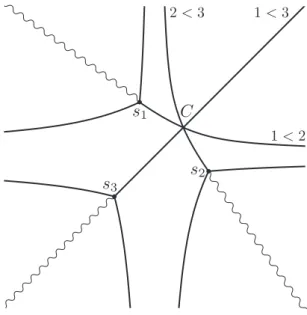
Figure 1.4.1 : The Stokes geometry of N2 with A1 = exp(3π√
−1/8). The wiggly lines designate the cut, and the label (j < k) indicates the order relation of the Stokes curve to which the label is attached; the indices in the labels are fixed by the appropriate cuts shown by the wiggly lines, and sj (j = 1,2,3) designates a simple turning point.
In Figure 1.4.1 one observes three ordinary Stokes curves meet at a point C, and this is an inevitable situation in view of the non-existence of a virtual turning point; if the Stokes curve emanating from s3 should fail to pass through the crossing point of the Stokes curve emanating from s1 and that from s2, we should be embarrassed how to deal with the ordered crossing point (in the sense of [HKT, Definition 1.4.2]) which is formed by the Stokes curves emanating from s1 and s2. Furthermore the explicit description of the bicharacteristic strip b emanating from a turning point (z0, ζ0), say s1, shows the following
Fact A. (y(r), z(r), ζ(r)) in the above description is single-valued. (Cf. (1.3.7), (1.3.11) [together with (1.3.13) and (1.3.16)] and (1.3.19).)
Fact B. The projection b= π(b) of the bicharacteristic strip b to the base manifold, that is, the bicharacteristic curve passing through s1 also passes through s2 and s3, and then comes back to s1.
Fact C. In parallel withFact Bthe bicharacteristic stripb emanating from (y0, z0, ζ0) (with η = 1) comes back to the same point when its projection π(b) makes a journey passing through s2 and s3 and coming back to s1.
To confirm Fact B and Fact C, it suffices to choose the parameter r to be
(1.4.1) r1 =ωα−α
and
(1.4.2) r2 =ω2α−α,
where ω = exp(2πi/3) and α is chosen so that z0 =z(r=r0 = 0) may be given by
(1.4.3) −3α2/8.
We note
(1.4.4) z(r=r1) =−3ω2α2/8,
(1.4.5) z(r=r2) =−3ωα2/8.
By those facts, we find (1.4.6)
∫ C s1
(ζ1−ζ2)dz+
∫ C s2
(ζ2−ζ3)dz =
∫ C s3
(ζ1−ζ3)dz, where (
ζ1(z), ζ2(z), ζ3(z))
are characteristic roots of q(z, ζ)|η=1 = 0 labeled in accor- dance with the cuts shown in Figure 1.4.1 and the paths of integration in (1.4.6) are chosen (rather freely thanks to Fact A) as in Figure 1.4.2 below.
Figure 1.4.2
By comparing (1.4.6) with [HKT, (1.4.32) and (1.6.4)] we find that s3 plays the same role, so to speak, as a virtual turning point in resolving the trouble caused by an ordered
crossing point of Stokes curves. Actually, in the current situation, not only the bicharac- teristic curve but also the bicharacteristic strip itself have self-intersection points, whose projection is s3. We note that clearly s3 is not an s-VTP by its definition requiring t′ ̸=t′′ (cf. Definition 1.1.1). We also note that in the definition of a (traditional) virtual (versus ordinary) turning point we implicitly assume the relevant characteristic roots are mutually distinct at a virtual turning point. With this implicit understanding, s3 is not a virtual turning point.
Remark 1.4.1. The stability (with respect to the parameter A) of the degeneration of the Stokes geometry shown in Figure 1.4.1 is evident from the fact that no virtual turning point appears there. Interestingly enough, however, such a degeneration with local stability can be found, as we will discuss in our subsequent article ([HiKT1]).
Remark 1.4.2. As we will show in [HiKT1] the Stokes curve emanating froms3 actually turns out to be inert after it passes over the pointC. To confirm this we analyze solutions of the non-linear equations associated with the Pearcey system (i.e., the counterpart of the Riccati equation associated with the Schr¨odinger equation) together with the connection formula formulated by Sasaki ([S, Section 2]).
§2. The Stokes geometry of the tangential system N (c)
§2.1. An s-virtual turning point of N (c)
To locate thes-VTP ofN (c), the tangential system ofM to the hyperplaneY(c) given by (0.6), we consider the restriction φ(c;x1, t) of φ(x, t) to Y(c), where
(2.1.1) φ(x, t) =t4+x2t2+x1t, that is
(2.1.2) φ(c;x1, t) =t4+c(x1−1)t2+x1t.
In this subsection we abbreviate x1 to x, that is,
(2.1.3) φ(c;x, t) =t4+c(x−1)t2+xt.
Then
(2.1.4) ψ(c;x, η) =
∫ exp(
ηφ(c;x, t)) dt
satisfies the tangential systemN (c), and we useφ(c;x, t) to locate thes-VTP ofN (c).
Let us first consider the equation
(2.1.5) φt(c;x, t) = 4t3+ 2c(x−1)t+x= 0,
and let (α, β, γ) denote the solutions of (2.1.5). Suppose that the pair of solutions (α, β) determines an s-VTP, that is,
(2.1.6) φ(c;x, α(x)) =φ(c;x, β(x)), where (α, β) satisfy (2.1.5), that is,
(2.1.7) 4α3+ 2c(x−1)α+x = 0
and
(2.1.8) 4β3+ 2c(x−1)β+x= 0,
with the additional condition
(2.1.9) α ̸=β.
Combining (2.1.7) and (2.1.8) with (2.1.9), we find
(2.1.10) 4(α2+αβ+β2) + 2c(x−1) = 0.
Similarly, by using (2.1.6) and (2.1.9), we obtain
(2.1.11) (α2 +β2)(α+β) +c(x−1)(α+β) +x= 0.
We also note that, since (α, β, γ) satisfy (2.1.5), we have
(2.1.12) α+β =−γ, αβγ =−x/4.
Hence we find
(2.1.13) x= 4αβ(α+β).
It then follows from (2.1.11) and (2.1.13) that
(2.1.14) (α2+β2)(α+β) + 4[c(α+β) + 1]αβ(α+β)−c(α+β) = 0.
Let M denote
(2.1.15) α2+β2+ 4cαβ(α+β) + 4αβ−c.
Then, again by (2.1.13), we obtain
(2.1.16) M =α2+β2+ 4αβ+c(x−1).
It then follows from (2.1.16) and (2.1.10) that we have
(2.1.17) M =α2+β2+ 4αβ−2(α2+αβ+β2) =−(α−β)2.
Since M ̸= 0 by (2.1.9), (2.1.14) and (2.1.15) imply
(2.1.18) α+β = 0.
Hence (2.1.13) entails that the s-VTP in question is given by
(2.1.19) x= 0.
Remark 2.1.1. In order to help the understanding of the role of (2.1.9) in the definition of an s-VTP, we present the following discussion: Suppose α(x) and β(x) merge at x♯. Then, in view of (1.1.5) applied to φ= φ(c;x1, t), we find that ξ = cα(x)2+α(x) and ξ′ = cβ(x)2+β(x) are two characteristic vectors the MOS involved, i.e., N (c), which is actually an ordinary differential equation; that is, two characteristic roots merge at x=x♯. Thus x♯ is an ordinary turning point. It is clear that
(2.1.20) (α, β) = (α(x♯), β(x♯))
satisfies (1.1.6), (1.1.7) and (1.1.8), but it does not satisfy (1.1.9). Hence it is not an s-VTP by its definition.
Remark 2.1.2. It is evident Y(c) approaches to a hypersurface parallel to Y2 = {x1 = A1}asctends to infinity. Then a natural question is: “What will be observed concerning the behavior of the s-VTP {x = 0} in Y(c) as c tends to infinity?” To answer this question, let us compute the value
(2.1.21) φ(c; 0, α(0)) =φ(c; 0, β(0)).
Since γ(0) is equal to 0, α(0) and β(0) are different from 0. Hence (2.1.7) and (2.1.8) imply
(2.1.22) 4α(0)2−2c= 4β(0)2−2c= 0.
Therefore we have
(2.1.23) φ(c; 0, α(0)) =φ(c; 0, β(0)) = (c
2 )2
− c2
2 =−c2 4 .
Hence in the variety V given by (1.1.5) the y-component associated with the s-VTP x = 0 tends to infinity. Thus by considering not only the x-component but also the y- component inV we find the result in this section is consistent with the result in Section 1.2, i.e., the non-existence of an s-VTP in N2.
§2.2. A non-hereditary turning point of N (c)
As is studied in [H3], a non-hereditary turning point (abbreviated as NHTP) is an ordinary turning point which appears in a tangential system. Here we give another
explanation of the origin of a NHTP, which is, from the logical viewpoint, different from the reasoning in [H3]; we make a straightforward use of the characteristic variety of N (c), which is given by (1.1.5) with φ(x, t) being given byφ(c;x, t) given in (2.1.3), that is,
(2.2.1) φ(c;x, t) =t4+c(x−1)t2+xt.
Making use of (1.1.5) we immediately find a point x∗ is an ordinary turning point if two cotangent vectors (ξ,1) = (
gradxφ(x, t(x)),1)
and (ξ′,1) = (
gradxφ(x, t′(x)),1) given in (1.1.5) merge at x = x∗, that is, if there exist continuous functions t(x) and t′(x) which satisfy
(2.2.2) ξ = gradxφ(x∗, t(x∗)) = gradxφ(x∗, t′(x∗)) =ξ′, with
(2.2.3) (gradtφ)(x, t(x)) = (gradtφ)(x, t′(x)) = 0.
Now, a non-hereditary turning pointx∗ is, by definition, supposed to further satisfy the following additional condition:
(2.2.4) t(x∗)̸=t′(x∗).
Remark 2.2.1. We will confirm in Remark 2.3.1 in the next subsection that the above definition coincides with the definition which is given ([H3]) through the relation of the characteristic variety of the Pearcey system and that of its tangential system N (c) on Y(c). Here we note that the condition (2.2.4) implies that the saddle points (x∗, t(x∗)) and (x∗, t′(x∗)) of the integral (2.1.4) are distinct.
Now, let us concretely locate the NHTP in this case. The relation (2.2.2) entails (2.2.5) ct(x∗)2+t(x∗) =ct′(x∗)2+t′(x∗).
Then, by (2.2.4), we find
(2.2.6) c(
t(x∗) +t′(x∗))
+ 1 = 0.
Since both t =t(x∗) and t =t′(x∗) satisfy
(2.2.7) 4t3 + 2c(x∗ −1)t+x∗ = 0,
(2.2.8) t= ˜t(x∗) =
def−(
t(x∗) +t′(x∗))
=c−1
should satisfy (2.2.7). Hence we find
(2.2.9) 4c−3+ 2(x∗−1) +x∗ = 0.
Hence the required NHTP x∗ is given by
(2.2.10) (2−4c−3)/3.
Remark 2.2.2. The same reasoning as above shows that no NHTP exists forN2 because of the assumption A1 ̸= 0 in (0.5). Then, in parallel with Remark 2.1.2, it is an interesting problem to study the behavior, asctends to infinity, of the cotangent vector ξ = gradxφ(c;x, t(x)) with gradtφ(c;x, t(x)) = 0, which is used to define the NHTP x∗. First we note
(2.2.6′) t(x∗) +t′(x∗) =−c−1. Further we find by (2.2.7), (2.2.8) and (2.2.10) the following:
(2.2.11) t(x∗)t′(x∗)˜t(x∗) =−x∗/4 and
(2.2.12) t(x∗)t′(x∗) =−cx∗/4.
Hence it follows from (2.2.10) that we have
(2.2.13) t(x∗)t′(x∗) = (2c−2−c)/6.
Thus we find that t(x∗) and t′(x∗) are solutions of the following equation:
(2.2.14) T2+c−1T + (2c−2−c)/6 = 0.
Then, as ξ=ct(x)2+t(x), we find at the NHTP x∗ the following:
(2.2.15) ξ = (−t(x∗) + (c2−2c−1)/6) +t(x∗) = (c2−2c−1)/6.
Hence ξ tends to infinity as c tends to infinity. This behavior of the cotangent vector associated with the NHTP x∗ is clearly consistent with the observation that no NHTP appears in N2.
§2.3. A computation of a bicharacteristic strip of N (c) with c= 1 In this subsection we present a computation of a bicharacteristic strip of the tangential system N (c) of M on Y(c).
To find the explicit form of the characteristic equation of the tangential system of the Borel transform of M on Y(c), we first introduce the coordinate change from x to z:
(2.3.1) z1 =x1,
(2.3.2) z2 =x2−c(x1−1).
Then we have
(2.3.3) ∂
∂x1 = ∂
∂z1 −c ∂
∂z2,
(2.3.4) ∂
∂x2
= ∂
∂z2
.
In what follows we let θj (j = 1,2) respectively denote
(2.3.5) σ0
((∂/∂zj)/(∂/∂y))
(j = 1,2).
Then in this coordinate system the characteristic variety of the Borel transform of M is given by
(2.3.6)
4(θ1−cθ2)3+ 2(z2+c(z1−1))(θ1−cθ2) +z1 = 0 (2.3.6.a)
θ2−(θ1−cθ2)2 = 0. (2.3.6.b)
Hence on Y(c) we have
(2.3.7)
4(θ1−cθ2)3+ 2c(z1−1)(θ1−cθ2) +z1 = 0 (2.3.7.a)
θ2−(θ1−cθ2)2 = 0. (2.3.7.b)
Remark 2.3.1. For the sake of the convenience of the reader, we note the content in the current situation of the definition of a non-hereditary turning point z1(0) given in [H3]:
If there exist two solutions (θ1(z1), θ2(z1)) and (θ′1(z1), θ′2(z1)) of (2.3.7) for which (2.3.8) θ1(z1(0)) =θ′1(z1(0))
and
(2.3.9) θ2(z1(0))̸=θ′2(z1(0))
are satisfied, then z1(0) is, by definition, a non-hereditary turning point. To see the relation of this notion and the definition of NHTP in Section 2.2, we first note that the
condition (2.2.3) allows us to assume without loss of generality that, with the identifi- cation x=z1, we have
(2.3.10) t(x) =θ1(z1)−cθ2(z1),
(2.3.11) t′(x) =θ1′(z1)−cθ2(z1).
Then (2.3.7.b) entails
(2.3.12) θ2(z1) =t(x)2 and θ′2(z1) =t′(x)2. Hence (2.3.8) can be rewritten as
(2.3.13) t(z1(0)) +ct(z(0)1 )2 =t′(z1(0)) +ct′(z1(0))2.
This relation coincides with the characterization (2.2.5) of a NHTPx∗. Further (2.3.8) and (2.3.9), together with (2.3.10) and (2.3.11), entail
(2.3.14) t(z1(0))̸=t′(z1(0)).
This coincides with (2.2.4). Thus we have seen that the notion of a NHTP introduced in Section 2.2 and that given in [H3] are the same.
For the sake of simplicity of presentation, we assume c= 1 in what follows. Then our first task is to eliminate θ2 in (2.3.7). By substituting (2.3.7.b) into (2.3.7.a) with c= 1, we find
(2.3.15) 4θ2(θ1−θ2) + 2(z1−1)(θ1−θ2) +z1 = 0.
By rewriting (2.3.7.b) as
(2.3.16) θ22 = (2θ1+ 1)θ2 −θ21 we obtain from (2.3.15) and (2.3.16)
(2.3.17) −4θ1θ2−4θ2−2(z1−1)θ2+ 4θ21+ 2(z1−1)θ1+z1 = 0, and hence, by using
(2.3.18) θ2 = 1
2 [
(2θ1+ 1)±√
4θ1+ 1 ]
,
we conclude
(2.3.19) 4θ12+ 2(z1−1)θ1+z1 = (2θ1+ 1 +z1)(2θ1+ 1±2√
4θ1 + 1 ).
A straightforward computation then shows (2.3.19) results in (2.3.20) −6θ1−1 =±(2θ1+ 1 +z1)√
4θ1+ 1.
Thus we have eliminated θ2 in (2.3.7). In what follows we abbreviate (z1, θ1) to (z, θ), and we fix the branch of √
4θ+ 1 by choosing
(2.3.21) √
4θ+ 1
θ=0
= 1 with the cut
(2.3.22) {θ ∈C; Reθ≤ −1
4,Imθ = 0}. Then we let q+ (resp., q−) denote
(2.3.23) 6θ+ 1 + (2θ+ 1 +z)√
4θ+ 1 (
resp., 6θ+ 1−(2θ+ 1 +z)√
4θ+ 1 ) ,
and define
(2.3.24) Q=q+q−.
By our computation presented in the above we find that the characteristic variety of N (c= 1) is given by
(2.3.25) Q= 0.
Now, at (z0, θ0) =
def(−2/3,−1/6), bothq+andq− vanish, and it follows from the concrete expression (2.3.23) that each of them is with simple characteristics. Hence we can compute the bicharacteristic strip b of, say q=
defq−, that emanates from (z0, θ0). The purpose of this subsection is to study the relation of a self-intersection point ofb and the s-VTP of N (c) discussed in Section 2.1. The effect on the global structure of N (c) of the multiple characteristic character of Q at (z0, θ0) will be studied in our forthcoming article ([HiKT2]). Incidentally we note that z0 =−2/3 is the NHTP given by (2.2.10) with c= 1.
Now, the differential equation that describes the bichracteristic strip b for q =q− is given by (2.3.26) given below. There we let (ζ, η) denote (σ1(∂/∂z), σ1(∂/∂y)) and henceθ =ζ/η. To avoid the possible confusion of the reader, we note that the degree of q with respect to the cotangent vectorθ is kept to be 0. (In Section 1.3, the counterpart of q in the above is multiplied by η3/2 to simplify the computation; this time it does
not seem to be of much help.)
(2.3.26)
dz dσ = ∂q
∂ζ =η−1(
6−2√
4θ+ 1−2(2θ+ 1 +z)/√
4θ+ 1)
(2.3.26.a) dy
dσ = ∂q
∂η =−ζη−2(
6−2√
4θ+ 1−2(2θ+ 1 +z)/√
4θ+ 1)
(2.3.26.b) dζ
dσ =−∂q
∂z =√
4θ+ 1 (2.3.26.c)
dη
dσ = 0 (2.3.26.d)
with the initial data at σ = 0 is given by
(2.3.27) (
z(0), y(0); ζ(0), η(0))
= (−2/3,0; −1/6,1).
Then we find
(2.3.28) η= 1
and hence by (2.3.26.c)
(2.3.29) dθ
dσ =√
4θ+ 1.
Let χ denote √
4θ+ 1, and then we have
(2.3.30) χ2 = 4θ+ 1.
Hence (2.3.29) entails
(2.3.31) χ dχ
dσ = 2dθ
dσ = 2χ.
Sinceχ(σ = 0) =√
4θ(0) + 1 = 1/√
3, we may assumeχis different from 0 near σ= 0.
Then we obtain
(2.3.32) dχ
dσ = 2, and hence
(2.3.33) χ= 2σ+ (1/√
3 ).
Let α and ˜σ be respectively defined by
(2.3.34) α= 1/(2√
3 )
and
(2.3.35) σ˜ =σ+α.
Then (2.3.30) and (2.3.31) entail
(2.3.36) θ = ˜σ2−(1/4).
It follows from (2.3.26.a) together with (2.3.28), (2.3.33), (2.3.35) and (2.3.36) that we find
dz dσ = dz
d˜σ = 6−2χ−2(2θ+ 1 +z)/χ (2.3.37)
= 6−2χ−(4θ+ 1 + 2z+ 1)/χ
= 6−3χ−(2z+ 1)/χ
= 6−6˜σ−(z+ (1/2))/˜σ.
Thus we obtain
(2.3.38) σ˜dz
d˜σ +z =−1
2 + 6˜σ−6˜σ2.
Therefore z(˜σ) has the following form (2.3.39) with some constant C−1: (2.3.39) z(˜σ) =C−1σ˜−1− 1
2 + 3˜σ−2˜σ2. Since
(2.3.40) z(σ = 0) =z(˜σ =α) =−2/3, we find
(2.3.41) −2
3 =C−1α−1− 1
2 + 3α−2α2. Thus we find
(2.3.42) C−1 =−1
4.
Using this expression of z(σ) together with (2.3.28), (2.3.33) and (2.3.36), we find by (2.3.26.b) the following:
dy dσ = dy
d˜σ =−6θ+ 2θχ+θ[
(4θ+ 1) + (2z+ 1)] /χ (2.3.43)
=−6θ+ 3θχ+θ(2z + 1)/χ
=−6˜σ2+ 3
2 + 6˜σ(
˜ σ2− 1
4 )+(
˜ σ− 1
4σ˜−1)(
− 1
4σ˜−1+ 3˜σ−2˜σ2)
= 4˜σ3−3˜σ2−σ˜+ 1 2 + 1
16σ˜−2.
Hence, by taking into account the initial condition
(2.3.44) y(σ = 0) =y(˜σ =α) = 0,
we have
(2.3.45) y(˜σ) = ˜σ4−σ˜3− 1
2σ˜2+ 1
2˜σ− 1
16σ˜−1+A, where
(2.3.46) A =
√3 18 + 5
144.
Now, let us confirm by using (2.3.39) and (2.3.45) that the bicharacteristic curve of q emanating from (z(σ = 0), y(0)) forms a self-intersection at z = 0. To see this let us compute (
z(˜σ±), y(˜σ±)) for
(2.3.47) σ˜± =
def
1±√ 2 2 .
Here, and in what follows, the sign±should be understood to be chosen correspondingly, that is, (2.3.47) means
(2.3.47′) σ˜+ = 1 +√
2 2 and
(2.3.47′′) σ˜− = 1−√
2 2 . With this understanding (2.3.47) entails the following:
(2.3.48) σ˜−±1 =−2(1∓√
2 ),
(2.3.49) σ˜±2 = 3±2√
2
4 ,
(2.3.50) σ˜±3 = 7±5√
2
8 ,
and
(2.3.51) σ˜4± = 17
16 ± 3 4
√2.
Hence we find
(2.3.52) z(˜σ±) = 0
and
(2.3.53) y(˜σ±) =A + 3
16. To stay on the safer side, we further note
(2.3.54) θ(˜σ±) = 1±√
2
2 .
Thus we find that {z = 0} is not an ordinary turning point but a (traditional) turning point given by the self-intersection point
(2.3.55) (z, y) =(
0,A + 3 16
),
which is formed by a bicharacteristic curve emanating from (z, y) = (−2/3,0). Thus we have seen the s-VTP detected in Section 2.1 is also a virtual turning point in the traditional sense.
§3. A simple example of the change of the redundancy and the non-redundancy of a virtual turning point
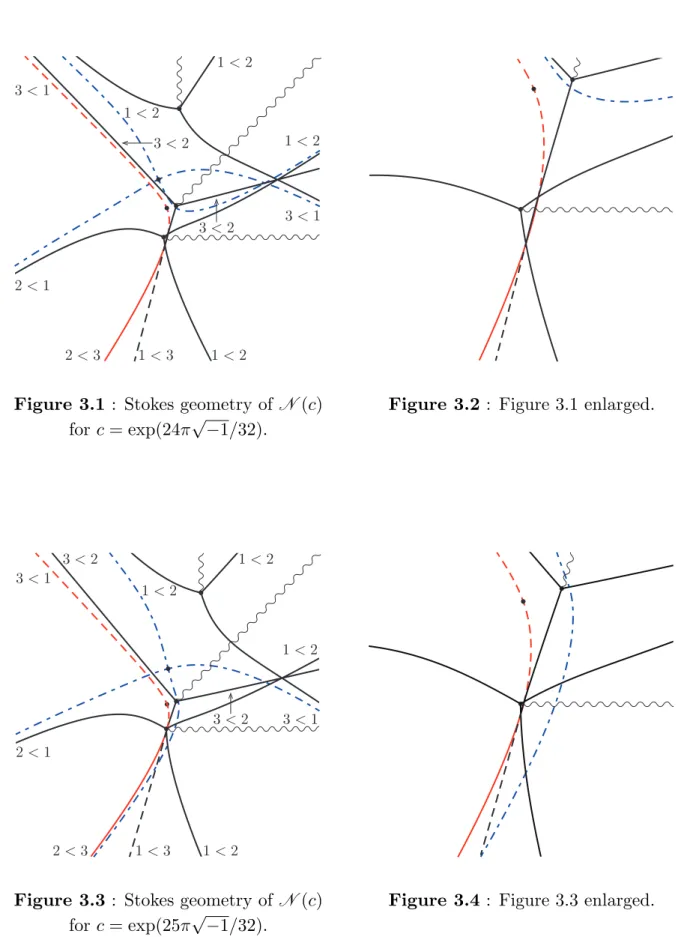
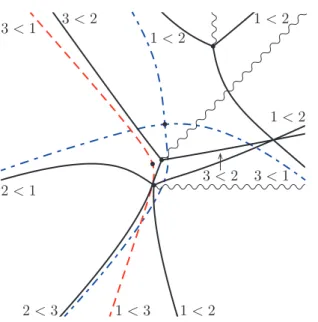
As was first observed in [H2], it sometimes occurs that a redundant virtual turning point turns out to be a non-redundant one with the change of a parameter contained in the equation in question. In this section we show that the same phenomenon occurs in a much simpler situation, i.e., when we change the parameter c in the tangential system N (c) of M to Y(c). Furthermore the finiteness of the number (actually, the uniqueness) of its s-virtual turning points implies that the redundancy observed here is not an experimental one (in the sense that within the limited screen shown by a computer) but a rather theoretical one (in the sense that the Stokes curve studied here cannot become active even out of the scope of the figure). We hope the following figures will also help the reader to imagine the Stokes geometry of N (c) in general.
Now, Figures 3.1, 3.3, 3.5 and 3.7 indicate the Stokes geometry of the system N (c) for c = exp(πj√
−1/32) with j = 24,25,26 and 27, respectively. (Figures 3.2, 3.4, 3.6 and 3.8 are their enlarged versions.) In Figures 3.1 and 3.3 a new Stokes curve written in red (please see the colored figures in the preprint version of this paper appearing on http://www.kurims.kyoto-u.ac.jp/preprint/preprint y2017.html;
in the printed version the new Stokes curve in question is written in black) emanating from the unique virtual turning point of N (c) has a solid portion. This means that some Stokes phenomena for WKB solutions of N (c) are observed on this portion and the virtual turning point in question is non-redundant. On the other hand, in Figures 3.5 and 3.7 the whole portion of the same new Stokes curve is dotted and hence the
Figure 3.1: Stokes geometry of N (c) for c= exp(24π√
−1/32).
Figure 3.2: Figure 3.1 enlarged.
Figure 3.3: Stokes geometry of N (c) for c= exp(25π√
−1/32).
Figure 3.4: Figure 3.3 enlarged.
Figure 3.5: Stokes geometry of N (c) for c= exp(26π√
−1/32).
Figure 3.6: Figure 3.5 enlarged.
Figure 3.7: Stokes geometry of N (c) for c= exp(27π√
−1/32).
Figure 3.8: Figure 3.7 enlarged.
virtual turning point is redundant. Thus these figures clearly show that the redundancy of the virtual turning point of N (c) varies with the change of c.
References
[A] T. Aoki: Toward the exact WKB analysis of holonomic systems, RIMS Kˆokyˆuroku, 1433, pp.1–8, 2005. (In Japanese.)
[AKT] T. Aoki, T. Kawai and Y. Takei: New turning points in the exact WKB analysis for higher-order ordinary differential equations, Analyse alg´ebrique des perturbations singul`ıeres I, pp.69–84, Hermann, Paris, 1994.
[BNR] H. L. Berk, W. M. Nevins and K. V. Roberts: New Stokes’ lines in WKB theory, J. Math. Phys.,23(1982), 988–1002.
[H1] S. Hirose: On the Stokes geometry for the Pearcey system and the (1,4) hypergeo- metric systems, RIMS Kˆokyˆuroku Bessatsu, B40, pp.243–292, 2013.
[H2] : On the redundant and non-redundant virtual turning points for the AKT equation, RIMS Kˆokyˆuroku Bessatsu,B57, pp.39–59, 2016.
[H3] : The article in this proceedings.
[HiKT1] S. Hirose, T. Kawai and Y. Takei: On the Stokes geometry ofA4-system. In prepa- ration.
[HiKT2] : On the microlocal analysis of multiple characteristic points in a tangential system. In preparation.
[HKT] N. Honda, T. Kawai and Y. Takei: Virtual Turning Points, Springer, 2015.
[PS] T. Poston and I. Stewart, Catastrophe Theory and Its Applications, Pitman, Lon- don, 1978.
[S] S. Sasaki: On parametric Stokes phenomena of higher order linear ODEs. RIMS Kˆokyˆuroku Bessatsu, B61, pp.163–180, 2017.
[SKK] M. Sato, T. Kawai and M. Kashiwara: Microfunctions and pseudo-differential equa- tions, Lect. Notes in Math., 287, Springer, pp.265–529, 1973.
[W] F. J. Wright: The Stokes set of the cusp diffraction catastrophe, J. Phys. A, 13 (1980), 2913–2928.