154 KONICA MINOLTA TECHNOLOGY REPORT VOL. 18 (2021)
要旨
多くの設計・目的パラメターがある複雑なデバイスの 設計において,エンジニアや研究者が制約条件を克服し 複数の目的パラメターを最適化するデバイスのデザイン セット,即ち設計パラメターのセットを見つける事を可 能にするソフトウェアのツールボックスを開発しました。 このツールボックスを用い,実際に複数の周波数領域で 高い音響透過抑制を可能にする音響メタマテリアルのデ ザインを試みました。音響メタマテリアルは従来の質量 法則に従う遮音材料に比して軽量な代替材料であり,自 動車や航空など多くの産業で活用されることが期待され ています。Abstract
A multi-objective optimization toolbox, which enables the engineer and researcher to navigate complex design and performance landscapes and find the optimum set of designs, has been developed. This toolbox can be applied in various disciplines, e.g. optimization of materials formulation or processing. In this study, the toolbox was used to design acoustic metamaterials with high sound transmission loss at multiple frequencies. These metamaterials can be light-weight alternatives to conventional mass-loaded acoustic insulating materials and could find many industrial applica-tions, such as in the automotive or aviation industries.
*Konica Minolta Laboratory USA, Konica Minolta Business Solutions USA, San Mateo, CA, USA
** Computational Fabrication Group, Computer Science and Artificial Intelligence Laboratory, Massachusetts Institute of Technology, Cambridge, MA, USA
Solving a Hard Multi-Objective Problem -
Optimization of Noise Absorbing Metamaterials
155 KONICA MINOLTA TECHNOLOGY REPORT VOL. 18 (2021)
1 Introduction
In the search and design process for a new material or component, researchers and engineers are faced with the task to pick the right ingredients or param-eters in order to obtain the optimal performance of the new material or design. With the availability of increasing amounts of data, the demand for improved performance in various fields and increasingly com-plex designs, this task can overwhelm the researcher. A traditional approach based on the researcher’s intu-ition or based on a simple visualization of the rela-tionship between one or two design parameters and the performance might not yield the optimal design. In addition, various performance goals might contra-dict each other. For instance, a car engine should be optimized for maximum fuel mileage, maximum power, minimum emissions and maximum reliability (Fig. 1). The number of parameters in designing an engine, such as displacement, number of cylinders, type of fuel is almost endless. The relationships between the large number of parameters (design space) and the performance space (e.g. fuel mileage, power output) are often complex and the parameters are interdepen-dent. This makes it difficult to find the optimal design. In fact, with multiple performance goals (objectives) and an unknown weighting between objectives (e.g., how much horsepower is the customer willing to sac-rifice for a 5 % gain in fuel mileage), there is no single optimal design that satisfies all objectives. Instead, there are multiple conflicting optimal designs which lie on the Pareto front (Fig. 3). The definition of the design set lying on the Pareto front (the Pareto set) is that there are no designs that offer improved perfor-mance in all perforperfor-mance directions. Those offering improved performance in one direction (e.g. engine power) have worse performance in another direction (e.g. fuel mileage).
These types of optimization problems are called multi-objective optimizations and are encountered in various disciplines, for instance formulation of poly-mer materials (e.g. type and ratio of ingredients vs. strength and cost), materials processing (e.g. tem-perature and time vs. strength and throughput), or component design (e.g. wall thickness and material type vs. stiffness and weight) [1]. In order to navigate these complex problems and to accelerate the dis-covery of optimal designs, we conducted an open innovation research project with the Computational Fabrication group under Professor Matusik at Massachusetts Institute of Technology, Computer
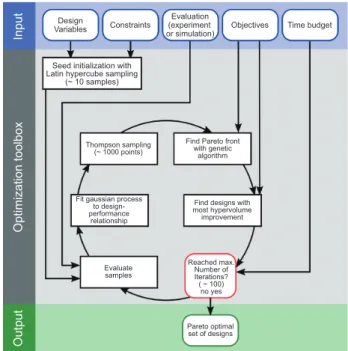
Science and Artificial Intelligence Laboratory and developed a toolbox that enables the engineer to eas-ily tackle difficult optimization problems (Fig. 2). This optimization toolbox was applied to the design of acoustic metamaterials using both simulations and experiments. These acoustic metamaterials offer out-standing noise attenuation at certain frequencies without the heavy weight of conventional acoustic insulating materials. Furthermore, acoustic metama-terials can be tailored to deliver optimal performance for a given use case [2].
Fig. 1 Illustration of design space and performance space, exemplified on a combustion engine vehicle. The four symbols represent dif-ferent engine designs.
Fig. 2 Flow chart of optimization toolbox.
Turbo boost pressur e Design space Performance space Powe r Hybrid Fuel mileage Engine size Input Optimization toolbox Pareto optimal set of designs Output Design Variables Constraints Evaluation (experiment
or simulation) Objectives Time budget Seed initialization with
Latin hypercube sampling (~ 10 samples)
Thompson sampling (~ 1000 points)
Evaluate samples Fit gaussian process
to design-performance
relationship
Find designs with most hypervolume improvement Find Pareto front
with genetic algorithm Reached max. Number of Iterations? ( ~ 100) no yes
2 Acoustic Metamaterials
Metamaterials are artificial materials whose prop-erties are determined by their engineered structures, not by the properties of the constituent materials. Metamaterials are designed to manipulate waves, e.g. electromagnetic waves (e.g. light, radio signal) or
156 KONICA MINOLTA TECHNOLOGY REPORT VOL. 18 (2021) acoustic waves (e.g. sound, ultrasound). They can
be designed to bend, focus, reflect or absorb waves. Acoustic metamaterials manipulate sound waves and typically use membranes or resonators. We have used the optimization toolbox to design an acoustic metamaterial that can attenuate road noise emanat-ing from a tire, based on a startemanat-ing material found in the literature [3]. It is light weight and can be installed in car wheel wells or in other locations in the vehicle. It consists of a honeycomb structure with membranes and can be 3D-printed. It is lighter than conventional mass-loaded acoustic insulating materials. Compared to conventional fabrication technologies (e.g. extru-sion, injection molding), 3D-printing enables com-plex designs without penalizing cost or manufactur-ability and thus represents an excellent use case for optimization over a large design space. With multi-material 3D-printing, as applied in this project, the design space is enlarged even further.
A typical tire road noise spectrum has two maxima at 800 Hz and 1600 Hz [4]. For that reason, we chose to optimize the design for two objectives: Maximize the sound transmission loss at 800 Hz and 1600 Hz. We started with a simple metamaterial with a honey-comb-membrane structure based on the state of the art (Fig. 4) and computed its performance using COMSOL Multiphysics simulation. We then per-formed a sensitivity analysis in order to identify design parameters which have the most effect on the performance (e.g. cell size, cell thickness, membrane stiffness). We optimized these parameters in order to obtain optimal performance for the road noise use case described above.
We connected the optimization toolbox to the COMSOL simulation software. In an iterative cycle, the optimization tool, based on the previous designs and their performances, proposes designs that likely offer improved performance, and the simulation soft-ware validates the performance of the proposed designs. More precisely, the optimization tool uses Gaussian processes in order to model the relationship between the design space and each objective. Then, Thompson sampling efficient multi- objective optimi-zation (TSEMO) algorithm is used to determine the designs that most likely yield improved performance for each objective [5]. Thompson sampling considers the probability distribution of performances for each design. Lastly, a genetic algorithm picks the designs that yields the most overall improvement after com-bining all objectives. These designs are then pro-posed to the simulation software. After validation of
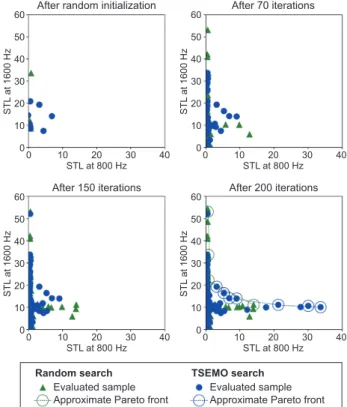
the design by the simulation software (or by experi-ment), this cycle is repeated about 200 times, depend-ing on the complexity of the design and the cost to evaluate the performance. Finally, a Pareto set of about 10 designs is obtained and the engineer can decide which of those designs is best for the given application. A comparison between TSEMO-guided performance optimization and random search shows that almost all points on the approximate Pareto front were found by TSEMO search and only few by ran-dom search (Fig. 3).
After finding the optimal designs in the simple design space, we allowed the simulation to explore more complex designs beyond regular hexagonal honeycombs. This led to even better performance. Fig. 5 shows the performance of various designs. Designs optimized for a single objective (either 800 Hz or 1600 Hz) typically yield poor performance at the other frequency. Simple design search approaches, which only optimize one design parameter while keeping all others constant, also show poor perfor-mance. Similarly, reducing the complexity by limiting the design to regular hexagons only, showed subopti-mal performance. In contrast, using the new toolbox with multi-objective optimization yielded designs that perform well at both objectives.
Random search TSEMO search
Evaluated sample
Approximate Pareto front Evaluated sampleApproximate Pareto front After random initialization
ST L at 1600 Hz ST L at 1600 Hz ST L at 1600 Hz ST L at 1600 Hz After 70 iterations
After 150 iterations After 200 iterations
STL at 800 Hz STL at 800 Hz STL at 800 Hz STL at 800 Hz 60 50 40 30 20 10 00 10 20 30 40 0 10 20 30 40 0 10 20 30 40 0 10 20 30 40 60 50 40 30 20 10 0 60 50 40 30 20 10 0 60 50 40 30 20 10 0
Fig. 3 Optimization of an acoustic metamaterial with the optimization toolbox. The performance space after various iterations is shown, comparing TSEMO optimization with random search. The approx-imate Pareto front is indicated by circles in the last graph. STL = sound transmission loss.
157 KONICA MINOLTA TECHNOLOGY REPORT VOL. 18 (2021)
3 Conclusion
An optimization toolbox that allows the researcher and engineer to find optimal solutions to complex problems has been developed as a part of the open innovation collaborative research project between Konica Minolta Laboratory USA, Research Division and Massachusetts Institute of Technology, Computer Science and Artificial Intelligence Laboratory. We successfully applied this tool to 3D-printed acoustic metamaterials. This multi-objective optimization pro-cess will accelerate the design propro-cess in various disciplines, such as single-material and multi-mate-rial 3D-printing, matemulti-mate-rials formulation and matemulti-mate-rials processing.
References
1) Tanabe, Ryoji, and Hisao Ishibuchi. “An easy-to-use real-world multi-objective optimization problem suite”. Applied Soft Computing 89 (2020): 106078.
2) Bruening, Karsten, Wan Shou, Mina Konaković Luković, Beichen Li, Kui Wu, Xianchen Xu, Jun Amano, Wojciech Matusik. “Active Learning with Multi-objective Optimization for 3D-printed Acoustic Metamaterials Combining Simulations and Experiments”. Fall Meeting of the Materials Research Society, Boston, MA, December (2020)
3) “Soundproofing material”. Patent No. WO2019022245A1, (2019)
4) Li, Tan. “Influencing Parameters on Tire–Pavement Interaction Noise: Review, Experiments, and Design Considerations”. Designs 2.4, p.38 (2018)
5) Bradford, Eric, Artur M. Schweidtmann, and Alexei Lapkin. “Efficient multiobjective optimization employing Gaussian processes, spectral sampling and a genetic algorithm”. Journal of Global Optimization 71.2, pp.407-438 (2018)
a) b) Sound out Sound in a b c d Starting material Regular hexagons only Regular and irregular hexagons
Approximate Pareto front for regular hexagons only Approximate Pareto front for regular and irregular hexagons Single-objective optimization for 800 Hz
Single-objective optimization for 1600 Hz Multi-objective optimization for 800 Hz and 1600 Hz 50 40 30 20 10 0 0 2 4 STL at 800 Hz [dB] ST L at 1600 Hz [dB ] 6 8 10
Fig. 4 Sketch of the acoustic metamaterials. a) Perspective projection of the material with regular hexagons. Blue indicates elastic mem-branes, grey indicates rigid cell walls. b) Honeycomb structure with regular periodic unit cells consisting of seven irregular hexa-gon cells. a, b, c, d are design parameters.
Fig. 5 Sound transmission loss (STL) performances of various optimized acoustic metamaterials, compared to the starting material. Better performance can be achieved with more complex designs.