An
$O(logn)$
parallel
algorithm
for constructing
a
spa.nning
forest
on.
$\mathrm{T}\mathrm{r}\mathrm{a}_{\mathrm{P}.\mathrm{g}\mathrm{r}}\mathrm{e}\mathrm{z}\mathrm{o}\mathrm{i}\mathrm{d}\sim$.aphs
本間 宏利 $($
Hirotoshi
$\mathrm{H}_{\mathrm{o}\mathrm{n}\mathrm{m}\mathrm{a}})^{\uparrow}$ 増山繁
(Shigeru
$\mathrm{M}\mathrm{a}\mathrm{s}\mathrm{u}\mathrm{y}\mathrm{a}\mathrm{m}\mathrm{a}$)
$\mathrm{I}$
\dagger Department of
lnformation Engineering,
Kushiro National
College
of
Technology,
Kushiro-shi,
Hokkaido
084,
JAPAN
\ddagger
Department
of Knowledge-Based lnformation Engineering,
Toyohashi UniV-ersity- of Technology
Toyohashi-shi,
Aichi
441,
JAPAN
Abstract
Let $G=(V, E)$ be a simple graph with $n$ vertices, $m$ edges and $p$ connected
com-ponents. The problem of constructing a spanning forest is to find a spanning tree for each connected component of$G$
.
For a simple graph, Chin et $\mathrm{a}1.[1]$ demonstratedthata spanning forest can be found in $O(log^{2}n)$ time using $O(n^{2}/log^{2}n)$ processors. In
this paper, we propose an $O(logn)$ time parallel algorithm with $O(n)$ processors on
the EREW PRAM for constructing a spanning forest on trapezoid graphs.
1
Introduction
Given a simple graph $G=(V, E)$ with $n$ vertices, $m$ edges and $p$ connected components, the
spanning forest problem is to find a spanning tree for each connected component of $G$
.
If$p=1$ for $G$, i.e., $G$ is connected, the spanning forest problem is equivalent to the spanning
tree problem of finding a connected subgraph which is a tree and contains all the vertices of $G$
.
These problems have applications to electrical power demand problem or computernetwork design problem etc. A spanning tree and a spanning forest can be found in linear timeusing, for example, the depth-first search. In recent years alarge number of studies have
been made to parallelize known sequential algorithms. The spanning tree probIem can be solved in $o(logn)$ time with $O(logn+m)\tau$ processors on CRCW PRAM (Concurrent-Read
Concurrent-Write Parallel
Rando..m
$\mathrm{A}\mathrm{c}$.cess
Machine) by$\mathrm{K}\mathrm{l}\mathrm{e}\mathrm{i}\mathrm{n}[5].\mathrm{e}\mathrm{t}$al.’s
$\mathrm{a}$
.lgorithm.
Moreover,$\mathrm{C}\mathrm{h}\mathrm{i}\mathrm{n}[1]$ et al. demonstrated that a spanning forest can be found in $O(log^{2}n)$ time using
$O(n^{2}/log^{2}n)$ processors for simple graphs. In general, it is known that more efficient or
optimal parallel algorithms can be developed by restricting classes of graphs. For instance,
permutation $graphs[2]$ which runs in $O(logn)$ time using $O(n/logn)$ processors on the EREW PRAM (Exclusive-Read Exclusive-Write Parallel Random Access Machine). In this
paper, we propose an efficient parallel algorithm which runs in $O(logn)$ time with $O(n)$
processors for constructing a spanning forest by restrictingthe class of graphs to trapezoid
$graphs[6]$
.
We next illustrate the trapezoid graph. There are two horizontal lines, called the top
channel and the bottom channel, respectively. Each channel is labeled with consecutive integer values $1’,2,\ldots,2n$ (where $n$ is the number of
$\mathrm{t}\mathrm{r}\mathrm{a}\mathrm{p}\mathrm{e}\ldots \mathrm{z}$oids). A trapezoid $T_{i}$ is defined
by four corner points $[a_{i}, b_{i}, c_{i}, d_{i}]$ where $a_{i},$ $b_{i}(a_{i}<b_{i})$ lie on the top channel and
$c_{i},$ $d_{i}$
$(c_{i}<d_{i})$ lie on the bottom channel, respectively. Without loss of generality, we assume that
each trapezoid has four corner points and all corner points are $\mathrm{d}\mathrm{i}\mathrm{s}\mathrm{t}\mathrm{i}\mathrm{n}\mathrm{C}\mathrm{t}[6]$
.
The geometricrepresentation described above is called a trapezoid diagram $T$.
Figure 1: Trapezoid diagram $T$.
Figure 1 shows a trapezoiddiagram$T$consisting of seventeen trapezoids. We assumethat
trapezoids are labeled in increasing order of their corner points $b_{i}’ \mathrm{s}$, i.e., $i<j$ if $b_{i}<b_{j}$
.
Anundirected graph $G=(V, E)$ is called a trapezoid graph ifthere exists a trapezoid diagram $T$ satisfying
$V=$
{
$i|$ vertex $i$ corresponds to trapezoid $T_{i}$},
$E=$
{
$(i,j)|$ trapezoids $T_{i}$ and $T_{j}$ intersect in trapezoid diagram $T$}
$.[6]$Input of trapezoid diagram consists of array $T_{T}[1 : 2n]$ ofcorner points, array $P_{T}[1 : 2n]$
of corner point numbers each of which is assigned to each corner point on the top channel
and array $T_{B}[1:2n]$ ofcorner points, array $P_{B}[1 : 2n]$
. ofcorner point numbers each of which
is assigned to each corner point on the bottom channel. Table 1 shows $T_{T}[1:2n],$ $P_{T}[1:2n]$,
$T_{B}[1 : 2n],$ $P_{B}[1 : 2n]$ for trapezoid diagram $T$ shown in Figure 1. The trapezoid graph $G$
class of trapezoid graphs includes two well-known classes ofintersection $\mathrm{g}\mathrm{r}\mathrm{a}\mathrm{p}\mathrm{h}\mathrm{S}[2]$, the class
of permutation $graph_{S}[2]$ and the class of interval $graphs[2]$
.
The former is obtained bysetting $a_{i}=b_{i}$ and $c_{i}=d_{i}$ for all $i$, and the latter is obtained by setting
$a_{i}=c_{i}$ and $b_{i}=d_{i}$
for all $i$, respectively.
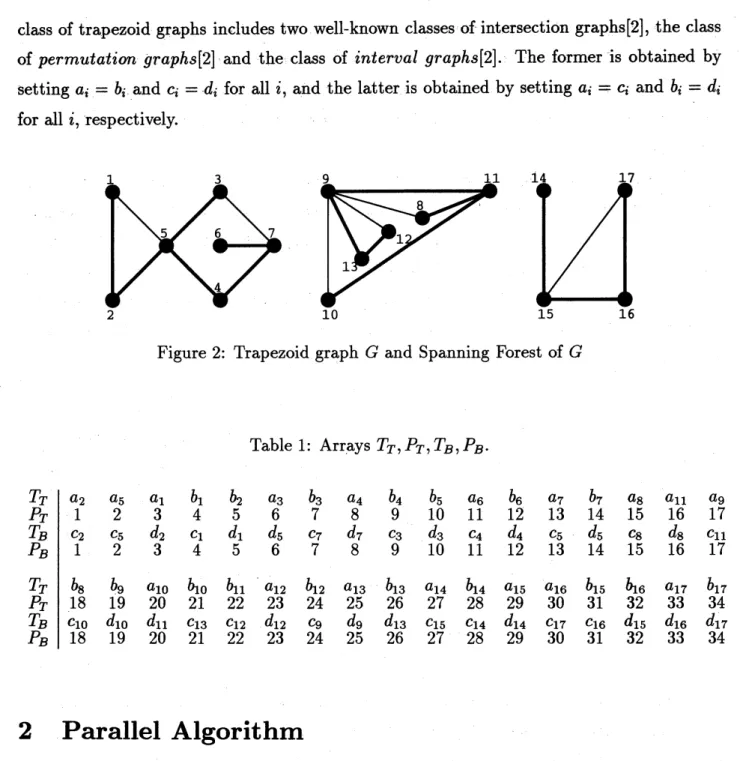
Figure 2: Trapezoid graph $G$ and Spanning Forest of $G$
Table 1: Arrays $\tau_{\tau},$$P_{T},$$TB,$$P_{B}$.
$P_{T}T_{T}$ $a_{2}1$ $a_{2^{5}}$ $a_{3^{1}}$ $b_{1}4$ $b_{2}5$ $a_{3}6$ $b7^{3}$
$a_{8^{4}}$
$b_{4}$ $b_{5}$
$a_{6}$ $b_{6}$ $a_{7}$ $b_{7}$ $a_{8}$ $a_{11}$ $a_{9}$
9 10 11 12 13 14 15 16 17
$P_{B}^{B}T$ $c_{2}1$ $c_{2^{5}}$ $d3^{2}$ $c_{1}4$ $d_{1}5$ $d6^{5}$ $c_{7^{7}}$ $d_{7}8$ $c_{9^{3}}$ $10d_{3}$ $11c_{4}$ $12d_{4}$ $13c_{5}$ $d_{5}14$ $15c_{8}$ $16d_{8}$ $c_{11}17$
$T_{T}$ $b_{8}$ $b_{9}$ $a_{10}$ $b_{10}$ $b_{11}$ $a_{12}$ $b_{12}$ $a_{13}$ $b_{13}$ $a_{14}$ $b_{14}$ $a_{15}$ $a_{16}$ $b_{15}$ $b_{16}$ $a_{17}$ $b_{17}$
$P_{T}$ 18 19 20 21 22 23 24 25 26 27 28 29 30 31 32 33 34
$T_{B}$ $c_{10}$ $d_{10}$ $d_{11}$ $c_{13}$ $c_{12}$ $d_{12}$
$c_{9}$ $d_{9}$ $d_{13}$ $c_{15}$ $c_{14}$ $d_{14}$ $c_{17}$ $c_{16}$ $d_{15}$ $d_{16}$ $d_{17}$
$P_{B}$ 18 19 20 21 22 23 24 25 26 27 28 29 30 31 32 33 34
2
Parallel
Algorithm
In this section we propose a parallel algorithm for constructing a spanning forest of trape-zoid graphs. The algorithm can be parallelized by applying pointer jumping $\mathrm{t}\mathrm{e}\mathrm{c}\mathrm{h}\mathrm{n}\mathrm{i}\mathrm{q}\mathrm{u}\mathrm{e}[3][4]$
and parallel prefix $\mathrm{c}\mathrm{o}\mathrm{m}_{\mathrm{P}}\mathrm{u}\mathrm{t}\mathrm{a}\mathrm{t}\mathrm{i}\mathrm{o}\mathrm{n}[3][4]$
.
Algorithm CSF (Construction ofSpanning Forest) forconstructing a spanning forest of a trapezoid graph is presented as follows: Algorithm CSF
Input: Arrays $\tau_{\tau}[1:2n],$ $PT[1:2n],$ $\tau_{B}[1:2n],$ $PB[1:2n]$
.
$o_{utp}$ : A $\mathrm{s}\mathrm{p}\mathrm{a}\ldots \mathrm{n}$ning forest
(Step 1) [Construction of arrays $P_{a}[1:n],P_{b}[1:n],Pc[1:n],P_{d}[1:n].$]
(1) If $T_{T}[i]$ is corner point $‘ a_{j}’,$ $P_{T}[i]$ is stored to $P_{a}[j]$, otherwise (i.e., $T_{T}[i]$ is
.
$‘ b_{j}’)P_{T}[i]$ is stored to $P_{b}[i]$ in parallel for $i,1\leq i\leq 2n$
.
(2) If $T_{B}[i]$ is corner point $‘ c_{j}’,$ $P_{B[]}i$ is stored to $P_{c}[j]$, otherwise (i.e., $T_{B}[i]$ is
$‘ d_{j}’)P_{B}[i]$ is stored to $P_{d}[j]$ in parallel for $i,1\leq i\leq 2n$
.
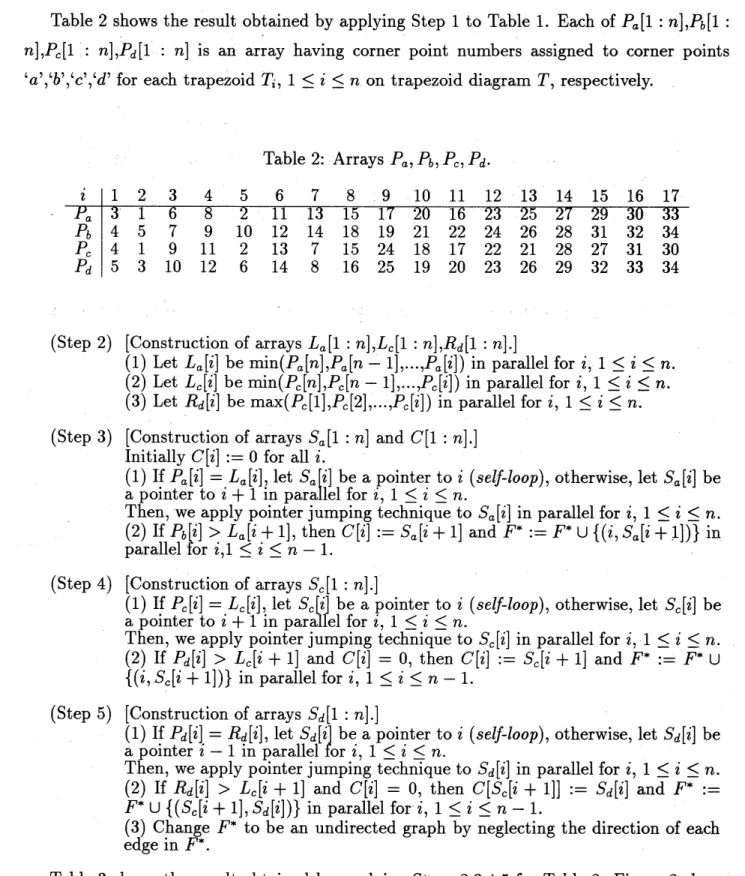
Table 2 shows the result $\mathrm{o}\mathrm{b}.\mathrm{t}$ained by $\mathrm{a}\mathrm{p}\mathrm{P}^{1}\mathrm{y}\mathrm{i}\mathrm{n}\mathrm{g}\sim$Step 1 to Table 1. Each of $P_{a}[1:n],P_{b}[1$ :
$n],P_{c}[1 : n],\dot{P}_{d}[1 : n]$ is an array having corner point numbers assigned to corner points
$‘ a’,‘ b’,‘ c’,‘ d$’ for each trapezoid $T_{i},$ $1\leq i\leq n$ on trapezoid diagram $T$, respectively.
Table 2: Arrays $P_{a},$$P_{b},$ $P\mathrm{C}’ P_{d}$
.
(Step 2) [Construction of arrays $L_{a}[1:n],L[C]1:n,R_{d}[1:n].$]
(1) Let $L_{a}[i]$ be $\min(P_{a}[n],P_{a}[n-1],\ldots,P_{a}[i])$ in parallel for $i,$ $1\leq i\leq n$
.
(2) Let $L_{c}[i]$ be $\min(P_{c}[n],P[\mathrm{C}n-1],\ldots,PC[i])$ in parallelfor $i,$ $1\leq i\leq n$
.
(3) Let $R_{d}[i]$ be $\max(P_{C}[1],Pc[2],\ldots,P_{\mathrm{C}}[i])$ in parallel for $i,$ $1\leq i\leq n$.(Step 3) [Construction of arrays $S_{a}[1:n.]$ and $C[..1$
:
$n].$]Initially $C[i]:=0$ for all $i$
.
$\mathrm{a}_{\mathrm{P}^{\mathrm{o}\mathrm{i}}+^{a}\mathrm{i}\mathrm{n}\mathrm{p}\mathrm{r}}(1)\mathrm{I}\mathrm{f}P_{a,\mathrm{e}}[\mathrm{n}\mathrm{t}\mathrm{r}\mathrm{t}_{\mathrm{o}i1}i]=L[i],1\mathrm{e}\mathrm{t}s_{a}\mathrm{a}\mathrm{a}\mathrm{f}_{11}^{i}]\mathrm{e}\mathrm{f}\mathrm{o}\mathrm{r}i,1\leq i\leq n\mathrm{b}\mathrm{e}\mathrm{a}\mathrm{p}\mathrm{o}\mathrm{i}\mathrm{n}\mathrm{t}\mathrm{e}\mathrm{r}\mathrm{t}_{0}i.$($self$-loop), otherwise, let
$S_{a}[i]$ be
Then, we apply pointerjumping technique to $S_{a}[i]$ in parallelfor $i,$ $1\leq i\leq n$
.
(2) If$P_{b}[i]>L_{a}[i+1]$, then $C[i]:=S_{a}[i+1]$ and $F^{*}:=F^{*}\cup\{(i, S_{a}[i+1])\}$ in parallel for $i,1\leq i\leq n-1$.
(Step 4) [Construction of arrays $s_{c}[1:n].$]
$\mathrm{a}\mathrm{p}_{\mathrm{o}\mathrm{i}}\mathrm{n}\mathrm{t}\mathrm{e}\mathrm{r}\mathrm{t}\mathrm{o}i+1\mathrm{i}\mathrm{n}\mathrm{p}\mathrm{a}\mathrm{r}\mathrm{a}\mathrm{f}_{\mathrm{e}1\mathrm{f}\mathrm{r}}^{\mathrm{b}\mathrm{o}_{1<}}\mathrm{e}\mathrm{a}\mathrm{p}\mathrm{i}\mathrm{n}\mathrm{t}\mathrm{e}\mathrm{r}\mathrm{t}\leq(1)\mathrm{I}\mathrm{f}P_{c}[i]=L_{C}[i],1\mathrm{e}\mathrm{t}s[_{1}Ci\mathrm{o}n\mathrm{o}i,ii$
.(self-loop), otherwise, let
$S_{c}[i]$ be
Then, we apply pointerjumping $\mathrm{t}\mathrm{e}\mathrm{c}\overline{\mathrm{h}\mathrm{n}}\mathrm{i}\mathrm{q}\mathrm{u}\mathrm{e}$ to
$S_{c}[i]$ in parallel for $i,$ $1\leq i\leq n$
.
(2) If $P_{d}[i]>L_{c}[i+1]$ and $C[i]=0$, then $C[i]:=S_{c}[i+1]$ and $F^{*}:=F^{*}\cup$$\{(i, S_{c}[i+1])\}$ in parallel for $i,$ $1\leq i\leq n-1$
.
(Step 5) [Construction ofarrays $S_{d}[1:n].$]
$\mathrm{a}\mathrm{p}_{\mathrm{o}\mathrm{i}}\mathrm{n}\mathrm{t}\mathrm{e}\mathrm{r}i-1^{d}\mathrm{i}\mathrm{n}\mathrm{p}\mathrm{a}\mathrm{r}\mathrm{a}11^{d}\mathrm{e}1\mathrm{f}\mathrm{o}\mathrm{r}(1)\mathrm{I}\mathrm{f}P_{d[i}]=R[i],1\mathrm{e}\mathrm{t}s[i\mathrm{b}\mathrm{e}_{i},\mathrm{a}\mathrm{l}\mathrm{p}_{\mathrm{o}\mathrm{i},\leq}\mathrm{n}\mathrm{t}\mathrm{e}\mathrm{r}\mathrm{t}\mathrm{o}ii\leq n$
. (self-loop), otherwise, let
$S_{d}[i]$ be
Then, we apply pointerjumping techniqueto $S_{d}[i]$ in parallelfor $i,$ $1\leq i\leq n$
.
(2) If $R_{d}[i]>L_{c}[i+1]$ and $C[i]=0$, then $C[S_{c}[i+1]]:=S_{d}[i]$ and $F^{*}$
$:=$ $F^{*}\cup\{(s_{c}[i+1], S_{d}[i])\}$ in parallel for $i,$ $1\leq i\leq n-1$
.
(3) Change $F^{*}$ to be an undirected graph by neglecting the direction of each
edge in $F^{*}$
.
Table 3 shows the result obtained by applying Steps 2,3,4,5 for Table 2. Figure 2 shows the spanning forest $F^{*}=(V, E’)$ constructedbyAlgorithm CSF fortrapezoidgraph $G$, where
$V=\{1,2,3,4,5,6,7,8,9,10,11,12,13,14,15,16,17\}$,
$E’=\{(1,2),(2,5),(3,5),(4,5),(6,7),(7,4),(8,11),(9,11),(10,11),(12,13),(13,9),(14,15),(15,16),(16,17)\}$
.
Table 3: Arrays $L_{a},$$L_{\mathrm{C}},$$Rd,$
Sa’
$sc’ s_{d},$ $c$.
3
The
correctness
and
complexity
of
Algorithm CSF
Before proving the correctness of Algorithm CSF, note that notation $(v, w)$ where $v,$ $w$ are
vertices, is used for both directed and undirected edges. Note also that we sometimes use abbreviatedexpressions like “$(i, S_{a}[i])$isan edge oftrapezoidgraph $G$” which means “directed edge $(i, S_{a}[i])$ corresponds to an undirected edge of trapezoid graph $G$”, and “a connected graph is constructed” whichmeans “a graph which is connected by neglecting the direction of edges”, whenever no confusion may arise. Furthermore recall that $F^{*}$ is directed until
Step $5-(3)$ is executed, but $F^{*}$ is regarded as an undirectedgraph byneglectingthe direction
of edges when we refer to connected components of$F^{*}$
.
Finally, note that $T$ is a rooted tree(in-tree) when we refer to the root of $T$
.
Lemma 1For$i,j,$ $1\leq i<j\leq n$,
if
$P_{b}[i]>L_{a}[\dot{\uparrow}],$ $(i, S_{a}[j])$ is an edgeof
trapezoid graph$G$afler
the executionof
Step 3.For$i,j_{f}1\leq i<j\leq n$,
if
$P_{d}[i]>L_{c}[j],$ $(i, S_{c}[i])$ is an edgeof
trapezoid graph $G$afler
the executionof
Step4.
For$i,j,$ $1\leq i<j\leq n_{f}$
if
$R_{d}[i]>L_{c}[j],$ $(S_{c}[j], S_{d}[i])$ is an $e\dot{d}ge$of
trapezoid graph $G$afler
executing Step 5Proof. We first givea condition for $(i,j)$ to exist between two distinct vertex $i$and $j(i<j)$
distinct vertex $i$ and $j$ in $G$ ifand only iftrapezoid $T_{i}$ and $T_{j}$ intersect in trapezoid diagram
$T$
.
Iftrapezoid.
$\tau_{i}$ and $T_{j}$ intersect, it satisfies either $P_{b}[i]>P_{a}[j]$ on the top channel or$P_{d}[i]>P_{c}[i]$ on the bottom channel. Therefore, edge $(i,j)$ exists between $i$ and$j$ in $G$if and only if (1) is satisfied:
$(i-j)(P_{b}[i]-P_{a}[i])<0$ or $(i-j)\sim(P_{d[i]-}. P_{C}[i])<0$
.
(1) By the assumption that $i<j$ and $P_{b}[i]>L_{a}[j]$ we obtain$(i-j)(P_{b}[i]-L_{a}[j])<0$. (2)
After executing Step $4-(1)S_{a}[j]$ has value $k_{1}(k_{1}\geq j)$ which satisfies $L_{a}[\dot{\uparrow}]=P_{a}[k_{1}]$
Besides, by the definition that $L_{a}[i]= \min(P_{a}[j], P_{a}[j+1], \ldots, P_{a}[n])$ we obtain $S_{a}[j]\geq j$,
$L_{a}[j]=La[S_{a}[j]]=P[aa[Sj]]$.
By applying the above to (2), we obtain
$(i-S_{a}[j])(P_{b}[i]-P_{a}[s_{a}[j]])<0$. (3)
(3) means that there exists an edge between vertex $i$ and $S_{a}[i]$ in $G$. Therefore $(i, S_{a}[i])$
is an edge in a trapezoid graph $G$. A similar discussion proves that $(i, S_{c}[i])$ is an edge and
$(S_{c}[j], S_{d}[i])$ is an edge in $G\square$
Lemma 2
If
array $C[1:n]$ has $q‘ \mathit{0}$’ elementsafler
executing Step 4, $F^{*}$ has $n$ vertices,$n-q$ edges and $q$ connected components such that each connected component is a tree with
root $i_{f}$ where $C[i]=0$
.
$\square$Proof. After executing Step 4, $C[n]$ obviously has value $‘ 0’$. We consider a vertex $i$ such
that $C[i]=0,$$C[i+1],$ $C[i+2],$$\ldots,C[n-1]\neq 0,C[n]=0$
.
If such $i$ does not exist, $G$ isconnected (i.e., $p=1$). Now we assume $G$ has more than one connected components (i.e.,
$p>1)$
.
Then, since $C[n-1]\neq 0$, thereexists an edge $(n-1, n)$ incident to vertex $n-1$ and$n$. And also, since $C[n-2]\neq 0$, there exists an edge incident to vertex$n-2$ and incident to
either vertex $n-1$ or $n$. In this way, there exists an edge between vertex $j$ and one among
vertices$j+1,j+2,\ldots,n$for each vertex$j,$ $i+1\leq j\leq n-1$. Onthe other hand, since$C[i]=0$,
having $n-i$ vertices from$i+1$ to $n$, and
$n-i-1$
edges is constructed. By the definition ofa tree, this subgraph of $G$ is a tree with root $n$
.
Similarly,we can construct other trees with root $j$ which corresponds to $C[j]=0$ for remaining vertex set $\{1, 2, \ldots,i\}$ where $1\leq j\leq i$.
Since $C[1:n]$ has $q‘ 0$’ elements, we can finally construct $q$ distinct trees in $F^{*}$
.
By Lemma1, edges constructed by Steps 3,4 are edges of trapezoid graph $G$
.
Therefore $p*$ is a subgraph of$G$with $q$ connected components, $n$ vertices, $n-q$ edges and each connected component isa tree with root $i$ where $C[i]=0$
.
$\square$Lemma 3
Afler
executing Step $\mathit{5}_{J}F^{*}$ is a spanningforest
of
G. $\square$Proof. It is easy to see that $F^{*}$ is a spanning forest of $G$ if and only if $F^{*}$ is a spanning
subgraph of$G$ where eachofconnected components of$F^{*}$ is atreeand thereexistsnoedge in
$G$whichconnectstwo distinct connected components of$F^{*}$
.
We call this condition, condition1 and prove that $F^{*}$ constructed after executing Step 5 satisfies this condition.
By Lemma 2, $F^{*}$ is a spanning subgraph of $G$ after executing Step 4 and has $q(q\leq$ $p)$ connected components $t_{1},t_{2},\ldots,t_{q}$ which are arranged in increasing order of the number
assigned to the root of each tree$t_{i},$ $n$ vertices and $n-q$ edges.
We also denote each connected component of $F^{*}$ constructed after executing Step 5 by
$t_{1}’,t_{2}’,\ldots,t_{p}’$. These connected components are constructed as follows.
For$t_{j},t_{j+}1,1\leq j\leq q-1$, if$P_{d}[i]>L_{c}[i+1]$where$i$ and $i+1$ correspondtotheroot vertex
of$t_{j}$ and the vertex of $t_{j+1}$ having the minimum number, respectively, then $(S_{c}[i+1], S_{d}[i])$
is added to $F^{*}$. Note that $S_{c}[i+1]$ is in $t_{j+1}$ and $S_{d}[i]$ is in one of $t_{k},$ $1\leq k\leq j$, and
$(S_{c}[i+1], S_{d}[i])$ is an edge incident to $t_{j+1}$ and one of$t_{k},$ $1\leq k\leq j$, furthermore, it is also
an edge of$G$by Lemma 1. For each $t_{i}$, at most one edge is connectedto each $t_{j}$ where$j<i$
.
Hence, $F^{*}$ is acyclic. As otherwise, any $t_{i}$ has two edges connected to $t_{j},t_{k}(j, k<i, j\neq k)$,
which is a contradiction.
Therefore $F^{*}$ is a spanning subgraph of$G$where each ofconnected components $t_{1}’,t_{2}’,\ldots,t’p$
of$F^{*}$ is a tree, since the connection of two trees byone edge forms a tree by the property of a
tree. On the other hand, unless $P_{d}[i]>L_{c}[i+1]$, it is clear that there exists no edge between
$t_{j+1}$ andone of$t_{k},$ $1\leq k\leq j$ from definition of$R_{d}$ and $L_{c}$. Itmeans that there exists no edge
in $G$ connecting two distinct connected components of $F^{*}$
.
Therefore $F^{*}$ satisfies condition1 and is a spanning forest of G. $\square$
We now analyze the complexity of Algorithm CSF. Step 1 can be executed in $O(logn)$
can be executed in $O(logn)$ time using $O(n/logn)$ processors by applying parallel prefix
$\mathrm{c}\mathrm{o}\mathrm{m}\mathrm{p}\mathrm{u}\mathrm{t}\mathrm{a}\mathrm{t}\mathrm{i}\mathrm{o}\mathrm{n}[3][4]$
.
Steps $3,4,5-(1)$ can be executed in$O(logn)$ time using $O(n)$ processors
by applying pointer jumping $\mathrm{t}\mathrm{e}\mathrm{c}\mathrm{h}\mathrm{n}\mathrm{i}\mathrm{q}\mathrm{u}\mathrm{e}[3][4]$
.
Steps $3,4,5-(2)$ can be executed in $O(logn)$time using $O(n/logn)$ processors by applying Brent’s scheduling principle. Above parallel
algorithm design techniques can be executedon EREW PRAM. Hence we have the following theorem.
Theorem 1 Algorithm $CSF$ constructs a spanning
forest
of
trapezoid graphs in $O(logn)$time with $O(logn)$ processors on EREW PRAM.
Acknowledgement
$\mathrm{s}$We would like tothank MinistryofEducation, Science and Culture of Japan for awarding
the first author a research fellowship at Toyohashi University of Technology, which enabled
us to do this research.
References
[1] F. Y. Chin, J. Lam and I. Chen, Efficient parallel algorithms for some graph problems,
Communications
of
the ACM, 25,9 (1982).[2] M. C. Golumbic, Algorithmic Gmph Theory and
Perfect
Graphs, Academic Press, New York (1988).[3] A. Gibbons and W. Rytter,
Efficient
parallel algorithms, Cambridge University Press (1988).[4] J. J\’aJ\’a, An Introduction to parallel algorithms, Addison-Wesley Publishing Company
(1992).
[5] P. Klein and C. Stein, A parallel algorithm for eliminating cycle in undirected graphs,
Information
processing. letters., 34 (1990) 307-312.[6] Y. D. Liang, Dominations in trapezoid graphs,
Information
processing. letters., 52 (1994) 309-315.[7] Yue-Li Wang, Hon-Chan Chen and Chen-Yu Lee, An $O(\log$n) parallel algorithm for
constructing a spanning tree on permutation graphs,