JAIST Repository
https://dspace.jaist.ac.jp/Title
A fuzzy set based approach to generalized
landscape theory of aggregation
Author(s)
SUGANUMA, Shigemasa; HUYNH, Van-Nam; NAKAMORI,
Yoshiteru; WANG, Shouyang
Citation
New Generation Computing, 23(1): 57-66
Issue Date
2004-11
Type
Journal Article
Text version
author
URL
http://hdl.handle.net/10119/5016
Rights
This is the author-created version of Springer,
Shigemasa SUGANUMA, Van-Nam HUYNH, Yoshiteru
NAKAMORI, Shouyang WANG, New Generation
Computing, 23(1), 2004, 57-66. The original
publication is available at www.springerlink.com.
Description
A Fuzzy Set Based Approach to
Generalized Landscape Theory of
Aggregation
Shigemasa SUGANUMA
Japan Advanced Institute of Science and Technology 1-1 Asahidai, Tatsunokuchi, Ishikawa 923-1292, JAPAN Academy of Mathematics and Systems Sciences
Chinese Academy of Sciences, Beijing 100080, P.R. CHINA
Van-Nam HUYNH† and Yoshiteru NAKAMORI Japan Advanced Institute of Science and Technology 1-1 Asahidai, Tatsunokuchi, Ishikawa 923-1292, JAPAN † On leave from University of Quinhon, VIETNAM
{huynh,nakamori}@jaist.ac.jp Shouyang WANG
Academy of Mathematics and Systems Sciences
Chinese Academy of Sciences, Beijing 100080, P.R. CHINA
Received 24 November 2002
Abstract
In this paper, we propose a fuzzy-set-theoretic based ex-tension to the landscape theory of aggregation introduced by Axelrod and Bennett in 1993. The significance of landscape theory is that it can pro-vide a deeper understanding of a wide variety of important aggregation processes in politics, economics, and society. To illustrate efficiency of the proposal, we make a simulation with the proposed framework for the international alignment of the Second World War in Europe. It is shown that the obtained results are essentially comparable to those given by theoriginal theory. Consequently, the fuzzy-set-theoretic based extension of landscape theory can allow us to analyse a wide variety of aggregation processes that have previously been considered in a more flexible manner. Keywords Landscape Theory, Aggregation, Alliance Analysis, Fuzzy Configuration, Genetic Algorithm
§1
Introduction
A formal theory of aggregation called the landscape theory was pro-posed by Axelrod and Bennett in 1993. “Aggregation” means the organization of elements of a system in patterns that tend to put highly compatible elements together and less compatible elements apart A93). The landscape theory aims
at predicting how aggregation will lead to alignments among actors (such as nations, business firms, etc.), whose leaders are myopic in their assessments and incremental in their actions. Typically, the theory mimics the idea of an abstract landscape that has been widely used in physical and natural sciences and, more recently, in artificial intelligence to characterise the dynamics of systems. Key concepts from these disciplines have been used in the landscape theory of ag-gregation. It has been shown that the landscape theory can be used to analyse a wide variety of important aggregation processes in political, economic, and social problemsA95),A97). Particularly, the landscape theory has been supported
by the results of the international alignment of the Second World War in Eu-ropeA93), and the coalition formation in standard-setting alliances in the case
of UNIX operating systemA95). It should be noticed that aggregation has been
studied without landscapes as a descriptive problem in statistics with the most commonly used technique being cluster analysis K90). However, cluster
analy-sis has been considered as the process of finding groups in data that have been mainly of the form of tuples, while this is not the case for actors in the landscape theory. Furthermore, unlike the landscape theory, cluster analysis is not based on a dynamic theory of behaviour and can not be used to make any predictions. In this paper, we propose a fuzzy-set-theoretic based extension to the landscape theory called fuzzy landscape theory. In particular, the notion of fuzzy partitions of a set of actors will be introduced into conventional landscape theory instead of crisp ones. Formally, the idea is similar to that of fuzzy clusteringR69).
The motivation to develop a fuzzy version of landscape theory is that it can allow us to analyse a variety of important aggregation processes in political, economic, and social problems in a more flexible manner. For example, in international
politics, the leaders of nations always want to find flexible policies in settlement of conflicts with others (such as a border dispute or a matter of ethnic problems). At the same time, there may be also some nations that play an intercessionary role in an attempt to facilitate an internationally peaceful status. Moreover, the consequences of such situations are not confined to the tensely international arena but also have consequences on business lifeO77),C00),G92). Even in situations
where we need a crisp aggregation, fuzzification of the landscape theory also allows us to use membership values in deciding the core and boundary actors of alliances, thereby providing more useful information for dealing with boundary actors.
The rest of this paper is organized as follows. Section 2 briefly recall basic notions of landscape theory. After mathematically restating the landscape theory in terms of an optimization problem with constraints, a framework of fuzzy landscape theory is introduced in Section 3. In Section 4, we develop a GA-based algorithm for finding near-optimised solutions corresponding to pre-dicted fuzzy configurations. Moreover, simulation results for the problem of the international alignment of the Second World War in Europe with the proposed algorithm are also presented. Finally, some concluding remarks and further work will be presented in Section 5.
§2
Basics of Landscape Theory
Landscape theory begins with a set of n actors (for example, nations), denoted by A = {A1, . . . , An}. Each actor Ai has its own size, si > 0, that
reflects the important of that actor to others. For example, the size of a nation might be measured by demographic, industrial, or military factors, or a com-bination of these depending on what is taken to be important in a particular application A93). In addition, each pair of actors A
i and Aj has a propensity,
denoted by pij, that is a measure of how willing the two actors are to be in the
same coalition together. For example, in the language of international align-ments, the propensity number is positive and large if the two nations get along well together and negative if they have many sources of potential conflict. Fur-ther, if one country has a source of conflict with another then the second country typically has the same source of conflict with the first. Thus, the theory assumes that propensity is symmetric, that is pij= pji.
By a configuration we mean a partition of the set of actors. That is, each actor is placed into one and only one group. Given a configuration X, we
then define the distance between any two actors Ai and Aj within X, denoted
by dij(X). For example, assume that X = {X1, . . . , Xm} is a configuration, the
measure of distance can be defined as follows dij(X) =
(
0 if Ai, Aj ∈ Xk, for some k
1 otherwise (1)
Using distance and propensity, the so-called frustration of an actor Aiis defined
as the measurement of how poorly or well a given configuration satisfies the propensities of a given actor to be near or far from each other. Formally, the frustration of an actor Ai in a configuration X is defined as follows
Fi(X) =
X
i6=j
sjpijdij(X) (2)
where sj is the size of Aj, pij is the propensity of Ai to be close to Aj, and dij(X) is the distance between Ai and Aj in X.
The energy E of a configuration X is now defined as the weighted sum of the frustrations of each actor in the configuration, where weights are just the sizes of the actors. More exactly, the energy of a configuration X is
E(X) =X
i
siFi(X) (3)
Equivalently, the following equation defines the energy of a configuration in terms of size of the actors, their propensities, and their distances in the configuration:
E(X) =X
i,j
sisjpijdij(X) (4)
where the summation is over all ordered pairs of distinct actors. The predicted configurations are then based on the attempts of actors to minimise their frustra-tions based on their pairwise propensities to align with some actors and oppose others. These attempts lead to a local minimum in the energy landscape of the entire system.
§3
An Extension of Landscape Theory
In this section, we propose a framework of fuzzy landscape theory based on the notion of fuzzy partitions. It should be also noticed that in landscape theory, the measure of distance in a configuration can be defined differently ac-cording to various applied situations. For instance, KijimaK01b) and Iriuchijima
I00) have extended the landscape theory by introducting different measures of
distance accompanied with corresponding application situations. In the present paper we extend the theory by relaxing the notion of membership grades in the definition of a configuration. To this end, we first mathematically restate landscape theory in terms of an optimization problem with constraints.
Assume that we are given the followings
• A = {A1, . . . , An} – a set of n actors, and each Ai has its size si, for i = 1, . . . , n,
• [pij]n×n – the symmetric matrix of propensities, • X = {X1, . . . , Xm} – a configuration, where 1 < m < n.
For any Ai∈ A, Xk ∈ X, let us denote uik:= µXk(Ai) =
(
1, if Ai∈ Xk
0, otherwise (5)
where µXk denotes the characteristic function of Xk.
It can be easily seen that the measure of distance defined by (1) can be restated in terms of membership grades as follows:
dij(X) = 1 2 m X k=1 (uik− ujk)2 (6)
Substituting (6) into (4) yields the following expression of the energy of a con-figuration E(X) =1 2 n X i=1 n X i6=j=1 sisjpij m X k=1 (uik− ujk)2 (7)
As mentioned in the previous section, the problem is to find out predicted con-figurations which are local minima in the energy landscape of the entire system. Mathematically, the problem can be formulated in terms of an optimization problem that is very similar to the optimization task to be solved in objective function based clustering as follows:
min E(X) = 1 2 n X i=1 n X i6=j=1 sisjpij m X k=1 (uik− ujk)2 (8) subject to
1 < m < n
uik∈ {0, 1}, for all i ∈ {1, . . . , n} and k ∈ {1, . . . , m} n X i=1 uik> 0, for all k ∈ {1, . . . , m} m X k=1 uik= 1, for all i ∈ {1, . . . , n} (9)
At this point we can see that the purpose of landscape theory is somehow similar to that of clustering based on objective functions with the well-known k-means algorithms. Normally, the parameter m may be small and could be determined easily in most practical situations. For simplicity, in this study we assume that m is given and fixed a priori.
With the above formulation, we now propose an extension of landscape theory by relaxing the notion of membership grades of actors in a configuration. Namely, we use the notion of a fuzzy configuration instead of a crisp one as defined below.
By a fuzzy configuration we mean a fuzzy partition of the set of actors. Formally, a fuzzy m-partition of A is a set X = {X1, . . . , Xm} such that each Xk, for k = 1, . . . , m, is a fuzzy set of A with its membership function denoted
by µXk, and m
X
k=1
uik= 1, where uikdef= µXk(Ai), for any Ai ∈ A.
Similarly, the energy of a fuzzy configuration is also defined in terms of size of the actors, their propensities, and their distances in the configuration by the equation (7) as above.
Under such a formalization, the problem in fuzzy landscape theory is of finding out fuzzy configurations that minimise the objective function (7) subject to the constraints as follows
uik∈ [0, 1], for all i ∈ {1, . . . , n}, k ∈ {1, . . . , m} n X i=1 uik> 0 for all k ∈ {1, . . . , m} m X k=1 uik= 1 for all i ∈ {1, . . . , n} (10)
In other words, let us denote by U = {[uik]n×m|uik∈ [0, 1] ∧ m X k=1 uik= 1 ∧ n X i=1 uik> 0, ∀i, k}
the set of all fuzzy m-configurations of A. We will have to look for fuzzy con-figurations in U in order to reduce the energy of the entire system as much as possible
In the next section we will develop a GA-based algorithm for finding near-optimised solutions corresponding to predicted fuzzy configurations. Then the simulations with the proposed algorithm for the problem of the international alignment of the Second World War in Europe A93) in comparison with those
given by original landscape theory will be presented.
§4
Simulation in International Alignments
4.1
Algorithm
Due to complexity of a multidimensional nonlinear optimization problem as stated in the preceding section, it would be inefficient to get locally optimal solutions in an analytical manner. However, we overcome this deficiency by developing an GA-based algorithm for luckily finding a near-optimal solution corresponding to a predicted fuzzy configuration. The algorithm proposed for solving the above optimization problem is described as follows.
Input: the set of sizes of actors {s1, . . . , sn}, the propensity matrix [pij]n×n
Output: U ∈ U that minimises the energy function E.
1. Set t = 0. Initiate the first configuration U0randomly. Set a value for T , the number of loop steps at most. 2. Calculate the energy value for U0=
h u(0)ik i n×m by E(U0) = 1 2 n X i=1 n X i6=j=1 sisjpij m X k=1 ³ u(0)ik − u(0)jk ´2 3. Set t = t + 1
4. Use GA to generate the next configuration Utfrom the preceding
con-figuration.
6. While | E(Ut) − E(Ut−1) | ≥ ε and t ≤ T do
if E(Ut) < E(Ut−1) Then go to Step 3.
Else set t := t − 1 go to step 3.
Using the landscape theory, Axelrod and Bennett have illustrated with the international alignment problem of Europe in the years preceding the Second World War. In the next subsection, we use the fuzzy landscape theory developed in the last section to study the same alignment problem and make a comparison of the obtained results with those given by the landscape theory.
4.2
Simulation for the Alignment of the Second World
War in Europe
In any application of landscape theory, the operationalization and testing require answers to the following four questions. 1. Who are the actors? 2. What are their sizes? 3. What are the propensities between every pair of actors? 4. What is the actual outcome? The answers to these question depend on the specific domain being investigated A93). In this simulation, the actors are the
seventeen European nations who were involved in major diplomatic action in the 1930’s. The size of each nation is measured with the national capabilities index of the Correlates of the War project S72). Propensities are estimated from the
presence of ethnic conflict, the similarity of the religions of the populations, the existence of a border disagreement, the similarity of the types of governments, and the existence of a recent history of wars between two nations. All these data of the years from 1936 to 1939 taken from the Complexity of Cooperation Web Site (http://pscs.physics.lsa.umich.edu/Software/CC/CCAB.html) are used to test with the proposed algorithm.
According to a criterion specified by Axelred and BennettA93), the
ac-tual alignment of the Second World War in Europe was Britain, France, the Soviet Union, Czechoslovakia, Denmark, Greece, Poland, and Yugoslavia versus Germany, Italy, Hungary, Estonia, Finland, Latvia, Lithuania, and Romania. Portugal, which has a defense agreement with Britain, was neutral. With this actual alignment, “the theory does very well in predicting the European align-ment of the Second World War with data up to 1936, but does even better as late data are used. By 1938, the prediction is narrowed from two to one, and by 1939 data the single prediction becomes accurate for all but one of the seventeen countries.” asA93)concluded.
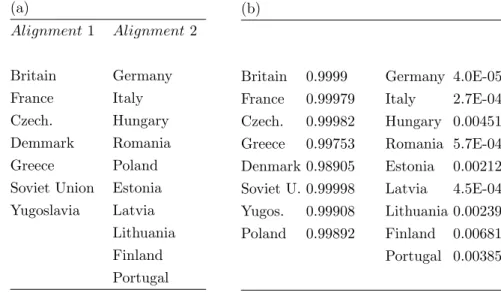
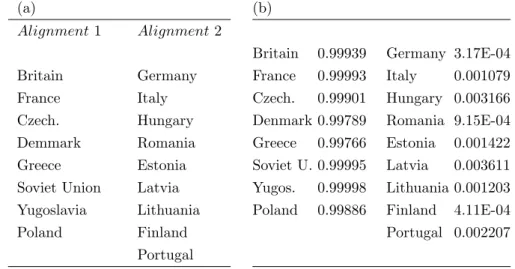
proposed algorithm, we have obtained the results for predicting the alignment of the Second World War in Europe that are almost the same as those given by landscape theory. Especially, using the 1938 data the prediction presented by the proposed framework shows a better result in comparison to that given by original landscape theory. That is the prediction becomes accurate for all but one of the seventeen countries, namely Portugal, as the prediction based on the 1939 data. Tables 1–2 show the predicted results resulting from both landscape theory and fuzzy landscape theory based on 1938 and 1939 data. In the Tables we only presented the membership grades of nations to an alignment in the predicted fuzzy configuration. The membership grades of nations to the other alignment would be easily obtained by the third constraint in (10).
Table 1 The predicted result from landscape theory (a) and fuzzy landscape theory (b) of the Second World War based on 1938 data.
(a) Alignment 1 Alignment 2 Britain Germany France Italy Czech. Hungary Demmark Romania Greece Poland
Soviet Union Estonia Yugoslavia Latvia
Lithuania Finland Portugal
(b)
Britain 0.9999 Germany 4.0E-05 France 0.99979 Italy 2.7E-04 Czech. 0.99982 Hungary 0.00451 Greece 0.99753 Romania 5.7E-04 Denmark 0.98905 Estonia 0.00212 Soviet U. 0.99998 Latvia 4.5E-04 Yugos. 0.99908 Lithuania 0.00239 Poland 0.99892 Finland 0.00681 Portugal 0.00385
§5
Conclusion
In this paper we have mathematically reformalised the landscape theory so that the distance between any two actors can be expressed via their member-ship grades in a specific configuration. With this basic we naturally extended the theory to a generalized one by considering fuzzy configurations instead of crisp ones. Formally the idea is strongly similar to that of objective function based fuzzy clustering. Due to the complexity of a multidimensional nonlinear optimization problem, it would be inefficient to get locally optimal solutions
Table 2 The predicted result from landscape theory (a) and fuzzy landscape theory (b) of the Second World War based on 1939 data.
(a) Alignment 1 Alignment 2 Britain Germany France Italy Czech. Hungary Demmark Romania Greece Estonia
Soviet Union Latvia Yugoslavia Lithuania
Poland Finland
Portugal
(b)
Britain 0.99939 Germany 3.17E-04 France 0.99993 Italy 0.001079 Czech. 0.99901 Hungary 0.003166 Denmark 0.99789 Romania 9.15E-04 Greece 0.99766 Estonia 0.001422 Soviet U. 0.99995 Latvia 0.003611 Yugos. 0.99998 Lithuania 0.001203 Poland 0.99886 Finland 4.11E-04 Portugal 0.002207
in an analytical manner. However, we have developed an GA-based algorithm which fortuitously presents us with a solution corresponding to a predicted fuzzy configuration. The simulation using the real data in the problem of the interna-tional alignment of the Second World War on Europe show that the algorithm should be feasible.
It should be emphasized that landscape theory offers promise in appli-cations to business alliance, parliamentary coalitions, friendship networks, social cleavages, and organizational structuresA97). We have made the simulation with
the proposed framework for the problem of coalition formation in standard-setting alliances in the case of UNIX operating system. The obtained results are also comparable to those given in A95). However, the restriction to
sym-metrical propensity in landscape theory becomes unsuitable in some particular applicationsK01a, K01b). In the further work we are taking the assumption of
asym-metrical propensity into account and to apply the proposed framework to the problem of business alliances, particularly in Automobile Industry partnership.
References
[A93] Axelrod, R. and Scott Bennett, D., “A landscape theory of aggregation,”
British Journal of Political Science, 23, 211–233, 1993.
[A95] Axelrod, R. et al., “Coalition formation in standard-setting alliances,”
[A97] Axelrod, R., The Complexity of Cooperation, Princeton University Press, Princeton, New Jersey, 1997.
[K90] Kaufman, L. and Rousseeuw, P.J.,Finding Groups in Data - an Introduction
to Cluster Analysis, New York, Wiley, 1990.
[R69] Ruspini, E.H., “A new approach to clustering,” Information and Control, 15, 22–32, 1969.
[O77] Owen, G., “Values of Games with a Priori Unions,” in: Essays in
Mathemat-ical Economics and Game Theory (Hein, R. and Moeschlin, M. eds.),
Springer-Varlag, New York, 76–88, 1977.
[C00] Crotts, J.C., Buhalis, D. and March, R., Global Alliances in Tourism and
Hospitality Management, Haworth Press, 2000, pp. 1–10.
[G92] George, H.C., The Human Group, New Brunswick: Transaction Publishers, 1992.
[S72] Singer, D., Bremer S. and Stuckey, J., “Capability distribution, uncertaintry and major power war: 1920-1965,” in Peace, War and Numbers, (Bruce Russett, Ed.), Beverly Hills, California, 1972, 19–48.
[K01a] Kijima, K., Invitation to Drama Theory (in Japanese), Ohmsha, 2001. [K01b] Kijima, K., “Generalized landscape theory: Agent-based approach to
al-liance formations in civil aviation industry,” Journal of Systems Science and
Complexity, 14, 113–123, 2001.
[I00] Iriuchijima, M., Generalization of landscape theory and its application, Master Thesis, Tokyo Institute of Technology, Tokyo, 2000.