単純口帰ネットワークの計算能力について
守谷純之介 (Junnosuke Moriya) 西野哲朗 (Tetsuro Nishino)電気通信大学大学院電気通信学研究科
〒 182-8585東京都調布市調布ケ丘1-5-1
$\mathrm{e}$
-mail: [email protected],
[email protected]1
Introduction
In the filed of cognitive psychology, simple
recurrent networks
are
used for recognizingse-quences of symbols and modeling the language
processing in the human brain. A simple
recur-rent network is a circuit whichconsists of
a
finitenumber ofgates, each of which computes a linear
function whose range is a closed interval $[$0.0,1.$\mathrm{o}]$
$[4, 5]$
.
McClelland et al. showedon
anexperi-mental basis that simple recurrent networks can
simulate finite automata [8]. Rrthermore, Elman
showed on an experimental basis that simple
re-current networks can predict the rightmost word
in sentential forms of
a
particular context-freegrammar with high probability, after a learning
process basedonthe sample words whichare
gen-erated by the grammar $[4, 5]$
.
Concerning theseresults, it is natural ask whether the computa-tional capability of simple recurrent networks is
sufficient to recognize naturallanguages
or
not.It is known that processor nets used by
Siegel-mannand Sontag in [10] cansimulate Turing
Ma-chines [10]. Processor nets
are
recurrent networkswhich consist ofafinite number ofprocessors (or
gates), each of which computes a saturated-linear function. Siegelmann and Sontag showed the
fol-lowing facts in [10]: if the weights of the
connec-tions in a processor net
are
rational numbers, itcan simulate
an
arbitrary Turing Machine. Theproof of this proposition is constructive.
More-over, if the weights of the connections
are
realnumbers, processor nets can recognize arbitrary
languages and if the weights of connections are
integers, processor nets
can
only recognizeregu-lar languages. Note that when the weights
are
rational numbers (or real numbers), the number
of the sates ofprocessor nets is infinite.
It is trivial that if each gate of simple recurrent
networks computes a saturated linear function,
simple recurrent networks
can
simulateproces-sor
nets in a straightforward fashion. Thismeans
that simple recurrent networks can recognize
re-cursive languages. In these works, however, the
range of a function computed at each gate is
in-finite. In this paper, we
assume
that the rangeof
a
function computed at each gate ofa simplerecurrent networks is
a
finite
set. This is a quiterealistic assumption especially when
we
performa computer simulation of a simple recurrnet
net-work.
On the other hand, computational complexity
classes
on
processor nets has been studied. In[10], Siegelmann and Sontag showed that
a
classof languages decided byprocessor nets in
polyno-mial time equals a class of languages decided by
bring Machines in polynomial time, and 1058
processors
are
sufficient in this simulation. Indykimproved this result and showed that 25
proces-sors are
sufficient [7]. Moreover, Balc\’azar et al.develop further relationships between languages
which are decided by processor nets and other
complexity classes [3]. The details of the
rela-tionshipsbetween timecomplexityclasses
on
pro-cessor
nets and circuit complexity on nonuniformcircuit $\mathrm{f}\mathrm{a}\mathrm{m}\mathrm{i}\mathrm{l}\dot{\mathrm{i}}\mathrm{e}\mathrm{s}$
are shown in [11].
A mathematical definition of simple recurrent
networks will be given insection2.1, and weadopt
a cirtain assumption
on
gates of simplerecur-rent networks. Then,
we
definean
equivalencerelation between simple recurrent networks and
Mealymachines which
are
a
finite automata withoutput. Our first result is
a
construction of aMealy machine which simulates
a
simplerecur-rent network. This result shows that, under
our
assumption, simple recurrent networks can only
learn a regular language and the computational
capabilltyofsimple recurrent networks is not
suf-ficient to recognize natural languages.
Theoutputsof the hidden unit dependonthe
out-puts ofthe input unit andthe context unit, while
the outputs of the output unit only depends on
the outputs from the hidden unit. More formally,
we define a SRN
as
follows.$1\mathrm{u}_{\mathrm{i}^{\ovalbox{\tt\small REJECT}\cup \mathrm{t}\mathrm{U}\mathrm{w}}}\iota$
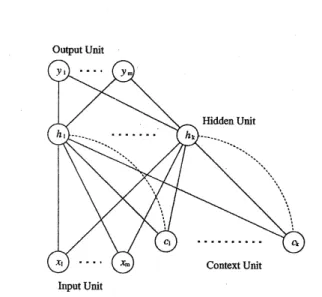
Figure 1: A simple recurrent network
simple recurrent networks and Moore machines
which
are
also finite automata with output. Oursecond result is
a
constructionof a simplerecur-rent network which simulates a Moore machine
under
our
assumption. Therefore, these twocon-structionsshow thatthe computationalcapability
ofsimple recurrent networksisequalto that of
fi-niteautomata with output under
our
assumption.In section 5, we discuss the relationships
be-tween the number of states ofa finite automaton
with output and the size of a simple recurrent networks.
2
Preliminaries
2.1 Simple
Recurrent
NetworksA $S\dot{i}mple$ recurrent network (SRN) consists of
an
$\dot{i}nput$ unit, an output $un\dot{i}t$, a hidden unit and
a
context $un\dot{i}t$ (see Figure 1). The hidden unit, the
context unit and the output unit aresets of gates
each of which computes a function $f[w_{1}, \ldots, w_{m}]$
($x_{1,\ldots,x_{m})}$ : $\mathrm{R}^{m}arrow \mathrm{R},$
$w_{1},$ $\ldots,$$w_{m}\in \mathrm{R},$ $m\in \mathrm{N}$
definedby $f[w_{1}, \ldots,w_{m}](x_{1}, \ldots, x_{m})=\{$ $0$ if $\sum_{i=1}^{m}w:xi<0$ $\sum n$ wixi if $0 \leq\sum_{i=1}^{m}w:x:\leq 1$ $:_{=}1$ 1 if $\sum_{1=1}^{m}.w:xi>1$.
For convenience, we $\mathrm{s}\mathrm{h}\mathrm{a}\mathrm{U}$
use
$F$[$\sum_{i=}^{m_{1}}$ wixi]
in-stead of$f[w_{1}, \ldots, w_{m}](X1, \ldots, xm)$ bom here on.
The context unit ofaSRN holds a copy of the
outputs of the hiddenunitat
a
previoustimestep.Definition 2.1 A $S\dot{i}mple$ recurrent network is a
7-tuple$\mathcal{E}=(G, I, O, H, C, A, w)$, where
1. $G=(V, E)\dot{i}S$ a directed graph, where $V$
is a
finite
setof
nodes $wh_{\dot{i}C}h$ is dividedinto the following
four
setsof
gates: anin-put $un\dot{i}tI=\{x_{1}, \ldots , x_{n}\}\subseteq V$, an
out-put unit $O=\{y_{1}, \ldots, y_{m}\}\subseteq V$, a hidden
unit $H=\{h_{1}, \ldots, h_{k}\}\subseteq V$ and a
con-text $un\dot{i}tC=\{c_{1}, \ldots, c_{k}\}$ $\subseteq$ V. Then,
$E=\{(v_{1}, v_{2})|(v_{1}, v_{2})\in I\cross H\cup C\cross H\cup H_{\mathrm{X}}$
$C\cup H\cross O\}\dot{i}S$ a set
of
edgesof
G. Edgesfrom
the $h_{\dot{i}}dden$ unit to the context $un\dot{i}t$ must be
of
the
form
$(h_{iC_{i}),h_{i}},\in H,$ $c_{i}\in C,$$1\leq\dot{i}\leq k$.
2. $A=\{A_{1}, \ldots, A_{k}\}\in \mathrm{R}^{k}\dot{i}S$ a set
of
$k$ realnumbers, called $in\dot{i}t\dot{i}al$ output
of
the contextunit.
3. $w$ : $Earrow \mathrm{R}\dot{i}S$ a weight assignment to the
edges $\dot{i}n$ E. We denote the weight
of
an edge$(v_{1},v_{2})$ by $w(v_{1}, v_{2})$
.
Weassume
that theweight
of
the edge $(h_{i,\mathrm{Q}}),$$h_{i}\in H,$ $c_{i}\in C,$$1\leq$$i\leq k\dot{i}S\mathit{1}$
.
In. this paper,
we
adopt the following realisticassumption
on
gates ofsimplerecurrent networks:Assumption 2.1 A $funct\dot{i}on$ computed at each
gate
of
a simple recurrent network is a $funct\dot{i}on$whose range is a
finite
set.This
means
that wecan
only physicallyimple-ment a logic gate whose output is a value of
fi-niteprecision. Rom Assumption1, for each gate,
there exists a finiteset of realnumbers which the
gate
can
output. We definea
finite ordered setVALwhichcontainsthese real numbers
as
follows:VAL $=$
{
$val_{1},$$\ldots,$$val_{i},$$\ldots$,
valj,
...,$val_{p}$},
where $val_{k}\in \mathrm{R},$ $1\leq k\leq p,$ $0\leq val_{i}<valj$ $\leq$
$1,\dot{i}<j,\dot{i},j,$$k\in$ N. In the sequel,
we
assume
that a gate compute
a
function $F[ \sum_{i}^{m}=1wiXi]$ :$\mathrm{R}^{m}arrow \mathrm{V}\mathrm{A}\mathrm{L},$ $m\in \mathrm{N}$
.
Now, we define an input sequence and
an
out-put sequence of
a
SRN. For $v\in V,$$t\geq 0$, let $S_{v}(t)$denote the output of the gate $v$ at time $t$
.
Thesequence $S_{x_{1}}(t)\cdots s_{x_{n}}(t)$
,
where $x_{i}\in I,$$S_{x_{i}}\in$$\{0,1\},$ $1\leq\dot{i}\leq n$
.
The output of a SRN attime $t\geq 2$ isthesequence $S_{y_{1}}(t)\cdot \mathrm{v}\cdot S_{y_{m}}(t)$, where
$y_{i}\in O,$ $1\leq\dot{i}\leq m$
.
Definition 2.2 An input sequence$\mathcal{I}$ with length
$n$ is $\mathcal{I}=\mathcal{I}(0)\mathcal{I}(2)\mathcal{I}(4)\cdots \mathcal{I}(2(n-1))$
.
For$a$ input sequence $\mathcal{I}$ with length $n$ and a $SRN$
$\mathcal{E}$, an output sequence
of
$\mathcal{E}$ is $T_{\mathcal{E}}(\mathcal{I})$ $=$$\mathcal{O}(2)\mathcal{O}(4)\mathcal{O}(6)\cdots \mathcal{O}(2n)$
.
2.2
MealyMachines
A Mealy mach\’ine is a deterministic finite
au-tomaton with output $[1, 6]$
.
Definition 2.3 A Mealy machine$M$ is a 6-tuple
$M=(Q, \Sigma, \Delta, \delta, \lambda, q\mathrm{o})$
,
where $Q$ is afinite
setof
states, $q_{0}\in Q$ is
an
initial state, $\Sigma$ is an inputalphabet, $\triangle$ is an output alphabet, $\delta$ : $Q\cross\Sigmaarrow Q$
is a transitionfunction, and $\lambda$ : $Q\cross\Sigmaarrow\Delta$ is an
output
function.
Let $q(t)\in Q$ denote the state of $M$ at time
$t$
.
We definean
input sequence and an outputsequence ofa Mealy Machine
as
follows:Definition 2.4 An input sequence $w$
of
a Mealymachine with length $i\in \mathrm{N}$, is a string $w=$
$a_{0}a_{1}\cdots a_{i-1},$ $a_{j}\in\Sigma,$ $0\leq j\leq i-1$
.
Definition 2.5 For an input sequence $w$ $=$
$a0a_{1}\cdots ai-1$, an output sequence
of
a Mealyma-chine $M,$ $T_{M}(w)$ is a string
$T_{M}(w)=\lambda(q(\mathrm{O}), a\mathrm{o})\lambda(q(1), a_{1})\cdots\lambda(q(\dot{i}-1), ai-1)$
such that$q(t+1)=\delta$($q(t)$,at), $0\leq t\leq\dot{i}-1$
.
We define an equivalence relation between simple
recurrent machines and Mealy machines.
Definition 2.6 A $SRN\mathcal{E}$ is said to be equivalent
to a Mealy machine $M$
if
$T_{\mathcal{E}}(W)=T_{M}(w)$for
any $\dot{i}nput$sequence $w$.
2.3
MooreMachines
$.\mathrm{A}$ Moore machine is also a deterministic finite
automaton with output [6].
Definition 2.7 A Moore machine$M$ is a 6-tuple
$M=(Q, \Sigma, \Delta, \delta, \lambda, q\mathrm{o})$, where $Q$ is a
finite
setof
states, $q_{0}\in Q$ is an initial state, $\Sigma$ is
an
input alphabet, $\Delta$ is an output alphabet, $\delta$: $Q\cross\Sigmaarrow Q$is a transition function, and $\lambda$ : $Qarrow\triangle$ is an
output
function.
We define
an
input $\grave{s}equence$andan
outputse-quence of
a
Moore machine in thesame
fashion ofthose of
a
Mealy machine. The following lemmais known [6].
Lemma 2.1 For
a
Mealy machine $M’$, thereex-ists a Moore machine $M$ which is equivalent to
$M’$
.
2.4
Vector representations
Suppose that the number ofstates of a Moore
machine $M=(Q, \Sigma, \Delta, \delta, \lambda, q\mathrm{o})$ is $m$
,
thenum-ber of elements of the input alphabet is $k$
,
andthe number of elements of the output alphabet
is $l$
.
Namely, let $Q=\{q_{0}, \ldots, q_{m}-1\},$ $\Sigma=$$\{a_{0}, \ldots, a_{k}-1\}$ and $\Delta=\{b_{0}, \ldots, b_{l-}1\}$
.
We first define
a
state vector ofa
Moorema-chine. Each entry of a state vector corresponds
to a tuple of
a
state and an input symbol of aMoore machine.
Definition 2.8 A state vector
of
$M$ at time $t$ is$v(t)\in\{0,1\}^{km}$ and
satisfies
thefollowingproper-ties:
1.
If
$t=0$ and$q(t)=q_{i}$,from
the$\dot{i}k+1$th entryto the $\dot{i}k+kth$ entry
of
$v(t)$are
all l’s andthe others are $0^{)}s$
.
2.
If
$t\neq 0$ and $q(t)=q_{i}$, only one entryfrom
the$ik+1$th entry to the$\dot{i}k+kth$ entry
of
$v(t)$is 1 and the others are $\mathrm{O}’ s$
.
Next,
we
definean
input vector ofa
Moorema-chine. Let $I(t)$ denote
a
given input symbol ofaMoore machine at time $t$
.
Definition 2.9 An input vector
of
$M$ at time $t$is $w(t)\in\{0,1\}^{k}$, and
if
$I(t)=a_{i}$, the $i+1$thentry
of
$w(t)$ is 1 and the others are $\mathrm{O}’ s$.
We define
a
state-input vector based onthe abovedefinitions.
Definition 2.10 Let$v(t)=(v_{1}(t), \ldots, vkm(t))\in$
$\{0,1\}^{km}$ a state vector and $w(t)=(w_{1}(t),$ $\ldots$, $w_{k}(t))\in\{0,1\}^{k}$ an input vector
of
$M$ at time$t$
.
Then, a state-input vectorof
$M$ at time $t$is $V(t)=(v_{1}(t), \ldots, vkm(t), w_{1}(t), \ldots, wk(t))\in$
$\{0,1\}^{km}+k$
.
Next, we define an output vectorof a Moore
ma-chine. Let $O(t)$ denote an output symbol of a
Definition 2.11
If
an output vector $\cdot ofM$ attime $t\dot{i}su(t)\in\{0,1\}^{l}$, and $O(t)=b_{i}$, then the
$i+1$th entry
of
$u(t)$ is 1 and the others are $\mathrm{O}’ s$.
Finally, we give the definition of equivalence
relation between simple recurrent networks and Moore machines.
Definition 2.12 For $a$ input sequence $w,$ $\sup-$
pose that a Moore machine $M$ yeilds the output
sequence $T_{M}(w)$ and a $SRN\mathcal{E}$ yeilds the output
sequence $T_{\mathcal{E}}(w)$
.
Then, $\mathcal{E}$ is $sa\dot{i}d$ to be equivalentto $M$
if
$T_{M}(w)=bTg(w)$for
all$w$ where $b$ is theoutput alphabet
for
the initial stateof
$M$.3
Constructing
Mealy
Mach-ines
In this section, we will construct a Mealy
ma-chine which isequivalent to
a
given SRN. Wede-scribe how to define thestates,thetransition
func-tionand the output functionofthe SRN.
Suppose that aSRN$\mathcal{E}=(G, I, O, H, C, A, w)$ is
given, where $|I|=n,$$|O|=m,$ $|H|=|C|=k$
.
Weconstruct aMealy machine$M=(Q, \Sigma, \Gamma, \delta, \lambda, q_{0})$
which simulates $\mathcal{E}$ in the following way.
1. Each state$p\in Q$ of$M$ represents the output
pattern $a_{c_{1}}\cdots a_{c_{k}}$ of the context unit, where $a_{c_{t}}\in$ VAL and $\mathrm{q}\in C$
.
Note that everyout-put pattern of the context unit
can
berepre-sented as a word in VAL$k$
.
Thus, the statesof $M$ includes all the repreS.entation of the
output pattern of the context unit of$\mathcal{E}$
.
The initial output pattern of the context unit of$\mathcal{E}$
corresponds to the initial state$$q0$ of$M$
.
2. Since the number of the gates in the context
unit is equal to that of the hidden unit, each
state $p\in Q$ of $M$ also represents the output
pattern $a_{h_{1}}\cdots a_{h_{k}}$ of the hidden unit, where
$a_{h_{\mathfrak{i}}}\in \mathrm{V}\mathrm{A}\mathrm{L}$ and $h_{i}\in \mathcal{H}$
.
for each $i,$ $1\leq i\leq k$
.
Then, the transitionfunction $\delta$ of $M$ is defined
by $\delta(p, \sigma)=p’$
where $p=a_{c_{1}}\cdots a_{c_{k}}\in Q,$$\sigma=a_{x_{1}}\cdots a_{x_{n}}\in$ $\Sigma$ and $p’=a_{h_{1}}\cdots ah_{k}\in Q\mathrm{S}\mathrm{a}\mathrm{t}\mathrm{i}\mathrm{s}\mathfrak{g}\Gamma$the above
equations.
4. Finally, we construct the output function $\lambda$
of $M$
.
Suppose that the output pattern ofthe input unit of $\mathcal{E}$ is
$a_{x_{1}}\cdots a_{x_{n}}$, the
out-put pattern of the context unit is $a_{c_{1}}\cdots a_{c_{n}}$
and the output pattern of the hidden unit is
$a_{h_{1}}\cdots a_{h_{k}}$
.
The output of$\mathcal{E}$ depends on theoutput pattern of the hidden unit. That is,
the output of the gates$a_{y_{i}}$ inthe output unit
is given by
$a_{yi}=F[ \sum_{j=1}^{k}w(h_{j,y_{i})]}ah_{k}$
.
Then, the output function $\lambda$ of$M$ is defined
by $\lambda(p, \sigma)=\gamma$where $p=a_{c_{1}}\cdots a_{c_{k}}\in Q,$$\sigma=$ $a_{x_{1}}\cdots a_{x_{n}}\in\Sigma,$ $\gamma=a_{y_{1}}\cdots a_{y_{m}}\in Q\mathrm{s}\mathrm{a}\mathrm{t}\mathrm{i}\mathrm{S}\mathfrak{h}\Gamma$
the above equations. We have the following result:
Theorem 3.1 Under Assumption 2.1,
for
anysimple recurrent network$\mathcal{E}$, there exists a Mealy
machine $M$ which is equivalent to $\mathcal{E}$
.
4
Constructing
Simple
Recur-rent
Networks
In this section, we will show that there exits
a
SRN which simulates a Moore Machine. For this
purpose, we
use
a connection matrix of a Mooremachine [2]. Our first goal is to show that
a
con-nection matrix ofa Moore machine
can
beimple-mented
on
a
SRN. Throughthissection, considera
Moore machine$M=(Q, \Sigma, \Delta, \delta, \lambda, q\mathrm{o})$with$Q=$ $\{q_{0}, q_{1}, \ldots, qm-1\}$ and $\Sigma=\{a0, a_{1}, \ldots, ak-1\}$.
3. We construct the transitionfunction $\delta$ of$M$
.
Suppose that the outputpatternof the input
unit of$\mathcal{E}$ is
$a_{x_{1}}\cdots a_{x_{n}}$ and the output pattern
of the context unit of $\mathcal{E}$ is
$a_{c_{1}}\cdots a_{\mathrm{c}_{n}}$
.
Theoutput pattern of the hiddenunitdependson
$a_{c_{1}}\cdot*\cdot ac_{k}$ and$a_{x_{1}}\cdots a_{x_{n}}$
.
That is, the outputof the gate $a_{h_{f}}$ in the hidden unit is given by
$a_{h_{i}}=F[_{j=1} \sum^{k}w(Cj, h_{i})a_{c}j+\sum_{j=1}^{n}w(Xj, h_{i})axj]$ ,
4.1
Connection matrices
Wefirst define a connection matrix ofa
transi-tion functransi-tion ofa Moore machine [2].
Definition 4.1 A connection matrix $\alpha$
of
transi-tion
function
of
$M$ is$\alpha_{ij}=\{x\in\Sigma|\exists q_{iq_{j}},\in Q, \delta(q_{i}, x)=qj\}$,
where $\alpha_{ij}$ is an entry
of
the $\dot{i}th$ row and the $jth$4.2
Weightmatrices
From the definition, a connection matrix $\alpha$ of
$M$isan$m\cross m$matrix. We define a weight matrix
$\mathrm{o}\mathrm{f}M$
.
Definition 4.2 For a Moore machine $M$, $a$
weight matrix$\alpha’$
of
$M$ is a $km\cross(km+k)$ matrixwhich
satisfies
the following properties:$\bullet F_{or}\dot{i}ifand’ Oj,nly\dot{i}fihereex’,0\leq 1\leq\dot{i},j\leq km_{istSh}iheen\iota ry\alpha_{ij}’\dot{i}S\frac{1}{-1,k+1}h\leq k$
such that $\delta(q_{\lfloor}(i-1)/k\rfloor’ ah)=q_{\lfloor}(j-1)/k\rfloor$ ’ and
the entry $\alpha_{ij}’$ is $0$
if
and onlyif
there doesnot exist $h,$ $0\leq h\leq k-1$, such that
$\delta(q_{\lfloor}(i-1)/k\rfloor’ ah)=q\lfloor(j-1)/k\rfloor$
.
.
For$\dot{i},j,$ $1\leq\dot{i}<km$, $km\leq j\leq km+k$, theentry$\alpha_{ij}’$ is $\frac{2k+\overline{1}}{2k+2}$
if
(j-km) mod $k=\dot{i}$ mod$k$and the entry $\alpha_{ij}’$ is
$\mathit{0}$
if
(j–km) mod $k\neq$$\dot{i}$ mod$k$
.
Now, weconstruct aweight matrix$\alpha’\mathrm{h}_{\mathrm{o}\mathrm{m}}$a
con-nection matrix $\alpha$ as follows:
SRN is a finite set, namely VAL$=\{0,1\}$
.
There-fore,
a
function computed at each gate is$F[ \sum_{i=1}^{m}wi^{X]}i=\{$
$0$ if $\sum_{i=1}^{m}$$wixi<0$ $0$ if $0 \leq\sum_{i=1}^{m}$$wixi\leq 1$
1 if $\sum_{i=1}^{m}$$wixi>1$
.
We will define a function $\sigma$ from the function$F$
.
Definition 4.3 For an $n\cross m$ matrix$A$, a
func-tion $\sigma_{A}$
:
$\{0,1\}^{m}arrow\{0,1\}^{n}$ is$\sigma_{A}(x)=$
,
where $x=$ $(x_{1}, \ldots , x_{m})$ and
$A=$
.
1. Let $\alpha^{T}$ be atransposed matrix of $\alpha$
.
2. For an$m\cross m$ matrix$\alpha$ of$M$, let a matrix $\alpha’$
be a $km\cross(km+k)$ matrix.
3. Entries in the 1st,...,the kmth rows and the
1st,..., the kmth columns of $\alpha’$
are
definedas:
(a) If the entry $\alpha_{ij}$ contains a symbol $at\in$
$\Sigma,$ $k$ entries in the $k(j-1)+1\mathrm{t}\mathrm{h},$ $\ldots$,
the$k(j-1)+k\mathrm{t}\mathrm{h}$columns and the $k(\dot{i}$ -$1)+t\mathrm{t}\mathrm{h}$
row
are all $\frac{1}{k+1}$.
(b) If the entry$\alpha_{ij}$ does notcontains a
sym-bol$at\in\Sigma,$ $k$entriesin the$k(j-1)+1\mathrm{t}\mathrm{h}$,
...,
the $k(j-1)+k\mathrm{t}\mathrm{h}$ columns and the$k(\dot{i}-1)+t\mathrm{t}\mathrm{h}$row are all$0$
.
4. Entries in the 1st, ...,thekmthrows and the
$km+1\mathrm{t}\mathrm{h},$ $\ldots$, the$km+k\mathrm{t}\mathrm{h}$columns of
$\alpha’$ are
defined
as
follows: for the$\dot{i}\mathrm{t}\mathrm{h}$row, anentry inthe ith
row
andthe $km+$($i$mod $k$)$\mathrm{t}\mathrm{h}$columnof$\alpha’$ is
$\frac{2k+1}{2k+2}$ and the other entries
are
all $0$.
4.3
Implementingmatrices on
simplerecurrent networks
In thispaper,
we
already haveassume
that therange of a function computed at each gate of
a
The outputs of units of SRN’s
are
regarded asvectors. A transition functionof$M$
can
beimple-mented by using a function $\sigma_{\alpha’}$
.
Lemma 4.1 Suppose that $\delta(q_{i}, a_{j})=q_{h}$, a state
vector
of
the state $q_{i}$ is $v$, an
input vectorof
theinput symbol $a_{j}$ is $w$, and a state-input vector
of
$v$ and $w$ is V. Then, a vector $\sigma_{\alpha’}(V)$ is a state
vector
of
the state $q_{h}$.
4.4
Constructing
simplerecurrent
net-works which simulate Moore
ma-chine.
$\mathrm{s}$In thissection,
we
willconstructa
SRNwhich isequivalenttoagiven Moore machine. Wedescribe
howtodefine the input unit, the output unit, the
context unit, the hidden unit, the initial output and the weights.
Let$M=(Q, \Sigma, \Delta, \delta, \lambda, q\mathrm{o})$ be
a
Moore machine . and $m=|Q|,$ $k=|\Sigma|$, and $l=|\Delta|$.
We willcon-struct
a
SRN $\mathcal{E}=(G, I, O, H, C, A, w)$as
follows:1. The input unit is $I=\{x_{1}, \ldots, x_{k}\}$
.
2. The output unit is $O=\{y_{1}, \ldots, y\iota\}$
.
3. The context unit is $C=\{c_{1}, \ldots, C_{k}m\}$, and
4. Let $v(\mathrm{O})$ be a state vector of the initial state $q_{0}$ and $v(\mathrm{O})=(v_{1}(0), \ldots, vkm(0))$, where
$v_{i}(0)\in\{0,1\},$$1\leq\dot{i}\leq km.$ Then, the
ini-tialoutput$A$is $A=\{A_{1}, A_{2}, \ldots A_{km}\}$, where
$A_{i}=v_{i}(\mathrm{O}),$ $1\leq i\leq km$.
5. Note that $t$he weight matrix $\alpha’$ of $M$ is a
$km\cross(km+k)$ matrix. We definethe weights
as follows:
(a) Foranedge $(x_{i}, h_{j}),$$xi\in I,$ $h_{j}\in H$, the
weight $w(X_{i}, h_{j})$ is the entry in the $j\mathrm{t}\mathrm{h}$
row and $km+1t\mathrm{h}$ column of$\alpha’$
.
(b) For a edge $(c_{i}, h_{j}),$ $c_{i}\in C,$ $h_{j}\in H$, the
weight $w(C_{i}, h_{j})$ is the entry in the $j\mathrm{t}\mathrm{h}$
row
and $\dot{i}\mathrm{t}\mathrm{h}$ column $\mathrm{f}\alpha’$.
6. If $\lambda(q_{i})=b_{j}$, the weight $w(h_{s}, y_{j})$ is an
ar-bitrary value that is greater than 1 for $h_{s}$,
$\dot{i}k\leq s\leq\dot{i}k+k$. The weights of the other
edges are all $0$
.
We obtain the following theorem.
Theorem 4.1 Under Assumption 2.1,
for
anyMoore machine $M$, there exists a simple
recur-rent network$\mathcal{E}_{M}$ which is equivalent to $M$
.
5
The
Size
of Simple
Recurrent
Networks
In this section, wediscuss the relationships
be-tween the number ofstates ofautomatawith
out-put and the size of a SRN. Suppose that a SRN
$\mathcal{E}$ is equivalnet to automata with output $M$
.
Let$K(M)$ be a set ofautomata which
are
equivalnetto $M$and$S(\mathcal{E})$ be aset of SRN’s which
are
equiv-alnet to $\mathcal{E}$
.
For $M$, let$\phi(M)$ denote
a
number ofthe states of $M$
.
For $\mathcal{E}$, let$S\dot{i}Ze(\mathcal{E})$ denote the
size of$\mathcal{E}$, where the size of
a
SRN isthe number of gates of$\mathcal{E}$
.
Definition 5.1 $M_{\min}$ is $a$ element
of
$K(M)$w.hich
satisfies
$\phi(M_{\min})=\min\{\phi(M)|M\in K(M)\}$
.
Definition 5.2 $\mathcal{E}_{\min}$ is $a$ element
of
$S(\mathcal{E})$ whichsatisfies
$S \dot{i}ze(\mathcal{E}_{\min})=\min\{size(\mathcal{E})|\mathcal{E}\in S(\mathcal{E})\}$
.
From the above two construction, we obtain the
following theorem.
Theorem 5.1 For$M$ and$\mathcal{E}$, there exit constants
$C$ and $C’$ such that
6
Conclusion
In this paper, we show that when the range of
a function computed at each gate of
a
SRN isa finite set, there exists
a
Mealy machine whichcan
simulates the SRN. This resultmeans
that,under
our
assumption, the computational powerof simple recurrent networks is not exceed $t$hat
offinite automata with output, and thus, is not
sufficient to recognize natural languages.
On the other hand, asimple recurrent network
can simulates a Moore machine as we showed in
Section4.4. From
our
two results, wehave shownthat the computationalcapabilityofsimple
recur-rent networks is equal to that offinite automata
under our assumption.
References
[1] Noga Alon, A. K. Dewdney, and Teunis J. Ott.
Ef-ficient simulation of finite automata by neural nets.
JoumalofAssociaiionforComputing Machinery, Vol. 38, No. 2, pp. 495-514, April 1991.
[2] M. A. Arbib, A. J. Kfoury, and Robert N. Moll. $A$
Basis for Theoretical Computer Science. Springer-Verlag, 1981.
[3] Jose’ L. Balca’zar, Ricard Gavald\‘a, Have T. Siegel-mann, and Eduardo D. Sontag. Somestructural
com-$\mathrm{p}\mathrm{l}\mathrm{e}\mathrm{x}\mathrm{i}\mathrm{t}\dot{\mathrm{y}}$aspects of neural computation. In Proceedings
ofthe IEEEStructure in Complexity Theory Confer-ence, pp. 253-265, San Diego, CA, 1993.
[4] $\mathrm{J}\mathrm{e}\mathrm{f}\mathrm{f}\mathrm{r}_{le}\mathrm{e}\mathrm{L}.\mathrm{E}tivecienC1,\mathrm{m}\mathrm{a}n.\cdot \mathrm{F}\mathrm{i}\mathrm{v}_{0}1\mathrm{l}4,\mathrm{p}\mathrm{p}.1\mathrm{n}\mathrm{d}\mathrm{i}\mathrm{n}\mathrm{g}\mathrm{s}\mathrm{t}\mathrm{r}\mathrm{u}_{21}\mathrm{C}\mathrm{t}\mathrm{u}\mathrm{r}\mathrm{e}\mathrm{i}\mathrm{n}079-1,199.\mathrm{i}\mathrm{t}\mathrm{m}\mathrm{e}$
.
Congni-[5] JeffreyL. Elman. Distributed representations, simple recurrent networks and grammatical structure.
Ma-chineLearning,
Vol.
7, pp. 195-225, 1991.[6] J. E. Hopcroft and J. D. Ullman. Introduction to Au-tomata Theory, Language and Computation. Read-ing. Addison-Wesley, MA, 1979.
[7] P. Indyk. Optimal simulation of automata by neural
$\mathrm{n}\mathrm{e}\mathrm{t}\mathrm{S}.\mathrm{I}\mathrm{n}\tau heoreiCa\iota^{r_{Atso}}Pocespecfedin\mathit{9}^{so}fhe\mathit{1}\mathit{2}thAnnualSym_{\oint g^{on}}osimc^{t}omputersCience(SAc^{u}s’ \mathit{5})$ ,
pp. 337-348, New York, April 1995. Springer-Verlag. [8] James L. $\mathrm{M}\mathrm{c}\mathrm{C}\mathrm{l}\mathrm{e}\mathrm{n}_{\mathrm{a}\mathrm{n}}\mathrm{d}$, Axel Cleeremans, and David
Servan-Schreiber. Paralleldistributedprocessing:
Br-idging the gap between human and machine
mtelli-gence. JoumalofJapanese SocietyofArtificial Intel-ligence, Vol. 5, No. 1, pp. 3-14, January 1990. [9] 守谷純之介, 西野哲朗. 「単純回帰ネットワークを模倣
するmealy機械の構成法」
.
電子情報通信学会コンピュテーション研究会資料. COMP98-27. 1998.
[10] Have T. Siegelmann and Eduardo D. Sontag. On the
$\mathrm{c}\circ \mathrm{m}the\mathrm{F}^{\mathrm{u}}iflhA^{\circ}cMWorksh_{\mathit{0}}p_{\mathit{0}}nComputationa\iota^{ee}Lea\mathrm{r}nin^{O}g\mathrm{t}\mathrm{a}\mathrm{t}\mathrm{i}\mathrm{n}\mathrm{a}\mathrm{l}\mathrm{P}^{\mathrm{O}}\mathrm{w}\mathrm{e}\mathrm{r}\mathrm{o}\mathrm{f}\mathrm{n}\mathrm{e}\mathrm{u}x\mathrm{a}1\mathrm{n}\mathrm{e}\mathrm{t}\mathrm{S}.\ln ProCding_{S}f$
Theory, Pittsburgh, PA, July1992.
[11] Have T. Siegelmann and Eduardo D. Sontag. Analog computation via neural networks. Theoretical
Com-puterScience, Vol. 131,pp. 331-360, 1994.