Stability analysis
of
numerical methods for
delay integr0-differential
equations
TOSHIYUKI Koto 小藤俊幸
Department ofComputer Science
The University of ElectrO-Communications
電気通信大学
e-mail : [email protected]
Abstract
Stability of $\theta$ methods for delay integr0-differential equations (DIDEs) is
studied on the basis ofthe linear equation
$\frac{\mathrm{d}u}{\mathrm{d}t}=\mathrm{X}\mathrm{u}(\mathrm{t})$$+\mathrm{f}\mathrm{i}\mathrm{u}(\mathrm{t} -\tau)$$+ \mathrm{t}\kappa\int_{t-\tau}^{t}u(\sigma)d\sigma$,
where $\lambda$,
$\mu$, $\kappa$ arecomplex numbers and $\tau$ is aconstant delay. It is shown that
every $A$-stable $\theta$-method possesses asimilar stability property to P-stability,
i.e., the method preserves the delay-independent stability of the exact solution under the condition that $\tau/h$ is an integer, where $h$ is astep-size. It is also
shown that the method does not possess the same property if$\tau/h$ is not an
integer. As aresult, any 0-method cannot possess asimilar stability property
to $GP$-stability with respect to DIDEs.
1. Introduction
We study stability of (2-stage)methods fordelay integr0-differential equations
(DIDEs) on the basis of the linear equation
$\frac{\mathrm{d}u}{\mathrm{d}t}=\lambda u(t)+\mu u(t-\tau)+\kappa\int_{t-\tau}^{t}u(\sigma)d\sigma$, (1.1)
where $\lambda$,
$\mu$, $\kappa$ are complex numbers and $\tau$ is aconstant delay. When $\kappa=0$, the
equation (1.1) coincides with the test equation
$\frac{\mathrm{d}u}{\mathrm{d}t}=\lambda u(t)+\mu u(t-\tau)$, (1.2)
which
was
proposed by Barwell [1] to examine stability of numerical methods fordelaydifferential equations (DDEs). As described in [1], if $\lambda$,
$\mu$ satisfy
$|\mu|<-{\rm Re}\lambda$, (1.3)
the zero solution of (1.2) is asymptotically stable for any $\tau\geq 0$
.
This asymptoticproperty is called delay-independent stability, and analogous stability properties of
numerical methods are considered on the basis of the condition (1.3). For example
数理解析研究所講究録 1265 巻 2002 年 189-199
anumerical method for DDEs is said to be $P$-stable if every numerical solution to
(1.2) tends to
zero
whenever $\lambda$,$\mu$ satisfy (1.3) and $\tau/h$is
an
integer, where $h$ is thestep-size. Anumerical method is said to be $GP$-stable if the
same
holds for anyconstant step-size.
In the last two decades, various studies
were
carried out concerning stabilityproperties of numerical methods for DDEs (see, e.g., [12]). In particular,
an
earlieststudy by Watanabe and Roth [10] has revealed that every $A$-stable $\theta$ method is
$GP$-stable. To the contrary, little is known about stability properties of numerical
methods for DIDEs. It isquite recent that we studied delay-independentstability of
linear
DIDEs
[7], andeven
stabilityof$\theta$-methodsfor
(1.1) remains tobe
investigated.By Theorem 2of [7], the zero solution of (1.1) is asymptotically stable for any
$\tau\geq 0$ if and only if $\lambda$,
$\mu$, $\kappa$ satisfy
$\lambda+\mu+\kappa\tau\neq 0$ for any $\tau\geq 0$, (1.1)
$z^{2}-z\lambda-\kappa=0$, $z\in C$, $z\neq 0$ $\Rightarrow$ ${\rm Re} z<0$, (1.5)
$| \frac{\mu z-\kappa}{z^{2}-z\lambda-\kappa}|<1$ for any ${\rm Re} z=0$ with $z\neq 0$. (1.6)
Moreover, the conditions (1.5), (1.6)
are
rewrittenas
${\rm Re}\lambda<0$ and
(
${\rm Re}$A${\rm Re}(\lambda\overline{\kappa})+({\rm Im}\kappa)^{2}<0$or
$\kappa=0$),
(1.7)${\rm Im}[(\lambda+\mu)\overline{\kappa}]=0$ and $[|\mu|^{2}<({\rm Re}\lambda)^{2}+2{\rm Re}\kappa$
or
(
${\rm Im}\lambda=0$, $|\mu|^{2}=({\rm Re}\lambda)^{2}+2{\rm Re}\kappa$)
$]$, (1.8)respectively (Sect. 3in [7]). When $\lambda$,
$\mu$, $\kappa$ are all real and $\kappa\neq 0$, these conditions
are reduced to the simple condition
$\lambda<0$, $\kappa<0$, $\mu^{2}\leq\lambda^{2}+2\kappa$
.
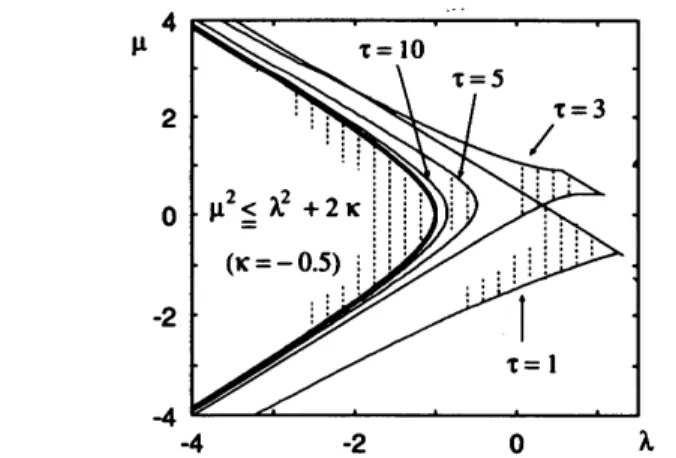
(1.9)We study stability properties of $\theta$-methods by comparing the region determined by
these conditions with akind of stabilityregions of the methods.
Fig. 1Delay-independent v.s. delay-dependent stability regions
It
should be noted thataconsiderable
number of papers [2, 3, 4, 6, 9]are
devotedto stability analysis of&-methods for DDEs, which does not
seem
strange froma
practical viewpoint. Some important instances of stiff DDEs
are
obtained from thespace-descritization of partial functional differential equations (see, e.g., [13]). The
&-methods
have practicality in such asituation.2. Stability
regions
of $\theta$-methodsConsider delay integr0-differential equations (DIDEs) with aconstant delay,
$\frac{\mathrm{d}u}{\mathrm{d}t}=f$
(
$t$,$u(t)$,$u(t-\tau)$,$\int_{t-\tau}^{t}g(t,$$\sigma$,$u(\sigma))d\sigma$).
(2.1)For
agiven step-size $h>0$,let
$m$ bethe smallest
integer greater thanor
equal to$\tau/h$. Then, the delay $\tau$ is represented in the form
$\tau=(m-\delta)h$, $0\leq\delta<1$, (2.2)
and the relation
$t_{n}-\tau=t_{n-m}+\delta h$ (2.3)
holds for the step points $t_{n}=t_{0}+nh$, $n\in Z$.
By approximating the delayed argument and the integrand in (2.1) with linear
interpolation, we can adapt a $\theta$-method to (2.1) as follows:
$u_{n+1}=u_{n}+h(1-\theta)f(t_{n}, u_{n}, v_{n}, G_{n})+h\theta f(t_{n+1}, u_{n+1}, v_{n+1}, G_{n+1})$, (2.4)
where, $0\leq\theta\leq 1$, $u_{n}$ is an approximate value of $u(t_{n})$, and
$v_{n}$ $=$ $(1-\delta)u_{n-m}+\delta u_{n-m+1}$, (2.5)
$G_{n}$ $=$ $\frac{h(1-\delta)^{2}}{2}g(t_{n}, t_{n-m}, u_{n-m})+\frac{h(2-\delta^{2})}{2}g(t_{n}, t_{n-m+1}, u_{n-m+1})$
$+h \sum_{k=2}^{m-1}g(t_{n}, t_{n-m+k}, u_{n-m+k})+\frac{h}{2}g(t_{n}, t_{n}, u_{n})$. (2.1)
As aresult, the integral term of (2.1) is approximated with the trapezoidal rule.
When $\theta=1/2$ and $\delta=0$, the formula (2.4)-(2.6) determines amethod that belongs
to aclass of Runge-Kutta methods discussed in [7]. But, when $\theta\neq 1/2$, it gives
another type of numerical method.
In the
case
of the test equation (1.1), the formula (2.4)-(2.6) is reduced to$u_{n+1}$ $=$ $u_{n}+(1-\theta)\alpha u_{n}+\theta\alpha u_{n+1}$
$+\beta[(1-\delta)(1-\theta)u_{n-m}+(\delta+\theta-2\delta\theta)u_{n-m+1}+\delta\theta u_{n-m+2}]$
$+ \gamma[\frac{(1-\delta)^{2}(1-\theta)}{2}u_{n-m}+\frac{(2-\delta^{2})(1-\theta)+(1-\delta)^{2}\theta}{2}u_{n-m+1}$
$+ \frac{2-\delta^{2}\theta}{2}u_{n-m+2}+\sum_{k=3}^{m-1}u_{n-m+k}+\frac{1+\theta}{2}u_{n}+\frac{\theta}{2}u_{n+1}]$, (2.7)
$\alpha=h\lambda$
,
$\beta=h\mu$,
$\gamma=h^{2}\kappa$.
The characteristic equation of (2.7) is written as
(2.8)
$z^{m+1}$ $z^{m}-(1-\theta)\alpha z^{m}-\theta\alpha z^{m+1}$
$-\beta[(1-\delta)(1-\theta)+(\delta+\theta-2\delta\theta)z+\delta\theta z^{2}]$
$- \gamma[\frac{(1-\delta)^{2}(1-\theta)}{2}+\frac{(2-\delta^{2})(1-\theta)+(1-\delta)^{2}\theta}{2}z$
$+ \frac{2-\delta^{2}\theta}{2}z^{2}+\sum_{k=3}^{m-1}z^{k}+\frac{1+\theta}{2}z^{m}+\frac{\theta}{2}z^{m+1}]=0$
.
(2.9)Using (2.9)
we
define the
sets $S_{\theta,m}^{(\delta)}$ and $S_{\theta}^{(\delta)}$for
$0\leq\delta<1$ by$S_{\theta,m}^{(\delta)}=$
{
$(\alpha$,$\beta$,$\gamma)\in C^{3}$ : all the roots of (2.9) satisfy$|z|<1$
},
(2.10)$S_{\theta}^{(\delta)}=\cap S_{\theta,m}^{(\delta)}m\geq 1^{\cdot}$ (2.11)
The set $S_{\theta}^{(\delta)}$ is
an
analogue of the $\delta$-stability region of the $\theta$-method[4].When $z=1$, the left hand side of (2.9) is equal $\mathrm{t}\mathrm{o}-[\alpha+\beta+(m-\delta)\gamma]$
.
Hence,for any $m\geq 1$, $z=1$ is not aroot of (2.9) if and only if
$(\mathrm{C}_{0})$ $\alpha+\beta+(m-\delta)\gamma\neq 0$ for any $m\geq 1$
.
Substituting $\sum_{k=3}^{m-1}z^{k}=(z^{3}-z^{m})/(1-z)$ into (2.9) and multiplying $(1-z)$,
we
get$z^{m}q(z)-p(z)=0$, (2.12) $q(z)$ $=$ $q_{0}z^{2}+q_{1}z+q_{2}$, (2.13) $p(z)$ $=p_{0}z^{3}+p_{1}z^{2}+p_{2}z+p_{3}$, (2.14) where $q_{0}$ $=$ $\theta\alpha+\frac{\theta}{2}\gamma-1$, $q_{1}=(1-2 \theta)\alpha+\frac{\gamma}{2}+2$, $q_{2}$ $=$ $-(1- \theta)\alpha+\frac{1-\theta}{2}\gamma-1$, $p_{0}$ $=$ $- \delta\theta\beta+\frac{\delta^{2}\theta}{2}\gamma$, $p_{1}=(3 \delta\theta-\delta-\theta)\beta+\frac{-3\delta^{2}\theta+\delta^{2}+2\delta\theta+\theta}{2}\gamma$, $p_{2}$ $=$ $(-3 \delta\theta+2\delta+2\theta-1)\beta+\frac{3\delta^{2}\theta-2\delta^{2}-4\delta\theta-2\delta^{2}+2\delta+1}{2}\gamma$, $p_{3}$ $=$ $( \delta\theta-\delta-\theta+1)\beta+\frac{-\delta^{2}\theta+\delta^{2}+2\delta\theta-2\delta-\theta+1}{2}\gamma$
.
Moreover we
set $r(z)=p(z)/q(z)$, (2.15)and consider the following conditions
(a) $q(z)\neq 0$ for any
|z
$|\geq 1$.
(\^a) $q(z)\neq 0$ for any $|z|>1$.
(b) $|r(z)|<1$ for any $|z|=1$ with $z\neq 1$
.
(b) $|r(z)|\leq 1$ for any $|z|=1$
.
These are regarded as conditions for $\alpha$, $\beta$,
$\gamma$. We also write
(c) $(\alpha, \beta, \gamma)\in S_{\theta}^{(\delta)}$.
Under this notation, we
can
characterize $S_{\theta}^{(\delta)}$as
follows.Theorem 2.1 The following implications hold:
$(\mathrm{C}_{0})$ and (a) and (b) $\Rightarrow$ (c) $\Rightarrow$ (\^a) and (b).
If, in addition,
$(\mathrm{C}_{1})$ $p(z)$, $q(z)$ have
no common zero on
$|z|=1$,then (c) implies (a).
Proof. Assume $(\mathrm{C}_{0})$, (a) and (b). We first show that $\hat{r}(z)=r(z)/z$ satisfies
$|\hat{r}(z)|<1$ for any $|z|\geq 1$ with $z\neq 1$.
The linear fractional transformation
$z= \frac{w+1}{w-1}$ (2.16)
maps ${\rm Re} w>0$ conformally onto $|z|>1$, with $w=\infty$ corresponding to $z=1$
.
Thefunction $\hat{R}(w)=\hat{r}[(w+1)/(w-1)]$ is represented in the form
$\hat{R}(w)$ $=$ $\hat{P}(w)/\hat{Q}(w)$, (2.17)
$\hat{P}(w)$ $=$ $[\gamma w^{2}+(-2\beta+2\delta\gamma-\gamma)w+2(1-2\delta)\beta-2\delta(1-\delta)\gamma]$
$\cross[w-(1-2\theta)]$, (2.18)
$\hat{Q}(w)$ $=$ $(w+1)\{\gamma w^{2}+[2\alpha-(1-2\theta)\gamma]w-2(1-2\theta)\alpha-4\}$. (2.19)
Then, itfollowsfrom (a) that $\hat{R}(w)$ is abounded, holomorphic functionin ${\rm Re} w>0$
.
Hence, by the Phragm\’en-Lindel\"of theorem (see, e.g., [8], p. 168), it follows from (b)
that $|\hat{R}(w)|<1$ for any ${\rm Re} w>0$, which implies that $|\hat{r}(z)|<1$ for any $|z|\geq 1$
with $z\neq 1$.
If $|z|\geq 1$ and $z\neq 1$, then
$z^{m}q(z)-p(z)=q(z)z[z^{m-1}-\hat{r}(z)]\neq 0$,
which, together with $(\mathrm{C}_{0})$, implies (c).
Assume (c). If $q(z_{0})=0$ for
some
$|z_{0}|>1$,then there
exists $\epsilon>0$ such that$C(z_{0}, \epsilon)\subset$
{|z
$|>1\}$and
$q(z)\neq 0$on
$C(z_{0},\epsilon)$, where
$C(z_{0}, \epsilon)=\{z\in \mathcal{O} : |z-z_{0}|=\epsilon\}$
.
By Rouch\’e’$\mathrm{s}$ theorem, the polynomial $z^{m}q(z)-p(z)$ has aroot in the
interior
of$C(z_{0}, \epsilon)$ for sufficiently large $m$, which contradicts (c). Therefore, (\^a) holds.
Moreover, if $|r(z_{0})|>1$ for
some
$|z_{0}|=1$, then the equation $z^{m}=r(z)$has asolution with $|z|>1$ for sufficiently large $m$
.
This is verified by applyingProposition 7 of [11] to$\psi(z)=1/r(z)$
.
Infact,there exists$\epsilon$ $>0$such that $|r(z)|>1$for any $z\in\overline{V_{\epsilon}}$, where $V_{\epsilon}=\{z\in \mathcal{O} : |z-(1+\epsilon)z_{0}|<\epsilon\}$
.
Hence, $\rho=\mathrm{m}_{\frac{\mathrm{a}\mathrm{x}}{V_{e}}}|\psi(z)z\in|<1$
,
and $1\in ae\backslash B(0, \rho)$, where $B(0, \rho)=\{z\in C : |z|\leq\rho\}$
.
On the other hand,we
have$\mathcal{O}\backslash B(0, \rho)\subset\cup\{z^{m}\psi(z)m\geq 1$: z
$\in V_{\epsilon}\}$, (2.20)
by Proposition 7of [11]. Since $|z|>1$ for any $z\in V_{\epsilon}$, it follows from (2.20) that
$z^{m}=r(z)$ holds for
some
$m\geq 1$ and $|z|>1$, which contradicts (c). Therefore, $(\hat{\mathrm{b}})$holds.
It is easy to
see
that (\^a) and (b) imply (a) under the condition $(\mathrm{C}_{1})$.
$\square$3. Stability regions
in
thecase
$\delta=0$We consider the
case
$\delta=0$.
Since $q(1)=\gamma$, $z=1$ satisfies $q(z)=0$ if and onlyif $\gamma$ $=0$
.
Weassume
that $\gamma\neq 0$ for awhile, and rewrite the conditions (a), (a),(b), (b) by making use of the linear fractional transformation (2.16).
The function $R(w)=r[(w+1)/(w-1)]$ is represented in the form
$R(w)$ $=$ $P(w)/Q(w)$, (3.1)
$P(w)$ $=$ $(\gamma w-2\beta)[w-(1-2\theta)]$, (3.2) $Q(w)$ $=$ $\gamma w^{2}+[2\alpha-(1-2\theta)\gamma]w-2(1-2\theta)\alpha-4$
.
(3.3)Hence, (a), (\^a), (b), $(\hat{\mathrm{b}})$
are
equivalent to(A) $Q(w)\neq 0$ for any ${\rm Re} w\geq 0$,
(A) $Q(w)\neq 0$ for any ${\rm Re}$w $>0$, (B)
|
$R(w)|<1$ for any ${\rm Re}$w $=0$,$(\hat{\mathrm{B}})$
|
$R(w)|\leq 1$ for any ${\rm Re} w=0$,respectively.
When $\alpha$, $\gamma$ are real, (A), (A) are reduced to
7$[2\alpha-(1-2\theta)\gamma]>0$, $\gamma[-4-2(1-2\theta)\alpha]>0$, (3.4)
7$[2\alpha-(1-2\theta)\gamma]\geq 0$, $\gamma[-4-2(1-2\theta)\alpha]\geq 0$, (3.5)
respectively. In addition, putting $w=\mathrm{i}y$, $y\in R$,
we
have$|Q(w)|^{2}-|P(w)|^{2}$
$=4{\rm Im}[(\alpha+\beta)\overline{\gamma}]y^{3}+4(|\alpha|^{2}-|\beta|^{2}+2{\rm Re}\gamma)y^{2}$
$+\{16{\rm Im}\alpha+4(1-2\theta)^{2}{\rm Im}[(\alpha+\beta)\overline{\gamma}]\}y$
$+|4+2(1-2\theta)\alpha|^{2}-|2(1-2\theta)\beta|^{2}$ (3.6)
When $\alpha$, $\beta$,
$\gamma$
are
real, it is reduced to$|Q(w)|^{2}-|P(w)|^{2}=4(\alpha^{2}-\beta^{2}+2\gamma)y^{2}+4\eta$, (3.7)
t7 $=[(1-2\theta)(\alpha+\beta)+2][(1-2\theta)(\alpha-\beta)+2]$
.
(3.8)Hence, in this case, (B), (B) are equivalent to
$\beta^{2}\leq\alpha^{2}+2\gamma$, $\eta>0$, (3.9) $\beta^{2}\leq\alpha^{2}+2\gamma$, $\eta\geq 0$, (3.10)
respectively.
Fig. 2 $\gamma$-section of $S_{\theta}^{(0)}\cap R^{3}(0\leq\theta<1/2)$
Let $\alpha<0$ and $\gamma<0$
.
The conditions (3.4), (3.9)are
reduced to$\alpha>-\frac{2}{1-2\theta}$, $\gamma>\frac{2\alpha}{1-2\theta}$ , $\beta^{2}\leq\alpha^{2}+2\gamma$, $| \beta|<\alpha+\frac{2}{1-2\theta}$, (3.12)
when $0\leq\theta<1/2$ (Fig. 2), and
$\beta^{2}\leq\alpha^{2}+2\gamma$, (3.12)
when $1/2\leq\theta\leq 1$. If$\alpha(<0)$, $\beta$ satisfy $\beta^{2}\leq\alpha^{2}+2\gamma$ for $\gamma<0$, then $\alpha+\beta<0$, and
$(\mathrm{C}_{0})$ holds. Hence, by Theorem 2.1, these determine the region
$S_{\theta}^{(0)}\cap\{(\alpha, \beta, \gamma)\in Ps \alpha<0, \gamma<0\}$, (3.13)
except for ambiguity of the boundary.
We
now
denote by $\Omega$ the set of all the triplicate $(\lambda, \mu, \kappa)$ for which thezero
solution of (1.1) is asymptotically stable for any $\tau\geq 0$, i.e.,
$\Omega=$
{
$(\lambda$,$\mu$,$\kappa)\in \mathcal{O}^{3}$ : (1.4), (1.5), (1.6)
are
satisfied}.
(3.14)It is easy to see that
$(\lambda, \mu, \kappa)\in\Omega$ $\Rightarrow$ $(h\lambda, h\mu, h^{2}\kappa)\in\Omega$ for any $h>0$
.
(3.15)The following theorem shows that $A$ stable $\theta$
-methods
possess asimilar stabilityproperty to $P$-stability with respect to
DIDEs.
Theorem 3.2
If
$1/2\leq\theta\leq 1$, then $\Omega\subset S_{\theta}^{(0)}$.
Proof. The inclusion $\Omega\cap\{\gamma=0\}\subset S_{\theta}^{(0)}$ follows from the known result
as
in thecase
of DDEs (see, e.g., Theorem 2.6 in [6]). We consider thecase
$\gamma\neq 0$.
Let $(\alpha, \beta, \gamma)\in\Omega$
.
The condition $(\mathrm{C}_{0})$ follows from (1.4). Moreover, it followsfrom (3.6) and ${\rm Im}[(\alpha+\beta)\overline{\gamma}]=0$that for $w=\mathrm{i}y$, $y\in R$,
$|Q(w)|^{2}-|P(w)|^{2}=m$$y^{2}+2\eta_{1}y+\eta_{2}$, (3.16)
$\eta_{0}=4(|\alpha|^{2}-|\beta|^{2}+2{\rm Re}\gamma)$, $\eta_{1}=8{\rm Im}\alpha$, $\eta_{2}=|2(1-2\theta)\alpha+4|^{2}-|2(1-2\theta)\beta|^{2}$
Since
$\eta_{2}=16+16(1-2\theta){\rm Re}\alpha+4(1-2\theta)^{2}(|\alpha|^{2}-|\beta|^{2})\geq 16$, (3.17)
$\eta_{1}^{2}-\mathrm{h}$$\eta_{2}\leq 64({\rm Im}\alpha)^{2}-64(|\alpha|^{2}-|\beta|^{2}+2{\rm Re}\gamma)$
$=-64[({\rm Re}\alpha)^{2}+2{\rm Re}\gamma-|\beta|^{2}]$, (3.18)
we
have|
$Q(w)|>|P(w)$|
for any ${\rm Re}$w $=0$, (3. 9)which implies (B).
When $\theta=1/2$, it holds that
$Q(w)=\gamma w^{2}+2\alpha w-4=-w^{2}[(2/w)^{2}-\alpha(2/w)-\gamma]$
.
(3.20)Hence, (A) for $\theta=1/2$ follows from (1.5).
The condition (A) for$\theta=1/2$, together with (3.19), implies (A) for $1/2<\theta\leq 1$
.
In fact, if $Q(w)=0$ has asolution with ${\rm Re} w\geq 0$ for some $1/2<\theta\leq 1$, then it
follows from (A) for $\theta=1/2$ that there exists $1/2<\theta_{0}\leq\theta$ such that $Q(w)=0$ for
$\theta=\theta_{0}$ has asolution with ${\rm Re} w=0$. But this is impossible by (3.19).
$\square$
4.
Stabilityregions
in
the
case
$\delta\neq 0$The
same
result as in Theorem 3.2 does not hold in thecase
$\delta\neq 0$.
As $\mathrm{a}$result, any $\theta$-method cannot possess asimilar stability property to GP-stability
with respect to DIDEs.
Theorem 4.3
If
$0<\delta<1$, there exists $(\alpha, \beta, \gamma)\in\Omega$ which does not belong to$S_{\theta}^{(\delta)}$
.
Proof. The function $R(w)=r[(w+1)/(w-1)]$ can be written as
$R(w)$ $=$ $\tilde{P}(w)/\tilde{Q}(w)$, (4.1)
$\tilde{P}(w)$ $=$ $[\gamma w^{2}+(-2\beta+2\delta\gamma-\gamma)w+2(1-2\delta)\beta-2\delta(1-\delta)\gamma]$
$\cross[w-(1-2\theta)]$, (4.2)
$\tilde{Q}(w)$ $=$ $(w-1)\{\gamma w^{2}+[2\alpha-(1-2\theta)\gamma]w-2(1-2\theta)\alpha-4\}$
.
(4.3)When $\alpha$, $\beta$, $\gamma$
are
real, we have for $w=\mathrm{i}y$, $y\in R$,$|\tilde{Q}(w)|^{2}-|\tilde{P}(w)|^{2}=4(y^{2}+1)[(\alpha^{2}-\beta^{2}+2\gamma)y^{2}+\eta]$
$+4\delta(1-\delta)(2\beta-\delta\gamma)[2\beta+(1-\delta)\gamma][y^{2}+(1-2\theta)^{2}]$ , (4.4)
$\eta=[(1-2\theta)(\alpha+\beta)+2][(1-2\theta)(\alpha-\beta)+2]$
.
(4.5)When $\alpha=-\sqrt{-2\gamma}$ and $\beta=0$, (4.4) is aquadratic function of $y$ and the
coefficient of $y^{2}$ is given by
4$[-(1-2\theta)\sqrt{-2\gamma}+2]^{2}-4\delta^{2}(1-\delta)^{2}\gamma^{2}$
.
(4.6)If$0<\delta<1\mathrm{a}\mathrm{n}\mathrm{d}-\gamma$is sufficiently large, the value (4.6) is negative. Thisimplies that
$(\hat{\mathrm{b}})$ does nothold
near
$(\mathrm{a}, \beta)=(-\sqrt{-2\gamma}, 0)$, apoint on the hyperbola$\beta^{2}=\alpha^{2}+2\gamma$,
$\mathrm{i}\mathrm{f}-\gamma$ is sufficiently large. Therefore, by Theorem 2.1, there are points in
$\Omega$ which
do not belong to $S_{\theta}^{(\delta)}$
.
$\square$In
some
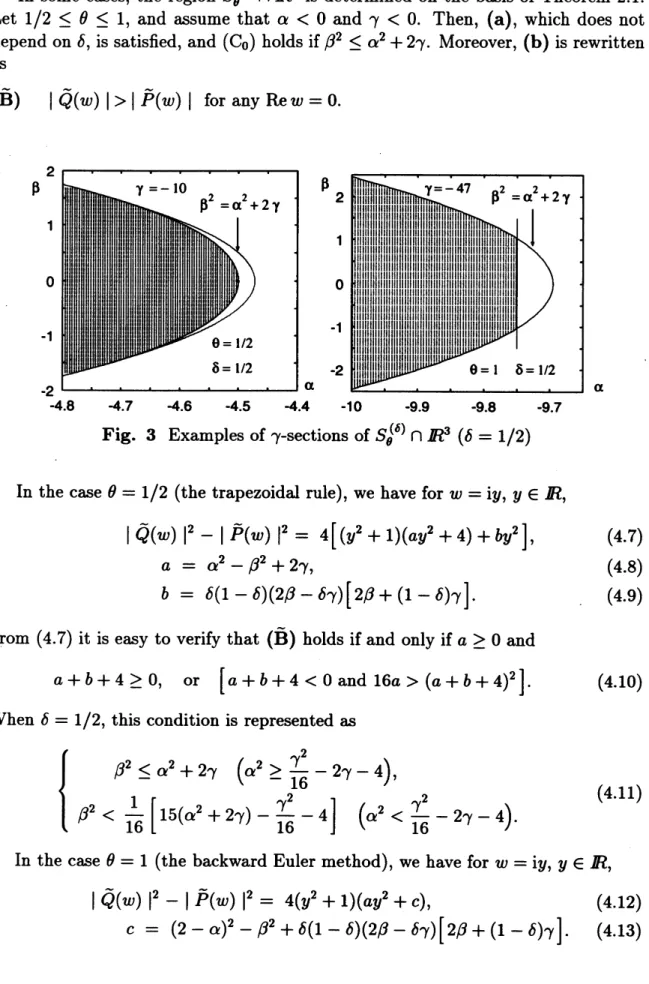
cases, the region $S_{\theta}^{(\delta)}\cap R^{3}$ is determinedon
the basis of Theorem 2.1.Let
$1/2\leq\theta\leq 1$,and
assume
that
$\alpha<0$and
$\gamma<0$.
Then, (a),which does
notdepend
on
$\delta$, is satisfied, and $(\mathrm{C}_{0})$ holds if$\beta^{2}\leq\alpha^{2}+27$. Moreover, (b) is rewrittenas
(B) $|\tilde{Q}(w)|>|\tilde{P}(w)|$ for any ${\rm Re} w=0$
.
Fig. 3Examples of $\gamma$-sections of $S_{\theta}^{(\delta)}\cap R^{3}(\delta=1/2)$
In the
case
$\theta=1/2$ (the trapezoidal rule),we
have forw
$=\mathrm{i}y$, y $\in R$,$|\tilde{Q}(w)|^{2}-|\tilde{P}(w)|^{2}=4[(y^{2}+1)(ay^{2}+4)+by^{2}]$, (4.7)
$a=\alpha^{2}-\beta^{2}+2\gamma$, (4.8)
$b=\delta(1-\delta)(2\beta-\delta\gamma)[2\beta+(1-\delta)\gamma]$
.
(4.9)Prom (4.7) it is easy to verify that (B) holds if and only if a $\geq 0$ and
$a+b+4\geq 0$, or
$[a+b+4<0$
and 16a $>(a+b+4)^{2}]$.
(4.10)When $\delta$ $=1/2$, this condition is represented as
$\{$
$\beta^{2}\leq\alpha^{2}+2\gamma$ $( \alpha^{2}\geq\frac{\gamma^{2}}{16}-2\gamma-4)$,
$\beta^{2}<\frac{1}{16}[15(\alpha^{2}+2\gamma)-\frac{\gamma^{2}}{16}-4]$ $( \alpha^{2}<\frac{\gamma^{2}}{16}-2\gamma-4)$
.
(4.11)
In the
case
$\theta=1$ (the backward Euler method),we
have for w $=\mathrm{i}y$, y $\in R$,$|\tilde{Q}(w)|^{2}-|\tilde{P}(w)|^{2}=4(y^{2}+1)(ay^{2}+c)$, (4.12)
c $=(2-\alpha)^{2}-\beta^{2}+\delta(1-\delta)(2\beta-\delta\gamma)[2\beta+(1-\delta)\gamma]$
.
(4.13)The condition
(B)holds
ifand
onlyif
a
$\geq 0$,c
$>0$,which is
equivalentto
$\beta^{2}\leq\alpha^{2}+2\gamma$, $\alpha<\frac{\gamma}{4}+2$, (4.14)
when $\delta=1/2$
.
References
[1] V. K. Barwell, Special stability problems for functional differential equations,
BIT 15 (1975), 130-135.
[2] M. Calvo and T. Grande, On the asymptotic stability of $\theta$-methods for delay
differential equations, Numer. Math. 54 (1988),
257-269.
[3] N. Guglielmi, Delay dependent stability regions of $$-methods for delay
differ-ential equations, $IMA$ J. Numer. A$nal$. 18 (1998), 399-418.
[4] M. Z. Liu and M. N. Spijker, The stability of the $\theta$-methods in the numerical
solution ofdelaydifferentialequations, $IMA$ J. Numer. Anal., 10 (1990), 31-48.
[5] L.$\cdot \mathrm{H}$. Lu, Numerical stability of the $\theta$-methods forsystems ofdifferential
equa-tions with several delay terms, J. Comput. Appl. Math., 34 (1991), 291-304.
[6] K. J. in ’$\mathrm{t}$ Hout, The stability of $\theta$-methods for systems of delay differential
equations, Ann. Numer. Math. 1(1994), 323-334.
[7] T. Koto, Stability of Runge-Kutta methods for delay integr0-differential
equa-tions, to appear in J. Comput. Appl. Math.
[8] G. Polya and G. Szego, Problems and theorems in analysis $\mathrm{I}$, Springer-Verlag,
Berlin, 1972.
[9] E. G. van den Heuvel, Using resolvent conditions to obtainnew stability results
for $\theta$-methods for delay differentialequations, $IMA$ J. Numer. Anal., 21 (2001),
421-438.
[10] D. S. Watanabe and M. G. Roth, The stability of difference formulas for delay
differential equations, SIAM J. Numer. Anal., 22 (1985), 132-145.
[11] M. Zennaro, $\mathrm{P}$-stability properties of Runge-Kutta methods for delay
differen-tial equations, Numer. Math., 49 (1986), 305-318.
[12] M. Zennaro, Delay differential equations: theory and numerics, in M.
Ainsworth, J. Levesley, W. A. Light, M. Marietta (ed.), “Theory and Numerics
ofOrdinary and Partial Differential Equations”, , Oxford University Press, New
York, 1995, 291-333.
[13] B. Zubik-Kowal, Stability in the numerical solution of linear parabolic equations
with adelay term, BIT41 (2001), 191-206