Japan Advanced Institute of Science and Technology
JAIST Repository
https://dspace.jaist.ac.jp/
Title
Round off error analysis based on Weighted
Pushdown Model checking
Author(s)
Do, Ngoc Thi Bich
Citation
Issue Date
2008-03-04
Type
Conference Paper
Text version
publisher
URL
http://hdl.handle.net/10119/8237
Rights
Description
JAIST 21世紀COEシンポジウム2008「検証進化可能電子
社会」= JAIST 21st Century COE Symposium 2008
Verifiable and Evolvable e-Society, 開催:2008年
3月3日∼4日, 開催場所:北陸先端科学技術大学院大学
, GRP研究員発表会 セッションB-3発表資料
Round off error analysis based on Weighted
Pushdown Model checking
Do Ngoc Thi Bich Advisor: Professor. Mizuhito Ogawa
1
The Aim of Research
In computer algorithms, real numbers are typically represented as floating-point numbers. On the other hand, the hardware implementations of algorithms rely on fixed-point approximations to reduce cost of hardware while increasing through-put rate. However, using fixed-point numbers may easily loose precision because of round off errors. In this case, we need to know: where precision was lost and whether the translation preserves precision. Current practiced methods for solv-ing this problem are mostly based on simulation and testsolv-ing. These methods cannot cover all possible scenarios of system runs and if input ranges are large, further they will consume time. Our aim is to propose a technique based on model checking to automatically analyze round off errors.
2
Approach
We propose a verification approach based on affine arithmetic and Weighted pushdown system. Interval algebra provides a general solution to modeling and manipulating uncertainties. The idea is to replace scalar quantities with bounded intervals, and propagate intervals through arithmetic operations. A recent tech-nique - affine arithmetic [1] - advances the field in handling correlated intervals. However, using affine arithmetic is very difficult to analyze an infinite program, because we have to introduce infinite number of new noise symbols. To face with this problem, we will combine affine arithmetic and interval arithmetic to form a new arithmetic.
Recently, Weighted Pushdown Systems (WPDSs) emerged as an attractive engine for performing interprocedural program analysis: on the one hand, WPDSs are expressive enough to capture precisely fairly complex control structure present in modern programming languages; on the other hand, WPDSs serve as a basis for higher-level analysis techniques, such as the analysis of concurrent programs. Adopting WPDSs as an engine for round off error analysis allows for easy in-tegration with these analysis techniques. An additional advantage of WPDSs is the ability to answer stack-qualified queries, that is, the ability to determine properties that arise at a program point in a specified set of calling contexts.
3
Progress of 2007
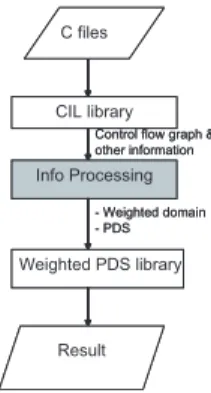
In 2007, the main task was to survey researches in numerical analysis, especially round off error analysis. For that, we introduce a new approach to solve round off error base on model checking (described in our research aim). We have been designing a system based on this approach. In particular, we have introduced an algorithm to create weighed domain for Weighed pushdown system base on fixed-point number and new combined arithmetic. The input for the system are program written by ANSI C. Because, most of hardware designs are implemented on this language or a C-like language. We select 2 libraries CIL (C Intermediate Language) and WPDS library. CIL [2] is a high-level representation along with a set of tools that permit easy analysis and source-to-source transformation of C programs. WPDS [3] is an available library which provides functions to the sets of forwards or backwards reachable configurations in a weighted pushdown system, and for the recovery of witness sets.
Control flow graph & other information Info Processing CIL library - Weighted domain - PDS Weighted PDS library C files Result
Control flow graph & other information Info Processing CIL library - Weighted domain - PDS Weighted PDS library C files Result
Fig. 1. System Overview
4
Future work
We are step-by-step developing the system. In addition, we are going to improve the algorithm to create weighted domain for having a more accurate result. We also plan to take into account some related problems such as point-to analysis, array bound checking.
References
1. Jorge Stolfi. Self-Validated Numerical Methods and Applications. PhD thesis, Luiz
Henrique de Figueiredo, 1997.
2. CIL. Available at http://hal.cs.berkeley.edu/cil/.