
石炭層の生成過程についての花粉分析学的研究 第2報 : 北海道池田層の亜炭層
8
0
0
全文
(2) Vol. 11, No. 1 B Journal of Hokkaido Gakugei University Aug., 1960. Pollen Analytical Study on the Process of the Formation of Coal Seams. (II) Lignite seams of the Ikeda formation, Hokkaido, Japan Yoshio OKAZAKI Geological Institute, the Kushiro Branch of Hokkaido Gakugei University. [WA^ : W<J8o^,@gr-3^-r®7£;^tJr£3£|'OTf% '2^ A®iS?lti.E9B'9ffi^^. Preface with respect to the origin of coal, there is a view that coal gets started with an initial stage of peat. Accepting this view, we are able to expect to find in coal seams. the original vegetal constituent similar to the varied types of peat such as the highland, the lowland and the transitional moor, and at the same time we may expect similar combination by pollen analytical methods. with this in mind, the writer intends to infer the process of coal formation and already made a fundmental study on the recent peat in the Kushiro moor, Hokkaido.. In this paper he has examined the lignite bed in the Ikeda formation of the Pliocene, making a comparison with pollen association of the recent peat. The writer wishes to state his sincere gratitude and hearty thanks to Dr. Y. Sasa of Hokkaido University, who has helped promote this investigation from the outset, and also revised this manuscript. Before entering upon our subject, we have a question which should be solved : Whether it is really possible or not to apply our idea on the Tertiary lignite, or whether or not the lignite seam still preserves the essential element of pollens to confirm our idea. The conclusion reached is that the application of pollen analysis to lignite is sufficiently possible as well as the peat for supposing the formation of lignite.. I. Materials examined The materials examined for this study were collected from the Ikeda formation of the Tokachi group, Pliocene in age. This formation, inlerbedding a great number of lignite seams, is exposed typically near Ikeda-machi, Tokachi province, Eastern Hokkaido, and is one of the youngest formations of the Tertiary series in Hokkaido. It is made -120—.
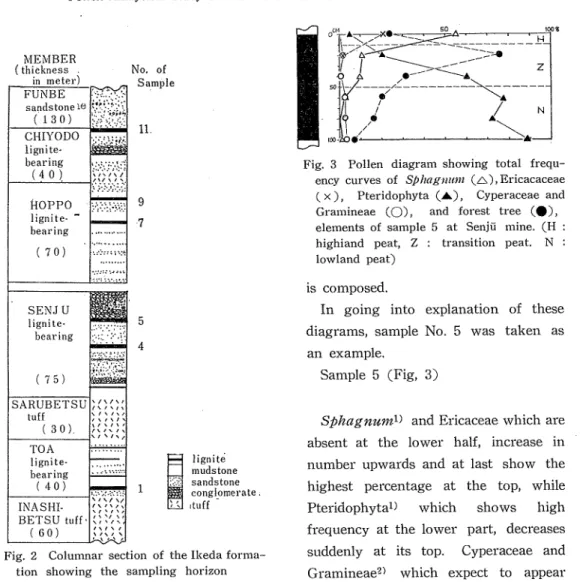
(3) Yoshio Okazaki up from mostly tuffaceous sandy materials, intercalating muddy layers, pyroclastic materials such as tuff, and contains abundant seams of lignite. These lignite seams are the most favourable ones in nature and also in age as the first step toward the solution as to the origin of coal seam, because it made it possible for us to learn easily the pollen constituent. All the lignite seams taken as samples in that area are more than 30 centimeters in thickness, and have been almost worked there at present. The sampling localities are mapped in Fig. 1, and the horizon is marked in the columnar section of the formation as in Fig. 2. The materials were taken at intervals of 5 to 20 centimeters1) as shown in the figures, and macerated with the usual method, Alkali solvent as in the case of the peat.. •X- I TOA MINE Kt.5 SENTUMINE » q HOPPOMIHE. . ...» H CHIVODAMINE. CHIYODA ^<;: FUBE'-Y/W <::•&:. Fig. 1 Map showing the sampling localities in the Ikeda formation, Tokachi Province, Hokkaido. II. Result obtained by pollen analysis The results thus obtained are in the pollen diagram as is shown in Figs. 3, 4, 5. In the present paper, the diagrams were made all with the frequency of five elements, namely Sphagnum, Ericaceae, Cyperaceae and Gramineae, Pteridophyta, and forest tree. These species are the main vegetal constituent of the three fundamental types of peat as already described in the prevoious paper. In the pollen diagram we expect that their figures vary according to the dominant component of which the peat 1) In the lignite seams, flattened stems varying in circumference from 2 to 40 centimeters, frequently occur. Regaining their original round shape, we may regard them as compressed to about onethird of their original bulk on the average.. -121-.
(4) Pollen Analytical Study on the Process of the Formation of Coal seams. MEMBER. (thickness in meter). No. of Sample. FUNBE. sandstoneie. ( 130) CHIYODO. 11.. lignitebearing. Fig. 3 Pollen diagram showing total frequ-. (40). ency curves of Sphaginun (A),Ericacaceae. (x), Pteridophyta (A), Cyperaceae and. HOPPO. Gramineae CO), and forest tree (•),. 1 ignitebearing. elements of sample 5 at Senju mine. (H : highland peat, Z : transition peat. N :. (70). lowland peat). is composed.. SENJ U. In going into explanation of these. lignitebearing. diagrams, sample No. 5 was taken as an example.. ( 75) SARUBETSU. (*;>"^w. Sample 5 (Fig, 3). /\/\f. tuff. ( 30).. TO A. Sphagnum^ and Ericaceae which are I \/>,. lignitebearing. ( 40). INASHIBETSU tuff.. ( 60). /\/ \/. r \ / ^ / \. absent at the lower half, increase in I ignite mudstone sandstone conglomerate ituff. number upwards and at last show the highest percentage at the top, while. Pteridophyta1) which shows high frequency at the lower part, decreases. \ /s / \. Fig. 2 Columnar section of the Ikeda formation showing the sampling horizon. suddenly at its top. Cyperaceae and Gramineae2) which expect to appear. parallel to the rising curve of pteridophyta, rather remain in small amounts. There is, however, no douubt to indicate a corresponding decrease parallel to the frequency of Sphagnum, and a corresponding increase to that of Pteridophyta as is seen in the other diagrams. Arboreal pollen is demanded to indicate a high percentage in the forest or transition peat and a decrease in the others, but such a change of frequency never appears,3^ and it shows rather a relatively high percentage in many cases, having nothing to do with the frequency of the above metioned species. From the results, what we are immediately able to point out is that with the exception of tree, the appearance of these curves is 1) In this paper, the frequency of pteridophyta is the sum total of polypodiaciae, Lycopodiaceae, Osmundae and Equisetum excluding Sphagnum. 2) Grass pollens such as Cyperaceae and Gramineae are said to decay easier than any others. Morever they are apt to be corroded by chemical solvents, especially more than Pteridophyta. 3) It may be due to the fact that most of arboreal pollen are regareded as foreigners, but not of local origin.. -122-.
(5) Yoshio Okazaki quite similar to that of the bog peat now seen in swamps. The fact therefore offers us an interesting comparison with the varied types of peat. Thus, we may regard the lower half, the upper, and the top of the diagram as correspoing to the lowland peat, the transition peat, and the highland peat respectively. III. Discussion As already mentioned, our subject is to verify the view that lignites are of a similar origin to peats, and to investigate the process of the formation of lignites.. 'X?.. -Bk-^:. ^•z H. % ^?:~—A-« N. -_^____________. Fig. 5 Pollen diagram showing total frequency curves of sample 7, 9 (Hoppo), and 11. (Chiyoda). Fig. 4 Pollen diagram showing total frequency curves of sample 1. CT"a) and 4. (Senju). In order to solve the problems, it is necesary to prove the following, apart from the geological view point : 1) The original materials from which lignites have been derived present a close resemblence to those of peats ; so to speak, lignite seams contain the original remains similar to the varied types of peats in themselves. 2) The process of the lignite fromation was regularly carried through such a normal sequence as is well seen in that of peat. The sequence passes through the stages of. 123.
(6) Pollen Analytical Study on the Process of the Formation of Coal seams. peat ; lowland-transition-highland-(or transition)-lowland and so on.. 3) Lignites were not derived from the materials drifted from other places to the present position by stream or flood, but are of autochthonous, and were deposited under a peat-like swampy condition. The following will be the answer to these points. 1) In support of the first point, the diagrams of sample 5 and others are prepared. From the fact that the pollen curves of the four elements have close analogy with that of peats as mentioned above, we find that a seam of lignite represents a composite formation, consisting of the original layers of the varied types of peats.. 2) The diagram of sample 5 is thought to be repesentative, indicating the normal process during the lignite formation. The process is quite similar to that of peat. Such a successive change is seen also in the other diagrams. The seam in the sample 4 is thicker than any others, being almost two meters in total thickness, and is one of the best quality. However, it differs from the others in lacking the base layer of the lowland peat. type. The section is all but composed of the original highland peat type, partly with the transition type-like layers at the time when the accumulation was interrupted (Fig. 4). This lignite section is very similar to that of the Kushiro moor, where the peat, having the thickness of at least four meters, consists only of the highland peat throughout an example of which the writer presented in his previous paper. In short, we may infer that the lignite seams in the Ikeda formation were normally formed in right order under a similar condition to that of peat. 3) The second point will support; the view that the original mother materials were accumulated in the place where the lignite exists to-day, for such a normal process of formation is never found in the lignite derived from drifted matrials. From these facts, it is not difficult to suppose that the picture that most closely parallels the conditions under which lignite seams were formed is that of a peat-forming swamp. In supporting this point of view, we can adduce the following two facts : One is the existence of some water-loving species or swamp habitas such as SpJiagmim, Equisetwn, Menianthes, Drosera, and members of Cyperaceae, Gramineae, Pteridophyta, etc. ; and another is that in a forested area, the total freqency of non-arboreal pollen. is said to be generally small (ca. 10°^), and to be high (50% or more) in area with little or no forest cover, whereas in our diagrams it shows 15 percent at the least, and in many cases even more than 50 percent. In this way, the present study may lead us to the conclusion that the lignite-forming plants which might grow in situ or lignite are of autochthonous formation, and that the lignite-forming conditions seemed to be similar to a peat-like swamp, and seemed to pass through the stages of low-moor-transition-moor-high-moor(or transition-moor)low-moor and so on. 124..
(7) Yoshio Okazaki In connection with quality,i-> it is interesting that the banded layers corresponding to the two types of peats, the highland and the transition or forest peats, are generally of superior quality. But further investigation of this is needed. We thus find our pollen analysis to be a useful method for the purpose of infering the process of lignite formation. However, it is still unknown whether this method is applicable to the paleogene coals or not. IV. Summary With the object of supposing the process of coal formation by pollen analysis, in comparison with the recent peats, the present paper dealt with the lignite seam of the Ikeda formation (upper Pliocene), in eastern Hokkaido. The lignite materials were treated with the alkali solvent, and the pollen diagrams were drawn with the frequency of the five elements, namely Sphagnum, Cyperaceae and Gramineae, Pteridophyta, Ericaceae, and forest tree. From the pollen diagrams obtained (Figs. 3, 4, 5), We find that these curves are quite similar to those of the present peat, and that the lignite has still preserved the correspondings to the three fundamental types of peats ; the lowland peat type is. marked by the predominance of Sphagnum with Ericaceae, the highland peat type by that of Pteridophyta wich Cyperaceae and Gramineae, and the transition peat type by an intermediate constituent between the two respectively. Judging the diagrams from this point of view, we have the following conclusions:. 1) Lignites have been originated from peats. This is proved from the fact that a lignite seam is a composite formation, corresponding to the varied types of peats. 2) Lignites are composed of the plants that grew in situ. It is based on the assumption that the process of the lignite formation shows the normal sequence which proceeds from the lowland, through the transition to the highland and repeats again. 3) The ligmte-forming condition seems to be a peat-like swamp, from the above statement, besides from the existence of some swamp habitas such as Sphagnum, Equisetimi, Drosera, Menianthes and others, and from that the percentage of nonarboreal pollen which is small in a forested area, is high (.50%). V. Literatures 1) Arber E. A. N. (1912) : The Natulal History of Coal, London. 2) Erdtman G. (1954) : An Introduction to Pollen Analysis, Chron. Bot. Co. 3) Faegrie K. & Iversen J. C1950) : Text-Book of Modern Pollen Analysis, Copenhagen. 4) Godwin H. (1933) : Pollen Analysis of Penland peats at St. Germans near King's Lynn, Geol. Mag. 70.. 5) Iwasaki J. (1937) : Coal (in Japanese), Tokyo. 6) Jeffrey E. C. (1915) : The Mode of Origin of Coal, Jour. Geol., Vol. 23. 1) The section may be desirable to mark the bands of lignite that are distinctly contrasted as regards physical properties and chemical composition. The bands are said to be due to the differences in the kind of plant debris from which they have been formed. But it is indeed difficult to classify petrologically the columnar section of the lignite in the present survey.. —125—.
(8) Pollen Analytical Study on the Process of the Formation of Coal seams 7) Moor E. S. (1940) : Coal, John wiley & Sons, N. Y.. 8) Okazald Y. (1957) : Geology of the Ikeda Formation (Pliocene Tertiary), Eastern Hokkaido (in Japanese), Bull. Geol. Comm. Hokk,. No. 35.. 9) — (1958) : Stratigraphical and Palynological Studies of the Honbetsu Group and the Ikeda Formation (Pliocene Tertiary) in Eastern Hokkaido, Jour. Hokkaido Gakugei Univ., No. 9.. 10) — (1959) : Pollen Analytical Study on the Process of The Formation of Coal Seams, (1) Peat bed of the Kushiro Moor. Hokkaido, Japan, Jour. Hokk. Gakugei Univ., Vol. 11, No. 1. 11) Raistrick A. & Marshall C. E. (1952) : The Nature and Origin of Coal and Coal Seams, London. 12) Sato S. C1958) : Palynological Study on Coal, with Special Reference to Haboro Coal-Bearing Formation (Miocene), Hokkaido (in Japanese), Cenozoic Research, No. 28.. 14) Ueji T. (1948) : Coal Geology (Ligaite) (in Japanese), Tokyo.. -126-.
(9)
図


関連したドキュメント
The only thing left to observe that (−) ∨ is a functor from the ordinary category of cartesian (respectively, cocartesian) fibrations to the ordinary category of cocartesian
An easy-to-use procedure is presented for improving the ε-constraint method for computing the efficient frontier of the portfolio selection problem endowed with additional cardinality
(Construction of the strand of in- variants through enlargements (modifications ) of an idealistic filtration, and without using restriction to a hypersurface of maximal contact.) At
It is suggested by our method that most of the quadratic algebras for all St¨ ackel equivalence classes of 3D second order quantum superintegrable systems on conformally flat
This paper develops a recursion formula for the conditional moments of the area under the absolute value of Brownian bridge given the local time at 0.. The method of power series
We present sufficient conditions for the existence of solutions to Neu- mann and periodic boundary-value problems for some class of quasilinear ordinary differential equations.. We
Splitting homotopies : Another View of the Lyubeznik Resolution There are systematic ways to find smaller resolutions of a given resolution which are actually subresolutions.. This is
It turns out that the symbol which is defined in a probabilistic way coincides with the analytic (in the sense of pseudo-differential operators) symbol for the class of Feller
