
「十六世紀後期における関係代名詞(II) : C.マーロウ及び同時代の作家の作品を中心として」 (英文)
19
0
0
全文
(2) 'Relative Pronouns in the Late 16th Century (II) : Centering on the Works of C. Marlowe and His Contemporaries". Masakatsu Mizuno. TABLE OF CONTENTS 0. Introduction 1. Forms and Frequency 2 . Restrictive and Non-Restrictive Clauses 3 . Relatives and Antecedents 4 . Functions of Relative Pronouns in Clauses. 4.1 In Restrictive Clauses 4.2 In Non-Restrictive Clauses. 4.3 With Prepositions 5 . Types of Antecedents 5.1 Antecedent Types and Functions of Relative Pronouns 5.1.1 Subject i ) Pronoun Antecedents. ii) Noun Antecedents 5.1.2 Object of a Verb or a Preposition i ) Pronoun Antecedents. h) Noun Antecedents 6. Summary. NOTES. 0. Introduction. In his book, "Early Modern English" ', C. Barber explains the use of the relative pronoun as. follows : "We have to take account, however, of stylistic differences. The spread of who and zuhich, and the recession of that, are especially characteristic of a formal style of writing. In informal and colloquial styles, that remains the commonest relative pronoun. This can be seen in Elizabethan and Jacobean plays that try to give the illusion of contemporary speech, and especially in those that are remote from courtliness." (p. 218)1. 1.
(3) Masakatsu MIZUNO. According to 0. Jespersen, too :. "In early Modem English that is the favorite relative and is found in non-restrictive as well as in restrictive clauses, but there is in literature a growing tendency to extend the sphere of the ivh-words, while more and more oust tlwt from non-restrictive clauses." (p. 80)2. The aim of this paper3, therefore, is to ascertain what would be the actual usage of relative pronouns4 (i.e. that, zuho, tuhom, tuhose, which, and ^-form (contact clause)), with special reference to plays written in the late sixteenth century.. This study is based on a statistical analysis of anaphoric relative pronouns in the plays of Marlowe and of his contemporaries. For comparative purposes, however, reference is made to the contemporary novels of. Thomas Deloney, which are said to reflect the everyday language of this period. His novels deal with the town and country life of old England, being written in a plain, unaffected style, and breathing always the natural atmosphere of everyday life. In making use of his novels, the passages of narrative (abb. NAR) and those of discourse (abb. DIS) are treated separately because, as Dr. K. Araki has pointed out, it is necessary to deal. with the novel separately under narrative (literary style) and discourse (colloquial style).5 In this study we have considered the following factors in determining the choice of relative pronoun : (1) the use of the relative pronoun as restrictive or non-restrictive, (2) the type of antecedent (whether personal or non-personal), (3) the grammatical function of the relative pronoun in the clause (whether subject, object, governed by preposition, etc.), and the grammatical status of the antecedent (whether noun, pronoun, proper noun, etc.).. The following is a list of the works with abbreviation symbols (dramas and contemporary novels) on which our analysis of the use of relative pronoun has been based. All the data of statistical tables are treated as a whole as DRAMA (under Marlowe and other Elizabethan) and DIS on the one hand, and as NAR on the other to see if we can find out if they have any stylistic traits in common.. Author. (DRAMA) C. Marlowe, • • • • The Tragical History of Doctor Faustus (F) -,•••• The few of Malta (J) -,•••• The First Part of Tamburlaine the Great (T 1) -, • • • • The Second Part of Tamburlaine the Great (T 2) -, • • • • Edward the Second (E) -,•••• The Tragedy of Dido, Queen of Carthage (D) -,•••• The Massacre at Paris (M). (abb. Marl) T. Kyd, ••••••••The Spanish Tragedy (ST)7 G. Peele, ••••••••The Old Wives' Tale (OWT)S R. Greene, • •• • • -Friar Bacon and Friar Bungay (FB)9.
(4) Relative Pronouns in the 16th Century (II). Anonymous, • • • •• -Arden of Feversham (AF) T. Dekker, ••••••The Shoemakers'' Holiday (SH)n. (abb. Eliz) (Novel) T. Deloney,12 • • • -lacke of Newberie (IN) -,•••• Thomas of Reading (TR). -,-••• The Gentle Craft (The First Part) (GC 1) -,•••• The Gentle Craft (The Second Part) (GC 2). (abb. DIS and NAR). 1. Forms and Frequency. The following table shows the frequency of relative pronouns in the plays and novels (NAR and DIS).. TABLE 1 DIS. DRAMA That. Which. NAR. Eliz. Marl. Total. Delon. Total. Delon. 410<22> (54.8). 669<28> (51.4). 1079<50> (52.6). 280<14>. 1359<64> (52.5). 155<4> (22.8). 93<1>. 201<2>. 294<3>. 102<1> (19.0). 396<4> (15.3). 190<1> (27.9). (12.4). 2. (15.4). 1. (14.3). 3. (52.1). 9. 12. 24. The which. (,0.3). (0.1). (0.2). (1.7). Who. 24<1>. 54. 78<1>. 44<1>. 122. WTnose. 64. 23. 251. 48. Whom. 37. 15. 113. 54<1> 27<2>. (3.2) (8.6). (4.9). (4.1). 164 (12.6) 61. (4.7). (3,8). 228 (11.1) 98. (4.8). (8.2). (4.3) (2.8). (0.5) (4.7) (9.7) (4.4). ^. 118<17> (15.8). 152<17> (11.7). 270<34> (13.2). 64<4> (11.9). 334<38> (12,9). Total. 748<41>. 1302<47>. 2050<88>. 537<20>. 2587<108>. (100 %). (100 %). (100 %). (100 %). (100 %). (3.5). 182 (26.8) (7.1) (7.9). (4.0). 680<8>. (100 %). Notes: 1. Figures in angle brackets show the frequency of the "it is ... Relative Pronoun" type. 2. (f) denotes the zero relative.. This table shows that there is a difference in the distribution of relative pronouns between NAR and DIS. As grammarians have pointed out, relatives are grouped into two groups : that of demonstrative origin and wh-torms of interrogative origin.13 The table shows that the. number of examples with that and those with tuh-torms amount to 155 : 498 in NAR and 280 : 193 in DIS. The percentage of that and wh-torms is 23.7% : 76.3% in NAR and 59.2% : 40.8% in DIS. In NAR, wh-relatiyes, which had only recently appeared in the development of the English language, are rather frequently used, whereas in DIS, which would be closer to the.
(5) Masakatsu MIZUNO. colloquial style of the language of our period, they have not yet come into frequent use. This tendency, as Barber has suggested, to use that more favorably in colloquial language can also. be detected in DRAMA, the percentage of that and w/z-relative being 60.6% and 39.4%.. 2. Restrictive and Non-Restrictive Clauses. Relative clauses introduced by an anaphoric relative pronoun are usually classified into two categories : (1) Restrictive clauses, which give a necessary determination to the antecedent and. thereby make it more precise ; (2) Non-Restrictive clauses, which might be discarded without serious injury to the precise understanding of the sentence as a whole (following Jespersen's classification and terminology)14.. The following two tables show the percentages of frequency of each relative pronoun in the above circumstances.. TABLE 2 DRAMA. Rest.. That. Which The which Who. DIS. NAR. Eliz. Marl. Total. Delon. Total. Delon. 61.5%. 64.3%. 63.1%. 66.7%. 63.9%. 65.4%. 8.7%. 8.9%. 8.8%. 11.4%. 9.4%. 15.6%. 0.3%. 0.1%. 0.5%. 0.3%. 1.0%. 0%. 0%. 0%. 0.2%. 0.1%. 0.2%. 0.9%. 2.3%. 2.4%. 2.3%. 0.3%. 2.9%. 1.9%. 1.6%. 2.0%. 2.2%. 4'. 24.4%. 1.2%. 22.7%. 2.0%. 23.4%. 2.4%. 19.2%. 22.4%. 13.1%. Total. 100 %. 100 %. 100 %. 100 %. 100 %. 100 %. Delon. Whose. Whom. TABLE 3 DRAMA. Non-R. That. Which The which Who Whose. Whom. ^. Total. DIS. NAR. Eliz. Marl. Total. Delon. Total. 42.6%. 37.5%. 39.0%. 28.1%. 19.2%. 37.0%. 22.4%. 4.4%. 21.5%. 31.5%. 23.3%. 0.8%. 33.3%. 0.2%. 0.3%. 4.0%. 1.0%. 8.7%. 4.8%. 8.4%. 8.5%. 20.2%. 20.0%. 10.7%. 23.5%. 37.9%. 22.5%. 10.8%. 20.3%. 9.3%. 8.7%. 8.0%. 8.2%. 5.4%. 7.7%. 10.3%. 100 %. 100 %. 100 %. 100 %. 100 %. 100 %. 0%. 0%. 0%. 0%. 0%. 0%. The percentage of each non-restrictive relative to the total relative pronoun can be shown as follows :.
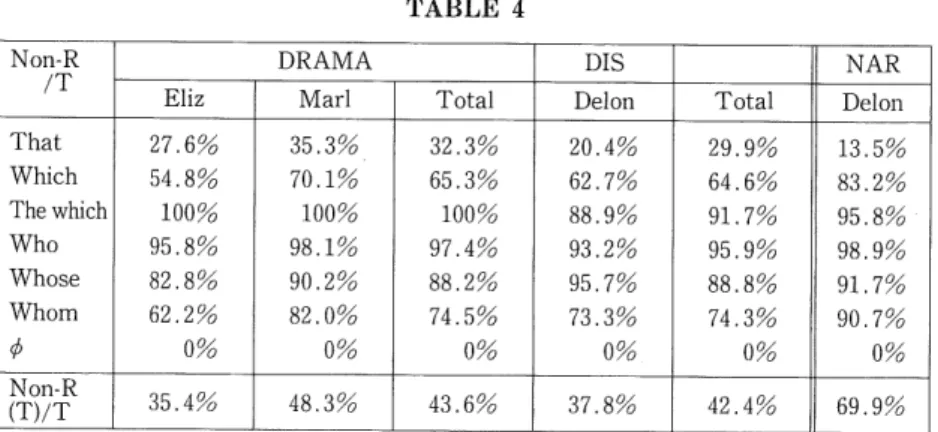
(6) Relative Pronouns in the 16th Century (II). TABLE 4 DRAMA. Non-R. /T. DIS. NAR. Eliz. Marl. Total. Delon. Total. 27.6%. 35.3%. 32.3%. 20.4%. 29.9%. 13.5%. 54.8%. 70.1%. 65.3%. 62.7%. 64.6%. 83.2%. 88.9%. 91.7%. 95.8%. Who. 95.8%. 98.1%. 97.4%. 93.2%. 95.9%. 98.9%. Whose. 82.8%. 90.2%. 88.2%. 95.7%. 88.8%. 91.7%. 62.2%. 82.0%. 74.5%. 73.3%. 74.3%. 90.7%. 35.4%. 48.3%. 43.6%. 37.8%. 42.4%. 69.9%. That. Which The which. Whom. ^. Non-R. (T)/T. 100%. Q%. 100%. 0%. 100%. 0%. 0%. 0%. Delon. 0%. We know that in literary English there is generally a strong tendency to use non-restrictive clauses more frequently than in colloquial language. From the figures we can observe readily that there is a definite tendency to prefer restrictive clauses to non-restrictive clauses in DIS as well as in DRAMA. In NAR, on the other hand, the non-restrictive character is quite. remarkable, showing the percentage 69.9% as against 43.6% of DRAMA and 37.8% of DIS. The above figures also reveal the clause character of each relative pronoun :. 1) There is a strong tendency to use the relative that in restrictive clauses. In may be said, however, that in DRAMA the frequency of the non-restrictive clause is remarkable. This will not be altogether unnatural in our period, if we remember Jespersen's statement above . In PE, that is used as a restrictive relative pronoun.. 2 ) In comparison with that, the relative which may be said to have a non-restrictive character. The non-restrictive character is much greater in NAR than in DIS and DRAMA.. 3 ) The which is predominantly non-restrictive. 4 ) Who is chiefly used in non-restrictive clauses. 5 ) Whose is also used non-restrictively. 6 ) Whom is used both restrictively and non-restrictively. The non-restrictive character. is much greater in NAR than in either DIS or DRAMA. 7 ) The relative clauses with zero-form are all of restrictive type.. 3. Relatives and Antecedents Next we shall observe the characteristics of the usage of the relative pronoun as regards the relation between the relative pronoun and its antecedents. Antecedents of the relative pronoun can be classified into two categories, personal and non-personal (abb. p. and np.. respectively). The following results can be obtained showing the distribution of relative pronouns according to these categories :.
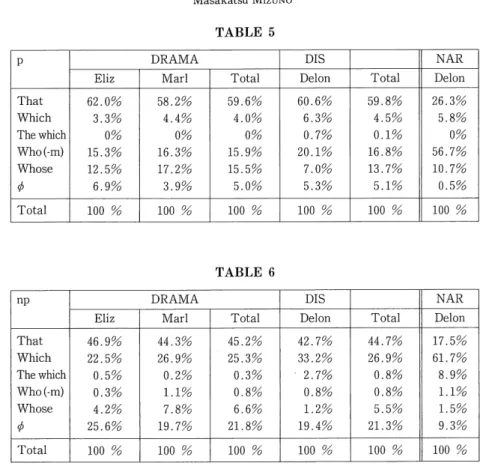
(7) Masakatsu MIZUNO. TABLE 5. That. Which The which. NAR. DIS. DRAMA. p Eliz. Marl. Total. Delon. Total. Delon. 62.0%. 58.2%. 59.6%. 60.6%. 59.8%. 26.3%. 3.3%. 4.4%. 4.0%. 6.3%. 4.5%. 5.8%. 0.7%. 0.1%. 0%. 0%. 0%. 0%. Who (-m). 15.3%. 16.3%. 15.9%. 20.1%. 16.8%. 56.7%. Whose. 12.5%. 17.2%. 15.5%. 7.0%. 13.7%. 10.7%. 6.9%. 3.9%. 5.0%. 5.3%. 5.1%. 0.5%. 100 %. 100 %. 100 %. 100 %. 100 %. 100 %. Delon. </>. Total. TABLE 6 NAR. DIS. DRAMA. np. Eliz. Marl. Total. Delon. Total. 46.9%. 44.3%. 45.2%. 42.7%. 44.7%. 17.5%. 22.5%. 26.9%. 25.3%. 33.2%. 26.9%. 61.7%. The which. 0.5%. 0.2%. 0.3%. • 2.7%. 0.8%. 8.9%. Who (-m). 0.3%. 1.1%. 0.8%. 0.8%. 0.8%. 1.1%. Whose. ^. 4.2%. 7.8%. 6.6%. 1.2%. 5.5%. 1.5%. 25.6%. 19.7%. 21.8%. 19.4%. 21.3%. 9.3%. Total. 100 %. 100 %. 100 %. 100 %. 100 %. 100 %. That. Which. From the tables above, we can note certain general tendencies.. 1) Which is used mainly with non-personal antecedents. In NAR the np which has a higher percentage in the total of np relative (i.e. 61.7%) than those in DIS and DRAMA (33.2% and 25. 3% respectively). 2 ) The which is, on the whole, non-personal. Only 2 examples of personal the which are found in DIS.16 3 ) Who (-m) is predominantly used to refer to personal antecedents. 4 ) The personal character of whose is also predominant. In DRAMA, however, the nonpersonal use of whose is rather frequently seen since the ratio of personal to non-personal. antecedent is 11: 1 (44 and 11 exs.) in NAR and 6.6 : 1 (20 and 3 exs.) in DIS, whereas in DRAMA the ratio is 2.5 : 1 (163 :65). It seems that Elizabethan dramatists were rather fond of using whose with animals and inanimate objects. This practice was not common in Deloney's novel (both. in DIS and NAR). In present-day colloquial English there is a tendency to use only whose alone to denote persons. 5 ) (f) -relatives are used with a non-personal antecedent, rather than with a personal one,. the ratio (p : np) being 1 : 12.5 (2 and 25 exs.) in NAR, 1 : 3.3 (15 and 49 exs) in DIS, and 1 : 4. 1 (53 : 217) in DRAMA. As for ^-relatives, there is a marked tendency to avoid them with personal antecedents in literary English at least so far as NAR is concerned..
(8) Relative Pronouns in the 16th Century (II). 4. Functions of Relative Pronouns in Clauses. Relative pronouns may have the function of a subject, a predicative, an object of a verb or. a preposition, or the SO (subject in a partially object environment)17. The tables below show the distribution of relative pronouns according to their function in clauses. Because of their rarity, however, we have omitted from the tables such constructions as :. 1) The SO (subject in a partially object environment) which occurs six times in all with the relative which (one p. ex. in DIS, two np. exs. in DRAMA, and three np. exs. in NAR). Here we illustrate some representative examples :. I feel that liuing in my womb, zuhich I fear will bring death vpon vs all : GC 1. 102. 27 (DIS) ; All which when his Grace vnderstood was done at the cost of a Clothier, TR 242.11 (NAR) ; Fearing the afflictions which my father feels Proceed from sin or want of faith in us, / I. 527.. 2 ) Predicative (2 exs.) with the relative which . and to lack good will to do your King and Countrey good were a signe of an vnworthy Subiect, ivhich I hope you will neuer be. GC 1. 122.45 (DIS) ; and were she froward, ivhich she will not be, ST II. iii. 6.. 3 ) Others which are specified nowhere (2 exs.) : for all the wealth my Master is worth, GC 1. 128.25 (DIS) ; all which I am content he shall still enioy, TR 251.20 (DIS).. 4.1 In Restrictive Clauses :. TABLE 7 p. Rest.. Subj. Obj. Prp. DIS. NAR. DRAMA. DIS. NAR. DRAMA. DIS. 89.2%. 85.6%. 87.1%. 35.9%. 38.4%. 25.0%. 9.1%. 7.2%. 8.9%. 9.4%. 15.4%. 12.5%. 0.5%. 2.0%. 2.0%. ^. 0%. 0% 0% 0%. 16.7%. 2.7%. 28.1%. 23.1%. 62.5%. 16.7%. 5.2%. 2.0%. 26.6%. 23.1%. 0%. 63.6%. 7.6%. 27.3%. 66.6%. 0% 0% 0% 0%. Total. 100%. 100%. 100%. 100%. 100%. 100%. 100%. 100%. 100%. DRAMA That. Which The which Who. Whom. 0% 0%. 0%. 0%. 0%. 0% Q%. 0% 0%. 0% 0%. 0% 0% 0%. NAR. 0%. 100%.
(9) Masakatsu MIZUNO. TABLE 8 Rest.. np. Subj That. Which. DIS. NAR. DRAMA. DIS. NAR. DRAMA. DIS. NAR. 81.2%. 78.3%. 82.9%. 30.3%. 35.6%. 19.6%. 27.8%. 35.3%. 25.0%. 11.5%. 15.9%. 17.1%. 13.3%. 15.1%. 30.4%. 27.8%. 11.8%. 0%. 5.9%. 25.0%. 0. 7.3%. 5.8%. Total. 100%. 100%. 100%. Who Wliom. Prp. DRAMA. 0% 0% 0% 0%. The which. Obj. 0% 0% 0%. 0% 0% 0%. 0% 0% 0%. 0% 0% 0%. 0% 0% 0%. 0% 0% Q%. 0% 0%. 0% 0%. 56.4%. 49.3%. 50.0%. 44.4%. 47.0%. 50.0%. 100%. 100%. 100%. 100%. 100%. 100%. From these tables of the restrictive clause we can discover the following general trends : 1) The personal that with a subjective function occurs more frequently by far than the personal who with the same function. On the other hand, the personal which with a subjective function can be found more frequently than the who of this case?. This may reveal that who has. not yet fully established itself in the sphere of subjective function18. 2 ) In NAR the personal whom with an objective function (as an object of a verb) occurs rather frequently (62.5%), while in DIS and DRAMA, the relative pronoun that is found as frequently as whom (that : whom = 38.4% : 23.1% in DIS and 35.9% : 28.1% in DRAMA). 3 ) The personal cf) with a subjective function is quite rare in NAR19, showing 2.0% to the total of relative pronouns of this case, while in DIS and DRAMA this relative is not unusual, the percentage of <f) to the total being 5.2% and 7.6% respectively. The non-personal ^ as the. object of a verb is, in contrast, quite frequent in both NAR and DIS (DRAMA as well). 4.2 In Non-Restrictive Clauses :. TABLE 9 p. Non-R.. Subj That. Which The which Who. Whom Total. DRAMA. DIS. NAR. DRAMA. 70.6%. 45.5%. 8.6%. 4.3%. 6.5%. 3.9%. 5.3%. 8.7%. 22.9%. 50.6%. 86.1%. 2.2%. 0% 0%. 100%. 0%. Q%. 100%. 0%. 0%. Obj. DIS. 0% 0% 0% Q%. Prp. NAR. 0% 0% 0% 0%. DRAMA. 0% 0% 0% 0%. DIS. 0% 0%. 28.6%. 0%. NAR. 0%. 6.3%. 0% 0%. 0%. 84.8%. 100%. 100%. 100%. 71.4%. 93.7%. 100%. 100%. 100%. 100%. 100%. 100%. 100%. From the tables (9 and 10) of non-restrictive clauses we can find the following traits : 1) The personal who with a subjective function is the commonest relative pronoun in NAR. The ratio of who to that is about 9.9 : 1. In DIS,too, the relative luho occurs rather.
(10) Relative Pronouns in the 16th Century (II). TABLE 10 np. Non-R.. Sub. DRAMA. DIS. Prp. NAR. DRAMA. DIS. NAR. DRAMA. DIS. 59.8%. 36.2%. 3.6%. 13.5%. 4.2%. 0%. 5.7%. 0%. Q%. 37.7%. 58.6%. 91.6%. 82.4%. 91.6%. 91.5%. 85.7%. 42.9%. 39.3%. 1.7%. 3.6%. 2.7%. 4.2%. 8.5%. 2.9%. 57.1%. 53.6%. 3.5%. 1.2%. That. Which The which Who WTiom Total. Q%. 2.5%. 0%. 100%. 0%. 100%. NAR. Obj. Q%. 0%. 1.4%. 0% 0%. 100%. 100%. 100%. 0% Q%. 100%. 5.7%. 0% 0%. 100%. 100%. 0%. 0%. 7.1%. 100%. frequently, although the relative that of this usage is still common, the ratio {who : that ) being 1.1 : 1. It is interesting and noteworthy that in DRAMA the relative used in this case is overwhelmingly that, the ratio {who : that} being 0.32 : 1. 2 ) In NAR the non-personal relative is almost exclusively which with the function of subject (91.6% of which as against 3.6% of that}. In DIS, the relative which is used more frequently than that (58.6% of which as against 36.2% of that}. In DRAMA, however, the relative that occurs rather frequently in this case, the percentage of that being 59.8% as against 37.7% of which. 3 ) When the relative pronoun has the function of the object of a verb or a preposition, the relative whom and which are used definitely with a personal antecedent and a non-personal one respectively.. 4) There is a functional difference between which and the which. The percentage of prepositional which and the zuhich of non-personal use to the other functions is 7.7% : 65.2% in NAR, 5.1% : 66.7% in DIS, and 18.1% : 33.3% in DRAMA. We can see that the which is more frequently used with a preposition (i. e. as an object of a preposition) than which. We may notice here also that Deloney favors this prepositional the which compared with DRAMA. On the whole, however, this relative is said to be rare at this time although it can fulfill a function almost similar to which20.. 4.3 With Prepositions Relative pronouns are usually placed at the beginning of the relative clause. This principle is always the case with the relative that and <^-form (contact clause), but not with the ivhpronoun. When the relative pronoun is used as the object of a preposition, a front-position of the preposition is also possible. Therefore, when the relative is governed by a preposition, the following syntactic variants are possible. I. Preposition+ w/z-pronoun, II. Wh-pronoun. . . preposition,. III. That. .. preposition, IV. <f) -form.. . preposition (i.e. contact clause)..
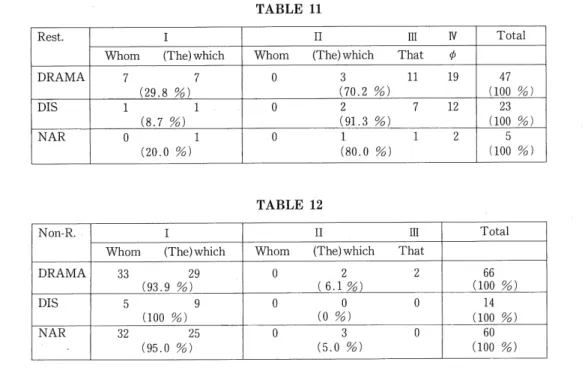
(11) Masakatsu MIZUNO. In the first type the preposition is placed in front-position, but in post-position in the other three. As regards formality of style grammarians admit that in the colloquial language there is a supremacy of post-position of prepositions in the relative clauses \. The following tables show the distribution of prepositions in these four types. Contact clauses are all restrictive, so that the type IV must be considered separately when we deal with the two kinds of clauses.. TABLE 11 I. Rest.. Whom DRAMA. 7. DIS. 1. NAR. 0. Whom. 7. 0. 1. 0. 1. 0. (29 .8 %) _(8_. II. (The) which. 7 %). (20 .0 %). Ill. (The) which 3. (70.2. 2. %}. (91.3 %)-. 1. (80.0. %). IV. That. 0. 11. 19. 7. 12. 1. 2. Total. 47. (100 %} 23. (100 %) 5. (100 %). TABLE 12 (The) which. Whom DRAMA DIS NAR. 11. I. Non-R.. 33 5 32. Whom. 29 (93.9 %} 9. 0. 25 (95.0 %). 0. (100 %). 0. (The) which. in. 2 (6.1%) 0. 2. 3 (5.0 %). 0. (0 %). Total. That. 0. 66. 1100 %\ 14. (100 %) 60. (100 %). As may be expected, there is a marked tendency in restrictive clauses to use post-position. (i.e. type II, III, IV) in DIS especially (91.3% of post-position as against 8.7% of front-position), though, in contrast, examples of relative pronoun are quite few in either position. In DRAMA too, there is a preference for post-position in restrictive clauses (70.2% as against 29.8% of. front-position). But it is to be noted that in DRAMA front-position is rather frequent, even in restrictive clauses. In non-restrictive clauses, on the other hand, the front-position of a preposition is usual and. no diversity can be found in this use between NAR and DIS. In DRAMA also, front-position is prevalent.. 5. Types of Antecedents. Antecedents may be classified roughly into three groups : nouns, pronouns, and clauses (or. phrases) (each abb. N, PR, CL for convenience' sake). The following table shows the statistics concerning the distribution of antecedent types: 10.
(12) Relative Pronouns in the 16th Century (II). TABLE 13 CL. PR. N DRAMA. DIS. NAR. DRAMA. DIS. NAR. DRAMA. DIS. Total. 613. 162. 320. 442. 122. 91. /. /. /. Total. 889. 198. 177. 75. 31. 11. 31. 24. 81. 9,5%. 30.1%. (p). (np). (%V.. 'T(np). 3.1%. NAR. Rather interesting information can be obtained from the table above. In NAR the proportion of N to PR is 3.5 : 1 and 16.1 : 1 with personal and non-personal uses respectively,. while in DIS it is 1.3 : 1 (p) and 6.4 : 1 (np), and in DRAMA it is 1.4 : 1 (p) and 11.9 : 1 (np) respectively. 1) PR antecedents have a personal character far more often than a non-personal character. 2 ) With N antecedents, they have not only a personal character but also a non-personal one in DIS and DRAMA, whereas in NAR they are more personal than non-personal. 3 ) When relative pronouns refer to a clause or a phrase, in which case the relatives used. are which and the which, it seems that this type of construction occurs more frequently in NAR. (30.1%) than in DIS (9.5%) and DRAMA (3.1%). 5.1 Antecedent Types and Functions of Relative Pronouns. In this section we further investigate the noun (N) and pronoun (PR) antecedents in detail as far as possible to find out if there are any general tendencies of the relative selection according to the functions of relative pronouns in clauses : 1. Subject,. 2 . Object of a Verb (or a Preposition). 5.1.1 Subject From the figures shown in TABLE 14 we can find the following results : [Personal antecedents] The relative that is used as a rule in the case of PR antecedents, while with Noun antecedents there is a diversity of relative usage between NAR on one hand and DIS and DRAMA on the other. The Noun antecedents are used with that about 70-80% in DIS and DRAMA, but in NAR they are used with that about 30% and with who about 60%. In the case of PN (proper noun) antecedents, it may be said that who occurs as well as that in this period. [Non-personal antecedents]. In the case of N antecedents there is a distributional diversity of the relatives that and which between NAR and DIS (DRAMA as well). The percentages in NAR are 38.2% of that 11.
(13) Masakatsu MIZUNO. TABLE 14 p. PR That. D R. Who. M. The which. A A. D I. s. N. A R. Which. <t>. np. N. Total. PR. N. Total. 11 (45.8%) 0. 320. 331 (74.0%) 5. 0. 603 (81.5%) 72 (9.7%) 32. 81. 0. 0. 0. 11 (45.8%) 0. 0. 92 (20.6%) 0. 17. 0. 0. 33. 2. 17. 19. PN. D. 250. 39. 11. 37. 22. 0. 19. 1. 0. 0. 16. 303 (88.1%) 13 (3.8%) 12. Noun. Total. (100%). 344. 323. 62. 11. That. 85 (81.0%) 9 (8.6%) 6. 80. 1. 0. 24. 8. 1. 7. 1. The which. 0. 0. ^. 5. Who Which. (100%). (100%). 24. 423. 1 (16.7%) 0. 74. 0. 166 (72.2%) 42 (18.3%) 14. 27. 0. 0. 0. 5 (83.3%) 0. 1. 32 (28.1%) 1. 3. 0. 0. 8. 0. 4. 4. Total. (100%). 105. 114. 10. 1. That. 38 (56.7%) 25 (37.3%) 4. 58. 9. 1. 104. 52. 0. 14. 2. Who. Which. 740. 5. 230. 2. (100%). 6. 108. 3 (50.0%) 0. 34. 0. 106 (34.3%) 181 (58.6%) 20. 51 3. 54 (56.8%) 3 0. 1. The which. 0. 0. 0. 0. 0. </>. 0. 1. 1. 0. 2. 0. 0. 67. 177. 64. 1. 6. 89. (100%). 75 (65.8%) 2. (100%). 3 (50.0%) 0. Total. 447. (100%). 309. (100%). (100%). 114. (100%) 37 (38.9%) 1. 95. (100%). Note:D=the case of Deity (God, Christ, etc.).. and 57.3% of which, while in DIS and DRAMA they are 68.5% {that) and 25.0% {which) and 75. 7% (that) and 19.1% (ivhich) respectively. When PR antecedents are used, both which and that occur with nearly the same frequency except in the case of DIS, where which is found rather frequently. i ) Pronoun antecedents :. The following table shows the frequency of the pronoun antecedents in the materials examined. The pronouns used here may be grouped into four kinds : personal, demonstrative, indefinite, and interrogative. The combinations many other and any other are also found. Here. we may notice the predominant use of personal pronouns especially in DIS and DRAMA, while in NAR indefinite pronouns occur as frequently as personal pronouns. As for the choice of relative pronouns in this use, personal pronouns are predominantly used with the relative that. 12.
(14) Relative Pronouns in the 16th Century (II). TABLE 15 PR. D R A. M A D I. s N A R. ind pr. dem pr. per pr p.. np.. p.. np.. p.. Total. inter pr. np.. p.. np.. p.. np.. ^. 251 12 3 12. 0 0 0 0. 24 0 7 1. 8 0 11 1. 27 1 2 3. 3 0 0 1. 1 0 0 0. 0 0 0 0. 303 13 12 16. 11 0 11 2. Total. 278. 0. 32-. 20. 33. 4. 1. 0. 344. 24. ^. 64 8 5 2. 0 0 0 0. 3 0 1 0. 1 0 5 0. 15 1 0 3. 0 0 0 0. 3 0 0 0. 0 0 0 0. 85 9 6 5. 1 0 5 0. Total. 79. 0. 4. 6. 19. 0. 3. 0. 105. 6. That. 16 17 1 0. 0 0 0 0. 2 1 1 0. 0 0 3 0. 20 7 2 0. 3 0 0 0. 0 0 0 0. 0 0 0 0. 38 25 4 0. 3 0 3 0. 34. 0. 4. 3. 29. 3. 0. 0. 67. 6. That Who. Which. That Who. Which. Who. Which. ^. Total. Note : Per pr, dem pr, ind pr, and inter pr indicate each personal, demonstrative, indefinite, and interrogative pronoun.. in DIS and DRAMA, but in NAR the relative who is also employed with nearly the same frequency.. As for the use of relative pronouns in all the texts examined, we can also find the following significant facts : 1) Generally speaking, indefinite pronouns tend to occur with the relative that irrespective of their personal or non-personal character22. 2 ) With demonstrative pronoun that (9 p. exs. and 20 np. exs.), which is preferred in personal (6 exs.) and non-personal (17 exs.) antecedents. This will be quite natural from the. viewpoint of euphony because we tend to avoid the combination that that (i. e. demonstrative followed by relative that). Here we illustrate some representative examples : Who's that that calls for help ? AF M. 22 ; Who is that luhich pincheth me ? OWT 153.. 3 ) The Demonstrative those of a non-personal character is always found with the relative. that (3 exs.). This demonstrative of personal character is also used with the relative that (25 out of 29 exs.). According to Ryden23, the usage of who with demonstrative those (i.e. those. who) is an innovation of Elizabethan English. But in the materials examined we found no example of a who of this type. Those is on the whole comparatively frequent as antecedents in the present study. Some illustrative examples :. 13.
(15) Masakatsu MIZUNO. If you unjustly deal with those tiwt in your justice trust ? 5T III. ii. 11 ; What horses are those that passed ? AF XII.' 12 ; he caused a great dinner to be prepared, and sent for all those that had been his masters and mistresses : luho being come, he thus began to commune with them GC 2. 202. 22 (NAR) ;. William was so daintily trickt vp, that all those zuhich beheld him, confest he was a most comely, trim, and proper man, GC 2. 201. 44 (NAR).. ii) Noun antecedents : Noun antecedents can be categorized roughly into the following types :. 1. (Art)+(Adj)+N 2. Gen+(Adj)+(N) 3. Dem+(Adj)+N 4. Ind+(Adj)+N. Note : Art =- article Adj= adjective Dem=demonstrative N^= noun Gen=genitive Ind=. indefinite In the type (2) we occasionally find such cases where relative pronoun refers to a noun in. the genitive : E.g.. Therefore die by thy loving mother's hand, Who gently now will lance thy ivory throat, And quickly rid thee both of pain and life. T 2. III. iv. 24.. It is generally said that when noun antecedent is qualified by a superlative, or a word such as only, any, every, the relative pronoun that is used rather than w/z-relatives. In the works examined we can find such tendencies as :. 1) Generally speaking, that is used alone when the noun antecedent is qualified by adjectives such as any, every, such.. 2 ) There is a definite tendency for the relative that to be used with the noun modified by the superlative degree of an adjective.. 3 ) The nouns modified by the demonstrative that are found rather frequently with the relative that contrary to the tendency seen in PR antecedent (14 out of 19 p. exs. and 13 out of 18 np. exs. are the cases)24.. 5.1.2 Object of a Verb or a Preposition TABLE 16 shows the distribution of noun and pronoun antecedents when their relative pronouns are the object of a verb or a preposition.. Comparing the table below with TABLE 14 (subjective function) it is evident that the personal luhom has higher frequency in the objective function (i.e. object of a verb and a. preposition). In the case of NAR, the percentage of whom to the total objective function is 89. 7% as against 58.6% of zuho to the subjective total. In DIS and DRAMA also we can discover the same tendency. In DIS we find 46.9% of whom and 18.3% of zvho, while in DRAMA we find 63.2% of whom and 9. 7% of who. This result will be quite reasonable if we consider the 14.
(16) Relative Pronouns in the 16th Century (II). TABLE 16 0 PR p.. D R. A. M A. D I. s. N A R. OP N. np.. p.. np.. p.. N. PR. PN. Noun. p.. Noun np.. p.. np.. Total tal. PN. D. p.. p.. p.. np.. 0. 26. 120. 0. 96. That. 10. 16. 14. 92. 1. 0. 0. 1. 12. 0. Whom. 28. 0. 17. 1. 13. 10. 0. 19. 2. 6. Which. 3. 10. 5. 85. 2. 0. 4. 0. 28. 0. 3. 10. The which. 0. 0. 0. 2. 0. 0. 0. 0. 1. 0. 0. 0. 3. yo. 3 127. (A. 10. 16. 7. 166. 0. 1. 3. 2. 13. 0. 0. 20. 198. Total. 51. 42. 43. 346. 16. 11. 7. 22. 56. 6. 3. 152. 451. That. 1. 5. 4. 22. 0. 1. 1. 0. 5. 0. 0. 6. 33. Whom. 4. 0. 5. 0. 0. 2. 0. 4. 0. 0. 0. Which. 1. 4. 1. 20. 0. 0. 1. 0. 2. 0. 0. (46.9%) 2. doo%)| 15^. 0 27. The which. 0. 0. 0. 0. 0. ^. 0. 0. 2. 5. 0. 0. 2. 5. 3. 11. 0. 25. 0. 1. 2. 2. 6. 1. 0. 7. 44. Total. 9. 20. 10. 67. 0. 4. 4. 8. 18. 1. 0. 32. 109. That. 1 5. 2. 1. 7. 0. 0. 0. 0. 1. 0. 0. 2. 10. Whom. 0. 12. 0. 5. 10. 0. 15. 2. 5. 0. 1. 1. 31. 0. 1. 0. 2. 3. 0. 0. 0. 0. 3. 0. 0. 0. 0. 13. 0. 0. 0. 16. 1. 0. 22. 0. 0. 1. 0. 1. 0. 0. 0. 25. 4. 14. 63. 5. 11. 1. 17. 20. 5. 0. 58. 88. Which. 0. The which. 0. ^. 0. Total. 6. (100%) 52. yo. 4. (100%)|. 2 35. history of the English language. It is said historically that the relative who established its subjective function later than the objective ivhom25. Especially in the case of prepositional use, the personal whom may be said to be the only relative. PN antecedents, it must be noted,. seldom occur with the relative that in the objective function (cf. the use of subjective that with PN antecedents). As in the subjective function, we can mention here some noteworthy facts concerning noun and pronoun antecedents in the works examined. i ) Pronoun antecedents : 1) As the object of a verb, personal pronouns of personal character (52 exs. in all) occur. mostly with the relative whom (35 exs.), less frequently with cf> (8 exs.), and that (7 exs.), but they are never found with which. In the function of prepositional object (i. e. as an object of a preposition) personal pronouns of personal nature (22 exs. in all) are all found with the relative whom except one example of cf). No personal pronoun was used with non-personal antecedents. 2 ) With demonstrative pronouns (9 p. exs.) as an object of a verb, such relative pronouns. 15.
(17) Masakatsu MIZUNO. as whom, which , that, and <f) are used, but in non-personal demonstrative pronoun (31 exs.), no example of np. whom was found. As for the demonstrative that (4 p. exs. and 25 np. exs. in all), it is used in personal use with which alone except for one cf> example, whereas in non-. personal use it is used mainly with which (12 exs.), <f) (11 exs.), and also that (2 exs.). 3 ) As for indefinite pronouns as an object of a verb, they are used with such relatives as that, whom, which, and <f> in personal use (8 p. exs.), but never used with whom in non-personal use (30 np. exs.). The examples of indefinite pronoun as an object of a preposition are quite few in number {that 1 ex., whom 1 ex., and which 1 ex. in personal use ; there is none in nonpersonal use).. ii) Noun antecedents : Here we can also find some significant facts concerning the relative selections (whom or other relative pronouns). 1) The nouns qualified by every (1 p. ex. and 9 np. exs. in all), any (6 np. exs. in all) have nearly the same tendency as we noted above in subjective function, since they are all found with the relative that except the case of every (7 out of 9 np. examples are used with cf>). No. example was found of the cases above as the object of a preposition. With the nouns modified by such (3 p. exs., 2 np. exs. in all), however, they are found only with the personal whom as the object of a verb (2 exs.) and a preposition (1 ex.), but in non-personal use they occur with that. and which once in each function (i. e. that as object of a verb and which as object of a preposition).. 2 ) When the nouns are modified by the demonstrative that, they are all used with the personal ivhom as an object of a verb (2 exs.) and a preposition (1 ex.) (cf. the noun of this usage with subjective relative that), while in the case of a non-personal antecedent they are used with which (9 exs.) and that (3 exs.) as an object of a verb and with which (1 ex.) and ^/^ (1 ex.) as an object of a preposition. 3 ) When the nouns are qualified by a superlative, they are always found in non-personal. use with the relative that (13 exs.) and ^ (10 exs.) as an object of a verb and ^ (1 ex.) as an object of a preposition respectively, while in personal use26 they occur only with ivhom (2 exs.) of the latter function and <f> (1 ex.) of the former function.. 6. Summary. So far we have investigated the use of relative pronouns with special reference to anaphoric that, w^-forms, and <^-form (contact clause) in Deloney's novels (treated under DIS and. NAR) and in Marlowe's as well as other Elizabethan plays. In particular, attention has been paid to the distributional pattern of relative pronoun usage in these works in order to see if, as pointed out in the introduction, we can detect in DRAMA'S English any traits characteristic of the colloquial (DIS) in comparison with literary language (NAR). Needless to say, the material on which our investigation is based, on the whole, is not extensive enough to enable us to arrive. 16.
(18) Relative Pronouns in the 16th Century (II). at any definite conclusions in the usage of relative pronouns in the late sixteenth century, but. we can at least point out the following three traits attested by both DIS and DRAMA in comparison with NAR, and,we may say that these traits are attributable to differences in style, the former more informal and colloquial, the latter more formal and literary.. 1) There is, as suggested by C. Barber and 0. Jespersen, a predilection for that in DIS and DRAMA, wh-re\atrve being less employed. (The percentage of that and wh-relative is 59.2% : 40.8% in DIS and 60.6% : 39.4% in DRAMA, while in NAR the percentage is 23.7% : 76.3%.) 2 ) There is a somewhat greater use of non-restrictive clauses than restrictive clauses in NAR. (The percentage of non-restrictive clauses and restrictive clauses is 69.9% : 30.1% in. NAR, but in DIS and DRAMA it is 37.8% : 62.2% and 43.6% : 56.4% respectively.) 3 ) The dominance of relative that can be seen in DIS and DRAMA especially because the subjective relative that is quite frequent even in non-restrictive clauses with personal and nonpersonal antecedents. (The percentage of personal that to the total of non-restrictive subjec-. tive relatives is 45.5% in DIS, 70.6% in DRAMA, while in NAR it is only 8.6%. The percentage of non-personal that to the same is 36.2% in DIS, 59.8% in DRAMA, but in NAR it is only 3.. 6%.). (NOTES) 1. C. Barber, Early Modern English (London : Andre Deutsch, 1970), p. 218. 2. 0. Jespersen, A Modern English Grammar Part HI (Copenhagen : Einar Munksgaard, 1940), p. 80. 3 . In my previous paper with the title "Relative Pronouns in the Late 16th Century : Centering on the Works. of Thomas Deloney" {Journal of Hokkaido University of Education Section I A, Vol. 30, No. 2), I have studied the use of relative constructions in the novels of T. Deloney with occasional reference to the relatives in Marlowe's seven plays. In this paper, however, I have further studied especially anaphoric relatives in five Elizabethan drama texts in addition to Deloney's novels and Marlowe's plays. 4. As, but, than which are used as relatives are not treated in this paper. The attributive uses of ivhich and the tvhich are also excluded in the present study. 5 . K. Araki, Theoretical and Practical studies in English Grammar (Tokyo : Kenkyusha, 1966), p. 12.. 6 . The edition used for this study is : The Plays of Christopher Marloiue ("The World's Classics" : London : Oxford U. P., 1969) 7 . T. Kyd, The Spanish Tragedy ("Minor Elizabethan Tragedies" : London : J. M. Dent & Sons Ltd, 1974) 8. G. Peele, Tlie Old Wives' Tale ("The Minor Elizabethan Drama" Vol. II, London, New York : Every-. man's Library, 1968) 9 . R. Greene, Friar Bacon and Friar Bnngay ("The Minor Elizabethan Drama") 10. Anonymous, Arden of Feve-i-sham ("Minor Elizabethan Tragedies") 11. T. Dekker, The Shoemakers' Holiday ("Early Seventeenth Century Drama", London, New York : Everyman's Library, 1970) 12. The edition used is : The Works of Thomas Deloney, ed. F. 0. Mann, Oxford : Oxford U. P., 1969) 13. F. Nakajima, Eigo Hattatsn-shi (Tokyo : Iwanami Shoten, 1970), pp. 186-193. 14. 0. Jespersen, op, cit., p. 82. 15. 0. Jespersen, op. cit., p. 80.. 16. E. g : ... a child... : to the which in despite of my beard they made me be God-father, GC 2. 197.2 (DIS) ; whilest he is abroad, the rest of his houshold will euery one of them seek for their own safegard, amongst. the ivhich, let faire Vrsula be one, GC 1. 105.10 (DIS).. 17.
(19) Masakatsu MIZUNO 17. R. Quirk, Essays on the English Language Medieval and Modem (London : Longmans, 1968), p. 101.. 18. M. Ryden states (Relative Constructions in Early 16th Century English ivith Special Reference to Sir Thomas Elyot, p. 366), " Who, which in 15th century English does not go far beyond certain more or less stereotyped closing phrases in letters, gains considerable ground in late Tudor literary English, but is there, as in early 16th century literature chiefly used in non-restrictive clauses." 19. The personal 4> with subjective function is restricted to cases in which the main clause is introduced by 'it is (was)', 'there is (was)', 'here is', or 'I have'. K. Araki states ("Kankeishi" Eibnnpo '-series, No. 5, p. 76), "... in standard PE the use of the subjective cf> belongs to colloquial speech, and is quite rare in literary style of language." 20. M. Ryden, op. cit., p. 366. 21. 0. Jespersen (MEG HI, pp. 184-5), C. T. Onions {An Advanced English Syntax, p. 147), etc. 22. E. g. (indefinite pronoun) :. I am not grown so fond to fond my love on any that shall quit it with disdain. SH III. i . 25 ; and therefore, being glad that he had met with one that could talk to him, he declared vnto him GC 1. 111. 29. (NAR).. 23. M. Ryden, op. cit., p. 366.. 24. E. g. : but thrice accursed be that fish that first seteth his nimble teeth thereon, GC 1. 81. 10(DIS);in remembrance of that ship, that first did bring him his wealth, GC 1. 125. 17 (NAR) ; I will tell thee what (quoth Gillian) that man ivhich needeth neither to flatter with his friends, nor borrow of his neighbours hath riches sufficient: GC 2. 144. 35 (DIS) ; with that beguiling snare ivhich late, methought, was pitch'd to cast the deer AF VI. 15. 25. 0. Jespersen, Essentials of English Grammar (London : George Alien & Unwin, 1979), p. 359. 26. E. g. : now 'tis time To be aveng'd on you for all your braves, And for the murther of my dearest friend, To tuhom right well you knew our soul was knit, E 1537 ; you have drunk to the properest man I keep SH HI. iii. 80. (Assistant-professor, Sapporo Branch). 18.
(20)
図


+6


関連したドキュメント
昨年の2016年を代表する日本映画には、新海誠監督作品『君の名は。」と庵野秀明監督作品『シ
To understand the writer’s understanding of this period in Shanghai, this article attempts to consider Hayashi’s realistic narrative style, analyze the scenery of Shanghai in war and
母子保健・子育て支援の領域では現在、親子が生涯
This paper develops a recursion formula for the conditional moments of the area under the absolute value of Brownian bridge given the local time at 0.. The method of power series
We present sufficient conditions for the existence of solutions to Neu- mann and periodic boundary-value problems for some class of quasilinear ordinary differential equations.. We
“Breuil-M´ezard conjecture and modularity lifting for potentially semistable deformations after
Then it follows immediately from a suitable version of “Hensel’s Lemma” [cf., e.g., the argument of [4], Lemma 2.1] that S may be obtained, as the notation suggests, as the m A
discrete ill-posed problems, Krylov projection methods, Tikhonov regularization, Lanczos bidiago- nalization, nonsymmetric Lanczos process, Arnoldi algorithm, discrepancy
