Plants to Soil Moisture in Mixed and Pure
Stands
著者
SUMI Akio, KATAYAMA Tadao C.
journal or
publication title
南太平洋海域調査研究報告=Occasional papers
volume
18
page range
210-229
URL
http://hdl.handle.net/10232/16694
Growth Responses of Upland Rice and Sorghum Plants to
Soil Moisture in Mixed and Pure Stands
Akio Sumi and Tadao C. Katayama
(Faculty of Agriculture, Kagoshima University, JAPAN)
Introduction
Mixed-cropping, or intercropping systems which are commom traditional practices
throughout the tropics n>19'22) are also predominant in African farming systems 3»14'25'28).
It is often suggested that not only relative advantages but also improved stability of yield
is one of the major reasons why intercropping continues to be an extremely important
practice in many developing areas of the world, especially those areas of greater risk28,29) gut as yet any qUantitative information on the magnitude or practical impor
tance of this improvement has been extremely limited; indeed, in many situations there is still considerable doubt as to whether improved stability is actually achieved. REES 31) indicated that intercropping, in the drought seasons of 1982/83 and 1983/84 in Botswana, gave harmful effects on crop production, particularly in standard row at the mediumplant densities. Fisher 12) also showed that mixed-cropping was disadvantageous under
poor moisture supply but advantageous under good moisture supply, with a conclusion that although mixed-cropping has been regarded as the expression of African farmers' desire to minimize risks, it does not appear always to operate well at the section where the major risk is from drought, whereas it may operate as it is expected if the risk is from pest or disease. However, in the rain-fed semi-arid tropics the lack of moisture has been major causes both of low yields and of marked instability of yields from season to season. If the relative advantages, indeed, depend on water resource, poor and erratic rainfall characterizing the climate of semi-arid tropics may well make the relative advan tages of mixed-cropping markedly unstable. This suggestion is considerably inconsistent with the concept of improved stability. On the other hand, LiGHTFOOT et al. 26) failed to ascertain greater stability of intercropping in Botswana, where the environmental conditions were harsh. Rao et al. 29) and Baker 6) concluded that intercropping gave yield
advantage in a wide range of environmental conditions and that intercropping should be
considered more stable than sole cropping, in a sense that probability of monetary re
turns falling below given 'disaster levels' was less in intercropping. In addition,
Natara-JAN et al. 27) found that intercropping-advantages of various crop combinations at a fixed
total density actually increased at a time when irrigation was withheld. As mentionedabove, the informations on stability are very complicated, depending on the crop com
binations, population density and the kind of damage, though greater yield advantages under stress have often been suggested as a probable effect of intercropping. Because it is expected that stability of mixed-cropping may be enhanced in a case when one compo nent compensates for the damage done to another, this study was carried out in order to examine whether such a compensation might be achieved for drought damage or
excess-moisture injury in the sorghum-upland rice mixture.
Materials and Methods
The experiments were carried out inside the vinyl plastic hothouse in the Ex
perimental Farm of Faculty of Agriculture, Kagoshima University, from 17 May to 21 June, 1988. Grains of the sorghum (Sorghum bicolor Moench, cv. Snow brand hybrid sorgo) and the upland rice (Oryza sativa L., cv. Norin 11) were sown in the 13 liter seedling culture boxes filled with a sort of uniform soil of 9.24kg of dried soil passed
through a sieve of 5mm across, on 17th, May. At sowing date, three treatments were
established; sole sorghum, sole upland rice and mixture treatments. In order to cause the young plants, in the early stage when the present experiment was carried out, to drastically compete for the environmental resources, seeds were sown at high seeding rate of 24 grains per pot (170 grains/m2) in the sole cropping treatments. And, seeds were sown in grid. Because it has been pointed out that relative advantages from mixed-cropping were produced, at least partly, by the increased population pressure, the seed ing rate in mixture treatment was also fixed at the respective 12 grains, setting limit at 24
grains in total to exclude its effect. And, seeds were sown alternately.
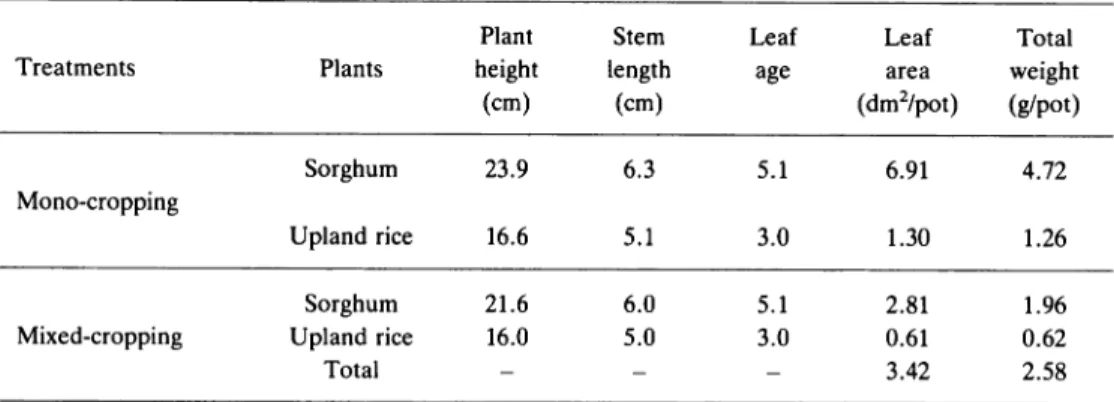
Compound fertilizer (8-8-8) was applied at the rate of 21g per pot, on 30th, May. Six soil moisture treatments, from arid condition to submerged condition, were imposed on the plants for three weeks from 31st May to 21st June. At the beginning of the treat ments, the soil moisture ratio in each seedling culture box was kept in about 16%, and the relative plants were noted to be at the states of growth, as shown in Table 1. Soil moisture control was carried out by a gravimetric method, and the amount of water sup plied in order to keep the soil moisture condition constant was sprinkled on the soil sur face every day. However, because the soil moisture conditions changed gradually with the increases in evapotranspiration and in plant weight, the soil moisture ratio used in this paper was enforced to be an averaged value during the treatment.
On 21st, June, 24 plants with two replications were harvested from each division. Five moderate plants selected from each harvest sample were separated into leaf blades, stems (including leaf sheath) and roots, after plant height, stem length, leaf age, number of tiller, number of green leaves, and leaf length and leaf width were determined. Leaf length and leaf width determined were those of the 7th and 5th leaf blades in sorghum and upland rice, respectively. The determination of leaf width was done at the most
em-Table 1. Growth increments of sorghum and upland rice at the beginning of soil mois
ture treatments
Plant Stem Leaf Leaf Total
Treatments Plants height length age area weight
(cm) (cm) (dm2/pot) (g/pot)
Sorghum 23.9 6.3 5.1 6.91 4.72
Mono-cropping
Upland rice 16.6 5.1 3.0 1.30 1.26
Sorghum 21.6 6.0 5.1 2.81 1.96
Mixed-cropping Upland rice 16.0 5.0 3.0 0.61 0.62
Total - - - 3.42 2.58
inent section. Leaf area was also measured with automatic area meter. The sub-samples
and the bulk samples were dried at 80°C for 72 hours in the dehydrater, and dry weights
were determined.
Evapotranspiration in each plot was assessed by accumulating the total amount of
water supplied during the soil moisture treatment and the increased total fresh weight.Results
Dry matterproduction
Total dry weight in sole sorghum increased with the increasing in soil moisture ratio
and then declined with an optimum counting around 45%. But, in sole upland rice, it
continued to increase steadily with the increasing in soil moisture ratio, and no optimum
could be recognized within the limits of soil moisture in this experiment (Fig. 1). The
100 o .£ .2? f2 0 10 20 30 40 50 60
Soil moisture ratio (%)
Fig. 1. Relationship between the soil moisture ratio and total dry matter weight at the time of harvest.
100
o
O
"0 25 50 75 100
Calculated value (g/pot)
Fig. 2. Comparison of the calculated value of total dry matter weight [based on Eqs. (1), (2) and (3)]
with the observed value.
Symbols are the same as those shown in Fig. 1.
effects of soil moisture upon the total dry weights of sole sorghum and sole upland rice were to be formulated by the following reciprocal equations, respectively :
1 0.2625
Sole sorghum ;
— = f_ gQ + 0.0001917 (f- 8.0) + 0.001667
• , • l °-8125
Sole upland rice ;
Mixture ;
w /-9.4 + 0.027083
where, / and w are soil moisture ratio (%) and total dry weight (g/pot), respectively. The observed values and the calculated values based upon Eqs. (1) and (2) corre sponded considerably well (Fig. 2). Eqs. (1) and (2) indicate that the soil moisture acted
as optimum factor 18) and as linear factor 20) on the dry matter productions in sole sor
ghum and sole upland rice, respectively, and that the uppermost limit values of unavail able soil moisture (f0) were 8.0 and 9.4% in sole sorghum and in sole upland rice, re spectively. These implications bespeak that upland rice possesses larger wet endurance than sorghum and that sorghum surpasses upland rice in drought tolerance or in dehydration tolerance.
The relationship between soil moisture ratio and total dry weight in mixture was formulated satisfactorily by the following reciprocal equation (Fig. 2).
1 0.3100
+ 0.000160 {f - 8.5) + 0.0065
w f-8.5
Eq. (3) indicates that soil moisture acted as optimum factor on the dry matter produc tion in mixture as well as sole sorghum, but f0 and optimum soil moisture ratio (fopt) of the former were 0.5 and 7.5% higher than those of the latter, respectively. Total dry weight in mixture lay halfway between those of sole sorghum and of sole upland rice. The land equivalent ratio (LER), defined as a relative land area that would be required as sole crops to produce the achieved yields in the mixed-cropping, was fixed to be near-Eq. (1)
Eq. (2)
10 20 30 40 50 60 Soil moisture ratio (%)
Fig. 3. Relationship between the soil moisture ratio and land equivalent ratio (LER) of total dry weight.
• : Sorghum LER, m : Upland rice LER, a : Total LER mixed-crop sorghum dry weight
mono-crop sorghum dry weight
Sorghum LER
Upland rice LER = ^d-crop upland rice dry weight
mono-crop upland rice dry weight
Total LER = Sorghum LER + Upland rice LER
^ u u o O 150 -^ ^^^^^ ^ / ° ^Ss\ E 0 x "O ^A a-^ CO g 100 /o t ^ CO <*H ec
° /
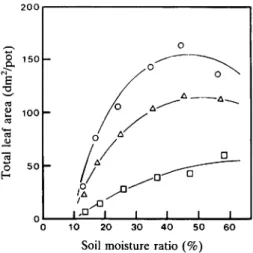
"e3 D O 50 H n I 10 20 30 40 50 Soil moisture ratio (%)60
Fig. 4. Relationship between the soil moisture ratio and total leaf area at the time of harvest. Symbols are the same as those shown in Fig. 1.
ly constant, independent of soil moisture conditions (Fig. 3). LER of sorghum became larger than 0.5 and that of upland rice smaller than 0.5, respectively. Total LER was
nearly equal to 1.0. Leaf area development
Leaf area was also successfully correlated with soil moisture ratio in the same way,
only the uppermost limit values of unavailable soil moisture for leaf area were 1.3-2.2%
Sole sorghum ;
Sole upland rice
Mixture ; -8* r'e i, OJ O ft! -J 0.0860 / - 10.2 0.4650 /-10.7 0.1104 + 0.00006(7- 10-2) + 0.0018 + 0.0090 .. ,, - + 0.000046
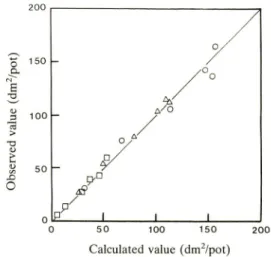
(f-In Eqs. (4), (5) and (6), /and u indicate soil moisture ratio (%) and leaf area (dm2/pot),
respectively. The calculated values based on Eqs. (4), (5) and (6) agreed fairly well with
the observed values (Fig. 5). LERs of leaf area were around 0.66, 0.34 and 1.0 in sorghum, upland rice, and total, respectively, independently of soil moisture ratio (Fig. 6).
The higher the soil moisture became, the more numerous the leaf number became
alike in sorghum and in upland rice, but the magnitude was noted to be more
conspic-10.5) + 0.0043
Eq. (4)
Eq. (5)
Eq. (6)
50 100 150 200
Calculated value (dm2/pot)
Fig. 5. Comparison of the calculated value of total leaf area [based on Eqs. (4), (5) and (6)] with the observed value.
Symbols are the same as those shown in Fig. 1
-A A • A A • • • • • 1 1 • | • • 1 1 • 1 O 10 20 30 40 50 60
Soil moisture ratio (%)
Fig. 6. Relationship between the soil moisture ratio and land equivalent ratio (LER) of total leaf area. Symbols are the same as those shown in Fig. 3.
20" A 15 <D B
1 10
CO 5£-•""•
rJ
I J 1 1 75 - c a ^ 50 " o°~~°—°—°~ "3d gw_#_..#_-.#_- ^
CO OR 0 1 1 1 20 40 60Soil moisture ratio (%)
150 - B T3 £ 100 <u X 6 50 h 00 c
A o
i- If
ff
1 1 L 20 40 60Soil moisture ratio (%)
Fig. 7. Relationship between the soil moisture ratio, and leaf number (A), [leaf length X leaf width] (B), leaf length (C) and leaf width (D) at the time of harvest.
o : Mono-crop sorghum, • : Mixed-crop sorghum, • : Mono-crop upland rice, • : Mixed-crop upland rice
Leaf length and leaf width determined were those of the 7th and 5th leaf blades in sorghum and upland rice, respectively.
uous in upland rice than in sorghum (Fig. 7A). However, in the former, a little increas ing was noted in the [leaf length X leaf width] (LW), which may be in proportion to leaf area per one leaf, whereas sorghum's LW increased rapidly due to the increase in soil moisture ratio and then declined quickly under an excess-moisture condition (Fig. 7B). These results suggest emphatically that as shown in Fig. 4, leaf areas of upland rice and sorghum were principally prescribed by the leaf number and by the leaf area per one leaf, respectively. The increases in LW occurred with the increasing in soil moisture were entirely correlated with an increase in the leaf width because leaf length was con stant, independently of soil moisture condition, excepting an excess-moisture condition. But the abrupt decline in LW of sorghum under an excess-moisture condition was corre lated with a rapid decreasing in leaf length rather than leaf width (Figs. 7C and 7D). The above-mentioned aspects of relationships were recognized irrespective of the sorts of cropping, namely whether in mono-cropping or in mixed-cropping, but the absolute values were, more or less, dependent on the cropping systems. In the mixed-cropping leaf number increased in sorghum and decreased in upland rice, respectively, as
com-100
6
0 20 40 60
Soil moisture ratio (%)
100
0 20 40 60
Soil moisture ratio (%)
Fig. 8. Relationship between the soil moisture ratio, and net assimilation rates (NAR) and leaf area ratios (LAR) during soil moisture treatment.
(A) and (C) : Sorghum, (B) and (D) : Upland rice.
Symbols are the same as those shown in Fig. 7.
pared with those in the sole cropping. Under mixed-cropping LW or leaf length became slightly larger in upland rice and considerably smaller in sorghum than under mono-cropping. Fundamentally no difference was noted in the relationship between soil mois ture and leaf width whether in mono-cropping or in mixed-cropping.
Growth function
The net assimilation rate (NAR) defined as the dry matter production rate per unit leaf area, increased continuously in upland rice together with the increasing in soil mois ture ratio, whereas sorghum's NAR tended to decline under excess-moisture conditions more than 45% (Figs. 8A and 8B). On the whole the decline in NAR due to water def icit tended to be smaller in upland rice than in sorghum. The leaf area ratio (LAR) de fined as the ratio of leaf area to the total dry weight was higher in sorghum than in up land rice under all soil moisture conditions (Figs. 8C and 8D). LAR declined consistently in upland rice together with the decreasing in soil moisture ratio, though soghum's LAR
was fixed to be constant within soil moisture ratio over 20% and afterwards decreased.
NARs of component crops in mixture were nearly equal to what shifted 10mg/dm2/
day above and below NARs in sole sorghum and sole upland rice, respectively. In theRGR under mono - cropping
(X 10~2/day)
Fig. 9. Comparison of relative growth rate (RGR) in pure stand with one in mixed stand. • : Sorghum, • : Upland rice
o
a
c
0 10 20 30 40 50 60
Increased total dry weight (g / pot)
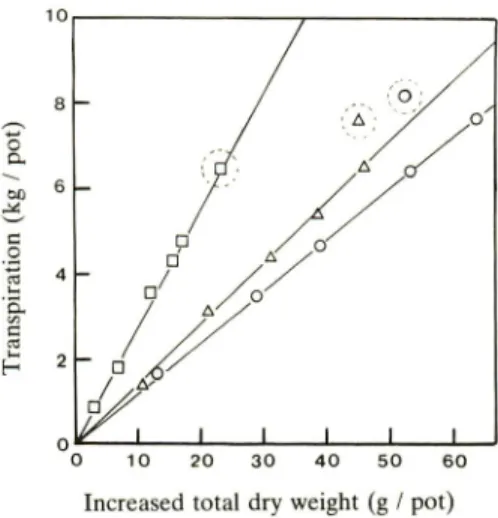
Fig. 10. Relationship between the increased total dry matter weight and evapotranspiration.
Symbols are the same as those shown in Fig. 1.
Arrows in the margin indicates 'unavailable evapotranspiration'.
•'J indicates the value under an excess-moisture condition.
result, although upland rice's NAR was larger than sorghum's in pure stand, the situa tion had been reversed in the mixed stand. On the other hand, no effect of mixed-cropping upon the relationship between soil moisture and LAR could be recognized at all. In mixed-cropping the relative growth rate (RGR), expressed as the product of NAR and LAR, became 1.16 times in sorghum and 0.84 times in upland rice as large as those in mono-cropping (Fig. 9).
Water use efficiency
When the soil moisture ratio was over 20%, evapotranspiration (ET) increased in proportion to the increased total dry weight, excepting sorghum and mixture under an excess moisture, though when the soil moisture ratio was less than 20%, ET lay below a linear equation observed above (Fig. 10). On the basis of the previous results 34'35) that
the water use efficiency (WUE) — the reciprocal of the slope shown in Fig. 10 - was constant independently of the soil moisture ratio and fertilizer application, some straight lines passing through the observed value, as well as those having the same slope (120, 280 and 140gH2O/g in sole sorghum, sole upland rice and sorghum-upland rice mixture, respectively) were drawn. And, on the assumption that when the increased total dry weight became zero, ET could be regarded as 'unavailable evapotranspiration' or 'evap oration' (£), the relationship between the soil moisture ratio and E was examined. E estimated in this way, increased with an increase in soil moisture ratio until it became about 4kg/pot under soil moisture conditions greater than 21.5% in all the treatments,
excepting in sole sorghum and mixture treatments under an excess-moisture condition
(Fig. 11). Although the estimated Es in sole sorghum and mixture treatments became
o ex oo M c o ca o a . > 5 4 3
3
> o ', A .'I
/-<&i ac—ata—Yd— / 1 1 1 1 1 1 t) 10 20 30 40 50 60Soil moisture ratio (%)
Fig. 11. Relationship between soil moisture ratio and evaporationmi.
Symbols are the same as those shown in Fig. 10.
•l : 'Unavailable evapotranspiration' was regarded as nearly equal evaporation.
c cd
H
10 20 30 40 50 60
Increased total dry weight (g / pot)
Fig. 12. Relationship between the increased total dry weight and transpiration*2. Symbols are the same as those shown in Fig. 10.
it! 2 : Transpiration was estimated by deducting unavailable evapotranspiration from evapotran spiration.
much larger than 4kg/pot under an excess-moisture condition, this was perhaps because there was a problem in the assumption that WUE was constant even under excess-moisture conditions rather than because E really increased under above-mentioned con dition, for E in upland rice under the same condition was equal to 4kg/pot. The tran spiration (T) assessed by deducting E from ET, increased in proportion to the increased total dry weight, though that was a natural thing to be expected (Fig. 12). WUEs were 8.3, 3.6 and 7.0mg/gH2O in sole sorghum, sole upland rice and sorghum-upland rice mixture, respectively, only WUEs in sole sorghum and mixture fell to 6.4 and 6.0 under
an excess-moisture condition, respectively.
It is very difficult to estimate WUEs of the components in mixture in this way. But, let it be supposed that WUEs of component crops would be the same as those in pure stand, then ETM in mixture is given by the following equation :
ETM = > -o t (A X> o AW5 AWk '+ „,r^ +E WUES ' WUER
where, ^Ws and ^WR are the increased total dry weights of sorghum and upland rice in mixture, WUES and WUER are the water use efficiencies of sorghum and upland rice in pure stand, and E is an evaporation in each soil moisture condition. The calculated values based on Eq. (7) and the observed values corresponded considerably well (Fig. 13). Judging from the results shown in Fig. 13, the above-mentioned assumption that
WUEs of component crops in mixture may be equal to WUEs in mono-cropping seems
to be valid.
2.5 5.0 7.5 10.0
Calculated value (kg / pot)
Fig. 13. Comparison of the calculated value of evapotranspiration in mixed stand [based upon Eq. (7)]
with the observed value.
Discussion
Growth responses of sorghum and upland rice to soil moisture in pure stand
In Africa, rice plant was often seen grown together with maize, taro, cassava,
beans, sesame etc., though it was frequently observed grown in single. Sorghum, a very important crop in the semi-arid zone, like the above crops, was seldom one of the com ponent crops in mixture mainly composed of rice. Although it has been well known that
crop combinations usually vary a great deal from one ecological zone to another x), the
percentage of rice-sorghum combination for mixed-cropping system was none too large everywhere. This may be partly because the cultural environments differ considerablybetween the two crops. According to the field observations in Kenya 33\ it is said that
sorghum culture began to be observed where the ratio of mean annual rainfall to mean annual potential evaporation (r/E0) was only 25%, whereas it was impossible to growrice without irrigation at any place where rlE0 was less than 80%. INTHAPAN et al. 21)
found that the total biomass production and grain yield of rice cultivars decreased more sharply with a decrease in water supply than those of sorghum did. On the other hand, sorghum as well as the other upland field crops seen to be frail to excess-moisture. KONO et al. 23) divided the summer cereals into the two groups designated sorghum and upland rice which were used, in the present experiment, as the species having a large drought tolerance capacity and a large waterlogging tolerance capacity, respectively. The practice of mixed-cropping has been associated partly with an assumption of greater stability. And, it is also based on an assumption that one component crop may compensate
for the damage due to drought, hail, nitrogen stress and so on to another 26,29) (although
stability is enhanced when crops hinder the spread of pests and diseases, that was ignored in the present paper). The greater the growth responses of component crops to environmental conditions differ, the greater will become such a 'compensation effect'. That is why the authors dared to take up sorghum-upland rice combination in the pres ent study, in spite of the fact that sorghum-upland rice combination isn't so much popu lar in Africa.The fact that Eqs. (2) and (5) lacked a term showing inhibition effect due to the surplus of soil moisture as the reciprocal factor, as compared with Eqs. (1) and (4) perhaps answer to 'large waterlogging tolerance capacity' of upland rice pointed out by KONO et al. 23) . On the other hand, upland rice was in possession of the higher f0 than
that of sorghum. FUKAI et al. 15) have attributed the sharp response of rice biomass pro
duction to water deficit, partly, to the inability to extract water thoroughly at lower depth. However, because the present study was carried out in shallow pot, it seems to be difficult to explain fully the high sensitivity of upland rice to water deficit only in their rationale. The relative importance of f0 to interspecific difference in drought toler ance is expected to be examined from a physiological point of view in the future.dif-ferences in the response to soil moisture. Firstly, the effects on leaf area development
were expressed mainly through leaf number in upland rice and leaf area per one leaf insorghum. Basing on the fact that leaf number in upland rice was related linearly with
stem number (unshown), it was assumed that water deficit firstly forced upland rice to
inhibit tillering might soften, to some extent, the direct effect of water deficit on leafarea per one leaf. On the other hand, in sorghum having no or few tillers independently
of soil moisture conditions, soil moisture stress was supposed to affect directly the leaf
area per one leaf. Hence the assumption that the difference in the expression of leafarea response to soil moisture is based partly on a difference in the tillering capacity be
tween the two crops. In appearance soil moisture didn't affect the leaf length as com
pared with the case of leaf width. This is perhaps due to the fact that the prolongation of
leaf-emergence interval under water deficit compensated the negative effect of soil mois
ture stress upon the leaf length, whereas in case of the leaf width no compensation was
expected because it was determined prior to leaf length 37). Under an excess-moisturecondition, where the dry matter production decreased and leaf-emergence interval didn't
expand as under dry condition, sorghum's leaf length abruptly got short. The result also
suggests a possibility of 'compensation' due to the prolongation of leaf-emergence inter
val as mentioned above.
Secondly, the effects of soil moisture on RGR were expressed, relatively, through
LAR in upland rice and through NAR in sorghum. The present result that the decline
percent in NAR occurring with a decreasing in soil moisture ratio was larger in sorghum
than in upland rice seems to be inconsistent with the indication that leaf photosynthesis
is affected by the soil moisture stress more severely in rice than in sorghum 21). When
the fact that NAR is remotely related to leaf photosynthesis, though NAR and leaf
photosynthesis are liable to be confused as the unit as the same, is taken into consideration together with the result that sorghum in possession of the larger LAR showed the
smaller NAR, the sharper decline in sorghum's NAR in comparison with that of rice's,
seems to be no more than a reverse of the result that sorghum's LAR was hard to be
affected by water deficit.Sorghum's WUE was about 2.3 times as large as upland rice's. It is expected that
the result is to be grounded on the difference in C02 fixation pathway between the two
crops 7,8), that is, sorghum and upland rice are C4 and C3 species, respectively. Sor
ghum's WUE under an excess-moisture abruptly fell to about 75% of that under other
conditions. This is partly due to the fact that the dry matter production of sorghum de
creased, and partly to that the transpiration increased under excess-moisture conditions. It has been generally believed that excess-moisture decreases the suction force of roots24). Further investigations, however, seem to be needed to clarify this inconsistency.
Growth responses of sorghum and upland rice to soil moisture in mixed standThere are a lot of reports which have substantiated the yield advantage of
mixed-cropping i>2,3-5,n,i4,i9,25,3o,3i,36)
Bm in the present study the sorghum-upland rice
total LERs of dry weight and leaf area in mixture were nearly equal to 1.0 independent
ly of soil moisture condition. According to some reports 1012) showing that
cropping has not always given yield advantage on to mono-cropping, the effect of mixed-cropping upon the yield advantage depends greatly on crop combinations. Apart fromcrop combination, FlSHER 13) indicated an example that the yield advantage from
mixed-cropping could be explained solely by the increased population pressure in the mixture. But, in this study the plant density was fixed to be constant. Those were assumed to be the major reasons why yield advantages were not given in the present study.The responses to soil moisture, as mentioned above, differed in various points con siderably between sorghum and upland rice. It is expected that in sorghum-upland rice mixture the stability to soil moisture remarkably increases when the two crops are grown together. Judging from the result that f0 and fopt in mixture were lower and higher than f0 of upland rice and fopt of sorghum in pure stand, respectively, mixed-cropping seems to have, somewhat, positive effect on the improved stability. However, considering that it gradually sacrificed the large tolerances to drought and excess-moisture of sorghum and upland rice, it comes to be thinkable that sorghum-upland rice mixture contributed little to the improved stability to soil moisture. The relationships between soil moisture ratio, and the total dry matter weights and leaf areas per pot of sorghum and upland rice in both pure and mixed stands are, in a lump, shown in Table 2. The calculated values
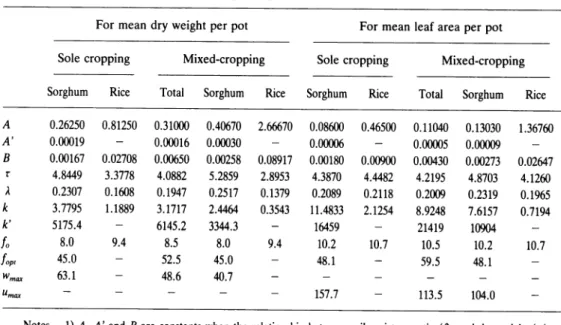
agreed very well with the observed values (Fig. 14). As seen from Table 2, f0, fop, and
the relative relation among A, A' and B were nearly constant independently of whether mixed- or sole- cropping, though the absolute values of A, A' and B differed between the pure and mixed stands. In addition, WUEs of component crops were not affected by mixed-cropping. The results show that the basic relationships between soil moisture ratio and growth increments of the two crops were not affected by mixture.Two results, the one that the LERs of sorghum and upland rice in mixed stand were larger and smaller than 0.5, respectively, and another that the RGRs of sorghum and up land rice in the mixed stand were 1.16 and 0.84 fold of those in pure stand, indicate that sorghum conquered upland rice in the growth. Plants are conceived to be competing for the limited supplies of environmental resources necessary for growth, usually light above, and nutrients and water below, ground 9). The general conclusion from all the ex periments involving competition for light is that the component whose leaf area is higher in the canopy is at an advantage, specially if the taller component has a greater leaf area. Such an example has been found in the mixed sorghum-pigweed communities by
Graham et al. 16). In the present study, sorghum was not only taller but had wider and
longer leaves than those of upland rice, in which the number of leaves was reduced (and those of sorghum increased) when the two crops were made to be grown together. Sorghum having the taller and the greater leaf area might reduce the light penetrating into upland rice. Consequently, it is assumed that NAR of upland rice in mixed stand decreased because of light deficiency, whereas NAR of sorghum having advantage for light competition increased. According to Yamasaki 37), shading at the occassions ofTable 2. Characteristic values of logistic growth at the time of harvest
For meandry weight per pot For mean leaf area per pot
Sole cropping Mixed-cropping Sole cropping Mixed-cropping
Sorghum Rice Total Sorghum Rice Sorghum Rice Total Sorghum Rice
A 0.26250 0.81250 0.31000 0.40670 2.66670 0.08600 0.46500 0.11040 0.13030 1.36760 A' 0.00019 - 0.00016 0.00030 - 0.00006 - 0.00005 0.00009 -B 0.00167 0.02708 0.00650 0.00258 0.08917 0.00180 0.00900 0.00430 0.00273 0.02647 T 4.8449 3.3778 4.0882 5.2859 2.8953 4.3870 4.4482 4.2195 4.8703 4.1260 A 0.2307 0.1608 0.1947 0.2517 0.1379 0.2089 0.2118 0.2009 0.2319 0.1965 k 3.7795 1.1889 3.1717 2.4464 0.3543 11.4833 2.1254 8.9248 7.6157 0.7194 k' 5175.4 - 6145.2 3344.3 - 16459 - 21419 10904 -So 8.0 9.4 8.5 8.0 9.4 10.2 10.7 10.5 10.2 10.7 Jopt 45.0 - 52.5 45.0 - 48.1 - 59.5 48.1 -Wmax 63.1 - 48.6 40.7 - - - -"max — - — — 157.7 - 113.5 104.0
-Notes. I) A, A' and Bare constants when the relationship between soil moisture ratio (/), and dry weight (w) or
leaf area (u) per pot were formulated by the following reciprocal equation.
1 A
Vo77 =J~f0 +A* (f - Q +B (A: %/g or %/dm2, A:1/g-%or 1/dm2- %, B:1/g or 1/dm2)
where, f0 indicates the uppermost limit value of unavailable soil moisture (f0 : %).2) r = - in (WoB)
where, w0 indicates the dry weight or leaf area at the beginnig of soil moisture treat
ment.
3) A=^-
(A :l/day)
where, At is the duration of soil moisture treatment (day).
1 - e~r
4) korW=
^
(k : g/% or dm2/%, W: g• %or dm2 • %)
f~A~
5) foPt = J^r+fo
(fopl: %)
where, fopt is optimum soil moisture ratio.
6) *W or umax = 2)/AA' + B
^Wmax '' ^^ Umax '' dm2/Pot)
where, wmax and umax indicate the dry weight and leaf area in optimum soil moisture
ratio.
emergence of a given leaf, increases blade length of the adjacent younger leaf. It was also found in the present experiment that leaf length of sorghum and upland rice in mixed stand became shorter and longer than those in pure stand, respectively. These re sults also indicate clearly that there was a keen competition for light in sorghum-upland rice mixtures.
100 70 40 -_ A
y
<§> _y
u?
—/
_ /• -?u
• rJi • , / I I I I l l i 2 4 7 10 20 40 70Calculated value (g / pot) Calculated value (dm / pot)
Fig. 14. Comparison of the calculated values of dry weight (A) and leaf area (B) [based upon characteris tic values of logistic growth shown in Table 2] with the observed values.
Symbols are the same as those shown in Fig. 7.
study into consideration together with REMlSON's result32) that there was no competition
between the crops for nitrogen or phosphorus, it is expected that there was also no or little competition for nutrients in this experiment. It was found not only that LERs of component crops were constant, independently of soil moisture conditions but also that the basic relationships between soil moisture ratio, and dry matter productions, leaf area developments, growth functions and WUEs were not affected by mixture. HAKOYAMA et al. 17) investigated the weed vegetation in noncultivated paddy fields and have found that the vegetation of paddy fields left off cultivation varied largely, depending on the differ ence of soil moisture. It, paradoxically speaking, suggests that the relative competitive power of species forming communities, varied depending on soil moisture. Although there were also some reports 12'27) showing that the relative advantages of mixed-cropping depend greatly on soil moisture conditions, the evidences showing that one component in mixture compensated for drought damage or excess-moisture injury to another, and that there was a competition for water below ground, couldn't be recog nized in the present study carried out in the shallow pot at all. Therefore, if a competi tion for absorbing water should arise between components in mixed sorghum-upland rice communities under field condition, the relative competitive power between crops seems to be decided not by soil moisture ratio at a given layer but by the interspecific differ ences in the rooting habit. Consequently, if sorghum-upland rice mixture should give the stability and yield advantages, it seems to be attributed to a more efficient soil moisture extraction resulting from the complementarity of rooting depth.Summary
Sorghum and upland rice were made to be grown in pure and mixed stands under 13 liter seedling culture boxes, respectively. The population density was fixed at 24
plants per pot in either treatment.
Soil moisture acted as linear factor and optimum factor on dry matter productions and leaf area developments of upland rice and sorghum, respectively. The uppermost limit value of unavailable soil moisture ratio (f0) was higher in upland rice than in sor ghum. From these results, it was, in general, concluded that sorghum and upland rice were in possession of the larger drought tolerance and excess-moisture endurance than upland rice and sorghum, respectively. The effect of soil moisture upon leaf area de
velopment was expressed comparatively through leaf number in upland rice and through
leaf area per one leaf in sorghum. The relative growth rate (RGR) was affected compar
atively through leaf area ratio (LAR) in upland rice and net assimilation rate (NAR) in
sorghum. The water use efficiency (WUE) was 3.6 and 8.3 in upland rice and sorghum,
independently of soil moisture conditions excepting that sorghum's WUE fell to 6.4under an excess-moisture condition.
The relative advantage of mixed-cropping could not be recognized in the present ex
periment at all. Although f0 and optimum soil moisture ratio (fopt) of total in
sorghum-upland rice mixture were lower and higher than f0 of sole sorghum-upland rice and fopt of sole
sorghum, they were higher and lower than f0 of sole sorghum and fopt of sole upland
rice, respectively. The basic relationships, as observed in pure stand, between soil mois ture ratio, and dry matter productions, leaf area developments and growth functionsweren't affected by mixture stand. WUE was also constant in both cropping systems.
Although there were evidences that component crops were competing for a environmen
tal resource in mixed stand, it was expected that it was not a competition for water but
one for light.From above-mentioned results, it was concluded that sorghum-upland rice mixture stand should contribute little to the improved stability to soil moisture. If sor
ghum-upland rice mixture should give the stability and yield advantages under field con
dition, it seemed to be attributable to the more efficient soil moisture extraction result
ing from complementarity of the rooting depth.
Acknowledgement
The authors wish to their gratitude to Mr. N. Kajiya, Kagoshima Prefectural Agri
cultural Experimental Station, for giving the seeds of upland rice.References
1) Adelana, B. O.: Evaluation of maize-tomato mixed-cropping in south-western Ni
geria. Indian. J. Agric. Sci., 54: 564-569 (1984)2) Andrews, D. J.: Intercropping with sorghum in Nigeria. Expl Agric, 8: 139-150
(1972)3) BAKER, E. F. L: Mixed cropping in northern Nigeria. I. Cereals and groundnuts.
Expl Agric, 14: 293-298 (1978)4)
:
. II. Cereals and cotton. Expl
Agric, 15:33-40(1979)
5)
:
. HI. Mixtures of cereals. Expl
Agric, 15:41-48 (1979)
6) : . IV. Extended trials with cere
als and groundnuts. Expl Agric, 16: 361-369 (1980)
7) Black, C. C: Ecological implications of dividing plants into groups with distinct
photosynthetic production capacities. Adv. Ecol. Res., 7: 87-114 (1971)8) Brown, R. H. and R. E. Simmons: Photosynthesis of glass species differing in C02
fixation pathways. I. Water use efficiency. Crop Sci., 19: 375-379 (1979)
9) Donald, C. M.: Competition among crop and pasture plants. Adv. Agron., 15:
1-18 (1963)10) Enyi, B. A. C: Effects of intercropping maize or sorghum with cowpeas, pigeon
peas or beans. Expl Agric, 9: 83-90 (1973)11) Faris, M. A., H. A. Burity, O. V. Dos Reis and R. C. Mafra: Intercropping of
sorghum or maize with cowpeas or common beans under two fertility regimes in northeastern Brazil. Expl Agric, 19 :251-261 (1983)12) Fisher, N. M.: Studies in mixed cropping. I. Seasonal differences in relative pro
ductivity of crop mixtures and pure stands in the Kenya highlands. Expl Agric, 13: 177-184 (1977)13) : II. Population pressures in maize-bean
mixtures. Expl Agric, 13: 185-191 (1977)
14) : IT!. Further results with maize-bean mix
tures. Expl Agric, 15: 49-58 (1979)
15) FUKAl, S. and P. Inthapan: Growth and yield of rice cultivars under sprinkler
irrigation in south-eastern Queensland. 3. Water extraction and plant water rela tions—comparison with maize and grain sorghum. Aust. J. Exp. Agric, 28: 249-252 (1988)16) Graham, P. L., J. L. Steiner and A. F. Wiese: Light absorption and competition in mixed sorghum-pigweed communities. Agron. J., 80: 415-418 (1988)
17) Hakoyama, S., H. Tanaka, W. Agata and T. Takeda: Studies on weed vegeta tion in non-cultivated paddy fields. I . The vegetation of Fukuoka prefecture.
Japan. Jour. Crop Sci., 46: 219-227 (1977) (in Japanese with English Summary) 18) HOZUMI, K., K. Shinozaki and T. KiRA: Concentration of mineral nutrients as an
optimum factor for plant growth. I. Analysis of the optimum curve of growth in leaf vegetables under different levels of nitrogen supply. Physiol. Ecol., 9: 57-69 (1960) (in Japanese with English Summary)
19) IKEORGU, J. E. G., H. C. EZUMAH and T. A. T. WAHUA: Productivity of species in cassava/maize/okra/egusi melon complex mixtures in Nigeria. Field Crops Res., 21: 1-7 (1989)
20) IKUSIMA, I. and T. KiRA : Effect of light intensity and concentration of culture solu tion on the frond multiplication of Lemna minor L. Physiol. Ecol., 8: 50-60 (1958) (in Japanese with English Summary)
21) INTHAPAN, P. and S. FUKAl: Growth and yield of rice cultivars under sprinkler irrigation in south-eastern Queensland. 2. Comparison with maize and grain sor ghum under wet and dry conditions. Aust. J. Exp. Agric, 28: 243-248 (1988) 22) Katayama, T. C: Agricultural practices in East Java, especially Madura Island
—actural situation of crop production-. Kagoshima Univ. Res. Center S. Pac, Occasional Papers, 2: 65-83 (1983)
23) Kono, Y., A. Yamauchi, N. Kawamura, J. Tatsumi, T. Nonoyama and N. Inagaki: Interspecific differences of the capacities of waterlogging and drought tolerances among summer cereals. Japan. Jour. Crop Sci., 56: 115-129 (1987) 24) Kramer, P. J. and W. T. Jackson: Causes of injury to flooded tobacco plants.
Plant Physiol., 29: 241-245 (1954)
25) LiGHTFOOT, C. W. F. and R. S. TAYLER: Intercropping sorghum with cowpea in dryland farming systems in Botswana. I. Field experiments and relative advantages of intercropping. Expl Agric, 23: 425-434 (1987)
26) , K. B. G. Dear and R. Mead :
. II . Comparative stability of alternative crop
ping systems. Expl Agric, 23: 435-442 (1987)27) Natarajan, M. and R. W. Willey: The effects of water stress on yield advantages of intercropping systems. Field Crops Res., 13: 117-131 (1986)
28) Norman, D. W.: Rationalising mixed cropping under indigenous conditions; the ex ample of Northern Nigeria. J. Devel. Studies, 11: 3-21 (1974)
29) Rao, M. R. and R. W. Willey: Evaluation of yield stability in intercropping; stud
ies on sorghum/pigeonpea. Expl Agric, 16: 105-116 (1980)30) Reddy, K. A., K. R. Reddy and M. D. Reddy: Effects of intercropping on yield
and returns in corn and sorghum. Expl Agric, 16: 179-184 (1980)31) Rees, D. J.: Crops growth, development and yield in semi-arid conditions in Bot
swana. II . The effects of intercropping Sorghum bicolor with Vigna unguiculata.
Expl Agric, 22: 169-177 (1986)32) REMISON, S. U.: Neighbour effects between maize and cowpea at various levels of N and P. Expl Agric, 14: 205-212 (1978)
33) Sombroek, W. G., H. M. H. Braun and B. J. A. van der Pouw: The
agro-climatic zone map of Kenya. In 'Exploratory soil map and agro-agro-climatic zone map of
Kenya, 1980'. Exploratory Soil Survey Report No. El, Kenya Soil Survey, Nairobi: 43-53 (1982)34) Sumi, A.: The early growth in sorghum plant under combined treatments of soil moisture and ammonium sulfate application. Mem. Fac. Agr. Kagoshima Univ., 24:
75-82 (1988)
35) : The early growth in sorghum plant under combined treatments of soil moisture and calcium phosphate application. Mem. Fac. Agr. Kagoshima Univ., 25: 53-63 (1989)
36) Willey, R. W. and D. S. O. OsiRU: Studies on mixtures of maize and beans
(Phaseolus vulgaris) with particular reference to plant populations. J. Agric. Sci.,
79: 517-529 (1972)
![Fig. 2. Comparison of the calculated value of total dry matter weight [based on Eqs. (1), (2) and (3)]](https://thumb-ap.123doks.com/thumbv2/123deta/6407495.1107683/5.754.233.494.128.380/fig-comparison-calculated-value-total-matter-weight-based.webp)
![Fig. 7. Relationship between the soil moisture ratio, and leaf number (A), [leaf length X leaf width]](https://thumb-ap.123doks.com/thumbv2/123deta/6407495.1107683/8.753.201.572.128.530/fig-relationship-soil-moisture-ratio-number-length-width.webp)