Fundamental Studies on the Fishing Efficiency
of Purse Seine
著者
KATIANDAGHO Elof Machten, IMAI Takehiko
journal or
publication title
南海研紀要
volume
6
number
2
page range
229-247
URL
http://hdl.handle.net/10232/15672
Mem. Kagoshima Univ. Res. Center S. Pac, Vol. 6, No. 2, 1985 229
Fundamental Studies on the Fishing Efficiency
of Purse Seine
Elof Machten Katiandagho* and Takehiko Imai**
Abstract
Studies on the efficiency of purse seines were carried out in a water circulating experimental tank in a static water condition using five simplified seine models of
different hang-in ratios. The results indicate that the seine with hang-in ratio
of 34 % sank the fastest and seines with 25 % and 30 % of hang-in ratios had
sinking speeds nearly equal to each other. The final depth of the former seine
wall was 91 % of the designed seine depth, while that for the later was 97 % and 100 %. From this data it is thought that a net with about a 30 % hang-in ratio is the most efficient for both fishing and also in terms of construction.
Model experiments on the two net designs of mackerel purse seines operating in Indonesian waters revealed high sinking speed those are 53 % and 40 % of set
ting time, after that time both model nets decreased the sinking speed. So it is
recommended to commence pursing because at this moment, the stretched seine wall
of model net A showed 72 % and model net B showed 86 % of seine depth. The
effects of various pursing speeds and pursing times on the purseline tension of two
model nets A and B showed a quadratic function. The purseline tension of model
net A was greater value than that of model net B, the reason might be caused by
the different design and size of the seine used in the experiment. The relationship
between pursing speed and the value of square root of the opening area of seine
bottom by initial opening area of seine bottom was a linear function. The opening
area of the seine bottom of model net B was faster closing than for model net A,
even though the purseline length of model net B was longer than of model net A.
Introduction
Indonesian waters have considerable resources of various species. There are
over one hundred species of fish and other marine organisms contributing to sea
fisheries production in Indonesian waters. These are grouped into four categories ;
* x. a -7 M. ti f-T > f "=f, -f A • =7 I- 7 y ^c-^kiS^SraS^h 4 > K^x-V
Faculty of Fisheries, Sam Ratulangi University : Manado, North Sulawesi, INDONESIA
Fishing Gear Science, Faculty of Fisheries, Kagoshima University : Shimoarata-4 Kagoshima 890,
230 KATIANDAGHO & IMAI I Fishing Efficiency of Purse Seine
crustaceans (e. g., primarily shrimps) ; demersals (e. g., ponyfishes, groupers, and
snappers); small pelagics (e. g., mackerels, scads, pomfrets, sardines, and anchovies); and large pelagics (e.g., tunas); FAO(1980).
The commercial exploitation of pelagic species in Indonesia is mainly by purse
seines, beach seines, gill nets, lampara nets, raft-lift nets, trolling, and
pole-and-lines, all of which are operated by non-mechanized traditional crafts.
Before purse
seine introduced extensively, the fishermen most familiar with lampara net in the
Bali Strait and in the Java Sea.
However, the still have problems with lampara
gear that is, when the net has been hauled, fish can escape under of the leadline.
The purse seine came to be used extensively after 1973 to replace lampara net. The
government of Indonesia suspended trawl net to prevent demersal resources and
supported purse seine by low interest loan.
The catch from Indonesian waters has a good demand both domestically and
overseas. The perspective demand of fish for the Southeast Asian countries in 1980 was about 6.0-7.0 million metric tons, while in 1985 estimated to be 7.0-8.5 million
metric tons, Unar (1978).
Therefore, it is thought that the prospects for the Indo
nesian pelagic fisheries are good. The application of the purse seine will also have
a good prospect. Despite the growing importance of purse seining, researchers have
made little attempt to improve the basic means of capture namely, the purse seine.
In this respect, purse seining lags far behind trawling, for which the techniques
and the designs of the gear have been throughly studied in many countries during
the last decade.
Many studies have been made on the physical characteristics of
the purse seine to improve fishing efficiency which have been carried out by BEN
Yami and Green (1968), Green (1964), Hamre(1963), Iitaka (1965), Inoue(I961),
Konagaya(1966), (1971), McNelly(1961), and Nomura et al (1967a), (1967b).
To obtain some fundamental information on the physical characteristics and gear
efficiencies of Indonesian mackerel purse seines, the authors carried out a series of experiments in the water circulaling experimental tank on the static water condition.
Materials and Method
Five simplified seine models are used in the first phase of this experiment carried
out in a static water condition, in the circulating experimental tank. Each seine had 3.00 m of corkline length and 0.81 m of net depth. The hang-in ratio of them was determined to be 30 % E2, 34 % E3, 40 % E4, and 50 % E5 from the mackerel
purse seine, which are commonly used in the Indonesian coastal waters. While the
25 % hang-in ratio for Ei was determined from the average value of the Japanese
makerel purse seine. Each seine was constructed from a same netting materials, that is made polyamide 210 denier 3x3 multi-filament yarn of netting twine with a diameter of 0.41 mm and a stretched mesh sise of 20 mm using Weaver's knot netting. The main lines (corkline, first leadline, and gavels) are constructed from a netting
Mem. Kagoshima Univ. Res. Center S. Pac, Vol. 6, No. 2, 1985 231
twine of polyamide 210 denier 6x3 multi-filament with a diameter of 0.60 mm
except for the second leadline, which was of polyvinyl-alcohol 20's 3x3 netting twine and had a diameter of 1.01 mm.
Each seine models was rigged with 73 pieces of plastic floats with 28.5 g of total buoyancy on the corkline and 100 pieces of thin lead plate with 13.0 g of total
under-water weight (including purse ring weight) on the leadline. The seine models are showed in Figure 1 and Table 1.
In the second phase of the experiment, two net designs of mackerel purse seine operat ing in Indonesian waters are used, namely;
model net A was reduced from net A on a
scale of 1/76.7, while model net B was reduced
from net B on the scale of 1/141.1 based upon
Dr. Tauti's (1934) method of fishing net
reduction. Various values ascribed to the
model and full-scale net are distinguished
hereafter by one prime (') and two primes ("), respectively.
The reduction factors between the model and the full-scale, were ascertained to be as
follows (Tauti, 1934) :
(1) Ratio of reducing scale X'/X"=A (2) Ratio of twine diameter and that of
mesh size
D'/D"= L'/L" (3) Ratio of rope diameter
E Floats: 73 011.50mm 285g E o •aEd 2005 20mm E, PA210D/3 E = 257. •<> CD 20mm 214 0 E=307 PA210D/3 20 mm ~2275 E3 PA210D/3 E=3W. o 20mm 2500 E4 PA210D/3 E=40% ~ww Corklines: -3.0 m . PA0O-27mm 3-0 m PA 0 0-60mm PA210D/3 Leadlines: 30m /PA""PA 0 0-60 mm -3-0m PVAfll-Olmm E = 50% Sinkers: 20 Pb 13-0g f 0 50cm
Figure 1. Construction diagram
on the simplified five model
nets with different hang-in
ratio. (>: meshes, Ei to E5
model nets, £": hang-in ratio.
Di'/Di"= JW/A-KV/vyw-D/w-i)
(4) Ratio of buoyancy and sinker and that of the force acting on the net
F{/Ft" = Fs'/Fs "= (A U I2 ( V'l Vf
(5) Time required to attain a corresponding stage of fishing operation of the purse seines
t'/t"=U>/A")/s/(D'/D")(P'1-l)/(Pl"-l)
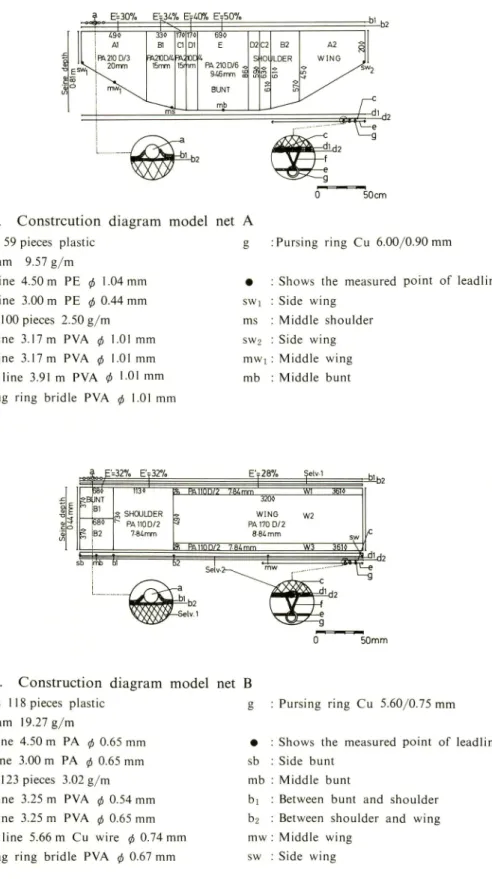
Model net A was a type of tapered seine constructed of two wings, two shoulders, and a bunt was located at middle of the seine; model net B was a type of rectan
gular seine with a bunt located at the end of its. Those two models are showed
in Figures 2 and 3.
Both of the model nets had a corkline length of 3.00 m and
the depth of model net A was 0.81 m and that of model net B was 0.44 m. The
principal dimensions of both model nets are tabulated in Tables 2 and 3. The
ratio of reduced-scale model and the full-scale net of the mackerel purse seine is provided in Table 4.
Table 1. Specification on the five simplified model nets with different hang-in ratio Model nets Data on netting Material Twine size E, Nylon(PA) 210 D/3 E2 Nylon(PA) 210 D/3 E3 Nylon(PA) 210 D/3 E4 Nylon(PA) 210 D/3 E5 Nylon(PA) 210 D/3 Mesh size (Stretched) 20 20 20 20 20 Length Depth Hang-in (Stretched) (Stretched) ratio (£") meshes meshes % 200 60:5 25 214 56.0 30 227 53.0 34 250 50.0 40 300 46.0 50 Data on lines, floats, and sinkers Items Material Diameter mm Shape Length Weight in water Buoyancy Numbers meters grams grams pieces Corklines Nylon(PA) 0.27 ; 0.60 twisted 3.00 Leadlines PA ; PVA 0.60; 1.01 twisted 3.00 Gavels Nylon(PA) 0.60; 0.60 twisted 0.81 Floats Plastic 11.50 spherical Sinkers Lead (Pb) 18.4x2.4x0.23 plate 0.13 0.39 2 2 2 73 100 > z a > o x o — s > 3
Mem. Kagoshima Univ. Res. Center S. Pac, Vol. 6, No. 2, 1985 233
Ei30% E'=3A% Ej40% E'=50%
Figure 2. Constrcution diagram model net A
a : Floats 59 pieces plastic g 0 12 mm 9.57 g/m
Corkline 4.50 m PE 0 1.04 mm • Corkline 3.00 m PE 0 0.44 mm sw,
Lead 100 pieces 2.50 g/m ms
Leadline 3.17 m PVA 0 1.01 mm sw2 Leadline 3.17 m PVA 0 1.01 mm mwi Purse line 3.91 m PVA 0 101 mm mb Pursing ring bridle PVA 0 1.01 mm
b, b2 c di d2 e f
Figure 3. Construction diagram model net B
a : Floats 118 pieces plastic g 0 12 mm 19.27 g/m bi: Corkline 4.50 m PA 0 0.65 mm b2: Corkline 3.00 m PA 0 0.65 mm c : Lead 123 pieces 3.02 g/m Leadline 3.25 m PVA 0 0.54 mm Leadline 3.25 m PVA 0 0.65 mm Purse line 5.66 m Cu wire 0 0.74 mm Pursing ring bridle PVA 0 0.67 mm
• sb mb bi b2 50 cm : Pursing ring Cu 6.00/0.90 mm
Shows the measured point of leadline Side wing Middle shoulder Side wing Middle wing Middle bunt 50mm Pursing ring Cu 5.60/0.75 mm
Shows the measured point of leadline Side bunt
Middle bunt
Between bunt and shoulder Between shoulder and wing mw : Middle wing
Table 2. Specification for model net A Netting sections Data on netting Material Twine Diameter size mm Mesh size (Stretched) mm Length Depth (Stretched) (Stretched) meters meshes mm meshes Hang-in ratio (£") % Wing : Ai Nylon (PA) 210D/3 0.41 20.00 0.98 49 408.9; 898.0 20; 45 30 7* A2 Nylon (PA) 210D/3 0.41 20.00 0.98 49 408.9; 898.0 20; 45 30 5 > Shoulder: Bi Nylon (PA) 210D/4 0.51 15.00 0.49 33 853.5 ; 907.8 57; 61 34 z o B2 Nylon (PA) 210D/4 0.51 15.00 0.49 33 853.5 ; 907.8 57; 61 34 > o Ci Nylon (PA) 210D/4 0.51 15.00 0.20 17 907.8 ; 937.5 61 ; 63 34 o c2 Nylon (PA) 210D/4 0.51 15.00 0.20 17 907.8 ; 937.5 61 ; 63 34 fcp Dl Nylon (PA) 210D/4 0.51 15.00 0.20 17 880.4; 880.4 59; 59 40 2 > D2 Nylon (PA) 210D/4 0.51 15.00 0.20 17 880.4; 880.4 59; 59 40 2! Bunt : E Nylon (PA) 210D/6 0.60 9.46 0.54 69 817.2; 817.2 86; 86 50 3- OQ Data on corklines, gavels leadlines, bridles, pursing 1 ine, floats, sinkers , and rings o Items Material Diameter Shape Length Weight in water Buoyancy Numbers O o mm meters grams grams pieces c Corklines PE 0.44; 1.04 twisted 3.00 ; 4.50 2 2 Leadlines PVA 0.54; 1.01 twisted 3.17 ; 3.17 2 <T» Gavels PVA 1.01 ; 1.01 twisted 0.22 2 Bridles PVA 1.01 twisted 0.01 35 Pursing line PVA 1.01 twisted 3.91 1 Floats Plastic 12.00 spherical 0.49 59 Sinkers Lead (Pb) 16.0X2.0X0.27 plate 0.08 100 Pursing rings Copper (Cu) 6.00/0.90 ring 0.12 35
Table 3. Specification for model net B Nettins Data on netting sections Material Twine Diameter Mesh size Length Depth E' size mm (Stretched) mm (Stretched) meters meshes (Stretched) mm meshes (cl) (11) % % Wing : Wi w2 w3 Nylon (PA) Nylon (PA) Nylon (PA) 110D/2 170D/2 110D/2 0.27 0.22 0.27 7.84 8.84 7.84 2.83 361 2.83 320 2.83 361 70.56 9 433.16 49 70.56 9 28 (-) (-) (-) (-) 22 2 to Shoulder: Sh Nylon (PA) 11OD/2 0.27 7.84 0.89 113 572.32 73 32 26 O Bunt : B, B2 Nylon (PA) Nylon (PA) 110D/2 11 OD/2 0.27 0.27 7.84 7.84 0.53 68 0.53 68 290.08 37 290.08 37 32 (-) (-) 26 3 c Selvedge : Selv. i Selv. 2 Nylon (PA) Nylon (PA) 210D/3 210D/4 0.41 0.51 7.35 22.86 4.25 578 4.25 186 3.68 0.5 34.29 1.5 < Data on corklines, leadline, g avels, bridles, purse line, floats, sin kers, and rings 3 2 Items Material Diameter Shape Length Weight in water Buoyancy Numbers C/3 •v mm meters grams grams pieces £ Corklines PA 0.65 ; 0.65 twisted 3.00 ; 4.50 2 On Leadlines PVA 0.54; 0.65 twisted 3.25; 3.25 2 p Gavels PVA 0.54; 0.54 twisted 0.44 2 Bridles PVA 0.67 twisted 0.01 33 OO Purse line Cu wire 0.74 twisted 5.66 1 Floats Plastic 12.00 spherical 0.49 118 Sinkers Lead(Pb) 16.0X2.0X0.27 plate 0.08 123 Pursing rings Copper (Cu) 5.60/0.75 ring 0.08 33 Key: £" = Hang-in ratio ; (cl)=corkline : (ll) = leadline; (-)=denotes that the edge concerned is laced to another. K)
236 KATIANDAGHO & iMAl : Fishing Efficiency of Purse Seine
Table 4. Dimension of the reducing ratio of the experimental condition
of two model nets A and B
76.7 1 141.3 D' V o r — D" L" 0.41 Eh Di" 0.07 0.30 0.05 Ft' F.' o r Ft" Fs-0.89X10"5 1.50X10"5
A .'Mackerel purse seine belong to Marine Fisheries Training Center Aertembaga Bitung, Indonesia.
B : Mackerel purse seine belong to P. T. Tirta Raya Mina Pekalongan, Indonesia.
Figure 4. Schematic drawing shows a rough sketch of circular frame fit with model
net by model net holders set up in the water circulating experimental tank,
a : Circular frame n : Thin copper wire
b : Electric terminals (16) o : Electric cable at inside circular frame c : Adjusting screws (4) p : Model net
d : Head bridge q : Electric cable at outside circular frame m : Model net holder with a lead Pb ' Lead
as sinker (16)
Figure 5. Schematic drawing shows the electrical circuit of the setting apparatus for model
net.
g : Transformer
m : Model net holder with a lead as sinker s : Switch
Mem. Kagoshima Univ. Res. Center S. Pac, Vol. 6, No. 2, 1985 237
models in the first phase of the experiment, the model net was hung from a circular
frame by thin copper net holders. The circular frame was 3.00 m in circumference
and is adjusted by screws under the head bridge so that the seine was one cm above
the water surface (see Figure 4). The electrical circuit is illustrated in Figure 5.
When the switch is closed, electric current cuts the thin copper wires of the all net
holders and the net falls simultaneously into the water. The sinking speed of
leadline was observed through an observation window and recorded with a camera every second until the net was stretched out. Measurements were carried out on the depth of the leadline, using a scaled stick installed in the tank by reading photographs.
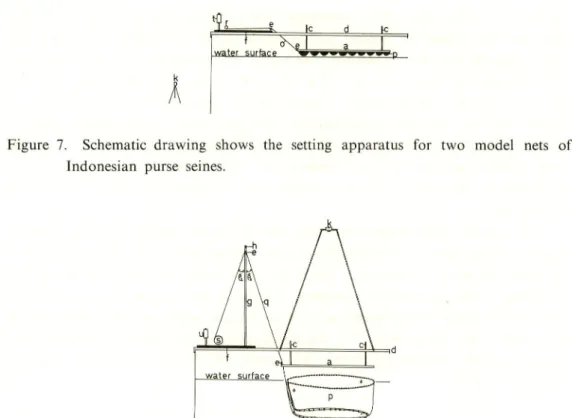
The second phase experiments were carried out on the models of Indonesian
mackerel purse seines. The experiments were carried out in two steps, the first to
determine the setting condition of the seines and the later to determine the pursing
conditions. The experimental equipment for setting the net consisted of a circular
frame with a 3.00 m circumference with 16 net holders, setting winch, winch control
ler, scaled sticks, and camera. The pursing equipment consisted of a pursing winch,
winch controller, and tension meter. The setting and pursing equipment is showed
in Figures 6 to 8.
Figure 6. Schematic drawing shows the experimental equipment set up in the water
two model nets of Indonesian purse
circulating experimental tank for
seines. a : Circular frame c : Adjusting screws (4) d : Head bridge e : Pulleys (4) f : Base board g : Square frame
h : Pursing tension detector (load cell) i : Electric lamps (4) j : Scale sticks (3) k : Camera (2) 1 : Observing window o : Setting line r : Setting winch s : Pursing winch
t : Setting winch controller u : Pursing winch controller v : Strain amplifier
238 KATIANDAGHO & IMAI: Fishing Efficiency of Purse Seine
i
water surface >^«p«» ^^-p
Figure 7. Schematic drawing shows the setting apparatus for two model nets of Indonesian purse seines.
Figure 8. Schematic drawing shows the pursing apparatus for two model nets of
Indonesian purse seines.
Circular frame g : Square frame r : Setting winch Adjusting screws (4) o: Setting line s : Pursing winch
Head bridge p : Model net t : Setting winch controller Pulleys (4) q: Purse line u: Pursing winch controller
a :
c
d
e
f : Base board h : Pursing tension detector (load cell)
Figure 9. Schematic drawing shows a rough sketch of circular frame fit with model
net holders set up in the water circulating expermental tank.
a : Circular frame b : Hanging screws (16) c : Adjusting screws (4) m: Model net holders (16) d : Head bridge
n
o
P
Pb
Small ring of copper material Setting line
Model net
Mem. Kagoshima Univ. Res. Center S. Pac, Vol. 6, No. 2, 1985 239 Pursing tension detector
3'mkoh load beam U3C1 5 kg
cos« = — = 0337 33-5 Kj=s<2 = 703° Pl'fc -2(70-3)= 394 cos^f = cos 39-4% 0-773 R2= ^l22-2\TfosVSf- f) T'(2.2cosP)
i
(2.2cospr £ # 20 -o 40 ' 60 Q 80The model net was hung under the circular
frame by the net holders and when wound the set
ting line by setting winch the line pass through end
ring of the all net holders (see Figure 9), so it is possible to set the net from one end to the another. The setting speed can be adjusted by using the setting
winch controller. The pursing begins as soon as
the net is set and the pursed at a constant speed
with both purseline ends. Those ends passing through
pulleys which connected to a load beam (Shinkoh U3C1 5kgf), and then connected to a strain amplifier (Y. E. W. 3458-10) and pen recorder (Y. E. W. 3052). It was therefore possible to record the resistance of
the whole pursing operation. These resistance values
were converted to purseline tension, and the
analyti-Figure 10. Determination of cal method is expressed in Figure 10.
purse line tension, 2Tg),
R : Resistance recorded by
tension meter system Results
Ti=T2: Tension of purse line
/? : Angle between T\ and To TU , .. c ^ c- i-rr j j <
I he observations or the five simplified models
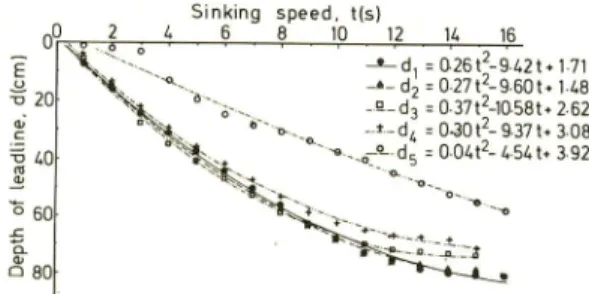
are presented in Figure 11. The sinking depth (d)
was a quadratic related to the sinking time (r), so the equation is as follows:
d=a t2 + b t+c
(I)
where d: Sinking depth of lead line (cm)
t: Sinking time (s)
From the five seines experimental values of stretched depth, the relationship
between hang-in ratio (E'%) and depth of leadline sinking ratio (P%) might be
Sinking speed. t(s) U 6 8 10 12 14 16 -*-d, = &26t -9-421* 171 -»- d2 =0-27t2-960t- 1-48 -s-d3 =0-37t2-10-58t.262 -*-d4 =0-3012-9371008 "•-..,>-*--ds =0.04t2-/,-54t»3-92
Figure 11.
Relationship between the sinking time, ?(s), and the sinking depth of
leadline, (/(em), during experiment on the five simplified model nets.
d\,
d2, d3, d4, and d5 denoted equations for model nets Ei, E2, E3, E4, and E5,
respectively.240 Katiandagho & Imai : Fishing Efficiency of Purse Seine
denoted by a linear function as follows :
P=dE'+e (2)
where P: Ratio of leadline sinking depth (%)
£": Hang-in ratio (%)
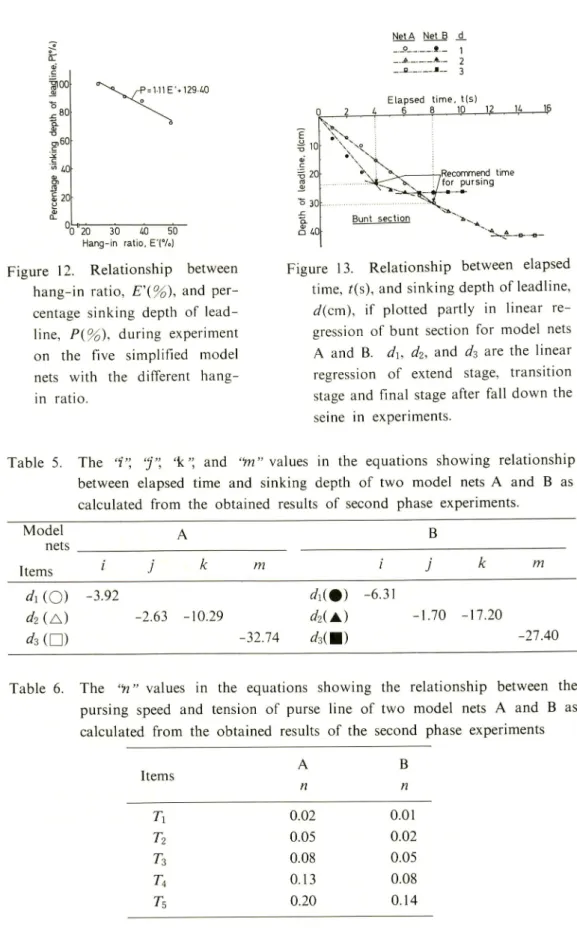
The ratio of designed depth versus stretched depth was 100, 97, 91, 88 and
72 %, for models Ei, E2, E3, E4 and E5, respectiveiy (see Figure 12).
The relationship between the time to set the net (t) and the sinking depth of the leadline (d) can be represented by a quadratic function as follows:
d=ff + gt+h (3)
where d: Depth of leadline (cm)
t: Elapsed time (s)
All of the seine sections sank at the same speed except for the bunt section on
both models. Figure 13 shows the relationship between elapsed time (t) and sinking depth of leadline (d) for the bunt section of model net A and model net B. The fastest sinking speed of the leadlines was for the first eighth seconds for model net A ; and the highest speed obtained for the first fourth seconds was for model net
B. After that the rate of sinking speed decreased until the end of the net reached.
Also, the sinking speed appears to be independent of the setting speed. The re
lationship between the elapsed time and the sinking depth of leadline can be re
presented by the linear functions as follows :
dx=it (4)
d2=jt+k (5)
d3=m (6)
where d\, dz , d$ ', Depth of leadline (cm)
t: Elapsed time (s)
The value of H", 'j", "k" and "m" for the two models are tabulated in Table
5. From Figure 13 it can be seen that the sinking speed decreased rapidly, about
53% and 40% of elapesed time on model net A and model net B, when the seine wall was stretched out to 72 % and 86 % respectively.
The tension of the purseline gradually increased when the pursing speed was accelerated. The tension of the purseline (77) is quadratically related to the pursing speed ( Kp2) as follows:
T=nV/ (7)
where T : Tension of purseline (g)
Vv : Pursing speed (cm/s)
The relationship between the pursing speed Vp and the tension of purseline
showed in Figure 14, and in Table 6.
The pursing time (fp) depends on both the pursing speed ( Kp) and the construction of the seine, therefore it might be influenced by the tension on the purseline.
Mem. Kagoshima Univ. Res. Center S. Pac, Vol.6, No. 2, 1985 241 EC 0i c loo "o £80
f
o,60 C j £20 o at 0_ 0, HE'* 129-40 0 20 30 40 50 Hang-in ratio, E'(7°)Figure 12.
Relationship between
hang-in ratio, E\%), and per centage sinking depth of lead line, P(%), during experiment on the five simplified model nets with the different
hang-in ratio. 0 # 10 c ^ 20 _a> o 30 _c ft 40 JCV Net A Net B A. _J?_ i._ i 2 3 ._* *..-Elapsed time. t(s) 4 6 8 10 1? 14 16 .Recommend time 9 'rZL*,. i/for pursin Runt section
Figure 13. Relationship between elapsed
time, f(s), and sinking depth of leadline, (/(cm), if plotted partly in linear re
gression of bunt section for model nets
A and B. d\, d2, and d3 are the linear
regression of extend stage, transition
stage and final stage after fall down the
seine in experiments.
Table 5.
The "i", "j", 'k", and "m" values in the equations showing relationship
between elapsed time and sinking depth of two model nets A and B as calculated from the obtained results of second phase experiments.
Model nets Items *(0) A (A) *(•) -3.92 A -2.63 -10.29 m -32.74 di{%) d2(A) d3(M) -6.31 B .70 -17.20 in -27.40
Table 6. The "n" values in the equations showing the relationship between the
pursing speed and tension of purse line of two model nets A and B as
calculated from the obtained results of the second phase experiments
Items 71 T5 A n B n 0.02 0.01 0.05 0.02 0.08 0.05 0.13 0.08 0.20 0.14
242 KATIANDAGHO & IMAI : Fishing Efficiency of Purse Seine
Net A NetB Baosed timefel
0 • i 7 „ • _ •)L A . P . . ._._• 3 , 300 _.._£.._.._,. *.. L A 4_ _ r yS A y" rt250 X' * ^..-i o» -=200 y** >•* d) A ,'•-'" .-**" *tso „-'**' ..•-""' -.-'"' 0
1 ..--<"""
*
_..-"
z ,..-•" * -"""""' 3 100 ..-••-"'' • ,--•'''«.-c 4 -.--'•-•-" b .--*-:*-—• « ,-? • -•" --.'-—"" 50 « .. «*=*•-*-5"" » "L.-^^-^T"*1 ^^^^ °() 26 28 30 32 34 36 38 4( Pursing speed, Vp (cm/s) *V 4-70 tp2 1 300 _ * •v 4-99 tp2 j - *•v 810 tp2 / /• -GL •v1036 tp2 *i f I • 200 V 14-29 tp2 f 1 / /• « / / /v o . o - 100 o ♦/J/
0 t / 1 2 4 6 Pursing time, tp(£lFigure 15. Relationship between purs
ing time, tp (s), and tension of purse
line, 77(g), during experiments on
model net A. 71, T2, T3, TA, and
775 denoted the equations for purs ing speeds of 26.5, 28.9, 31.8, 35.5, and 39.8 cm/s, respectively.
Figure 14. Relationship between pursing
speed, Vp (cm/s), and tension of purse line, 7Tg), for model nets A and B. 7*i, T2, 7*3, 774, and 775 denote the equations at one second intervals.
S200 . -«-T,*M3t|^ * D -*-T2=619 tp2 • / -M-ifi-Taq? ''>/ ~0-T4 =6-11 tp2
//;
-f—TE= 704 tp2 w3-U /
'*// "k //A, «*r
% 2 u 6 Pursing time.tp(s)Figure 16. Relationship between purs ing time, tp (s), and tension of purse line, 77(g), during experiments on
model net B. 71, T2, 773, 74, and
7~5 denoted the equations for purs ing speeds of 31.5, 32.5, 33.6, 34.8 and 39.8 cm/s, respectively.
It was observed that the tension of the purseline (T) and the pursing time(?P) of the two nets can be expressed by a quadratic relation as in Figures 15 and 16. So it is possible to denote the relation as follows :
T=p Zp2
(8)
where T: Tension of purseline (g)
Mem. Kagoshima Univ. Res. Center S. Pac, Vol. 6, No. 2, 1985 243 26-Scm/s 31-fLcm/s Pursing
speed
Figure 17. Variation of the opening
area of the seine bottom during the pursing of model net A.
1-0 Vaa. 08 0-6 0-4-02
Net A NetB Elapsed timels)
_a 1_ , 2 3 4 JSL •,_, oh 0 ^6 28 30 32 34 36 38 To Pursing speed, Vp(cm/s) 31-5 cm/s 32-5cm/s 33-6cm/s Pursing speed
Figure 18. Variation of the opening area of the seine bottom during the
pursing of model net B.
Figure 19. Relationship between the purs
ing speed, Kp (cm/s), and the square
root of non-dimensional values,
J A/Aq, during experiments on model
nets A and B. A/Aq denoted ratio
of the opening area of seine bottom
A (cm2), to the opening area of seine
bottom at the beginning pursing Ao
(cm2). JAi/Aq, JA2/A0, Ja\/A0,
and JAiJAo denote the equations
at one second intervals.
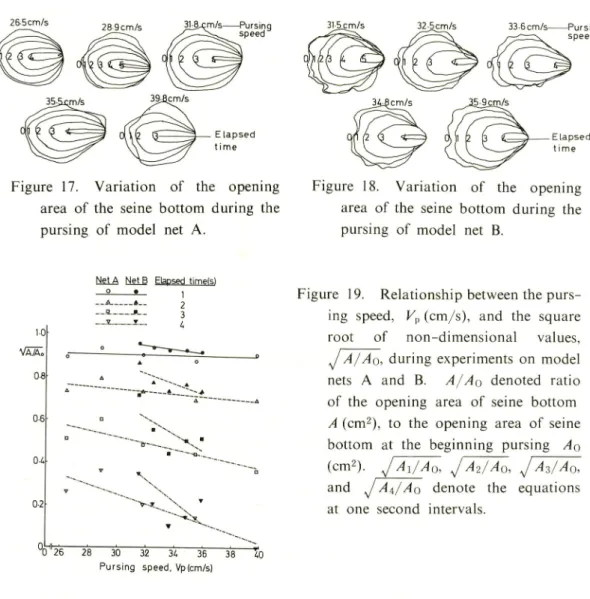
The decrease in the opening of the seine bottom at one second intervals during
pursing is illustrated in Figures 17 and 18. The opening area decreased as the
pursing speed and pursing time increased. At the beginning, the area showed various
values, therefore the relation denoted as the function between the pursing speed ( Vp) and square root of A/Aq, In this case A was an opening area of seine bottom at one second intervals and Aq was the opening area at the begining of pursing.
The relationship can be expressed as follows :
J A/A0 = q Vp + r
Vp : Pursing speed (cm/s)
where
(9)
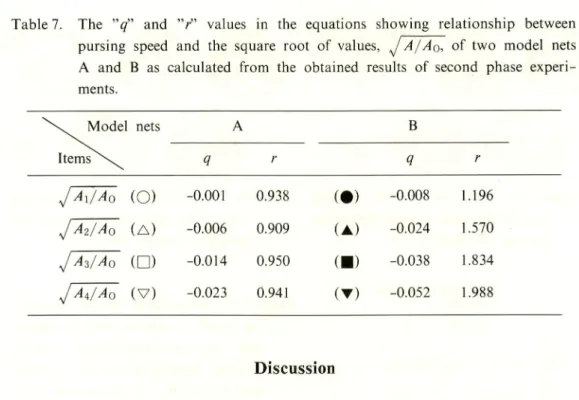
From Figure 19 it can be seen that the value of J A/Aq decreased as the
pursing speed increased and the values of coefficient "47" and constant "r" on the equation (9) are tabulated in Table 7.
244 KATIANDAGHO & IMAI: Fishing Efficiency of Purse Seine
Table 7. The "q" and "r" values in the equations showing relationship between
pursing speed and the square root of values, J A/Aq, of two model nets
A and B as calculated from the obtained results of second phase experi
ments. \ . Model nets A B Items^v a r q r -0.001 0.938 (•) -0.008
JA1/A0 (O)
1.196JA2/A0 (A)
-0.006 0.909 (•) -0.024 1.570JA%/Aq O
-0.014 0.950 (•) -0.038 1.834JAi/Aq (V)
-0.023 0.941 (T) -0.052 1.988 DiscussionThe hanging of netting on the corkline and leadline is one of the important elements which directly influence the hydrodynamical resistance and the performance of the seine wall, and therefore, this element influenced to the fishing efficiency of the
seine.
The first phase of the experiment obtained, 1) the relation between the hang-in ratio and the sinking speed, 2) of the hang-in ratio and the sinking depth of lead line, and, 3) the highest sinking speed from the experimental nets obtained on net
E3 with a 34 % hang-in ratio. The sinking speed of net Ei (25 %) and net E2
(30 %) were similar to net E3 (see Figure 11). Regarding to the seine wall stretched
length, net Ei obtained 100% of its stretching ratio, net E2 97%, and net E3 91
% (see Figure 12). The seines with a greater than 30% of hang-in ratio become
entangled during setting seine because of the excess netting. So the best choice of
hang-in ratio is 30 % for fishing efficiency.
The fishing efficiency of a purse seine is mainly determined by the operational
speed (setting and pursing), and the sinking speed of the seine. The operational
speed determine the ability of enclosing a school of fish, and the sinking speed is
also important to prevent the fish escape. Several elements of the operation depend
upon the design of the seine, such as, the sinking speed of the leadline, the shape of seine before and during pursing, and the opening seine bottom during each stage of pursing.
In the second phase experiments, the sinking speed of every section of netting were very similar, except for the bunt sections of models A and B.
It was also detremined that the sinking speed is independent of the setting speed
Mem. Kagoshima Univ. Res. Center S. Pac, Vol. 6, No. 2, 1985 245
operations leadline sinking depth depends on the setting speed of the seiner, setting condition for the particular school of fish, and current and wave conditions.
The recommended time to commence pursing determined by Figure 13, is
when 53% of the setting time elapsed on model net A (2 min and 7 sec. for the
full-scale net) stretched seine depth ratio obtained 72% (25.7 m for full-scale) and
40% of the setting time elapsed on model net B (1 min and 22 sec for full-scale)
stretched seine depth ratio obtained 86% (45.6 m for full-scale), after that the
sinking speed decreaed rapidly and then enough stretched seine wall to prevent
the fish escape.
To compare two Indonesian mackerel purse seines designs and one Japanese
mackerel purse seine design (net C), field research was carried out on net C. The
sinking speed of net A was 3.9 cm/s (5.5 m/min for full-scale), and net B was 5.9 cm/s (12.5 m/min for full-scale) in the experimental tank and net C was
21.2-35.0 cm/s (12.7-21.1 m/min determined by net-sonde) in the field. The results of
nets B and C were similar but net A had a slow sinking speed. It is thought
that the reason for this is that nets B and C have nearly the same hang-in ratio of
about 30%, but net A has a bigger hang-in ratio. Although other important
factors also influencing these are the weight of the ballast, mesh size, twine size,
and the materials used. The influence of hang-in ratio and net depth on the
characteristics of the purse seine according to KoNAGAYA (1971), is that the sin king speed of shallow nets with a large hang-in ratio was faster than that of deep nets with a small hang-in ratio.
The pursing to close the seine bottom is very important to prevent the fish
from escaping. During pursing the opening decreases but the tension of purseline
increases. It seems both models gradually acquired a cup shape, and become more
cup-like towards the final stages of pursing.
In this experiment the pursing speed chosen was 26.5 cm/s (0.42 m/s for full-scale) to 39.8 cm/s (0.62 m/s) for model net A and 31.5 cm/s (0.57 m/s) to 35.9
m/s (0.66 m/s) for model net B. The purseline tension of the two models when
gradually increased at various pursing speed (see Figure 14). Within the range of
31.5 cm/s to 35.9 cm/s the tension on the purseline of model net A was rather
greater than of model net B. The maximum tension at the final stage of pursing,
converted from the results of models to full-scale, was 90.5 to 117.6 kg for net A
and 218.2 to 283.3kg for net B. According Konagaya (1966), the relationship
between pursing speed and purseline tension during pursing operation might given as a linear function, and the seine shape during pursing depends chiefly upon the
d/l ratio of the netting, in this case d is a twine diameter and / is a leg length
of netting mesh. The most favourable shape such as cupping or scooping was
observed in the case of model net A which had a larger d/l ratio than model
net B.
The pursing time plays an important role in fishing efficiency, and it depend
246 Katiandagho & IMAI: Fishing Efficiency of Purse Seine
and pursing time might be expressed as a quadratic function (8), the relation for model net A is shown in Figure 15 and that for model net B is shown in Figure
16. IlTAKA (1965), described that at the beginning stage of pursing, the leadline
is still sinking, the tension on the purseline increases slowly only after it increases
rapidly. Figure 19 shows the relationship between the pursing speed and the open
ing of the bottom of two models at one second intervals.
The opening of model net B closed more rapidly than model net A. It might
be causes by the different material of purseline or design of the seine. A poly
vinyl alcohol fibre twisted was used in model net A and a thin copper wire rope
was used in model net B. The shape of seine bottom opening was a ellipse, this
elongation was due to the increased drag on the central part of the seine, model net A was more elongated than model net B, possibly because of the position of
the bunt section, defference of the mesh size, or twine size.
Acknowledgement
The authors are greatly indebt to Professor Nobio HiGO Dr. and Research
Associate Shigeru Fuwa of the Laboratory of Fishing Gear, Faculty of Fisheries, Kagoshima University for their guidance, assistance, cooperation, helpfull sugges
tions and all the facilities provided in these experiments. We are further indebted
to Shizuo Tabata for his help of the making model nets.
Thanks are also extended to Junichi Takamura, the owner of Fukuho Suisan
Kabushiki Kaisha in Nagasaki, fishing-master Norimura, the Shofuku Maru No. 1, and crew members of the vessel too numerous to mention individually, who con tributed greatly to the success of our field research.
References
Ben Yami, ML, and R.E.Green. (1968). Designing an improved California tuna
purse seine. U. S. Fish. Wild. Serv., Fish. Ind. Res., 4(5): 183-207.
Food and Agriculture Organiation of the United Nations. (1980). Implication of
the extension of national jurisdiction for fisheries management and develop
ment. (Reported by an FAO Mission to the Government of Indonesia).
Jakarta, Indonesia.
Green, R. E. (1964). Norwegian bluefin tuna seines. Faster sinking, faster haulingg
than U.S. nets. Pacif. Fisherman, 62(1): 10-11.
Hamre, J. (1963).
Some technological aspects of the Norwegian tuna purse sein
ing fishery. Fisk Dir. Skr. Ser. HavUnders., 13: 106-1 19.
IlTAKA, Y. (1965). Studies on the mechanical characters of purse seine in relation
Mem. Kagoshima Univ. Res. Center S. Pac, Vol.6, No. 2, 1985 247
INOUE, M. (1961). A study of the fishing power of the purse seine fishery. J.
Tokyo Univ. Fish., Japan, 47(2): 123-248.
KoNAGAYA, T. (1966). Studies on the purse seine-I. Effect of the pursing velocity.
(In Japanese) Bull. Japan. Soc. Sci. Fish., 32(6): 506-510.
KONAGAYA, T. (1971). Studies on the design of the purse seine. J. Fac. Fish. Pref.
Mie, 8 (3) : 209-296. (In Japanese).
Mc Nelly, R. L. (1961). The purse seine revolution in tuna fishing. Pacif. Fisher
man, 59(7): 27-58.
Nomura, M., Y. Tawara, K.Mori, Y. Osawa, and K. Kumura. (1967a). Study
on behaviour of purse seine-I. Experiments of small model purse seine for horse-mackerel and mackerel. (In Japanese). Bull. Tokyo Reg. Fish. Res. Lab.
49 : 11-39.
Nomura, M., Y. Tawara, K.Mori, Y. Osawa, and K. Kumura. (1967b). Study
on behaviour of purse seine-II. Experiments of small model purse seine for
horse-mackerel and mackerel. (In Japanese). Bull. Tokyo Reg. Fish. Res. Lab.
49 : 41-51.
Tauti, M. (1934). A relation between experiments on model and fullscale of fish
ing net. Bull. Japan. Soc. Sci. Fish., 3(4): 171-177.
Unar, M. (1978). Potensi Sumber Perikanan Sebagai Landasan pengembangan
usaha perikanan. Simposium modernisasi perikanan rakyat, SMPR/78 No. p 49. LPPL, Jakarta. (In Indonesian).