Classification for the union of the totally geodesic 3‐punctured
spheres in an orientable hyperbolic 3‐manifold
Ken’ichi Yoshida
Graduate School of Mathematical Sciences, The University of Tokyo
1 Introduction
This note is a brief summery of my talk at RIMS workshop (‘Topology and Analysis of
Discrete Groups and Hyperbolic Spaces” I am preparing a paper [7] for details.
We consider essential 3‐punctured spheres in orientable hyperbolic 3‐manifolds. In this
note, a hyperbolic 3‐manifold is a manifold with toroidal boundary whose interior admits a complete hyperbolic metric. Its boundary component is called a cusp. A 3‐punctured sphere is the compact orientable surface of genus zero with three boundary components. We always assume that the boundary of a 3‐punctured sphere is contained in the cusps.
Adams [1] showed that an essential 3‐punctured sphere in a hyperbolic 3‐manifold is
isotopic to a totally geodesic one. Hence we naturally assume that a 3‐punctured sphere is totally geodesic.
We remark on immersed 3‐punctured spheres.
Theorem 1.1 (Agol [2]). Suppose that a totally geodesic 3‐punctured sphere $\Sigma$ is im‐
mersed in an orientable hyperbolic 3‐manifold M, and $\Sigma$ is not embedded. Then M is
homeomorphic to a manifold obtained by (possibly empty) Dehn filling on a cusp of the
Whitehead link complement. Furthermore, $\Sigma$ is contained in M as in Figure 1.
From now on, we consider embedded totally geodesic 3‐punctured spheres in an ori‐ entable hyperbolic 3‐manifold. 3‐punctured spheres in a hyperbolic 3‐manifold may in‐ tersect. The union of 3‐punctured spheres may be complicated.
Theorem 1.2. A connected component X of the union of all the totally geodesic 3‐
punctured spheres in an orientable hyperbolic 3‐manifold with finitely many cusps is one of the following types:
\bullet (general types)
A_{n}(n\geq 1),B_{2n}(n\geq 1),T_{3},T_{4}.
\bullet (types determining the manifolds)
Whi_{2n}(n\geq 2),Whi_{4n}'(n\geq 2), Bor6, Mag4, Tet8,Pen_{10}, Oct8.
\bullet (types almost determining the manifolds)
\overline{Whi_{n}}(n\geq 2)
,\overline{Whi_{2n}'}(n\geq 1)
,\overline{Tet}_{2},
\overline{Pen_{4}}, \hat{Oct}_{4}.
We classify the topological type of a pair(N(X), X), whereN(X) is a regular neigh‐
borhood of X. The index indicates the number of 3‐punctured spheres.
Figure 2: A_{n}
Figure 3: B_{2n}
Figure 5: Whi_{2n}(Whi_{4n}'),
\overline{Whi_{n}}(\overline{Whi_{2n}'})
andBor_{6}Figure 6: Mag4, Tet8,Pen_{10}andOct_{8}
Figure 7:
\hat{Tet}_{2}, \overline{Pen_{4}}
and\overline{Oct_{4}}
The general types appear in various manifolds. For any finite multiset of general types,
there is a manifold containing 3‐punctured spheres of those types. When the typeB_{2n}, T3
or T_{4} appears, however, there are isolated 3‐punctured spheres near it. Contrastingly,
each of the determining types appears only in a certain special manifold. The almost determining types appear only in manifolds obtained by Dehn fillings on a cusp of those special manifolds. For eachn, the types Whi_{4n}and Whi4n’ have the common topology of
the union, but they are distinguished by their neighborhood. The same argument holds
for
\overline{Whi_{2n}}
and\overline{Whi_{2n}'}.
We remark on non‐hyperbolic 3‐manifolds. If a 3‐punctured sphere is contained in an irreducible 3‐manifold whose boundary consisting of incompressible tori, it is cut into
a 3‐punctured sphere and annuli by the JSJ decomposition. Hence we are reduced to the cases for geometric pieces. A 3‐punctured sphere is contained only in three Seifert 3‐manifolds, which are the fiber bundles of 3‐punctured sphere over a circle. The product
of a 3‐punctured sphere and a circle contains infinitely many (pairwise non‐isotopic) 3‐
punctured spheres.
2
Description of the types
At first, we introduce the manifolds containing the 3‐punctured spheres of special types.
Let \mathcal{W}_{n} denote the manifold in the left of Figure 5 which is an n‐sheeted cyclic cover
of the Whitehead link complement. Let \mathcal{W}_{n}' denote the manifold which is obtained a half twist along a certain 3‐punctured sphere of \mathcal{W}_{n}. For odd n, the manifold \mathcal{W}_{n}' is
homeomorphic to \mathcal{W}_{n} by reversing orientation. See Kaiser‐Purcell‐Rollins [4] for more
details. The manifold \mathcal{W}_{2}' is the Borromean rings complement. For 3\leq n \leq 6, let \mathcal{M}_{n}
denote the mimimally twisted hyperbolic n‐chain link complement as in Figure 6. The
mamifold \mathcal{M}_{3} is called the magic manifold. The manifold \mathcal{M}_{4} has the smallest volume of the orientable hyperbolic 3‐manifolds with 4 cusps [6]. The manifolds \mathcal{M}_{3}, \mathcal{M}_{5} and \mathcal{M}_{6} are conjectured to have smallest volume with respect to the number of the cusps. The 3‐punctured spheres of the typeWhi_{2n},Whi_{4n}' , Bor6, Mag4, Tet8,Pen_{10}andO\mathrm{c}t_{8} are contained only in the manifolds\mathcal{W}_{n},\mathcal{W}_{2n}', \mathcal{W}_{2}',\mathcal{M}_{3}, \mathcal{M}_{4}, \mathcal{M}_{5} and\mathcal{M}_{6} respectively.
The Borromean rings complement \mathcal{W}_{2}' has six 3‐punctured spheres. We can put the Borromean rings in such a manner that each component is in a plane in\mathbb{R}^{3}. Then there are two 3‐punctured spheres in the union of each plane and the infinite point as shown in
the right of Figure 5.
The 3‐punctured spheres of the type A_{n} are placed linearly, and can be considered as the most general type. If the 3‐punctured spheres are placed cyclically, the union is the type
\overline{Whi_{n}}
or\overline{Whi_{2n}'}
. Now consider the 3‐punctured spheres of the type Whi_{n}or
\overline{Whi_{2n}'}
. A regular neighborhood of the union of such 3‐punctured spheres and theadjacent cusps is homeomorphic to \mathcal{W}_{n} or \mathcal{W}_{2n}' . Hence if a hyperbolic 3‐manifold has such 3‐punctured spheres, it is obtained by Dehn filling on a cusp of \mathcal{W}_{n} or \mathcal{W}_{2n}'. In fact, such a surgered hyperbolic 3‐manifold except\mathcal{M}_{3}, . . . ,\mathcal{M}_{6} has no more 3‐punctured spheres. The manifolds \mathcal{M}_{3}, . . . ,\mathcal{M}_{6} have more 3‐punctured spheres as shown in Figure 6. Rotational symmetries give the remaining 3‐punctured spheres.
The types
\hat{Tet}_{2}, \overline{Pen_{4}}
and\overline{Oct}_{4}
appear only in the manifolds obtained by Dehn fill‐ ings on a cusp of \mathcal{M}_{4},\mathcal{M}_{5} and \mathcal{M}_{6} respectively, except \mathcal{M}_{3},\mathcal{M}_{4} and \mathcal{M}_{5}. The 3‐ puncture\underline{\mathrm{d}}
spheres of Tet8,Pen_{10} andOct_{8} which are disjoint from the filled cusp remainin
\overline{Tet}_{2},
Pen_{4} and\hat{Oct}_{4}.
We describe the remaining general types. Let T_{3} and T_{4} denote the hyperbolic 3‐ manifolds with totally geodesic boundary obtained by cutting \mathcal{M}_{5} and \mathcal{M}_{6} respectively along a 3‐punctured sphere. Similarly, let \mathcal{B}_{n} denote the hyperbolic 3‐manifold with totally geodesic boundary obtained by cutting \mathcal{W}_{n} along a 3‐punctured sphere which intersects only one of the other 3‐punctured spheres. The typesT_{3},T_{4} and B_{2n} appear in the manifolds containingT_{3}, T_{4} and\mathcal{B}_{n+1} respectively. Hence if there are the 3‐punctured
spheres of the type T_{3},T_{4} orB_{2n}, there are isolated 3‐punctured spheres which correspond to the boundary of T_{3}, T_{4} or \mathcal{B}_{n+1}.
We explain that the types Tet8,Pen_{10} and Oct_{8} are quite symmetrical in the way
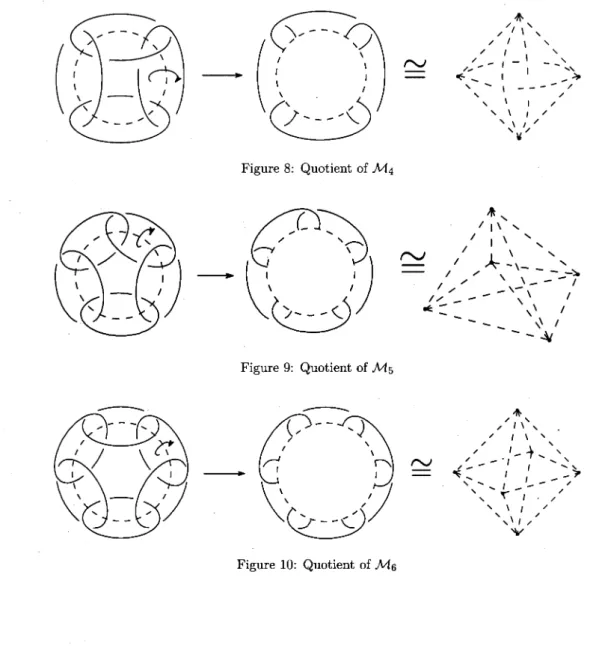
introduced by Dunfield‐Thurston [3]. Each of\mathcal{M}_{4},\mathcal{M}_{5} and\mathcal{M}_{6} has an involutional sym‐
metry as shown in Figure 8, 9 and 10. The quotients by this involution is naturally decomposed by ideal polyhedra. Then the original manifolds are recovered by double branched coverings. The quotient of M5 is the boundary of 4‐dimensional simplex (\mathrm{a}.k.a.
pentachoron) made of five regular ideal tetrahedra. The quotient of M_{6} is the double of
a regular ideal octahedron. The 3‐punctured spheres in\mathcal{M}_{4}, \mathcal{M}_{5} and\mathcal{M}_{6} correspond to the faces of ideal polyhedra in this decomposition. In particular, the manifolds \mathcal{M}_{4},\mathcal{M}_{5}
and\mathcal{M}_{6} have symmetries which can map a 3‐punctured sphere to any other one.
J^{\prime,\backslash }
奔 、
1-|\displaystyle \int\prime_{1} -\wedge^{\backslash }\backslash \backslash
一
\cong
\mathrm{e}_{\backslash }''\sim\backslash \sim || \rightarrow\rightarrow//\rightarrow*\backslash \backslash
$\iota$ 1\backslash 1\backslash (
/\backslash \mathrm{v}
Figure 8: Quotient of\mathcal{M}_{4}
/^{k}|\backslash
、 \backslash / | \backslash \rightarrow\underline{\underline{\sim}}
受\sim\sim\sim\sim\sim
\backslash \backslash /\sim
諏
Figure 9: Quotient of\mathcal{M}_{5}
J'\displaystyle \int\backslash ^{\backslash }\backslash 4
/ \displaystyle \int 1 \backslash\prime l_{-} 今、\backslash \backslash
\rightarrow
\cong
\leq\displaystyle \rightarrow.|\int
\sim \backslash
/
\backslash ->\backslash
、
\displaystyle \sim \mathrm{Y}'\prime\int\rightarrow
l--\backslashゞ ( \displaystyle \int /
\backslash ^{1}\mathrm{v}^{l/}
3
Number of 3‐punctured spheres
For a hyperbolic 3‐manifold with totally geodesic boundary, we can estimate its volume by the Euler characteristic of its boundary.
Theorem 3.1 (Miyamoto [5]). LetN be a hyperbolic manifold with totally geodesic bound‐
ary. Then\mathrm{v}\mathrm{o}\mathrm{l}(N) \geq | $\chi$(\partial N)|V_{oct}/2, whereV_{oct} is the volume of a regular ideal octahedron.
When we cut a hyperbolic 3‐manifold along totally geodesic surfaces, we obtain a
hyperbolic manifold with totally geodesic boundary. Hence if a hyperbolic 3‐manifoldM containsndisjoint 3‐punctured spheres, the volume ofMis at least nV_{o\mathrm{c}t}. Therefore the
classification gives an estimate of the number of 3‐punctured spheres by the volume. For
example, 3‐punctured spheres of the type A_{n} contains \lfloor(n+1)/2\rfloor disjoint ones.
Corollary 3.2. Suppose that an orientable hyperbolic 3‐manifold M has n 3‐punctured
spheres. Thenn\leq 4\mathrm{v}\mathrm{o}\mathrm{l}(M)/V_{oct}. The equality holds if and only ifM is the manifold \mathcal{M}_{4}.
4
Sketch of proof
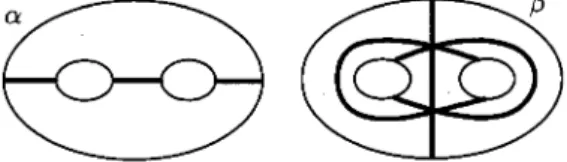
There are six simple geodesics in a totally geodesic 3‐punctured sphere. Each of these six geodesics is one of the two types. We indicate a geodesic whose endpoints are in different
boundary components by the type $\alpha$. Let the others be of the type $\beta$ . At first, we consider
the intersection of two 3‐punctured spheres.
Figure 11: Simple geodesics in a 3‐punctured sphere
Lemma 4.1. Intersection of two totally geodesic 3‐punctured spheres in an orientable
hyperbolic 3‐manifold is one of the following types:
(o) The intersection is empty, i.e. the two 3‐punctured spheres are disjoint.
(i) The intersection is one simple geodesic, and it is of the type $\alpha$ in both 3‐punctured
spheres.
(ii) The intersection is one simple geodesic, and it is of the type $\alpha$ in a 3‐punctured
sphere and of type $\beta$ in the other 3‐punctured sphere.
(iii) The intersection is two simple geodesics, and they are of the type $\alpha$ in both 3‐
The orientability is necessary for Lemma4.1. For instance, a non‐orientable hyperbolic
3‐manifold obtained by gluing one regular ideal octahedron contains two 3‐punctured spheres which intersect at three geodesics.
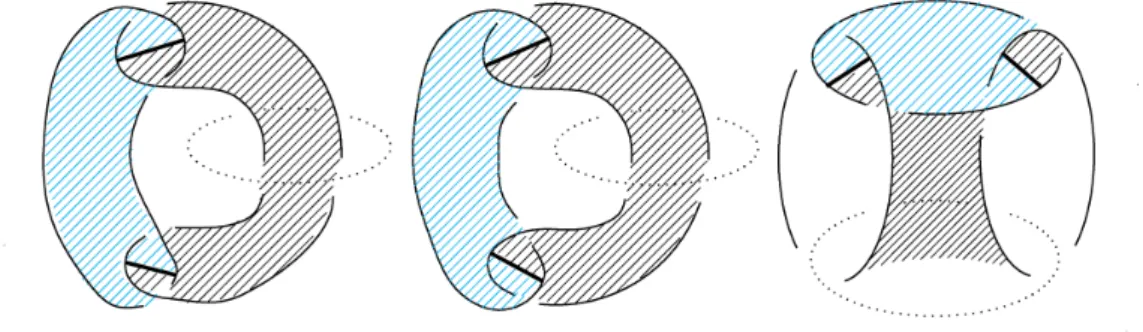
In the case (iii), the union of the two 3‐punctured spheres is
\overline{Whi_{2}},
\overline{Whi_{2}'}
or\hat{Tet}_{2}
asin Figure 12. The boundary of a regular neighborhood of these two 3‐punctured spheres
and the adjacent cusps is a torus. Hence the ambient 3‐manifold is obtained by (possibly empty) Dehn filling on a cusp of \mathcal{W}_{2},\mathcal{W}_{2}' or \mathcal{M}_{4}. Then the union of the 3‐punctured
spheres is
\overline{Whi_{2}}
, Whi4,\overline{Whi_{2}'}
, Bor6,\overline{Tet}_{2},
Mag_{4} or Tet8.Figure 12: Two 3‐punctured spheres intersecting at two geodesics
We next consider the case (ii). Suppose that 3‐punctured spheres $\Sigma$_{1} and $\Sigma$_{2} intersect at a geodesic of the type $\beta$ in $\Sigma$_{1} and of the type $\alpha$ in $\Sigma$_{2}. Their union is B_{2}. If another
3‐punctured sphere intersects$\Sigma$_{2}, the ambient 3‐manifold is the Borromean rings comple‐
ment \mathcal{W}_{2}'. Otherwise the component of the union containing $\Sigma$_{1} and $\Sigma$_{2} is B_{2n},Whi_{2n} or
Whi_{4n}'.
Figure 13: Two 3‐punctured spheres of the typeB_{2}
From now on, we consider a component X of the umion without intersection of the
type (ii) or (iii). Consider intersection C of a cusp andX. We can assume that a slope ofC is0, 1 or\infty. Remark that there are only two geodesic of type $\alpha$emanating from one
\bullet If Ccontains three loops of slope0, 1 and \inftywith common intersection, X contains
T_{3}.
\bullet If C contains three loops of slope 0, 1 and \infty without common intersection, X
contains
\overline{Pen_{4}}.
\bullet If Ccontains four loops of slope0 and \infty, X contains
\hat{Oct}_{4}.
Figure 14: Special types ofC (The squares are fundamental domains of cusps.)
These can be constructed explicitly. In these cases, the unionXisT_{3},
\overline{Pen_{4}}, \overline{Oct}_{4},
oct_{8}or Pen_{10}. All the three above cases hold for Pen_{10}.
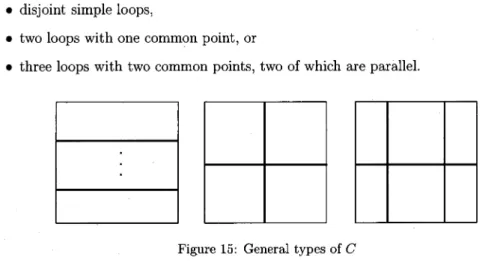
We next consider the remaining cases. Then the intersectionC is one of the following general types;
\bullet disjoint simple loops,
\bullet two loops with one common point, or
\bullet three loops with two common points, two of which are parallel.
Figure 15: General types of C
If there is a 3‐punctured sphere which intersects three 3‐punctured spheres, the union X is T_{4}. Then they intersect no more 3‐punctured spheres.
In the last remaining cases, the 3‐punctured spheres inXform a line or a cycle. Then the union X is A_{n},
\overline{Whi_{n}}
or\overline{Whi_{2n}'}.
References
[1] C. Adams, Thrice‐punctured spheres in hyperbolic 3‐manifolds, Trans. Amer. Math. Soc., 287 (1985), no. 2, 645‐656.
[2] I. Agol, Pants immersed in hyperbolic 3‐manifolds, Pac. J. of Math., 241 (2009) no.
2, 201−214.
[3] N. Dunfield and W. Thurston, The virtual Haken conjecture: Experiments and ex‐
amples, Geom. Topol., 7 (2003), no. 1, 399‐441.
[4] J. Kaiser, J. Purcell and C. Rollins, Volume of chain links, J. of Knot Theor. Ramif., 21 (2012) no. 11, 1250115.
[5] Y. Miyamoto, Volumes of hyperbolic manifolds with geodesic boundary, Topology, 33
(1994), no. 4, 613‐629.
[6] K. Yoshida, The minimal volume orientable hyperbolic 3‐manifold with 4 cusps, Pac.
J. of Math., 266 (2013) no. 2, 457‐476.
[7] K. Yoshida, Union of the 3‐punctured spheres in a hyperbolic 3‐manifold, in prepara‐
tion.
Graduate School of Mathematical Sciences
The University of Tokyo
Tokyo 153‐8914
JAPAN
\mathrm{E}‐mail address: [email protected]‐tokyo.ac.jp