A Scheme
for
Generating Rooted
Graphs with
Reflectional
Block
Structures
BINGBING ZHUANG
Graduate School of Informatics Kyoto University
zbb@amp. i.kyoto-u.ac.jp
HIROSHI NAGAMOCHI*
Graduate School of Informatics Kyoto University
nag@amp. i. kyoto-u. ac.jp
Abstract
In this paper, we consider an arbitrary class $\mathcal{H}$ of rooted graphs such that each biconnected
component is given by arepresentation with reflectional symmetry, which allows a rooted graphto
have several different representations, called embeddings. We give ageneral framework to design
algorithms for generating embeddings of all graphs in$\mathcal{H}$ without repetition. The framework yields
an efficientgeneration algorithmfora class$\mathcal{H}$if the class$B$of biconnectedgraphsused in thegraphs
in$\mathcal{H}$ admitsanefficient generation algorithm.
1
Introduction
Generation of restricted graphs or graphs with configurations has many applications in various fields
such as machine learning and chemoinformatics. For example, Horv\’ath et al. [3] reported that 94.3%
ofchemical compounds in NCI chemical database have outerplanar structures. Generation oftrees and
outerplanargraphs canbe used for many purposes including theinference of structuresofchemical
com-pounds [5], virtual exploration ofchemical universe [6], and reconstruction ofmolecular structures from their signatures [2]. Stereoisomers of chemical graphs can be treated
as
graphs with three-dimensionalconfigurations,and recentlyanefficientgenerationalgorithm for tree structured chemical graphs has been
proposed [4].
The
common
idea behind most of the recent efficientgeneration algorithms (e.g., [8, 7, 9]) is to defineaunique object for each of all objects
as
its “theparent,” whichinducesarootedtree of all objects, called thefamily tree $\mathcal{F}$. Then all objects can begeneratedone byone according to the depth-first traversal of thefamily tree$\mathcal{F}$. For example, Nakano [7] presentedan
efficient algorithm that generates all triconnected rooted plane graphs in constant time per each, where a plane graph is one of the representations ofa
planar graph based on embeddings in theplane. Note that possibly two different plane graphs may be
isomorphic to the
same
planar graph, ifwe ignore their embeddings.Objectsto be generated
are
often encoded into mathematically tractable representations. For example,a
rooted unordered tree is represented bya
rooted ordered tree by introducinga
total order amongthe siblings of each vertex in the tree. Hence the representation of
a
rooted unordered tree hasa
symmetryaround eachvertex. Inordertogenerate rooted unordered trees
as
rooted ordered trees withoutduplication,
we
chooseone
of all rooted ordered trees of a rooted unordered tree $T$as
the ”canonicalrepresentation” of$T$
.
Then all canonical representations will be generatedone
by one according to thedepth-first traversal of the family treeinsuch away that anewone is generatedby attachinganew leaf vertex to the immediatelyprevious output $and/or$ bydeleting a few leaf vertices from the previous one
(e.g., [9]). The algorithms output only a constant-size difference between two consecutive trees in the
series of all canonicalrepresentations, achievinga constanttime generation per each output.
Recently, based
on
the tree generation algorithm proposed by Nakano and Uno [8, 9], Fujiwara etal. [1] and Ishida et al. [5] presented an efficient branch-and-bound algorithm for generating treelike
chemical graphs, whose implementation is available
as
a webserver
$*$.
Currently we aim to provide anefficient branch-and-bound algorithmforgeneratingchemicalgraphs for
a
wider classof graphsthantrees suchas
outerplanar graphs inour
webserver.
In this paper, we propose
a new
method that enables us to treat the reflectional symmetry of bi-connected components separately $hom$ that of the symmetry that arises from the tree-like combinationof biconnected components in designing generation algorithms. For this, we consider an arbitrary class
$\mathcal{H}$ of rooted graphs such that each biconnected component is given by
a
representation withreflectionalsymmetry, which allows a rooted graph to have several different representations, called “embeddings.”
We give ageneral framework to design of algorithms for generating embeddings of all graphs in $\mathcal{H}$. The
framework yieldsanefficient generation algorithm foraclass$\mathcal{H}$
as
longas an
efficient generation algorithmfor the class $\mathcal{B}$ofbiconnected graphs used in graphs in$\mathcal{H}$ is available.
2
Preliminaries
For two sequences $A$ and $B$, let $A>B$
mean
that $A$ is lexicographically larger then $B$, and let $A\geq B$mean
that $A>B$or
$A=B$.
Let$AB$ mean
that $B$ is aprefix of$A$ and $A\neq B$, and let $A\gg B$mean
that $A>B$ but $B$ is not
a
prefix of$A$. Let$AB$ mean
that $A\supset B$or
$A=B$, i.e., $B$ isa
prefix of$A$.
Throughout the paper, a graph stands fora
simple undirected graph, which is denoted bya
pair$H=(V, E)$ of
a
vertexset $V$andan
edge set $E$.
Agraph istreatedas
alabelgraphinwhich all verticesreceive distinct vertex
names
unless stated otherwise. The set ofvertices and the set of edges ofa
givengraph $H$ are denoted by $V(H)$ and$E(H)$, respectively.
A graph withavertex$r$designated
as
theroot is calledarooted graphor agraph rooted at$r$.
For eachbiconnected component $B$of
a
graph rootedata
vertex$r$, the root$r(B)$ of$B$is defined tobe the uniquevertex $v\in V(B)$ closest to $r$, and treat $B$
as
agraph rooted at $r(B)$.
Let $V’(B)$ denote $V(B)-\{r(B)\}$.
For
a
vertex $v$, let $B(v)$ denote the biconnected component with $v\in V’(B)$ ifany. The depth $d(B)$ ofabiconnected component $B$ is definedby the number of biconnected components which edgesetsintersect with
a
simple pathfroma
vertex in$V’(B)$ to the root $r$.Two rooted graphs$H_{1}$ and $H_{2}$ are rooted-isomorphicif they admits
an
isomorphic bijection by whichthe roots of$H_{1}$ and$H_{2}$ correspond each other. Such
a
bijection is called rooted-isomorphic.In this paper, we define a block to be a rooted biconnected graph with a configuration such as an
embedding into the plane. Two blocks
are
called equivalent if the biconnected graphs of these blocks admita
rooted-isomorphic bijection under the configuration, where these biconnected graphs may bea
rooted-isomorphic bijection which does not obey the configuration. We
assume
that, foreach block $B$,either (i)
no
other block $B’$ is equivalent to $B$ under the configuration, where $B$ is called asymmetric or (ii) there is exactly one distinct block $B’$ which is equivalent to $B$, and $B$ and $B’$ admit asymmetryof order 2 which is given by an automorphism $\psi$ such that $V_{1}(B)=\{\psi(v)|v\in V_{2}(B)\}$ and $\psi(v)=v$,
$v\in V_{3}(B)$ for a partition $V_{1}(B),$ $V_{2}(B)$ and $V_{3}(B)$ of the vertex set $V(B)$
.
A block $B$ in (ii) is called$symmet_{7\eta}c$. A level$\ell$ofvertices in ablock $B$is
an
assignment ofapositive integer$\ell(v)$ for each vertex in$V’(B)$ if it satisfies the following property: (1) For anasymmetric block$B$, it holds$l(v)\neq\ell(u)$ for every
two distinct vertices $u,$$v\in V’(B)$; and (2) For a symmetric block $B$, there is a partition $V_{1}(B),$ $V_{2}(B)$
and $V_{3}(B)$ of$V(B)$ such that the vertices in each $V_{i}$ receive distinct integers and $l(v)=\ell(\psi(v))$ for all
$v\in V_{1}(B)$
.
Let $\mathcal{B}$denote aset of such blocks. More formally,
we assume
that aparent-child graph relationship$(\mathcal{P}_{B},C_{B})$is definedover all blocks in$\mathcal{B}$: Ablock$B$is called the seedblock if it has
no
parentin$\mathcal{B}$.
For eachnon-seed block$B,$ $P_{\mathcal{B}}(B’)$ denotes ablock $B’\in \mathcal{B}$ that is defined asthe parent of$B$, and$C_{B}(B’)$ denotes
the set of children of$B’$, i.e., blocks $B”$ with $B’=\mathcal{P}_{B}(B’’)$
.
Alsoassume
that thereexists signature $\gamma$ ofall blocks in $\mathcal{B}$ such that (Sl) every two blocks $B$ and $B’$ are equivalent under the configuration of$\mathcal{B}$ if
and only if$\gamma(B)=\gamma(B’)$; (S2) there is
a
parent-child relationship among blocks in$\mathcal{B}$such thatno
childofablock has less number of vertices than itsparent has; and (S3) $B$contains exactlyone seed block$\tilde{B}$.
two blocks $B’,$$B”\in C_{\mathcal{B}}(B),$ $B\in \mathcal{B}$, if $|V(B’)|>|V(B’’)|$ then $\gamma(B’)>\gamma(B’’)$; and (S5) for any block
$B\in \mathcal{B},$ $\gamma(B’)>\gamma(B)$ holds for all children $B’\in C_{B}(B)$, and $|V(B’)|>|V(B)|$, for all $B’\in C_{\mathcal{B}}(\tilde{B})$
.
We consider the set $\mathcal{H}$ ofsuch rooted graphs in which each biconnected component is represented by
a
block $B\in \mathcal{B}$.
Ina
rooted graph $H\in \mathcal{H}$,a
block $B$ with $r(B)=v$ is called the child-block of $v$.
Fortwo blocks $B$ and $B’$ with $r(B’)\in V’(B)$ in arooted graph $H\in \mathcal{H}$, we say that $B$ is the parent-block of
$B’$ and that $B’$ is a child-block of$B$. For two blocks$B$ and $B’$ such that $r(B’)$ appears in anypathfrom
$r(B)$ to $r_{G}$, we call $B’$ an ancestor-blockof$B$ and $B$ an descendant-blockof$B’$, where $B$ is an
ancestor-block and a descendant-block of itself. Two blocks $B$ and $B’$
are
called incompamble if$B$ is neitheran
ancestor-blockof$B’$
nor
adescendant-block of$B’$. Given two incomparableblocks $B_{1}$ and$B_{2}$, we definethe least
common
ancestor lca$(B_{1}, B_{2})$ of$B_{1}$ and $B_{2}$ to be either thecommon
ancestor-block $B_{3}$ of$B_{1}$and $B_{2}$ such that $B_{1}$ and $B_{2}$ are descendant-block of different child-blocks of $B_{3}$,
or
thecommon
root$r(B_{1}’)=r(B_{2}’)$ of ancestor-blocks $B_{i}’$ of$B_{i},$ $i=1,2$with $B_{1}’\neq B_{2}’$. If$B_{1}=B_{2}$, then define lca$(B_{1}, B_{2})$
to be block $B_{1}$. If$B_{1}\neq B_{2}$ and$B_{1}$ is anancestor-block of$B_{2}$, then lca$(B_{1}, B_{2})$ is defined to be the root
$r(B_{3})\in V’(B_{1})$ of the child-block $B_{3}$ of$B_{1}$ such that $B_{3}$ is
an
ancestor-blockof$B_{2}$.
$rc$
$r(B)$ $r(B)$
(a) (b)
(c)
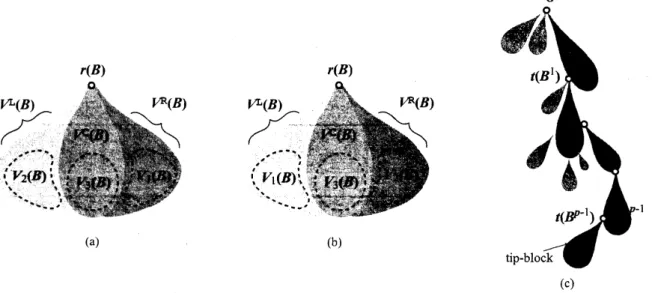
Figure 1: (a), (b) Two left$/right$-assignments of $V^{R}(B)$ and $V^{L}(B)$ to $V_{2}(B)$ and $V_{3}(B)$ ofa symmetric
block $B;(c)$ Spine $B^{1},$ $B^{2},$ $\ldots,$
$B^{p}$ ofanembedding $G$
.
In this paper, we consider aclass $\mathcal{H}$ of all embeddings
over
aclass $\mathcal{B}$ ofblocks; For eachblock $B$, wedefine $lefl/right$-assignments$V^{c}(B),$ $V^{L}(B)$ and $V^{R}(B)$
as
follows. For the vertex set $V_{3}(B)$,we
always set $V^{c}(B)=V_{3}(B)$.
For the vertex sets $V_{1}(B)$ and $V_{2}(B)$, thereare
two choices,either $V^{L}(B)=V_{1}(B)$,$V^{R}(B)=V_{2}(B)$
or
$V^{L}(B)=V_{2}(B),$ $V^{R}(B)=V_{1}(B)$,as
shown in Fig. l(a) and (b). Foran
asymmetricblock $B\in \mathcal{B}$, let $V^{c}(B)=V(B)$ and $V^{L}(B)=V^{R}(B)=\emptyset$
.
For each vertex $v\in V(B)$, define the sideside(v) of$v$in$B$to be the index$i$ suchthat$v\in V_{i}(B)$. For convenience,
we
calla
vertexin$V^{L}(B)$ (resp.,$V^{R}(B)$ and $V^{c}(B))$
left
(resp., right and central). Weassume
that $V^{c}(B),$ $V^{L}(B)$ and $V^{R}(B)$ denotesubsets of these vertices to which other blocks
are
allowed to append.We define the depth $\delta(v)$ ofa vertex $v$ in a rooted graph $H\in \mathcal{H}$ to be $\delta(v)=(d(B), \ell(v))$ for the
block $B$ of$H$with $v\in V’(B)$ and thelevel $\ell(v)$ of$v$ in $B$
.
We say that tworooted graphs $H_{1},$ $H_{2}\in \mathcal{H}$are
depth-isomorphic if and only if they admit a rooted-isomorphic bijection $\phi$ that maps each vertex$v\in V(H_{1})$ toa vertex $\phi(v)\in V(H_{2})$with $\delta(\phi(v))=\delta(v)$.
We define an embedding ofarooted graph $H\in \mathcal{H}$ as follows. For each vertex $v$, let $BS[v]$ denote
a
sequence $(B_{1}, B_{2}, \ldots, B_{k})$ of all child-blocks of $v$ such that $B_{1},$ $B_{2},$
$\ldots$,$B_{k}$ appear in this order, where
we saythat $B_{1},$ $B_{2},$
$\ldots,$$B_{k}$ appear
from left
to right. For asymmetric block $B$ inan
embeddingare
twoleft$/right$-assignments. An embedding ofa
rooted graph $H\in \mathcal{H}$ is specified bysequences $BS[v]$of cut-vertices in $H$ and left$/right-assnments$ of all symmetric blocks $B$
.
A rooted graph $H\in \mathcal{H}$ mayhave several different embeddings. Two embeddings $G_{1}$ and $G_{2}$ of$H_{1},$ $H_{2}\in \mathcal{H}$
are
equivalentif$H_{1}$ and $H_{2}$are
depth-isomorphic, i.e., $G_{1}$can
beobtained from $G_{2}$ bychanging the orderingsofblocks in $BS[v]$for
some
vertices $v$ and exchanging the left$/right$-assignments ofsome
symmetric blocks.3
Signature
of Embeddings
In this section,
we
define signature $\sigma$ of embeddings ofgraphs in $\mathcal{H}$. Foran
embedding $G$ ofa
graph$H\in \mathcal{H}$,let$r_{G}$denotetherootof$H$
.
Fora
block$B$, let$V_{cut}(B)$denote theset of cut-vertices of$v\in V’(B)$.
Let $V_{cut}^{L}(B)=V_{cut}(B)\cap V^{L}(B)$
.
Similarly for $V_{cut}^{R}(B)$ and $V_{cut}^{c}(B)$.
For
a
block $B$,a
child-block $B’$of
$B$ is called
a
left
(resp., nght and central) child-block if $r(B’)\in V^{L}(B)$ (resp., $r(B’)\in V^{R}(B)$ and$r(B’)\in V^{C}(B))$, where $V^{L}(B)=V^{R}(B)=\emptyset$
.
In particular,a
left (resp., right and central) child-block$B_{i}$ of$B$ is called the
first
left (resp., right and central) child-block if$B$hasno
other left (resp., right and central) child-block $B_{j}$ with $j<i$.
We define the key key(v) of
a
vertex $v\in V(B)$ ofa
block $B$ inan
embedding $G$ to be key(v) $=$ (side(v),$\ell(v)$) and define a total order among keys by thelexicographical order with the first entry side andthe second entry$\ell$.
Wedefine the tip$t(B)$ of ablock$B$with $V_{cut}(B)\neq\emptyset$in
an
embedding $G$tobe thevertex $v\in V_{cut}(B)$ withthe smallest key. In otherwords, tip$t(B)$ is chosenas
follows:(1) $V_{cut}^{R}(B)\neq\emptyset$: Define $t(B)$ to be the right vertex$v\in V_{cut}^{R}(B)$ with thesmallest $\ell(v)$;
(2) $V_{cut}^{R}(B)=\emptyset$and $V_{cut}^{L}(B)\neq\emptyset$: Define$t(B)$ to be the left vertex $v\in V_{cut}^{L}(B)$ with the smallest $\ell(v)$; and
(3) $V_{cut}^{R}(B)=V_{cut}^{L}(B)=\emptyset$, and $V_{cut}^{c}(B)\neq\emptyset$: Define$t(B)$ to be the central vertex $v\in V_{cut}^{c}(B)$ with the smallest$\ell(v)$
.
For
a
block $B$ such that $V_{cut}(B)\neq\emptyset$, thesuccessor
of $B$ is defined to be the rightmost block in$BS[t(B)]$
.
The spineof$G$is defined to be thesequence ofallsuccessors
starting fromthe rightmost block$B^{1}\in BS[r_{G}]$ by $B^{1},$ $B^{2},$ $\ldots,$
$B^{p}$, where $B^{1}$ is the rightmost block in $BS[r_{G}]$, and each $B^{i}(i\geq 2)$ is the
successorof$B^{i-1}$
.
SeeFig. 1 (c). The last block$B^{p}$ is called the tip-blockof$G$.
The parent-embedding$P_{\mathcal{H}}(G)$ of
an
embedding$G$ isdefinedas
follows.1. Ifthe tip-block $B$ of$G$ is not
a
block equivalent to the seed block $\tilde{B}$then $\mathcal{P}_{\mathcal{H}}(G)$is defined to be
the embeddingobtained byreplacing$B$ with itsparent $\mathcal{P}_{\mathcal{B}}(B)$
.
2. Otherwise, $\mathcal{P}_{7i}(G)$ isdefined tobe the embedding obtained by removing the vertices in $V’(B)$ from
$G$
.
Weintroduce
a
total order$\pi(G)$amongall blocks inanembedding$G$as
follows. Let$G$have$K$blocks,let$\mathcal{P}_{\mathcal{H}}^{i}(G),$ $i=0,1,$
$\ldots,$$K-1$ denote the embedding
$\mathcal{P}_{\mathcal{H}}(\mathcal{P}_{\mathcal{H}}^{i-1}(G))$
.
Let$\pi(G)=(B_{1}, B_{2}, \ldots, B_{K})$, where$B_{i}$ is the tip-block of$\mathcal{P}_{\mathcal{H}}^{K-i}(G)$, i.e., the tip-block of the embedding obtained after repeating removal of
the tip-block$K-i$ times.
The code$\gamma’(B)$ of
a
block $B$ in $G$is defined to be$\gamma’(B)=(d(B)$,side$(r(B)),$$\ell(r(B)),$$\gamma(B))$,
whereside$(r(B))$ and$\ell(r(B))$
are
the side and level ofavertex$v$in the block$B(v)$andwe
setside$(r(B))=$$\ell(r(B))=0$ if$r(B)=r_{G}$
.
The signature$\sigma(G)$ ofan
embedding $G$ isdefined to be$\sigma(G)=[\gamma’(B_{1}), \gamma’(B_{2}), \ldots, \gamma’(B_{K})]$
for the order $\pi(G)=(B_{1}, B_{2}, \ldots, B_{K})$ of all blocks in $G$
.
Observe thatwhere $\delta(r(\mathcal{P}_{\mathcal{B}}(B_{K})))=\delta(r(B_{K}))$.
For two indices $i$and$j(i\leq j)$, let $\sigma_{i,j}(G)$ denote the subsequence $\sigma_{i,j}(G)=[\gamma’(B_{i}), \gamma’(B_{i+1}), \ldots, \gamma’(B_{j})]$
for the blocks $B_{i},$$B_{i+1},$$\ldots,$$B_{j}$ which appear consecutively in $\pi(G)$. Let $G(B)$ denote the embedding
induced from $G$ by $B$ and all descendant-blocks of $B$
.
For a block $B,$ $G(B)$ consists ofsome
blocks$B_{i},$$B_{i+1},$
$\ldots,$$B_{j}$ that appear in this order in $\pi(G)$
.
and let $\sigma(G(B);G)$ denote $\sigma_{i,j}(G)$.
Then signature$\sigma$ has the following property.
Lemma 1 Let $G$ and $G’$ be two embeddings
of
a rooted graph $H\in \mathcal{H}$.
Then $G$ and $G’$are
thesame
embedding
if
and onlyif
$\sigma(G)=\sigma(G’)$.
Proof. Since $\sigma(G)$ ofan embedding $G$ is uniquely determined by definition, we see that $G$ and $G’$
are
the
same
embedding only if$\sigma(G)=\sigma(G’)$.We show that, for any embedding $G$, no other embedding $G’$ satisfies $\sigma(G’)=\sigma(G)$
.
Let $\pi(G)=$$(B_{1}, B_{2}, \ldots, B_{K})$, and let $G_{i}$ denote the embedding induced from $G$ by the first $i$ blocks in $\pi(G)$, i.e.,
$G_{i}$ is obtained from $G$ by removing blocks $B_{i+1},$ $B_{i+2},$
$\ldots,$$B_{K}$. Let $\sigma_{i}=[\gamma’(B_{1}), \gamma’(B_{2}), \ldots, \gamma’(B_{i})]$,
$i=1,2,$$\ldots,$$K$
.
For $i=1$, wesee
that only $G_{1}=B_{1}$can
satisfy $\sigma(G_{1})=\sigma_{1}$.
Assuming that, for$i=j(<K)$
, only embedding $G_{j}$can
satisfy $\sigma(G_{j})=\sigma_{j}$, we show that only $G_{j+1}$ can admit signaturewith $\sigma(G_{j+1})=\sigma_{j+1}$. For any embedding $G”$ such that $\sigma(G’’)=\sigma_{j+1}$, the last code $\gamma’(B_{j+1})=$ $(d(B_{j+1})$,side$(r(B_{j+1})),$ $P(r(B_{j+1})),$$\gamma(B_{j+1}))$ in $\sigma_{j+1}$ specifies the tip-block of$G$“, and the embedding
$G”’$obtainedfrom$G”$ byremoving the tip-block$B_{j+1}$ satisfies$\sigma(G’’’)=\sigma_{j}$
.
By the induction hypothesis,$G”’$ is $G_{j}$. Note that $G”$ is obtained from $G_{j}$ by attaching $B_{j+1}$. It is suffices to show that a way of
attaching $B_{j+1}$ to $G_{j}$ is uniquely determined by the information in $\gamma’(B_{j+1})$
.
Code $\gamma’(B_{j+1})$ specifiesthe depth ofa block $B$ in $G_{j}$ towhich block $B_{j+1}$ is attached. There may bemore than suchone block
$B$, but exactly
one
such block $B$ is determined asthe one in the spine of$G_{j}$, since $B_{j+1}$ cannotbe thetip-block of the resulting embedding if $B_{j+1}$ is attached to any other block thanthose in the spine of
$G_{j}$
.
The vertex to which $B_{j+1}$ is allowed to attach is also uniquely determined by side$(r(B_{j+1}))$ and $P(r(B_{j+1}))$, since vertices in each of $V_{1}(B),$ $V_{2}(B)$ and $V_{3}(B)$ are assigned with distinct levels $\ell$. Thisshows that only $G_{j+1}$ satisfies$\sigma(G_{j+1})=\sigma_{j+1}$, as required. 1
4
Canonical
Embeddings
For each block $B\in BS[v],$ $G(B)$ consists of blocks $B=B_{i},$$B_{i+1)}\ldots,$$B_{j}$ which appear consecutively in
$\pi(G)$, and
we
denote by $\sigma(G(B);G)$ the subsequence$\sigma_{i,j}(G)=[\gamma’(B_{i}), \gamma’(B_{i+1}), \ldots, \gamma’(B_{j})]$.
An embedding $G$ is called left-sibling-heavy at a block $B\in BS[v]=(B_{1}’, B_{2}’, \ldots, B_{p}’)$ if $B=B_{1}’$
or
$\sigma(G)\geq\sigma(G’)$ holds for the embedding $G’$ obtained from $G$byexchanging the order of$B_{i-1}’$ and$B_{i}’=B$
in $BS[v]$
.
Lemma 2 An embedding $G$ is left-sibling-heavy at a block$B_{i}’\in BS[v]=(B_{1}’, B_{2}’, \ldots, B_{p}’)$ with $i\geq 2$
if
and only
if
$\sigma(G(B_{i-1}’);G)\geq\sigma(G(B_{i}’);G)$ holds.Proof. Let $G’$ be the embedding obtained from $G$by exchanging the order of$B_{i-1}’$ and$B_{i}’$ in$BS[v]$
.
Sig-natures$\sigma(G)$and$\sigma(G’)$haveacommon
subsequencebefore thesubsequences $[\sigma(G(B_{i-1}’);G), \sigma(G(B_{i}’);G)]$Note that $\sigma(G(B_{i}’);G’)=\sigma(G(B_{i}’);G)$ and $\sigma(G(B_{i-1}’);G’)=\sigma(G(B_{i-1}’);G)$
.
Hence $\sigma(G)\geq\sigma(G’)$holds if and only if
$[\sigma(G(B_{i-1}’);G), \sigma(G(B_{i}’);G)]\geq[\sigma(G(B_{i}’);G), \sigma(G(B_{i-1}’);G)]$
.
Since the lemma holds when $\sigma(G(B_{i-1}’);G)=\sigma(G(B_{i}’);G)$, it suffices to show that $\sigma(G(B_{i-1}’);G)$
$>\sigma(G(B_{i}’);G)$ implies
$[\sigma(G(B_{i-1}’);G), \sigma(G(B_{i}’);G)]>[\sigma(G(B_{i}’);G), \sigma(G(B_{i-1}’);G)]$, (1)
and that $\sigma(G(B_{i}’);G)>\sigma(G(B_{i-1}’);G)$ implies
$[\sigma(G(B_{i}’);G), \sigma(G(B_{i-1}’);G)]>[\sigma(G(B_{i-1}’);G), \sigma(G(B_{i}’);G)]$. By symmetry, it issufficient to show the
former.
Assume that$\sigma(G(B_{i-1}’);G)>\sigma(G(B_{i}’);G)$
.
If $\sigma(G(B_{i-1}’);G)\gg\sigma(G(B_{i}’);G)$”or
“$|\sigma(G(B_{i-1}’);G)|=$ $|\sigma(G(B_{i}’);G)|$ and $\sigma(G(B_{i-1}’);G)\supset\sigma(G(B_{i}’);G)$” holds, thenwe
have $[\sigma(G(B_{i-1}’);G), a(G(B_{i}’);G)]>$$[\sigma(G(B_{i}’);G’), \sigma(G(B_{i-1}’);G’)]$
.
Then we consider thecase
where $\sigma(G(B_{i-1}’);G)\supset\sigma(G(B_{i}’);G)$ and $|\sigma(G(B_{i-1}’);G)|>|\sigma(G(B_{i}’);G)|$.
In this case, the first code $\gamma’(B_{a})$ in $\sigma(G(B_{i-1}’);G)$ is compared withthe $(|\sigma(G(B_{i}’);G)|+1)$st code$\gamma’(B_{b})$ in$\sigma(G(B_{i-1}’);G)$
.
Let $B_{a}’$ (resp., $B_{b}’$) be the block such that $r(B_{a})\in V’(B_{a}’)$ $($resp., $r(B_{b})\in V’(B_{b}’))$
.
Then the firstentry in $\delta(r(B_{a}))$ of$\gamma’(B_{a})$ is $d(B_{a}’)=d(B_{i-1}’)-1$, whereas the first entry$d(B_{b}’)$ in $\delta(r(B_{b}))$ of$\gamma’(B_{b})$
satisfies $d(B_{b}’)\geq d(B_{i-1}’)$
.
Hence$\gamma’(B_{b})>\gamma’(B_{a})$ holds,as
required. 1For
a
symmetric block $B$ inan
embedding $G$, let $G/B^{f}$ denote the flipped embedding of $G$ that isobtainedbyexchanging thevertex set $V^{R}(B)$with$V^{L}(B)$; i.e.,re-attach all child-blocks$B’$ at each vertex
$u\in V^{R}(B)$ $($resp., $u\in V^{L}(B))$ tothe vertex $u’\in V^{L}(B)$ $($resp., $u’\in V^{R}(B))$ with $\delta(u’)=\delta(u)$.
An embedding $G$is called left-side-heavy at
a
symmetric block $B\in BS[v]$ if$\sigma(G)\geq\sigma(G’)$ holds forthe embedding $G’=G/B^{f}$ obtained from $G$byflipping $B$
.
For
a
block $B$, let $B=B_{i},$$B_{i+1},$$\ldots,$$B_{j}$ be the blocks in $G(B)$ that appear in this order in $\pi(G)$.
Sequence$\sigma(G(B);G)$ consistsoffour subsequences: the first
one
is$\sigma_{i,i}(G)=[\delta(r(B)), \gamma(B)]$, the second$\sigma_{i+1,i_{C}}(G)$, the second $\sigma_{t_{C+1,i_{L}}}(G)$, and the second $\sigma_{i_{L}+1,j}(G),$ $B_{k}$ with $i+1\leq k\leq i_{C}$ (resp., $i_{C}+1\leq$
$k\leq i_{L}$ and$i_{L}+1\leq k\leq j$) is
a
descendant-block ofa
vertex $u\in V_{cut}^{c}$ (resp., $u\in V_{cut}^{L}$ and $u\in V_{cut}^{R}$). We denote these subsequences by $\sigma(B;G),$ $\sigma_{C}(G(B);G),$ $\sigma_{L}(G(B);G)$, and$\sigma_{R}(G(B);G)$, respectively. Hence $\sigma(G(B);G)=[\sigma(B;G), \sigma_{C}(G(B);G), \sigma_{L}(G(B);G), \sigma_{R}(G(B);G)]$.
We define the flipped code$\overline{\gamma}’(B)$ of$\gamma’(B)$ tobe the code obtained from $\gamma’(B)$ by replacing the value of the second entry side $=1$ (resp., side $=0$) with side $=0$ (resp., side $=1$). Let $\overline{\sigma_{L}}(G(B);G)$ (resp.,
$\overline{\sigma_{R}}(G(B);G))$ denote the sequence obtained from $\sigma_{L}(G(B);G)$ $($resp., $\sigma_{R}(G(B);G))$ by replacing $\gamma’(B’)$
with $\overline{\gamma}(B’)$ for all blocks $B’$ such that $r(B’)\in V’(B)$
.
Denote $\overline{\sigma_{f}}(G(B);G)=[\sigma(B;G),$$\sigma_{C}(G(B);G)$,$\overline{\sigma_{R}}(G(B);G),\overline{\sigma_{L}}(G(B);G)]$
.
Lemma 3 An embedding $G$ is left-side-heavy at a symmetrnc block $B\in BS[v]$
if
and onlyif
it holds $\sigma_{L}(G(B);G)\geq\overline{\sigma_{R}}(G(B);G)$.
Proof. Let $G’=G/B^{f}$
.
Signatures $\sigma(G)$ and $\sigma(G’)$ have acommon
subsequence before theirsubse-quences $[\sigma_{L}(G(B);G), \sigma_{R}(G(B);G)]$ and $[\sigma_{R}(G(B);G), \sigma_{L}(G(B);G)]$ start, respectively. Note that $\sigma(G’)$ is obtained $hom\sigma(G)$ by replacing$\sigma(G(B);G)$ with$\sigma_{f}(G(B);G)$
.
Hence$\sigma(G)\geq\sigma(G’)\Leftrightarrow[\sigma_{L}(G(B);G), \sigma_{R}(G(B);G)]\geq[\overline{\sigma_{R}}(G(B);G),\overline{\sigma_{L}}(G(B);G)]$. (2)
For simplicity, let $\sigma^{L}$ denote
$\sigma^{L}(G(B);G)$
.
Similarly for $\sigma_{R}$.Since (2) holds when $\sigma_{L}=\sigma_{R}$, it suffices to show that $\sigma_{L}>\overline{\sigma_{R}}$(resp., $\overline{\sigma_{R}}>\sigma_{L}$) implies $[\sigma_{L}, \sigma_{R}]>[\overline{\sigma_{R}},\overline{\sigma_{L}}]$
$($resp., $[\overline{\sigma_{R}},$$\overline{\sigma_{L}}]>[\sigma_{R},$$\sigma_{L}])$. We prove the former (the latter
can
be treatedsymmetrically).Assume $\sigma_{L}>\overline{\sigma_{R}}$. If $\sigma_{L}\gg\overline{\sigma_{R}}$, then we have $[\sigma_{L}, \sigma_{R}]>[\overline{\sigma_{R}}, \overline{\sigma_{L}}]$. We
assume
$\sigma_{L}\overline{\sigma_{R}}$.
If $|\sigma_{L}|=$$|\overline{\sigma_{R}}|$, then
we
again obtain $[\sigma_{L}, \sigma_{R}]>[\overline{\sigma_{R)}}\overline{\sigma_{L}}]$.
Assume that $|\sigma_{L}|>|\overline{\sigma_{R}}|$ holds. In this case, the first code $\gamma’(B_{a})$ in $\overline{\sigma_{L}}$ is compared with the $(|\sigma_{L}|+1)$st code $\gamma’(B_{b})$ in $\sigma_{L}$, and it suffices to show that $\gamma’(B_{b})>\gamma’(B_{a})$.
Let $B_{a}’$ (resp., $B_{b}’$) be the block such that$r(B_{a})\in V’(B_{a}’)$ $($resp., $r(B_{b})\in V’(B_{b}’))$, andlet $\gamma’(B_{a})=(d(B_{a}’)$, side$(r(B_{a})),$$l(r(B_{a})),$$\gamma(B_{a}))$ and $\gamma’(B_{b})=(d(B_{b}’)$,side$(r(B_{b})),$$p(r(B_{b})),$$\gamma(B_{b}))$
.
Itholds $d(B_{b}’)\geq d(B)+1=d(B_{a}’)$. If$d(B_{a}’)=d(B_{b}’)=d(B)+1$ holds, then we have $\gamma’(B_{b})>\gamma’(B_{a})$ by
side$(r(B_{b}))=2>1=$side$(r(B_{a}))$,
as
required. 1An embedding $G$ is called canonical if it is left-sibling-heavy and left-side-heavy at all symmetric blocks in $G$.
Lemma 4 Let $G$ be
an
embeddingof
a rooted graph $H\in \mathcal{H}$. Then $G$ is canonicalif
and onlyif
$\sigma(G)$ is lexicographically maximum among all$\sigma(G’)$of
embeddings $G’$of
$H$.Proof. (i) Only if part: Let $G$be anembedding of
a
rooted graph $H\in \mathcal{H}$ such that$\sigma(G)$ is lexicograph-ically maximum. To derive acontradiction,assume
that $G$ is not canonical.If $G$ is not left-sibling-heavy at some block $B_{i}\in BS[v]=(B_{1}’, B_{2}’, \ldots, B_{p}’)$, then $\sigma(G(B_{i}’);G)>$
$\sigma(G(B_{i-1}’);G)$ holds by Lemma 2. Hence by the definition of left-sibling-heaviness, the embedding $G’$
obtained from $G$ by exchanging the order of$B_{i-1}’$ and $B_{i}’$ in $BS[v]$ has signature $\sigma(G’)$ which is
lexico-graphically larger than$G$
.
If $G$ is not left-side-heavy at
some
symmetric block $B$, then it holds $\overline{\sigma_{R}}(G(B);G)>\sigma_{L}(G(B);G)$ byLemma 3. Hence by the definition of left-side-heaviness, the embedding $G’=G/B^{f}$ obtained from$G$by
flipping $B$ has signature $\sigma(G’)$ which is lexicographically larger than $\sigma(G)$
.
(ii)Ifpart: By (i),any embedding$G’$ is canonical if$\sigma(G’)$ is lexicographically maximum. Hence it suf-fices to show that acanonical embedding isunique. Let$v$beacut-vertexwith the largest depth in$G$. The
ordering ofblocks $B_{1}’,$ $B_{2}’,$
$\ldots,$$B_{q}’\in BS[v]$ in $G$ lexicographically maximizes $[\gamma’(B_{1}’), \gamma’(B_{2}’), . , ., \gamma’(B_{q}’)]$,
and is unique, since either $\gamma’(B_{i}’)>\gamma’(B_{j}’)$ or $\gamma’(B_{j}’)>\gamma’(B_{i}’)$ whenever blocks $B_{i}’$ and $B_{j}’$ are distinct. Also let $B$ be a symmetric block with the largest depth. Then $\sigma(G(B);G)$ takes the lexicographically
maximum of $\sigma(G(B);G)$ and $\overline{\sigma_{f}}(G(B);G)$
.
By applying the argument ina bottom-upmanner
along $G$,we seethat acanonical embedding is rooted-isomorphically unique. 1
Lemma 5 Fora canonical embedding $G$, its parent-embedding$\mathcal{P}_{\mathcal{H}}(G)$ (ifany) is acanonical embedding.
Proof. Let $G$ be a canonical embedding of a graph $H\in \mathcal{H}$
.
Hence $G$ satisfies all the inequalities inLemmas 2 and 3. Let $B^{1},$ $B^{2},$ $\ldots,$
$B^{p}$ be the spine of $G$, let $G’=\mathcal{P}_{\mathcal{H}}(G)$, and $H’\in \mathcal{H}$ be the graph represented by $G’$. Then $\sigma(G’)$ is obtained from $\sigma(G)$ by deleting the last code $\gamma’(B^{p})$ or replacing
$\gamma’(B^{p})=(d(B^{p})$, side$(r(B^{p})),$$P(r(B^{p})),$$\gamma(B^{p}))$ with $(d(B^{p})$,side$(r(B^{p})),$$\ell(r(B^{p})),$$\gamma(\mathcal{P}_{B}(B^{p})))$. In this
case, all the inequalitiesin Lemmas 2 and 3remain valid since such a change in the signature canmake the right hand side ofanyof these inequalities smaller. Thus, $G’$ is also acanonical embedding of$H’$. $1$ Let $G$ be an embedding with $\sigma(G)=[\gamma’(B_{1}), \gamma’(B_{2}), \ldots, \gamma’(B_{K})]$, where $B_{K}$ is the tip-block of$G$
.
Let $v$ be a vertex in $G$
.
Fora
block $B_{i}$ which has an ancestor-block $B_{k}$ of$B_{i}$ with $v=r(B_{k})$,we
call each block $B_{j}$ with $k\leq j\leq i$ a pre-blockof$B_{i}$ to $v$, and define the pre-sequence ps$(v, B_{i})$ of$B_{i}$ to $v$ tobe $\sigma_{k,i-1}(G)=[\gamma’(B_{k}), \gamma’(B_{k+1}), \ldots, \gamma’(B_{i-1})]$, where ps$(B_{h}, B_{i})=\emptyset$if $k=i$
.
Let $B_{h}$beablockin$G$
.
Forablock$B_{i}$whichisadescendant-block ofaleft (resp., right/central) child-blockof$B_{h}$, we define the initial ancestor-block $B_{i’}$ of$B_{i}$ to$B_{h}$ to be the first left (resp., right/central)child-blockof$B_{h}$, and call each block$B_{j}$ with$i’\leq j\leq i$ apre-blockof$B_{i}$ to $B_{h}$. Define the pre-sequence
ps$(B_{h}, B_{i})$ of$B_{i}$ to $B_{h}$ to be $\sigma_{i’,i-1}(G)=[\gamma’(B_{i’}), \gamma’(B_{i’+1}), \ldots, \gamma’(B_{i-1})]$
.
A left (resp., right) child-block$B_{a}$ ofablock $B$ is called opposing witharight (resp., left) child-block
(a)
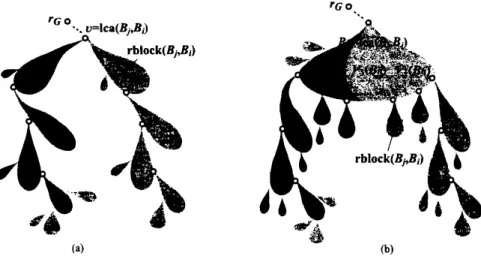
Figure 2: Two possible
cases
wherea
block $B_{j}$ is pre-identical toa
block $B_{i},$ $(a)$ lca$(B_{i}, B_{j})$ isa
vertex$v;(b)$ lca$(B_{i}, B_{j})$ isablock $B_{h}$.
otherwise. For two subsequence$\sigma_{j,k}(G)$and$\sigma_{j’,k’}(G)$,let$\sigma_{j,k}(G)\simeq\sigma_{j’,k’}(G)$ implythat$k’-j’=k-j\geq 0$ and$\gamma’(B_{j+i})\simeq\gamma’(B_{j’+i}),$ $i=0,1,$$\ldots,$$k-j$
.
For
a
block $B_{i}$,a
block $B_{j}$ with $j<i$ incomparable $B_{i}$ is called pre-identical to $B_{i}$ ifone
of the following conditions holds:(i) lca$(B_{i}, B_{j})$ is
a
vertex $v$, ps$(v, B_{j})=$ ps$(v, B_{i})$, and the first pre-blocks of $B_{i}$ and $B_{j}$ to $v$are
immediately adjacent siblingsat $v$
.
See Fig. 2(a).(ii) lca$(B_{i}, B_{j})$ is
a
block $B_{h}$andps$(B_{h}, B_{j})\simeq$ps$(B_{h}, B_{i})$.
See Fig. 2(b).Note that ps$(B_{h}, B_{j})\simeq$ ps$(B_{h}, B_{i})$ holds only when $B_{h}$ is symmetricand the initialancestor-block $B_{i’}$
of$B_{i}$ (resp., $B_{j’}$ of$B_{j}$) to $B_{h}$ is
a
right (resp., left) child-blockof$B_{h}$.
Hence conditions (i) and (ii)can
be expressed by ps$(1ca(B_{i}, B_{j}), B_{j})\simeq$ps$($lca$(B_{i},$ $B_{j}),$$B_{i})$.
If$B_{i}$ has
a
leftsibling $B_{j}$ at$v=r(B_{i})$, then$B_{j}$ is pre-identicalto$B_{i}$, whereps$(v, B_{j})=$ ps$(v, B_{j})=\emptyset$.
In
a
canonical embedding $G$, the first right child-block $B$ ofa
block $B_{h}$ hasan
opposing block suchas
the first left child-block $B_{j}$, since otherwise $G$ is not left-side-heavy. Hence $B_{j}$ is pre-identical to such
block $B_{i}$
.
Lemma 6 For
a
block $B_{d}$ ina
canonical embedding $G$, let $B_{c}$ and $B_{b}(b<c<d)$ be two blockspre-identical to $B_{d}$
.
Then $\gamma’(B_{c})\geq\gamma’(B_{b})\geq\gamma’(B_{d})$ holds. In particular, $\gamma’(B_{d})\simeq\gamma’(B_{c})$ implies$\gamma’(B_{d})\simeq$$\gamma’(B_{b})$
.
Proof. Since $B_{b}$ is pre-identical to$B_{i}$,
we
have ps$($lca$(B_{d},$ $B_{b}),$ $B_{d})\simeq$ ps$(1ca(B_{d}, B_{b}), B_{b})$.
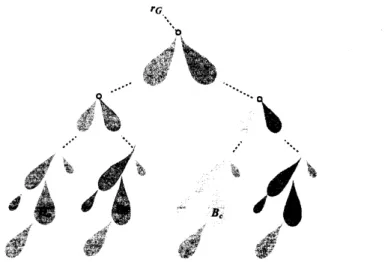
This impliesthat there is
a
block $B_{a},$ $a<b$ pre-identical to $B_{c}$ and $\gamma’(B_{a})\simeq\gamma’(B_{c})$ holds. See Fig. 3. Since$B_{c}$ is pre-identical to $B_{d}$,
we
have ps$($lca$(B_{d},$ $B_{c}),$ $B_{d})\simeq$ ps$(1ca(B_{d}, B_{c}), B_{c})$.
Hence $B_{a}$ is pre-identicalto $B_{b}$
.
Since $G$ is canonical, it must hold $\gamma’(B_{a})\geq\gamma’(B_{b})$ and $\gamma’(B_{b})\geq\gamma’(B_{d})$.
Hence it holds $\gamma’(B_{c})=\gamma’(B_{a})\geq\gamma’(B_{b})\geq\gamma’(B_{d})$,as
required. Hence, $\gamma’(B_{d})\simeq\gamma’(B_{c})$ implies $\gamma’(B_{b})\simeq\gamma’(B_{d})$.
I5
Generation Algorithm for Class
$\mathcal{H}$Anembedding $G’$ is called
a
child-embedding ofan
embedding $G$if$G=\mathcal{P}_{\mathcal{H}}(G’)$. Let $C_{\mathcal{H}}(G)$ denote thesetofallcanonical child-embeddings of
an
canonical embedding $G$.
We definea
family tree$\mathcal{F}_{\mathcal{H}}$ in which$rc....b$
Figure 3: Illustration fortwo blocks $B_{j}$ and$B_{k}(k<j<i)$ pre-identical to
a
block $B_{i}$.
Given
an
integer $n\geq 2$,we
designan
algorithm GENERATE(n) which generates all canonicalembeddings of graphs in $\mathcal{H}$ containing at most$n$ vertices.
Algorithm GENERATE(n) Input: An integer $n\geq 2$
.
Output: All canonical embeddings of graphs in $\mathcal{H}$ containingat most $n$vertices.
begin
Create an embedding$G$ with exactly
one
block $B_{1}$ by setting $B_{1}$ to be the seed block $\tilde{B}\in \mathcal{B}$;$C(B_{1})$ $:=\emptyset;/*C(B)$ denotes the competitor of$B*/$
Output $G$; GEN$(G)$
end.
After creating a new block equivalent to the seed block $\tilde{B}\in \mathcal{B}$
as
the first block$B_{1}$ in an canonical
embedding $G$, we generate all canonical child-embeddings $G’$ of $G$by the following recursive procedure GEN$(G)$
.
ProcedureGEN$(G)$
Input: Acanonical embedding $G$with at most $n$ vertices.
Output: All descendent-embeddings of$G$containing at most $n$ vertices.
begin
$/*$ Let $\pi(G)=[B_{1}, B_{2}, \ldots, B_{K}]$, and let $(B^{1}, B^{2}, \ldots, B^{p})$ be the spine of$G$,
where $B^{p}=B_{K}$ is the tip-block of$G^{*}/$
LOWESTBLOCK;
$/*$ Let $B^{h}$ be the lowest block in the spine to whicha
new
blockcan
be appended $*/$ if$|V(G)|+|V’(\tilde{B})|\leq n$thenfor $i=1,2,$$\ldots,$
$h$ do
APPENDSEED
endfor endif;
if$h=p$ then $ExPANDTIP$ endif
Supposing that
a
canonical embedding $G$ is obtained,we
givean
outline of GEN$(G)$.
Weeasilysee
that
a child-embedding
$G’$ of$G$is obtained by appendinga new
block$B$toa
vertexina
block inthe spineof$G$
or
by extending the tip-block $B^{p}$ of$G$ to its child $B\in C_{B}(B^{p})$.
We first compute thelowest block$B^{h}$ in the spine of$G$that containsavertex to which
a
newblockcan
be appended to generatea
canonicalchild-embeddingof$G$
.
Hence GEN$(G)$ consists of three tasks: $LowESTBLOCK$; the task of finding thelowest block $B^{h},$
APPENDSEED:
the task ofappendingnew
blocks to all blocks $B^{i},$ $i\leq h$ in the spine,and $ExPANDTIP$; the task of extending the tip-block $B^{p}$ of$G$ toeach of all children $B\in C_{B}(B^{p})$
.
To facilitate finding the lowest block$B^{h}$ in LOWESTBLOCK,
we
introduce “competitors“ ofblocks inanembedding. Wedefine the competitorof
a
block $B_{i}$ to be the block $B_{j}$ pre-identical to $B_{i}$ which hasthe smallest index$j(<i)$
among
allblocks pre-identicalto$B_{i}$.
A block $B_{i}$ hasno
competitor ifno
block$B_{j},$ $j<i$ is pre-identical to$B_{i}$.
Let $G’$ be the embedding obtained fromacanonical embedding $G$by appendinga
new
block $B$whichis equivalent to the seed block $\tilde{B}\in \mathcal{B}$
to avertex $v\in V’(B^{i})$ ofablock $B^{i}$ in the spine of$G$
.
We considerwhen $G’$ remains canonical. Since $G$ needs to be the parent-embedding of $G’$, the
new
block $B$ in $G’$needs tobethe tip-blockof$G’$
.
To obtaina
correct child-embedding$G’$ from $G$, thevertex$v$mustsatisfykey$(v)< \min\{$key$(u)|V_{cut}(B^{i})\}$, where
min{key(u)
$|V_{cut}(B^{p})$}
$=\infty$ for the tip-block $B^{p}$ of$G$.
Lemma 7 Let$B_{j}$ and $B_{i}(j<i)$ be blocks in the spine
of
a
canonical embedding G. Assume that thechild-embedding $G_{i}’$ is obtained
from
$G$ by appending anew
seed block toa
vertex $u\in V’(B^{i})$.
Thenthe child-embedding $G_{j}’$ obtained
from
$G$ by appendinga
seed block to any vertex$v\in V’(B^{j})$ satisfyingkey(v) $< \min\{$key$(u)|V_{cut}(B^{j})\}$ is canonical.
Proof. Since $d(G_{j}’)<d(G_{i}’)$, we
see
that $\gamma’(B)$ of thenew
block $B$ appended to$v$ in $G_{i}’$ is smaller than $\gamma’(B)$ of$B$ appended to$u$in $G_{i}’$.
Henceonlythe right hand side of eachofthe inequalities in Lemmas 2 and 3 for blocks in the spine of$G_{j}’$ can decrease by replacing the position of the new block, indicating that $G_{j}’$ remains canonical.1
Consider the block $B^{h}$ with the smallest $h$, called the lowest block, to which the seed block can
be appended to obtain
a
canonical child-embedding $G’$, and the maximum key $endkey^{h}$ ofa
vertex$v\in V’(B^{h})$ with key(v) $\leq endkey^{h}$ to which the seed block
can
be appended to obtaina
canonicalchild-embedding $G’$
.
For two incomparable blocks
B.
and $B_{j}(i<j)$, let rblock$(B_{i}, B_{j})$ be the ancestor-block $B_{h}$ of$B_{j}$with $r(B_{h})=$ lca$(B_{i}, B_{j})$ if lca$(B_{i}, B_{j})$ is avertex;letrblock$(B_{i}, B_{j})$ be the first right child-block of block lca$(B_{i}, B_{j})$ otherwise.
Lemma 8 Let$G$ beacanonicalembedding, and denote$\pi(G)=[B_{1}, B_{2}, \ldots, B_{K}]$, and let$(B^{1}, B^{2}, \ldots, B^{p})$
be the spine
of
$G$, where $B^{p}=B_{K}$ is the tip-blockof
G. Assume that $B^{p}$ has the competitor$B_{j}$ with$\gamma’(B_{j})\simeq\gamma’(B_{K})$
.
Let $B_{l}$ be the parent-blockof
$B_{j+1}$ in $G$, and let $B^{*}$ be the block in the spine with$d(B^{*})=d(B_{l})$.
(i)
If
$\gamma’(B_{j})=\overline{\gamma}’(B_{K})$ and $B_{j+1}$ is aleft
child-blockof
the symmetmc block lca$(B_{j}, B_{K})$, then thelowest block $B^{h}$ is given by $B^{*}$ and endke$y^{}$ $=(1, P(r(B_{j+1})))$ (see Fig.
4
$(a)$);(ii)
If
$\gamma’(B_{j})\simeq\gamma’(B_{K})$ and $B_{j+1}$ is thefirst
mght child-blockof
the symmetmc block$1ca(B_{j}, B_{K})$, thenthe lowest block$B^{h}$ is given by the parent-block
of
$B^{*}$ andendke$y^{}$ $=$ key$(r(B^{*}))$ (see Fig. $4(b),(c)$);
and
(iii) In the other
case
than $(i)-(ii),$ $B^{h}\iota s$ given by $B^{*}$ and endke$y^{}$ $=$key$(r(B_{j+1}))$ (see Fig. $4(d)-(f)$).
Proof. We can observe that the
case
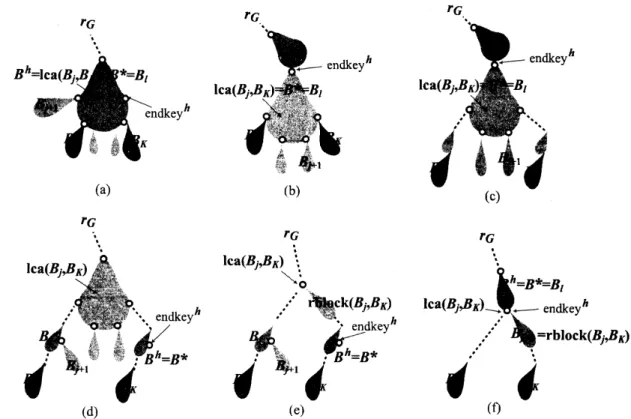
where $B^{p}$ has the competitor $B_{j}$ with $\gamma’(B_{j})\simeq\gamma’(B_{K})$ has thefollowing six subcases: (a) $B_{j+1}$ is
a
left child-block of symmetric block lca$(B_{j}, B_{K})=B^{*}=B_{l}$ (see$\prime c..$
.
$\prime c$.
$rG$.
(a) (b) (c) $rc_{:}$.
$rc$ $1ca(B_{j},B_{K})^{:}:\backslash _{o}^{:}$ $\prime c_{\backslash }$.
$’$
$i$
(d) (e) (f)Figure4: Illustration for the six subcases ofthe
case
where the tip-block $B_{K}=B^{p}$ has the competitor$B_{j}$ with $\gamma’(B_{j})\simeq\gamma’(B_{K})$
.
(b) $B_{j+1}$ is the first right child-block of symmetric block lca$(B_{j}, B_{K})=B^{*}=B_{l}$, and $B_{j}$ and $B_{K}$
are
right and left child-blocks of lca$(B_{j}, B_{K})$ (see Fig. $4(b)$);(c) $B_{j+1}$ is the first right child-block ofsymmetric block lca$(B_{j}, B_{K})=B^{*}=B_{l}$, and both $B_{j}$ and $B_{K}$
are
not child-blocks of lca$(B_{j}, B_{K})$ (see Fig. $4(c)$);(d) $B_{j+1}$ is a descendant-block ofaleft child-block of symmetric block lca$(B_{j}, B_{K})$ (see Fig. $4(d)$);
(e) $B_{j+1}$ is a descendant-block ofaleft child-blockof vertex lca$(B_{j}, B_{K})$ (see Fig. $4(e)$); and
(f) $B_{j+1}$ is the child-block rblock$(B_{j}, B_{K})$ ofvertex lca$(B_{j}, B_{K})$ (see Fig. $4(f)$).
Let $B^{h}$ and endke
$y^{}$ $=$key$(r(B_{j+1}))$ be the block and the key value determined by the lemma. Then
we
see
that the block lca$(B_{j}, B_{K})$or
rblock$(B_{j}, B_{K})$ is no longer left-side-heavyor left-sibling-heavy ifa new block$B$ is appended at a vertex$u$ such that $u\in V’(B^{h})$ with key$(u)>endkey^{h}$ or$u\in V’(B^{i})$ with$i>h$.
We next show that the embedding $G’$ obtained from $G$ by appending
a new
seed block $B$ to thevertex $u\in V’(B^{h})$ with key(v) $=endkey^{h}$ is canonical, which proves that $B^{h}$ is the lowest block and
endke$y^{}$ is the maximum key in $V’(B^{h})$byLemma7. We consider
case
(a) (theothercases can
be treatedanalogously). Assume that $G’$ is not canonical. Then $G’$ has a block $B_{a}$ which is not left-sibling-heavy
or is not left-side-heavy. Since we see that $B_{l}=B^{h}=$ lca$(B_{j}, B_{K})$ remains left-side-heavy in $G’$, we
have $a<l$. Then the new tip-block $B’$ has a pre-identical block $B_{t}$ in $G’$. This meansthat block $B_{t-1}$,
$t-1<j$
, is pre-identical to $B_{K}$, contradicting that $B_{j}$ with$t-1<j$
is the competitor of$B_{K}$. 1 Lemma 9 For a canonical embedding $G$, let $\pi(G)=[B_{1}, B_{2}, \ldots, B_{K}]$, and let $(B^{1}, B^{2}, \ldots, B^{p})$ be the spineof
$G$, where $B^{p}=B_{K}$ is the tip-blockof
G. Assume that$B^{p}$ hasno
competitor$B_{j}$ with $\gamma’(B_{j})\simeq$$\gamma’(B_{K})$
.
Then the lowest block$B^{h}$ is given by the tip-block$B^{p}$ and endkeProof. ByLemma7, it sufficestoshowthatthe embedding$G’$obtained from$G$byappending
a new
seedblock$B$ tothe vertex $u\in V’(B^{h})$ with the maximum keyis canonical. Assume that $G’$ is notcanonical.
Then $G’$ has
a
block $B_{a}$ which is not left-sibling-heavyor
is not left-side-heavy. Then thenew
tip-block$B’$ has
a
pre-identical block $B_{t}$ in $G’$.
Thismeans
that block $B_{t-1}$ is pre-identical to $B_{K}$, contradictingthat$B_{K}$ has
no
competitor in G. 1Task$LowESTBLOCK$is attained by computingthelowestblock$B^{h}$andthe themaximumkey$endkey^{h}$
according to Lemmas8 and9.
$LowESTBLOCK$
if$\gamma’(C(B_{K}))\simeq\gamma’(B_{K})$ then $/*B_{j}=C(B_{K})$ in $\pi(G)^{*}/$
Let $B_{l}$ be the parent-block of$B_{j+1}$ in $G$;
Let $B^{*}$ bethe block in the spine with $d(B^{*})=d(B_{l})$;
if$1ca(B_{j}, B_{K})=B^{*}$ then
if$B_{j+1}$ is
a
left child-block of$B^{*}=$lca$(B_{j}, B_{K})$ then$B^{h};=B^{*};$ endke$y^{}$ $:=(1, \ell(r(B_{j+1})))$
else if$B_{j+1}$ is the first right child-block of$B^{*}=$ lca$(B_{j}, B_{K})$ then
Let $B^{h}$ be the parent-blockof$B^{*};$ endke
$y^{}$ $:=$key$(r(B^{*}))$
endif endif
else
$B^{h};=B^{*};$ endke$y^{}$ $:=$key$(r(B_{j+1}))$
endif endif;
if$\gamma’(C(B_{K}))\not\simeq\gamma’(B_{K})$ then $B^{h};=B^{p};$ endke$y^{}$ $:=\emptyset$ endif
We
are
ready to examine when the embedding $G’$ obtained from $G$ by extending the tip-block$B^{p}$ toone
of its child $B\in C_{\mathcal{B}}(B^{p})$ remains canonical.Lemma 10 Let $G’$ be the embedding obtained
from
a canonical embedding $G$ by expanding the tip-block$B^{p}$ to
a
child $B\in C_{B}(B^{p})$.
Then $G’$ is not canonicalif
and onlyif
$B^{p}$ has the competitor$B_{j}$ in $G$ and$\gamma(B)>\gamma(B_{j})$ holds.
Proof. (i) Ifpart: Assume that $B^{p}$ has the competitor $B_{j}$ and $\gamma(B)>\gamma(B_{j})$ holds. Iflca$(B_{j}, B^{p})$ is
a
block $B_{l}$, thenwe
see
that $B_{l}$ is not left-side-heavy in $G’$. Otherwise iflca$(B_{j}, B^{p})$ isa
vertex $v$, thenthere
are
two consecutive siblings$B_{j’},$$B_{j’’}\in BS[v]$ such that$B_{j’}$ and $B_{j’’}$are
ancestor-blocks of$B_{j}$ and$B^{p}$, indicating that $B_{j’’}$ is not left-sibling-heavy in $G’$
.
(ii) Only if part: Assumethat$G’$ is not canonical. Since$G$is canonical,we
see
that all blocks$B’$ thatare
not left-sibling-heavyor
left-side-heavy in $G’$ belong to the spineof$G$.
Let $B_{k}$ be suchablock $B’$.
First consider the
case
where $B_{k}$ is not left-sibling-heavy in $G’$.
Then the left sibling $B_{k’}\in BS[v]$of$B_{k}$ at the root $v=r(B_{h})$ has a descendant-block $B_{c}$ which is pre-identical to $B^{p}$ in $G’$ and satisfies
$\gamma(B)>\gamma(B_{c})\geq\gamma(B^{p})$ and $(d(B_{c})$,key$(r(B_{c})))=(d(B^{p})$, key$(r(B^{p})))$ holds. Hence by definition, $B^{p}$
has the competitor $B_{b}$ with $b\leq c$. Since $b=c$ implies the lemma,
we
derivea
contradiction assuming$b<c$
.
Since $b<c$ and $B_{b}$ is pre-identical to $B^{p}$, we have $(d(B_{b})$, key$(r(B_{b})))=(d(B^{p})$,key$(r(B^{p})))$(note that $B_{b}$ and $B^{p}$ cannot share the
same
parent-block due to the block $B_{c}$). By Lemma 6, it holds$\gamma’(B_{c})\geq\gamma’(B_{b})\geq\gamma’(B^{p})$. Hence, $(d(B_{b})$,key$(r(B_{b})))=(d(B_{c})$, key$(r(B_{c})))=(d(B^{p})$,key$(r(B^{p})))$
implies that $\gamma(B_{c})\geq\gamma(B_{b})\geq\gamma(B^{p})$
.
Flrom this and $\gamma(B)>\gamma(B_{c})\geq\gamma(B^{p})$, weobtain $\gamma(B)>\gamma(B_{c})=$$\gamma(B_{b})=\gamma(B^{p})$,
as
required.We next consider the
case
where$B_{k}$ isa
symmetric block which is not left-side-heavy in $G’$.
Then$B^{p}$is
a
descendant-block ofa
right child-blockof$B_{k}$ and there is descendant-block $B_{c}$ ofa
left child-blockof $B_{k}$ which is pre-identical to $B^{p}$ in $G$ and satisfies $\gamma(B)>\gamma(B_{c})\geq\gamma(B^{p})$ and $(d(B_{c})$, key$(r(B_{c})))=$
$B^{p}$ are child-blocks of$B_{k}$). By definition, $B^{p}$ has the competitor $B_{b}$ with $b\leq c$. Since $b=c$implies the
lemma,
we
derivea
contradiction assuming $b<c$. Since $b<c$ and $B_{b}$ is pre-identical to $B^{p}$, we have$(d(B_{b})$,key$(r(B_{b})))=(d(B^{p})$, key$(r(B^{p})))$. By Lemma 6, it holds $\gamma’(B_{c})\geq\gamma’(B_{b})\geq\gamma’(B^{p})$
.
Again thisand $\gamma(B)>\gamma(B_{c})\geq\gamma(B^{p})$ imply$\gamma(B)>\gamma(B_{c})=\gamma(B_{b})=\gamma(B^{p})$, asrequired. 1
By Lemma 10, if $B^{p}$ has the competitor $B_{j}$ with $\gamma’(B_{j})\simeq\gamma’(B^{p})$, then the tip-block $B^{p}$ cannot
be expanded to generate a canonical embedding. In this case, the lowest block $B^{h}$ is not equal to $B^{p}$
by Lemma 8. On the other hand, $B^{p}$ is the lowest block $B^{h}$ by Lemma 9. Hence
we
try to expandthe tip-block $B^{p}$ onlywhen $B^{h}=B^{p}$
.
Basedon
the above observation,a
procedure for $ExPANDTIP$ isdescribed
as
follows.$ExPANDTIP$
Let $B_{\min}$ $:=\tilde{B}$ and$B_{\max}$ $:=C(B_{K})$ $($let $B_{\max}$ $:=\infty$ if$C(B_{K})$ $:=\emptyset)$ ;
while $B:=NEXTMINCHILD(B_{K}, B_{\min}, B_{\max})\neq\emptyset$ and $|V(G)|+|V’(B)|\leq n$ do
$B$$:=NEXTMINCHILD(B_{K}, B_{\min}, B_{\max})$;
Let $G’$ be the embedding obtained from $G$by replacing $B_{K}$ with$B$, and
output $G’$ (or the difference between $B_{K}$ and$B$); GEN$(G’)$;
$B_{\min}:=B$
endwhile
To append a new block to the current embedding $G$, we need to know all vertices to which
a new
block
can
beappendedone
byone.
A procedure for
APPENDSEED can
be describedas
follows. Let $B^{0}$ denotean
imaginary blockwhichis the parent-block of$r_{G}=r(B^{1})$ such that $V’(B^{0})=\{r_{G}\}$ for notational convenience.
APPENDSEED
if$i<h$ then endke$y^{}$ $:=$key$(r(B^{i+1}))$ for the root $r(B^{i+1})$ of block $B^{i+1}$ endif;
currentkey$:=-\infty$;
while NEXTVERTEX($B^{i}$, currentkey) $\neq\emptyset$ do ($v$,key$(v)$) $:=N$EXTVERT$EX$($B^{i}$,currentkey);
Create a
new
block $B$ which is equivalent to seed block $\tilde{B}$;Let $G’$ bethe embedding obtained from$G$ by appendingblock $B$ to$v$;
Compute the competitor $C(B)$ ofthe newblock $B$, lca$(C(B), B)$ and
rblock(C(B),$B$) according to Cases-Cl and C2;
Output $G’$ (or$B$ and $v$);
GEN$(G’)$;
currentkey $:=$key(v) ;
if currentkey$=$endkey
$i$
then currentkey $:=\infty$
$/*$ This terminates the while-loop by NEXTVERTEX$(B^{i}, \infty)=\emptyset^{*}/$ endif
endwhile $/*$ no vertexin $B^{i}$ is left for appending a
new
block $*/$We can compute the competitor $C(B)$ of the new block in APPENDSEED in $O(1)$ time if we also
maintain data lca$(C(B), B)$ and rblock(C(B),$B$)
We
assume
that the set of vertices in $V’(B)$ ofablock $B\in \mathcal{B}$ is stored in a linked list LIST$(B)$ inthe decreasing order with respect to their levels $\ell$, and that the following procedure NEXTVERTEX of
reporting the current vertex in LIST$(B)$ is available.
Input: Ablock $B$ and
a
key value $\kappa\in(\{1,2,3\}\cross Z)\cup$$\{$-00,$\infty\}$, where $Z$denotes the set ofintegers.Output: The vertex
name
$u$and key$(u)=$ (side$(u),$$\ell(u)$) of the vertex next to the vertex $v\in V(B)$ with key$(v)=\kappa$ina
list LIST$(B)$ of vertices to which ablockcan
beattached, wherewe
choose sucha
vertex $u$ from $V_{3}(B),$ $V_{2}(B),$ $V_{1}(B)$ in this order and the first such vertex is chosen when$\kappa=-\infty$; return $\emptyset$if
no
sucha
nonroot vertex$v$ of$B$ exists
or
$\kappa=\infty$.
We
can
maintain the cell in LIST$(B)$ thatwas
accessedlast bya
pointerso
that the next cellcan
beaccessed in constant time.
We also
assume
that a procedure NEXTMINCHILD for returninga
block $B’\in \mathcal{B}$ with $\gamma(B_{\min})<$$\gamma(B’)\leq\gamma(B_{\max})$ for given blocks $B_{\min}$ and$B_{\max}$ is available. Procedure
NEXTMINCHILD
$(B, B_{\min}, B_{\max})$Input: Blocks$B,$ $B_{\min}$ and$B_{\max}$, where possibly $B_{\max}=\infty$.
Output: The child $B’\in C_{\mathcal{B}}(B)$ with the minimum $\gamma(B’)$ such that $\gamma(B_{\min})<\gamma(B’)\leq\gamma(B_{\max})$ (ifany)
or
$B’=\emptyset$ifno
such $B’$exists, wherewe
treat $\gamma(B_{\max})$with $B_{\max}=\infty$as
oo.
How to Compute Competitors For each block $B_{i}\in\pi(G),$ $i=1,2,$$\ldots,$$K$ inthis order,
we can
setthe competitorof
a
block $B_{i}$ to bethe block $B_{j}$ whichsatisfiesone
of the nextcases
holds, wherewe
alsocomputelca$(B_{i}, B_{j})$ and rblock$(B_{i}, B_{j})$:
Case-Cl. $i\geq 2$ and the previous block $B_{i-1}$ of$B_{i}$ has
a
competitor $B_{j-1}$ and it holds lca$(B_{i}, B_{j})=$$1ca(B_{i-1}, B_{j-1})$:
(a) lca$(B_{i}, B_{j})$ is
a
vertex and $\gamma’(B_{i-1})=\gamma’(B_{j-1})$ holds: Then the competitor of$B_{i}$ is given by $B_{j}$.
(b) lca$(B_{i-1}, B_{j-1})$ isa
symmetric block, $B_{i-1}$ and $B_{j-1}$are
notchild-blocks of block lca$(B_{i}, B_{j})$, and$\gamma’(B_{i-1})=\gamma’(B_{j-1})$: Then the competitor of$B_{i}$ is given by $B_{j}$
.
(c) lca$(B_{i-1}, B_{j-1})$ is a symmetric block, $B_{i-1}$ and $B_{j-1}$ are child-blocks of block lca$(B_{i}, B_{j})$, and $\gamma’(B_{i-1})=\overline{\gamma}’(B_{j-1})$: Then the competitor of$B_{i}$ is given by $B_{j}$.
In each of $(a)-(c)$,
we
set lca$(B_{i}, B_{j})$ $:=$lca$(B_{i-1}, B_{j-1})$ and rblock$(B_{i}, B_{j})$ $:=$rblock$(B_{i-1}, B_{j-1})$.
Case-C2. $B_{i}$ has
no
such previousblock $B_{i-1}$ in Case-Cl:(a) $B_{i}$ has a left sibling $B_{j}\in BS[v]$ at $v=r(B_{i})$: Then the competitor of$B_{i}$ is given by $B_{j}$
.
We set$1ca(B_{i}, B_{j}):=v$ and rblock$(B_{i}, B_{j}):=B_{i}$.
(b) $B_{i}$ has no left sibling $B_{j}\in BS[v]$ at $v=r(B_{i}),$ $B_{i}$ has the parent-block $B_{l}$ which has
a
left child-block, and $B_{i}$ is the first right child-block of$B_{l}$: Thenthecompetitorof$B_{i}$ isgiven by thefirst leftchild-block $B_{j}$ of$B_{l}$
.
We set lca$(B_{i}, B_{j})$ $:=B_{l}$ and rblock$(B_{i}, B_{j})$ $:=B_{i}$.
Lemma 11 In a canonical embedding $G$, the competitor
of
block $B_{i}$ is correctly obtained in Cases-Cl and $C2$,if
any,if
the competitorsof
all blocks $B_{t},$ $t<i$ have been obtained.Proof. If $B_{i}$ has a left sibling at $v=r(B_{i})$, then $B_{i}$ has a competitor. Note that a block $B$ which
has
a
right child-block must have a left child-block in a canonical embedding $G$, since otherwise $B$ isnot left-side-heavy. Hence if $B_{i}$ is the first right child-block ofits parent-block $B_{l}$, then $B_{l}$ has
a
leftchild-blockand thereby $B_{i}$ has
a
competitor.(i) Assume that there is no block pre-identical to $B_{i}$
.
We show that no competitor is given to $B_{i}$ inCase-Cl and C2. Since $B_{j}$ in Case-C2 is pre-identical to $B_{i}$, weconsider Case-Cl(a), i.e., $B_{i-1}$ has the competitor $B_{j-1}$ such that lca$(B_{i}, B_{j})=$ lca$(B_{i-1}, B_{j-1})$ is a vertex $v$ and $\gamma’(B_{j-1})=\gamma’(B_{i-1})$ holds
(subcases (b) and (c) can be treated analogously). By definition ofcompetitors,
we
have ps$(v, B_{j-1})=$$\gamma’(B_{i-1})]=$ ps$(v, B_{i})$. This, however, implies that $B_{j}$ is pre-identical to $B_{i}$, contradicting that there is
no block pre-identical to$B_{i}$
.
Therefore, no competitor is assigned to $B_{i}$.(ii) Assume that there is ablock $B_{t},$ $t<i$ pre-identical to $B_{i}$
.
Let $t$be the minimum index for suchblock $B_{t}$
.
We show that if $B_{t}$ is the left sibling in $BS[v]$ at $v=r(B_{i})$, thenno
competitor is assigned to $B_{i}$ in Case-Cl, which implies that $B_{t}$ is assigned to $B_{i}$as
the competitor of$B_{i}$ in Case-C2(a). Ifa block $B_{j}$ in Case-Cl is assigned to such $B_{i}$ in Case-Cl, then we seethat $B_{j}$ is pre-identical to$B_{i}$, and$j<t$ holds, contradicting the choice of$B_{t}$
.
Wecan
treat thecase
where $B_{i}$ and $B_{t}$ arethefirst left- andright-blocks of
a
block analogously.Assume
that $B_{i}$ and $B_{t}$ do not satisfy each ofconditions (a) and (b) inCase-C2.
In this case, thepreceding block $B_{t-1}$ of$B_{t}$ is pre-identical to the precedingblock $B_{i-1}$ of$B_{i}$
.
Hence if the competitorof $B_{i-1}$ is $B_{t-1}$, then $B_{t}$ is assigned to $B_{i}$
as
its competitor in Case-Cl,as
required. We derive a contradiction by assuming that the competitor of$B_{i-1}$ is ablock $B_{k-1}$ with$k-1<t-1$ .
By Lemma6and $\gamma’(B_{t-1})\simeq\gamma’(B_{i-1})$, we have $\gamma’(B_{k-1})\simeq\gamma’(B_{i-1})$
.
This, however,means
that $B_{k}$ is pre-identicalto $B_{i}$, contradicting the choice of$B_{t}$.
I
Whether lca$(B_{i}, B_{j})=$ lca$(B_{i-1}, B_{j-1})$ or not
can
be tested using lca$(B_{i-1}, B_{j-1})$ and rblock$(B_{i-1}$, $B_{j-1})$as
follows: lca$(B_{i}, B_{j})=$ lca$(B_{i-1}, B_{j-1})$ if and only if$j<h$
and $d(B_{h})>d(B_{i})$ for $B_{h}=$rblock$(B_{i-1}, B_{j-1})$. Hence
we can
determine the competitor$C(B)$ ofanew
block $B$ according to Cases-Cl andC2 in $O(1)$ time.Finallyweconsider the entire algorithmGENERATE. For thecorrectness of GENERATE, weonly need to show that, when GEN$(G)$ terminates a recursive call to avoid generating $G’$ with
more
than $n$ vertices, alldescendant-embeddings of$G$with atmost $n$vertices have been generated. InGEN
$(G)$, taskAPPENDSEED
is executedonlywhen $|V(G)|+|V’(\tilde{B})|\leq n$. Wesee
that, if$|V(G)|+|V’(\tilde{B})|>n$, thenno
child-embedding $G’$ of$G$ obtained by appending the seed block
can
havean
embedding with at most $n$vertices due to the monotonicity (S5) of$\gamma$. Similarly, $ExPANDTIP$ terminates expansionofthe tip-block
once
thenew expanded block $B$satisfies $|V(G)|+|V’(B)|>n$.
In this case,no child-embedding$G’$ of$G$obtained by expanding the tip-block$B^{p}$toanyotherunseenchildren$B’\in C_{B}$, because$\gamma(B’)>\gamma(B)$holds
by the listing order of NEXTMINCHILD and thereby $|V(B’)|\geq|V(B)|>n$ holds by the monotonicity (S4) of$\gamma$.
It is not difficult to implement GENERATE(n)
so
that each new embeddingcan
be generated in$O(\triangle)$ time and $O(n)$ without including the time and space complexity of procedures $NEXTERTEX$and
NEXTMINCHILD, where $\triangle$ denotes the maximum size between two consecutive outputs. Let $T(n)$ and
$S(n)$ denote the time and space complexities of procedures NEXTVERTEX and NEXTMINCHILD. Then
we see
that all rooted graphsin$\mathcal{H}$canbegeneratedby GENERATE(n) in$O(T(n))$ time in averageandin$O(S(n)+n)$time,where$\triangle=O(T(n))$ is assumed. We
can
reduce the worstcase
of time delay betweentwo consecutive outputs to $O(T(n))$ usingthe technique of changing the timing ofoutputs (e.g., [8, 7, 9])
so that
a
canonical embedding $G$ at an odd (resp., even) depth in the family tree $\mathcal{F}_{\mathcal{H}}$ is output before(resp., after) generatingany child of$G$.
Theorem 12 Let $\mathcal{B}$ be
a
classof
blocks which admits signature$\gamma$ monotone with respect to the number
of
vertices. Then all canonical embeddingsof
rooted graphs in a class $\mathcal{H}$ over $\mathcal{B}$ can be genemted in$O(S(n)+n)$ space and in $O(T(n))$ time per output.
6
Concluding Remarks
In this paper,
we
introduce a framework for generating rooted graphs which consists of representations ofbiconnected components with reflectional symmetries, called blocks. Our framework delivers an algo-rithm for generating all graphs in such a class of graphs in constant time per output if two procedures NEXTVERTEX and NEXTMINCHILD for the class of blocksare designed so that they run in in constant time peroutput. Recently, we have designedan
algorithm that generates all rooted biconnected planargraphs with internally triangulated facesin $O(1)$ time per output [12, 13]. The algorithm also provides
procedures NEXTVERTEX and NEXTMINCHILD that
run
in $O(1)$ time. Hence Theorem 12 implies thatall rooted connected planar graphs with internally triangulated faces
can
be generated in $O(1)$ time peroutput.
In this paper,
we
havetreateda
class of biconnected components that admitssymmetrywhoseorderis at most 2. It
seems
possible toextendour
hamework to symmetry of blocks witha
higherordersucha
rotational symmetry with order $k\geq 2$
.
It is alsoour
future work to provideanew
frameworkfor rootedgraphs which consists of representations of triconnected components with reflectional symmetries.
References
[1] H. Fujiwara, J. Wang, L. Zhao, H. Nagamochi and T. Akutsu, Enumerating tree-like chemical graphs with
given pathfrequency, Journal ofChemicalInformation and Modeling, 48, (2008) 1345-1357.
[2] L. H. Hall and E. S. Dailey, Design of molecules hom quantitativestructure-activity relationship models. 3.
role of higher order path counts: path 3., J. Chem. Inf. Comp. Sci., 33, (1993) 598-603.
[3] T. Horv\’ath, J. Ramon, andS. Wrobel, Frequentsubgraph miningin outerplanargraphs, In Proc. 16th ACM
SIGKDD International Conference on Knowledge Discovery andDataMining, (2006) 197-206.
[4] T. Imada, S. Ota, H. Nagamochi, and T. Akutsu, Enumerating stereoisomers of tree structured molecules
using dynamic programming, The 20thInternational Symposium on Algorithms and Computation (ISAAC
2009),December 16-18, 2009, in Hawaii, USA, LNCS 5878, 14-23.
[5] Y. Ishida, L. Zhao, H. Nagamochi, and T. Akutsu, Improved algorithm for enumerating tree-like chemical
graphs, The 19th International Conference on Genome Informatics, Gold Coast, Australia, 1- 3 December
2008; Genome Informatics 21, (2008) 53-64.
[6] H. Mauserand M. Stahl, Chemicalfragmentspacesfor de novodesign. J. Chem. Inf. Comp. Sci., 47, (2007)
318-324.
[7] S. Nakano, Efficient generation oftriconnected plane triangulations, Computational Geometry Theory and
Applications, 27(2), (2004) 109-122.
[8] S. NakanoandT. Uno, Efficient generationof rootedtrees, NII Technical Report $(NII-2003arrow 005)$ (2003).
[9] S. Nakano and T. Uno, Generating coloredtrees, LectureNotes in Computer Science, 3787, (2005)249-260.
[10] J. Wang and H. Nagamochi, Constant time generation of rooted and colored outerplanar graphs,
Tech-nical Report 2010-007 (2010), http://www-or.amp.i.kyoto-u.ac.jp$/members/nag/Technica1_{-}report/TR2010-$
007.pdf.
[11] J. Wang, L. Zhao, H. Nagamochi, and T. Akutsu, An efficient enumeration of colored outerplanar graphs,
Lecture NotesinComputer Science, 4484 (2007)573-583.
[12] B. Zhuang and H. Nagamochi, Enumerating rooted biconnected planar graphs with internally
triangu-lated faces, Technical Report 2009-018 (2009), http://www-or.amp.i.kyoto-u.ac.jp$/members/nag/Technical$
-report/TR2009-018.pdf.
[13] B. Zhuang, H. Nagamochi, Generation of symmetric and asymmetric biconnected rooted
outerpla-nar graphs, Technical Report 2010-008 (2010), http://www-or.amp.i.kyoto-u.ac.jp/members/nag/Technical