Pallets and
coloring
invariants
for spatial
graphs
Kanako
Oshiro
(JapanWomen’s.University)
E-mail:ooshirok\copyright fc.jwu.acjp
Abstract
We introduce the notion of pallets of quandles and define
color-ing invariants for spatial graphs which give a generalization of Fox
colorings studied in [4]. And we show a result for pallets of dihedral
quandles, which implies that all possible coloring conditions around
vertices for Fox colorings are classified.
1
Spatial graphs
For an embedding of a graph to the 3-dimensional Euclidean space $\mathbb{R}^{3}$, the
image is called
a
spatial graph. Two spatial graphsare
equivalent ifwe
can
deform by ambient isotopyone
onto the other. A diagram ofa
spatialgraph $G$ is
an
image of$G$ bya
regular projection ontoa
plane witha
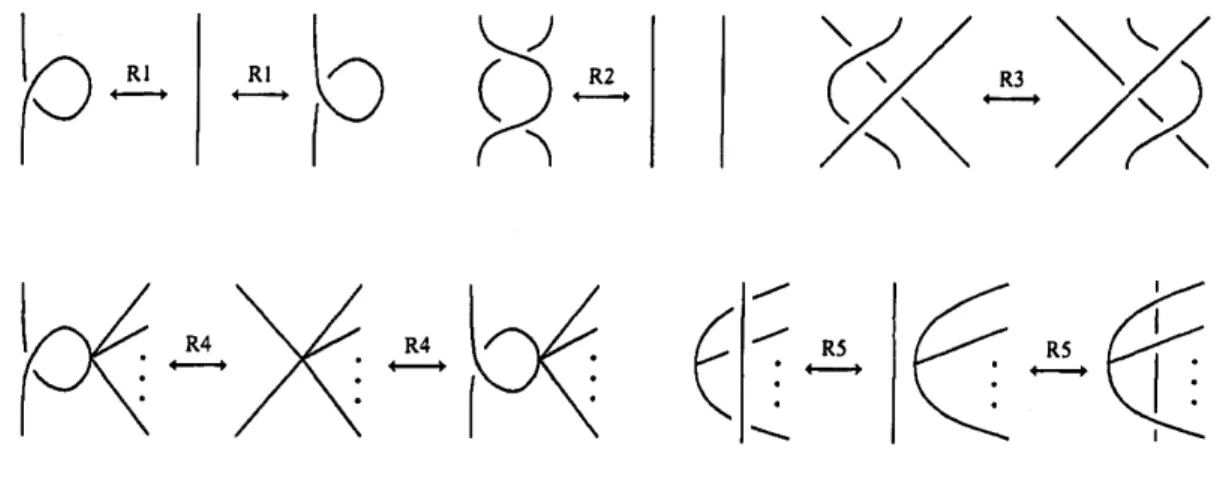
crossinginformation at each doublepoint. It is known thattwo spatial graph diagrams
represent
an
equivalent spatial graph ifand only if theyare
related bya
finitesequence of the Rl-5
moves
depicted in Figure 1. Each edge ofa spatial graphis separated into some pieces in
a
diagram. We call each piecean
arc of thediagram.
2
Pallets
of
quandles
and
coloring
invariants
A
quandle [5, 6] isa
set $X$ equipped witha
binary operation $(a, b)\mapsto a^{b}$on
$X$ satisfying the following conditions: (i) For any $a\in X$, the formula $a^{a}=a$
holds, (ii) for any $a\in X$, the map $S_{a}$ : $Xarrow X$ defined by $S_{a}(x)=x^{a}$ is
Figure 1: Elementary moves
We omit round brackets throughout this paper and we call the bijection $S_{a}$
$(a\in X)$ defined in (ii) the symmetry by $a$. A dihedml quandle of order $p$
$(p\geq 3)$ is the set $Z_{p}=\{0,1, \ldots,p-1\}$ equipped with the quandle operation
$a^{b}=2b-a$
.
We denote it by $R_{p}$.
Wesee
that all symmetries of $\mathscr{N}$are
involutions of $R_{\tau}$
.
We saya
quandle such that all symmetriesare
involutionsan
involutory quandle.We mean by $Z_{+}$ the set of the positive integers throughout this paper.
Definition 2.1 Let $X$ be a quandle. For any element $a$ in $X$, we denote
simply by $a^{+1}$ the pair $(a, S_{a})$ of
$a$ and the symmetry $S_{a}$ by $a$, and by $a^{-1}$
the pair $(a, S_{a}^{-1})$ of $a$ and the inverse map of $S_{a}$
.
Let$\mathcal{X}=\{a^{+1}|a\in X\}\cup\{a^{-1}|a\in X\}$.
A pallet of $X$ is a subset $P$ of $\bigcup_{n\in Z+}\mathcal{X}^{n}$ satisfying the following conditions:
(i) for any $(a_{1^{1}}^{\epsilon}, \cdots , a_{n}^{\epsilon_{n}})\in P$, it holds that
$(a_{2^{2}}^{\epsilon}, \cdots, a_{n}^{\epsilon_{n}}, a_{1}^{\epsilon_{1}})\in P$
(ii) for any $(a_{1}^{\epsilon_{1}}, \cdots , a_{n}^{\epsilon_{n}})\in P$, it holds that
$S_{a_{n}^{n}}^{\epsilon}o\cdots oS_{a_{1}^{1}}^{\epsilon}=id$,
(iii) for any $(a_{1}^{\epsilon_{1}}, \cdots, a_{n}^{\epsilon_{n}})\in P$ and any $x\in X$, it holds that
$(a_{2}^{\epsilon 2}, S_{a_{2}^{2}}^{\epsilon}(a_{1})^{\epsilon_{1}}, a_{3^{3}}^{\epsilon}, \cdots, a_{n}^{\epsilon_{n}})\in P$ and $(S_{a_{1}}^{-\epsilon_{1}}(a_{2})^{\epsilon 2}, a_{1}^{\epsilon 1}, a_{3^{3}}^{\epsilon}, \cdots, a_{n}^{\epsilon_{n}})\in P$
.
For any $n\in z_{+}$,
we
calla
pallet which is a non-empty subset of $\mathcal{X}^{n}$an
n-pallet.
Example 2.2 For any $n\in z_{+}$, let
$U_{n}=\{(a_{1}^{\epsilon_{1}}, \cdots, a_{n}^{\epsilon_{n}})\in \mathcal{X}^{n}|S_{a_{n}^{n}}^{\epsilon}o\cdots oS_{a_{1}^{1}}^{\epsilon}= id\}$
.
This set is a pallet of$X$ and we call it the universal n-pallet
of
$X$.
Let$U= \bigcup_{n\in Z+}U_{n}$
.
This is also a pallet of $X$
.
Since it includes any pallet as a subset,we
call itthe universal pallet
of
$X$.
Assume that $X$ is
an
involutory quandle. Since it holds that $a^{+1}=a^{-1}$for any $a\in X$,
we
may omit the superscrlpts $+1$ or-l ofthe elements of$\mathcal{X}$.For any $n\in z_{+}$, let
$C_{n}=\{(a_{1},$ $\ldots,$ $a_{n})\in \mathcal{X}^{n}|S_{a_{n}^{n}}^{\epsilon}o\cdots oS_{a_{1}^{1}}^{\epsilon}=$ id and $a_{1}=\cdots=a_{n}\}$
.
This is
a
pallet of $X$ andwe
call it the classical n-palletof
$X$.
Let$C= \bigcup_{n\in Z+}C_{n}$
.
This is also
a
pallet of $X$ and we call it the classical palletof
$X$.Each pallet gives a coloring invariant for spatial graphs:
Let $G$ be
an
oriented spatial graph embedded in $\mathbb{R}^{3}$ and $D$ be a diagramof $G$. Let $P$ be a pallet of a quandle $X$
.
An X-colortng of $D$ associated with $P$ is an assignment of
an
element of$X$ to each
arc
of $D$ satisfying the following conditions:$\bullet$ Around
a
crossing $c$, let $e_{o}$ be theover
arc, $e_{r}$ the underarc
which ison
the right side of $e_{o}$ along the orientation of $e_{o}$, and $e_{l}$ be the otherunder
arc.
Suppose that thearcs
$e_{o},$ $e_{r}$ and $e_{l}$are
colored by $a_{1},$ $a_{2}$ and$\underline{a_{2}}\downarrow^{a_{1}}\frac{a_{3}}{c}$
$a_{t}$
$a_{2}$ $=a_{3}$
$v$
$(a_{1}^{1}, a_{2}^{+1}, \cdot \cdot a_{n}^{-1})\in P$
Figure 2: Coloring conditions
$\bullet$ For
an
n-valent vertex$v$, let $e_{1},$
$\ldots,$ $e_{n}$ be the arcs which are situated
clockwise around $v$. Let $a_{1},$ $\ldots,$ $a_{n}$ be the elements of $X$ assigned to
the
arcs
$e_{1},$$\ldots,$$e_{n}$, respectively. Then it holds that $(a_{1}^{\epsilon_{1}}, \ldots, a_{n}^{\epsilon_{n}})\in P$,
where for each $i\in\{1, \ldots, n\},$ $\epsilon_{i}$ is $+1$ if the
arc
$e_{i}$ is directed in toward$v$, and it is-l if the
arc
is dlrected out (Figure 2).Let $Co1_{X,P}(D)$ be the set of X-colorings of $D$ associated with $P$
.
We havethe following proposition:
Proposition 2.3 Let $D$ and$D’$ be diagrams which represent the
same
spatialgraph. Then there is
a
bijection between $Co1_{X,P}(D)$ and $Co1_{X,P}(D’)$.
Pmof.
Suppose that $D$ and $D’$are
diagrams related by a single move amongRl-5
moves
shown in Figure 1. Let $E$ be a 2-disk in $\mathbb{R}^{2}$ in which the singlemove
is applied. For each X-coloring of $D$ associated with $P$, its restrictionto $D\backslash E(=D’\backslash E)$
can
be uniquely extended to an X-coloring of$D’$ associatedwith $P$. Thus there is abijection between the sets $Co1_{X,P}(D)$ and Col$X,P(D’)$
.
1
By Proposition 2.3,
we
see that the number of the elements of $Co1_{X,P}(D)$is
an
invariant for spatial graphs. Thereforewe
also denote the invariant by$\#Co1_{X,P}(G)$
.
Remark 2.4 When $X$ is an involutory quandle, for any pallet $P$ of $X$, the
coloring invariant by $X$ and $P$ does not depend
on
orientations of spatialgraphs. Therefore
we can
definea
coloring invariant for un-oriented spatial$a$
$G$ $G$’
Figure 3: Coloring invariants
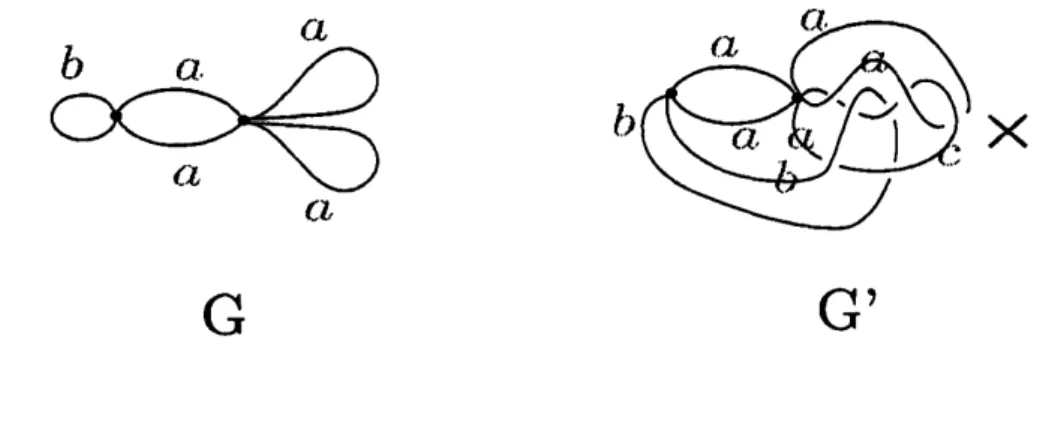
Example 2.5 Let $G$ and $G’$ be the spatial graphs shown in Figure
3.
Let $D$and $D’$ be diagrams of $G$ and $G’$, respectively. We consider $R_{3}$-colorings of
$D$ and $D’$ with
some
pallets. Since the dihedral quandle $R_{3}$ is the involutoryquandle, it holds that $a^{+1}=a^{-1}$ for any $a\in R_{3}$. Hence
we
omit thesu-perscripts $+1$ or-l of the elements of $\mathcal{X}=\{0^{+1}(=0^{-1}),$ $1^{+1}(=1^{-1}),$ $2^{+1}(=$
$2^{-1})\}$.
Let $P$ be the classical pallet of $R_{3}$
.
Then we can not distinguish thespatial graphs $G$ and $G’$ with the above coloring invariant because it holds
that $\#Co1_{R_{3},P}(G)=\#Co1_{R_{3},P}(G’)$
.
Replace the pallet $P$
as
follows: Let$P_{4}=$ $\{(0,0,1,1),$ $(0,0,2,2),$ $(0,1,0,2),$ $(0,1,1,0),$ $(0,1,2,1),$ $(0,2,0,1)$,
$(0,2,1,2),$ $(0,2,2,0),$ $(1,0,0,1),$ $(1,0,1,2),$ $(1,0,2,0),$ $(1,1,0,0)$,
(1, 1, 2, 2), $($1, 2, $0,2),$ $(1,2,1,0),$ $(1,2,2,1),$ $(2,0,0,2),$ $(2,0,1,0)$,
$(2, 0,2,1),$ $(2,1,0,1),$ $(2,1,1,2),$ $(2,1,2,0),$ $(2,2,0,0),$ $(2,2,1,1)\}$
and
$P_{6}=\{(a_{1}, \ldots, a_{6})\in R_{3}^{6}|a_{1}=\cdots=a_{6}\}$,
and let $P=P_{4}\cup P_{6}$. Then $\#Co1_{R_{3},P}(G)=6$ and $\#Co1_{R_{3},P}(G’)=0$, see
Figure 3. Hence the spatial graphs $G$ and $G’$
are
not equivalent.We
can
also distinguish the spatial graphs $G$ and $G’$ with the universalpallet of $R_{3}$. But the calculation is complicated compared with that using
Figure 4: Coloring conditions
3
Fox
colorings
Fox colorings [1, 2, 3]
are
defined for diagrams of classical links. Foran
integer $p\geq 3$,
we
consideran
assignment of an element of$Z_{p}$ to eacharc
of aclassical link diagram. It is called
a
Foxp-coloring ifa
coloring condition forcrossings is satisfied. Then the coloring condition is given
as
follows: It holdsthat $a+c=2b$ in $Z_{p}$
near
each crossing, where the lower arcs are colored by$a$ and $c$ and the upper
arc
is colored by $b$.As
a
generalization, Ishii and Yasuhara [4] introduced Fox colorings forspatial graphs such that the valency of each
vertex
iseven.
The additionalcoloring condition is to satisfy $a_{1}=\cdots=a_{n}$ for
an
n-valent vertex whosearcs are colored as shown in Figure 4. The Fox colorings are the
same
as thedihedral quandle colorings with the classical pallets. And they also studied
Fox colorings for spatial graphs such that the coloring condition for vertices
is given
as
$\sum_{i=1}^{n}(-1)^{i}a_{i}=0$ for an n-valent vertex whosearcs
are colored asshown in Figure 4. The Fox colorings
are
also given by using pallets, that is,we
use
the following pallet of $\mathscr{W}$ for $R_{p}$-colorings:$P= \{(a_{1}, \ldots, a_{n})\in U_{p}|n\in 2Z_{+}, \sum_{i=1}^{n}(-1)^{i}a_{i}=0\}$.
Thus, Fox colorings for spatial graphs
are
translatedas
dihedral quandlecolorings with pallets, and each pallet gives a coloring condition for vertices.
Now,
we
have the following question: For Fox colo$nngs$of
spatial graphs, $is$it possible to give any other coloring conditions
for
vertice$s^{p}$ The question istranslated as the following question: For dihedral quandles, is there any other
pallets except
for
the above two pallets? Our main theorem in the section 4In this section,
we
classify all n-pallets of dihedral quandles.For any integers $n>0$ and $p\geq 3$, define $\varphi_{n,p}:R_{p}^{n}arrow\{1, \ldots,p\}$ by
$\varphi_{n,p}(a_{1}, \cdots, a_{n})=\max\{k\in\{1, \ldots,p\}|k|p, a_{1}\equiv\cdots\equiv a_{n} (mod k)\}$
.
When $p$ is
an even
number, define $\kappa_{n,p}:R_{p}^{n}arrow Z_{p}$ by $\kappa_{n,p}(a_{1}, \ldots, a_{n})=\sum_{i=1}^{n}(-1)^{i}a_{i}$,and define $\mu_{n,p}:R_{p}^{n}arrow Z$ by
$\mu_{n,p}(a_{1}, \ldots, a_{n})=E[(a_{1}, \ldots, a_{n})]-O[(a_{1}, \ldots, a_{n})]$,
where
$E[(a_{1}, \ldots, a_{n})]=\#\{i\in\{1, \cdots, n\}|a_{i}\equiv 0 (mod 2)\}$
and
$O[(a_{1}, \ldots, a_{n})]=\#\{i\in\{1, \cdots, n\}|a_{i}\equiv 1 (mod 2)\}$
.
Let $k\in\{1, \ldots,p\}$ be
an
even divisor of$p$ and let$S_{k}=\{a\in R_{p}^{n}|\varphi_{n,p}(a)=k\}$
.
We define $\epsilon_{n,p,k}:S_{k}arrow\{0,1\}$ by
$\epsilon_{n,p,k}(a_{1}, \ldots, a_{n})=\{\begin{array}{ll}0 if a_{1}\equiv\cdots\equiv a_{n}\equiv 0 (mod 2),1 if a_{1}\equiv\cdots\equiv a_{n}\equiv 1 (mod 2).\end{array}$
Let $k\in\{1, \ldots,p\}$ be
an even
divisor of$p$ such that $p/k$ isan even
number.We define $\mu_{n,p,k}$ : $S_{k}arrow Z$ by
$\mu_{n,p,k}((a_{1}, \ldots, a_{n}))=|\mu_{n,\not\in}(0,$$\frac{a_{2}-a_{1}}{k},$ $\cdots,$ $\frac{a_{n}-a_{1}}{k})|$
We have the following theorem:
Theorem 4.1 Let $n$ and$p$ be integers such that $n>0$ and $p\geq 3$
.
(ii) When $n$ is
an even
number, the setof
the n-palletsof
$R_{p}$ is equal tothe set which consists
of
the non-empty subsetsof
a set $V$:{n-pallets
of
$\mathscr{N}$}
$= \{\bigcup_{w\in W}w|W\subset V, W\neq\emptyset\}$,
where $V$ is the following
set.
(1) When $n=2$ and $p$ is an odd number,
$V=\{\{(a, a)|a\in R_{\tau}\}\}$
.
When $n=2$ and$p$ is
an
even
number such that $p/2$ isan
odd number,$V=\{$ $\{(a, a)|a\in R_{v}, a\equiv 0 (mod 2)\}$, $\{(a, a)|a\in R_{p}, a\equiv 1 (mod 2)\}$,
$\{(a, a+_{2}^{e})|a\in R_{p}\}\}$
.
When $n=2$ and$p$ is
an
even
number such that$p/2$ isan
even
number,we
have$V=\{$ $\{(a, a)|a\in R_{p}, a\equiv 0 (mod 2)\})$ $\{(a, a)|a\in R_{p}, a\equiv 1 (mod 2)\}$,
$\{(a, a+e2)|a\in R_{7}, a\equiv 0 (mod 2)\}$,
$\{(a, a+22)|a\in\%, a\equiv 1 (mod 2)\}\}$.
(2) When $n$ is
an even
number other than 2 and $p$ isan
odd number, $we$have
$V=\{\eta_{k}|k\in\{1, \cdots,p\}, k|p\}$,
where $\eta_{k}=\{a\in R_{p}^{n}|\varphi_{n,p}(a)=k, \kappa_{n,p}(a)=0\}$
.
(3) When $n$ is
an even
number other than 2 and $p$ isan even
number, $we$have
$V=\{\alpha_{k,\kappa,\mu}$
$k\in\{1,\cdot\cdot,p\},$
$k|p,kis, \cdot\kappa\in\{0_{2}^{R}\};-n<\mu.<n,\mu iseven\frac{oddn-|\mu|}{2}\equiv\kappa(mod 2)$ $\}$
$\cup$
{
$\beta_{k,\epsilon}|k\in\{1,$ $\cdots,p\},$ $k|p,$ $k$ is even, $2k$ is odd; $\epsilon\in\{0,1\}$}
$\alpha_{k,\kappa,\mu}=$ $\{a \in R_{p}^{n}|\varphi_{n,p}(a)=k, \kappa_{n,p}(a)=\kappa, \mu_{n,p}(a)=\mu\}$,
$\beta_{k,\epsilon}=\{a\in R_{p}^{n}|\varphi_{n,p}(a)=k, \kappa_{n,p}(a)=0, \epsilon_{n,p,k}(a)=\epsilon\}$ , and
$\gamma_{k,\kappa,\mu,\epsilon}=\{a\in R_{p}^{n}|\varphi_{n,p}(a)=k,$ $\kappa_{n,p}(a)=\kappa,$$\mu_{n,p,k}(a)=\mu,$ $\epsilon_{n,p,k}(a)=\epsilon\}$ .
By the above theorem,
we
have the following properties:Corollary 4.2 When $n$ is
an
even
number such that $n\geq 4$ and$p$ isan
oddnumber, the number
of
the n-palletsof
$R$ is equal to $2^{t}-1$, where $t$ is thenumber
of
the divisorsof
$p$.
Especially, when $p$ isa
$p$rime, we have exactlythree n-pallets
of
$\mathscr{N}$: One is the universal n-pallet $U_{n}$, another pallet is theclassical n-pallet $C_{n}$, and the other is the
difference
set $U_{n}\backslash C_{n}$.
References
[1] R. H. Crowell and R. H. Fox, An introduction to knot theory, Ginn and
Co., 1963.
[2] R. H. Fox, A quick trip through knot theory, in: Topology of 3-manifolds
and related topics (Georgia, 1961), Prentice-Hall (1962), 120-167.
[3] R. H. Fox, Metacyclic invantants
of
knots and links, Canadian J. Math.22 (1970), 193-201.
[4] Y. Ishii and
A.
Yasuhara, Color invariantfor
spatial graphs, J. KnotTheory Ramifications 6 (1997),
no.
3, 319-325.[5] D. Joyce, A classifying invariants
of
knots, the knot quandle, J. PureAppl. Algebra 23 (1982), 37-65.
[6] S. Matveev, Distnbutive groupoids in knot theory (Russian), Mat. Sb.
(N.S.) 119 (1982), 78-88; English translation: Math. USSR-Sb. 47