Dimension
of Partial
Orders
and
Its
Application
to
Rectangle
Packing
宮下 弘 梶谷洋司
Hiroshi Miyashita Yoji Kajitani
北九州市立大学 国際環境工学部情報メディア工学科
Department ofInformation andMedia Sciences
Faculty of
Environmental
Engineering, The University ofKitakyushuAbstract
Asequence pair can be used to represent aset of instances of arectangle-packing problem
so
that the set isguaranteedto includethe minimum-arealayout. The sequencepairhas attracted
much attentionfrom CAD researchers because it provides them with
an
efficient representationof theinstances of the rectangle-packingproblemwithout restricting layoutstoslicing structure.
Inthis respect, the sequence pair is the first representation that can adequatelyhandle realistic
requirements. This paper relates the sequence pairto the notion of dimension ofpartial orders and clarifies its mathematical background.
1Introduction
The notion of the sequence pair
was
proposed in [1]. Asequence paircan
be used to representfeasible instances of the rectangle-packing problem in asimple form. The rectangle-packing
problem is
one
of the fundamental problems in LSI layouts, and its purpose is to pack agivenset of rectangular modules without overlapping
so
that the chiparea
can
be minimized. Sincethe publication of the paper, the sequence pair has attracted much attention among CAD
researchers because it is the first efficient representation that
can
be applied to instances thatdo not necessarily have aslicing structure.
The sequence pairis apair ofsequenceswhose terms
are
thenames
of rectangular modulesplaced
on
achip. It is characterized by the feasible placement of the rectangular modules. Thismeans
that the feasible placement of modulescan
be determined by the sequence pair and,conversely, that asequence pair
can
be constructed from thefeasible
placement of modules.The solution space defined bythe sequence pair not only
can
be easilyenumeratedbutcan
alsobe confirmed to include the optimum solution ofthe minimum
area.
Hence, ifwe
constructa
数理解析研究所講究録 1340 巻 2003 年 65-76
a
$\mathrm{P}_{1}=(\mathrm{b}, \mathrm{d}, \mathrm{e}, \mathrm{f}, \mathrm{c}, \mathrm{a})$
,
$\mathrm{P}_{2}=$($\mathrm{b},$$\mathrm{a}$,
$\mathrm{d}$,
$\mathrm{c}$,
$\mathrm{e}$,
f)(1)
(2)
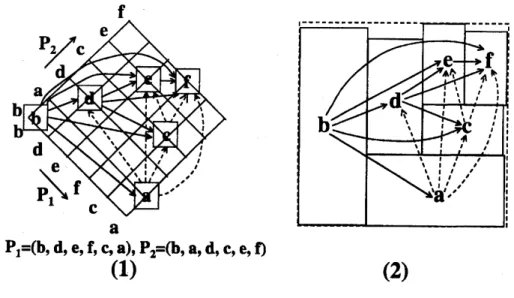
Figure 1: Sequence pair representing rectangle placement. (1) Sequence pair. (2) Rectangle
packing.
mechanism such as simulated annealing to search for the instances in the solution space,
we
can
obtain abetter solution than those by previously proposed methodsas
longas
sufficientcomputing time is given.
For thesereasons,thesequencepair continues to be used in the placement stage ofVLSI (Very
large scale integrated circuits) layout design process. However, the mathematical background
of the sequencepair has not beenclarifiedyet. In this paper, we relate thesequence pairto the
notion ofdimensionofpartial orders and clarify its mathematical background.
The rest of this paper is organized
as
follows. In Section 2,we
review the notion of thesequence pair. We introduce the dimension of partial orders in
Section
3.Section
4relates the sequence pair to the dimension of partial orders. The rectangle packing method basedon
simulated annealing and
some
application results are described in Section 5. Finally, Section 6gives
some
concluding remarks.2Sequence
Pair
Figure 1shows
an
example of the sequence pair. Figure $1(1)$ demonstrates how torepre-sent the rectangle placement described in (2) by asequence pair, $P_{1}=(b, d, e, f, c,a)$ and
$P_{2}=(b, a, d, c, e, f)$
.
Asolid (broken)arrow
represents horizontal (vertical) relation betweenrectangles. The $P_{1}$ sequence corresponds to the axis having slope -1, while the $P_{2}$ sequence
corresponds to the axis having $\mathrm{s}\mathrm{l}\mathrm{o}\mathrm{p}\mathrm{e}+1$
.
We consideran
orthogonal coordinate system that isdetermined by the two axes above. The coordinates are confined to $n\mathrm{x}n$ grid lines separated
uniformly, where $n$ is thenumber of rectangular modules. Each grid line corresponds to
arect-angle in the
same
orderas
it appears in the sequence. Each module is placed on the grid pointforming the intersection of the two orthogonal grid lines determined by the rectangle.
Assume an $xy$ orthogonal coordinate system
on
the plane where aset of rectanglesare
placed without overlapping one another. Arectangle that is placed above (right on) another
rectangle impliesthat the former is included in the halfspaceof$\{(x,y)|y\geq k\}(\{(\mathrm{z}, y)|x\geq k\})$,
while the latter is in $\{(x, y)|y\leq k\}(\{(x, y)|x\leq k\})$, for
some
constant $k$.
On the basisof this implication, the correspondence between the rectangle placement and its sequence pair
representaion is defined
as
$P_{1}=$ $(\ldots$ ,$i$,
$\ldots$ ,$j$,$\ldots$$)$ and $P_{2}=(\ldots, i, \ldots,j, \ldots)$
$\Leftrightarrow def$
Rectangle$j$ is right
on
rectangle $i$, (1)$P_{1}=$ $(\ldots$ ,$j$,$\ldots$ ,$i$,$\ldots$$)$ and $P_{2}=(\ldots, i, \ldots,j, \ldots)$
$\Leftrightarrow d\mathrm{e}f$
Rectangle$j$ is above rectangle $i$
.
(2)Given arectangle packing, we can obtain asequencepair that correspondsto the rectangle
packing
as
demonstrated in Fig. 2. Wemove
the rectangles slightly sothat every two rectanglesis separated each other. For each rectangle $i$,
we
draw linesas
follows. First, the startingpoint, from which
we
begin to draw lines, is located at the upper rightcorner
of $i$. Startingto
move
upward,we
turn its direction alternately right and up untilwe
reach the upper rightcorner
without crossing: i) boundaries of other rectangles,\"u)
previously drawn lines, and\"ui)
the boundary of the chip. The drawn line is called the up right step line of rectangle $i$
.
Thedown-left step line is also drawn in asimilar fashion. The union of these step lines together
with the connecting diagonal line of rectangle$i$ is called the positive step-line of rectangle$i$
.
Wecan
drawsuch apositive step-line for each rectangle. The positive step lines arereferred to bythe corresponding rectangles. Anexample of resultant positive step lines is shown in Fig. $2(1)$
.
Since
no
two positive step linescross
each other, theyare
linearly ordered. Selecting positivestep-lines from left to right,
we
can
obtain thesequence
ofrectangles $P_{1}=(b, d, e, f, c, a)$.
Negative step lines
are
drawn in asimilarmanner
tothe positive steplines, asdemonstratedin Fig. $2(2)$
.
The difference is that anegative step line is the union of the left-up step lineand right-down stepline, whose directions alternate between left and upand between right and
down, respectively. Ordering the negative step-lines also from left to right,
we can
reach thesequence of rectangles $P_{2}=(b, a, d, c, e, f)$
.
Consequently, wecan
obtain apair ofsequence(1) (2)
Figure 2: Conversion from arectangle packing to the correspondingsequence pair. (1) Positive
step lines. (2) Negative step lines.
$P_{1}$ and $P_{2}$ from agiven rectangle packing.
Conversely, given asequence pair, we
can
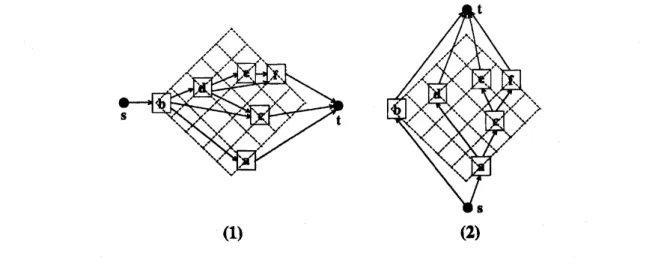
construct arectangle packing that corresponds to thesequence pair. First, for horizontal relation betweenrectangles,we
construct adirected andvertex-weighted graph called the
horizontal-constraint
graph $G_{x}(V, E_{x})$as
shown in Fig. $3(1)$.
Here, vertex set $V$ comprises
source
vertex $s$, sink vertex $t$, and vertices labeled with rectanglenames.
Forsource
$s$ and sink $t$, there exist directed edges $(s, i)\in E_{x}$ and $(i, t)\in E_{x}$ for eachrectangle$i$
.
Thereexistsadirectededge $(i,j)\in E_{x}$ ifand onlyifrectangle$j$ isrightonrectangle $i$as definedin equation(1). Itshould be remarked that the transitive directed-edges
are
omittedfor simplicity in Fig. 3. Vertex-weight is defined
as
zero
forsource
$s$ and sink $t$, while widthofrectangle$i$ for the corresponding vertex$i$
.
Second, thevertical-constraint graph $G_{y}(V, E_{y})$ isconstructed using vertical relations defined
as
in equation (2) and the heights ofrectangles inasimilar fashion. See Fig. $3(2)$
.
These constraint graphs containno
directed cycles. Finally,after x- and $y$-coordinates of
source
vertex $s$ are initialized by zero, longest path length ffomsource $s$ to vertex $i$ is calculated in both $G_{x}(V, E_{x})$ and $G_{y}(V, E_{y})$ independently. For example,
we
can
aPPly alongest path algorithm proposed in [2]. We set thex-
and the y-coordinatesof rectangle $i$ to the longest path lengths from
source
vertex $s$ to vertex $i$ in $G_{x}(V, E_{x})$ and$G_{y}(V, E_{y})$, respectively. Here, x- and $y$-coordinates arethe
ones
of the lower leftcorner
ofthe(1) (2)
Figure 3: Conversion from asequence pair to the corresponding rectangle padcing. (1)
Horizontal-constraint graph. (2) Vertical-constraint graph.
3Dimension of Partial Orders
Apartially ordered set (poset) isdefined as apair $(X, P)$ where $X$ is aset (finitein thispaper)
and$P\subset X\mathrm{x}X$ is apartial order
on
$X$.
Apartialorder$P$ is abinaryrelationon
$X$ that satisfiesthe following three conditions:
(1) For all$x\in X$, $(x,x)\in P$
.
(reflexivity)(2) If $(x, y)\in P$ and $(y, x)\in P$, then $x=y$
.
(antisymmetry)(3) If$(x, y)\in P$ and $(y, z)\in P$, then $(x, z)\in P$
.
(transitivity)The notations $(x, y)\in P$, $x\leq y$ and $y\geq x$ in $P$
are
used interchangeably. If $(x, y)\in P$ and$x\neq y$, then we
use
the obvious notation$x<y$or
$y>x$ in $P$.
Elements $x,y$ in $X$are
said tobe comparable if $(x, y)$ or $(y, x)$ in $P$;otherwise$x$ and$y$ are incomparable, which isdenoted by
$x||y$
.
Let$\mathrm{I}_{P}=${
$\{x$,$y\}|x$, $y\in X$, $x||y$ in $P$}.
If$\mathrm{I}_{P}=\emptyset$, then $P$is called alinear orderon
$X$and $(X,P)$ is calledalinearly ordered set
or
achain.If$P$and$Q$
are
partialorders definedon
$X$such that $P\subset Q$, then$Q$issaid to bean extensionof$P$
.
Inparticular, if$P\subset Q$ and $Q$ is alinear order,we
call $Q$ alinear extension of$P$.
For any binary relation $R$
on
$X$, the transitive closure $\overline{R}$ of $R$ isa
set of $(x,y)\in X\mathrm{x}X$for which there exists a sequence $x_{1},x_{2}$,$\ldots$
,
$x_{n}\in X$ such that $n\geq 2$, $x_{1}=x$, $x_{n}=y$, and$(x:,x_{+1}.\cdot)\in R$for every $i(1\leq i\leq n-1)$
.
For agiven poset $(X, P)$,
we
can
construct adirected graph $G_{P}=(V,E)$as
follows. Thevertex set $V$ is defined by $Vdef=X$ and the directed-edge set $E$ by $(x,y)\in E$ if and only if
$x<y$in $P$
.
Since $(x,y)\in E$ and $(y,z)$ $\in E$ imply $(x, z)$ $\in E$, the transitivity ofdirected edgeholds. An undirected graph $G=(V, E)$ is transitively orientable if each edge
can
be directedso
that the transitivity holds.Acomparability
graph is an undirected graph that is transitivelyorientable. For
an
undirected graph $G=(V, E)$, its complementary graph $G^{\mathrm{c}}=(V, E^{c})$ is anundirected graph defined by $\{x, y\}\in E^{\mathrm{c}}$ if and only if$\{x, y\}\not\in E$
.
Lemma
1If
$P$ is apartial orderon
$X$ and $\{a, b\}\in \mathrm{I}_{P}$, then$\overline{P\cup\{(a,b)\}}$is a partial order on$X$.
$\mathrm{P}\mathrm{r}\mathrm{o}\mathrm{o}\mathrm{f}$ Reflexivity and transitivity
are
obviously satisfied. Suppose that $x\geq y$ and $y\geq x$ for
$x$,$y\in X$
.
From the definitionofthe transitiveclosure, there exists adirectedloop$x_{1}$,$x_{2}$,$\ldots$ ,$x_{n}$
such that $(x_{i}, x_{i+1})\in P\cup\{(a, b)\}$, $(1 \leq i\leq n)$ and $x_{n+1}=x_{1}$, which includes $x$ and $y$
.
Ifthe sequence does not include $(a, b)$, then $x=y$
.
Otherwise, $a$ and $b$ becomecomparable in $P$,which is acontradiction (i.e., $\{a$,$b\}\not\in \mathrm{I}_{P}$). Hence, antisymmetry also holds. Thus, $\overline{P\cup\{(a,b)\}}$
is apartial order
on
X.1
Given areflexive binary relation whose graph representation is $G=(V, E)$, where $V=$
$\{v_{1}, v_{2}, \ldots, v_{n}\}$,
we
can
generate its transitive closure by applying WarshalPs algorithm to $G$[3]. The time complexity of the algorithm is $O(n^{3})$
.
Theorem
1If
$P$ isa
partial orderon
$X$, then the collection $\mathrm{C}$of
all linear extensionsof
$P$ isnonempty $and\cap \mathrm{C}=P$
.
Proof: If$\mathrm{I}_{P}\neq\emptyset$, then
we
can
choose $\{a, b\}\in \mathrm{I}_{P}$.
From Lemma 1,we
can
construct apartialorder $P_{1}=\overline{P\cup\{(a,b)\}}$
.
If$P_{1}$ is not alinear order, then
we
again choose another $\{c, d\}\in \mathrm{I}_{P_{1}}$, which remainsincom-parable, and construct apartial order $P_{2}=\overline{P_{1}\cup\{(c,d)\}}$
.
This procedure is repeated until wereach alinearorder $P(a,b)$, whichdepends
on
the first selection $(a, b)$.
Thus, $C$ is not empty. Forany $\{x, y\}\in \mathrm{I}_{P}$, we can construct linear orders $P(x,y)$ and $\mathrm{P}(\mathrm{y},\mathrm{x})$ as described above. Let $\mathrm{C}$ be
the set of all linear orders constructed in this way. Clearly, $\cap \mathrm{C}=P$ holds.
1
Let $F$ be an edge orientation of the complete graph $K_{n}$
on
$n$ vertices. The set $F$ isa
transitive tournament if and only if $(x, y)\in F$ and $(y, z)\in F$ imply $(x, z)\in F$
.
Clearly, thisis equivalent to the condition that there existsno 3-cycle. It should also be noted that alinear
order precisely corresponds to atransitivetournament. Thuswe
can
considerthetheorembelowas acharacterization oflinearly ordered sets or chains. See [4] for detailed proof.
Theorem 2 [4] Let $F$ be an edge orientation
of
the complete graph $K_{n}$.
The followingstate-rnents
are
equivalent(1) $F$ is a transitive
toumament.
(2) $F$ is acyclic.
(3) The vertices can be linearly ordered $(v_{1}, v_{2}, \ldots, v_{n})$ such that$vi$ has in-degree $i-1$ in $F$
for
all$i=1,2$,$\ldots$ ,$n$.
(4) The vertices can be linearly ordered$(v_{1}, v_{2}, \ldots, v_{n})$ suchthat$(v_{\dot{l}}, v_{j})\in F$
if
and onlyif
$i<j$.
From Theorem 2,
we
can
consider alinearly ordered set (chain)as
asorted sequenceof itselements. Thus
we can
aPply topological sort to construct acollection $C$ of linear extensionsdirectly in Theorem 1.
Let $G=(V, E)$ with $V=\{v_{1}, v_{2}, \ldots, v_{n}\}$ be agraph representaion of apartial order $P$
on
$X$. If$\{x, y\}\in \mathrm{I}_{P}$, then $G=(V, E\cup\{(x, y)\})$ is acyclic. By applying topological sort based
on
the depth-first search to graph $G$, we
can
obtainalinear extension. As inthe proof ofTheorem1, acollection $C$ of linear extensions
can
be generated by applying topological sort to edge sets$E\cup\{(x, y)\}$ and $E\cup\{(y, x)\}$ for all $\{x, y\}\in \mathrm{I}_{P}$
.
This collection of linear extensions $\mathrm{C}$ satisfies$\cap \mathrm{C}=P$
.
While the time complexity needed to generate transitive closure of $G$ is $O(n^{3})$, thetime complexity of depth-first search is $O(m+n)$ when $|E|=m$
.
Thus direct application oftopological sort is superior to that of transitive closure.
Definition 1For a partially ordered set $(X, P)$, its dimension denoted by $\dim(X, P)$ is the
smallest positive integer $m$ such that there exists a set
of
linear extensions $\{L_{1}, L_{2}, \ldots, L_{m}\}$that
satisfies
$\bigcap_{i=1}^{m}L_{i}=P$. The setof
linear extensions is called a realizerof
thepartially orderedset $(X, P)$.
Theorem 1assures the existence of the dimension ofany partial order.
4Equivalence
of
Sequence
Pair to Dimension of Partial Orders
Let$X$ be aset of rectanglesonaplane. Horizontal and vertical relations between the rectangles
are
definedas
in Section 2. We consider two partial orders$P_{x}\subset X\mathrm{x}X$and$P_{y}\subset X\mathrm{x}X$, whichcorrespondto horizontaland verticalrelations, respectively. Weuse $(i,j)\in P_{x}((i,j)\in P_{y})\mathrm{m}\mathrm{d}$
$i<_{x}j(i<_{y}j)$ interchangeably unless$i=j$
.
The relation $i<_{x}j(i<_{y}j)$ implies rectangle$j$ isright
on
(above) rectangle $i$.
Let $P_{1}$ and $P_{2}$ be two sequencesof all the rectangles in $X$
.
As in (4) ofTheorem 2, wecan
consider $P_{1}$ and $P_{2}$
as
two linear orders (chains). For example, $P_{1}$ includes aset of rectanglepairs $(i,j)$ such that $P_{1}=(\ldots, i, \ldots,j, \ldots)$ and rectangle pairs $(i, i)$ for all rectangles $i$ in $X$
.
The reverse-0rdered sequence of$P_{1}$ also defines achain, and we denote it by
$P_{1}’$
.
On the basisof this notation,
we can
represent equations (1) and (2) in Section 2as$P_{x}$ $=$ $P_{1}\cap P_{2}$, (3)
$P_{y}$ $=$ $P_{1}’\cap P_{2}$
.
(4)Inequations (3) and (4) above, $\cap \mathrm{m}\mathrm{e}\mathrm{a}\mathrm{n}\mathrm{s}$ set intersection. It shouldbe noted that equations (3)
and (4)
mean
that partialorders $P_{x}$ and $P_{y}$ have dimension two (See Definition 1).The next theorem characterizes partiallyorderedsets of dimension two. Althoughthe$\mathrm{t}\mathrm{h}\infty-$
rem
is known,we
give its proofto make the mathematical argumentself-contained.
Theorem 3 [5] Let $G$ be the comparability graph
of
a
poset $(X,P)$.
Then, $\dim(X,P)\leq 2$if
and only
if
the complementary graph$G^{c}$ is transitively orientable.Proof: Assume that $\dim(X,P)\leq 2$
.
If$\dim(X, P)=1$, then $P$ itself is achain. The edge setof $G^{c}$ is empty. If$\dim(X, P)=2$, then there exists two linear extensions $\{L_{1}, L_{2}\}$ such that $L_{1}\cap L_{2}=P$
.
This implies $L_{1}-P=(L_{2}-P)^{-1}$.
Here, $H^{-1}=\{(i,j)|(j,i)\in H\}$.
Clearly,$L_{1}-P$
can
beconsideredan
orientationofthe complementary graph $G^{c}$.
If$(i,j)$,$(j, k)\in L_{1}-P$such that $i\neq j$ and$j\neq k$, then $(i,k)\in L_{1}$ because $L_{1}$ is achain. If
we
assume
that $(i, k)\in P$,
then $(i, k)\not\in L_{1}$ - $P$
.
This implies $(k,i)\not\in L_{2}$ - $P$.
Since $(j, i)$,$(k, j)\in L_{2}-P$, $(\mathrm{k},\mathrm{i})\in L_{2}$.
Hence, $(k, i)\in P$ because if $(k,i)\not\in P$, then $(k, i)\in L_{2}-P$ and consequently $(i, k)\in L_{1}-P$,
which contradicts $(i,k)\not\in L_{1}$ - $P$
.
Combining $(i, k)\in P$ and $(k,i)\in P$, we obtain$i=k$.
Thisleads to$j=k$, which is acontradiction. Thus, $(i, k)\not\in P$ holds, which leads to $(i, k)\in L_{1}-P$
.
This implies that transitivity holds
on
$L_{1}$ -$P$.
Hence, $L_{1}-P$is atransitive orientation of$G^{c}$.
Conversely, let $F$be atransitive orientaion of$G^{c}$
.
Aset oflinear extensions $C$$=\{P\cup F,P\cup$$F^{-1}\}$ satisfies $\cap \mathrm{C}=P$
.
Consequently, $\dim(X, P)=2.1$As defined in [6], in the rectangle packing problem, given aset $X$ of rectangles on aplane,
we
pack all of the rectangles intoas
small an enclosing rectangulararea
as
possible withoutoverlapping. It is clear that
we can
place all of the rectangles in $X$ without overlapping ifand only if every pair of rectangles has ahorizontal
or
vertical relationas
defined in Section 2.Furthermore,
as
shown in [6], it is sufficient to search for placements where any two rectangleshave only ahorizontal or only avertical relation. The next theorem, which is obtained from
Theorem 3, clarifiesthe mathematical
essence
of the sequencepair for rectangle packing.Theorem 4Let $X$ be a given set
of
rectangles in the rectangle packing problem. Three sets(1)
(2)
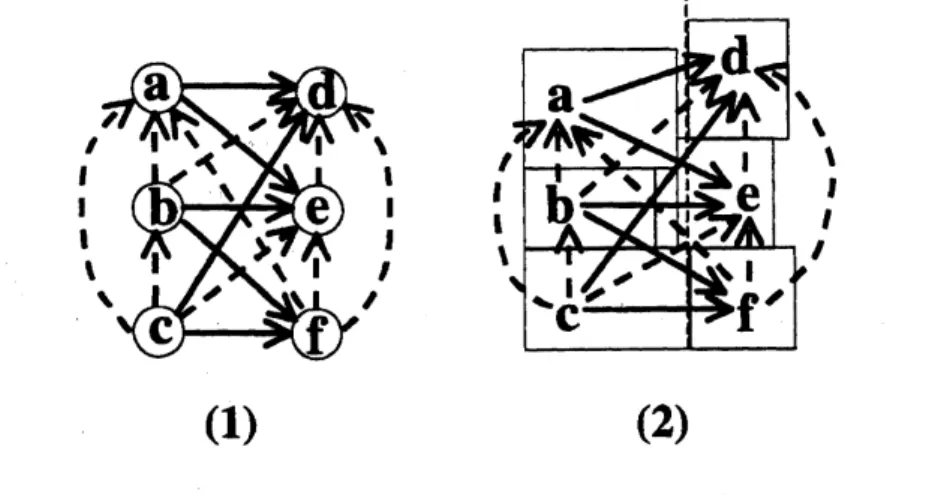
Figure4: Partially ordered set ofdimensiontwo for horizontal relation (solid arrow) (1) Graph
representation. (2) Rectangle packing.
(1)
(2)
Figure 5: Partially ordered set of dimension three for horizontal relation (solid arrow). (1)
Graph representation. (2) Rectangle packing.
of
instancesfor
rectangle packing satisfying (1), (2) and (3) below all coincide and include theoptimal solution to the rectangle packing problem.
(1) Partially orderedset$P_{x}(P_{y})$
of
horizontal (vertical) relation has dimension two.(2) Every pair
of
rectangles $i,j$ in $X$ only has eithera
horizontalor
a
vertical relation.(3) For a sequence pair $P_{1}$ and$P_{2}$
,
every pairof
rectangles $i,j$ hasa
horizontalor a
verticalrelation
as
defined
by equation (1) or (2) in Section 2.Figure 4shows
an
instance of the rectangle packing problem. The horizontal (vertical)relation is depictedwith solid(broken)
arrows
in Fig. 4. Let$P_{x}(P_{y})$ be aposet forthehorizontal(vertical) relation. The poset $P_{x}$has dimensiontwo, and its realizer is$P_{1}=(a, c, b,d)$ and $P_{2}=$
$(b,a, d,c)$
.
Ofcourse, this isan
instance that must be searchedin the rectangle packing problem.Onthe other hand, Fig. 5demonstrates another instance in the rectangle packing problem
for
six rectangles. The
same
symbolsas
inFig. 4are used in Fig. 5. Theposet $P_{x}$ forthe horizontalrelation has dimension three, and its realizer is $P_{1}=(a, b, e, c, d, f)$, $P_{2}=(b, c, f, a, d, e)$ and
$P_{3}=(c, a, d, b, e, f)$
.
Ifwe change horizontal relation $(c, d)$ to the vertical one, the dimension of $P_{x}$ decreases to two. This correspondsto packingrectangle $d$ inthe horizontal directionso
thatit touches rectangle $a$
.
It is sufficient to examine only the resultant poset $P_{x}$ of dimension two.5Applications
to Rectangle Packing
Asimulated annealing algorithm
was
applied to therectangle packing problem. The sequencepair
was
used to construct the solution space for the simulated annealing algorithm. Figure 6shows the simulated annealing algorithm. The number with parenthesis at the head of each
line is only for reference. The outer while loop between lines (4) and (14) is repeated until
astopping criterion is satisfied. At each repetition, the temperature is lowered in accordance
with acooling schedule. On the other hand, in the inner while loop between lines (6) and
(12), the solution is perturbed at random until the solution reaches
some
equilibrium at eachtemperature. The function $C(S)$ ofsolution $S$ is acost function, which calculates the
area
ofthe rectangle packing created by the solution $S$
.
As shown in line (9) to (11), thenew
solution$S’$ is accepted with probability 1if $\mathrm{A}\leq 0$, and with probability $e^{-\frac{\mathrm{A}}{T}}$
if $\Delta>0$
.
The functionrandom$(0, 1)$ generates arandom number between 0and 1. This procedure allows occasional
“uphill moves”, which
worsen
the current solution. The movement prevents the solution frombeing stuck at alocally optimal solution.
Simulated Annealing Algorithm
(1) begin
$\{\begin{array}{l}23\end{array}\}$ $T^{\cdot}\cdot.=\mathrm{I}\mathrm{n}\mathrm{i}\mathrm{t}\mathrm{i}\mathrm{a}\mathrm{l}\mathrm{t}\mathrm{e}\mathrm{m}\mathrm{p}\mathrm{e}\mathrm{r}\mathrm{a}\mathrm{t}\mathrm{u}\mathrm{r}.\mathrm{e}S.=\mathrm{I}\mathrm{n}\mathrm{i}\mathrm{t}\mathrm{i}\mathrm{a}\mathrm{l}\mathrm{s}\mathrm{o}1\mathrm{u}\mathrm{t}\mathrm{i}\mathrm{o}\mathrm{n}S_{0}$
,
$T_{0;}$
(4) while (stopping criterion is not satisfied) do
5) begin
6) while (not yet in equilibrium) do
(7) begin
(8) $S’:=\mathrm{S}\mathrm{o}\mathrm{m}\mathrm{e}$random neighboring solution of$S$;
(9) $\Delta:=C(S’)-C(S)$ ; $(\mathrm{f}$
10) Prob$:=\mathrm{m}\mathrm{i}$
.
$(1, e^{-\frac{\Delta}{T}})$;11) if random$(\mathit{0}, 1)\leq Pr\mathrm{o}b$then $S:=S’$;
12) end;
(13) Update$T$;
(14) end;
(
$16(15\}\mathrm{e}\mathrm{n}\mathrm{d}\mathrm{O}\mathrm{u}$tput best
solution;
Figure 6: Simulated annealing algorithm
We
can
represent the solution by the sequence pair $P_{1}$ and$P_{2}$, which are sequencesofrect-angle
names.
If necessary,as
described inSection 2, thesequencepaircan
be easily transformedintothe corresponding rectangle packing. The initial sequence pairmade at line (2) in Fig. 6is
the one such that $P_{1}=P_{2}$, which corresponds toalinear horizontal arrangement of rectangles.
The random perturbations used at line (8) consist of three kinds of pair-interchanges: i) two rectangles in $P_{1}$, $\mathrm{i}\mathrm{i}$) two rectangles both in $P_{1}$ and $P_{2}$, and $\mathrm{i}\mathrm{i}\mathrm{i}$) the width and the height of
rectangle, which optimizes the orientation of the rectangle. The temperature $T$
was
decreasedexponentially. Prom aheuristic point ofview,
we
madetheprobability of selecting the operationi) high in higher temperature, whilethe probabilityofselectingtheoperation$\mathrm{i}\mathrm{i}\mathrm{i}$) higher in lower
temperature.
The algorithm
was
applied to the test data where 146 rectangles must be packed. Thepr0-cessing timeon Sun Sparc-StationII
was
29.9minutes. The algorithm searched at most606192
distinct sequence pairswithin the solution space whose size canbe estimated by $(146!)^{2}2^{146}\approx$
$1.23\mathrm{x}10^{552}$
.
It should be remarked that the search ofonlyafraction about 4.92$\mathrm{x}10^{-547}$ of thesolution space
was
enough to reach the good packing result. For alarger test data where 500rectangles must be packed, 18.83 hours
were
required with the same workstation. See [1] and[6] for details including the several figures of the rectangle packing results.
6Conclusions
We have presented the mathematical background to
an
approach using the sequence pair forsolving the rectangle packing problem. The equivalence of the sequence pair to the realizer of
partial ordershavingdimension two
was
proved inconnectionwith the algorithms for generatinglinear extensions of partial orders. We
can
say that thesequence
pair for rectangle packingrediscovered acharacterization of partial orders of dimension two. The
sequence
pair providesan
efficient representation of instances of the rectangle packing problem, but it also givesa
compact data structure that can be extended to solve
more
complex problems. On the basisof the
mathematical
badcground described in this paPer,we
intend to study its extensions tovarious problems such
as
three-dimensional packing and its analysis methods.References
[1] H. Murata, K. Fujiyoshi, S. Nakatake and Y. Kajitani, “VLSI module placement based
on
rectangle-packing by the sequence-pair,” IEEE Trans, onComputer-Aided
Designof
Integrated Circuits and Systems, vol. 15,
no.
12, pp. 1518-1524, Dec. 1996.[2] Y.Z. Liaoand C.K. Wong, “Analgorithm to compact aVLSI symboliclayout with mixed
constraints,” IEEE Tmns.
on
Computer-Aided Designof
Integrated Circuits and Systems,vol. 2,
no.
2, pp. 62-69, Apr. 1983.[3] A. V. Aho, J. E. Hopcroft and J. D. Ullman, The Design and Analysis
of
ComputerAlgor.thms, Addison-Wesley Publishing Company, Massachusetts, 1974.
[4] M. C. Golumbic, Algorithmic Graph Theory and
Perfect
Graphs, New York, AcademicPress,
1980.
[5] B. Dushnik andE. W. Miller, ”Partially ordered sets,” American Journal
of
Mathematics,vol. 63, pp. 600-610, 1941.
[6] Y.Kajitani, “Onpackingof rectangles into asmall planearea,” IPSJ SIGNotes, DA-89-2,
pp. 7-14, Sept. 1996.