Bifurcation
structure
of
the
stationary
solution
set
to
a
strongly
coupled
diffusion system
Kousuke
KUTO
(久藤衡介
) *Department of Intelligent
Mechanical Engineering
Faculty of
Engineering,
Fukuoka
Institute
of
Technology
(
福岡工業大学工学部知能機械工学科
)
Abstract
Westudy thepositive stationary solutionset ofastrongly coupled diffusion system
with the Lotka-Volterra reaction term. We obtain the bifurcation branch of the
positivesolutions,whichextends globally with respecttoabifurcation parameter.
Furthermore, by the analysis for the shadow systems,
we
derive the nonlineardiffisioneffectof
on
thepositivesolution branch.1 Introduction
Many
reaction-diffision
modelshave beenproposedtodescribethepopulationdy-namics in
various
ecological situations. Inparticular, thenonlinear-diffision
systemswithffieLotka-Volterra
interaction
terms have beenextensively studiedbymanymath-enaticians, sincetheadvocated
wgrk
by$\mathrm{S}\mathrm{b}_{\wedge}\mathrm{i}\mathrm{g}\mathrm{e}\mathrm{s}\mathrm{a}\mathrm{d}\mathrm{a}- \mathrm{K}\mathrm{a}\mathrm{w}\mathrm{a}\mathrm{s}\mathrm{a}\mathrm{k}\mathrm{i}- \mathrm{T}\mathrm{e}\mathrm{r}\mathrm{a}\mathrm{m}\mathrm{o}\mathrm{t}\mathrm{o}[19]$.
Inffiisarticle,
we
focuson
ffie following stronglycoupled diffisionsystemwiththeprey-predator interactionterms:
(P)$\{$
$u_{t}=\Delta u+u(a-u-cv)$ in $\Omega \mathrm{x}(0, \infty)$,
$v_{t}= \Delta[(\mu+\frac{1}{1+\beta u})\not\in+v(b+du-v)$ in $\Omega \mathrm{x}$ $(0, \infty)$,
$u=v$ $=0$
on
$\partial\Omega \mathrm{x}$ $(0, \infty)$, $u(\cdot,t)=u_{0}\geq 0$, $v(\cdot, t)=v_{0}\geq 0$on
$\Omega$,where
0
isa
bounded domain in $R^{N}$ witha
smooth boundaryan
; a,b,c,d, and$\mu$are
all positiveconstants; $\beta$ isa
nonnegative constant. System (P) isa
prey-predatormodel, From the ecologicalpointofview,the unknownfunctions $u$and$v$,respectively,
denotethe population densitiesof
prey
andpredatorspecies whichare
interacting andmigrating inthe
same
habitat$\Omega$. Inthereactionterms,$a$and$b$representthebirthratesofthe respective species, $c$ and $d$ denote the prey-predator interactions. In the
sec-ond equation, thestronglycoupled diffusion term$\Delta(\frac{v}{1+\beta u})$ models
a
situation in whichthepopulation
pressure
of predatorspecies weakensin the high density place ofprey
species. On the solvability of(P), Le.Dung [8] has recently found theglobal attractor
for
a
class of thequasilinear parabolic systems involving(P).So itbecomesmore
inter-estingto study the dynamicalstructureforthe solutionsetof(P). As the beginningof
the study,
we
have beenanalyzing for the stationarysolution setof(P), since [10]. Tomyknowledge, there
are
few workson
this fractional type of densitydependencedif-fusions inthe field ofreaction-diffusionsystems. Itshouldbenoted that
our
nonlineardiffusiontermisdifferentfrom theusualcross-diffusiontermproposed by [19].
Our
purpose
istoderive the global bifurcation structure of the stationary solutionset. Then
we
will discuss the associatestationaryproblemwith(P);(SP)$\{$
$\Delta u+u(a-u-cv)$ $=0$ in $\Omega$,
$\Delta||(\mu+\frac{1}{1+\beta u})\not\in+v(b+du-v)=0$ in $\Omega$,
$u=v$ $=0$
on
an.
Among otherthings,
we are
interested in thepositive solutions of(SP). Itis said that$(u, v)$ is
a
positive solution ifboth $u>0$ and $v$ $>0$ satisfy (SP). From the viewpointof theprey-predatormodel,
a
positivesolution$(u, v)$impliesa
coexistencesteady state.Hence,itis
an
importantproblemtoderivethepositivesolution setof(SP).Inordertostudythepositivesolutionset,
we
needsome
notations. Henceforth,we
will
use &i
(q)todenotethe leasteigenvalueof theproblem$-\Delta u+q(x)u=\lambda u$ in $\Omega$,
u
$=0$on
an,
where$q(x)$ is
a
continuous function in$\overline{\Omega}$.
We simply vite $\lambda_{1}$ instead of$\lambda_{1}(0)$
.
It iswell knownthat thefollowingproblem
$\Delta u+u(a-u)=0$ in $\Omega$, u$=0$
on
an
(1.1)has
a
unique positive solution$u=\theta_{a}$ifandonly if$a>\lambda_{1}$.
Hence,(SP)hasa
semitrivialsolution$(u,v)$ $=(9\mathrm{a},0)$ if$a$ $>\lambda_{1}$
.
Furthermoreitis easily verified that(SP)has anothersemitrivial solution$(u, v)=(0,0/+1)\theta_{b/\psi+1)})$if$b>(\mu+1)\mathrm{A}\mathrm{i}$, Here,$\theta_{b/\{\mu+1\}}$represents
a
positivesolution of(1.1)with$a$replaced by$b/(\mu+1)$.
Theusualnorms
of thespaces
$L^{p}(\Omega)$for$p\in[1, \infty)$ and$C(\overline{\Omega})$
are
definedby$|[u||_{p}:=( \int_{\Omega}|u(x)|^{p}dx)^{1/p}$ and
2
Positive
Solution
Set
2.1
Coexistence
Region
Inthisarticle,
we are
restrictedon
thecase
b$>(\mu+1)\lambda_{1}$.
The first theoremgivesa
sufficient
con
ditionof the existence ofpositivesolutions:Theorem
2.1
([10]), Let$a^{*}=\lambda_{1}(c\omega+1)\theta_{b/\{\mu+1)})$.
$Ifb>(\mu+1)\lambda_{1}$, (SP)hasa
positiveso-lution
for
$a>a^{*}$.
From thebifurcation
structurepointof
view, thepositive solutionsetof
(SP)containsa
localbifurcation
branch$\Gamma=\{(u(s),v(s),a(s))\in X\mathrm{x} R : s\in(0,\delta)\}$,such that $(u(0), v(0),a(0))=(0,(\mathrm{p}+1)\theta_{b/\{\mu+1\rangle},a^{*})$. Furthermore, $\Gamma$
can
be extendedglobally withrespectto$a(arrow\infty)$
as a
positive solution branchof
(SP).Weremarkthattheabove bifurcationpoint
$a^{*}=\lambda_{1}(c\phi+1)\theta_{b/(u+1)})$ (2.1)
depends
on
$(b, c,\mu)$,butisindependent$\mathrm{o}\mathrm{f}\beta$.
Furthermore in [10,Lemma2.3],we
haveproved thatfor any fixed $(\mathrm{c},/\mathrm{i})$, $a^{*}=a^{l}(b)$ is
a
monotone increasing smoothfunctionwith respect to $b>(\mu+1)\lambda_{1}$ such that $\lim_{b\backslash \zeta\mu+1)\lambda_{1}}a^{*}(b)=\lambda_{1}$ and $\lim_{b\prec\infty}a^{*}(b)=$
$\infty$
.
Theorem2.1
enablesus
to find the coexistence regionon
the $(a,b)$space.
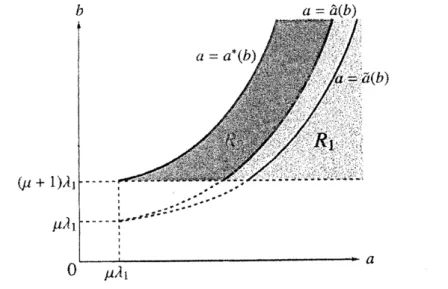
Bythe monotone property of the
curve
$a=a^{*}(b)$ (Theorem 2.1),one can
deducethat if$(a,b)$ lies in the region surrounded by $a=a^{*}(b)$ and $b=(\mu+1)\lambda_{1}$, then (SP) has
a positive
solution (see the region $R_{1}\cup R_{2}$ in Figure1). This region ,$\mathrm{i}\mathrm{n}$case
$\beta=0$,corresponds tothe exact coexistence region shown by L\’opez-G6mez andPardo [15].
Fromtheviewpointofthebifurcationtheory,positive solutions bifurcatefrom$(u, v)$ $=$
$(0, y +1)\theta_{b/(\mu+1)})$when $(a, b)$
moves
across
$a=a^{*}(b)$.2.2
Asymptotic Behavior
of
Positive Solutions
as
$\beta\sim$ $\infty$Next, Iwill derive the nonlinear effectof large$\beta$
on
thepositive
solution set. Forthesake of thederivation,
we
will introduce two shadowsystemsas
$73arrow$ oo in (SP).We
assume
that$\psi_{n}$}
isany positivesequence
with$\lim_{n\prec\infty}\beta_{n}=\infty$,andthat$\{(u_{n},v_{n})\}$ isany
positive
solutionsequence
of (SP) with$\beta=\beta_{n}$.
Withsome
suitable assumptions,we
will
prove
thatone
ofthe following twosituations necessarilyoccurs:
(i) There exists
a
certain positive
solution $(u,v)$of$\{$
$\Delta u+u(a-u-cv)=0$ in $\Omega$,
$\mu\Delta v+v(b+du-v)=0$ in $\Omega$,
$u=v$$=0$
on
an,
(2.2)
such that$\lim_{narrow\infty}(u_{n},v_{n})=(u,$v) in
(ii) Thereexists
a
certain positivesolution$(w, \mathrm{v})$ of$\{$
$\Delta w$$+w(a-cv)$ $=0$ in $\Omega$,
$\Delta[(\mu+\frac{1}{1+w})v]+v(b-v)=0$ in 0, $w$$=v$ $=0$
on
$\partial\Omega$,(2.3)
suchthat$\lim_{narrow\infty}(\beta_{nn’ n}u\iota\})=(w,$v) in
$C(\overline{\Omega})^{2}$,passingto
a
subsequence.Our
convergence
result (Theorem 4.1) will alsoensure
that if$\beta$ is sufhciently large,any
positive solution of (SP)can
be approximated bya
suitable positive solution ofeither (2.2)
or
(23). Hence itisnatural to ask which of(2.2) and(23) (orboth)can
characterizepositive solutions of(SP),accordingtoeachcoefficientvalue.
Thepositivesolution setofthe firstshadowsystem(2.2)has beenextensively
stud-ied by
many
mathematicians (e.g., [2], [4], [5], [6], [13], [14], [15], [16], [20]). Asa
summary
oftheir all results,we
know the next resulton
the positive solution set of(2.2):
Theorem 2.2, Let
a
$=\lambda_{1}(c\mu\theta_{b/\mu})$.
Then (2.2) hasa
positive solutionif
and onlyif
a>\^a. From the
bifurcation
structurepointof
view, the positive solution setof
(2.2)contains
a
localbifurcation
branch$\Gamma_{1}=\{(\mathrm{w}(\mathrm{s}),\mathrm{v}(\mathrm{s}),\mathrm{a}(\mathrm{s}))\in X\mathrm{x} R : s\in(0,\delta)\}$, suchthat$(u(0),v(0),a(0))=(0,\mu\theta_{b/\rho},\text{\^{a}})$. Furthermore, $\Gamma_{1}$
can
be extendedin the directiona>\^a
as an
unboundedpositive solution branchof
(22).Here
we
note that for any fixed $(\mathrm{c},/\mathrm{i})$, $\text{\^{a}}=\lambda_{1}(c\mu\theta_{b/\mu})$ isa
monotone increasingsmoothfunctionwithrespectto$b>\mu\lambda_{1}$,suchthat$\lim_{b\forall\lambda_{\mathrm{t}}}\mathrm{a}(\mathrm{b})=\lambda_{1}$and$\lim_{barrow\infty}$
\^a(b)=
$\infty$
.
Furthermore,itcan
beverified that$a^{*}(b)<\ (\mathrm{b})$for all$b>(\mu+1)\lambda_{1}$ (seeFigure 1).Hence, it becomes
a
crucialpart ofthis article to studythepositivesolution setofthe second shadow system (23). By regarding $a$
as a
bifurcation parameter,we
willshow thatthebranch ofthepositivesolutionsetof(2.3)bifurcatesfrom the semitrivial
solution with $lB$ $\equiv 0$ at$a=a^{*}$, and
moreover
that this branch extends globally andblows
up
with respectto $||w||_{\infty}$ ata=\^a:Theorem2,3 ([12]). Suppose that$b>(\mu+1)\lambda_{1}$. Positive solutions
of
(2.3)bifurcate
from
thesemitrivialsolutioncurve
$\{(0, \mathrm{Q}l +1)\theta_{b/(u+1)},a) : a\in R_{+}\}$if
and onlyif
$a=a^{*}$.
To beprecise, allpositive solutions
of
(52)near
(0,(ju $+1$) $\theta_{b/\zeta\mu+1)}$,$a^{*}$) $\in X\mathrm{x}$ $R_{+}$can
beparameterizedas
$\Gamma_{2}=\{(w(s),v(s),a(s))\in X\mathrm{x} R_{+} : s\in(0,\delta)\}$, such that$(w(0),v(0),a(0))=(0,\mu\theta_{b/\mu}, \text{\^{a}})$
.
Furthermore, $\Gamma_{2}(\subset X\mathrm{x} R_{+})$can
be extendedas an
unboundedpositive solution branch (of (23)), which
contains an
unbounded smoothcurve
which isparameterized by $a$; $(\mathrm{w}(\mathrm{a}), \mathrm{v}(\mathrm{a})$ $)\in X\mathrm{x}$ [\^a-\kappa ,\^a)}
witha
cenainpositive number$\kappa$
.
Here, $(w(a), v(a))$isa
smoothfunction
such that$\lim_{a\nearrow\hat{a}}||w(a)|\}_{\infty}=\infty,\lim_{a\nearrow\hat{a}}v(a\grave{)}=\mu\theta_{b/\mu}$ in
Furthermore, it
can
be proved that (2.3) hasno
positive solution if $a\geq$a
$:=$$\lambda_{1}(c\mu^{-1}(\mu+1)^{\gamma}\sim\theta_{b/\mu})$. Here,
we
note that$\tilde{a}=\lambda_{1}(c\mu.(\mathrm{J}p +1)^{9}\sim\theta_{b/\mu})$ is alsoa
monotoneincreasingsmooth function for$b>\mu\lambda_{1}$,such that$\lim_{b\backslash _{\mu\lambda_{\mathrm{I}}}}$ $\text{\^{a}}\langle b$) $=\lambda_{\mathrm{t}}$ and$\lim_{barrow\infty}$\^a(b)=
$\infty$. Furthermore, itholds that$a^{*}(b)<\mathrm{a}(\mathrm{b})<\tilde{a}(b)$forall$b>(\mu+1)\lambda_{1}$ (seeFigure 1).
Consequently, it follows thatif$a\in(a^{*},\text{\^{a}})$, (2.3) has at least
one
positive solutionwhile (2.2) has
no
positive solution, and that if$a>\overline{a}$, (2.3) hasno
positive solutionwhile (2.2) has at least
one
positive solution. Ow ing to such studieson
the shadowsystems,
we
willprove
theapproximateresultin large$\beta$case:
Theorem
2.4
([12]). Supposethat $\{(u_{n}, v_{n})\}$ is anypositive solution sequenceof
(SP)will$\beta=\beta_{n}$ and
,$\lim_{\iotaarrow\infty}\beta_{n}=\infty$
.
Let$\epsilon$and 6 bearbitrarysmall positive numbers. Then,
thereexistpositive numbers
a
$>a^{4}(>\lambda_{1})$ suchthatif
$a\in(a^{*}, \text{\^{a}}-\delta 1\cup [\hat{a}+\delta, \infty)$, $b>$$(p +1)\lambda$
.
and$n$ is sufficiently large, eitherthefollowing situation(i)or(ii)necessarilyoccurs
:(i) There existsa certainpositive solution $(u, v)$
of
(2.2)such that$\mathrm{m}_{X\in}|u\frac{\mathrm{a}\mathrm{x}}{\Omega},$‘$(x)-u(x)|+\mathrm{m}_{X\epsilon^{\frac{\mathrm{a}\mathrm{x}}{\Omega}}}|v_{n}(x)-v(x)|<\epsilon$.
(ii) There exists
a
certainpositive solution $(w, v)$of
(2.3)such that$\mathrm{m}_{\lambda\in}\frac{\mathrm{a}\mathrm{x}}{\Omega}|\beta_{r\iota}u_{\mathit{1}},(x)$$-w(x)|+\mathrm{m}_{X\epsilon^{\frac{\mathrm{a}\mathrm{x}}{\Omega}}}|v_{n}(x)-v(x)|<\epsilon$.
Furthe rnore, there existsanumber$\tilde{a}(>\hat{a})$suchthat
if
$\mathrm{a}\in$ [$\tilde{a}_{\backslash }\infty)$, the situationof
(ii)can not occur, and
if
$a\in(a^{*}$.a
$-\delta$], thesituationof
(i) can notoccur.Figure
1:
Theregion$R_{\mathrm{J}}$ givestheexactcoexistence regionfor(2.2). The region3
A
Priori
Estimates
In this subsection,
we
introducea
semilinear elliptic system equivalent to (SP),and give
some a
prioriestimates forpositivesolutions of the semilinearsystem([10]).These
a
priori estimates willplayan
important role inthesucceeding sections. Sincewe are
restrictedon
nonnegative solutions, it is convenientto introduce theunknownfunction$V$by
$V=( \mu+\frac{1}{1+\beta u})v$
.
(3.1)There is
a
one-to-one correspondence between $(u,v)\geq 0$and $(u, V)\geq 0$.
Then, (SP) isrewritteninthefollowing equivalent form:
(EP) $\{$
$\Delta u+u(a-u-cv)=0$ in $\Omega$,
$\Delta V+\nu(b+du-v)=0$ in $\Omega$,
$u=V=0$
on
$dn$,where
v
$=v(u,$V) is understoodas
the function of (u, V) defined by (3.1). Itis easytoshow that(EP)has twosemitrivialsolutions
(u,$V)=(\theta_{a},0)$ for
a
$>\lambda_{1}$ and (u,$V)=(0, \psi +1)^{2}\theta_{b/(u+1)})$ for b$>(\mu+1)\lambda_{1}$,in addition to the trivial solution (u,$V)=(0,$0). We obtain the following
a
prioriestimatesforpositivesolutions of(EP) (orequivalently (SP)):
Lemma
3.1.
Suppose that$(u, v)$ is anypositivesolutionof
(EP) Let$V$be thepositivefunction
defined
by(3. 1). Then,$0<u(x)<a$, $\mu^{2}\theta_{b/(\mu+1)}(x)<\mathrm{V}(\mathrm{x})\leq v(x)<(1+\frac{1}{\mu})(b+ad)$
for
all$X$ $\in\Omega$.
We refer to [10] and [I2] for the proof of Lemma
3.1.
The next lemma givesa
nonexistence regionforpositive solutions of(EP):
Lemma
3.1.
If
a
$\leq\lambda_{1}$or
$(1+\beta a)(b+ad)\leq\lambda_{1}$, (EP) (orequivalently, (SP)) hasno
positivesolution.
Proof
Supposeforcontradiction that(m,V) isa
positivesolutionof(EP)with thecase
$(1+\beta a)(b+ad)\leq\lambda_{1}$
.
Sinceu
$<a$byLemma3.1, theninO. Then bytaking $L^{2}(\Omega)$ innerproduct withV,
we
obtain$ll\nabla V|[_{2}^{2}<(1+\beta a)(b+ad)]|V||_{2}^{2}$
.
(3.2)Since$||\nabla V||_{2}^{2}\geq\lambda_{1}||V$]$\}_{2}^{2}$by Poincare’sinequality, (3.2) obviously yields
a
contradiction.Observingthat$u(a-u-cv)$ $<au$in$\Omega$,
we
can
derive theassertion inthecase
$a\leq\lambda_{1}$along
a
similarway.$\square$
4
Existence of
Tvvo
Shadow Systems
as
$73-\neq\infty$In whatfollows,
we
will concentrate ourselveson
thespecialcase
when$\beta$ issuf-ficiently large. Our
purpose
is to derive the nonlineareffectoflarge$\beta$on
the positivesolutionset of(SP). Thenexttheorem
ensures
theexistence of two shadowsystemsas
$\betaarrow\infty$
.
We referto [12] for theproofof thetheorem.Theorem
4.1.
Leta
$:=\lambda_{1}(c\mu\theta_{b/\mu})$ and$b>(\mu+1)\mathrm{A}\mathrm{i}$.
Suppose that {(un,$\mathrm{v}\mathrm{n})$}
is anypositive solution
sequence
of
(SP) with$\beta=\beta_{t}$, and$\lim_{narrow\infty}\beta_{n}=\infty$.
Then,for
any smallpositive numbers5and$\epsilon$, there exists
a
largeinteger$N$(whichdependson
$\delta$,$\epsilon$and the
coefficients
of
(SP)$)$ such thatif
$a\in(\lambda_{1},\hat{a}-\delta]\cup[\hat{a}+\delta, \infty)(=:I_{\delta})$
and$n\geq N$, either thefollowingproperty (i)
or
(ii)holdstrue :(i) Thereexist
a
certain positivesolution(u,$v)=(\overline{u},\overline{\iota’})$of
(2.2)such that$||u_{n}-\overline{u}||_{\infty}+||v_{n}-\overline{v}|[_{\infty}<\epsilon$
.
(ii) There exist
a
certainpositivesolution$(w, v)=(\overline{w},\overline{v})$of
(2.3)such that $\{|\beta_{n}u_{n}-\overline{w}||_{\infty}+||v_{n}-\overline{v}||_{\infty}<\epsilon$.
5
Second
Shadow System
5.1
A
Priori Estimates
Inthis section,
we
willstudythesecondshadowsystem(2.3). Byemployinga
new
unknown functio
we
reduce (2.3)to thefollowing semilinear ellipticsystem ;$\{$
$\Delta w+w\{a-\frac{c(1+w)z}{\mu(1+w)+1}\}=0$ in $\Omega$,
$\Delta z+\frac{(1+w)z}{\mu(1+w)+1}\{b-\frac{(1+w)z}{\mu(1+w)+1}\}=0$ in $\Omega$,
$w=z=0$
on
$\partial\Omega$.
(5.2)
Because of the one-to-one corresponding between $(w, \mathrm{v})$ $\geq 0$ and $(\mathrm{w},\mathrm{z})\geq 0$,
we
may
concentrate ourselves
on
(5.2), We note that (5.2) hasa
semitrivial solution $(w, z)=$$(0, \psi +1)^{2}\theta_{b/(\mu+1)})$ if$b>(\mu+1)\lambda_{1}$. Thefollowinglemmagives the aprioriboundsfor
the$v$(resp.$z$) componentofanypositive solution of(2.3) (resp.(5.2)).
Lemma
5.1.
Suppose that $b>(\mu+1)\lambda_{1}$. Let $(w, n)$ beany
positive solutionof
(23),andlet$z$he the positive
function
defined
by(5.1). Then, itfollows
that$\frac{\mu^{2}}{\mu+1}\theta_{b/(u+1)}<v<\frac{(_{\vee}\mu+1)^{2}}{\mu}\theta_{b/\mu}$ and $\mu^{2}\theta_{b/\zeta\mu+1)}<z<(\mu+1)^{2}\theta_{b/\mu}$
in O. (5.3)
Funhermore,
if
$a \leq\lambda_{1}(\frac{c\mu^{2}}{\mu+1}\theta_{b/\{\mu+1)})$
or
$a \geq\lambda_{1}(\frac{c(\mu+1)^{2}}{\mu}\theta_{b/\mu})$,both
of
(2.3)and(5.2) haveno
positive solution.The abovenonexistenceregion of thepositive solutions
can
beled from (5.3)withthe aidofthe comparison argument. Werefer to [12] fortheproofofLemma
5.1.
5.2 Local Bifurcation
Structure
of
the
Positive Solution Set
Forthe frameworkof
our
bifurcationanalysis,we
prepare
twoBanachspaces$\{$
$X:=[ W^{2.p}(\Omega)\cap W_{0}^{1_{P}}’(\Omega)]\mathrm{x}[W^{2,p}(\Omega)\mathrm{n} W_{0}^{1,p}(\Omega)]$,
$\mathrm{Y}:=L^{p}(\Omega)\mathrm{x}L^{p}(\Omega)$
for$p>N$
.
Wenotethat$X\subset C^{1}(\overline{\Omega})\mathrm{x}C^{1}(\overline{\Omega})$by theSobolevembedding theorem. Forthepositive number$a^{*}=\lambda_{1}(c(\mu+1)\theta_{b/(\mu+1)})$
introduced
in (2.1),we
define theassociatepositive eigenfunction $\phi^{*}$, whichsatisfies
$-\Delta\phi^{*}+\{c(\mu+1)\theta_{b/\{\mu+1\}}-a^{*}\}\phi^{\mathrm{r}}=0$ in $\Omega$, $\phi^{*}=0$
on
$\partial\Omega$, $||\phi^{*}||_{2}=1$.
(5.4)We recall that (5.2) has the semitrivial solution $(w,z)=(0, \omega +1)^{2}\theta_{b/\{\mu+1)})$
.
Positivesolutionsof(5.2) bifurcate from thesemitrivial solution
curve
$\{(0, (u+1)^{2}\theta_{b/(\mu+1)},$$a)\in$Proposition
5.2.
Supposethat$b>(\mu+1)\lambda_{1}$. Positive solutionsof
(5.2)bifurcatefrom
thesemitrivialsolution
curve
$\{(0, (\mu+1)^{2}\theta_{b/(\mu+1)},a) : a\in R_{+}\}$if
andonly$ifa$ $=a^{*}$.
Tobeprecise, allpositive solutions
of
(5.2)near
$(0, \phi +1)^{2}\theta_{b/(\mu+1)},a^{*})\in X\mathrm{x}R_{+}can$ beparameterized
as
$\Gamma_{\mathit{5}}:=$ $\{(s(\phi^{*}+\tilde{W}(s)), \psi +1)^{2}\theta_{b/(\mu+1)}+s(\chi+\tilde{z}(s)),a(s)) : 0<s\leq\delta\}$ (5.5)
for
some
$\delta>0$and$\mathcal{X}\in X$.
Here, $(\tilde{W}(s),\tilde{z}(s),a(s))$isa
smoothfunction
withrespectto$s$and
satisfies
$(\tilde{W}(0),\tilde{z}(0),a(0))=(0,0, a^{*})$and$\int_{\Omega}\tilde{W}(s)\phi^{*}=0$.
Proof.
Inviewof thenonlinearterms of(5.2),we
put$f(w, z,a)=w \{a-\frac{c(1+w)z}{\mu(1+w)+1}\}$ ,
(5.6)
$g(w,z)= \frac{(1+w)z}{\mu(1+w)+1}\{b-\frac{(1+w)z}{\mu(1+w)+1}\}$
.
ByTaylor’s expansion at thecentreof$(w^{\mathrm{r}},z^{\triangleleft})$,
we
reduce the differential equations of(5.2)to theform
$(\Delta w+f(w^{*},,z_{Z}^{*}a)\Delta z+g(w^{*\ddagger}))+(\begin{array}{ll}f_{w}^{*} f_{z}^{*}g_{w}^{*} g_{z}^{*}\end{array})(\begin{array}{l}w-w^{*}z-z^{\mathrm{s}}\end{array})$$+(\begin{array}{lll}p^{1}(w-w^{*} ,z-z^{\mathrm{r}} ,a)\rho^{2}(w-w^{*} ,z-z^{s} ,a)\end{array})$ $=(\begin{array}{l}00\end{array})$, (5.7)
where $f_{w}^{*}:=f_{w}(w^{*},z^{*},a)$ and the other notations
are
definedby similar rules. Here,$\rho^{i}(w-w^{*},z -z^{*},a)(\mathrm{i}=1,2)$
are
smooth functions such that$\rho^{i}(0,0, a)=\rho_{(w,z)}^{i}(0,0,a)=$$0$
.
Wenotethat/$(0, (\mu+1)^{2}\theta_{b/\zeta\mu+1)}$,$a)=0$and$g(0, (\mu+1)^{2}\theta_{b/\zeta\mu+1\}})=(\mu+1)\theta_{b/(\mu+1)}\{b-(\mu+1)\theta_{b/(\mu+1)}\}=-(\mu+1)^{2}\Delta\theta_{b/\zeta\mu+1)}$
.
By letting $(w^{*},z^{*})=(0, (\mu+1)^{2}\theta_{b/\zeta\mu+1)})$ and$\overline{z}:=z-(\mu+1)^{2}\theta_{b/[\mu+1)}$in (5.9), after
some
calculations,
we
obtain$(\begin{array}{l}\Delta w\Delta\overline{z}\end{array})+(\begin{array}{llll}a-c(\mu +1)\theta_{b/\{\mu+1)} 0\theta_{b/\{\mu+1)}\{b-2(\mu+1)\theta_{b/(\mu+1)}\} \frac{b}{\mu+1} -2\theta_{b/\{\mu+1)}\end{array})$$( \frac{w}{z})$
(5.8)
$+(\begin{array}{l}\rho^{1}(w,\overline{z},a)\rho^{2}(w,\overline{z},a)\end{array})$ $=(\begin{array}{l}00\end{array})$,
where$\rho^{i}(w,\overline{z},a)(i=1,2)$
are
smoothfunctionssatisfying$\rho_{(\iota v,7z}^{1}(0,$0,$a)=\rho_{(w,z3}^{2}(0,0, a)=0$ forall
a
$>0$.
(5.9)We define
a
mappingF:
Xx$R_{+}arrow Y$using theleft-handside of(5.10):$F(w,\overline{z},a)$
$=[ \Delta\overline{z}+\theta_{b/(\mu+1)}\{b-2(\mu+1)\theta_{b/\zeta\mu+1)}\}w+(\frac{1)1wb}{\mu+1}-2\theta_{b}/\{\mu+1))\overline{z}+\rho^{2}(w,\overline{z},a)\Delta w+\{a-cM+1$
)
Since $(w,z)=(0, \psi +1)^{2}\theta_{b/(\mu+1)})$ is
a
semitrivial solution of(5.2), $F(0,0,a)=0$ for$a>0$
.
It follows (5.11)and(5.12)that theFrechetderivativeof$F$at$(w,\overline{z})=(0,0)$is givenby
$F_{\{w,\mathrm{z}\gamma}(0, 0, a) (\begin{array}{l}hk\end{array})=[\Delta k+\theta_{b/(\mu+1)}\{b-2(\mu+1)\theta_{b/\zeta\mu+11}\}h+(\frac{1)\}bh}{\mu+1}-2\theta_{b/(\mu+1)})k\Delta h+\{a-c(\mu+1)\theta_{b/(\mu+})$
.
From(5.6),
we
know that$\mathrm{K}\mathrm{e}\mathrm{r}F_{(w,\overline{z})}(0,0, a)$is nontrivial for$a=a^{*}$ andthat$\mathrm{K}\mathrm{e}\mathrm{r}F_{(\overline{U},z)}(0,0,a^{*})=$
span
$\{\phi^{*},\psi\}$.
Here,$\psi$is defined by
$\psi=(-\Delta-\frac{b}{\mu+1}+2\theta b/(\mu+1))^{-1}(\theta b/\psi+1)\{b-2(\mu+1)\theta_{b/(\mu+1)}\}\phi^{*})$,
$\mathrm{h}\mathrm{o}\mathrm{m}o\mathrm{g}\mathrm{e}\mathrm{n}\mathrm{e}\mathrm{o}\mathrm{u}\mathrm{s}\ddot{\mathrm{m}}\mathrm{c}\mathrm{h}1\mathrm{e}\mathrm{t}\mathrm{b}\mathrm{o}\mathrm{u}\mathrm{n}\mathrm{d}\mathrm{a}\mathrm{r}\mathrm{y}\mathrm{c}\mathrm{o}\mathrm{n}\mathrm{d}\mathrm{i}\mathrm{t}\mathrm{i}\mathrm{o}\mathrm{n}\mathrm{o}\mathrm{n}\partial\Omega.(\mathrm{R}\mathrm{e}\mathrm{c}\mathrm{a}11\mathrm{t}\mathrm{h}\mathrm{a}\mathrm{t}’\Delta-\frac{\theta_{b}b}{\mu+1}+2\theta_{b/(\mu+1)}\mathrm{i}\mathrm{s}\mathrm{w}\mathrm{h}\mathrm{e}\mathrm{r}\mathrm{e}(-\Delta-\frac{b}{\mu+1,\mathrm{D}’}+2\theta_{b/\{\mu+1\}})^{-1}\mathrm{i}\mathrm{s}\mathrm{t}\mathrm{h}\mathrm{e}\mathrm{i}\mathrm{n}\mathrm{v}\mathrm{e}\mathrm{r}s\mathrm{e}\mathrm{o}\mathrm{p}\mathrm{e}\mathrm{r}\mathrm{a}\mathrm{t}\mathrm{o}\mathrm{r}\mathrm{o}\mathrm{f}-\Delta-\frac{b}{\mu+1,-}+2_{/(\mu+1)}\mathrm{w}\mathrm{i}\mathrm{t}\mathrm{h}\mathrm{t}\mathrm{h}\mathrm{e}$
invertible, see,e.g.,[4].) If$(\tilde{h},\tilde{k})\in$Range
$F_{(w,z7}(0,0,a^{*})$, then
$\{$
$\Delta h+$$\{a-c(u+1)\theta_{b/(\mu+1)}\}h=\tilde{h}$ in $\Omega$,
$\Delta k+\theta_{b/\{\mu+1)\{b-2(\mu+1)\theta_{b/\mathrm{t}u+1)}\}h+}(\frac{b}{\mu+1}-2\theta_{b/\{\mu+1)})k=\tilde{k}$ 1n $\Omega$,
$h=k=0$
on
$\partial\Omega$for
some
$(h,k)\in X$. Byvirtue ofthe Fredholmalternative theorem,we
know that thefirst equation has a solution $h$ ifand only if$\int_{\Omega}\tilde{h}\phi^{*}=0$
.
For sucha
solution $h$, thesecondequation has
a
uniquesolution$k$because$- \Delta-\frac{b}{\mu+1}+2\theta_{b/\{\mu+1)}$ is invertible. Then,it follows that $\mathrm{c}\mathrm{o}\mathrm{d}\mathrm{i}\mathrm{m}\mathrm{R}\mathrm{a}\mathrm{n}\mathrm{g}\mathrm{e}F_{(w,\overline{z})}(0,0,a^{*})=1$
.
In order touse
the local bifurcationtheory of
Crandall-Rabinowitz
[3] at$(\mathrm{w},\mathrm{z}7a)=(0,0, a^{*})$,we
needto verify $F_{\mathrm{t}^{\mathrm{p}\}},\overline{z}\mathrm{J},a}(0,$0,$a^{*})(\begin{array}{l}\phi^{*}\psi\end{array})\not\in$ Range$F_{(\iota v,7\mathrm{z}}(0,0,a^{*})$.
Since$\rho_{(w,7z,a}^{i}(0,0,a^{\mathrm{r}})=0$by(5.11), thedifferentiationof(5.12)yields
$F_{(w,3z,a}(0, 0, a^{*})(\begin{array}{l}\phi^{*}\psi\end{array})=(\begin{array}{l}\phi^{*}0\end{array})$
.
Suppose forcontradiction that there exists
a
certain function$h\in W^{2,p}(\Omega)\cap W_{0}^{1,p}(\Omega)$such that
Multiplyingtheabove equation by$\phi^{*}$and
integrating
theresultingexpression,we
have $||\phi^{*}||_{2}=0$, which contradictsthe fact that $||\phi^{*}||_{2}=1$.
Since$\overline{z}=z-(\mu+1)^{2}\theta_{b/\zeta\mu+1)}$,one
can
obtainexpression (5.7) by using thelocal bifurcationtheorem([3]). We note thatthe possibility of other bifurcation points except $a=a^{*}$ is excluded by virtue of the
Krein-Rutman
theorem. Thenwe
accomplishtheproofofProposition5.3.
$\square$5.3 Asymptotic
Behavior of
the
Global Bifurcation
Branch
Inthissubsection,
we
willextend$\Gamma_{\delta}$globallyas a
positivesolutionbranchof(5.2).It will be proved that the global branch is uniformly bounded with respect to $(z,a)$,
while ]$|w||_{\infty}$ blows
up
along the branch at $a=\hat{a}(=\lambda_{1}(c\mu\theta_{b/\mu}))$. Before discussing theglobalextension,
we
shouldprove
thefollowinginequality.Lemma
5.3.
Let $a^{*}=\lambda_{1}(c(\mu+1)\theta_{b/\{\mu+1)})$ anda
$=\lambda_{1}(c\mu\theta_{b/\mu})$.
(These twopositivenumbershave been introduced in(2.1)and Theorem4 $\mathrm{J}$, respectively.)
if
$b>(\mu+1)\lambda_{1\prime}$$a^{*}<\text{\^{a}}.$
Lemma 5,4
can
beprovedby thecomparisonargument (e.g., [4, Lemma 1]). See[12] forthedetail.
Proposition
5.4.
Assume that $b>(\mu+1)\lambda_{1}$. Let$\Gamma_{\mathit{5}}$ be the localbifurcation
branchobtained in Proposition
5.3.
Then $\Gamma_{\delta}(\subset X\mathrm{x}R_{+})$can
be extendedas
an
unboundedpositive solution branch $\hat{\Gamma}$
of
(5.2). Furthermore, $\hat{\Gamma}$ containsan unbounded
smoothcurve
which isparameterized
by$a$;$\{(w(a),z(a),a)\in X$
x
$[\text{\^{a}}-\kappa, \text{\^{a}})\}$ (5.11)with
a
certain positivenumberK. Here, $(w(a),z(a))$ isa
smoothfunction
such that$\lim_{a\nearrow\hat{a}}||w(a)[|_{\infty}=\infty,\lim_{a\nearrow\hat{a}}z(a)=\mu^{2}\theta_{b/\mu}$ in
$C^{1}(\overline{\Omega})$
.
(5.12)Proof.
Suppose that $b>(\mu+1)\lambda_{1}$.
For the local bifurcation branch $\Gamma_{\mathit{5}}$ obtained inProposition 5.3, let$\hat{\Gamma}$be
a
maximum extension of$\Gamma_{\delta}$as
a
solutioncurve
of(5.2).Ac-cording to the global bifurcation theory (Rabinowitz [18]),
one
of the following twoproperties
mustholdtrue;(i) $\hat{\Gamma}$
is
unbounded
in$X\mathrm{x}$ $R$;(ii) $\hat{\Gamma}$ meets the trivial
or a
semitrivial solutioncurve
ata
certain point except for$(w, z,a)=(0, (\mu+1)^{2}\theta_{b/(\mu+1)},a^{*})$
.
We introducethe following
positive
cone
$P:=\{(w,z)$ : $w>0$, $z$$>0$in$\Omega$, and $\frac{\partial w}{\partial n}<0$,
where $n$denotestheunitoutward normalto$\partial\Omega$
.
Assume that thereexists$(\hat{w},\hat{z},\hat{a})\in\hat{\Gamma}$suchthat$(\mathrm{w},\mathrm{z})\in\partial P$. Then it followsfrom Lemmas
5.1
and5.2that$\frac{\mu^{2}}{m+1}\theta_{b/\zeta\mu+1)}\leq\hat{z}\leq\frac{(\mu+1)^{2}}{\mu}\theta_{b/\mu}$ in $\Omega$, $\lambda_{1}(\frac{c\mu^{2}}{m+1}\theta_{b/(u+1)})\leq\hat{a}\leq\lambda_{1}(\frac{cM+1)^{2}}{\mu}\theta_{b/\mu})$
,
(5.13) respectively. Hence$(\hat{w},\hat{z})\in\partial P$implies that$\hat{w}\geq 0,\hat{z}\geq 0$in$\Omega$and
$\hat{w}(x_{0})\hat{z}(x_{0})=0$at
a
certain$x_{0}\in\Omega$ (5.14)or
$\frac{\partial\hat{w}}{\partial n}(x_{1})\frac{\partial\hat{z}}{\partial n}(x_{1})=0$ at
a
certain$x_{1}\in$
an.
(5.15)By applying the strong maximum principle to (5.2), it is possible to verify that each
of(5.19) and(5.20) leads to $\hat{w}\equiv 0$
or
$\hat{z}\equiv 0$.
By taking accountfor (5.18),we
mustassume
that $\hat{w}\equiv 0$ and$\hat{z}>0$ in $\Omega$.
We recall thatpositivesolutions of(5.2)bifurcate from the semitrivial solution
curve
$\{(0, \psi +1)^{2}\theta_{b/\zeta\mu+1)},a) : a\in R_{+}\}$ only at $a=a^{*}$.
This fact leadsto $(\hat{w},\hat{z}, \text{\^{a}})$ = $(0, (\mu+1)^{2}\theta_{b/(\mu+1\}},a^{*})$, which contradicts (ii). Therefore,
the situation of (i) necessarily
occurs.
Togetherwith thea
priori estimates of$z$ and$a$(Lemmas 5.1 and 5.2),
we
can
deduce that $\hat{\Gamma}$consists of
a
continuum, which isun-boundedwith respect to $||w||_{W^{1.p}}$
.
Fromthe continuum,we
take any positive solutionsequence
$\{(w_{n},z_{n},a_{n})\}\subset\hat{\Gamma}$with$\lim_{arrow\infty}$$||w_{n}||_{W^{1.p}}=\infty$
.
In ordertoprove$n.\neg\infty \mathrm{h}\mathrm{m}||w_{n}||_{\infty}=\infty$,we
use
the standardelliptic regularity theory(seee.g., [9]). Fromthe first equationof(5.2),
we
obtain$||w_{n}||_{\mathrm{W}^{2p}}| \leq C(\{|w_{n}||_{p}+||w_{n}\{a_{n}-\frac{c(w_{n}+1)z_{n}}{\mu(w_{n}+1)+1}\}||_{p})$ (5.16)
for a certain positive constant $C$ independent of $n$.
Since
$z_{n}$ and $a_{n}$
are
uniformlybounded with respect to $n$ (see Lemmas
5.1
and 5.2), (5.21)ensures a
certainposi-tive constant$C’$ suchthat $|[w_{n}|]_{\mathrm{W}^{2p}}\leq C’||w_{n}||_{\infty}$
.
Hence, itfolowsthat Jim$|[w_{n}||_{\infty}=\infty$.
Next
we
$\mathrm{w}\mathrm{i}\mathrm{U}$show$n\varliminf,\infty a_{n}=\hat{a}(=\lambda_{1}(c\mu\theta_{b/\mu}))$. Since
{an}
isa
bounded$\prec\infty \mathrm{s}\mathrm{e}\mathrm{q}\mathrm{u}\mathrm{e}\mathrm{n}\mathrm{c}\mathrm{e}$
from
Lemma5.2,
we
can
put$a_{\infty}:= \lim_{narrow\infty}$an, subjecttoa
subsequence. Furthermore,we
put$\overline{w}_{n}:=w_{n}/||w_{n}]|_{\infty}$. Therefore,
a
similarcompactness argument to theproof of Theorem
4.1
enablesus
to finda
certain (u),$v_{\infty})\in C^{1}(\overline{\Omega})^{2}$ suchthat$\lim_{narrow\infty}(\tilde{w}_{n},z_{t},)=(\tilde{w},\mu v_{\infty})$ in $C^{1}(\overline{\Omega})^{2}$, (5.17)
andmoreover,
$\{$
$\Delta\tilde{w}+\overline{w}(a_{\infty}-cv_{\infty})=0$ in $\Omega$,
$\mu\Delta_{I\mathit{1}_{\alpha}},$ $+v_{\infty}(b-v_{\infty})=0$ in $\Omega$,
$\overline{w}=v_{\infty}=0$
on
on,
passingto asubsequence. Since $v_{\infty}>0$in$\Omega$from (5.22) and Lemma5.1, the second
equation of(5.23) implies $v_{\infty}=\mu\theta_{b/\mu}$
.
Therefore,we
obtain a\infty =& fromthe firstequationof(5.23). Consequently,
we
have proved that$\lim_{narrow\infty}||w_{n}||_{\infty}=\infty,\lim_{narrow\infty}z_{n}=\mu^{2}\theta_{b/\mu}$in
$C^{1}(\overline{\Omega}),$
$n’\infty\varliminf a_{n}$ =\^a. (5.19)
Next,
we
willobtaintheexpression(5.16). Ouraimis toprove
thenon-degeneracy of$\{(w_{n},z_{n},a_{n})\}\subset\hat{\Gamma}$for sufficiently large $n\in N$,because sucha
non-degeneracy yields(5.16)byvirtue ofthe implicit function theorem. Withrespect to (5.2),
we
define theassociate linearizedoperatorat$(w,z)=(w_{n},z_{n})$by
$L_{n}$$(\begin{array}{l}hk\end{array})$ $:=-$$(\begin{array}{l}\Delta h\Delta k\end{array})-(\begin{array}{llll}f_{w}(w_{n},z_{n} a_{n}) f_{z}(w_{n},z_{n} a_{n})g_{w}(w_{n} z_{n}) g_{\mathrm{z}}(w_{n} z_{n})\end{array})(\begin{array}{l}hk\end{array})$ ,
where$f$and$g$
are
nonlineartermsdefined by(5.8). By directcomputations,we
obtain$L_{n}$$(\begin{array}{l}hk\end{array})=-(\begin{array}{l}\Delta h\Delta k\end{array})$
$+\{$
$\overline{\{\mu(1+w_{n})+1\}^{2}}-a_{n}$
$c\{\mu(1+w_{n})^{2}+2w_{n}+1\}z_{h}$
$\frac{cw_{n}(1+w_{n})}{\mu(1+w_{n})+1}$
$\frac{z_{n}}{\mathfrak{h}x(1+w_{n})+1\}^{2}}\{\frac{2(1+w_{n})z_{n}}{\mu(1+w_{n})+1}-b\}$
$\frac{1+w_{n}}{\mu(1+w_{n})+1}\{\frac{2(1+w_{n})z_{n}}{\mu(1+w_{n})+1}-b\}\ovalbox{\tt\small REJECT}$$(\begin{array}{l}hk\end{array})$
.
Henceforth,
we
write $\eta_{n}$to denote the principaleigenvalue of$L_{n}$
.
Furthermorewe
put$m_{n}:=|||v_{n}||_{\infty}$ and $\tilde{w}_{n}:=w_{n}/m_{n}$. In order to study the behavior of$\eta_{n}$
as
$narrow\infty$,we
modify$L_{n}$totheform
$\tilde{L}_{n}$$(\begin{array}{l}hk\end{array})$ $:=-(\begin{array}{l}\Delta h\Delta k\end{array})$
$+\{$
$\frac{c\{\mu(1+w_{n})^{2}+2w_{n}+1\}z_{n}}{\{\mu(1+w_{n})+1\}^{2}}-a_{n}$ $\frac{cw_{n}(1+w_{n})}{m_{n}^{2}\{\mu(1+w_{n})+1\}}$
$\frac{m_{n}^{2}z_{n}}{\{\mu(1+w_{n})+1\}^{2}}\{\frac{2(1+w_{n})z_{n}}{\mu(1+w_{n})+1}-b\}$
$\frac{1+w_{n}}{\mu(1+w_{n})+1}\{\frac{2(1+w_{n})z_{n}}{\mu(1+w_{n})+1}-b\}\ovalbox{\tt\small REJECT}$$(\begin{array}{l}hk\end{array})$
.
(5.20)
It is possible to verify that the spectrum set of $L_{n}$ coincides with that of
$\tilde{L}_{n}$ for any
n $\in N$
.
Werecall that$\lim_{narrow\infty}(\tilde{w}_{n},z_{n},a_{n})=(\tilde{w},\mu^{2}\theta_{b/\mu}, \text{\^{a}})$ in
$C^{1}(\overline{\Omega})^{2}\mathrm{x}R$, (5.21)
where$\tilde{w}$satisfiesthelinearelliptic problem
Therefore,lettingn $arrow$ ooin(5.25),
we
know that$\tilde{L}_{n}$ convergesto$\tilde{L}_{\infty}$
$(\begin{array}{l}hk\end{array})$ $:=-(\begin{array}{l}\Delta h\Delta k\end{array})$ $+$
(
$c\mu_{\gamma}\theta_{b/\mu}-\text{\^{a}}(arrow\mu\theta_{b/\mu}-$b) $2 \theta_{b/\mu}-\frac{b}{\mu}0$
)
$(\begin{array}{l}hk\end{array})$in the
sense
of the operatornorm.
(Herewe
notethat theoperatornorms
of theoriginalsequence$\{L_{n}\}$areunbounded with respectto$n.$)Consequently,theassociate eigenvalue
problemwith $\tilde{L}_{\infty}$
can
be expressed
as
$\{$
$-\Delta h+(c\mu\theta_{b/\mu} -\text{\^{a}})h=\eta h$ in $\Omega$,
$- \Delta k+\theta_{b/\mu}(2\mu\theta_{b/p}-\mathrm{b})\mathrm{h}+(2\theta_{b/\mu}-\frac{b}{\mu})k=\eta k$ in 0,
$h=k=0$
on
$\partial\Omega$.
(5.23)
Fromthefirstequationof(5.28),
we
know thataU eigenvalues of$\tilde{L}_{\infty}$consistofinfinitelymany
realnumbers. It follows from(5.27)that$(h,\eta)=(\tilde{w},0)$satisfies the firstequationof (5.28). We will show that y7 $=0$ is the leasteigenvalue of $\tilde{L}_{\infty}$
.
Since $\lambda_{1}(q)$ ismonotone increase with respectto $q\in C(\overline{\Omega})$,
we
observe ffom the secondequationof(5.28) thatif$h=0$ and$k\neq 0$,
$\eta\geq\lambda_{1}(2\theta_{b/\mu}-\frac{b}{\mu})>\lambda_{1}(\theta_{b/\mu}-\frac{b}{\mu})=0$
.
(5.24)Here,
we
notethatthe right equalitycomes
from the definition of$\theta_{b/\mu}$.
Atonce, (5.29)alsoyieldsthe invertibity of -A$+2 \theta_{b/\mu}-\frac{b}{\mu}$. Therefore, by letting $(h,\eta)=(\mathrm{w}, 0)$in the
secondequationof(5.28),
we
obtain$k=(- \Delta+2\theta_{b/\mu}-\frac{b}{\mu})^{-1}(\theta_{b/\mu}(b-2\mu\theta_{b/\beta})\tilde{w})(=:k_{\infty})$
.
Consequently,together with the positivityof$\tilde{w}$,
we
obtain that$\eta=0$isthe least
eigen-value of$\tilde{L}_{\infty}$,and that $(h, k)=(\mathrm{w}, k_{\infty})$istheassociate eigenfunction. With
the aidof the
perturbation theory ofT.Kato [11],
we
mayassume
that$\eta_{n}$are
single realeigenvaluesforsufficientlylarge$n\in N$, andthat
$\lim_{narrow\infty}(h_{n},k_{n},\eta_{n})=(\tilde{w}, k_{\alpha},,$0) in
$C^{1}(\overline{\Omega})^{2}\mathrm{x}$R. (5.25)
satisfies
$\{$
$- \Delta h_{n}+[|\frac{c\{\mu(1\cdot\dotplus\cdot w_{n})^{2}+2w_{n}+1\}z_{n}}{\{\mu(1+w_{n})+1\}^{2}}-a_{n}\ovalbox{\tt\small REJECT} h_{n}+\frac{cw_{n}(1+w_{n})}{m_{n}^{2}\{\mu(1+w_{n})+1\}}k_{n}=\eta_{n}h_{n}$ in 0, $- \Delta k_{n}+\frac{m_{\hslash}^{2}z_{n}}{\{\mu(1+w_{n})+1\}^{2}}\{\frac{2(1+w_{n})z_{n}}{\mu(1+w_{n})+1}-b\}h_{n}$
$+ \frac{1+w_{n}}{\mu(1+w_{n})+1}\{\frac{2(1+w_{n})z_{n}}{\mu(1+w_{n})+1}-b\}k_{n}=\eta_{n}k_{n}$ in $\Omega$,
$h_{n}=k_{n}=0$
on
$\partial\Omega$.
(5.26)
Bymultiplyingthefirstequationsof(5.2)with$(w,z,a)=(w_{n},z_{n},a_{n})$by$\tilde{w}$and
integrat-ingthe resulting expression,
we
have$\int_{\Omega}w_{n}\Delta\tilde{w}dx$$+ \int_{\Omega}\{a_{n}-\frac{c(1+w_{n})z_{n}}{\mu(1+w_{n})+1}\}w_{n}\tilde{w}dx$
.
(5.27)Bysubstituting (5.27)for(5.32),
we
obtain$( \hat{a}-a_{n})\int_{\Omega}w_{n}\tilde{w}dx=c\int_{\Omega}\{\mu\theta_{b/\mu}-\frac{(1+w_{n})z_{n}}{\mu(1+w_{n})+1}\}w_{n}\tilde{w}dx$
.
(5.28)The
same
procedureforthe firstequationof(5.31)leadsto$( \hat{a}-a_{n})\int_{\Omega}h_{n}\tilde{w}dx+c\int_{+C\int_{\Omega}}\Omega[$
$\frac{\{\mu(1+w_{n})^{2}+2w_{n}+1\}z_{n}}{\{\mu(1+w_{n})+1\}^{2}}-\mu\theta_{b/p}\ovalbox{\tt\small REJECT}$$h_{n}\tilde{w}dx$
(5.29)
$\frac{w_{n}(1+w_{n})}{m_{n}^{2}\omega(1+w_{n})+1\}}k_{n}\tilde{w}dx=\eta_{n}\int_{\Omega}h_{n}\tilde{w}dx$
.
(5.32)
Multiplying(5.34)by$m_{n}$and letting$narrow\infty$intheresultingexpression,
we
knowalongwith(5.26) and(5.30)that
$||\tilde{w}||_{2}^{2}1\mathrm{i}\mathrm{m}m_{n}\eta_{n}narrow\infty$
$=[| \tilde{w}|]_{2}^{2}\lim_{n\prec\infty}(\hat{a}-a_{n})m_{n}+c\lim_{narrow\infty}m_{n}\int_{\Omega}[\frac{\{\mu(1+w_{n})^{2}+2w_{n}+1\}z_{n}}{\{\mu(1+w_{n})+1\}^{2}}-\mu\theta_{b/\mu}\ovalbox{\tt\small REJECT}\tilde{w}^{2}dx.$
$(5.30)$
Since$w_{n}=m_{n}\tilde{w}_{n}$,letting $narrow\infty$in (5.33)yields
$|| \tilde{w}|]_{2}^{2}\lim_{narrow\infty}(\delta-a_{n})m_{n}=c\lim_{narrow\infty}m_{n}\int_{\Omega}\{\mu\theta_{b/\mu}-\frac{(1+w_{n})z_{n}}{\mu(1+w_{n})+1}\}\tilde{w}^{2}dx$
.
(5.31)Thereforeby substituting(5.36)for(5.35),
we
obtain$|| \tilde{w}||_{2}^{2}\lim_{narrow\infty}m_{n}\eta_{n}$
$=c \lim_{narrow\infty}m_{n}\int_{\Omega}[\frac{\{\mu(1+w_{n})^{2}+2w_{n}+1\}z_{n}}{\{\mu(1+w_{n})+1\}^{2}}-\frac{1+w_{n}}{\mu(1+w_{n})+1}]\tilde{w}^{2}dx$
Furthermore, it follows from(535)and(5.37)that $||\tilde{w}||_{2_{n}}^{2}\varliminf_{4\infty}(\hat{a}-a_{n})m_{n}$ $= \lim_{narrow\infty}m_{n}\eta_{n}+c\lim_{narrow\infty}m_{n}\int_{\Omega}\ovalbox{\tt\small REJECT}_{\mu\theta_{b/\mu}-\frac{\{\mu(1+w_{n})^{2}+2w_{n}+1\}z_{n}}{\{\mu(1+w_{n})+1\}^{2}}]\tilde{w}^{2}dx}$ (5.33) $= \lim_{n\prec\infty}m_{n}\eta_{n}+\mu(\mu+1)c\lim_{narrow\infty}m_{n}\int_{\Omega}\frac{\theta_{b/\mu}}{\{\mu(1+w_{n})+1\}^{2}}dx$ $= \varliminf_{1\infty}m_{n}\eta_{n}=\frac{c}{\mu^{2}}||\tilde{w}||_{1}n>0$
.
Hence (5.37) and (5.38) imply that $\eta_{n}>0$ and $a_{n}$ <\^a for sufficiently large $n\in N$,
respectively. Consequently,
we
have proved that the linearized operator $L_{n}$ isnon-degenerateif$n\in N$islarge enough. Since $L_{n}$isinvertibleforsuch$n\in N$,theimplicit
function theoremgives
a
positive number $\kappa_{n}$ anda
neighborhood $O_{n}$ of$(w_{n},z_{n})\in X$such that allpositivesolutionsof(5.2) in$\tilde{O}_{n}$
can
beparameterizedas
$\{(w(a),z(a),a) : a_{n}-\kappa_{n}\leq a\leq a_{n}+\kappa_{n}\}$,
where $\tilde{O}_{n}:=O_{n}\mathrm{x}(a_{n}-\kappa_{n},a_{n}+\kappa_{n})$ and $(w(a),z(a))$ is
a
smooth function satisfying$(\mathrm{w}(\mathrm{a}), \mathrm{z}(\mathrm{a}))=(\mathrm{w}\mathrm{n},\mathrm{z}\mathrm{n})$. By using the covering argument (see
e.g.,
Du-Lou [7,Ap-pendix]) for {On},
we can
construct theunbounded smoothcurve
(5.16). Since$a_{n}$ <\^afor sufficiently large$n\in N$, it follows that
a<&
in (5.16). Hence (5.17)comes
from(5.24). Thus
we
accomplish theproofofProposition 5.5.$\square$
Bythe one-to-onecorrespondence between$(w, v)>0$ and$(w, z)>0$ (see (5.1)),
we
can
give the followingresulton
thepositivesolution set of(2.3),as a
summaryof thissection:
Theorem5,5.
If
$b>(\mu+1)\lambda_{1}$, thepositive solutionsetof
(2.3) containsa
localbifur-cation branch$\Gamma_{2}=\{(w(s),v(s),a(s))\in X\mathrm{x}R : s\in(0,\delta)\}$,suchthat$(w(0),u(0),a(0))=$
$(0, \psi +1)\theta_{b/\psi+1)},a^{*})$
.
Furthermore, $\Gamma_{2}$can
be extendedas
an
unboundedpositivesolu-tionbranch$\Gamma_{2}$
of
(23)withthefollowingproperties:
(i) Any(w,$a)\in\hat{\Gamma}_{2}$
satisfies
$\frac{\mu^{2}}{\mu+1}\theta_{b/(\mu+1)}<v<\frac{(\mu+1)^{2}}{\mu}\theta_{b/\mu}$ in $\Omega$,
(ii) $F_{2}$contains
an
unbounded smothcurve
parametrizedwithrespectto$a$;{(
$w(a)$,$v(a),a)\in X\mathrm{x}$[a
-$\kappa$,\^a)}
for
a
certainpositive number$\kappa$.
Here$(w(a),z(a))$isa
smoothJunction
such that$\lim_{a\nearrow\hat{a}}||w(a)||_{\infty}=\infty,\lim_{a\nearrow\hat{a}}v(a)=\mu\theta_{b/\mu}$ in
$C^{1}(\overline{\Omega})$.
6
Completion
of
the
Proof
of Theorem
2.4
In this section,
we
will accomplish the proof ofTheorem2.4.
Hence Theorem4.1
yields theconvergence
properties (i) and (ii) in Theorem2.4. Withrespect to thefirst shadow system, from Theorem 2.2,
we
know that (2.2) has at leastone
positivesolutionif and only ifa>\^a. Onthe otherhand, formTheorem5.6,
we
have provedthat the secondshadow system (2.3) has at least
one
positive solution if$a^{*}<a<\partial$,and
no
positive solution if$a\geq\tilde{a}$.
Herewe
put $\tilde{a}:=\lambda_{1}(c\psi +1)^{2}\mu^{-1}\theta_{b/\mu})$, which isthenumber in(539). Therefore,by combiningTheorem
4.1
with such informationon
the positivesolution sets oftwo shadowsystems,
we
can
deducethatas
$\betaarrow\infty$, anypositive solution of(SP) approaches
a
certain positivesolution of (2.2)(resp.(2.3)) if$a\in(\tilde{a},\delta^{-1}]$(resp. $a\in(a^{*},$\^a-\mbox{\boldmath$\delta$}]$)$
.
Furthermore,it followsthatif$\beta$is sufficientlylargeand$a\in(a^{*},$\^a-\mbox{\boldmath$\delta$}], any positive solution $(u, v)$ of(SP) satisfies $||u||_{\infty}=O(1/\beta)$
.
Renthe proofofTheorem
2.4
iscomplete.References
[1] J.Blat and K. J.Brown,
Bifurcation of
steady-state solutions in predator-prey andcompetition systems, Proc. Royal.Soc,Edinburgh,
97A
(1984),21-34.
[2] M.G.Crandall and P. H.Rabinowitz,
Bifurcationfrom
simple eigenvalues, J. Funct.Anal.,8(1971),
321-340.
[3] E. N.Dancer, Onpositive solutions
of
some
pairsof differential
equations, Trans.Amer.Math.Soc,
284
(1984),729-743.
[4] E.N.Dancer, On positive solutions
of
some
pairsof
differential
equations,
II,J.Differential Equations,
60
(1985),236-258.
[5] E. N.Dancer, On uniqueness and stability
for
solutionsof
singularly perturbedpredator-prey type equations with diffusion, J.Differential Equations,
102
(1993),[6] Y. Du and Lou, $S$-shaped global
bifurcation
curve
and Hopfbifurcation
ofposi-tivesolutionsto predator-preymodel,J.DifferentialEquations, $1\mathcal{M}$(1998),
390-440.
[7] L. Dung, Cross
diffusion
systemson
n spatial dimension domains, Indiana Univ.Math.J.,
51
(2002),625-643.
[8] D.GilbargandN.S. Trudinger,“Elliptic partial differential equationsofsecond
or-der. Second edition”,Springer-Verlag, Berlin,
1983.
[9] T. Kadota and K.Kuto, Positivesteady-states
for
a
prey-predator modelwithsome
nonlinear
diffusion
terms,toappear
in J.Math.Anal.Appl.[10] T.Kato, “Perturbation theory forlinearoperators”, Springer-Verlag, Berlin-New
York,
1966.
[J1] K.Kuto, A strongly coupled
diffusion effect
on the stationary solution setof
$a$prey-predatormdel, submitted.
[12] L.Li, Coexistence theorems
of
steadystatesfor
predator-prey interactingsystem,Trans. AmenMath. Soc,
305
(1988), 143-166.[13] L.Li, Onpositivesolutions
of
a
nonlinear equilibrium boundaryvalue problem,J.Math. Anal.Appl.,
138
(1989),537-549.
[14] J. Lopez-Gomez,R.Pardo, Coexistence regions in Lotka-Volterra models with
dif-fusion,Nonlinear Anal.TMA.,
19
(1992), 11-28.[15] J. Lopez-Gomez and R.Pardo,Existenceanduniqueness
of
coexistencestatesfor
the predator-prey model with diffusion, Differential Integral Equations,
6
(1993),1025-1031.
[16] R.H.Rabinowitz, Some global results
for
nonlinear eigenvalue problems,J. Funct Anal.,7(1971), 487-513,
[17] N.Shigesada, K.Kawasaki, E.Teramoto, Spatial segregation
of
interactingspecies, J. Theor.Biol.,
79
(1979),83-99.
[18] Y.Yamada, Stability