138
A
positive
detecting
algorithm
for
DNA
library
screening based
on
CCCP
慶慮大学・理工学研究科 上原 啓明 (Hiroaki Uehara)
Graduate School of Science and Technology,
Keio University Abstract
We describe a new algorithm for extracting as much information as possible
from poolingexperiments forlibrary screening based on concave-convexprocedure
(CCCP). In this PaPer, we introduce a new positive clone detecting algorithm,
CCCP pool result decoder (CCPD). The performance ofour CCPD is compared,
by simulation, with Bayesian network pool result decoder (BNPD) proposed by
Uehara et $al$ and Markov chain pool result decoder (MCPD) proposed by Knill
et al. (1996).
Key words: DNA library screening, pooling experiment, two stage test, group testing,
Bayesian network, CCCP.
1
Introduction
In a screening experiment, it is desired to determine whether
a
clone contains a specificsequence of nucleotides. The clone is positive if it contains the specific sequence. A goal
of DNA library screening is to identify all positive clones. Group testing is utilized to
reduce the number of tests. In group testing, the plural clones
are
assayed in groups.Each group is called a pool. If a pool gives a negative outcome, all clones contained in
it
are
found to be negative. In this case, we can save the number oftests. On the otherhand, if a pool is positive, we know that the pool contains at least
one
positive clone.This screening method is called a pooling experiment which is a popular group testing.
The aim of
a
pooling experiment is tosave
the number oftests to find positive clonesamong a large amount of clones. However, the existence of errors cannot be disregarded.
That is, we should takeinto account ofthe possibility of false positive and false negative.
Therefore, in pooling experiments it is required that positive clones
can
be detected witha
high probability even when errors exist in experiments. In this PaPer,we
introduce anewalgorithm based
on concave-convex
procedure (CCCP) and show the efficiencyof the2
Pooling experiments
and their
stochastic model
In thissection, we describe theoutlineofapooling design andits stochastic model treated
in this paper.
2.1
Pooling designs
Here, we explain a pooling design which is a method for planning a group testing. In
poolingexperiments, eachpool includes many kinds of clones. A collectionofpoolswhich
includes various combinations of clones is called
a
pooling design. When thereare
quitefew positive clones, it may be possible to reduce the number of tests by designing
an
efficient pooling experiment.
We denote clones by $c$ and pools by $G$. Let $C$ be the set of $n$ clones and let $\mathcal{G}$ be a
collection of$m$ pools. Each pool $G$ in $\mathcal{G}$ is a subset of $C$ corresponding to clones in the
pool.
The incidence relation of $C$ and $\mathcal{G}$ is written by an $m\mathrm{x}$$n\{0,1\}$-matrix
or
a bipartitegraph. This combinatorial structure is said to be a pooling design.
Let $E=\{\{c, G\}|c\in G\}$. Then, we call thebipartite graph $(C, \mathcal{G};E)$ a Tannergraph.
The
name
of “Tanner graPh” comes from the field of coding theory. Here, we utilize thesame name
to make our algorithm correspond to that of lowdensity parity check (LDPC) code.2.2
A
stochastic model of
pooling
experiments
Let $X_{c}$ be
a
random variable such that$X_{\mathrm{c}}=\{$
0, if clone $c$ is negative,
1, if clone $c$ is positive.
Usually, the priori probability $P(X_{\mathrm{c}}=1)$ is small, for example, $P(X_{c}=1)=$ 0.0001,
0.001, etc. And, let $Z_{G}$ be a random variable defined by
$Z_{G}=\vee X_{c}\mathrm{c}\in G$’ (1)
where $\mathrm{V}$ implies the
or-sum
of$X_{c}$’s in $G$. If a pool $G$ includes only negative clones, then $Z_{G}=0$. And, if a pool $G$ includes at least one positive clone, then $Z_{G}=1$. Let $S_{G}$ be $\mathrm{a}$random variable representing the observation of experiment for pool $G$
.
An observation[1]$)$:
$S_{G}=\{$
0ifpool $G$ is negative,
1ifpool $G$ is weak positive,
2if pool $G$ is mediumpositive,
3ifpool $G$ is strong positive.
This is because the response of the experiment is measured by a fluorescence sign by
a
machine. Then we should take into account ofthe
error
probability $P(S_{G}=s|Z_{G}=z)$,i.e. $P(S_{G}=1,2,3 |Z_{G}=0)$ is the probability of false positive, while $P(S_{G}=0|Z_{G}=1)$
is that of false negative. Here, we assumethat $X_{\mathrm{c}}$
)
$\mathrm{s}$ are independent, each observation $S_{G}$
depends only on$Z_{G}$, andobservation $S_{G}’ \mathrm{s}$ are ind ependent underthe conditionthat $Z_{G}’ \mathrm{s}$
are known.
Let$X=$ $(X_{c_{1}}$,. . .,$X_{c_{n}})$ and $S=(S_{G_{1}}, \ldots, S_{G_{m}})$ be random vectors. Inanexperiment,
when observation $S$ is measured, posterior probability is written by
$P(X=x|S =s)= \frac{P(X=x,S=s)}{P(S=s)}$
$=KP(X=x, S=s)$
$=KP(X=x)P(S=s|X=x)$
$=K \prod_{c\in C}P(X_{c}=x_{c})\prod_{G\in \mathcal{G}}P(S_{G}=s_{G}|Z_{G}=z_{G})$,
where, $K=P(S=s)^{-1}$ is a constant and $zc=_{c\in G^{X_{C}}}$.
Therefore, the marginal conditional probability for $X_{\mathrm{c}}$ is
$P(X_{c}=x|S=s)=K \sum_{x_{\mathrm{c}}=x}\prod_{d\in C}P(X_{d}=x_{d})\prod_{G\in \mathcal{G}}P(S_{G}=s_{G}|Z_{G}=z_{G})$,
where $\sum_{x_{c}=x}$
means
thesum
of all $x\in\{0,1\}^{n}$ such that $x_{c}=x$. Moreover, it is assumed that the values $P(S_{G}=s_{G}|Z_{G}=z_{G})$ are empirically known from the previous
experiments.
Note that we need $2^{n-1}$
summ
ations to calculate the probability $P(X_{c}=x|S =s)$.Hence,
as
the number of clones $n$ becomes large, as the amount of calculation increaseexponentially. Therefore, an efficient algorithm which calculates this value is necessary In
1996, [1] proposed
an
algorithm based on Markov Chain Monte Carlo method. In 2005,[3] proposed an algorithm based
on
Bayesian network. In this paper, we will propose3
Positive
clone
detecting algorithm
Inthissection, wedescribeour newalgorithmbasedon concave-convexprocedure (CCCP)
[5].
3.1
Bethe
free
energy
$P(X=x|S=s)$
canbe expressedas amarginaldistribution of the following conditionaljoint distribution
$P(X=x, U=u|S=s)s$
$P(X=x, U=u|S=s)$
$=K \prod_{G\in \mathcal{G}}(P(S_{G}=s_{G}|Z_{G}=\vee u_{c}^{G})\prod_{cc\in G\in G}\delta(u_{c}^{G}, x_{c}))\prod_{c\in C}P(X_{c}=x_{c})$,
where $u_{G}=(u_{c}^{G})_{c\in G}\in\{0,1\}^{|G|}$, $u=(u_{G})_{G\in \mathcal{G}} \in\prod_{G\in \mathcal{G}}\{0,1\}^{|G|}$ and
$\delta(a, b)=\{$
1, if $a=b$,
0, if $a\neq b$.
Then we have
$P(X=x, U=u|S =s)=\{$
$P(X=x|S=s)$
, if$u_{G}=x_{G}$ for $G\in(;$,0, otherwise,
where $x_{G}=(x_{c})_{c\in C}\in\{\mathrm{O}, 1\}^{|G|}$.
Nowwe define
$\psi_{c}(x_{c})=P(X_{c}=x_{c})$ for $x_{c}\in\{0,1\}$ $(c\in C)$,
$\psi c(u_{G})=P(S_{G}=s_{G}|Z_{G}=\vee u_{c}^{G})\mathrm{c}\in G$ for $u_{G}\in\{0,1\}^{|G|}$
$(G\in \mathcal{G})$,
$\psi_{cG}(x_{c}, u_{G})=\delta(u_{c}^{G}, x_{c})$ for $(x_{C}, u_{G})\in\{0,1\}\cross\{\mathrm{O}, 1\}^{|G|}$ $(c\in G)$.
Then
For
$P(X=x, U=u|S=s)$
, the Bethe free energy becomes$F_{B}(q)= \sum_{c\in G}\sum_{\langle x_{\mathrm{c}},u_{G})\in\{0,1\}\mathrm{x}\{0,1\}^{|G\}}}qcG(x_{\mathrm{C}}, u_{G})\log\frac{q_{cG}(x_{\mathrm{c}},u_{G})}{\phi_{cG}(x_{c},u_{G})}$
$- \sum_{c\in C}(|(c)|-1)\sum_{x_{\mathrm{c}}\in\{0,1\}}q_{c}(x_{\mathrm{c}})\log\frac{q_{c}(x_{c})}{\psi_{c}(x_{c})}$
-$\sum_{G\in \mathcal{G}}(|G|-1)\sum_{uc\in\{0,1\}^{|G|}}q_{G}(u_{G})\log\frac{q_{G}(u_{G})}{\psi_{G}(u_{G})}$
where (c) denotes the set ofpools which includes a clone $c$,
$\phi_{cG}(x_{c}, u_{G})=\psi_{c}(x_{c})\psi_{G}(u_{G})\psi_{cG}(x_{c}, u_{G})$
and $q_{c}(x_{c})$, $qc(u_{G})$ and $q_{cG}(x_{c}, u_{G})$ satisfy
$\sum_{x_{c}\in\{0,1\}}q_{c}(x_{c})=1$ $(c\in C)$,
$\sum_{u_{G}\in\{0,1\}^{|G|}}q_{G}(u_{G})=1$
$(G\in \mathcal{G})$,
$\sum_{x_{c}\in\{0,1\}}q_{cG}(x_{c}, u_{G})=q_{G}(u_{G})$ for $u_{G}$ $\in\{0, 1\}^{|G|}$ $(c\in G)$, $\sum$ $qcG(x_{C}, u_{G})=q_{\mathrm{C}}(x_{\mathrm{C}})$ for $x_{c}\in\{0,1\}$ $(c\in G)$.
$uc\in\{0,1\}^{|G|}$
In the remaining part of this PaPer, we assume that $\psi_{c}(x_{\mathrm{c}})$ is always
non-zero
tosimplify the discussions and descriptions. Then the Bethe free energy is simplified into
$F_{B}(q)= \sum_{c\in C}.\sum_{x_{c}\in\{0,1\}}q_{c}(x_{c})\log\frac{q_{c}(x_{c})}{\psi_{c}(x_{c})}+\sum_{G\in \mathcal{G}}\sum_{u_{G}\in\{0,1\}^{|G|}}q_{G}(u_{G})\log\frac{q_{G}(u_{G})}{\psi_{G}(u_{G})}$
(2)
$- \sum_{\mathrm{c}\in C}|(c)|\sum_{x_{\mathrm{c}}\in\{0,1\}}q_{\mathrm{c}}(x_{c})\log q_{c}(x_{c})$
and
$\sum_{x_{c}\in\{0,1\}}q_{c}(x_{c})=1$ $(c\in C)$,
$\sum$ $q_{G}(u_{G})=1$ $(G\in \mathcal{G})$,
$u_{G}\in\{0,1\}^{|G|}$ (3)
$u_{G} \in\{0,1\}^{|G|}\sum_{\mathrm{s}.\mathrm{t}u_{\mathrm{c}}^{G}=x_{\mathrm{c}}}q_{G}(u_{G})=q_{c}(x_{c})$
for
$x_{c}\in\{0, 1\}$
3.2
Positive clone
detecting
algorithm
CCCP is aprocedure thatfinding$q$ minimized Bethefreeenergy (2) subject to the linear
constrains (3) by utilizing Lagrange multiplier method.
Our new positive clone detecting algorithm consists ofthe following steps.
Step 0 For each clone $c\in C$, set $P(X_{\mathrm{c}}=x)5$ For example, $P(X_{c}=1)=$ 0.001,
0.002
and $P(X_{c}=0)=$ 0.999, 0.998.
Step 1 (Initialization of$Q$): For each $c\in C$, initialize
$Q_{x}(c)=P(X_{c}=x)$, $x=0,1$.
Step 2.1 (Initialization of$\Gamma$ and $\Lambda$): For each $c\in C$ and $G\in \mathcal{G}$, initialize
$\Gamma(c)=1$, $\Gamma(G)=1$
.
For each $(c, G)\in C\cross$ $\mathcal{G}$ such that $c\in G$, let
$\Lambda_{x}(c, G)=1$, $x=0,1$ .
Step 2.2 (Update of $\Lambda$): For each $(’c, G)\in C\mathrm{x}$ (; such that $c\in G$, update $\Lambda_{x}(c, G)$ by
$\{$
$R_{1}$$(c, G),$ $=P(s_{G}|1)$ $\prod$ $\sum\Lambda_{x}(c’, G)$,
$c’\in G\backslash \{\mathrm{c}\}x\in\{0,1\}$
$R_{0}(c, G)=(P(s_{G}|0)-P(s_{G}|1)) \prod_{c’\in G\backslash \{\mathrm{c}\}}\Lambda_{0}(c’, G)+R_{1}(c, G)$ ,
$\Lambda_{x}(c, G)=$ $x=0,1$.
Step 2.3 (Update of $\Gamma$): For each $c\in C$, update $\Gamma(c)$ by
$\Gamma(c)=\frac{1}{e}\sum_{x\in\{0,1\}}\frac{e^{|(c)|}P(X_{\mathrm{c}}=x)Q_{x}(c)^{|(c)|}}{\prod_{G\in(c)}\Lambda_{x}(c_{7}G)}$ .
For each $G\in(;$, update $\Gamma(G)$ by
$\Gamma(G)=\frac{1}{e}((P(s_{G}|0)-P(s_{G}|1))\prod_{c\in G}\Lambda_{0}(c, G)+P(s_{G}|1)\prod_{c\in G}\sum_{x\in\{0,1\}}\Lambda_{x}(c, G))$.
Step 3 (Update ofQ): For each
c
$\in C$$Q_{x}(c)= \frac{1}{e}\frac{1}{\Gamma(c)}\frac{e^{|(c)|}P\acute{(}X_{c}=x)Q_{x}(c)^{|(c)|}}{\prod_{G\in(c)}\Lambda_{x}(c_{1}G)}$.
Step 4 (Iteration of outer looP): Iterate Step 2.1 and Step 3 for several times until the
values $Q_{x}$ converges.
Step 5 (Output ofmarginal probability): Output $Q_{x}(c)$ as the result.
We call
our
algorithmconcave-convex
procedure pool result decoder (CCPD). IfaTan-ner graph has no cycle, it is known that each estimate of CCPD and Bayesian network
pool result decoder (BNPD) converges to the correct marginal probability after enough
iteration. If it has cycles, CCCP
can
obtain the better estimate than BNPD.4
Simulation results
4.1
The method of simulations
Our simulation is pursued as follows:
(i) We set the priori probability that each clone is positive and the number ofpositive
clones. We choose a given number of positive clones randomly,
(ii) The experimental results $S_{G^{7}}\mathrm{s}$ are determined randomly according as the true value $Zg’ S$ and the conditional probability $P(S_{G}=a|Z_{G}=b)$. These conditional
probabilities are given beforehand.
(iii)The experimental results obtained in (ii) are passed to each of BNPD and MCPD
algorithms, and the probability of positiveness is computed for each clone. And
clones
are
sorted by the value of $P(X_{c}=1|S=s)$.4.2
Simulation 1:
a
comparison of CCCP, BNPD
and
MCPD
Firstly, we compare the detectability of true positive clones among three algorithms
CCCP, BNPD and MCPD.
Let$n=129\mathrm{S}$and$m=131$. Thenumber $n$ $=1298$is chosentocomparetheexperiment
withthat of [1], which does not satisfy the “unique collinearity condition”. Inthis section
we utilizeapooling design satisfying theuniquecollinearity condition
so
that itisexpectedthat BNPD algorithm converges. The
case
when the unique collinearity condition is notsatisfied is treated in the later section.
In order to utilize a pooling design satisfying the unique collinearity condition we
pair $(V, B)$, where $V$isa $v$-set of elements (calledpoints) and $\mathcal{B}$is acollection ofk-subsets
of $V$ (called blocks), such that every pair of$V$ occurs in at most one block in $\mathcal{B}$. In our
simulation a clone corresponds to a block, and a pool corresponds to a point, A packing
design satisfies the unique collinearity condition by its definition, i.e. any two clones are
included together at most one pool and a Tanner graph of the design has no loops of
lengthfour. Here, we utilize $\mathrm{a}(131,4)- \mathrm{p}\mathrm{a}\mathrm{c}\mathrm{k}\mathrm{i}\mathrm{n}\mathrm{g}$, which
can
be generated by the finite field$GF(131)$. This pooling design has $n=1298$ clones and$m(=v)=131$ pools.
In our simulation, the priori probability each clone being positive is set to $P(X_{c}=$
$1)=$ 0.002. Andweconsidered fourcases when the number ofpositive clonesare fromone
to four. For given number oftrue positive clones, we choose true positiveclones randomly
from 1298 clones. The conditional probability of false-positive or alse-negative for the
experiment is given from the result of
an
actual DNA library screening by [1]. They fixedthe conditional probability
as
follows:$P(S_{G}=0|Z_{G}=0)=$ 0.871, $P(S_{G}=0|Z_{G}=1)=0.05$,
$P(S_{G}=1|Z_{G}=0)=$ 0.016, $P(S_{G}=1 |Z_{G}=1)=0.11$,
(4)
$P(S_{G}=2|Z_{G}=0)=0.035$, $P(S_{G}=2|Z_{G}=1)=0.27$,
$P(S_{G}=3|Z_{G}=0)=$ 0.078, $P(S_{G}=3|ZG=1)=0.57$.
The reader may consider that the
error
probabilities in (4) do not seem to be naturalbecause the monotoniety
$P(S_{G}=0|Z_{G}=0)>P(S_{G}=1|Z_{G}=0)>P(S_{G}=2|Z_{G}=0)>P(S_{G}=3|Z_{G}=0)$
is not satisfied. Thus we also treated the following artificially settled value oferrors:
$P(S_{G}=0|Z_{G}=0)=$ 0.856, $P(S_{G}=0|Z_{G}=1)=$ 0.021,
$P(S_{G}=1|Z_{G}=0)=$ 0.126, $P(S_{G}=1|Z_{G}=1)=0.154$,
(5)
$P(S_{G}=2|Z_{G}=0)=$ 0.016, $P(S_{G}=2|Z_{G}=1)=$0.288, $P(S_{G}=3|Z_{G}=0)=$ 0.002, $P(S_{G}=3|Z_{G}=1)=0.537$ .
This probability is given by
$P(S_{G}=1|Z_{G}=0)=q$,
$P(S_{G}=2|Z_{G}=0)=q^{2}$,
$P(S_{G}=1|Z_{G}=1)=q^{\prime 3}$, $P(S_{G}=2|Z_{G}=1)=q^{\prime 2}$,
and
$P(S_{G}=0|Z_{G}=0)=1-q-q^{2}-q^{3}$,
$P(S_{G}=0|Z_{G}=1)=1-q’-q^{\prime 2}-q^{\prime 3}$,
where $q=$
0.126
and $q’=$ 0.537. The value $q$ and $q’$ is setso
that the probabilities aresimilar to those of (4).
Firstly, we adopt
error
probability (4). Then under these conditions, experimentalresult for eachpool is randomly decided according to the conditional probability (4) and
$Z_{G^{2}}\mathrm{s}$. Note that given number ofpositive clonesare randomly chosen beforehand and the
values $Z_{G^{\dot{\mathit{1}}}}\mathrm{s}$
are
determined by equation (1).Let $R_{d}(k, A)$ be the number of simulations such that all $d$ positive clones
are
rankedwithin the top k-th position when algorithm $A$ is utilized.
In the real pooling experiment, after knowing the result of each pool, we proceed to
the second stage, that is, clones
are
tested from the highest rank to the lowerrank. Thusin orderto reducethe number ofindividualexperiment inthesecond stage, it isdesiredto
obtain a good $R_{d}(k, A)$. That is, $R_{d}(k, A)$ may differ not only by the pooling experiment
but also by the decoding algorithm A. If $R_{d}(k, A_{1})\geq R_{d}$($k$,A2) holds for any $k$, then
algorithm $A_{1}$ is considered to be better than $A_{2}$
.
We will compare $R_{d}$($k$, CCPD) with$R_{d}$($k$,BNPD and $R_{d}$($k$,MCPD).
Figure 1 includes graphs of $R_{d}$($k$, CCPD), $R_{d}$($k$,BNPD and $R_{d}$($k$, MCPD). We can
see
that detectability of positive clones of CCPD, BNPD and MCPD is almostsame
in(1) number ofpositive clones: 1(2) number of positive clones: 2
$(3)\backslash$ number ofpositive clones: 3 (4) number ofpositive clones: 4
Figure 1: Detectability of positive clones $(n=1298, m=131)$
4.3
Simulation
2:
a
comparison of
execution
speed
Here,
we
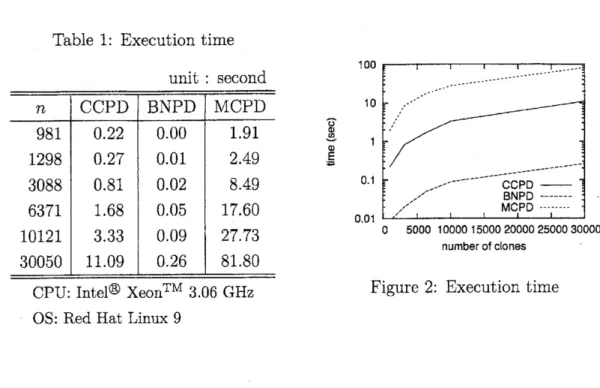
should note that the execution speed of CCPD is about ten times faster thanthat of MCPD and about thirty times slower than that of BNPD
as
is shown in Table 1and Figure 2. Note that, the vertical axis of Figure 2 is logarithmic scale. Moreover,
Table 1: Execution time 100 .– $—arrow\vee^{--}\cdot-$ ’. .,,$\cdot$ 10 $\prime\prime\prime\prime\prime.\cdot$ $\overline{=\mathrm{q}\mathrm{o}\mathrm{Q}^{\cdot}\}\in\{n’}$ 1 / $—-’\sim---’\sim---$ O.1 $,,\wedge^{\prime^{---}}$ CCPD – $\prime’$ $J^{J^{\prime’}}$ ” MCPD -BNPD
–.-0‘01 0 5000 2000015000200002500030000 numberof clonesFigure 2: Execution time
$\mathrm{O}8$: RedHat Linux 9
4.4
Simulation
3:
non
unique
collinearity
condition
case
In this section
we
consider thecase
when theunique collinearityconditionis not satisfied.We pursued the simulation on the following condition. The number of clones $n=1298$
in the first simulation is chosen so that we can compare the result with the real pooling
experiment which is reported in [1] for 1298 kinds of clones of Human chromosome 16
with 47 pools. In the experiment they utilized
a
random four-set pooling design. Arandom four-set design puts each clone in four pools. The design does not satisfy the
“unique collinearity condition”, i.e. there are two clones which
are
included together inmorethantwopools, hence
a
Tanner graph ofthedesign hasloopsoflengthfour. Inorderthat a pooling design with
1298
clones and replication number four satisfies the uniquecollinearity condition,
we
need at least 131 pools since it must be a packing design. Inthis section we utilize the same pooling design with 47 pools and try
300
simulations toexam the ability of CCPD algorithm. And weadopt error probability (5) instead of (4).
In this case, we may not expect a good performance for BNPD algorithm since the
pooling design does not satisfy the unique collinearity condition. However, CCPD
(1) number of positive clones: 1 (2) number of positive clones: 2
(3) number ofpositive clones: 3 (4) number ofpositive clones: 4
Figure
3:
Detectability of positive clones in thecase
oferror probability (5)$(n=1298, m=47)$
5
Conclusion
As a conclusion, for
a
pooling design a packing design should be utilized toassure
theunique collinearity condition. In the
case
when we can utilize a packing design, firstlyBNPD algorithm should be applied, then we will get good detectability ofpositive clones
with
a
high execution speed. If we cannot utilize a packing design, CCCP algorithm isrelativelyefficient at short time.
References
[1] E. Knill, A. Schliep and D. C. Torney (1996), Interpretation of pooling experiments
using the Markov chain Monte Carlo method, Journal
of
Computational Biology, 3,395-406.
[2] T. Shibuya, K. Harada, R. Tohyama and K. Sakaniwa (2005), Iterative Decoding
Based on the
Concave-Convex
Procedure, IEICE Trans, Fundamentals, E88-A(5),[3] H. Uehara and M. Jimbo (2005), Apositivedetecting codeandits decodingalgorithm
for DNA library screening, Journal
of
Computational Biology, submitted.[4] J. S. Yedidia, W. T. Freeman and Y. Weiss (2001), Bethe free energy, Kikuchi
ap-proximations, and belief propagation algorithms, Tech. Rep,
of
MitsubishiElectric
Research Lab., TR-2001-16.
[5] A. L. Yuille (2002), CCCP algorithms to minimize the Bethe and Kikuchi free
en-ergies: convergent alternatives tobeliefpropagation, Neural Computation, 14,