半線形波動方程式に対するスタッガード
Runge-Kutta
スキームStaggered Runge-Kutta
schemes for Semilinear Wave
Equations
1*) 村井 大介 ,2) 小藤 俊幸
1) 名古屋大学,2) 南山大学
1)Daisuke Murai, 2)Toshiyuki Koto
1)Nagoya University, 2)Nanzan University
*Email: [email protected] Abstract
A staggered Runge-Kutta (staggered RK) scheme is the time integration
Runge-Kutta type scheme based on staggered grid, which was proposed by
Ghrist and Fornberg and Driscoll in 2000. Afterwords, Vewer presented
ef-ficiency of the scheme for linear and semilinear wave equations through
nu-merical experiments. We study stability and convergence properties of this
scheme for semilinear wave equations. In particular, we prove convergence of
a fully discrete scheme obtained by applying the staggered RK scheme to the
MOL approximation of the equation.
Keywords: wave equation, staggered Runge-Kutta schemes, convergence
1
Introduction
We consider initial-boundary value problems of the form $\frac{\partial^{2}\prime u}{\partial t^{2}}=D\triangle u+g(t, x, u)$
, $0\leq t\leq T$, $x\in\Omega$,
$u(t, x)=\varphi(t, x)$, $0\leq t\leq T$, $x\in\partial\Omega$,
$u(0, x)=u_{0}(x)$, $\frac{\partial u}{\partial t}(0, x)=cf0(x)$, $x\in\Omega$.
Here $u(t, x)$ is an $\mathbb{R}$-valued unknown function, $\Omega$ is a bounded domain in $\mathbb{R}^{i},$$i=$
$1,2,3$ with the boundary $\partial\Omega,$ $\triangle$ is the Laplace operator, $D$ is a positive constant,
and $g(x, t, u)$ is an $\mathbb{R}$-valued given function. Also,
$\{\iota_{0}(x),$ $tJ_{0}(x),$ $\varphi(t, x)$ are given
functions.
Many important wave equations, such as the Klein-Gordon equation (see, e.g., [10],
[19]$)$ and the nonlinear Klein-Gordon equation (see [17]), are represented in this
form.
To apply numerical schemes, we may use the form
$\frac{\partial u}{\partial t}=v$, $\frac{\partial v}{\partial t}=D\triangle u+g(t, x, u)$
, $0\leq t\leq T$, $r\in\Omega$
.
$\prime t\iota(t, \alpha^{\backslash })=\varphi(t, x)$, $0\leq t\leq T$, $x\in\partial\Omega$, (1)
A well-known approach in the numerical solution of
wave
problems in partialdiffer-ential equations (PDEs) is the method of lines (MOL) (see [12]). In this approach,
PDEs
are
firstdiscretized
in space by finite differenceor
finite element techniquesto be converted into
a
system of ordinary differential equations (ODEs).Let $\Omega_{h}$ be a grid with mesh width $h>0$, and $V_{h}$ be the vector space of all functions
from $\Omega_{h}$ to $\mathbb{R}$. An MOL approximation of (1) is written in the form
$\frac{du_{h}(t)}{dt}=v_{h}(t)$, $\frac{dv_{h}(t)}{dt}=DL_{h}u_{h}(t)+\varphi_{h}(t)+g_{h}(t, u_{h}(t))$. (2)
Here $\prime u_{h},$ $\prime u_{h}$ are approximation functions of $u$ and
$’\iota$) such that $n_{h}(t),$ $v_{h}(t)\in V_{h}$ for
$t\in[0, T],$ $L_{h}$ is
a
difference approximation of $\triangle,$$g_{h}$ is a function from $[0, T]\cross V_{h}$ to $V_{h}$
defined
by $g_{h}(t, u_{h})(x)=g(t, x, u_{h}(t)),$ $x\in\Omega_{h}$, for $t\in[0, T],$ $u_{h}\in V_{h}$, and $\varphi_{h}(t)$is a function determined from the boundary condition.
For the time integration of (2), Ghrist et al. [5] have proposed a staggered
Runge-Kutta (staggered RK) scheme for semi-discretewave equations whichusesstaggering
in time. Spatial grid staggering is well-known. For example, the FDTD scheme (see
[18]$)$ in the electromagnetic field analysis and the SMAC scheme (see, e.g., [3, 9])
in the fluid calculation
use
space staggering. Ghrist et al, [5] have proposed andanalyzed a fourth-order time-staggered scheme (RKS4) which can be viewed as an
extension of an existing second-order time-staggered scheme along the idea of RK
methods. This scheme has further been examined by Verwer [15, 16].
As is well known, RK approximations for PDEs suffer from order reduction
phenom-ena. That is, the order of time-stepping in the fully discrete scheme is, in general,
less than that of the underlying RK scheme (see, e.g., [8], [11], [14] on order
reduc-tion phenomena of RK schemes in the PDE context). Verwer [15] has observed that
in the PDE context the order of RKS4 is equal to three. He also gives an analysis
of this phenomenon.
In this paper, we study stability and convergence of staggered RK schemes for (2).
Specifically,
we
introducea new
stability condition which guarantees thebounded-ness of numerical solutions and prove convergence of the schemes.
The paperis organized
as
follows. In the next section (Section 2), weintroduce somenotation, including the form of the staggered RK schemes. In Section 3, we prove
a theorem on the boundedness of the numerical solution. In Section 4, we prove a
theorem on convergence of the scheme applied to (2). In Section 5, we numerically
estimate the order of convergence through a numerical experiment.
2
Preliminaries
Let $\tau>0$ be
a
step size. We define the step points $t_{n}=7\iota.\tau,$ $t_{n+1/2}=(\uparrow?+1/2)\tau$ forAs described in [5], for positive integer $s$, a staggered RK scheme for ODEs of the form
$\{\begin{array}{l}\prime u’ =f(t, \uparrow_{-}f)v’ =g(t, u)’\end{array}$ $0\leq t\leq T,$
$\iota\iota,$ $u\in \mathbb{R}$ (3)
is given by
$v_{n+1/2,1}=0_{n+1/2}$,
$u_{n,i}= \prime u_{n}+\tau\sum_{j=1}^{i}b_{i,j}f(t_{n+1/2}+e_{j^{\mathcal{T},tf}n+1/2,j}),$ $i=1,$
$\cdots,$$6’-1$,
$v_{n+1/2,i}=v_{n+1/2}+ \tau\sum_{j=1}^{i-1}a_{i,j}g(t_{n}+C_{j}\mathcal{T}, \cdot tl_{n,j}),$ $i=2,$
$\cdots,$ $s$,
(4)
$\prime u_{n+1}=u_{n}+\tau\sum_{i=1}^{s}d_{i}f(t_{n+1/2}+e_{i}\tau, v_{n+1/2,i})$,
$u_{n+1,1}’=u_{n+1}$,
$v_{n+1/2,i}’=v_{n+1/2}+ \tau\sum_{j=1}^{i}b_{i,j}’g(t_{n+1}+e_{j}’\tau, u_{n+1,j}’),$ $i=1,$ $\cdots,$$s-1$ ,
$u_{n+1,i}’=u_{n+1}+ \tau\sum_{j=1}^{i-1}a_{i,j}’f(t_{n+1/2}+c_{j}’\tau, v_{n+1/2,j}’),$ $i=2,$ $\cdots,$$s$,
(5)
$v_{n+3/2}=v_{n+1/2}+ \tau\sum_{i=1}^{s}d_{i}’g(t_{n+1}+e_{i}’\tau, \iota\iota_{n+1,i}’)$
with the abscissae
$c_{i}= \sum_{j=1}^{i}b_{i,j},$ $c_{i}’= \sum_{j=1}^{i}b_{i,j}’,$ $i=1,$
$\ldots,$$s-1$,
(6)
$e_{i}= \sum_{j=1}^{i-1}a_{i,j},$ $e_{i}’= \sum_{j=1}^{i-1}a_{i,j}’,$ $i=2,$
$\ldots,$$s$.
Here$a_{i,j},$ $b_{i,j},$ $a_{i,j}’,$ $b_{i,j}’,$ $c_{i},$ $d_{i},$ $d_{i},$ $d_{i}’,$ $e_{i},$ $e_{i}’$ arecoefficients, $e_{1}=e_{1}’=0,$
$?\iota_{n,i},$ $v_{n+1/2,i}$,
$u_{n+1,i}’,$ $v_{n+1/2,i}’$ are intermediate variables, $u_{n}$ and $c\prime_{n+1/2}$ are approximate values of
$u(t_{n})$ and $v(t_{n+1/2})$, respectively.
Wedescribe the algorithmofthestaggered RK scheme. Inthe first step, wecalculate
$u_{1}$ from $u_{0}$ and $v_{1/2}$ by (4), where $v_{1/2}$ is produced from given initial values $u_{0}(:\iota\cdot)=$
the next step, we calculate $\iota\dagger_{3/2}$ from $u_{1/2}$ and $\iota\iota_{1}$ by (5). So, generally, we calculate
$n_{n+1}$ from $\prime u_{n}$ and $\iota\prime_{n+1/2}$ by (4), and $tf_{n+3/2}$ from $\iota_{n+1/2}$) and $u_{n+1}$ by (5) and all
approximate values are calculated explicitly.
We introduce some notation. The $m\cross m$ identity matrix will be denoted by $I_{m}$. We
use the standard symbol $1=(1, \cdots, 1)^{T}\in \mathbb{R}^{S}$. To analyze stability of the scheme,
we use the following linear test equation:
$\{\begin{array}{l}u’(t)=v(t)v’(t)=-\omega^{2}u(t)’\end{array}$ $\omega>0$ (7)
where $\prime u(t)$ is an $\mathbb{R}$-valued function.
Applying (4)$-(5)$ to (7), we get $V_{n+1/2}1-\tau\omega^{2}AU_{n}$, $U_{n}=1u_{n}+\tau BV_{n+1/2}$, $u_{n+1}=u_{n}+\tau dV_{n+1/2}$, (8) $U_{n+1}’=1u_{n+1}+\tau A’L_{n+1/2}^{\gamma/}$, $V_{n+1/2}’=1v_{n+1/2}-\tau\omega^{2}B’U_{n+1}’$, $t;_{n+3/2}=v_{n+1/2}-\tau\omega^{2}d’U_{n+1}’$, where
$A=(\begin{array}{llll}0 a_{2,l} 0 O \vdots \ddots \ddots a_{s,l} \cdots a_{s,s-1} 0\end{array}),$ $B=(\begin{array}{llll}b_{l,l} b_{2,1} b_{2,2} O \vdots \vdots \ddots b_{s,l} b_{s,2} \cdots b_{s,s}\end{array}),$ $d=(\begin{array}{l}d_{l}d_{2}\vdots d_{s}\end{array})$
$A’=(\begin{array}{llll}0 a_{2_{\rangle}1} 0 O \vdots \ddots \ddots (\iota_{s,1} \cdots a_{s,s-1}’ 0\end{array})$ $B’=(\begin{array}{llll}b_{1,1}’ b_{2,1}’ b_{2,2}’ O \vdots \vdots .b_{s,1} b_{s,2} \cdots b_{s,s}’\end{array})$ $d=(\begin{array}{l}d_{l}’(l_{2}’\vdots d_{s}’\end{array})$
$V_{n+1/2}=(v_{n+1/2,1}, \iota\prime_{n+1/2,2}, \cdots, v_{n+1/2,s})^{T},$ $U_{n}=(\cdot\iota\iota_{n,1}, \tau\iota_{n,2}, \cdots, \tau\iota_{n,s})^{T}$,
$V_{n+1/2}’=(v_{n+1/2,1}’, v_{n+1/2,2}’, \cdots, v_{n+1/2,s}’)^{T}$,
$U_{n+1}’=(u_{n+1,1}’, \iota\iota_{n+1,2}’, \cdots. u_{n+1,s}’)^{T}$.
Eliminating $V_{n+1/2},$ $U_{n},$ $U_{n+1}’$ and $V_{n+1/2}’$, we can rewrite (8) as
For $\theta\geq 0,$ $R(\theta)$ is given by
$R(\theta)=(_{r_{1,2}’(\theta)1(r_{1,1}(\theta)1+1)}1+r_{1,1}(\theta)1$
with
$1+r_{1,2}’(\theta)1r_{1,2}(\theta)1+r_{1,1}’(\theta)1r_{1,2}(\theta)1)$ (10)
$r_{1,1}(\theta)=-\theta^{2}d(I_{s}+\theta^{2}AB)^{-1}A$, $r_{1,2}(\theta)=\theta d(I_{s}+\theta^{2}AB)^{-1}$,
$r_{1,1}’(\theta)=-\theta^{2}d’(I_{s}+\theta^{2}A’B’)^{-1}A’$, $r_{1,2}’(\theta)=-\theta d’(I_{s}+\theta^{2}A’B’)^{-1}$.
Noticing $(\theta^{2}AB)^{s}=O$ and $(\theta^{2}A’B’)^{s}=O$, we get
$(I_{s}+ \theta^{2}AB)^{-1}=\sum_{i=0}^{s-1}(-\theta^{2}AB)^{i}$, $(I_{s}+ \theta^{2}A’B^{f})^{-1}=\sum_{i=0}^{s-1}(-\theta^{2}A’B’)^{i}$
with $(-\theta^{2}AB)^{0}=(-\theta^{2}A’B’)^{0}=I_{s}$. Then we rewrite the coefficients in (10) as
$_{1,1}( \theta)=d\sum_{i=0}^{s-1}(-\theta^{2})^{i+1}(AB)^{i}A$, $r_{1,2}( \theta)=d\sum_{i=0}^{s-1}(-\theta^{2})^{i}\theta(AB)^{i}$,
(11)
$r_{1,1}’( \theta)=d’\sum_{i=0}^{s-1}(-\theta^{2})^{i+1}(A’B’)^{i}A’$, $r_{1,2}’( \theta)=-d’\sum_{i=0}^{s-1}(-\theta^{2})^{i}\theta(A’B’)^{i}$.
Let $\lambda_{\pm}=\lambda_{\pm}(\theta)$ be the eigenvalues of (10), which are the roots of
$\lambda^{2}-(2+r_{1,1}(\theta)1+r_{1,1}’(\theta)1+r_{1,2}(\theta)1r_{1,2}’(\theta)1)\lambda$
(12)
$+(1+r_{1,1}(\theta)1)(1+r_{1,1}’(\theta)1)=0$.
Under this notation, we define the stability interval of the scheme.
Definition 1. The stability interval $S$
of
a staggered $RK$ scheme (4)$-(5)$ isdefined
by a connected closed interval
of
$\{\theta;|\lambda_{\pm}(\theta)|\leq 1, \theta\geq 0\}$, which includes $0$.The simplest example of staggered RK schemes is the (staggered) leapfrog scheme
(see, e.g., [15])
$u_{n+1}=u_{n}+\tau f(t_{n+1/2,1f_{n+1/2}})$,
(13)
$v_{n+3/2}=v_{n+1/2}+\tau g(t_{n+1}, u_{n+1})$.
This scheme is of order 2 for ODEs. In this case, the scheme applied to (7) is reduced
to (9) with
Substituting (14) into (12),
we
get $\lambda^{2}-(2-\theta^{2})\lambda+1=0$.Since
the discriminantof $\lambda^{2}-(2-\theta^{2})\lambda+1=0$ is $D(\theta)=(2-\theta^{2})^{2}-4$, it is easy to see that $|\lambda_{\pm}(\theta)|\leq 1$ iff $D(\theta)\leq 0$. $S$ is estimated by using the smallest positive root of-2 $=2-\theta^{2}$, i.e.
$S=[0,2]$.
RKS4 from [5] is another example of a staggered RK scheme. It is obtained by
taking
$A=A’=(\begin{array}{lll}0 0 0-1 0 00 1 0\end{array})$ $B=B’=(\begin{array}{lll}0 0 01 0 00 0 0\end{array})$ $d=d^{f}=( \frac{11}{12’}\frac{1}{24},$ $\frac{1}{24})$ . (15)
This scheme is of order 4 for ODEs. In this case, the scheme for (7) is reduced to
(9) with
$r_{1,1}(\theta)1=r_{1,1}’(\theta)1=0,$ $r_{1,2}( \theta)1=\theta-\frac{\theta^{3}}{24},$ $r_{1,2}’( \theta)1=-\theta+\frac{\theta^{3}}{24}$ . (16)
Substituting (16) into (12), we get
$\lambda^{2}-\{2-(\theta-\theta^{3}/24)^{2}\}\lambda+1=0$.
In [15], $S$ is found to bedefinedby the smallest positive rootof-2 $=2-(\theta-\theta^{3}/24)^{2}$,
i.e. $S=[0,2(2^{1/3}+2^{2/3})]$.
3
Stability
of
staggered RK schemes
We use (9) to estimate the stability of the staggered RK scheme. In order to prove
convergence of the staggered RK scheme in the next section, we have to evaluate
$||R(\theta)^{n}||_{2}$ of (10), where $||\cdot||_{2}$ is the Euclidean norm on $\mathbb{R}^{2}$ and the corresponding
operator norm for $2\cross 2$ matrices. To accomplish this evaluation, we define another
stability interval.
Let $\gamma_{0}>0(\gamma_{0}\in S)$ be the smallest positive root of
$D(\theta)=\gamma_{1,2}(\theta)1_{1_{1,2}^{J}}\cdot(\theta)1\{7_{1,2}(\theta)1\gamma_{1,2}’(\theta)1+4\}=0$. (17)
By using this $\gamma_{0}$,
we
define another stability interval $S’=[0, \gamma_{0})$. By Definition 1,$S’$ is a subset in $S$. We prove the boundedness of $||R(\theta)^{n}||_{2}$ by using the following
hypotheses for the staggered RK scheme (4)$-(5)$:
(Hl) For $\theta\in S’,$ $0\leq-r_{1,2}’(\theta)1\leq r_{1,2}(\theta)1\leq-\gamma_{0}r_{1,2}^{f}(\theta)1$.
(H2) For $\theta\in S^{f},$ $D(\theta)\leq 0$.
(H4) The following order condition holds: $d1=d’1=1$ .
The leapfrog scheme (13) and RKS4 (15) satisfy these hypotheses. Substituting (14)
into (17), we can take $\gamma_{0}=2$ and $S’=[0,2)$ for the leapfrog scheme. By (14), the
leapfrog scheme satisfies (Hl)$-(H3)$. (H4) is checked by using (13). Similarly, we
can take $\gamma_{0}=2\sqrt{6}$ and $S’=[0,2\sqrt{6})$ for RKS4, by substituting
(16) into (17). By
(16), RKS4 satisfies $(H1)-(H3)$. By (15), (H4) holds,
Theorem 3.1. Let$\gamma_{\epsilon}>0$ be $\gamma_{\epsilon}<\gamma_{0}$. Assume that the
coeffict
ents$0_{i,j},$ $(x_{i,j}’,$ $b_{i,j},$ $b_{i,j}’$,
$c_{i},$ $c_{i}’,$ $d_{i},$ $d_{i}’,$ $e_{i},$ $e_{i}’$ in (4)$-(5)$ satisfy $(H1)-(H4)$. Then, there is a positive constant
$C$ such that
$||R(\theta)^{n}||_{2}\leq C$ (18)
holds
for
any $0\leq\theta\leq\gamma_{\epsilon}$ and $’,\iota\in \mathbb{N}$. Here $R(\theta)$ is the matrixof
(10).Proof. By (H3), we can rewrite
$R(\theta)=(\begin{array}{lll}1 r_{1,2}(\theta)1r_{1,2}’(\theta)1 1+ r_{1,2}(\theta)1r_{l,2}(\theta)1\end{array})$. (19)
If$\theta=0,$ $R(\theta)$ is the identity matrix. Then (18) holds for $C=1$. Let $\theta>0$. We can
diagonalize (19) as
$R(\theta)=Q(\theta)(\begin{array}{ll}\lambda_{+}(\theta) 00 \lambda_{-}(\theta)\end{array})Q(\theta)^{-1}$. (20)
Here
$\lambda_{\pm}(\theta)=\lambda_{\pm}=\frac{2+r_{1,2}(\theta)1r_{1,2}’(\theta)1\pm\sqrt{D(\theta)}}{2}$,
(21)
$Q( \theta)=\frac{1}{r_{1,2}’(\theta)1}(\begin{array}{llll}-\lambda_{-} +1 -\lambda_{+} +1r_{1,2}’(\theta)1 r_{1,2}’(\theta)1 \end{array})$,
$Q( \theta)^{-1}=\frac{1}{\lambda_{+}-\lambda_{-}}(_{-r_{12}’(\theta)1}r_{1,2}’,(\theta)1$ $-\lambda_{-+1}^{-1}\lambda_{+)}$ .
Since $\theta\in S$, we have $|\lambda_{\pm}|\leq 1$. By (H2), the adjoint matrices of $Q(\theta)$ and $Q(\theta)^{-1}$
are
$Q( \theta)^{*}=\frac{1}{r_{1,2}’(\theta)1}(_{-\lambda_{-}+1}^{-\lambda_{+}+1}$ $r_{1,2}^{f}(\theta)1|_{1,2}’(\theta)1)$
Putting $a(\theta)=(\lambda_{+}-1)(\lambda_{-}-1)$ and $b(\theta)=\gamma_{1,2}’(\theta)1\{\lambda_{+}+\lambda_{-}-2\}$, we have
$Q( \theta)^{*}Q(\theta)=\frac{1}{(r_{1,2}’(\theta)1)^{2}}(,$ $(\lambda_{+}-1)^{2}+(r_{1’ 2}’(\theta)1)^{2}a(\theta)+(\prime r_{1,2}’(\theta)1)^{2)}$
’
$(Q( \theta)^{-1})^{*}(Q(\theta)^{-1})=\frac{-1}{\{\lambda_{-}-\lambda_{+}\}^{2}}(^{2r_{1,2}^{f}(\theta)^{2}}b(\theta)$ $2b(\theta)(\iota(\theta))\cdot$
Then, the eigenvalues of $Q(\theta)^{*}Q(\theta)$ and $(Q(\theta)^{-1})^{*}(Q(\theta)^{-1})$ are
$a(\theta)+(r_{12}’(\theta)1)^{2}\pm\sqrt{\{(\lambda_{+}-1)^{2}+(r_{12}’(\theta)1)^{2}\}\{(\lambda_{-}-1)^{2}+(r_{1}’},2(\theta)1)^{2}\}$
$\overline{(r_{1,2}^{f}(\theta)1)^{2}}$
’ $a(\theta)+(r_{1,2}’(\theta)1)^{2}\pm\sqrt{(a(\theta)-(r_{12}^{f}(\theta)1)^{2})^{2}+b(\theta)^{2}}$ $\overline{-\{\lambda_{-}-\lambda_{+}\}^{2}}$, respectively. Putting $\alpha(\theta)=-r_{1,2}(\theta)’\prime\prime_{1,2}.$ , $\beta(\theta)=r_{1,2}’(\theta)1(\lambda_{+}-\lambda_{-})i$, (22)these eigenvalues are rewritten as
$\alpha(\theta)\pm\sqrt{\alpha(\theta)^{2}-\beta(\theta)^{2}}$
$(r_{2,1}(\theta)1)^{2}\{\alpha(\theta)\pm\sqrt{\alpha(\theta)^{2}-\beta(\theta)^{2}}\}$
$\overline{(r_{2,1}(\theta)1)^{2}}$, $\overline{\beta(\theta)^{2}}$
’
respectively. Then, by (20), we have
$||R( \theta)^{n}||_{2}\leq||Q(\theta)||_{2}||Q(\theta)^{-1}||_{2}=|\frac{\alpha(\theta)+\sqrt{\alpha(\theta)^{2}-\beta(\theta)^{2}}}{\beta(\theta)}|\leq 2|\frac{\alpha(\theta)}{\beta(\theta)}|+1$. (23)
Substituting (21) into (22) and using (Hl), we have
$\leq\frac{(1+\gamma_{0})l_{1,2}’(\theta)1}{r_{1,2}’(\theta)1\sqrt{r_{12}(\theta)1r_{12}(\theta)1+4}}$
for any $\theta\in[0, \gamma_{\epsilon}]$. By (Hl) and (H2), we get $-4\leq r_{1}$,2$(\theta)1_{l_{1,2}’}\cdot(\theta)1\leq 0$. As
$\gamma_{1,2}(\theta)1_{1,2}’,.(\theta)1$ isa polynomialof
4 in $[0, \gamma_{\in}]$. Let
$\gamma_{1}$ be the value of
$\theta$ that gives
the minimum value of 1,2$(\theta)1\cdot r_{1,2}’(\theta)1+$
4. We get
$| \frac{\alpha(\theta)}{\beta(\theta)}|\leq\frac{1+\gamma_{0}}{\sqrt{r_{12}(\gamma_{1})1r_{21}(\gamma_{1})1+}\overline{4}}$.
Then, this, together with (23), gives (18) with $C= \frac{2(1+\gamma_{0})}{\sqrt{r_{12}(\gamma_{1})1r_{21}(\gamma_{1})1+4}}+1$. 口
4
Convergence
of
fully discrete schemes
We assume the following hypotheses for $L_{h}$:
$L_{h}$ is
a
negativedefinite
symmetric matrix.There exist $h_{0}>0$ and $C_{3}’>0$ such that any eigenvalue of$L_{h}$ is less $than-C_{3}$
for any $h<h_{0}$.
By these hypotheses, there exists
a
positive definite symmetric matrix $l\eta,\prime r_{h}$ satisfying$-DL_{h}=W_{h}^{2}$; any eigenvalue of $lW_{h}^{-1}$ is less than $1/\sqrt{DC_{3}}$ for any $h<h_{0}$. Then
$W_{h}^{-1}$ is bounded.
Using $W_{h}$, we can rewrite (2) as
$\frac{du_{h}(t)}{dt}=v_{h}(t)$, $\frac{dv_{h}(t)}{dt}=-M^{\Gamma_{h}^{2}}\cdot u_{h}(t)+\varphi_{h}(t)+g_{h}(t, u_{h}(t))$ . (24)
In this paper, $||\cdot||_{W_{h}}$ denotes a discrete energy norm (see, e.g., [1], [2]), given by
$||(u_{h}, v_{h})^{T}||_{W_{h}}^{2}=||W_{h}u_{h}||^{2}+||v_{h}||^{2}$ for any $u_{h},$$v_{h}\in V_{h}$, (25)
where $||\cdot||$ denotes the discrete version of the $L_{2}$-norm in $V_{h}$, given by
$||u_{h}||^{2}=h \sum_{x\in\Omega_{h}}\{(\cdot u_{h})_{x}\}^{2}$
and the corresponding operator norm for $m\cross 7\eta$ matrices with $m=di_{l}nV_{h}$.
We define the spatial truncation
error
$\alpha_{h}(t)$ (see, e.g., [6], I.4) by$\alpha_{h}(t)=v_{h}’(t)+\mathfrak{h}t_{h}^{\gamma 2}u_{h}(t)-\varphi_{h}(t)-g_{h}(t, u_{h}(t))$ , (26)
where $u_{h}(t),$ $v_{h}(t)$ are $V_{h}$-valued functions obtained by restricting the variable
$e\iota$: of
By applying (4)$-(5)$ to (24), we obtain the following scheme for the problem (1): $V_{n+1/2}=1’v_{n+1/2}+\tau A\{-W_{h}^{2}U_{n}+\varphi_{h}(t_{n})+g_{n}\}$, $U_{n}=1’u_{n}+\tau BV_{n+1/2}$, $u_{n+1}=u_{n}+\tau dV_{n+1/2}$, (27) $U_{n+1}’=1’u_{n+1}+\tau A’V_{n+1/2}’$, $V_{n+1/2}^{f}=1’v_{n+1/2}+\tau B’\{-W_{h}^{2}U_{n+1}’+\varphi_{h}(t_{n+1})+g_{n+1}\}$, $v_{n+3/2}=v_{n+1/2}+\tau d’\{-W_{h}^{2}U_{n+1}’+\varphi_{h}(t_{n+1})+g_{n+1}\}$ .
Here 1’ denotes $1\otimes I_{m}$ for $1=(1, \cdots, 1)^{T}\in \mathbb{R}^{S}$,
$A=A\otimes I_{m},$ $B=B\otimes I_{m},$ $d=d\otimes I_{m},$ $A’=A’\otimes I_{m},$ $B’=B’\otimes I_{m}$,
$V_{n+1/2}=(v_{n+1/2,1}^{T}, v_{n+1/2,2}^{T}, \cdots, v_{n+1/2,s}^{T})^{T},$ $U_{n}=(u_{n,1}^{T}, u_{n,2}^{T}. \cdots, u_{n,s}^{T})^{T}$, $V_{n+1/2}’=(v_{n+1/2,1}^{\prime T}, v_{n+1/2,2}^{\prime T}. \cdots, v_{n+\iota/2,s}^{\prime T})^{T}$,
$U_{n+1}’=(u_{n+1,1}^{\prime T}, u_{n+1,2}^{\prime T}, \cdots, u_{n+1,s}^{\prime T})^{T}$,
$\varphi_{h}(t_{n})=(\varphi_{h}(t_{n,1})^{T}, \varphi_{h}(t_{n,2})^{T}, \cdots, \varphi_{h}(t_{n,s})^{T})^{T},$ $d=d’\otimes I_{m}$,
$g_{n}=(g_{h}(t_{n,1}, u_{n,1})^{T}, g_{h}(t_{n,2}, u_{n,2})^{T}, \cdots, g_{h}(t_{n,s}, u_{n,s})^{T})^{T},$ $W_{h}=I_{s}\otimes W_{h}$
with $\otimes$ standing for the Kronecker product (see, e.g., [4]), $u_{n,i},$ $v_{n+1/2,i},$ $u_{n+1,i}’$ and $v_{n+1/2,i}^{f}$ are intermediate variables, $t_{n,j};=t_{n}+c_{j}\tau,$ $t_{n+1,j}:=t_{n+1}+c_{j}’\tau,$ $u_{n}$ and
$v_{n+1/2}$ are approximate values of $u_{h}(t_{n})$ and $v_{h}(t_{n+1/2})$, respectively.
For some s-dimensional vector $a=(a_{1}, \cdots, a_{s})^{T}$,
we
define $a^{i}=(a_{1}^{i}, \cdots, a_{s}^{i})^{T}$. Inaddition to the $(H1)-(H4)$, we assume the following hypothesis for the staggered RK
scheme (4)$-(5)$:
(H5) The following order conditions hold:
$(A1)^{2}+A1=2AB1,$ $(B1)^{2}-B1=2BA1$ ,
$(A’1)^{2}+A’1=2A^{f}B’1$
.
$(B’1)^{2}-B’1=2B’A’1$,$dA1=d^{f}A’1=0$.
The leapfrog scheme and RKS4 satisfy (H5), which is checked by (13) and (15).
We
assume
the following condition which gives the restriction for $\tau$ and $l?$.(H6) $\tau\rho(W_{h})\in S’$. Here $p(W_{h})$ is the spectral radius of $W_{h}$.
Moreover, we assume the following condition for the problem (1):
The exact solution $u(t, x)$ is of class $C^{4}$ with respect to $t,$ $g(t, x, u)$ is of class $C^{3}$
with respect to $t,$ $u$ and (each component of) the derivative $\partial g/\partial\cdot n$ is bounded for
$(t, x, u)\in[0, T]\cross\Omega\cross \mathbb{R}$.
For simplicity, we consider a step size of the form $\tau=T/N$ with positive integer $N$.
Theorem 4.1.
Assume
that thecoefficients
$a_{i,j},$ $(l_{i,j}’,$ $b_{i,j},$ $b_{i,j}’,$ $c_{i},$ $c_{i}^{J},$ $d_{i},$ $d_{i}’,$ $e_{i},$ $e_{i}’$ in(4)$-(5)$ satisfy $(H1)-(H5)$ and $\tau$
satisfies
$(H6)$. Then, there isa
positive constant$C_{1}$ such that
$\Vert(u_{n}-u_{h}(t_{n}), v_{n+1/2}-v_{h}(t_{n+1/2}))^{T}\Vert_{W_{h}}\leq C_{1}(\tau^{2}+\max_{0\leq t\leq T}||(y_{h}(t)||)$ (28)
holds.
Proof. Put
$V_{h}(t_{n+1/2})=(v_{h}(t_{n+1/2,1})^{T}, v_{h}(t_{n+1/2,2})^{T}, \cdots, v_{h}(t_{n+1/2,s})^{T})^{T}$ , $U_{h}(t_{n})=(u_{h}(t_{n,1})^{T}, u_{h}(t_{n,2})^{T}, \cdots, u_{h}(t_{n,s})^{T})^{T}$,
$V_{h}(t_{n+1/2}’)=(v_{h}(t_{n+1/2,1}’)^{T}, v_{h}(t’n)^{T}\cdots, v_{h}(t_{n+1/2,s}’)^{T})^{T}$,
$g_{h}(t_{n})=(g_{h}(t_{n,1}, u_{h})^{T}, g_{h}(t_{n,2}, u_{h})^{T}, \cdots, g_{h}(t_{n,s}, u_{h})^{T})^{T}$,
where $t_{n+1/2,j}:=t_{n+1/2}+e_{j}\tau,$ $t_{n+1/2,j}’:=t_{n+1/2}+e_{j}’\tau,$ $j=1,$ $\cdots,$ $s$. Replacing
$U_{n},$ $U_{n+1}’,$ $V_{n+1/2},$ $V_{n+1/2}’,$ $u_{n}$ and $v_{n+1/2}$ in the scheme (27) with $U_{h}(t_{n})_{\rangle}U_{h}(t_{n+1})$,
$V_{h}(t_{n+1/2}),$ $V_{h}(t_{n+1/2}’),$ $u_{h}(t_{n})$ and $v_{h}(t_{n+1/2})$, we obtain the
recurrence
relation$V_{h}(t_{n+1/2})=1’v_{h}(t_{n+1/2})+\tau A\{-W_{h}^{2}U_{h}(t_{n})+\varphi_{h}(t_{n})+g_{h}(t_{n})\}+r_{n+1/2}$ , $U_{h}(t_{n})=1’u_{h}(t_{n})+\tau BV_{h}(t_{n+1/2})+r_{n}$, $u_{h}(t_{n+1})=u_{h}(t_{n})+\tau dV_{h}(t_{n+1/2})+\rho_{n}$, $U_{h}(t_{n+1})=1’u_{h}(t_{n+1})+\tau A’V_{h}(t_{n+1/2}’)+r_{n+1}$, $V_{h}(t_{n+1/2}’)=1^{f}v_{h}(t_{n+1/2})+\tau B’\{-W_{h}^{2}U_{h}(t_{n+1})+\varphi_{h}(t_{n+1})+g_{h}(t_{n+1})\}+r_{n+1/2}’$, $v_{h}(t_{n+3/2})=v_{h}(t_{n+1/2})+\tau d’\{-W_{h}^{2}U_{h}(t_{n+1})+\varphi_{h}(t_{n+1})+g_{h}(t_{n+1})\}+\rho_{n+1/2}$ (29)
with the residuals
$r_{n}=(0\cdot 1\cdot,$ $r_{n+1/2}’=(\prime_{n+1/2,1n+1/2,2,n+1/2,s}^{\prime\tau\tau.\tau}r’\cdots, \prime’)^{T}$ ,
$p_{n}$ and $p_{n+1/2}$. By (6), (26), (H4) and (H5), these residuals are expanded as
$r_{n+1/2}=\tau^{3}\zeta v_{h}^{(3)}(t_{n+1/2})+\tau A\alpha_{h}(t_{n})+O(\tau^{4})$,
$r_{n}=\tau^{3}\eta u_{h}^{(3)}(t_{n})+O(\tau^{4})$, $\rho_{n}=\frac{\tau^{3}}{2}(\frac{1}{12}-d(A1)^{2})u_{h}^{(3)}(t_{n})+O(\tau^{4})$, (30) $r_{n+1}=\tau^{3}\zeta’u_{h}^{(3)}(t_{n+1})+O(\tau^{4})$ , $r_{n+1/2}’=\tau^{3}\eta’v_{h}^{(3)}(t_{n+1/2})+\tau B’\alpha_{h}(t_{n+1})+O(\tau^{4})$, $\rho_{n+1/2}=\frac{\tau^{3}}{2}(\frac{1}{12}-d’(A’1)^{2})v_{h}^{(3)}(t_{n+1/2})+\tau d’\alpha_{h}(t_{n+1})+O(\tau^{4})$.
Here
$\alpha_{h}(t_{n})=(\alpha_{h}(t_{n,1})^{T}, \alpha_{h}(t_{n,2})^{T}, \cdots, \alpha_{h}(t_{n,s})^{T})^{T}$ ,
$\zeta=\zeta\otimes I_{m},$ $\eta=\eta\otimes I_{m},$ $\zeta’=\zeta’\otimes I_{m},$ $\eta’=\eta’\otimes I_{m}$,
$\zeta=\frac{4(A1)^{3}+6(A1)^{2}+3(A1)}{24}-\frac{A(B1)^{2}}{2}$,
$\eta=\frac{4(B1)^{3}+6(B1)^{2}+3(B1)}{24}-\frac{B(A1)^{2}}{2}!$
$\mathfrak{c}’=\frac{4(A’1)^{3}+6(A’1)^{2}+3(A^{f}1)}{24}-\frac{A’(B’1)^{2}}{2}$,
$\eta’=\frac{4(B’1)^{3}+6(B’1)^{2}+3(B’1)}{24}-\frac{B’(A^{f}1)^{2}}{2}$
and $O(\tau^{4})$ denotesaterm whose component for each $l:\in\Omega_{h}$ is of$O(\tau^{4})$. Subtracting
(27) from (29), we obtain $\delta_{n+1/2}=1’\epsilon_{n+1/2}-\tau A(W_{h}^{2}\delta_{n}-g_{h}(t_{n})+g_{n})+r_{n+1/2}$, $\delta_{n}=1’\epsilon_{n}+\tau B\delta_{n+1/2}+r_{n}$, $\epsilon_{n+1}=\epsilon_{n}+\tau d\delta_{n+1/2}+\rho_{n}$, $\delta_{n+1}^{f}=1’\epsilon_{n+1}+\tau A^{f}\delta_{n+1/2}^{f}+r_{n+1}$ , $\delta_{n+1/2}’=1’\epsilon_{n+1/2}-\tau B’(W_{h}^{2}\delta_{n+1}’-g_{h}(t_{n+1})+g_{n+1})+r_{n+1/2}’$ , $\epsilon_{n+3/2}=\epsilon_{n+1/2}-\tau d^{f}(W_{h}^{2}\delta_{n+1}’-g_{h}(t_{n+1})+g_{n+1})+\rho_{n+1/2}$ . Here $\delta_{n+1/2}=V_{h}(t_{n+1/2})-V_{n+1/2},$ $\delta_{n}=U_{h}(t_{n})-U_{n}$, $\delta_{n+1}’=U_{h}(t_{n+1})-U_{n+1}’,$ $\delta_{n+1/2}’=V_{h}(t_{n+1/2}’)-V_{n+1/2}^{f}$ and $rightarrow\succ_{n}^{\wedge}=u_{h}(t_{n})-u_{n},$ $\epsilon_{n+1/2}=v_{h}(t_{n+1/2})-v_{n+1/2}$.
Let $J_{n}$ be $J_{n}=$ diag$(J_{n,1}, J_{n,2}, \cdots, J_{n,s})$ and $J_{n,i}$ be a function from $\Omega_{h}$ to $\mathbb{R}$ whose
value for $:\ell.\cdot\in\Omega_{h}$ is
$J_{n,i}( \cdot l:)=\int_{0}^{1}\frac{\partial g}{\partial_{1}\iota}(t_{n,i},:l:, (1-\theta)u_{n,i}(.\iota:)+\theta u_{h}(t_{n,i}, \backslash l:))d\theta$.
By the assumption that $\partial g/\partial u$ is bounded, there is a constant $\gamma_{3}$ such that
where the multiplication $J_{n,i}u$ is component-wise $for.\iota\cdot\in\Omega_{h}$. Then we obtain $\delta_{n+1/2}=1^{\prime_{c_{n+1/2}}}.-\tau A(W_{h}^{2}-J_{n})\delta_{n}+r_{n+1/2}$, $\delta_{n}=1’\epsilon_{n}+\tau B\delta_{n+1/2}+r_{n}$, $\epsilon_{n+1}=\epsilon_{n}+\tau d\delta_{n+1/2}+p_{n}$, $\delta_{n+1}’=1’\epsilon_{n+1}+\tau A’\delta_{n+1/2}’+r_{n+1}$, $\delta_{n+1/2}’=1’\epsilon_{n+1/2}-\tau B’(W_{h}^{2}-J_{n+1})\delta_{n+1}’+r_{n+1/2}’$, $\epsilon_{n+3/2}=\epsilon_{n+1/2}-\tau d’(W_{h}^{2}-J_{n+1})\delta_{n+1}’+\rho_{n+1/2}$.
Eliminating $\delta_{n},$ $\delta_{n+1/2},$
$\delta_{n+1/2}^{f}$ and $\delta_{n+1}’$, we have
$(\begin{array}{l}M/^{r_{h}}\epsilon_{n+1}rightarrow\sigma_{n+3}/2\end{array})=R_{n}(\begin{array}{l}M_{h}^{f}\hat{\epsilon}_{n}\epsilon_{n+1}/2\end{array})+M_{n}(\begin{array}{l}I/V_{h}\xi_{n}\xi_{n+1/2}\end{array})$ . (32)
Here
$R_{m}=(\begin{array}{ll}I_{m}+R_{I,1}1^{/} R_{l,2}1’R_{1,2}’1,R_{1,1}1,+R_{l,2}’1’ I_{m}+R_{l,2}’1,R_{l,2}1’+R_{l,l}’1’\end{array}),$ $M_{n}=(\begin{array}{ll}I_{m} OR_{1,2}1^{f} I_{m}\end{array})$
$R_{1,1}=-\tau^{2}d(I+\tau^{2}A(W_{h}^{2}-J_{n})B)^{-1}A(W_{h}^{2}-J_{n})$ , $R_{1,2}=\tau d(I+\tau^{2}A(W_{h}^{2}-J_{n})B)^{-1}W_{h}$, $R_{1,1}’=-\tau^{2}d’(W_{h}^{2}-J_{n+1})(I+\tau^{2}A’B’(W_{h}^{2}-J_{n+1}))^{-1}A_{t}’$ $R_{1,2}’=-\tau d’(W_{h}^{2}-J_{n+1})(I+\tau^{2}A’B’(W_{h}^{2}-J_{n+1}))^{-1}W_{h}^{-1}$, $W_{h}\xi_{n}=R_{1,1}W_{h}r_{n}+R_{1,2}r_{n+1/2}+W_{h}\rho_{n}$, (33) $\xi_{n+1/2}=R_{1,2}’W_{h}r_{n+1}+R_{1,1}’r_{n+1/2}’+\rho_{n+1/2}$
with $I=I_{s}\otimes I_{m}$.
In orderto prove theconvergence, we introduce new variables following [6] and [15].
As in the proof of Lemma II.2.3 in [6] and 5.3 in [15], we put
$(\begin{array}{l}W_{h}\nu_{n}\nu_{n+1}/2\end{array})=(R(\tau W_{h})-I_{2m})^{-1}M(\tau W_{h})(\begin{array}{l}W_{h^{}}\psi_{J_{n}}\uparrow l)_{n+1/2}\end{array})$
$=(^{[d^{f}(I+\tau^{2}A^{f}B’W_{h}^{2})^{-1}1’]^{-1}\nu l^{r_{h}-1}\tau^{-1}\psi_{n+1/2}}[d(I+\tau^{2}AW_{h}^{2}B)^{-1}1^{f}]^{-1}W_{h}^{-1}\tau^{-1}i\prime V_{h\ell’n}\uparrow))$
(34)
$(\begin{array}{l}W_{h}\hat{\epsilon}_{n}\hat{\epsilon}_{n+1/2}\end{array})=(\begin{array}{l}7V_{h}\epsilon_{n}\hat{\epsilon}_{n+1}/2\end{array})+(\begin{array}{l}W_{h}\nu_{n}\nu_{n+1}/2\end{array})$ ,
$(\begin{array}{l}W_{h}\hat{\xi}_{n}\hat{\xi}_{n+l/2}\end{array})=\tau M(\tau W_{h})(\begin{array}{l}W_{h}\overline{\xi}_{n}\overline{\xi}_{n+l/2}\end{array})-\tau\overline{R}_{m}(\begin{array}{l}W_{h}\nu_{n}\nu_{n+1}/2\end{array})+(\begin{array}{l}W_{h}(\nu_{n+l}-\nu_{n})\nu_{n+3}/2^{-\nu_{n+l}}/2\end{array})$ (35)
and rewrite (32) as
Here
$\Lambda I(\tau W_{h})=(\begin{array}{ll}I_{m} Or_{1,2}’(\tau W_{h})1’ I_{m}\end{array})$
$W_{h^{}}\psi)_{n}=r_{1,1}(\tau W_{h})W_{h}r_{n}+r_{1,2}(\tau W_{h})r_{n+1/2}+W_{h}p_{n}$,
(37)
$\psi_{n+1/2}=r_{1,2}’(\tau W_{h})W_{h}r_{n+1}+r_{1,1}’(\tau W_{h})r_{n+1/2}’+\rho_{n+1/2}$,
$W_{h}\overline{\xi}_{n}=\overline{R}_{1,1}W_{h}r_{n}+\overline{R}_{1,2}r_{n+1/2}$,
(38)
$\overline{\xi}_{n+1/2}=\overline{R}_{1,2}’1’\dagger V_{h}\xi_{n}+\overline{R}_{1,2}’W_{h}r_{n+1}+\overline{R}_{1,1}’r_{n+1/2}’$.
$\overline{R}_{\eta}$ is defined
as
$\tau\overline{R}_{\eta}=R_{\eta}-R(\tau \mathfrak{h}V_{h})$, given by$\overline{R}_{\eta}=(-\overline{R}_{1,1}1’$ $R_{1,2}’1’\overline{R}_{1,2}1\prime^{-;_{r_{1,2}})}+R_{1,2}’1(\tau W_{h})1’+\overline{R}_{1,1}’1’\overline{R}_{12}1’$ .
Since $AW_{h}^{2}B=W_{h}^{2}AB,$ $A’B^{f}W_{h}^{2}=W_{h}^{2}A’B’,\overline{R}_{1,i},\overline{R}_{1,i}^{f},$ $i=1,2$ are written as
$\overline{R}_{1,1}=-\tau d\sum_{i=0}^{s-1}(-1)^{i}\{(\tau^{2}W_{h}^{2}AB-\tau^{2}AJ_{n}B)^{i}-(\tau^{2}W_{h}^{2}AB)^{i}\}AW_{h}^{2}$ $+ \tau d\sum_{i=0}^{s-1}(\tau^{2}A(J_{n}-W_{h}^{2})B)^{i}AJ_{n}$, $\overline{R}_{1,2}=d\sum_{i=0}^{s-1}(-1)^{i}\{(\tau^{2}W_{h}^{2}AB-\tau^{2}AJ_{n}B)^{i}-(\tau^{2}W_{h}^{2}AB)^{i}\}W_{h}$, $\overline{R}_{1,1}’=-\tau d’W_{h}^{2}\sum_{i=0}^{s-1}(-1)^{i}\{(\tau^{2}W_{h}^{2}A’B’-\tau^{2}A’B’J_{n+1})^{i}-(\tau^{2}W_{h}^{2}A’B’)^{i}\}A’$ $+ \tau d’J_{n+1}\sum_{i=0}^{s-1}(\tau^{2}A’B’(J_{n+1}-W_{h}^{2}))^{i}A’$, $\overline{R}_{1,2}^{J}=-d’W_{h}\sum_{i=0}^{s-1}(-1)^{i}\{(\tau^{2}W_{h}^{2}A’B’-\tau^{2}A’B’J_{n+1})^{i}-(\tau^{2}W_{h}^{2}A’B’)^{i}\}$ $+d’J_{n+1} \sum_{i=0}^{s-1}(\tau^{2}A’B’(J_{n+1}-W_{h}^{2}))^{i}W_{h}^{-1}$.
By (31) and (H6), we can estimate $\overline{R}_{1,i},\overline{R}_{1,i}’,$ $i=1,2$
as
$\overline{R}_{1,i}=O(\tau),\overline{R}_{1,1}^{f}=O(\tau),\overline{R}_{1,2}’=O(1)$. (39)
Substituting (30) into (33) and (38), we get
with a positive constant
C\’i.
For $\theta\in S’$, there exist some positive constants
$\gamma_{4},$ $\gamma_{4}’$ such that, $r_{1,2}(\theta)1/\theta=d(I_{s}+$
$\theta^{2}AB)^{-1}1>\gamma_{4}$ and $-r_{1,2}’(\theta)1/\theta=d’(I_{s}+\theta^{2}A’B’)^{-1}1>\gamma_{4}’$. By (H6), any
eigen-value of$[d(I+\tau^{2}W_{h}^{2}AB)^{-1}1’]^{-1}$ and $[d(I+\tau^{2}W_{h}^{2}AB)^{-1}1’]^{-1}$ areless than $\gamma_{4}$ and
$\gamma_{4}’$, respectively. Substituting (30) into (37),
$W_{h}^{v}\tau W_{h}\uparrow l_{n}^{}$ and $ijV_{h}^{-1}\tau^{-1}\psi)_{n+1/2}$ are
represented as
$W_{h}^{-1}\tau^{-1}W_{h}\psi)_{n}=\gamma_{1,2}(\tau W_{h})A\alpha_{h}(t_{n})+O(\tau^{2})$,
$W_{h}^{-1}\tau^{-1}\psi_{n+1/2})=(r_{1,1}^{f}(\tau|\eta_{h}^{r}/’)B’+d’)\alpha_{h}(t_{n+1})+O(\tau^{2})$ . (41)
Substituting (41) into (34), there is a positive constant $C_{1}’’$, such that
$\Vert(\nu_{n}, \nu_{n+1/2})^{T}\Vert_{W_{h}}\leq C_{1}’’(\tau^{2}+\max_{i=0,1}||\alpha_{h}(t_{n+i})||)$ . (42)
Since $u_{h}^{(3)}(t_{n+1})-u_{h}^{(3)}(t_{n})=O(\tau)$ and $v_{h}^{(3)}(t_{n+3/2})-v_{h}^{(3)}(t_{n+1/2})=O(\tau)$, we get
$W^{-1}\tau^{-1}W_{h}(\psi_{n+1}-\psi_{n})=\tau r_{1,2}(\tau I4^{\gamma_{h}})A\{\alpha_{h}(t_{n+1})-\alpha_{h}(t_{n})\}+O(\tau^{3})$,
$W^{-1}\tau^{-1}(\psi_{n+3/2}-\psi_{n+1/2})=\tau(r_{1,1}’(\tau lV_{h})B’+d’)\{\alpha_{h}(t_{n+2})-\alpha_{h}(t_{n+1})\}+O(\tau^{3})$.
Thus, by using (35), (40) and (42), there is a positive constant $C_{2}$, such that
$\Vert(\hat{\xi}_{n},\hat{\xi}_{n+1/2})^{T}\Vert_{W_{h}}\leq C_{2}(\tau^{3}+\tau\max_{i=0,1}||\alpha_{h}(t_{n+i})||)$ . (43)
Moreover, let $\omega_{j}$ be the eigenvalues of $W_{h}$. Then, by taking the orthogonal matrix
$P$ to be $P^{-1}(\tau W_{h})P=diag(\tau\omega_{j})$, we have
$R(\tau lV_{h})=PR(diag(\tau\omega_{j}))P^{-1}$, where $P=I_{2}\otimes P$.
Here $R(diag(\tau\omega_{j}))$ is the
same
formula as (10), replacing $\theta$ by diag$(\tau\omega_{j})$. Let $\lambda_{\pm}(\tau\omega_{j})=\lambda_{\pm j}$ be the eigenvalues of $R(diag(\tau\omega_{j}))$. $\lambda_{\pm j}$ are the solutions of (12),
replacing $\theta$ by
$\tau\omega_{j}$. By (H6), we have $0\leq\tau\omega_{j}<\gamma_{0}$ and $|\lambda_{\pm j}|\leq 1,$ $j=1,$ $\cdots,$ $m$.
Then, by using Theorem 3.1, we obtain
$||R(\tau W_{h})^{n}||=||R(diag(\tau\omega_{j}))^{n}||\leq K$ (44)
with $K$ a constant independent of $n\in \mathbb{N},$ $\tau$ and $h,$ $||\cdot||$ denotes the operator norm
for $2m\cross 2m$ matrices.
By (39), we obtain
where $K_{1}$ is
a
constant independent of $’\gamma,$ $\tau$ and $h$.From (44) and (45), we obtain
$\Vert\prod_{i=1}^{n}R\Vert\leq||R(\tau W_{h})^{n}||(1+\tau K_{1})^{n}\leq Ke^{n\tau K_{1}}\leq K_{2}$. (46)
Hence, from (36), (43) and (46), we obtain
$\Vert(\hat{\hat{\epsilon}}_{n},\hat{\epsilon}_{n+1/2})^{T}\Vert_{W_{h}}\leq K_{2}\Vert(\hat{\epsilon}_{0},\hat{\epsilon}_{1/2})^{T}\Vert_{M^{r_{h}}}+K_{2}nC_{2}(\tau^{3}+\tau\max_{0\underline{<}t\leq T}$
II
$\alpha_{h}(t)||)$ ,which implies that
$\Vert(\hat{\epsilon}_{n},\hat{\epsilon}_{n+1/2})^{T}\Vert_{W_{h}}\leq K_{2\Vert(\nu_{0},\epsilon_{1/2}+\nu_{1/2})^{T}\Vert_{W_{h}^{+K_{2}TC\prime}}2}(\tau^{2}+\max_{0\leq t\leq T}||\alpha_{h}(t)||)$
for $1\leq n\leq N$. Using $\Vert(\nu_{0}, \epsilon_{1/2}+\nu_{1/2})^{T}\Vert_{W_{h}}=C_{2}’’\tau^{2}$ for a constant $C_{2}’’>0$,
$\Vert(\epsilon_{n}, \epsilon_{n+1/2})^{T}\Vert_{W_{h}}\leq\Vert(\hat{\epsilon}_{n},\hat{\epsilon}_{n+1/2})^{T}\Vert_{W_{h}}+\Vert(\nu_{n}, \nu_{n+1/2})^{T}\Vert_{W_{h}}$
and rewriting the constants,
we
finally obtain (28). $\square$5
Numerical
experiments
We examine the convergence of the leapfrog scheme (13) and RKS4 (15), by using
the following model problem
$\frac{\partial u}{\partial t}=v$, $\frac{\partial v}{\partial t}=\frac{\partial^{2}u}{\partial x^{2}}+g(t, x, u)$, $0\leq t\leq T$, $x\in\Omega$,
$u(t, 0)=\beta_{0}(t),$ $u(t, 1)=\beta_{1}(t)$, $0\leq t\leq T$, (47)
$u(0,\cdot\ell:)=\prime u_{0}(_{\backslash }\iota:),$ $\frac{\partial u}{\partial t}(0, \lambda)=0_{0}(x\cdot)$, $\backslash \iota\cdot\in\Omega$.
Here $T=1,$ $\Omega=[0,1],$ $g(t, x, u)=-\sin u$ and $\beta_{0}(t),$ $\beta_{1}(t),$ $t\iota_{0}(_{t}\iota:)$ and $n_{0}(x)$ are
given by using the following exact solution ([13])
$u(t, x)=4 \tan^{-1}\{\gamma\sinh(\frac{l}{\sqrt{1-\gamma^{2}}})/\cosh(\frac{\gamma t}{\sqrt{1-\gamma^{2}}})\}$
with $\gamma=0.5$. Let $N$ be a positive integer, $h=1/N$, and $\Omega_{h}$ be a uniform grid with
$\partial c)$ $\partial^{2}\cdot\iota\iota$
the fourth-order implicit scheme
$\frac{1}{12}\{\frac{dv^{j-1}(t)}{dt}+10\frac{dv^{j}(t)}{dt}+\frac{dv^{j+1}(t)}{dt}\}=\frac{1}{h^{2}}\{u^{j-1}(t)-2\cdot u^{j}(t)+\cdot u^{j+1}(t)\}$
1
$-\overline{12}\{\sin u^{j-1}(t)+10\sin u^{j}(t)+\sin u^{j+1}(t)\}$
with $u^{j}(t)\approx u(t, x_{j}),$ $v^{j}(t)\approx v(t, x_{j})$ (see, [16]). Putting
$u_{h}(t)=(u^{0}(t), \cdots, u^{N}(t))^{T},$ $v_{h}(t)=(\iota\prime^{0}(t), \cdots, \iota\prime^{N}(t))^{T}$ ,
we obtain the MOL approximation
$\frac{du_{h}(t)}{dt}=o_{h}(t)$, $\hat{H}\frac{dv_{h}(t)}{dt}=\hat{L}_{h}u_{h}(t)+\hat{\varphi}_{h}(t)+\hat{H}g_{h}(t, u_{h}(t))$ , (48)
where
$\hat{L}_{h}=\frac{1}{h^{2}}(_{0}^{-..2}01$ $-.2011$ $-...201$
.
$1^{\cdot}$
$-2_{/}00^{\backslash }0:$ , $\hat{H}=\frac{1}{12}(\begin{array}{llllll}10 1 0 \vdots \vdots 01 10 1 \vdots \vdots 00 1 10 \vdots \vdots 0\vdots \vdots \vdots \vdots \vdots \vdots 0 0 \cdots \vdots 1 l0\end{array})$
and $\hat{\varphi}_{h}(t)=(\beta_{0}(t), 0, \cdots, 0, \beta_{1}(t))^{T}$. The eigenvalues of $\hat{L}_{h}$ and $\hat{H}$
are
$\frac{2}{h^{2}}(\cos\frac{(j+1)\pi}{N+2}-1),$ $\frac{1}{6}(5+\cos\frac{(j+1)\pi}{N+2})$ , $j=0,1,$ $\cdot$ $\cdot\cdot$ , $N$, (49)
respectively.
Multiplying $\hat{H}^{-1}$ to
(48), we get (2) with $D=1,$ $L_{h}=\hat{H}^{-1}\hat{L}_{h},$ $\varphi_{h}(t)=\hat{H}^{-1}\hat{\varphi}_{h}(t)$.
By (49) the eigenvalues of $L_{h}$ are
$\frac{12}{h^{2}}(1-\frac{6}{5+\cos((j+1)\pi/(N+2))})$ , $j=0,1,$ $\cdots,$$N$.
Since
$\tau p(W_{h})=\frac{2\sqrt{3}\tau}{h}(\frac{6}{5+\cos((N+1)\pi/(N+2))}-1)^{\frac{1}{2}}<\frac{\sqrt{6}\tau}{l1}$
.
if we take the step size $\tau<\sqrt{2}h/\sqrt{3}$, (H6) holds for the leapfrog scheme. If we
take the step size $\tau<2h$, (H6) holds for RKS4. We take the spatial step size
satisfied. We apply the leapfrog scheme and $RI\backslash ^{r}S4$ to the MOL approximation (48),
and integrate from $t=0$ to $t=T$. We
measure
the errors of the schemes by usingthe discrete $L_{2}$
-norm
$\epsilon_{u,L2}=\max_{0<n\leq 2NT}||\hat{e}_{n}|.|,$ $\epsilon_{v,L2}=\max_{0<n\leq 2NT}||_{\{\hat{:}n+1/2}||$,
the discrete energy norm
$\hat{\epsilon}_{e}=\max||(\epsilon_{n}, \epsilon_{n+1/2})||_{W_{h}}0<n\leq 2NT$
and maximum norm
$\epsilon_{u,\max}=\max_{0<n\leq 2NT}\{||\epsilon_{n}||_{\infty}\},$ $\epsilon_{v,\max}=\max_{0<n\leq 2NT}\{||\sigma_{n+1/2}||_{\infty}\}$
with $||\cdot||_{\infty}$ the maximum norm on $\mathbb{R}^{m}$.
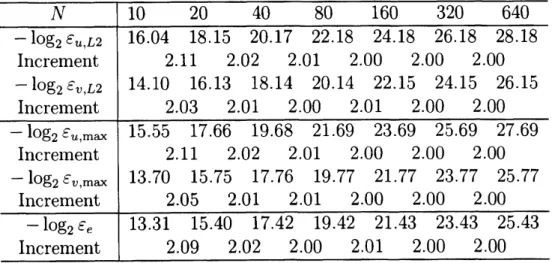
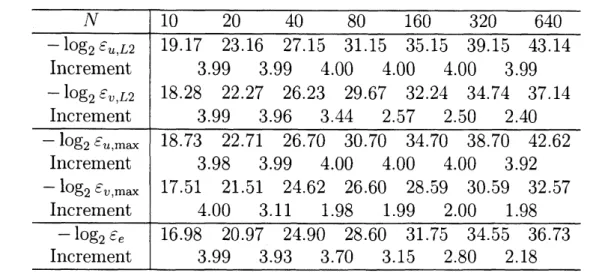
Table 2: Numerical results for (47) using RKS4
Table 1 and Table 2 show that the observed order of the leapfrog scheme and
RKS4 are more than or equal to 2. We observe that the order for $u$ of RKS4 is
higher than expected results from Theorem 4.1.
References
[1] I. Alonso-Mallo, B. Cano, M.J. Moreta, Order reduction and how to avoid it
when explicit Runge-Kutta-Nystr\"om methods are used to solve linear partial
differential equations, J. Comput. Appl. Math. 176 (2005) 293-318.
[2] I. Alonso-Mallo, B. Cano, M.J. Moreta, Stability of Runge-Kutta-Nystr\"om
methods, J. Comput. Appl. Math. 189 (2006) 120-131.
[3] A.A. Amsden, F.H. Harlow, A simplified MAC technique for incompressible
fluid flow calculations, J. Comput. Phys. 6 (1970) 322-325.
[4] K. Burrage, W.H. Hundsdorfer, J.G. Verwer, A study of B-convergence of
Runge-Kutta methods, Computing 36 (1986) 17-34.
[5] M. L. Ghrist, B. Fornberg, T.A. Driscoll, Staggered time integrators for wave
equations, SIAM J. Numer. Anal. 38 (2000) 718-741.
[6] W. Hundsdorfer, J.G. Verwer, Numerical Solution of Time-Dependent
Advection-Diffusion-Reaction Equations, Springer, Berlin, 2003.
[7] W. Hundsdorfer, Stability and B-convergence of linearly implicit Runge-Kutta
[8] T. Koto, Explicit Runge-Kutta schemes for evolutionary problems in partial
differential equations, Ann. Numer. Math. 1 (1994) 335-346.
[9] B.P. Leonard, A stable and accurate convective modelling procedure based on
quadratic upstream interpolation, Comput. Methods Appl. Mech. Engrg. 19
(1979) 59-98.
[10] P.M. Morse, H. Feshbach, Methods of Theoretical Physics, Part I. New York:
McGraw-Hill, 1953, p. 272.
[11] J.M. Sanz-Serna, J.G. Verwer, W.H. Hundsdorfer, Convergence and
order-reduction of Runge-Kutta schemes applied to evolutionary problems in partial
differential equations, Numer. Math. 50 (1986) 405-418.
[12] W. E. Schiesser, The Numerical Method of Lines. Academic Press, San Diego,
1991.
[13] M. Tabor, The Sine-Gordon Equation. \S 7.5.b in Chaos and Integrability in
Nonlinear Dynamics: An Introduction. Wiley, New York, 1989, pp. 305-309.
[14] J.G. Verwer, Convergence and order reduction of diagonally implicit
Runge-Kutta schemes in the method of lines, in: D.F. Griffiths, G.A. Watson (Eds.),
Numerical analysis (Dundee, 1985). Pitman Res. Notes Math. Ser. 140,
Long-man Sci. Tech. (1986) 220-237.
[15] J.G. Verwer, On time staggering for wave equations, J. Sci. Comput. 33 (2007)
139-154.
[16] J.G. Verwer, Time staggering for wave equations revisited, CWI-report
MAS-E0710 (preprint)
[17] G. B. Whitham, Linear and nonlinear waves, John Wiley& Sons, New York,
1999.
[18] K.S. Yee, Numerical solution of initial boundary value problem involving
maxwell $s$ equations in isotropic media, IEEE Trans. Antennas Propag. 14
(1966) 302-307.
[19] D. Zwillinger, Handbook of Differential Equations, 3rd ed. Boston, MA: