A
certain
surgery
construction
of contact 3-manifolds
(
)
(JiroADACHI
Department of Mathematics, Hokkaido University1
Introduction
The construction and classification of contact manifolds is still a basic
problem in
differential
topology. Itwas
shown byWeinstein
[W2] andEliashberg [E] that the manifold obtained from
a
contact manifold bya certain handle surgery carries a contact structure. In order to define
surgery of contact manifolds, they
use
symplectic and Stein handles. Inthis note,
a new
construction method, contact round surgery, isintro-duced. In other words, symplectic round handle is introduced. Round
handle itself has
some
geometric meanings. Therefore, it may havesome
meaning in contact topology to consider round surgery of contact
man-ifolds. An attempt to apply round handle theory to contact topology is
in [Ad2].
In this note, round surgery of contact 3-manifolds is introduced. In
other words, 4-dimensional symplectic round handles
are
constructed. Thecases
of general dimensionsare
discussed in [Ad3]. The situation is rather complicated in thatcase.
We should remark that
a
4-dimensional symplectic round handle ap-peared in [Ga]. That symplectic round handle is different from the round handle defined in this paper. Although Gay’s symplecticround
handlethere is
a
global Liouville vector fieldon
the round handle in this paper.Unfortunately,
no
application of symplectic round handle is given in [Ga].These days, Weinstein‘s contact
surgery
isone
of important tools incontact topology. In terms of contact Dehn surgery, Weinstein $s$ contact
surgery along
a
Legendrian knot isa
(-l)-surgery. Attaching thesym-plectic handle
on
theconcave
end ofthe trivial cobordism corresponds to($+$l)-surgery. Ding and Geiges [DGe] proved that every
closed
orientablecontact manifold is constructed by these two operations. And now, these
are
good tools to deal with Heegaard Floer homology (see [OS]). Thenthe contact round surgery may also be
a
good tool in contact topology.The result is described
as
follows.Theorem A. Let $M$ be
a convex
contact type subsetof
the boundaryof
a 4-dimensional symplecticmanifold
$(W, \omega)$ with respect toa
Liouvillevector
field
$X$defied
$nearM\subset W$.
Let$L\subset M$ bean
Legendnan link withtwo components with respect to the contact structure induced
on
$M$from
$X$ and$\omega$. Then the Liouville vector
field
$X$ and the symplectic structure $\omega$ extend to themanifold
obtainedfrom
$W$ by attachinga
round handleof
index $k$ along $\tilde{S}_{f}^{k}$and the
modified
boundary is alsoconvex.
We should remark that the framing of the attachment is restricted to the
so
called contact framing of Legendrian knots. Asa
corollary, we obtain the following.Corollary B. Let $(M, \xi)$
be a contact
3-manifold, and $L\subset(M, \xi)a$Legendrian link with two components. Then the
manifold
obtainedfrom
$M$ by
a
round surgery along $L$ with respect to contactframingof
$L$ hasa
contact structure.If
$(M, \xi)$ is strongly symplectically fillable, then theobtained contact
manifold
is also strongly symplecticallyfillable.
2
Round
handle and
Round surgery
Round handle
was
introduced by Asimov [As] to study the Morse-Smaleuseful tool for the study of manifolds and
some
structures on manifolds.Round handle and round handle decomposition
are
definedas
follows.Let $M$ be
a
manifold of dimension $n$ with boundary $\partial M\neq\emptyset$.Definition. A round handle of dimension $n$ and index $k$ attached to $M$
is defied
as
a pair$R_{k}=(D^{k}\cross D^{n-k-1}\cross S^{1}, f)$
of
a
product ofan
$(n-1)$-dimensional disk $D^{k}\cross D^{n-k-1}$ witha
circleand
an
attaching embedding $f:\partial_{-}(D^{k}\cross D^{n-k-1}\cross S^{1})arrow\partial M$, where$\partial_{-}(D^{k}\cross D^{n-k-1}\cross S^{1})$ $:=\partial D^{k}\cross D^{n-k-1}\cross S^{1}$ is the attaching region.
Round handles
are
used to study flow manifolds. Flow manifold isdefined
as
follows. Let $(M, \partial_{-}M)$ bea
pair ofa
manifold $M$ witha
specific union $\partial_{-}M$ of connected components of the boundary $\partial M$. The
pair $(M, \partial_{-}M)$ is called
a
flow
manifold
if there existsa
non-singularvector field on $M$ which looks inward on $\partial_{-}M$ and outward on $\partial_{+}M:=$
$\partial M\backslash \partial_{-}M$. The following propertyofflow manifolds is proved byAsimov.
Theorem 2.1 (Asimov, [As]). Let $(M, \partial_{-}M)$ be a compact
flow
mani-fold
whose dimension is greater than3.
Then, $M$ hasa
round handledecomposition.
By using round handles in stead of ordinary handles, round surgery
is defined. In other words, a round surgery corresponds to attaching
a round handle to a cobordism. Let $M$ be a manifold of dimension
$n$. A round
surgery
of index $k$ is definedas
the operation removingan
embedded int $(\partial D^{k}\cross D^{n-k}\cross S^{1})$ from $M$ and regluing $D^{k}\cross\partial D^{n-k}\cross S^{1}$
by the identity mapping of $\partial D^{k}\cross\partial D^{n-k}\cross S^{1}$.
In this paper
we
construct certain symplectic structureson
these round3
Symplectic
round
handle
3.1 Liouville vector fields and symplectizations
A contact manifold
appears
as a
hypersurface ina
symplectic manifold.This relation is given by the
so
called Liouville vector field. A vector field$X$
on a
symplectic manifold $(M,\omega)$ is calleda
Liouville vectorfield
iftheLie derivative along it
preserves
the symplectic structure: $L_{X}\omega=\omega$.
Thefollowing property is well known (see [Wl]
for
example).Lemma 3.1. Let $X$ be a Liouville vector
field
on
a symplecticmanifold
$(W, \omega)$.
If
$M\subset W$ is a hypersurface tmnsverse to $X$, then the pullback$i^{*}(X_{\lrcorner}\omega)$ is
a
contactform
on
$M_{\rangle}$ where $i:M\mapsto W$ is the inclusionmapping.
Such hypersurface $M\subset(W,\omega)$ transverse to $X$ is said to be of contact
type. When
a
contact type hypersurface isa
boundary ofa
symplectic manifold, it is said to beconvex
(resp. concave) if the Liouville vectorfield looks outward (resp. inward) there.
From another point of view, the induced contact structure depends
more
on theLiouville vector field thanon
the hypersurface. The followinglemma implies this property (see [W2]).
Lemma 3.2. Let $X$ be a Liouville vector
field
on
a syrnplecticmanifold
$(W_{)}\omega)$. And let $M_{j}\subset W_{f}j=0,1$, be hypersurfaces with the
inclu-sion mappings $i_{j}:M_{i}\mapsto W$.
Assume
that there existsa
diffeomorphism$f:M_{0}arrow M_{1}$ following the integml
curves
of
X. Then $f$ iscontactomor-phic with respect to the induced contact structures $\xi_{j}=ker(i_{j}^{*}(X_{\lrcorner}\omega))$,
$j=0,1$.
One of the most typical examples is the symplectization of
a
contactmanifold. In other words, any contact manifold with a contact form is
realized
as a
contact type hypersurface insome
symplectic manifold. Let$(M, \xi)$ be
a
contact manifold witha
contact form $\alpha$on
$M$.
The 2-form $\omega$ $:=d(e^{t}\alpha)=e^{t}(dt\wedge\alpha+d\alpha)$ isa
symplectic structureon
$M\cross \mathbb{R}$, whereis
a
coordinate of . The symplectic manifold $(M\cross \mathbb{R}, \omega)$ is calledthe symplectization of $(M, \alpha)$. The Liouville vector field
on
$(M\cross \mathbb{R}, \omega)$ is $X=\partial/\partial t$, which is transverse to $M=M\cross\{0\}\subset M\cross \mathbb{R}$, and the inducedcontact
on
$M=M\cross\{0\}$ is $\alpha$. This implies that $(M, \alpha)$ is realizedas a
contact type hypersurface in
the
symplectization $(M\cross \mathbb{R}, \omega=d(e^{t}\alpha))$. On the other hand,a
tubular neighborhood of any contact type hy-persurface is symplectomorphic to the tubular neighborhood of the hy-persurface in its symplectization (see [Adl], [Ge] for example).Lemma 3.3. Let $M$ be
a
compact contact type hypersurface in asym-plectic
manifold
$(W, \omega)$ with a Liouville vectorfield
X. Let $\alpha$ denote thecontact
form
$i^{*}(X_{\lrcorner}\omega)$ induced on $M$, where $i:M\mapsto W$ is the inclusion.Then there exists
a
local symplectomorphism between neighborhoodsof
$M=M\cross\{0\}\subset(M\cross \mathbb{R}, d(e^{t}\alpha))$ and $M\subset(W, \omega)$ which maps $\partial/\partial t$ to $X$, and $M$ to $M$ identically.
This lemma is important in the attaching procedure of symplectic round
handles in Subsection 3.3.
3.2 The model symplectic round handle
The model round handle is taken
as a
subset in $\mathbb{R}^{3}\cross S^{1}$ withsome
symplectic structure whose attaching region is of
concave
contact type and the belt region is ofconvex
contact type. Note that like Weinstein‘s$2n$-dimensional symplectic handle is defined for index $k=1,2,$
$\ldots,$$n$
(see [W2]), the 4-dimensional symplectic round handle is defined only for index $k=1$
.
First of all,
we
need the following symplectic structure and Liouvillevector field on $\mathbb{R}^{3}\cross S^{1}$. The standard symplectic structure
$\omega_{0}$ on
$\mathbb{R}^{3}\cross S^{1}$ is given
as
$\omega_{0}:=(dp\wedge dq)+dz\wedge d\phi$,
field
$X_{1}$on
$\mathbb{R}^{2n-1}\cross S^{1}$as
$X_{1}$ $:=(-q \frac{\partial}{\partial q}+2p\frac{\partial}{\partial p})+z\frac{\partial}{\partial z}$ (3.1)
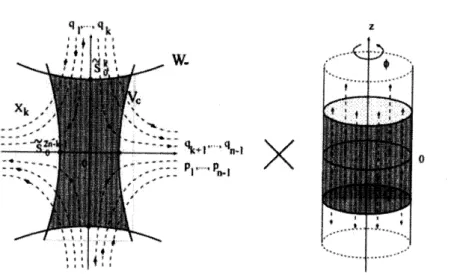
(see the dotted
curves
andarrows
in Figure 1). It is the Liouville vectorfield for the symplectic
structure
$\omega_{0}$. Note that thevector
field $X_{k}$ isthe
gradient vector field of the function
$f_{1}(p, q, z, \phi)$ $:=(- \frac{1}{2}q^{2}+p^{2})+\frac{1}{2}z^{2}$ (3.2)
with respect to the standard Euclidean metric. It is
a
Morse-like function whose critical lociare
not isolated points but circles.Now, the model symplectic round handle is defined
as
follows. In order to define it,we use
two functions $f_{1}$ above and$g_{1}(p, q, z, \phi)$ $:=-Aq^{2}+B(p^{2}+z^{2})$ (3.3)
on
$\mathbb{R}^{3}\cross S^{1}$, where$A,$ $B$
are
arbitrarypositive constants. The 4-dimensionalmodel symplectic round handle is defined
as a
domain in the symplecticspace $(\mathbb{R}^{3}\cross S^{1}, \omega_{0})$ above bounded by the following two hypersurfaces:
$W_{-}:=\{x=(p, q, z, \phi)\in \mathbb{R}^{3}\cross S^{1}|f_{1}(x)=-1\}$ , $V_{c}:=\{x=(p, q, z, \phi)\in \mathbb{R}^{3}\cross S^{1}|g_{1}(x)=c\},$ $c>0$.
These hypersurfaces do intersect and bound
a
domain if $B/A$ issuffi-ciently large.
Definition. The 4-dimensional model symplectic round handle $R_{1}^{0}$ of
in-dex 1 is defined
as
$R_{1}^{0}:=\{x=(p, q, z, \phi)\in \mathbb{R}^{3}\cross S^{1}|f_{1}(x)\geq-1, g_{1}(x)\leq c\}$ (3.4)
with the symplectic structure $\omega_{0}$ (see Figure 1).
This $R_{k}^{0}$ is homeomorphic to $D^{k}\cross D^{n-k-1}\cross S^{1}$.
a
$\cross$ $t$
Figure 1: Model round handle
Lemma 3.4. Let $(R_{1}^{0}, \omega_{0})$ be
a
model symplectic round handle.(1) The attaching region $\partial_{-}R_{1}^{0}\subset R_{1}^{0}$ is transverse to the Liouville vector
field
$X_{1}$.At
$\partial_{-}R_{1}^{0}$, $X_{1}$ looks inward.(2) The belt region $\partial_{+}R_{1}^{0}\subset R_{1}^{0}$ is transverse to the Liouville vector
field
$X_{1}$. At $\partial_{+}R_{1)}^{0}X_{1}$ looks outward.
(3) The attaching
core
$\tilde{S}_{0}^{1}\cong S^{0}\cross S^{1}$ is a Legendrian link with twocomponents in the contact
manifold
$\partial_{-}R_{1}^{0}\subset W_{-}$.
(4) $R_{1}^{0}$
can
be takenso
that its attaching region is contained in anarbi-tmry small neighborhood
of
$\tilde{S}_{0}^{1}$ in $W_{-}$.3.3 Attaching the model symplectic round handles
We attach the model symplectic round handle defined in the previous
subsection to
a
symplectic manifold in this subsection. The attachmentimplies Theorem A.
We attach the model symplectic round handle $(R_{1}^{0}, \omega_{0})$ to the following
setup. Let $(W, \omega)$ be asymplectic manifold with boundary, and $M\subset\partial W$
convex
components with respect to a Liouville vector field $X$ definednear
$M\subset W$. Let $\alpha$ denotea
contact form $i^{*}(X_{\lrcorner}\omega)$on
$M$, where $i:M\mapsto W$going to attach $(R_{1}^{0},\omega_{0})$ along
an
Legendrian link $L\subset(M, \xi)$ with twocomponents.
We attach the model symplectic round
handle
$(R_{1}^{0},\omega_{0})$as
follows. It iswell known that Legendrian knots have
a
uniquestandard contact tubularneighborhood. Therefore, there exists
a
local strict contactomorphism$\varphi:(U(\tilde{S}_{0}^{1}, W_{-}),$$\alpha_{1})arrow(U(L, M), \alpha)$ between suitable neighborhoods of
$\tilde{S}_{0}^{k}\subset\partial_{-}R_{k}^{0}\subset W_{-}$ and $L\subset M$ which satisfies $\varphi(\tilde{S}_{0}^{k})=L$
.
We maysuppose $\partial_{-}R_{k}^{0}\subset U(\tilde{S}_{0}^{k}, W_{-})\subset W_{-}$ since $\partial_{-}R_{k}^{0}$
can
be taken arbitrarilyclose to $\tilde{S}_{0}^{k}$ from the construction of the model symplectic round handle
(see Lemma 3.4). Then, from Lemma 3.3, the contactomorphism extends
to
a
symplectomorphism of neighborhoods. By this symplectomorphism,two symplectic manifolds $(R_{k}^{0}, \omega_{0})$ and $(W, \omega)$
are
glued symplectically.3.4 Contact round surgery
Now, we define the contact round surgery
as
follows. Thenwe
obtainCorollary $B$ almost directly. Let $(M, \xi=ker\alpha)$ be
a
contact 3-manifold,and $L\subset(M_{i}\xi)$
a
Legendrian link with two components. In general,round
surgery of an
$(2n-1)$-dimensional manifold $M$ is defined byat-taching
a
round handle ofdimension $2n$ to $M\cross[0,1]$ (see Subsection 2 forprecise definition). Then
we
needa
symplectic structureon
$M\cross[0,1]$. We take $M\cross[0,1]$as a
subset of the symplectization $(M\cross \mathbb{R},$ $d(e^{t}\alpha)$of the given contact manifold $(M, \xi)$. The induced contact structure
on
$M\cross\{i\}$ is $\xi$ for both $i=0,1$
.
Regarding $L$as
a
Legendrian link in $(M\cross\{1\}, \xi)$, we can attach a symplectic round handle of index 1 along$L$ by Theorem A. Since the modified end is also
convex
from Theorem $A$,a
contact structure is induced there. Thuswe
obtaineda new
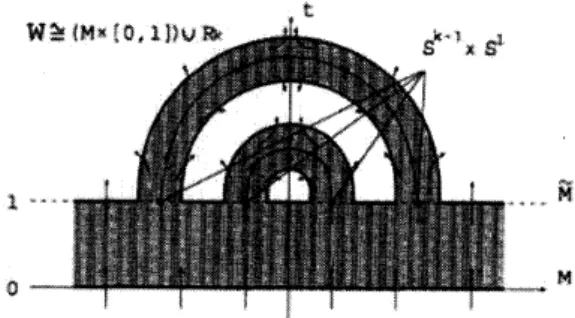
contactmanifold. We call this operation
a contact
round surgery (see Figure 2).Like Weinstein’s contact surgery,
we
can
discuss the strong symplec-tic fillability by the contact round surgery. A contact manifold $(M, \xi)$Figure 2: Contact round surgery
boundary of a compact symplectic manifold $(W, \omega)$ and the induced
con-tact structure is also $\xi$
.
The manifold obtained from $(M, \xi)$ bya
contactround surgery and $(M, \xi)$ itself have
a
symplectic cobordism $(\tilde{W},\tilde{\omega})$con-structed by attaching
a
symplectic handle. Note that $(M, \xi)$ isa
convex
boundary of $(W, \omega)$ and
a
concave
end of $\tilde{W},\tilde{\omega}$). Therefore, theyare
glued symplectically along $(M, \xi)$. Then
we
obtaina
symplectic filling ofthe surgered contact manifold.
References
[Adl] J. Adachi, Liouville setup and contact cobordism, Hokkaido Math. J. 25 (1996),
637-650.
[Ad2] J. Adachi, Round surgery and contact structures, (preprint).
[Ad3] J. Adachi, Contactroundsurgeryandsymplectic roundhandlebodies, (preprint). [As] D. Asimov, Round handles and non-singularMorse-Smalefiows, Ann. of Math.
(2) 102 (1975), 41-54.
[DGe] F. Ding, H. Geiges, A Legendrian surgery presentation ofcontact 3-manifolds,
Math. Proc. Cambridge Philos. Soc. 136 (2004), 583-598.
[E] Ya. Eliashberg, Topological characterization
of
Stein manifoldsof
dimension$>2$, Internat. J. Math. 1 (1990), 29-46.
[Ga] D. Gay, Four-dimensional symplectic cobordisms containing three-handles,
Geom. Topol. 10 (2006), 1749-1759.
[Ge] H. Geiges, An introductiontocontact topology, Cambridge Studiesin Advanced
[M] J. Morgan, NonsingularMorse-Smale
flows
on3-dimensionalmanifolds,Topol-ogy 18 (1979), 41-53.
[OS] B. Ozbagci and A. Stipsicz, Surgery on contact 3-manifolds and Steinsurfaces,
Bolyai Society Mathematical Studies, 13, Springer-Verlag, Berlin, 2004.
[Wl] A. Weinstein, On the hypotheses
of
Rabinowitz’ periodic orbit theorems, J.Dif-ferential Equations 33 (1979), 353-358.
[W2] A. Weinstein, Contact surgery and symplectic handlebodies, Hokkaido Math. J.
20 (1991), 241-251.
Department ofMathematics,
Hokkaido University,
Sapporo, 060-0810, Japan.