Solving Cubic Equations by
ORIGAMI
森継修–
SHUICHI MORITSUGU’
筑波大学大学院図書館情報メディア研究科
GRADUATE SCHOOL OF LIBRARY, INFORMATIONAND MEDIASTUDIES, UNIVBRSITY OF TSUKUBA
Extended
Abstract
This article isanexcerpt ofthefull versionpaper[l] with theotherreferencesomitted, and itspurpose
is toshowan algebraic proof of the method for solvingcubicequations byorigami (paper folding).
In the early $1980’ \mathrm{s}$, H.Abe solved the construction problems using origami that are unsolvable in
Euclideangeometry,suchas angle trisection and doublingcubes. This paper expands$l\mathrm{I}.\mathrm{A}\mathrm{b}\mathrm{e}\mathrm{s}$methods
to general cubic equationsand showsthemain resultsin three propositions. Foran algebraic proof, we
solve the radical membership problem in polynomial ideals $\infty$mputing a Gr\"obner basis together with
constraints of parameters, which correspond to geometrically degenerate cases. Consequently, cubic
equationsareclearlysolved as constructionproblems.
First,weexpimdH.Abe’s angle trisectionmethod(1980)tothecasewith obtuseangles,and prove it
by a Gr\"obner basis. Assuming asemi-transparentsheet of origami, we can trisect anarbitraryobtuse
ange
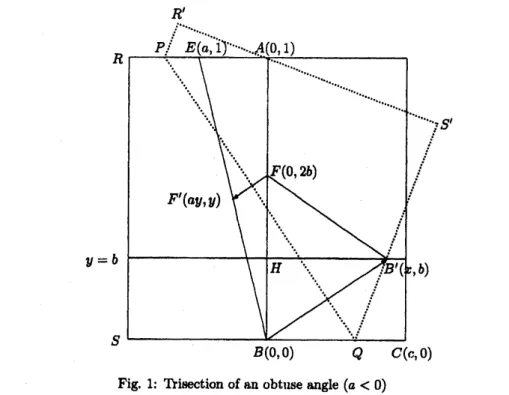
asshowninFig. 1.Proposition 1 (Irigection of
an
obtuse angle by origami)Letpoints$A(\mathrm{O}, 1),$$B(\mathrm{O},0)$ and$C(r,, 0)(\exists \mathrm{c}>0)$be$\hslash \mathrm{x}d$,and$E(a, 1)$ be$\mathrm{c}b\alpha n\mathrm{n}$ withanarbitrary$a(<0)$
.
Then the trisection of$\angle BBC$ isconstructed as follows.
(i) Mark twopoints$H(\mathrm{O}, b),$ $F(\mathrm{O}, 2b)$ with a properlength$b(>0)$
.
(ii) Drawthe horizontal line$y=b$ through $H$
.
(iii) Fold thepaperto place simultaneously$F$ontoBEand$B$onto$y=b$
.
(iv) If
we
let the point$B$ be mapped to point$B’$,
thenwe
have $\angle B’BC=(\angle EBC)/3$.
Proof Let thepoints$F$and$B$bemapped to$F$‘$(ay,y)$and$B$‘$(x,b)$respectively. $i^{\mathrm{F}\mathrm{r}\mathrm{o}\mathrm{m}}$the symmetry
byfoldingwiththecrease$PQ$,wehaveanisoscelestrapezoid$F’BB’F$
.
(1) Since$F’B=FB’$, wehave$f_{1}:=(ay)^{2}+y^{2}-(x^{2}+b^{2})$
.
(2) Since$F’F||BB’$ means $(2b-y)/(-ay)=b/x$, we have$f_{2}:=(2b-y)x+b(ay)$
.
(3) The slopes of$BB’,$ $BF’$and$B’F$are $k=b/x,$ $k_{1}=1/a$ and$k_{2}=b/(-x)$ respectively. Thenwehave
$\tan\angle B’BF’=\frac{k_{1}-k}{1+kk_{1}}=\frac{x-ab}{ax+b}$ , $\tan\angle FB’B=\frac{k-k_{2}}{1+k_{2}k}=\frac{2bx}{x^{2}-b^{2}}$ Therefore,from $\angle B’BF’=\angle FB’B$, it isdeducedthat $fs:=(x-ab)(x^{2}-b^{2})-2bx(ax+b)$
.
Fig. 1: Trisection ofanobtuseangle $(a<0)$
(4) The conclusion to be proved is $\angle EBC=3\angle B’BC$
.
Substituting $\tan\theta=\tan\angle B’BC=b/x$ and$\tan 3\theta=\tan\angle EBC=1/a$totheformtllafor triple angle,
we
obtain$\tan 3\theta=\frac{3\tan\theta-\tan^{3}\theta}{1-3\tan^{2}\theta}$
Henceweput$p:=(x^{3}-3b^{2}x)-(3bx^{2}-b^{\theta})a$
.
$\Rightarrow$ $\frac{1}{a}=\frac{3bx^{2}-b^{3}}{x^{\theta}-\theta b^{2_{X}}}$
(5) Weregard$J=(f_{1}, f_{2}, f_{3},1-zp)\mathrm{a}_{\iota}\mathrm{s}$anidealin$\mathrm{Q}(a,b)[x,y, z]$
.
ComputingitsGr\"obnerbasiswiththetotal degree lexicographicorder$(x>y>z)$ ,we obtain $J=(1)$, namely,$p\in\sqrt{(f_{1},f_{2},f_{3})}$
.
Hence theconclusion$p$iscorrect andthepoint$B’(x,b)$ trisectsanarbitrarily given angle $\angle EBC$
.
(6) Collecting$\mathrm{a}\mathrm{U}$ denominatorsduringthecomputation of
the Gr\"obner basis,we alsoobtain subsidiary
conditionsfor geometricalnondegeneracy. The constraint forparameters is$\{a\neq 0, a^{\mathit{2}}+1\neq 0, b\neq 0\}$
and it shows thatthisproposition holds foranyobtuse angle$\angle EBC>90^{\mathrm{O}}(a<0)$
.
Remark 1
H.Abe’soriginalmethod isprovedfor acuteangles$(a>0)$
.
For therectangularcase$(a=0),$ $t$wopoints$F$ and$F’$in Fig. 1 ooincide, and theydo not formanis($\mathrm{x}\mathrm{v}\mathrm{o}\mathrm{e}l\infty$trapezoid. Though thesamepolynomials
$f_{1},$$f_{2},$ $f_{3}$do nothold, $\Delta FBB’$ formsaregular triangle insteadandweobtain $\angle B’BC=30^{\mathrm{o}}$
.
Therefore, $\mathrm{a}rb\mathrm{i}tr\mathrm{a}\iota \mathrm{y}$ angles$(0^{\mathrm{O}}<\theta<180^{\mathrm{o}})$can be trisected byorigami.Second, weshowanorigami solution to general cubic equations$t^{\theta}+at^{2}+bt+c=0(a,b, r, \in \mathrm{R})$
.
Ifwerestrict$\{a=0, b=0, c, =-2\}$inthefollowingformulation, it coincides to H.Abe$‘ \mathrm{f}t\mathrm{f}t\mathrm{o}\mathrm{l}\mathrm{u}\mathrm{t}\mathrm{i}\mathrm{o}\mathrm{n}(\mathrm{c}\mathrm{a}.1981)$
$y=-c$
$A(-1, a)$
Fig. 2: Asolution$\overline{RP}$
for the cubicequation$t^{3}+at^{2}+bt+r,$ $=0$
Proposition 2 (Construction for cubic equations- 1)
Given a cubic equation$t^{3}+at^{2}+bt+c=0$, we$\mathrm{a}\iota\tau\partial ng\mathrm{e}$the points$A(-1, a),$ $B(-b, c)$ ona$s\mathrm{q}$uareorigami
asFig. 2, where$ti<0$isassumed. Then areal solution to theequation isconstructedasfollows.
(i) Draw the lines$x=1$ and$y=-C$
.
(ii) Fold thepaperto placesimultaneously$A$onto$x=1$and$B$ onto$y=-C$
.
(iii) Ifwelet$P$ bethe midpoint of the segment$AA$‘, then$RParrow$givesareal solution to the
$\mathrm{e}\mathrm{q}$uation.
Proof Let the point $A(-1, a)$ be mapped to $A’(1, a+2y)$, and $B(-b, \mathrm{r},)$ to $B’(x, -c)$
.
Then, themidpointsof$AA’$and $BB’$ are$P(\mathrm{O},a+y)$and$Q((x-b)/2,0)$respectively.
(1) IFbom the$\mathrm{f},3$mmetry by folding with thecrease$PQ$, wededuce the following polynomials:
$AB=A’B’$ $\Rightarrow$ $f_{1}:=-x^{2}+2x-4y^{\mathit{2}}-4(a+c,)y+b^{2}-2b-4ac$,
$AA’||BB’$ $\Rightarrow$ $f_{\mathit{2}}:=xy+by+2c$ ,
$AA’\perp PQ$ $\Rightarrow$ $f_{3}:=-X+2y^{2}+2ay+b$
.
(2) The conclusion to be proved is that $RParrow(=y)$ is a solution tothe given equation. Hence, we let
$p:=y^{3}+ay^{2}+by+ti$
.
(3) Weregard$J=(f_{1}, f_{2}, f_{3},1-zp)$
as
an idealin$\mathrm{Q}(a,b, c)[x,y,z]$.
Computing its Gr\"obner basiswiththe totaldegreelexicographicorder $(x>y>z)$, weobtain$J=(1)$ and the conclusion$p$iscorrect.
(4) Subsidiarycondition for parameters is emptyand it shows that thisproposition holds for any real coefficients$a,b,$$\mathrm{c}$
.
Remark 2
If thegiven cubic equation$h\epsilon.\mathrm{s}$three real zeros, there exist three waysoffolding.
For the$\mathrm{C}\mathrm{K}ec>0$, Fig. 2 shouldbe$t$urned$up_{\mathrm{L}}\backslash ’ ide$down. If
$c,$$=0$, thisconstruction essentially gives$\mathrm{g}$
real solution toquadrat$ic$equations. Therefore, given cubic$e\mathrm{q}$uatiomt$t^{3}+at^{2}+bt+c,$$=0$witharbitrary
realcoefficients, itsreal$z\mathrm{e}\mathfrak{n}$) $(s)$can beconstructed by origami.
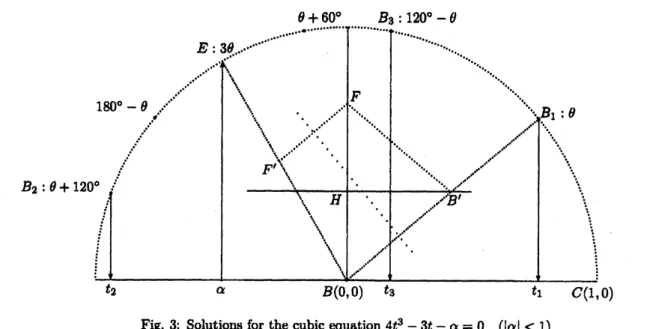
Fig. 3: Solutions for thecubic equation4$t^{3}-3t-\alpha=0$ $(|\alpha|<1)$
Finally, we show another origami solutiontocubicequations$t^{\theta}+at^{2}+bt+c=0(a,b, \mathrm{r}, \in \mathrm{R})$ with
three realzeros. The $\mathrm{f}\mathrm{o}\mathrm{U}\mathrm{o}\mathrm{w}\mathrm{i}\mathrm{n}\mathrm{g}$ propositionisbasedon aclassicalformula,but it
cannotbe constructed
withinEuclideangeometry becallse angletrisectionisnecessary.
Proposition 3 (Construction forcubic equations- 2)
A cubicequation$x^{3}+3px+2q=0$hasthree real zeros,$itfp^{3}+q^{2}<0(p<0)$ fromitsdiscriminant. If
welet$x=2\sqrt{-p}\cdot t$, then theabove$\mathrm{e}q$uation is transformed into
$4t^{3}-3t-\alpha=0$
$a= \frac{q}{\sqrt{-p^{3}}}$ $(-1<\alpha<1)$
.
(I)Compared with the triple angle formulacos39 $=4\mathrm{c}\alpha;^{3}\theta-3\cos \mathit{9}$, let a $=\infty \mathrm{s}3\theta$ as $0^{\mathrm{o}}<3\theta<180^{\mathrm{o}}$
.
Then,weobtainthe three realzerosfor (I) :
$t=\infty \mathrm{s}\mathit{9}$, $\mathrm{c}\infty(\theta+120^{\mathrm{O}})$, $\mathrm{c}\mathrm{o}\mathrm{e}(\theta+240^{\mathrm{O}})$ (II)
Thethirdoneisrewrittenas$\mathrm{c}\mathrm{o}\mathrm{e}(\mathit{9}+240^{\mathrm{O}})=\mathrm{c}\omega(\theta-120^{\mathrm{o}})=\mathrm{c}\alpha;(120^{\mathrm{O}}-\theta)=\mathrm{c}\mathrm{o}\mathrm{e}((180^{\mathrm{o}}-\mathit{9})-60^{\mathrm{o}})$
.
Sinoe $0^{\mathrm{O}}<\theta<60^{\mathrm{Q}}$, all thezeros (II)arefound in theupper semicircle.InFig. 3,
we
showanexample of construction for agiven equation$4t^{3}-\mathit{3}t+1/2=0$ (a$=-1/2$).(i) Mark the point $B$ on the
upper
semicircle whose orthogonal projection is$x=\alpha$.
In this example,(ii) Trisect $\angle EBC$by Prop. 1 using origami, andweobtain the trisector$BB$‘. Then,markthepoint $B_{1}$
onthe semicircle.
(iii) The orthogonal projection of$BB_{1}arrow$ gives
the firstzero : $t_{1}=\alpha$)$\mathrm{s}\theta=\cos 40^{\mathrm{Q}}$
.
(iv) Usinga compass, constmict$\theta+120^{\mathrm{O}}(=\theta+2\mathrm{x}60^{\mathrm{O}})$
,
andwe
obtain$B_{\mathit{2}}$.
Then, the projectionof$\overline{BB}_{2}$
givesthe secondzero: $t_{2}=\omega\S 160^{\mathrm{o}}$
.
(v) Using a$\mathrm{c}o$mpass, construct $(180^{\mathrm{O}}-\theta)-60^{\mathrm{o}}$, and we obtain $B_{3}$
.
Then, theprojection of$BB_{3}arrow$ givesthethirdzero : $t_{3}=\omega \mathrm{s}80^{\mathrm{o}}$
.
1
In summary, constructing realzerosforcubic equationsby origamiis discussed in thispaper,and two
methods areproposedtogetherwithalgebraic$\mathrm{p}\mathrm{r}\infty b$usingGr\"obnerbases. Thosearerespectively related
toclassicalorigamiconstructionproblemsas follows.
$\bullet$ Prop. 2: Expansionof the method fordoublingcubes. $\bullet$ Prop. 3
:
Application of the method for angle trisection.In futurework,followi $\mathrm{g}$problemsshould bestudiedto expand the present results.
$\bullet$ How torepresent complexsolutions using origami.
$\bullet$ How to solvequartic equationsbyorigami. In principle, it is reduced to solving auxihiary equations
with degrees two andthree, butits clear representation is not known yet.
References
[1] Moritsugu, S.: Solving Cubic Equations by ORIGAMI, $\mathcal{I}\succ ans.Japan$Soc.Indust.Appl.Math., 16(1),