Numerical
methods
of
calculating
projection
to
positive
eigenspace*1
大阪大学基礎工学研究科 田中冬彦
Fuyuhiko Tanaka
Graduate
School
ofEngineering Science Osaka UniversityAbstract
Recently, Sakashita andNagaoka presented their researchon numerical
sim-ulatipn of asymptotic methods in quantum statistics. Their method heavily
depends on accurate calculation of all the eigenvalues and eigenvectors of a
hugeHermitianmatrix. However, onlyaprojectionoperatortothe eigenspaee
corresponding to positive eigenvalues is necessary. We propose two different
numerical methods, both of which avoid numerical diagonalization.
1
Basic
Motivation
Recently, Sakashita and Nagaoka [9] has worked for numerical simulation of
asymp-totic methods in quantum statistics. Their method heavily depends on accurate
calculation of all the eigenvalues and eigenvectors of
$\{\rho^{\bigotimes_{1}n}-k\rho_{2}^{\otimes n}>0\}$, (1)
where $n$ is sufficiently large integer, $k$ is a real constant, and
$\rho_{1}$ and $\rho_{2}$
are
densitymatrices in the two-dimensional Hilbert space. The notation $\{X >0\}$ for a given Hermitian matrix $X$ is defined by
$\{X>0\}:=a:\sum_{\lambda_{a}\in\sigma(X)}, \lambda_{a}>0^{E_{a}}$’
where$\sigma(X)$ denotesthe set ofeigenvalues (spectrum) of$X$and$E_{a}$ isaprojection
oper-ator corresponding to the eigenvalue $\lambda_{a}$
.
Other projection operators,$\{X<0\},$ $\{X=$
$*1$
$0\}$
are
also defined in thesame manner.
The above projection operator (1) is indeed the quantum Neyman-Pearson test [4] for $\rho_{1}^{\otimes n}$ vs $\rho_{2}^{\otimes n}(k$ is determined according to the significance level Asymptotic behavior of some quantities derived from (1) has theoretical importance [6, 3, 5]. However,
our
proposed methodsare
very general and the author believes that theyare
important apart from quantum statistical significance.Efficient computation of all the eigenvalues and eigenvectors
of a
huge butstruc-tured Hermitianmatrix$X$isthe
essence
ofthe previousresult [9]. However,a
general-purpose method (diagonalization of
a
matrix)was
applied to numerical computationofthe projection operator $\{X>0\}$ while not eigenvalues themselves but their signs
are
necessary. Thus, a basic question arises: Is there any other numerical methodcomparable to the previous approach? Since the workshop,
some
discussions withSakashita have continued and finally
we
obtain two numerical methods of calculating $\{X >0\}$.
Both1nethods
avoid the numerical diagonalization ofa
Hermitian matrix to compute the projection operator.2
Problem Setting
Suppose that a Hermitian
matrix
$X$ ina
$d$-dimensional complex vector space isgiven. $(d is$ assumed $to be$ very large, $say, d=10^{6}.)$ Our
purpose here
is to proposea
numerical method of computing projection operators without numerical diagonal-ization.$\{X>0\}, \{X<0\}, \{X=0\}.$
We obtain two methods in the present article.
(i) Monte Carlo optimization (ii) Topological Method
Monte Carlo optimization is
one
of the mostcommon
optimization methods (See,e.g., Robert and Casella [8]). Topological Method
uses
the stability of some points ina
discrete-time dynamical system (See, e.g., Guckenheimer and Holmes [1] for dynamical systems). The latter method is developed by the author in order to dealwith
our
problem.3
Monte Carlo optimization
The first method applies the well-known optimization technique to
our
specificproblem. The basic idea is very simple. We construct the objective function
so
that its maximizer is the desired projection $\{X >0\}$.
Our method usessome
results inclassical and quantum hypothesis testing for simple hypotheses (See, e.g., Hayashi [2]
for basic notations and terminology).
Definition 1. Let $M:=\{M_{x}\}_{x\in \mathcal{X}}$ denote
a finite-valued
POVM $(|\mathcal{X}|<\infty)$.
The set of test with $M$ is defined by$\mathcal{P}_{M}:=\{T=\sum_{x}\phi(x)M_{x}:0\leq\phi(x)\leq 1, \forall x\in \mathcal{X}\}$
and the whole set of test is defined by
$P_{full}:=\{T:0\leq T\leq I\}.$
(By definition $\mathcal{P}_{M}\subset \mathcal{P}_{full}.$)
It is easy to seethat both $\mathcal{P}_{M}$ and $\mathcal{P}_{full}$
are
closed (compact) andconvex.
We giveForgeneral algorithm,
we can
select the candidatedistribution$\mu(U)$ tobeindepen-dent of the current $M^{(n)}$
.
Practically speaking, it is inefficient and it would be fasterto generate $U$ accordingto the current $M^{(n)}$ if
we
assume
some
conditionson
$X.$It is easily
seen
that $\sup\{RTX : T\in \mathcal{P}\}$ is achieved when thesubset
$\mathcal{P}\subseteq \mathcal{P}_{full}$ iscompact. In order to understand the above algorithm,
we
need three lemmas (thoseare easy to prove, thus, proofs are omitted
Lemma 1. Let $X$ be a Hermitianmatrix and $M=\{M_{x}\}_{x\in \mathcal{X}}$ be
a
POVM. Then$\tilde{M}:=\sum_{x:TrXM_{x}>0}M_{x}$
achieves the following maximum.
The above result is anotherformof the result inclassicalBayesian hypothesis testing (See, e.g., Chap.5 in Robert [7] for Bayesian testing).
Now
we
define$E_{U}:=\{UE_{1}U^{*}, . . . , UE_{d}U^{*}\},$
$\tilde{E}_{U}:=\arg\max\{TxTX:T\in \mathcal{P}_{E_{U}}\}$
for every unitary matrix $U\in \mathcal{U}$
.
In particular, thefollowing holds.
Lemma 2. For
a
standard PVM $E$ fixed,$\mathcal{P}_{full}=\overline{co\{\mathcal{P}_{E_{U}}:U\in \mathcal{U}\}},$
where $co\{A\}$ denotes the closed
convex
hull ofa subset $A\subset \mathcal{P}_{full}$ and $\mathcal{U}$ denotes thewhole set ofunitary matrices.
For
a
pair ofsubsets
satisfying $\mathcal{P}_{1}\underline{\subseteq}\mathcal{P}_{2},$max{TrTX:
$T\in \mathcal{P}_{1}$}
$\leq\max\{hTX_{\dot{\iota}}T\in \mathcal{P}_{2}\}$holds. Using this monotonicity and the above Lemma 1 and Lemma 2,
we
easily obtain the following lemma, which is essential toour
algorithm.Lemma 3. For
a
standard PVM $E$ fixed, the following holds.$\{X>0\}=\max\{$
TrTX
: $T\in \mathcal{P}_{full}\}$$= \max\{\max\{$
TrTX
: $T\in \mathcal{P}_{E_{U}}\}:U\in \mathcal{U}\}$ $= \max\{h\tilde{E}_{U}X:U\in \mathcal{U}\}$Clearly the last equality in Lemma 3
assures
the validity of our algorithm. Fora
sufficiently large $n,$ $M^{(n)}\approx\{X>0\}$
.
The projection to negative eigenspace $\{X<0\}$4
Topological
Method
First we deal with exceptional
cases
whererankX $=1$.
Innumerical
calculationwe
do not have this information on X. $($Again, $we$ emphasize that $X is a$ huge matrix.$)$
Without diagonalization and knowing eigenvalues,
we
can
decide whether rankX is equal toone or
not by calculating $RX^{2}$ and $(^{r}RX)^{2}$.
When $X$ isa
Hermitian matrix,$hX^{2}\geq(RX)^{2}$ holds. In particular, rankX $=1$ if and only if Tr$X^{2}=(hX)^{2}$ and
$X\neq 0.$
Ifwe know rankX $=1$, then dividing $X$ by the scalar $TrX$ yields
$\{X>0\}=\{\begin{array}{ll}\frac{1}{TrX}X, X>0,0, X<0,\end{array}$
$\{X<0\}=\{\begin{array}{ll}0, X>0,\frac{1}{TrX}X, X<0,\end{array}$
$\{X=0\}=I-\{X>0\}-\{X<0\}.$
Now
we
assume
that rankX $\geq 2$ and presentour
main result. In this case,we
may consider the maximum of the absolute eigenvalue is smaller thanone
for simplicity. Indeed $\Vert X\Vert_{2}$ $:=\sqrt{hX^{2}}>\Vert X\Vert_{\infty}$ when rankX $\geq 2$ and \’ifwe
take $Y$ $:=X/\Vert X\Vert_{2}$then $\{Y>0\}=\{X>0\}$ holds.
Our main result is due tothe following elementaryresult in
a
discrete-time dynam-ical system.Lemma4. Thereexisttwo positiveconstants$b>0$ and $c>0$and
a
third order poly-nomial $h(x)$ satisfying the following. For the initial value $x_{0}\in(-c, c)$, we recursivelydefine
and the sequence converges to three values depending
on
the initial value, i.e.,$\lim_{narrow\infty}x_{n}=\{\begin{array}{ll}b, 0<x_{0}<c0, x_{0}=0,-b, -c<x_{0}<0\end{array}$ (2)
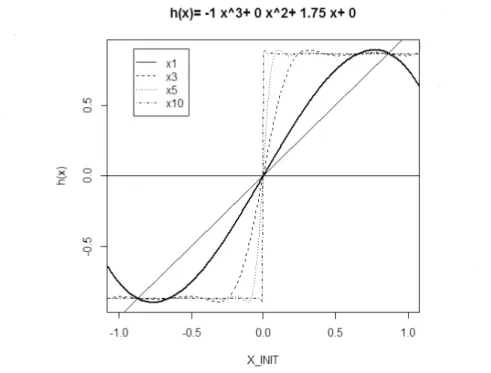
One example is $b=c=\sqrt{3}/2$ and $h(x)=-x^{3}+7/4x$ ($c$ could be larger). Fig. 1 shows thegraph of$x_{1},$ $x_{3},$ $x_{5},$ $x_{10}$
as
a
function ofthe initialvalue$x_{0}$.
Wesee
that $x_{10}$is nearly a step
function
taking three values $-\sqrt{3}/2,$$0,$ $\sqrt{3}/2$ according to the initial value$x_{0}$.
It impliesthat 10 timesrepetitionof the calculation of$h(x)$ isenough except when $x_{0}$ is very close to 0.0.$h\{x|=\cdot 1x^{A}3*0x^{A}2*1.75x*O$
$-10$ $-0.5$ 00 0.$5$ $\{0$
$X_{-}\prime N/T$
Fig. 1: Example of $h(x)=-x^{3}+7/4x.$
4.1
Our
Algorithm
When the maximum absolute eigenvalue of $Y$ is smaller than one, the following
formula is used.
$\lim_{narrow\infty}(I-Y^{2})^{n}=\{Y=0\}.$
Thus, the projection to the
nonzero
eigenspace,$\{Y\neq 0\}=\{Y>0\}+\{Y<0\}=I-\{Y=0\}$
is easily obtained by numerical computation. If
we can
compute $\{Y>0\}-\{Y<0\}$as
above, then we obtain a numerical method of computing $\{Y>0\}.$If we do not impose any condition, then
we
coulduse
the following analytical formula, generally intractable in numerical computation. Takea
sequence ofreal-valued analytical functions $\{f_{n}\}$ satisfying
$\lim_{narrow\infty}f_{n}(x)=\{\begin{array}{ll}1, x>0,0, x=0,-1, x<0.\end{array}$
Then, for
a Hermitian
matrix $Y$we
obtain$\lim_{narrow\infty}f_{n}(Y)=\{Y>0\}-\{Y<0\}.$
$f_{n}(x)=\tanh(nx)$isatypicalexample. There
are
too manycandidatesotherthan thisfunction. However, for example, numerical computation of$\tanh(nY)$ is troublesome. The matrix function $e^{nY}$ is intractable
as
$narrow\infty$ in numerical computation. Evenif
we usethe Taylor expansion of$\tanh(x)$, the higher order is more essential as $narrow\infty.$Thus, we impose
some
conditions onour
numerical method.(i) Not solving any eigenvalue problemor linear equation
(ii) Not using numerically unstable calculations such
as
matrix inverseor
matrix determinantUnder these conditions,
we
finda
simplemethod
due to the last lemma.Theorem 1. We fix a Hermitianmatrix$Y$with maximum absolute eigenvaluesmaller
than
one.
We take positive constants $b>0,$$c>0$ and $h(x)$ satisfying the condition(2). Let
us
define $Z_{0}$ $:=Y/c$ and $Z_{n+1}$ $:=h(Z_{n})$, $n=0$, 1, 2,.
.
.
recursively. Then,$\frac{1}{b}hmZ_{n}narrow\infty=\{Y>0\}-\{Y<0\}$
holds.
Its proof is also elementary due to Lemma 4,
The main point here is that
we
derivea
recursive wayof obtaining $\{Y>0\}-\{Y<$$0\}$ by using only matrix multiplication and summation. As
an
illustrative example,we give
an
explicit form. $Z_{0}= \frac{2}{\sqrt{3}}Y,$$Z_{1}=h(Z_{0})=-(Z_{0})^{3}+7/4Z_{0},$
$Z_{2}=h(Z_{1})=-\{-(Z_{0})^{3}+7/4Z_{0}\}^{3}+7/4\{-(Z_{0})^{3}+7/4Z_{0}\}$,
. . .
For a suffciently large $n$, we obtain $\frac{r_{3}}{2}Z_{n}\approx\{Y>0\}-\{Y<0\}.$
5
Concluding
Remarks
In the present article, we proposed two numerical methods to compute $\{X >0\}$
without numerical diagonalization. We
showed
the result of the numericalexperimentof the latter methodfor realscalar values. In addition,
we
tried to performnumericalcomputation of the latter one for $2\cross 2$ matrices, which will be reported later. It
was surprisingly
easy
to implement andconverges
well. Numerical experiment forhuge matrices, which
was
the original motivation, and detailed comparison with the previous result from the viewpoint of efficiency, robustness tonumerical errors are
Acknowledgments
This work
was
supported by the Grant-in-Aid for YoungScientists
(B)(No. 24700273) and the Grant-in-Aid for Scientific Research (B) (No. 26280005). The author is also grateful to all ofparticipants for fruitful discussions in the RIMS
workshop.
REFERENCES
[1] J. Guckenheimer and P. Holmes: Nontinear Oscillations, Dynamical Systems, and
Bifurcations of
Vector Fields (Applied Mathematical Sciences), Springer-Verlag, New York, 2002.[2] M. Hayashi: Asymptotic
Theow
of
Qwantum StatisticalInference.
WorIdScien-tific, Singapore, 2005.
[3] M. Hayashi: Errorexponent in asymmetric quantum hypothesis testing and its application to classical-quantum channel coding. Phys. Rev. A, vol. 76, no. 6
(2007), 062301.
[4] C. W. Helstrom: Quantum Detection Theory. Academic Press, New York,
1976.
[5] H. Nagaoka: The
converse
part ofthe theorem for quantum Hoeffding bound. arXiv: quant-ph/0611289, 2006.[6] H. Nagaoka and M. Hayashi: Aninformation-spectrum approach to classical and quantum hypothesis testing for simple hypotheses.
IEEE
$\mathcal{I}Vans$.
Inf.
Theory, vol. 53no.
2 (2007), 534-549.[7] C. P. Robert: The Bayesian Choice: FVom Decision-Theoretic Foundations to Computational Implementation. Springer, New York, 2001.
[8] C. P. Robert and G. Casella: Monte Carlo Statistical Methods. Springer, New York, 2005.
[9] T. Sakashita and H. Nagaoka: A numerical study of hypothesis testing for
quantumi.i.d. states. Asian