ONE-STEP EXTENSIONS OF SUBNORMAL 2-VARIABLE WEIGHTED SHIFTS
SANG HOON LEE
(BASED
ON JOINT WORK WITH R. CURTO AND J.
YOON.)
1.
INTRODUCTION
Consider
the
following reconstruction-of-the-measure
problem:
Problem
1.1 (A).
Given two
probability
measures
$\mu_{1}$and
$\mu_{2}$on
$\mathbb{R}_{+}^{2}$,
find
necessary
and
sufficeint
conditions
for
the existence
of
a
probability
measure
$\mu$on
$\mathbb{R}_{+}^{2}$
such
that
(1.1)
$\frac{sd\mu(s,t)}{\int sd\mu(s,t)}=d\mu_{1}(s, t)$and
$\frac{td\mu(s,t)}{\int td\mu(s,t)}=d\mu_{2}(s, t)$.
Note that (1.1) implies that
$td\mu_{1}(s, t)=\lambda sd\mu_{2}(s, t)$
for
some
$\lambda>0.$
In
this talk,
we
solve
this
interpolation problem using techniques
from
multivariable
operator theory, namely
the
theory
of 2-variable weighted
shifts.
Definition
1.2.
$T\in \mathcal{B}(\mathcal{H})$:
normal
if
$T^{*}T=TT^{*},$
subnormal
if
$T=N|_{\mathcal{H}}$, where
$N$
normal and
$N(\mathcal{H})\subseteq \mathcal{H},$hyponormal
if
$[T^{*}, T]$
$:=T^{*}T-TT^{*}\geq 0.$
Definition
1.3.
$T\equiv(T_{1}, \cdots, T_{n})$
: hyponormal
if
$[T^{*}, T]$
:
$=$$([Tj, T_{i}])_{i,j=1}^{k}$
$= (\begin{array}{llllll}[_{\tau^{i^{T_{1}|}}}^{\tau_{i^{T_{2}]}}},,\cdots [T\cdot,T_{l}|[T_{2}^{2}\cdot,T_{2}|\cdots \cdots \cdots \cdots [T\cdot,T_{l}][T_{n}^{\mathfrak{n}}\cdot,T_{2}|\vdots \vdots .\vdotsl^{T}i^{T_{\mathfrak{n}}]}’ \mathfrak{l}^{T_{2}}.T_{n}| \cdots [T_{n}\cdot ’ T_{n}]\end{array})\geq 0.$
Definition 1.4. The
$n$-tuple
$T\equiv(T_{1}, T_{2}, \cdots\rangle T_{n})$is
said to
be
normal
if
$T$
is commuting and each
$T_{i}$is
normal
and
$T$
is
subnormal
if
$T$
is the restriction
of
a normal
$n$-tuple
to
a common invariant
subspace.
$\bullet$
Clearly, normal
$\Rightarrow$subnormal
$\Rightarrow$hyponormal.
$\bullet$
Normality(sub-,
hypo-)
of
$T$
is not affected by permuting
of
the operators
$T_{i}.$$\bullet$
If
$(T_{1}, \cdots, T_{n})$
is
normal(sub-, hypo-)
then
so
is
$(k_{1}T_{1}, \cdots, k_{n}T_{n})$
for
any
$k_{1},$$\cdots,$$k_{n}\in \mathbb{C}.$
$\bullet$
If
$(T_{1}, \cdots, T_{n})$
is normal(sub-,
hypo-)
then
any
operator
in
$LS\{T_{1},$
$)T_{n}\}$is
normal(sub-,
hypo
Problem
1.5 (Lifting
Problem for Commuting
Subnormals). Find necessary and
suficient
conditions
for
a
pair
of
$subno7mal$
operators
on a
Hilbert space
to admit
commuting
normal
extensions
i. e.,
to be subnormal.
Necessary
Conditions: Commuting
Sufficient
Conditions:
Doubly commuting, either
$T_{1}$or
$T_{2}$is normal, either
$T_{1}$or
$T_{2}$is isometry,
$\cdots$2000 Mathematics Subject
Classification.
Primary
$47B20,$
$47B37,$ $47A13,$ $28A50$
; Secondary
$44A60,$
$47A20.$
Besides their relevance
for the
construction of
examples
and
counterexamples in
Hilbert
space operator theory,
weighted shifbs
can
also be used
to
detect properties such
as
$subnormality_{\rangle}$
via
the
Lambert-Lubin Criterion([15,
17
Theorem
1.6
([15]).
If
$T\in \mathcal{B}(\mathcal{H})$is one-one,
then
$T$
is
subnormalif
and only
if
$T_{x}$is
$subno\ovalbox{\tt\small REJECT} al$for
all
$x(\neq 0)\in \mathcal{H}$where
$T_{x}$is
the weighted
shift
with weights
$\{ \frac{||T^{n+1}x||}{||T^{n}x||}\}_{n=0}^{\infty}.$Theorem 1.7
([17]).
If
$T_{1},$ $T_{2}\in \mathcal{B}(\mathcal{H})$are
commuting
and one-one,
then
$T\equiv(T_{1}, T_{2})$
is
subnormal
if
and
only
if
$T_{x}$
is
subnormal
for
all
$x(\neq 0)\in \mathcal{H}$where
$T_{x}$is the
2-variable
weighted
shift
with
weights
$\alpha_{m,\mathfrak{n}}$$:= \frac{||T_{1}^{m+1}T_{2}^{1}x||}{||T_{1}^{m}T_{2}^{n}x||}$
and
$\beta_{m,\mathfrak{n}}$ $:= \frac{||T_{1}^{m}T_{2}^{\mathfrak{n}+1}x||}{||\tau i^{n}T_{2}^{n}x||}.$Thus,
to study the
subnormality
of
commuting pairs,
we
focus
on
weighted
shifts in the
sequel.
Example
1.8
(1-variable
weighted shift).
For
a
bounded sequence
$a\equiv\{a_{n}\}_{n=0}^{\infty}$of
positive real numbers (called
weights),
let
$W_{a}$:
$\ell^{2}(\mathbb{Z}_{+})arrow\ell^{2}(\mathbb{Z}_{+})$be
the
associated unilateral
weighted shift,
defined
by
$W_{a}e_{n}:=a_{n}e_{n+1}$
(all
$n\geq 0)$
, where
$\{e_{n}\}_{n=0}^{\infty}$is the
canonical
orthonormal basis
in
$\ell^{2}(\mathbb{Z}_{+})$.
For
a
weighted
shift
$W_{a}$, the
moments
of
$a$are
given
as
$\gamma_{k}\equiv\gamma_{k}(a):=\{\begin{array}{ll}1, if k=0a_{0}^{2}\cdots a_{k-1}^{2}, if k\geq 1.\end{array}$
It
is easy
to
see
that
$W_{a}$is
never
normal,
and that
it
is
hyponormal
if and
only
if
$a_{0}\leq a_{1}\leq\cdots.$
We
shall
often
write
shift
$(a_{0}, a_{1}, \cdots)$to
denote
the weighted
shift
$W_{a}.$Example
1.9
(2-variable
weighted
shift).
For
$\alpha\equiv\{\alpha_{k}\},$ $\beta\equiv\{\beta_{k}\}\in\ell^{\infty}(\mathbb{Z}_{+}^{2})$,
we define
the
2-variable
weighted
shift
$W_{(\alpha,\beta)}\equiv(W_{\alpha}, W_{\beta})$on
$\ell^{2}(\mathbb{Z}_{+}^{2})$by
$W_{\alpha^{(},k}$ $:=rx_{k^{f^{J}},1\sigma+e_{1}}$
and
$W_{\beta^{\zeta)}k}$$:=\prime i_{k^{\prime^{r}},k+\epsilon_{2)}}$where
$\epsilon_{1}$$:=(1,0)$
,
$\epsilon_{2}$$:=(0,1)$
and
$\{e_{k} :k\in \mathbb{Z}_{+}^{2}\}$is the
canonical orthonormal
basis of
$\ell^{2}(\mathbb{Z}_{+}^{2})$.
In
an
entirely similar
way one
can
define multivariable weighted
shifts.
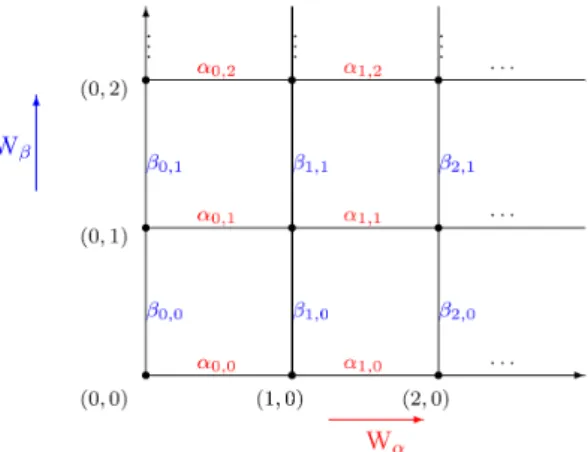
$W_{\beta}|$
$W_{\alpha}$
FIGURE 1.
Weight diagram
for 2-variable weighted shift
$W_{(\alpha,\beta)}$Clearly,
$k$
$k+\epsilon_{1}$
$W_{\alpha}$
In
the
sequel,
we
assume
that
all
2-variable
weighted
shifts
$W_{(\alpha,\beta)}$are
commuting, i.e.,
it
satisfies
condition
(1.2).
Given
$k\in \mathbb{Z}_{+}^{2}$,
the
moments
$\gamma_{k}\equiv\gamma_{k}(\alpha, \beta)$of
$(\alpha, \beta)$of order
$k$is
defined by
$\{\begin{array}{ll}1 ifk \equiv(k_{1}, k_{2})=(0,0)\alpha_{(0,0)}^{2}\cdots\alpha_{(k_{1}-1,0)}^{2} if k_{1}\geq 1 and k_{2}=0\beta_{(0,0)}^{2}\cdots\beta_{(0,k_{2}-1)}^{2} if k_{1}=0 and k_{2}\geq 1\alpha_{(0,0)}^{2}\cdots\alpha_{(k_{1}-1,0)}^{2}\cdot\beta_{(k_{1},0)}^{2}\cdots\beta_{(k_{1_{\rangle}}k_{2}-1)}^{2} if k_{1}\geq 1 and k_{2}\geq 1.\end{array}$
We remark
that,
due to the commutativity condition (1.2),
$\gamma_{k}$can
be computed using
any
nondecreasing path
from
$(0,0)$
to
$k.$
Question
1.10. Which
weighted
shifts
are
$subnormal^{Q}$
Theorem 1.11
(Berger’s Theorem(l-variable)).
$W_{a}$is
subnormal
if
and only
if
there exists
a
probability
measure
$\xi$
(called the Berger
measure
of
$W_{a}$) supported in
$[0, \Vert W_{a}\Vert^{2}]$such
that
$\gamma_{k}(a)=\int s^{k}d\xi(s)(k\geq 0)$
.
Theorem
1.12 (Berger’s Theorem(2-variab1e)([14])).
$W_{(\alpha,\beta)}$is subnormal
if
and only
if
there is
a
probability
measure
$\mu$(called
the
Berger
measure
of
$W_{(\alpha,\beta)}$) supported in the
2-dimensional
rectangle
$R=[0, ||W_{\alpha}||^{2}]\cross$
$[0, ||W_{\beta}||^{2}]$
such that
$\wedge,/k(\alpha, \beta)=\int_{R}s^{k_{1}}t^{k_{2}}d/\iota(s, t),\forall k\equiv(k_{1}, k_{2})\in \mathbb{Z}_{+}^{2}.$
2. AUXILIARY LEMMAS
For
a
2-variable weighted shift
$W_{(\alpha,\beta)\rangle}$we let
$\mathcal{M}$(resp.
$\mathcal{N}$)
be the
invariant subspace of
$\ell^{2}(\mathbb{Z}_{+}^{2})$spanned by the
canonical orthonormal basis vectors associated
to
indices
$k=(k_{1}, k_{2})$
with
$k_{1}\geq 0$
and
$k_{2}\geq 1$
(resp.
$k_{1}\geq 1$and
$k_{2}\geq 0$
).
We consider
the
following
problem:
Problem 2.1 (B).
Assume
that
$W_{(\alpha,\beta)}|_{\mathcal{M}}$and
$W_{(\alpha,\beta)}|_{\mathcal{N}}$are subnormal with
the Berger
measures
$\mu_{\mathcal{M}}$
and
$\mu \mathcal{N},$respectively.
Find
necessary
and
sufficient
conditions
on
$\mu_{\mathcal{M}},$$\mu \mathcal{N}$and
$\beta_{00}$for
the subnormality
of
$W_{(\alpha,\beta)}.$Note
that
Problem (B) is equivalent to
Problem
(A).
If
$W_{a}$is subnormal
with Berger
measure
$\xi$, and if we let for fixed
$i\geq 1,$
$\mathcal{L}_{i}:=\vee\{e_{n}:n\geq i\}$
then the Berger
measure
$\xi_{i}$of
$W_{a}|_{\mathcal{L}}$.
is
$\frac{s^{l}}{\gamma}d\xi(s)$.
Lemma 2.2
(1-variable
subnormal
backward extension ([5])).
If
$W_{a}|_{\mathcal{L}_{1}}$is
subnormal
with Berger
measure
$\xi_{1}$then
$W_{a}$
is
subnormal
if
and only
if
(2.1)
$\frac{1}{S}\in L^{1}(\xi_{1})$and
$W_{\beta}|$
$W_{CY}$
FIGURE
2. 2-variable
weighted
shift
$W_{(\alpha,\beta)}$in
Problem
(B)
In
this case, the Berger
measure
$\xi$of
$W_{a}$is
$d \xi(s)=\underline{a}_{\Lambda}^{2}\delta d\xi_{1}(s)+(1-a_{0}^{2}||\frac{1}{\dot{s}}||_{L^{1}(\xi_{1})})d\delta_{0}(s)$.
$\bullet$
Let
$\mu$
and
$\nu$be two
positive
measures
on
$\mathbb{R}+\cdot$We say that
$\mu\leq\nu$
if
$\mu(E)\leq\nu(E)$
for
each Borel subset
$E\subseteq \mathbb{R}+\cdot$
$\bullet$
Let
$\mu$
be
a
probability
measure
on
$\mathbb{R}+\cross \mathbb{R}+and$assume
that
$\frac{1}{t}\in L^{1}(\mu)$.
The
extremal
measure
$\mu_{ext}$(which
is
also a
probability
measure)
on
$\mathbb{R}+x\mathbb{R}_{+}$is given by
$d \mu_{cxt}(s,t):=(1-\delta_{0}(t))\frac{1}{t\Vert\frac{1}{t}||_{L^{1}(\mu)}}d\mu(s, t)$
.
Here
$\delta_{0}$denotes
Dirac
measure
at
O.
$\bullet$
Given a
measure
$\mu$
on
$X\cross Y$
,
the
marginal
measure
$\mu^{X}$
is
a
measure
on
$X$
given by
$\mu^{X}:=\mu\circ\pi_{X}^{-1},$
where
$\pi_{X}$:
$XxYarrow X$
is the
canonical projection onto X.
Lemma
2.3
(2-variable
subnormal backward
extension ([10])).
Assume
that
$W_{(a,\beta)}|_{\mathcal{M}}$is
subnormal with
the
Berger
measure
$\mu_{\mathcal{M}}$and
that
shift
$(\alpha_{00}, \alpha_{10}, \cdots)$is
subnormal with
Berger
measure
$\xi$.
Then
$W_{(\alpha,\beta)}$is
subnormal
if
and only
if
the following conditions hold:
(i)
$\frac{1}{t}\in L^{1}(\mu_{\mathcal{M}})$(ii)
$\beta_{00}^{2}\leq(\Vert\frac{1}{t}\Vert_{L^{1}(\mu_{\lambda 4})})^{-1}$;
(iii)
$\beta_{00}^{2}\Vert\frac{1}{t}\Vert_{L^{1}(l^{t}\Lambda t)}(\mu_{\mathcal{M}})_{ext}^{X}\leq\xi.$Moreover,
if
$\beta_{00}^{2}\Vert\frac{1}{t}\Vert_{L^{1}(\mu_{\Lambda t_{1}})}=1$, then
$(\mu_{\mathcal{M}})_{ext}^{X}=\xi.$Lemma 2.4
([11]).
Let
$\mu$be
the Berger
measure
of
a
subnormal 2-variable
weighted
shift
$W_{(\alpha,\beta)}$,
and let
$\xi$be the
Berger
measure
of
the
associated
$0$-th horizontal
1-variable
shift
$(\alpha_{00}, \alpha_{10}, \cdots)$.
Then
$\xi=\mu^{X}$
3.
MAIN
RESULT
AND
APPLICATION
We provides
a
concrete solution
of Problem
(B) in terms
of
$\mu_{\mathcal{M}},$$\mu \mathcal{N}$and
$\beta_{00}.$Theorem 3.1
(Main Theorem).
Assume that
$W_{(\alpha,\beta)}|_{\mathcal{M}}$and
$W_{(\alpha,\beta)}|_{N}$are
subnorrnal with
associated
Berger
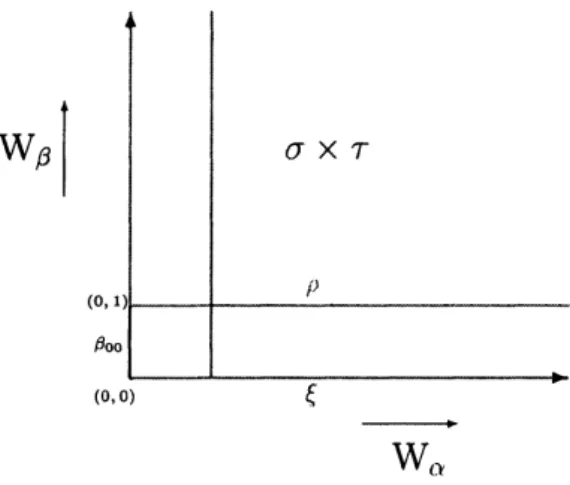
$w_{\beta}\uparrow$
$(0,0)$
$\backslash 1^{1}\prime.\cdot=x$$\overline{W_{\alpha}}$
FIGURE
3.
2-variable weighted shift
$W_{(\alpha,\beta)}$in Lemma
2.4
conditions
hold:
(i)
$\frac{1}{t}\in L^{1}(\mu_{\mathcal{M}})$and
$\frac{1}{s}\in L^{1}(\mu \mathcal{N})$;
(ii)
$\beta_{00}^{2}\Vert\frac{1}{t}\Vert_{L^{1}(\mu\Lambda t})\leq 1$(iii)
$fl_{00}^{2} \{\Vert\frac{1}{t}\Vert_{L^{1}(\mu_{\mathcal{M}})}(\mu_{\mathcal{M}})_{ext}^{X}+c\Vert\frac{1}{s}\Vert_{L^{1}(\mu N)}\dot{\delta}_{0}$ $\frac{c}{s}(\mu \mathcal{N})^{X}\}<\{\overline{\rangle}_{0}.$For
a measure
$\mu$with
$\frac{1}{s}\in L^{1}(\mu)$,
we
write
$d\tilde{\mu}(s)$$:= \frac{1}{s\Vert\frac{1}{}\Vert_{L^{1}(\mu)}}d\mu(s)$
.
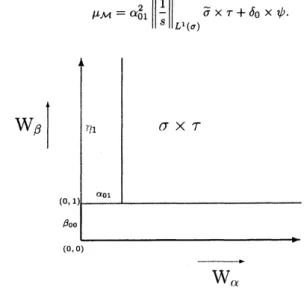
Lemma 3.2 ([8]). Let
$W_{(\alpha,\beta)}$be the 2-variable weighted
shift
given
in
Figure
4.
Then
$W_{(\alpha,\beta)}|_{\mathcal{M}}$is
subnormal
if
and only
if
$\psi$$:= \eta_{1}-\alpha_{01}^{2}\Vert\frac{1}{s}\Vert_{L^{1}(\sigma)}\tau$is
a
positive
measure.
In this case, the Berger
measuoe
of
$W_{(\alpha,\beta)}|_{\mathcal{M}}$is
$\mu_{\mathcal{M}}=\alpha_{01}^{2}\Vert\frac{1}{s}\Vert_{L^{1}(\sigma)}\tilde{\sigma}\cross\tau+\delta_{0}x\psi.$
$w_{\sqrt{}}\uparrow$
$(0,0)$
$W_{\alpha}$
FIGURE 4. 2-variable
weighted
shift
$W_{(\alpha,\beta)}$in
Lemma
3.2
As a
special
case
of
Main Theorem,
we
have:
Theorem
3.3
(The
case
when
$W_{(\alpha,\beta\rangle}$has a core
of tensor
form).
Assume that
$W_{(\alpha,\beta)}|_{\mathcal{M}}$and
$W_{(\alpha,\beta)}|_{\mathcal{N}}$are
subnormal
with associated
Berger
measures
$\mu_{\mathcal{M}}$and
$\mu \mathcal{N}$, respectively, and let
$\rho$$:=\mu_{\mathcal{M}}^{X}$.
Also
assume
that
$\mu_{\mathcal{M}\cap N}=$$\sigma\cross\tau$
for
some
1-variable
probability
measures
$\sigma$and
$\tau$.
Then
$\rho=\mu_{\mathcal{M}}^{X}=(\mu_{\mathcal{M}})_{ext}^{X}$,
and hence
$W_{(\alpha,\beta)}$is
subnormal
if
and
only
if
the following conditions
hold:
(ii)
$\beta_{00}^{2}\Vert\frac{1}{t}\Vert_{L^{1}(\mu_{\mathcal{M}})}\leq 1$;
$( \ddot{u}i)(\beta_{00}^{2}\Vert\frac{1}{t}\Vert_{L^{1}(\mu_{At})})\rho\leq\xi$
,
where
$\xi$is
the
Berger
measure
of
shift
$(\alpha_{00}, \alpha_{10}, \cdots)$.
$W_{\beta}$