Article
RIGHT WING POPULISM IN EUROPE:
A DISCOURSIVE RHETORIC FOCUSED ON
EUROPEAN UNION, ETHNO-NATIONALISM,
DEMOCRACY AND GLOBALIZATION
DE CUETO NOGUERAS, Carlos
Key words: Right-wing parties, populism, Euroscepticism, ethno-nationalism, democracy,globalization.
1. POPULISM IN SOCIAL SCIENCES AND POLITICAL ANALYSIS.
Despite the fact that the term “populism” is highly ambivalent, it is increasingly used in the social sciences and has become a particular field in political analysis, without being precisely defined. Populism is a particular political rhetoric, which extremely simplifies complex problems and offers apparently easy, painless but at the same time vague solutions. However, due to the negative connotation of the term, far-right populist parties prefer to define themselves to be centrists, reject most of labels normally associated with them -con-servative, right-wing, racist, xenophobic- and threaten to take legal actions or denounce in some cases media companies and journalists who do. After a Swedish journalist of SverigesRadion called the Sweden Democrats party xenophobic in 2013, the party reacted with a
complaint lodged to the broadcasting regulator. In 2014, the Supreme Court of Hungary ruled that Jobbik couldn’t be labelled “far-right” in any domestic radio or television transmission.
They present themselves as common men and women who understand and represent people, especially the under-privileged and under-represented segments, who know and voice their concerns, in contrast to the corrupt and established elites. Populism relies on charismatic leaders with decisive roles in their parties and on popular support. Populism respects the basic criteria of democracy but rejects all existing ideologies as insufficient for the particular society and tries to find and adopt its “own new path”. However, it is charac-terised by a lack of any coherent and clear set of ideas, or any consistent ideology and policy for the long run.
The current and complex multidimensional socio-economic, political, cultural and discur-sive crisis our European societies are facing can be used to explain the re-emergence of
populism today. They have become increasingly popular at a time when public trust in government is at the lowest level in the last at least 30 years due to the dramatic effects -unemployment, poverty, inequality- of the economic recession and financial crisis that started in 2008, due to the painful austerity plans implemented in many countries including controversial measures like increases in retirement age and taxes, significant reduction in budgetary allocations to education and healthcare policies, the freezing of public workers salaries, etc., and due to the growing number of scandals of corruption and wrong doings by public officials. It is interesting to see how their current electoral successes began roughly at a time when public disillusionment with the established political elites was at its height due to corruption scandals and to their proven inability or unwillingness to find and adopt fair solutions to address the challenges of our European societies. Another particular cause behind the rise in populism, Euroscepticism, and ethno-nationalism across the continent has been the economic and political fallout from the eurozone debt crisis that has been taking place in the European Union since the end of 2009, and in particular the economic meltdown in Spain, Portugal, Ireland, Cyprus and Greece that required rescue programs from its European partners as they were unable to repay their government debt or to bail out over-indebted banks without the assistance of third parties like the European Financial Stability Facility, the European Central Bank or the International Monetary Fund. Another reason is related to the consequences of the enlargement process towards Central and Eastern Europe, the recent lifting of controls on migration from Romania and Bulgaria, the arrival of young employed people from southern European countries, and the refugee crisis. These migration flows have led to political attacks by these right-wing populist parties on the impacts of central, eastern and southern European migrants on security, salaries, em-ployment, welfare programs and social benefits, schools and hospital that hit home during a time of austerity and falling national budgets. Immigration concerns, inflamed by the media, are troubling the political classes in Germany, the Netherlands, France, Finland and Sweden as well as the United Kingdom.
2. THE RISE OF RIGHT WING POPULISM IN EUROPE
Recent electoral evidence shows clearly a shocking and outstanding rise of right-wing populist movements and related political parties in most of European Union member states and beyond, like Norway, Switzerland, official candidate countries such as Serbia, and po-tential candidates like Ukraine. The interesting thing is that countries and world areas, such as Scandinavia, considered for decades to be a safe haven of liberal and stable democ-racy, cultural tolerance and social inclusion have also become examples of anti-immigration, Eurosceptic, and Islamophobic activism. Political and social movements promoting racist, xenophobic, ethno-nationalist, and populist extreme-right ideologies have grown substan-tially in the past two decades mobilizing a wide range of segments of European citizens, obtaining outstanding performances in local, regional, national and European Parliament elections, becoming a permanent feature and active players on the political stage, as well as champions of public debates, and influential agenda-setters.
to expand their electoral support and political base. Current right-wing populism in Europe has dissociated itself from the non-democratic past, from the burden of racism and Nazism, has moved away from overt neo-fascist discourse, and has softened their language and rhetoric. These parties have moderated their public face to hide an ideological hard core, not only accepting the rules of democratic constitutions but presenting themselves as the guardians and protectors of Western liberal and democratic values and principles against the cartel of traditional parties, and of the cultural and religious values, customs and tradi-tions of European societies against the enemies from outside, immigrants and Muslims in particular.
Right-wing populism has demonstrated an outstanding ability to take advantage of the huge possibilities offered by social networks and modern media democracies to create a permanent process of campaigning not only tied to electoral processes providing and secur-ing a massive attention and cover from the media. Their political communication has relied on a discursive and rhetorical strategy that simplify extremely complex phenomena, make false claims, deny the obvious, say the unsayable, transcend the limits of the permissible, and use double messages with calculated ambivalence related to race, culture, traditions, and national identity. Creating permanent provocation and scandals, they don’t only assure the cover of media but also the control of public debates forcing the other parties and politi-cians to react and respond permanently to ever new scandals offering few opportunities to present other frames, values, counterarguments or agendas.
Right-wing populist parties in Europe have promoted an effective discourse and agenda very much single-issue oriented. These political parties don't claim anymore an alternative to the existing political system or model of state, as did the traditional fascist parties in the past, but an alternative to specific policies, like migration, globalization and European inte-gration once they have changed considerably since their foundation, adjusted their rhetoric to the changing national and international political conditions and to the new citizens´ concerns. They pursued the principles of modernization and pragmatism. So recently, an-ti-Semitism, revisionism were replaced by Islamophobia, Euroscepticism and anti-global-ization. Topics such as immigration, increasing cultural and religious diversity, race rela-tions, national identity, rights of the local population, and radical political Islam have constituted a core element of such movements with controversial slogans such as “people like you”.
Another political and electoral strategy of these parties has been their ability to cut across, and transcend traditional left-right cleavages facilitated by the Third Way adopted by many social-democratic parties in the continent during the 1990s and 2000s. European party systems, dominated historically by polarization and electoral competition between two clearly ideological profiles and political blocs, became profoundly affected as those polit-ical and electoral options largely moved towards the centre to win the support of the middle class and become a credible political and governmental alternative. The broad consensus on economic and welfare issues between the traditional left-wing and right-wing parties pro-voked that many voters perceived those blocs as more or less indistinguishable inciting many of them to seek out to new political alternatives, and lead to a confrontation on moral and cultural issues and the risk of promoting a politicization and polarization of value issues
which represents a great success of right-wing populism. At the same time, the acceptance of neo-liberal policies allowed them to construct new social cleavages related to, often legit-imate and justified, fears about globalization, Europeanization and the subsequent rise of nationalism, chauvinism, etc., appealing to the common-sense and traditional conservative values linked to aggressive exclusionary rhetoric.
One crucial explanation to this outstanding performance of right-wing populism has been the use of increasingly sophisticated techniques of political communication and marketing, skilled use of new social media and networks within and across countries, a new political language, new tools of outreach and mobilization, and the role played by charismatic leaders -Jean Marie Le Pen, Nigel Farage, Umberto Bossi, Jörg Haider, Nick Griffing, Heinz-Christian Strache, Pim Fortuny, Kaczynski brothers, Christoph Blocher, Carl I. Hagen, Frauke Petry, Nikolaos Michaloliakos, etc.- with the ability to excite audiences at rallies and appeal to common people and make complicated things look easy using a populist tone and rhetoric.
But we should not forget the fact that right-wing populism is not a new phenomenon in Europe, but has a long-term history. Since the end of the Second World War, revisionist ideologies have circulated and have been promoted by neo-Nazi or far-right extremist par-ties and movements, such as Occident, Group Union Défense, and Ordre Nouveau in
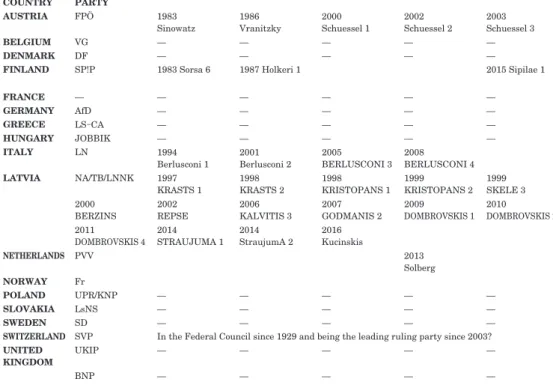
Table 1. Current and former leaders of right-wing populist parties in Europe.
COUNTRY PARTY CURRENT LEADER PREVIOUS LEADERS
UNITED KINGDOM UKIP HENRY BOLTON NIGEL FARAGE
SWITZERLAND SVP-UDC ALBERT RÖSTI CHRISTOPH BLOCHER
SWEDEN SD JIMMIE AKESSON MIKAEL JANSSON
SLOVAKIA LsNS MARIAN KOTLEBA
POLAND UPR/KNP STANISŁAW ŻÓŁTEK
NORWAY Fr SIV JENSEN CARL I. HAGEN
NETHERLANDS PVV GEERT WILDERS
LATVIA NA/TB/LNNK RAIVIS DZINTARS ROBERTS ZILE
ITALY LN MATTEO SALVINO UMBERTO BOSSI
HUNGARY JOBBIK GÁBOR VONA
GREECE LS-CA NIKOLAOS MICHALOLIAKOS
GERMANY AfD ALEXANDER GAULAND FRAUKE PETRY
FRANCE FN MARINE LE PEN JEAN-MARIE LE PEN
FINLAND SPiP JUSSI HALLA-AHO TIMO SOINI
DENMARK DF KRISTIAN THULESEN DAHL PIA KJÆRSGAARD
BELGIUM VB TOM VAN GRIEKEN
France, Italian Social Movement in Italy, etc. But the true thing is that today this new kind of right-wing populism has specific features compared to the traditional far-right move-ments. In the first two decades of the 21st century, we have seen an important transforma-tion in the ideologies, electoral strategies, discourses and organizatransforma-tional forms of racist, extreme right and populist movements and political parties.
3. A CALCULATED STRATEGY OF SOFTENING LANGUAGE AND RHETORIC.
Most of right-wing populist political parties in Europe have moderated and softened their discourse and rhetoric to obtain the support of a larger electoral base and to appear as a credible political force in regional, national and European politics.Under the leadership of Marine Le Pen, elected president of the party in 2011 by two thirds of the members, the National Front has tried to de-demonise the party and soften its xenophobic and extremist image by expelling controversial members like his father when he referred to the Nazi gas chambers as “a point of detail of the history of the Second World War”. This change of image and discourse showed to be effective increasing its popularity and electoral performance in subsequent elections. The National Front won mayoralties in 12 cities in the municipal elections held in March 2014; became the first French party at the 2014 European elections with 24,86% of the vote and 24 of France´s 74 seats; reached the second round of 2017 presidential elections obtaining 33,9% of the vote; and obtained 8 deputies in the 2017 legislative election, the best number for the party in a majority parlia-mentary election since its creation.
The Sweden Democrats, a party with its roots in Swedish fascism and part of the white supremacy movement in the late 1980s, had some founding party officials who expressed strong support for the ideology of Nazism1), chose as the party´s logo from the 1990s until 2006 a version of the torch used by the UK National Front, until it was changed to an Anemone hepatica flower in 2006, and in the early days of the party, it recommended its members international connections with extreme organizations such as the National Democratic Party of Germany, the American National Association for the Advancement of White people founded by David Duke, and publications like the Nazi Nation Europa and Nouvelle École, a newspaper that advocated racial biology. But under the leadership of Miakel Jansson and Jimmie Åkesson since 2005, the party has softened its image and has moderated its positions and statements. They took controversial decisions such as formally banned in 1996 the use of any kind of uniform after that several members dressed in Nazi uniforms at party meetings.2) But anyway, Sweden Democrats have the largest share of elected municipal representatives resign since 2010 elections, in most of the cases those resignations were brought on by racist statements or actions3).
Similarly, since the 2014 legislative election, Jobbik, due to its growing popularity and broadening supporter groups, implemented major changes in its program and policies, started to re-define itself as a conservative people´s party, and changed the controversial elements of its communication. This political trend adopted before the 2014 legislative elections, called “moderation to a people´s party” –néppártosodás-, resulted in a new style of communication avoiding many radical elements of the earlier program and putting an end
to the previous time of radicalism. In Norway, the Progress Party from the mid 2000s, under the leadership of Siv Jensen, has to some extent sought to moderate its profile and move and position itself more towards conservatism in order to seek government cooperation with centre-right parties. As part of that strategy, in 2001 the party decided to expel certain controversial and radical members. The Latvian party, became more moderate after merg-ing with the Latvian National Independence Movement in 1997 shiftmerg-ing their emphasis to economic issues and in particular to free market.
Nevertheless, other right-wing populist parties, such as Alternative for Germany, the Northern League and the Slovak People´s Party Our Slovakia, behave differently and maintained or even hardened their positions. In the particular case of the Italian Lega
Nord, under the leadership of Matteo Salvini since 2013, the party has emphasized
Euroscepticism, opposition to immigration and other populist policies. Alternative for Germany, after few months of internal disagreements under the new leadership of Frauke Petry in mid 2015, the party has completed a clear shift to the right hardening its position on issues such as immigration, and Islam. This shift provoked the exit of several members some weeks later in protest for the rise of xenophobic and pro-Russian sentiments, and some of them, lead by Bernd Lucke, formed a new part in July 2015, the Alliance for Progress and Renewal.
The People´s Party Our Slovakia party during the elections of 2016, nominated several candidates seen as controversial, such as the ex-singer of neo-Nazi music bands Krátky
process and Juden Mord, and a candidate who openly admired Adolf Hitler and promoted
Hlinka´s historical Slovak people´s Party. Some of its members are connected to extremist movements such as the Slovak Brotherhood. Equally controversial was when the party and its members requested a minute of silence for Jozef Tiso, who supported and actively put laws in place during the Second World War that discriminated against Jews and made the country pay Nazi Germany to transfer Slovak Jews into concentration camps. In May 2017, the General prosecutors Office of the Slovak Republic made a submission to the Supreme Court, requesting a dissolution of the party due to pro-fascist tendencies, violation of the Constitution and Slovak and International laws.
But probably, the most extreme case of all is the Greek Golden Dawn. Its leader, Nikolaos Michaloliakos, during the 1980s and 1990s was arrested several times for politically moti-vated offences such as beatings and illegal possession of explosive materials while the party embraced at that time Hellenic Neopagan beliefs. Afterwards, members of the party at-tacked students at the Athens University during a massive demonstration against the use of the name Macedonia by the Republic of Macedonia, and a significant number of them participated during the Bosnian War in the Greek Volunteer Guard supporting the Serbian army, and being decorated for their contribution in the war crimes committed against Bosnian Muslims in Srebrenica. More recently, following the investigation of the murder by several supporters of the party of anti-fascist rapper Pavlos Fyssas in September 2013, its leaders and several members were arrested and held in pre-trial detention on suspicion of forming a criminal organization.
4. RIGHT WING POPULIST PARTIES IN EUROPE.
In this paper, I will focus on a limited number of far-right populist parties in Europe, choosing one main representative from each European country that has been affected by the emergence of these political and social movements. Most of these political parties are members of the three main eurosceptic parliamentary groups in the European Parliament: the Europe of Freedom and Direct Democracy, Alliance of European Conservatives and Reformists, and the Europe of Nations and Freedom.
United Kingdom Independence Party (United Kingdom). Originated as the Anti-Federalist League, it is a Eurosceptic party founded by the historian Alan Sked in 1991, and was renamed UKIP in 1993. In 1997, Sked was replaced by a faction of the party led by Nigel Farage, who became the new leader in 2006. Under his leadership, the party adopted a broader policy stance taking advantage of the concerns about rising immigration among a significant part of the British working class. Its most remarkable achievements were the 2014 European Parliament election, when the party became the largest British party, and the final result of the Brexit referendum held in the United Kingdom on 23 June 2016. Swiss People´s Party -Schweizerische Volkspartei- (Swizterland). Originated in 1971, as a merger of the Party of Farmers, Traders and Independents (BGB) and the Democratic Party, is currently the largest party in the Federal Assembly, with 65 members of the National Council and 5 seats of the Council of the States. From being a marginal party during the 1970s and 1980s, the party obtained unknown electoral outcomes during the 1990s and the first two decades of the 21st century when adopted deep structural and ideo-logical changes under the leadership of Christoph Blocher and focused primarily on issues such as Euroscepticism and opposition to mass immigration. As a crucial fact, in the 2007 Federal Council election the party obtained the vote share of 28,9%, the highest vote ever recorded for a single party in Switzerland since 1919, until 2015 when it surpassed its own record with 29,4%.
Sweden Democrats –Sverigedemokraterna- (Sweden). The party was founded in 1988 as a successor to the Sweden Party, which was been formed in 1986 by the merger of Bevara
Sverige Svenskt -Keep Sweden Swedish- and a faction of the Swedish Progress Party. It was
not until the 2010 general election that the Sweden Democrats crossed the 4% threshold necessary for parliamentary representation for the first time in its history and obtained 20 seats. The party continued this trend in the 2014 general election, polling 12,9% of the votes and winning 49 seats in the Riksdag.
Kotleba- People´s Party Our Slovakia – Kotleba- L’udová strana – Naše Slovensko- (Slovakia). The origins of the party are closely related to the nationalist Slovak Togetherness. When the Supreme Court, on grounds of anti-constitutional activities, dissolved the party, its members under the leadership of Marian Kotleba entered the small Party of Friends of Wine that has existed since 2000 and changed its name to People´s Party of Social Solidarity in May 2009 and then to People´s Party –Our Slovakia in early 2010.
The Congress of the New Right - Kongres Nowej Prawicy- (Poland). This Polish economi-cally libertarian, socially conservative and radieconomi-cally eurosceptic party was founded in March 2011 by Janusz Korwin-Mikke as a result of the merger of the Liberty and Lawfulness
(WiP) with several members of the Real Politics Union (UPR), but adopted the current offi-cial name “Congress of the New Right” in May 2011.
The Progress Party –Fremskrittspartiet- (Norway). This classical neoliberal and conserva-tive party was founded by Anders Lange in 1973 as a political movement for a strong reduc-tion in taxes, subsidies, duties, foreign aid and public intervenreduc-tion. The party adopted its current name, the Progress Party, in January 1977 inspired by the great success of the Danish Progress Party. In the 1973 parliamentary election, the party won 5% of the vote and gained 4 seats, and after the 2013 parliamentary election entered into its first ever government.
For Fatherland and Freedom/LNNK - Tēvzemei un Brīvībai/LNNK- (Latvia). The party was founded when several small groups merged in 1993 – 18th November Union and Fatherland- to form the centre-right “For Fatherland and Freedom”, with a particular focus on national identity issues such as promoting the Latvian language and tighter or stricter citizenship/naturalization laws for Latvian non-citizens. They sponsored a national referen-dum in 1998 on citizenship that was supported by a majority of Latvians but was defeated overall by opposition from ethnic Russians. It merged with the moderate Latvian National Independence Movement (LNNK) in 1997, and moved its emphasis to economic liberaliza-tion since then. For the 2010 parliamentary elecliberaliza-tion, the party formed an alliance with far-right nationalist All For Latvia, and in July 2011, both parties merged into a unitary party, bearing the name National Alliance.
Northern League – Lega Nord per l´Indipendenza della Padania- (Italy). It is a regionalist party in Italy, founded in 1991 as a federation of several regional parties of Northern and Central Italy –Liga Veneta, Lega Lombarda, Piemont Autonomista, Uniun Ligura, Lega Emiliano-Romagnola and Alleanza Toscana-.
JOBBIK, the Movement for a Better Hungary - Jobbik Magyarországért Mozgalom- (Hungary). It was established in 2002 by a group of Catholic and Protestant university students, and became a political party in October 2003. Initially the party defined itself as a ”Conservative and Patriotic Christian Party”, with the main task of protecting the ”Hungarian values and interests”. In April 2014 parliamentary election, the party won 20,54% of the vote becoming the third largest party in the National Assembly.
The Popular Association – Golden Dawn - Laïkós Sýndesmos – Chrysí Avgí- (Greece). Probably this is the most ultranationalist, racist, far-right party of those analysed in this paper. Its neo-Nazi and fascist label comes from its members expressed admiration for the former dictator Ionnis Metaxas, the use of alleged Nazy symbolism, and for having praised figures of Nazi Germany in the past. After creating the magazine and joining the National Political Union, in January 1985, Nikolaos Michaloliakos broke away and founded the Popular National Movement-Golden Dawn, which was officially recognised as a political party in 1993. By the mid-2000s, Golden Dawn redirected its attention to opposing non-Eu-ropean, and particularly Muslim immigration into Greece, but recently, their rhetoric and concerns were about unemployment, austerity, and the economy, receiving in 2012 Greek national elections 7% of the popular vote and 21 seats and after 2015 elections, the party became the third largest party in parliament despite winning only 17 seats.
nationalist, right-wing populist and Eurosceptic political party was founded in April 2013, but its origin could be traced back in September 2012 when several prominent figures founded the political group Electoral Alternative 2013 to oppose German federal policies regarding the Eurozone crisis. The party obtained parliamentary representation -94 seats and 12,6% of the vote- in the Bundestag after 2017 legislative elections and becoming the third largest party in Germany. Before that historical attainment, the party not only won 7 seats and 7,1% of the vote in the 2014 European Parliament election becoming member of the European Conservatives and Reformists Group4), but also secured representation in 14 of the 16 German state legislatures, being Hesse the first one where the party obtained representation.
National Front – Front National- (France). Due to the French electoral system, the party´s representation in political institutions is very limited, despite its significant share of the vote and popular support. The party was founded in 1972 when several French nationalist movements – Ordre Nouveau, Party of the French Unity, Justice and Liberty Movement, as well as former Poujadists, Algerian War veterans and some monarchists- were unify under the undisputed leadership of Jean-Marie Le Pen until his resignation in 2011. Two turning points could be identified that changed the marginal position of the party since its creation in the early 1970s. The first one took place in 1984, when Jean-Marie Le Pen was invited to a primer-time television interview program for the first time and when Francois Mitterrand adopted a proportional representation electoral system to moderate a foreseeable defeat for his Socialist Party. In the 1984 European Parliament elections, the party won 11% of the vote and ten seats, in the 1986 legislative election obtained 9,8% of the vote and 35 seats in the National Assembly, and an unprecedented 14,4% of the vote in the 1988 presidential election5). And the second crucial moment was the replacement of Jean-Marie Le Pen by his daughter, Marine Le Pen in 2011, who reach the second round of 2017 Presidential elections, as her father did in 2002.
Finns Party – Perussuomalaiset- (Finland). This populist and nationalist party was founded in 1995 following the dissolution of the Finnish Rural Party, its predecessor founded by Agrarian League dissident Veikko Vennamo in 1959 that became partner in two coalition governments. Along the 2010s the party performed quite well in all elections. The party won 19,1% of the vote in the 2011 parliamentary election, becoming the third largest party in the Finnish parliament with 39 seats; 12,3% of the vote in 2012 municipal elections, and 12,9% in the 2014 European Parliament election. In the 2015 parliamentary election, the party became the second largest party in terms of seats, 38, and the third in terms of votes, 17,7%. After that election, the party joined the government coalition led by Juha Sipilä after softening its Eurosceptic position6).
Danish People´s Party - Dansk Folkeparti- (Denmark). This far-right, populist and an-ti-immigrant party was founded in 1995 by Pia Kjærsgaard and Kristian Thulesen Dahl, who broke out from the Progress party. It has become a crucial power broker supporting the Liberal-Conservative government, led by Anders Fogh Rasmussen, from 2001 to 2011. The popularity of the party has grown since its foundation, as well as its electoral support. In 2005 parliamentary election the party obtained 13,2% of the vote and 24 seats. In 2007 parliamentary election, the party remained the third largest party with 13,9% of the vote
and 25 seats, a position confirmed in 2011 election but with 12,3% of the vote. In 2014 European Parliament election became the largest party securing 27% of the vote joining afterwards the European Conservatives and Reformists Group, while in 2015 general elec-tion became the second largest party in Denmark for the first time.
Flemish Interest – Vlaams Belang- (Belgium). This Flemish nationalist, far-right and secessionist political party was created in 1978. Previously was called Vlaams Blok but once the Court of Appeal in Ghent ruled in 2004 that the party had breached the 1981 anti-racism law, the party was dissolved and started afresh under a new name, the Vlaams Belang, becoming at that time the most popular Flemish party in Belgium7). When the party dis-banded itself, adopted some changes in its political program, carefully moderating some of the more extreme positions At the same time, the direct predecessor to the Vlaams Blok was the People´s Union which was founded in 1954 as the successor to the Christian Flemish People´s Union electoral alliance. The hardliner faction of this party who rejected the par-ty´s participation in the coalition government in 1977 and the Egmont Pact, left the party and established the Vlaams Blok in 1979, even though during its first years of existence it got not much electoral success. Then in the early 1980s, its electoral support started to in-crease once the party´s emphasis shifted from Flemish nationalism and separatism to the immigration issue.
The Freedom Party of Austria - Freiheitliche Partei Österreichs- (Austria). The party was founded in 1956 as the successor to the Federation of Independents, representing the third camp of Austrian politics, the pan-German and national-liberal camp -Lager- and founded in 1949. Its first party leader, Anton Reinhaller, was a former Nazi minister of Agriculture and SS officer. The party participated in a government led by the Social-Democratic Party after the 1983 legislative election. When in 1980 the party chose Norbert Steger as the new leader, he transformed the party into a moderate centrist liberal party focusing on free market and anti-statist policies. But after the worst electoral results in its history, the new leader elected in 1986, Jörg Haider, forced the party to initiate an ideological turn towards radical right-wing populism. Under Heinz-Christian Strache leadership since April 2005, the party´s ideology became more radical and very focus on immigration and Islam and that shift has attracted an increasing support: 11% of the vote in the 2006 general election; 17,4% in the 2008 general election; 20,5% in the 2013 general election; and 26,6% in the last 2017 parliamentary election. At the same time, in the 2016 presidential election, the FPÖ candidate, Norbert Hofer, won the first round receiving 35,1% but was defeated by the Greens ‘candidate, Alexander Van der Bellen, in the second definitive round.
The Party of Freedom -Partij voor de Vrijheid- (Netherlands). This Dutch nationalist and right-wing populist party was founded in 2006 as the successor to Geert Wilders´one-man party in the House of Representatives, when he left the VVD in September 2004 as a formal protest against the positive stance of the party towards Turkey´s possible accession to the European Union. In the 2010 general election, the party won 24 seats becoming the third-largest party and agreed to support the minority government led by Prime Minister Mark Rutte till April 2012. In the 2017 general election, the party became the second-largest party in the Dutch unicameral parliament.
5. RIGHT-WING POPULIST RHETORIC.
Political scholars and sociologists describe those parties as right-wing populist, whose strategies rely on a combination of ethno-nationalism, Euroscepticism, Islamophobia, an-ti-elite populist rhetoric and a radical critique of existing political institutions, with econom-ic protectionism, zero tolerance approach to law and order issues, opposition to free migra-tion, and firm defence and preservation of national culture, identity and values. They reject the common classification of the political spectrum in left and right and they see themselves as simply patriotic and centrist actors. I will analyse now their statements regarding the process of European integration, the democratic systems, the multicultural nature of our European societies, the process of Globalization, and trans-nationalization of this political and social movement.
5.1 RIGHT-WING POPULISM AND THE EUROPEAN UNION.
Since Margaret Thatcher´s speech on 20 September 1988 in Bruges, Euroscepticism has grown across Europe. According to political analysists, Aleks Szczerbiak and Paul A. Taggart, there are three major factors that explain this growth. Firstly, the decline of the permissive consensus that appeared with the difficulties of ratifying the Maastricht Treaty in the early 1990s; secondly, the increasing tendency in the European integration to resort to referendums to ratify treaties; and finally, the enlargement of the European Union that widened the scope of the European project, as well as the diversification of expectations within the European community (Szczerbiak and. Taggart, 2003). A crucial and primary emphasis of most of these right-wing populist parties has been on Euroscepticism calling for their country´s exit from the European Union, or for a complete transformation of the pro-cess of European integration.
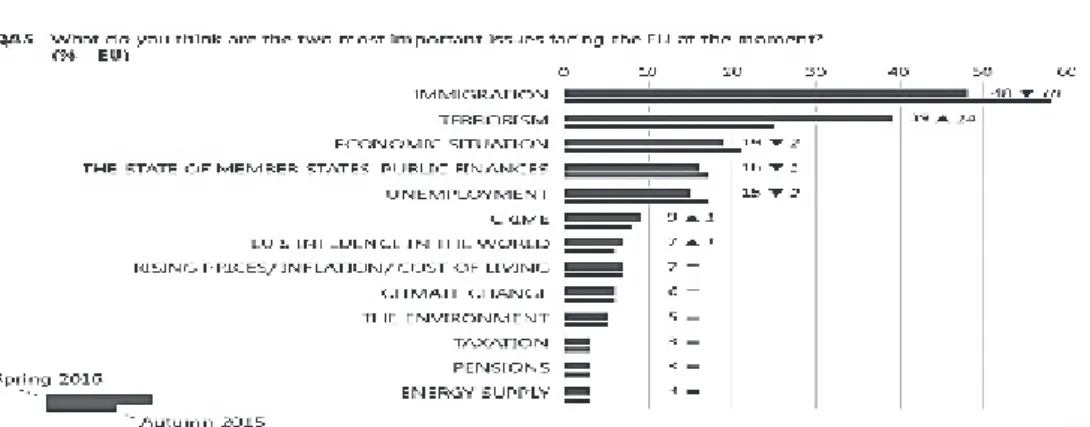
Being aware of the vagueness of the term Euroscepticism and the lack of consensus among scholars on it, we should understand it as a movement of opposition to European construction based on taking powers away from their national government undermining their national sovereignty. Data from Eurobarometer shows that trust in the European project has fallen not only in debtor countries, especially affected by the economic recession and financial crisis –Greece, Portugal, Cyprus, Spain-, but also in creditor countries – Austria, Netherlands, Germany-, and non-Eurozone member states, like Britain, where there is a growing number of citizens with a negative image of the European Union. Euroscepticism, and particularly right-wing populist Eurosceptic parties, have been ana-lysed and understood as a monolithic entity with regards to its position on European inte-gration but a deep analysis of their rhetoric, discourse, parliamentary behaviour, and statements shows different types of Euroscepticism. The first category, the rejecting type Euroscepticism, consists of the political parties against all aspects of European integration and supporters of leaving the Union. The second type includes the parties not against the principle of European Union cooperation but against its practice and its future. And finally, the third one, compromising type, comprises parties accepting both the principle and the practice of the European Union cooperation but oppose future integration. So basically, Euroscepticism in the European Union could be simplified in withdrawalist Euroscepticism,
opposing European Union membership, and reformist Euroscepticism, that supports its existence and EU membership, but opposes further integrationist European policies and the idea of a federal Europe showing concerns on one or several European supranational policy
Graphic 1. European citizens’ trust in the European Union.
Source: Eurobarometer EB85 – 2016.
areas. There is a sense that national interest is currently at odds with the EU´s project and trajectory.
While the member parties of Europe of Freedom and Direct Democracy Group and Europe of the Nations and Freedom Group could be considered representatives of the first category of Euroscepticism, the European Conservatives and Reformists Group and the European United Left-Nordic Green Left Alliance could be included in the second category. But it is important and necessary to stress the specific attitudes of the right-wing populist parties analysed as well as the shifts in their positions and stances regarding the process of European integration.
During the 1990s, the Austrian FPÖ´s opposition to the European Union grew stronger. The party not only opposed Austria´s membership in the referendum held in 1994, but also promoted a popular initiative against the replacement of Austrian Schilling with the Euro in 1998, and reiterated its opposition to the Turkey´s accession to the Union. This reinforced Euroscepticism after the end of the Cold War was reflected by its shift from pan-Germanism to Austrian patriotism. The Dutch PVV supports the withdrawal from the European Union and the return to the Guilder, the old Dutch currency, the abolition of the European Parliament and no cooperation in any European Union activity. The party is against future enlargement to Muslim-majority countries like Turkey, and was one of the political leaders in the campaign against the European Constitution, which was finally rejected by Dutch voters by 62% in June 2005. The Vlaams Belang was the only major Belgian party that op-posed Belgium´s membership of the European Union, as well as the idea of a federal Europe itself but defended a con-federal Europe based on sovereign culturally homogenous Graphic 2. How European citizens think national interests are taken into account
in the European Union.
nation-states. The Slovak People´s Party Our Slovakia party sees the European Union and NATO as undermining the sovereignty of the Slovak nation and wants to leave those two organizations to give Slovakia full sovereignty and liberate the country from the slavery of foreign bankers. The French National Front´s policy shifted dramatically from the 1980s to the 1990s. During the 1980s the party favoured the European Union, but in the 1990s turned against it. In 2002 presidential elections, Jean-Marie Le Pen campaigned on pulling France out of the European Union and out of the Eurozone re-introducing the Franc as na-tional currency. Afterwards, the party also denounced the Schengen, Maastricht, and Amsterdam treaties, rejected the accession of Turkey, backed France´s 2005 rejection of the Treaty for a European Constitution, and opposed dual citizenship. The Finns Party also has maintained its opposition to the EU, to the admission to NATO and advocates a significant reduction in foreign aid. A similar position has the Slovak People´s Party Our Slovakia party. It wants Slovakia to leave the European Union, the European Monetary Union, and NATO.
Under the new leadership of Matteo Salvini, the Italian Northern League embraced a very critical view of the European Union, advocating the abandonment of the Euro, which Table 2. Right-wing populist parties and European Parliament´s Group affiliation.
ALLIANCE OF EUROPEAN CONSERVATIVES AND REFORMISTS
• Finns Party (Finland) • National Alliance (Latvia)
EUROPE OF FREEDOM AND DIRECT DEMORACY
• Alternative for Germany (Germany) • Sweden Democrats (Sweden)
• Uk Independence Party (United Kingdom)
EUROPE OF NATIONS AND FREEDOM
• Freedom Party of Austria (Austria) • Flemish Interest (Belgium) • National Front (France) • Northern League (Italy) • Party for Freedom (Netherlands) • Congress of the New Right (Poland)
NON-ATTACHED MEMBERS
• Golden Dawn (Greece) • JOBBIK (Hungary)
he described as “a crime against mankind” and started to cooperate with Marine Le Len, leader of the French National Front, and Geert Wilders, leader of the Dutch Party for Freedom. Umberto Bossi criticized this new stance regarding Europe. In the 2014 European Parliament election, the party ran on the “Basta Euro / Stop the Euro” ticket, emphasized Euroscepticism and obtained 6,2% of the vote and 5 seats. So the party often criticises the European Union and opposes what it calls the European super-state favouring instead a Europe of the Regions. Since the formation of Jobbik, the party had a strongly critical stance towards the European Union, and considered the accession of Hungary a failure as the European supranational entity doesn´t serve the interests of the Hungarians. Indeed, its leader Vona said that “Hungarians became slaves because the European Union had only
wanted Hungary to enter because of its cheap workforce”. However, after the Brexit
referen-dum and negotiations and the intense debate on the future of the Union, the party instead of defending, as they did before, the idea of a radically reformed European confederation, now the party has reassessed its views on Europe and emphasizes the need to adopt reforms that could transform it into a advantageous organization for the European nations. The party supports that Hungary should join the Eurozone as soon as possible. In a interview in 2017, Márton Gyöngyösi, deputy leader of the party´s parliamentary group pointed out that Jobbik seeks for the constructive reform of the European Union and that some national competences, such as labour conditions and wage regulations should be reconsidered. During the electoral campaign of 2014 parliamentary election in Hungary, Jobbik´s leader. Vona, said that the party would initiate a referendum on protecting Hungarian land and on amending Hungary’s European Union accession Treaty.
Alternative for Germany was originally founded on opposition to Germany´s financial support –bailouts- of Southern European countries such as Greece, so the party has a clear tendency towards soft Euroscepticism. Being generally supportive of Germany´s European Union membership, the party has advocated the
ab-olition of the Euro currency, and called for Germany to cede no further elements of its sovereignty without approval via a referendum. In its 2017 party Congress, a new platform was approved urging Germany to leave the European Union if Berlin fails to retrieve national sovereignty from Brussels. The Danish People´s Party opposes any further cession of
Denmark`s sovereignty to the European Union, wants to maintain the Danish krone and opposes the accession of Turkey, as well as the Danish government´s plan to recognise the independence of Kosovo advocating the territorial integrity of Serbia.
The Latvian National Alliance held an anti-federal, soft Eurosceptic position, as it was the only centre-right party to have flirted with opposing membership of the European Union before Latvian accession, but in March 2003 it changed to supporting membership fearing that voting “No” would cause the country to lose support for economic reforms and security policy. Sweden Democrats rejects joining the Economic and Monetary Union, opposes the accession of Turkey to the European club, and wants to renegotiate Swedish membership in the European Union. The Norwegian Progress Party officially adopted in 2016 a position
against Norwegian membership in the European Union which con-trast with its strongly pro-Atlanticism and pro-Globalization, while the Swiss People´s Party has always advocated a firm defence of Swiss neutrality in foreign affairs and a clear opposition to European Union membership.
Another common, or at least extended, position of right-wing populist parties in Europe is to seek closer relationship with Russia and a call to lift the international sanctions against Russia after the conflict in Ukraine, such is the case of the Hungarian Jobbik, the Greek Golden Dawn, the Austrian Freedom Party, and the French National Front. Marine Le Pen described Vladimir Putin as a de-fender of the Christian heritage of European civilization, denounced anti-Russian feelings in Eastern Europe, the submission of Western Europe to NATO´s interests, and the new cold war launched by the US against Russia. In November 2014, Marine Le Pen confirmed that the party had received a 9 million Euro loan from the First Czech Russian Bank (FCRB) in Moscow, what shows the growing Russia´s attempt to influence the internal politics of the European Union to a new level.
5.2 POPULISM AND DEMOCRACY.
Taking advantage of the clear apathy of the general public to mainstream politics and traditional governing parties and politicians and exploiting the damage caused by the countless cases of corruption and other scandals8), far-right populism advocates for a rather different understanding of democracy and national and European politics and for a clearly anti-establishment position. These parties present populism as a noble ideology seeking to empower the people. Populism claims that people should govern themselves and intermedi-ary actors of our representative democracies, like parliaments, and political parties, should be secondary instruments, as they have become potentially obstacles for true democracy. The established and corrupt political elite, with a particular agenda that exclusively satisfy their own individual or party self-interests, has betrayed the trust of the people, forgotten their democratic mandate, and ignored citizens ‘concerns and demands (Mény and Surel, 2000; 2002). Right-wing populism asks for a new political system with a direct citizens in-volvement in the decision-making process, a new democratic order where people have more direct power, have a greater role in politics through increased use of plebiscitary tools of Swiss-style direct democracy, such as referendums, citizens’ initiatives and recall9). The representative democracy has created frustration, disillusion and disappointment among those segments of society that do not feel sufficiently represented. Then, the new expressed political goals of far-right populism are not anymore centralized totalitarianism but small government, a functioning state free of corruption in the public sphere and administration, combined with more direct democracy. In summer of 2016, the president of the Hungarian Jobbik party, Gábor Vona, declared a new style of politics, called “modern conservatism” with the aim to exceed the pointless debates between the right and the left wing and to in-duct cooperation among Hungarians with different political backgrounds leading to more social cohesion and to a more democratic political functioning state. Another common
feature of most of these analysed parties in this paper in their populist crusade against the political establishment and for a healthy and functioning democracy is their demand to re-duce, decrease the total number of seats and members of parliament (from 150 to 100 seats in the case of the Slovak People´s Party Our Slovakia; from 300 to 180 members in the case of the Greek Golden Dawn, and similar demand was voiced by the Polish Congress of the New Right).
So right-wing populist parties creating an emotional identification with the people, iden-tify themselves with the common and ordinary people, as their true representatives voicing
their concerns and defending their demands, against an illegitimate and corrupt elite that seems to be re-sponsible for corruption, mass migration, Europeanization, Globalization, and for the painful austerity measures adopted to face the economic and financial crisis. For instance, to distinguish them-selves from the mainstream political establishment, the UKIP uses a populist rhetoric describing its supporters as the “people´s army”, and in the same terms Jean-Marie Le Pen, former leader of the National Front, presented himself as the representative of the people against the “gang of four” (RPR, UDF, PS, Communist Party).
A rather particular case is the Austrian FPÖ. During decades Austrian voters became highly disaffected with the consociational nature of Austrian political system where the two main political parties, the Social-Democrats SPÖ and the Conservatives ÖVP, monopolized political power as they jointly ruled the country basically since the end of the Second World War. The Freedom party, FPÖ, presented itself as the only political formation which could seriously challenge the two parties ‘control and advocated the replacement of the Austrian Second Republic by a Third Republic with a radical transformation from a party state to a citizens ‘democracy. It supported a new political and democratic order based on more
Graphic 3. Citizens ‘trust in Supranational and national political institutions.
referendums, a directly elected President, a significant reduction of federal ministers and local councils.
5.3 POPULISM AND ETHNO-NATIONALISM.
As it was mentioned before, right-wing populism claims to speak on behalf of the people, and is rooted in the assumption that the “people” do exist. In their policies and rhetoric, they consider and advocate the existence of an ethnically and culturally homogeneous entity or society, and speak of a mythical nation, of a sovereign community that exists through time and is tied to certain space or geography. But the problem is their definition of the demos, who does and who doesn't belong to the people, who is included and excluded from their narrow definition. Right-wing populist parties ignore, overlook and reject traditional differ-ences and cleavages based on class, generation, language, ideology or gender, within the people and societies. By contrast, their mythical nation is constructed in the negative, by opposing it to out-groups, and the people they are speaking for are defined by the exclusion of others. So, ethnically-based nationalism lies at the heart of right-wing populism. Their campaigns usually are accompanied by explicit xenophobic, racist or anti-Semitic propagan-da in their respective nation states.
The ethno-nationalist populism shares an agenda aiming at the rejection of the cultural diversity and at the exclusion of or discrimination against sub-societies or different social groups. Today the enemy against whom right-wing popu-list movements and parties mobilized is no longer a one-party regime, but a foreign enemy that succeeded in breaking into the fortress of the nation state, an ethnical-ly, culturally and religiously foreign or defined other. The definition of the “other” is rather mutable according to the national scenario analysed. Their exclusionary, discrimi-native and aggressive discourse is directed against the Turks in Germany, the Roma in Central and Eastern Europe, the Jews in Britain, Austria, and Hungary, the Russian speakers in the Baltic countries such as Estonia or Latvia as a consequence of the massive demographic shifts provoked by the large-scale immigration of Russian speaking industrial workers during the Soviet era, or the French-speakers in Belgium.
Right-wing populism has transformed immigration into a major political issue of the na-tional agenda and public debate calling for a stop to immigration or at least a much more restrictive immigration policy and tougher integration in order to protect the cultural identity and social peace. They hold that Europe doesn't consist of naturally countries of immigration, don´t accept a multi-ethnic transformation of societies, and reject multicultur-alism, described as a “national disaster”10). For these populist movements and parties, the answer to the increasingly complex and pluralistic societies is not multiculturalism, as was proposed by Will Kymlicka, that denationalize one´s own nation, deconstruct one´s own people, and endanger the cultural and political values of the nation-state and European Christian civilization. They believe in pure nations of homogenous peoples, so right-wing populism rejects meaningful forms of interaction between segments, and opposes social
integration of marginalized groups asserting exclu-sionary essentialist boundaries. According to this logic, all that is alien must be firstly identified and ruled out, excluded from popular democracy, and have their rights limited, and called to return to their own fatherlands in order to ensure the nation´s/ people´s survival. The Vlaams Blok, the predecessor
of the Vlaams Belang, proposed in 1984 an initiative in the Chamber of Representatives to offer cash incentive for immigrants to return to their native countries, and in 1987 general election the party campaigned with the slogan “Own people first” (Eigen volk Eerst). This exclusionary and discriminatory ideology draws on a self-image of a party of the si-lent white majority community that has gradually lost voice, status, privilege, rights and welfare at the expense of foreign segment. Ethnic identities are transformed into legitimate political topics leading to the ethnicization of national politics and social relations. Their discourses on immigration and cultural identity have become central to their ideologies event though they reject generated accusations of racism and xenophobia. For instance, in 2002 the European Commission against Racism and Intolerance firstly denounced the Italian Northern League for using racist and xenophobic propaganda.
In 1993, the Austrian FPÖ, following the increasing importance of immigration as a polit-ical issue, decided to launch the “Austria First” initiative calling for a referendum on immi-gration restrictions and asserted that “Austria is not a country of immiimmi-gration”. As a matter of fact, under the leadership of Strache, the FPÖ has focused on describing itself as a
Heimat and social party, what means the guarantor of Austrian cultural identity and social
welfare. In the early years of the French National Front, the party called for immigration to be reduced and the exclusion of non-European immigrants11). Recently, as part of the mod-eration campaign launched, the party has soften the image and statements on immigration no longer calling for the systematic repatriation of legal immigrants, but still supporting the deportation of illegal, criminal or unemployed immigrants. The Danish People´s Party stated clear goals in its manifesto including the need to protect freedom, the rule of law, the family, the Monarchy, the Evangelical Lutheran Church, the cultural heritage of the Danish people, as well as to work against Denmark becoming a multicultural society by limiting non-Western immigration and promoting cultural assimilation of admitted immi-grants as a moral responsibility to the people of Denmark to “keep Denmark Danish”. Their support of the Liberal-Conservative coalition during the first decade of the 21st century re-sulted in the adoption of strong restrictions in immigration, preventing Danish citizens and others from bringing a foreign spouse into the country unless both partners were aged 24 or above, passed a solvency test showing the Dane had not claimed social security for 12 months and could lodge a bond of 60,011 kroner. Mechanisms were adopted to prevent ar-ranged marriages, the number of family reunification permits granted dropped considerably, social benefits for refugees were also cut by 30-40% during their first seven years in the country, and ordinary unemployment benefits were replaced by a reduced start-up aid. The Sweden Democrats continued to use the “Keep Sweden Swedish” as a slogan in their political discourse. They believe that the current Swedish immigration and integration
policies have been a complete failure. They oppose integration because they believe that integration involves “meeting in the middle” and do not think that the indigenous Swedish people should have to bear the burden of what they see as a reckless immigration policy. This situation with a large number of immigrants living in cultural enclaves is not beneficial for the country. They argue that immigrants themselves are rootless, that they have been raising antagonistic tensions between various population groups, and the immigration itself has caused social and economic strains on the country. They consider Sweden has had too much immigration in recent years, which it claims has seriously threatened national iden-tity and societal cohesion. Sweden Democrats wants to reinstate a common Swedish national identity, rejects the policy of multiculturalism, but a multi-ethnic society where cultural assimilation is promoted, defends to restrict immigration, and the return of refugees to their countries of origin as Sweden is better able to help them in their own nearby locations. Sweden Democrats advocates a cultural policy that would stop funding multicultural initia-tives and immigrant cultural organizations and festivals but strengthen support for tradi-tional Swedish culture. Another interesting case is the Norwegian Progress Party. While from the second half of the 1980s the party focused on the economic and welfare aspects of immigration policy, during the 1990s the party shifted to focus more on cultural and ethnic issues and conflicts. The party defended a stricter immigration policy, and a reduction of accepted asylum-seekers.
The Dutch Party for Freedom calls for a halt to immigration especially from non-Western countries, and a strong assimilationist stance on the integration of immigrants into Dutch society. The party fielded a controversial motion in the 2007 general deliberations on the immigration budget, calling for a stop to immigration from Muslim countries. And the same time, in 2012 the party launched a controversial website named Reporting Centre on Central and East Europeans to receive complaints about Central and East European immi-grants in the Netherlands. Alternative for Germany, describes Germany national identity as under threat both from European integration and from the presence and accommodation of immigrants and refugees. In its 2017 party Congress a new platform was approved urging Germany to close its borders to asylum applicants, end sanctions on Russia, as well as to amend the constitution to allow people born to non-German parents to have their German citizenship revoked if they commit serious crimes. In 1992, the Flemish Interest established the party´s comprehensive immigration program, titled the 70-points plan that included closing the borders towards non-European immigrants, a gradual repatriation of those im-migrants already in the country, and the adoption of an “own people first” principle in all policy areas, even though this last controversial proposal was officially discarded in 2000. Similarly controversial legislative initiatives were proposed by the French National Front since the party obtained parliamentary representation for the first time in the 1980, such as restoring the death penalty, expelling foreigners who proportionally committed more crimes than the French, restricting naturalization policy, introducing a national preference, or imposing taxes on the hiring of foreigners by French companies. Later on, in the mid 1990s after obtaining 12,7% of the vote in 1993 legislative elections and almost 15% of the vote in 1995 presidential election and the mayorship in three cities in the same year -Toulon, Marignane and Orange- the party reinforced its anti-immigration stance advocating
significant reduction of subsidies for multicultural associations, and interventionist policies with regards to the culture in towns. This aggressive rhetoric explains that in the 1997 legislative elections, the National Front obtained its best-ever result with 15,3% of the vote confirming its position as the third most important force in France.
The Northern League takes a tough stance on crime, illegal immigration, especially from Muslim countries and terrorism. It supports the promotion of immigration from non-Muslim countries in order to protect the “Christian Identity” of Italy and Europe, which according to party officials should be based on Judaeo-Christian heritage. The Finns Party emphasizes limiting humanitarian immigration, family unification to proven direct relatives, deporting those immigrants guilty of serious or recurrent crimes, hardening naturalization, imposing the acceptance by immigrants of Finnish cultural norms and ending positive discrimination. The party advocates teaching healthy national pride in schools, the removal of the obligato-ry character of the second official language –Swedish-, also opposes using public funds to advance multiculturalism, as well as the common European asylum policy, and the refugee quota. In Norway, after asking for a referendum on the immigration policy during the elec-toral campaign of 1989 general election, the Progress Party obtained 13% of the vote and became the third largest party in the national parliament. The Greek Golden Dawn de-manded the expulsion of all illegal immigrants who have entered Greece.
A particular case in Central and Eastern Europe is the anti-Roma rhetoric of these ex-tremist political parties. In Hungary, after the riots provoked in 2006 when Roma people lynched a Hungarian teacher in an Eastern village, a political debate opened regarding the failure of Roma integration and the inability of Hungarian police to maintain law and order in the Hungarian countryside. The leader of JOBBIK, Gábor Vona, in June 2007 founded and registered the organisation called Magyar Gárda – “Hungarian Guard”-, that according to its deed of foundation intended to become part or core of a national guard to be set up to strengthen national defence and maintain public order12). The People´s Party Our Slovakia describes the un-integrated groups of Romani people as being a drain on the social security system, describing the “Gypsy extremists” as a social parasites and extremists that steal, rape and murder. But this anti-Roma rhetoric does not mean the lack of references to immi-grants and refugees. They define non-European immiimmi-grants coming from third world coun-tries as invaders who are supported by globalists to destroy the European continent. The party is against the acceptance of even a single refugee. On the contrary, in the Baltic countries, the far-right populist parties, such as the Latvian National Alliance/For Fatherland and Freedom/LNNK or the Estonian Independence Party, opposed initially the naturalization of the large ethnic Russian population that live in the region due to the large-scale immigration of industrial workers and managers during the Soviet era and strongly advocate for a stronger role of their own languages in the public space.
Another common feature of all these populist groups is the strong emphasis placed, not only on lowering immigration and rejecting multiculturalism, but also on what they call the “islamization” of Europe accompanied by an overt and blunt anti-Islam rhetoric. The grow-ing concerns over Islamic fundamentalism and their anti-Islam stance appeared in the late 1980s and early 1990s with the fatwa against Salman Rushdie, the 1989 affaire du foulard in France, and were aggravated with the jihadist terrorist attacks in the first half of the
2000s in United States (2001), Spain (2004), and the United Kingdom (2005). Their campaigns are full of neg-ative stereotypes presenting Islam as an totalitarian ide-ology, as a violent religion that try to take over the rest of the world, as a omnipresent threat not only to the Western liberal democracy, national traditions, customs and values, but also to the headlined Christianity and secularism, using an undercover cultural jihad consisting of mosques, minarets, burkhas and sharia councils.
At its party Congress in mid 2016, Alternative for Germany adopted a policy platform based upon the opposition to Islam, calling for the ban of Islamic symbols including burkhas, minarets and the call to prayer using the slogan “Islam is not part of Germany”. Similarly, the current leader of the Danish People´s Party, Kristian Thulesen Dahl, declared and de-fined recently the party as an anti-Islam party, while the leader of the Sweden Democrats, Jimmie Akesson, expressed concern that what he described as Islamization of Sweden will eventually lead to the rights of sexual minorities being violated. The Flemish Interest not only blamed Turks and Moroccans for criminal activity in the 1980s when immigration be-came an important issue considered to be a threat to the Flemish ethnic community, but reinforce its anti-Islam position when in its 1993 program regarded Islam and a “doctrine which preaches holy war, assassination, forced conversions, oppression of women, slavery and extermination of infidels”. The Dutch Party for Freedom has also proposed banning the Quran and shutting down all mosques in the Netherlands. The short film, Fitna, produced by Geert Wilders argued that Islam encourages acts of terrorism, anti-Semitism, violence against women and homosexuals. In Central European countries, this aggressive Islamophobia is also promoted by right-wing populist parties. Massive street demonstration were organised in those countries to prevent the “hordes of Muslim immigrants” from com-ing to Poland, Hungary or Slovakia and to protect Christianity and European culture. This nativist prejudice vis–a-vis Muslim communities in Europe, has provoked that during the last years a prominent number of European radical right-wing populist parties have seek proximity to the state of Israel, excluding anti-Semitism from their rhetoric, rec-ognising the holocaust and the right of Israel to secure its borders. In February 2017, the
leader of Jobbik, announced a radical change in the party´s position regarding Israel. While in the beginnings the party opposed Zionism, Gábor Vona stated that he has never questioned Israel´s existence and that the party supports a two-state solution to Israel-Palestine conflict. There has been a huge difference concerning the holocaust and Jews between Marine Le pen and her father. While Jean-Marie Le Pen stated that the German occupation of France was not inhu-mane and referred to the Nazi gas chambers as “a point of detail of the history of the Second World War”, and Bruno Gollnisch said that he doesn't question the existence of concentration camps but histori-ans could discuss the number of deaths in 2004, Marine Le Pen has distanced herself from his father position affirming Israel´s right to
secure itself from terrorism. Equally interesting is the Austrian FPÖ. Under Strache lead-ership, the party became also friendlier towards Israel. Indeed he visited Israel in December 2010 and he issued the Jerusalem Declaration, which affirmed Israel´s right to exist and defend itself, particularly against Islamic terror. But probably the most extreme case in this respect is the Norwegian Progress Party. It is the party that has shown the strongest sup-port for Israel. It has supsup-ported its right to defend itself against rocket attacks from Hamas, but went much further being the only party in Europe which openly backed Israel through the Gaza war (2008-09), and advocates to relocate the Norwegian embassy in Israel from Tel Aviv to Jerusalem. It is rather surprising the extremely negative perception and image of Muslims in Central and Eastern European, the aggressive anti-Islam discourse in countries with practically and virtually no Third-World immigration, and the fierce opposition to the quotas established by the European Union to host Arab refugees.
Nevertheless, ambivalence about anti-Semitism still exists in their statements and rhet-oric in particular cases such as Germany, Belgium, Latvia, or Hungary. Since its creation in 2013, Alternative for Germany has been focused on German nationalism, and on reclaiming Germany´s sovereignty and national pride, especially in repudiation to Germany´s culture of shame with regard to its Nazi past. One of its founders, Björn Höcke, in a speech given in Dresden in January 2017 about the Holocaust memorial in Berlin, said that “Germans need to make a 180 degrees change in their politics of commemoration”. A member of the Belgian
Graphic 4. Views of Muslims in Europe.
Flemish Interest, Roeland Raes, was forced to resign when in a TV interview conducted in 2001 doubted on the scale of the holocaust. Much more evident is the allegations of an-ti-Semitism among members of the Hungarian Jobbik. Judit Szima, in a newsletter pub-lished by a group calling itself “The trade union of Hungarian police officers prepared for action”, declared that Hungary should be prepared for armed battle against the Jews. Zsolt Baráth commemorated in Spring 2012, the 1882 blood libel against the Jews in Parliament. Márton Gyöngyösi, while evaluating the news on the Israeli military action in the Gaza strip, stated in Parliament “I think such a conflict makes it timely to tally up people of
Jewish ancestry who live here, especially in the Hungarian Parliament and the Hungarian government, who, indeed, pose a national security risk to Hungary”. Tibor Ágoston, the
deputy chairman of Jobbik´s Debrecen and Hajdú-Bihar County organization, referred in 2014 to the Holocaust as the “Holoscam”. Similar controversies came in May 2013, when the party organised a rally against the gathering of the World Jewish Congress in Budapest claiming the protest was against a Jewish attempt to buy up Hungary13), and in November 2013, when Jobbik members lead by Márton Gyöngyösi, unveiled a bronze bust of Miklós Horthy, the regent of Hungary from 1920 to 1944 who was consider to be a Nazi collaborator complicit in the murder of half a million Hungarian Jews in the Holocaust in Hungary. Regarding the Latvian National Alliance, some of its members pay public homage to the Latvian-SS Legion, which fought against the USSR and alongside Nazi Germany in the Second World War.
5.4 LAW AND ORDER AND THE SUPPORT OF TRADITIONAL VALUES.
Right-wing populist parties in Europe also advocate zero tolerance approach to law and order issues. This approach includes tougher punishments for crimes such as rape, violence, sexual abuse, or reckless driving, some of them demand for extremely violent crimes to in-state the possibility of life without parole (National Front and the Finns Party) or even the death penalty (Jobbik, Congress for the New Right), repatriation or expel of foreign citizens found guilty and convicted of serious crimes (Sweden Democrats, Progress Party), opposi-tion to any incorporaopposi-tion of sharia law into judicial practices (Naopposi-tional Front), and more resources for police and prosecutors. The Slovak People´s Party Our Slovakia demands the creation of a home guard to protect the people where the normal police forces are not ade-quate at stopping “Gypsy extremists” who steal, rape and murder the “honest people”. In 2002, the National Front campaigned on a law and order platform of zero-tolerance, harsher sentencing, increased prison capacity, and a referendum on re-introducing the death penal-ty, something that Marine Le Pen abandoned but instead announcing support for imprison-ment “in perpetuity” for the worst crimes in February 2017. Particularly interesting was the proposal of the Danish People´s party to abolish the blasphemy and hate speech clause in the Danish criminal code.
Likewise, they promote lifestyles according to the Christian-conservative morality and traditional values supporting the traditional family and opposing modern feminism, same-sex marriages, and any government sanctioned adoption and in vitro fertilization given to same-sex couples and single women14). They regard the traditional nuclear family to be the natural, necessary and basic element in a free society, and the preferred option to raise