権利
Copyrights 日本貿易振興機構(ジェトロ)アジア
経済研究所 / Institute of Developing
Economies, Japan External Trade Organization
(IDE-JETRO) http://www.ide.go.jp
シリーズタイトル(英
)
Occasional Papers Series
シリーズ番号
36
journal or
publication title
Industrialization and Private Enterprises in
Mexico
page range
1-23
year
2001
1
Introduction
Objective of the Study
The major objective of this book is to shed light on the characteristics of Mexico’s industrialization process by analyzing the growth process of enter-prises as entities of economic activity, the main focus of study being on in-digenous enterprises in particular. One question examined is the features that have characterized the growth of Mexico’s indigenous enterprises. Another is the circumstances that have formed these features. These questions are the first issue taken up in this book and will be examined through an empirical analysis of the formation and growth of large-scale indigenous enterprises from the end of the nineteenth century, when Mexico’s industrialization be-gan, up to the beginning of the 1980s and the end of the country’s import substitution industrialization. The growth of enterprises cannot be discussed separate from the economic conditions it takes place in, and the second issue this book will examine is the mutual effects that the growth of indigenous enterprises and the industrialization process exert on each other, and how both come to mutually condition one another. How has the growth of indig-enous enterprises been related to the expansion of Mexico’s industrialization process, to the oligopolization of its industrial structure, and to the formation of its mixed economy? At the same time what sort of effects have the overall conditions of Mexico’s industrialization exerted on the growth rate of indig-enous enterprises, on innovation, on business development, and on relations with government? This study will make an empirical examination of this
mutual conditioning between the growth of indigenous enterprises and the process of Mexico’s industrialization.
I would now like to explain the reason for focusing on enterprises and especially on indigenous enterprises.
Why Enterprises
First I would like to define “enterprise” and “entrepreneur” as used in this book. An enterprise is defined as “an economic entity that works as a basic unit of the national economy, and which purchases factors of production on the market, combines these to transform and create value, then conducts sales on the market.” At the same time an enterprise is an organization composed of people who perform different functions such as management, ownership, and labor. With Mexican enterprises, however, there has not been much progress in the separation of ownership and management functions, and for the most part ownership and management are combined in the same person. Thus in this book the term “entrepreneur” by and large means the “owner-manager” of an enterprise.
The reason I have focused on enterprises in this study is because the re-search to date has mainly analyzed the process of Mexico’s industrialization at the national level and no further down than industry level. Research at these levels have for the most part treated enterprises as entities responding passively to changes in government policies and economic environment, or as aggregates expressed in macroeconomic statistics. It has been rare for them to be depicted as active entities possessing their own independent struc-tural and behavioral logic and it has been much rarer still to find analyses of this logic itself. Enterprises, of course, are affected by the politico-economic environment surrounding them and have to adjust to the overall behavior of the economy. At the same time, however, they are a part of that politico-economic environment and a part of the overall behavior of the economy; and there are times when they are able to exert an influence on the overall political and economic state of the country. In this sense, elucidating the structural and behavioral logic of enterprises, which are a part of the overall political economy, can be seen as an important approach for comprehending the process of industrialization in Mexico. A particularly important charac-teristic of Mexico’s economy from the early stages of its industrialization has been its oligopolistic industrial structure. Thus, there is a good deal of scope available for explaining the overall behavior of Mexican industry by examining the behavior of some specific relevant enterprises. Moreover, in recent years there has been an increasing concentration of capital in
large-scale indigenous enterprise groups which has rapidly strengthened the eco-nomic and political influence of these groups. Therefore there is a growing need to take a closer look at the state of individual enterprises in order to better understand the direction in which Mexico’s economy is moving.
Why Indigenous Enterprises
In general, enterprises can be categorized as indigenous enterprises,1
pub-lic enterprises, and foreign-owned enterprises depending on the nationality of the stockholders who own the majority of stocks, and whether the enter-prises are private or government-run.2 Each enterprise category possesses a
different structural and behavioral logic, and each is also different in the way it has been connected with the country’s industrialization. Of the three cat-egories, the reasons I have focused on indigenous enterprises are: First, the actual conditions of these enterprises are the most difficult to understand even though they are the most important of the three categories for the na-tional economy. The biggest reason for the difficulty in understanding the actual conditions of indigenous enterprises is the closed nature of their busi-ness operations which has made it difficult to obtain information about them. However, since the end of the 1970s, many indigenous enterprises have be-come listed on the stock exchange which has required them to operate more openly, making it easier to obtain information about them. Nevertheless, it is still difficult to get hold of some kinds of information that are fundamental for research on Mexico’s enterprises, such as historical documents concerned with matters before the 1970s or documents dealing with stockholders.
A second reason for focusing on indigenous enterprises is because this writer feels there is room for reconsidering the role played by these enter-prises in the development of Mexico’s economy. Opinions on this issue, as will be discussed later, can be divided between the “national bourgeoisie” approach and the “innovative entrepreneur” approach on the one side which evaluate the role of indigenous enterprises (and that of indigenous entrepre-neurs) in a positive way, while on the other side is the “dependency” ap-proach which evaluates them negatively. The common problem with all three approaches is that their ways of comprehending these enterprises are one-sided and static. Actual enterprises (and entrepreneurs) change as they adjust to their levels of growth, to market conditions and the state of technology in the industries where they operate, to the level of national economic develop-ment, and to the international economic environment. Because of this, be-fore making any evaluation of indigenous enterprises and their role, the re-searcher has to explain the logic existing behind these changes, and this
requires the accumulation of a sufficient amount of empirical research. A third reason for focusing on indigenous enterprises is this writer’s con-cern to offer a more positive evaluation of the capabilities of these enter-prises as players in Mexico’s industrialization. Normally one would expect indigenous enterprises to be involved in the development of the national economy because they would be expected to be under more constraints from national economic, political, and social controls than foreign-owned enter-prises would be; but for this reason indigenous enterenter-prises would also be expected to benefit more from the development of the national economy. The fact is, however, that things are not that simple. For one thing, the word “indigenous” itself is a very ambiguous term. Many of the so-called “indig-enous” enterprises in Mexico and the rest of Latin America trace their roots back to immigrant founders, and how to evaluate the immigrant is itself a major issue in research on Latin American enterprises. Secondly, develop-ments in recent years have made it more difficult to say that indigenous en-terprises are more constrained by national interests. One development has been the multinationalization of Mexican indigenous enterprises (Garrido 1999). The ability of enterprises which transcend national frontiers to avoid national controls is an issue needing to be studied. Thirdly, even if it can be argued that generally and over the long run indigenous enterprises benefit from the development of the national economy, under certain circumstances the benefits of the enterprise and those of the national economy do not neces-sarily coincide. During times of financial instability, for example, indigenous enterprises will become involved in dollar speculation and capital flight. One could list numerous examples where such actions by indigenous enterprises have worsened the conditions of an already troubled national economy. Also some indigenous enterprises have taken over others as they have grown which in the end has led to an oligopolistic industrial structure, and opinions are divided over whether or not such a structure is beneficial to the national economy. The issue of diverging benefits is a problem but not one that I will take up in this study. Rather than fault-finding and criticizing the actions of indigenous enterprises, I want to explain the logic that lies behind their ac-tions. It is more worthwhile to look for the factors that arise from that logic, and this would contribute to understanding the capabilities and limitations of indigenous enterprises, and to seeking out ways to solve problems. To do this of course requires the accumulation of sufficient empirical research.
Why the Period of Import Substitution Industrialization
Mexico, starting with the earliest case in 1890 and continuing up to the start of the 1980s. It will examine in particular the period of import substitution industrialization that was introduced after World War II. One reason for delving into this period is because enterprises and their activities during this time have not been well researched and are still not well known. Empirical re-search on Mexico’s indigenous enterprises has only dealt with the period since the 1970s. The first step in studying enterprises is to set down a definite name for the enterprises that will come under study. To do this it is necessary to find out what are the major enterprises in Mexico and how many of them there are in total. The first survey of these major enterprises was the work of Salvador Cordero and Rafael Santín. They focused on the indigenous enter-prise groups that had been involved in promoting the oligopolization of the country’s economic structure. Using their own methods they separated out 131 major groups, and drew up a list which provided such information as business activities, production volume, capitalization, and member enterprises constituting an enterprise group (Cordero and Santín 1977). Considering the extremely limited amount of documents and information available about in-digenous enterprises, their survey was a significant contribution to the study of these enterprises. Thereafter conditions regarding information and docu-mentation improved,3 and it became easier to find out about the actual
condi-tions of the major enterprises. Thus research on the state of Mexico’s enter-prises since the 1970s has made comparatively good progress.4 But it is not
at all clear what these enterprises were doing in the period before the 1970s, and for this reason indigenous enterprises and their role in Mexico’s industri-alization still cannot be properly evaluated. For although large-scale indig-enous enterprises stand at the center of the economy, the predominant per-ception is that they lack the will to invest, have low productivity, and cannot perform their roles as primary players in developing the national economy.5
But this perception is problematic because for one thing it strays greatly from reality, and moreover it cannot explain the dynamic changes that indigenous enterprises have undergone since the 1980s.
I have concentrated on the period of import substitution industrialization not just to fill in a vacant spot in the research, but also because I feel that for two reasons the study of this period has real significance for understanding the present and future state of indigenous enterprises. One reason is that since the 1980s indigenous enterprises have gone through dynamic changes. These changes, as studies have pointed out, have been in response to changes exter-nal to the enterprises and taking place at two levels, at the level of the na-tional economy and at that of the internana-tional economy. This writer sees these changes and the rapid adaptation of enterprises to the new external
conditions as possible because within these enterprises there already existed internal conditions which enabled them to adapt. These internal conditions brewed and developed during the period prior to the 1980s. The second rea-son for focusing on the import substitution industrialization period, and one also connected with the brewing of internal conditions, is because funda-mental features of indigenous enterprises, such as oligopolistic market domi-nation, development of diversified businesses, concentration in specific in-dustries, which will be discussed later, were formed during this period. Shedding light on the origin of these fundamental features is important to understanding changes posterior to the period of import substitution indus-trialization which started in the early 1980s. In other words, some questions that will need to be answered are whether or not there has been any change in the fundamental features of indigenous enterprises since the 1980s; and if there has, we will need to know how they have changed, and how they have been related to changes in the overall economy. This study will provide a starting point for answering these questions.
Major Previous Research on Mexico’s Indigenous Enterprises
As background to the main study in this book, I would like to look at some of the important research done in the past on Mexico’s indigenous enterprises. I must point out first, however, that the empirical studies that have focused on the situation posterior to the 1980s lay outside the scope of this book and will not be dealt with in this section. Also outside the main interest of this book and likewise not discussed in this section are the numerous studies which have examined the heightened political activity of Mexico’s entrepre-neurs since the nationalization of private banks in 1982, and which have endeavored to explain the significance of this political activity and its rela-tionship to political and social reform in the country.6
A work dealing with Mexican indigenous enterprises that lies very close to the interests of this writer is the economic history study written by Stephen H. Haber in 1989. Two points in this study have been of great significance for research on Mexico’s industrialization. The first is his view that the start of Mexico’s industrialization along with the rise of problems associated with industrialization can be dated back to the 1890s. This is fifty years earlier than the generally accepted notion of previous studies that industrialization had begun in the 1940s. The second point is the novelty of Haber’s method-ology. Because of limited access and restrictions on documentation, little was known about the course of Mexico’s industrialization during the pre– World War II period. Nevertheless, Haber gathered data on thirteen
indi-vidual enterprises in nine industries, and by exploiting this data to the fullest, he sought to depict the overall course of the country’s industrialization. All of the thirteen companies were large-scale indigenous enterprises, and ac-cording to Haber, from its very start, Mexico’s industrialization was carried along by modern large-scale enterprises, but they lacked export competitive-ness, needed protection from imports, were greatly dependent on imported technology, and a fundamental feature of industries was their oligopolistic structure. Haber indicated that the causes for this oligopolization were such problems as the use of large-scale technology unsuitable for the size of the market (which led to low capacity utilization and low profits which were compensated for by oligopolistic market domination), low labor productiv-ity, and the high cost of imported capital compared with the financial sector’s ability to mobilize funds. These fundamental features of the industrialization process remained unchanged after the 1940s, and Haber asserted that the origin of the 1982 economic crisis can be traced back to them.
However, there is a problem with Haber’s argument which I would like to point out. He stressed that it was conditions of inadequate market size, low labor productivity, low levels of capital accumulation, and inappropriate tech-nology introduced at the early stage which were factors that determined the oligopolistic features of Mexico’s industrialization process. However, a more careful look at this argument shows that it becomes a fatalistic one where underdeveloped nations which cannot avoid the problematic conditions of the early stage will also be unable to escape underdevelopment after the start of industrialization. The limitation of this fatalistic argument is that it cannot explain change. The logic of Haber’s argument was able to explain the course of industrialization up to the failure of import substitution industrialization, but this same logic cannot explain the transition since 1982 to a new model of industrialization which has emerged from import substitution industrial-ization. The logic of change does not see the fundamental features of indus-trialization as unchanging. Rather it comprehends indusindus-trialization as a pro-cess that goes through stages, and it explains change by focusing on the differences of each stage and on the factors that give rise to these differences. The intent of this study is also to focus on those segments where differences lie. This criticism, however, in no way detracts from the landmark impor-tance of Haber’s study for research on Mexico’s indigenous enterprises; and this book will also follow his methodology and view which focus on the relationship between enterprise development and the economic conditions surrounding the enterprise.
Next I would like to look at previous research that falls under the three standard approaches mentioned earlier: the national bourgeoisie, innovative
entrepreneur, and dependency approaches, and see what they have to say about the role of indigenous enterprises in Mexico’s industrialization.
The national bourgeoisie approach is not so much an argument of previ-ous research as it is a practical theory of politics adopted by communist par-ties and their adherents. It argues that under a colonial system the indigenous bourgeoisie disintegrates because the development of local industries is ob-structed by imports of cheap manufactured goods and by the existence of compradors who prosper as the local representatives of foreign trade. At the same time the mass of the population in the cities and villages grows increas-ingly impoverished. As a result, this arguments perceives the advantageous situation of the disintegrating indigenous bourgeoisie uniting with the im-poverished masses to fight for independence from colonial domination and for self-reliant indigenous development. In reality, however, industrializa-tion by the 1960s had brought forth a new industrial bourgeoisie in most of the countries of Latin America. This bourgeoisie was indigenous, and more-over it was progressive, and it was expected to play a role in advancing eco-nomic development, political democratization, and social modernization in Latin America. Communist parties in particular regarded the indigenous bour-geoisie as the class that would challenge the feudal landed oligarchy. They expected this bourgeoisie along with the working class to be the creator of capitalism and to play a role in preparing the conditions for the coming so-cialist revolution.7 Studies on Mexican indigenous enterprises that have used
this approach include Juan Manuel Fragoso and others (1979). However, their research was not of the 1960s and earlier when the national bourgeoisie approach was influential, but of the 1970s. By then the national bourgeoisie argument has been altered to cope with the growth of indigenous enterprises. It no longer regarded the indigenous bourgeoisie as an ally but as an adver-sary.
Turning to the innovative entrepreneur approach, it has mainly been posed by sociologists. It argues that there is an intimate relationship between eco-nomic development and value systems, and it looks upon entrepreneurs as promoters working to introduce new value systems conducive to develop-ment. According to Seymour M. Lipset, there are things in a value system that promote economic development, and things that tend to hold it back. In Latin America the value system has generally been characterized by the lat-ter, and Lipset provides four reasons why development has nevertheless taken place. The first is introduction of an entrepreneurial spirit by socially deviant persons. But the existence of this deviant minority alone is not enough for entrepreneurship to take place. Also necessary is that the value system that governs their behavior has to be one that facilitates development. The second
reason is that economic development itself pushes change in the value sys-tem. Thirdly, the breakdown of the old value system through social revolu-tion leads to the introducrevolu-tion of a new value system conducive to economic development, and he points to the Mexican Revolution as an example. The fourth reason is reform of the education system (Lipset 1967). Fundamen-tally in agreement with Lipset is the sociologist Fravia Derossi. She stresses the importance of noneconomic factors like the value system, culture, and social structure in Mexico’s industrial development. According to her the policies of the nationalistic government after the revolution in Mexico brought about changes in the value system and social structure. These changes worked to facilitate the economic activity of entrepreneurs, and this stimulated the advance of industrialization (Derossi 1977). Both Lipset and Derossi see the relationship between Latin America’s traditional value system and capital accumulation as being antagonistic, and they assume that the entrepreneur is free from this traditional value system. In contrast to this is the thinking of the cultural anthropologists Larissa Lomnitz and Marisol Pérez-Lizaur. They undertook an empirical study of the history of an entrepreneurial family in Mexico and made the following conclusion. Entrepreneurial behavior is also governed by the traditional value system; moreover, the relationship between the traditional value system and capital accumulation is not necessarily an-tagonistic. The relationship between both changes according to circumstances, and the traditional value system can, depending on circumstances, play a positive role in capital accumulation (Lomnitz and Pérez-Lizaur 1987). One reason accounting for the difference between Lipset/Derossi and Lomnitz/ Pérez-Lizaur is that the latter took the values of a family as the axis of value system while the former included factors other than the family in the value system. Thus both sides had a different understanding of what a value system is.
Turning to the dependency approach and the study of indigenous enter-prises, there is the work of Andre Gunder Frank and his idea of the “lumpen bourgeoisie” (Frank 1971). Frank characterizes the lumpen bourgeoisie as simply a passive tool of foreign trade and industry, a class which of necessity shares the interests of foreign business. According to him, the lumpen bour-geoisie stands midway in the link between the capitalist metropolis and the exploited satellites. This class is dependent on the metropolis and performs the role of exploiting the satellites. As a result the satellites are left in a state of underdevelopment, what Frank calls “lumpen development.” Frank does not recognize any possibility for bourgeoisie autonomy from foreign capital and trade. But Fernando H. Cardoso and Enzo Faletto, who also follow the dependency approach, are more flexible on this point. They argue that the
dependency relationship does not consist of simply exploitation by and sym-biosis with the outside. It is composed of the coinciding interests that exist between international forces and dominant domestic forces, both which are in opposition to the domestic subjected forces. The relationship between these three forces is not fixed, and there are times when the interests of dominant domestic forces and international forces diverge (Cardoso and Faletto 1971). The argument of these two researchers was further developed by Peter Evans who used the example of Brazil to set forth his idea of what he termed a “triple alliance” (Evans 1979). The important points of Evans’s argument are that dependency and development can coexist, that local capital in a depen-dent country can participate in the development process, and that the role of the state in the dependent country increases. At the same time, as the depen-dent country becomes increasingly integrated into the system of global capi-talism, a three-sided relationship forms between the dependent state, local capital, and multinational enterprises representing foreign capital, i.e., Evans’s triple alliance. He asserted that within the partnership of this triple alliance, the multinational enterprises do not simply occupy the dominant position and local capital the dependent one. There are times when the latter can hold economic and political advantage which can enhance its negotiating power vis-à-vis the former. Moreover the relationship between both sides will dif-fer from industry to industry. Evans also stated that dependent development sustained by the triple alliance carries with it contradictions that produce manifold clashes of interests among three partners, and between the three and those who are excluded from development. Evans’s argument of a three-sided relationship between the dependent country’s local capital, multina-tional enterprises, and the dependent state, along with his argument of the possibility for the development of local capital and the overall economy of the dependent country contains a wealth of suggestions which will often be referred to in this book.
The Industries Analyzed
The five industries that will be analyzed in this book are beer brewing, steel, baking, nonferrous metal mining, and autoparts manufacturing, all which are carried on by large-scale indigenous enterprises. By analyzing these five in-dustries, I would like to look into what I consider five important points re-garding the role of indigenous enterprises in Mexico’s industrialization. These five are: the logic for the oligopolization of industries; the logic that sepa-rates indigenous, foreign-owned, and public enterprises into their spheres of business; the logic of indigenous enterprise business diversification; the
innovativeness of indigenous enterprises during the period of import substi-tution industrialization; and the role of government in the growth of indig-enous enterprises.
Why are these five points important? And why have these five industries been selected when considering these points? To understand why, we first need to know where indigenous enterprises stood in the national economy at the close of the import substitution industrialization period.
In a previous study this writer examined the standing of large-scale prises in Mexico’s economy in the mid-1980s using the ranking list of enter-prises published annually in Expansión (Hoshino 1988, 1990). This study brought out three points about these enterprises. One was the extreme con-centration of sales volume in a small number of large-scale enterprises or enterprise groups. Figure 1-1 shows the composition of total sales classified by scale of sales for the 324 individual enterprises and groups (215 enter-prises/109 groups)8 listed in Expansión in 1987. The top 50 companies and
groups accounted for around 80 per cent of total sales while the top 100 accounted for around 90 per cent. Even with the exclusion of PEMEX (Mexico’s huge state petroleum company), sales of the top 49 companies accounted for around 70 per cent of the total, and the top 99 accounted for around 85 per cent. In effect, the top 50 large-scale enterprises and enterprise groups, and at most the top 100, stand at the center of Mexico’s economy.
Fig. 1-1. Percentage of Total Sales for Mexico’s 324 Largest Enterprises and Groups, 1986
Source: By the author from data in Expansión, August 19, 1987 and September 2, 1987.
A second point brought out by the study was that indigenous enterprises were no less important in the economy than foreign-owned or public enter-prises. In 1986, 44 individual enterprises and 56 enterprise groups made up the top 100 companies. When these are classified by capitalization following the criteria of Expansión, there are 62 indigenous, 25 foreign-owned, and 13 public enterprises, and their portions of total sales are shown in Figure 1-2. When the sales of top-ranking PEMEX are included, public enterprises ac-counted for 43 per cent of total sales, exceeding those of indigenous enter-prises; but when PEMEX is excluded, indigenous enterprises accounted for more than half of all sales.
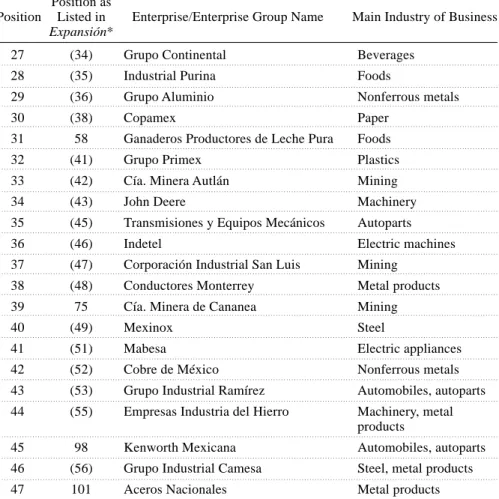
The third point brought out is that indigenous enterprises very often form enterprise groups. Of the 62 above-mentioned indigenous enterprises and groups, Table 1-1 shows the names of 47 that are operating in manufacturing and mining which are analyzed in this book. Of these 47, 8 are individual enterprises and the remaining 39 are enterprise groups according to the clas-sification in Expansión.
As to the reason the five industries mentioned earlier are taken up in this book, it is because these industries are among those of principal business activity of enterprise groups located at or near the top of the ranking list. The beer brewing industry is the main area of business for no.-3 listed VISA (Valores Industriales); the steel industry is the main area of business for no. 1 Alfa (Grupo Industrial Alfa); the baking industry is the main area of business for no. 6 Bimbo (Grupo Industrial Bimbo); the nonferrous metal mining
in-Fig. 1-2. Percentage of Total Sales by the Type of Ownership for Mexico’s 100 Largest Enterprises and Groups, 1986
. . . . . . . . . . . . . . . . . . . . . . . . . . . . . . . . . . . . . . . . . . . . . . . . . . . . . . . . . . . . . . . . . . . . . . . . . . . . . . . . . . . . . . . . . . . . . . . . . . . . . . . . TABLE 1-1
INDIGENOUS ENTERPRISESAND GROUPSINTHE MININGAND MANUFACTURING INDUSTRIESAMONG
MEXICO’S 100 LARGEST ENTERPRISESAND GROUPS LISTEDINTHE JOURNAL, Expansión: 1986
Position as
Position Listed in Enterprise/Enterprise Group Name Main Industry of Business Expansión*
1 (1) Grupo Industrial Alfa Steel, petrochemicals, foods, other
2 (2) Vitro Glass, plastics
3 (4) Valores Industriales Beer/other beverages, metal products, foods 4 (6) Desc, Sociedad de Fomento Industrial Petrochemicals,
autoparts, foods 5 (7) Industrias Peñoles Mining, chemicals 6 (8) Grupo Industrial Bimbo Foods
7 (9) Cydsa Synthetic fibers, plastics,
mining 8 10 Celanese Mexicana Synthetic fibers 9 (10) Grupo Industrial Minera México Mining 10 (11) Cementos Mexicanos Cement
11 (13) Grupo Condumex Conductor, electric appliances, autoparts
12 (14) Grupo Gamesa Foods
13 (15) Sociedad Industrial Hermes Autoparts, machinery, metal products 14 (16) Cía. Industrial de San Cristóbal Paper 15 (17) Empresas Tolteca de México Cement 16 (18) Tubos de Acero de México Steel
17 (19) Grupo Industrial Saltillo Electric appliances, metal products, autoparts 18 27 Fábrica de Jabón La Corona Soap, deodorizers 19 29 Cigarros La Tabacalera Mexicana Cigarettes
20 (23) Grupo IMSA Metal products
21 (27) Industrias Nacobre Metal products, autoparts
22 (29) Grupo Anahuac Cement
23 (30) Union Carbide Mexicana Chemicals
24 (31) Grupo Sidek Metal products, autoparts 25 (33) Ponderosa Industrial Paper
27 (34) Grupo Continental Beverages
28 (35) Industrial Purina Foods
29 (36) Grupo Aluminio Nonferrous metals
30 (38) Copamex Paper
31 58 Ganaderos Productores de Leche Pura Foods
32 (41) Grupo Primex Plastics
33 (42) Cía. Minera Autlán Mining
34 (43) John Deere Machinery
35 (45) Transmisiones y Equipos Mecánicos Autoparts
36 (46) Indetel Electric machines
37 (47) Corporación Industrial San Luis Mining 38 (48) Conductores Monterrey Metal products 39 75 Cía. Minera de Cananea Mining
40 (49) Mexinox Steel
41 (51) Mabesa Electric appliances
42 (52) Cobre de México Nonferrous metals 43 (53) Grupo Industrial Ramírez Automobiles, autoparts 44 (55) Empresas Industria del Hierro Machinery, metal
products
45 98 Kenworth Mexicana Automobiles, autoparts 46 (56) Grupo Industrial Camesa Steel, metal products 47 101 Aceros Nacionales Metal products
Source: By the author using data from Expansión, August 19, 1987, pp. 98–137 and September 2, 1987, pp. 50–57.
* The numbers in parentheses show the ranking within the list of 109 enterprise groups; the numbers not in parentheses show the ranking within the list of 500 individual enterprises.
TABLE 1-1 (Continued) Position as
Position Listed in Enterprise/Enterprise Group Name Main Industry of Business Expansión*
dustry is the main area of business for no. 5 Peñoles (Industrias Peñoles) and no. 9 Grupo Industrial Minera México; the autoparts manufacturing industry is the main area of business for no. 4 Desc (Desc, Sociedad de Fomento Industrial). Likewise for the listing from no. 11 and below—the steel indus-try is the main area for no. 16 TAMSA (Tubos de Acero de México); the nonferrous metal mining industry is the main area for no. 33 Autlán (Cía. Minera Autlán), no. 37 San Luis (Corporación Industrial San Luis), and no.
. . . . . . . . . . . . . . . . . . . . . . . . . . . . . . . . . . . . . . . . . . . . . . . . . . . . . . . . . . . . . . . . . . . . . . . . . . . . . . . .
39 Cananea (Cía. Minera de Cananea); the autoparts manufacturing industry is the main area for no. 13 Hermes (Sociedad Industrial Hermes), no. 21 Nacobre (Industrias Nacobre), no. 35 TREMEX (Transmisiones y Equipos Mecánicos), and no. 43 Ramírez (Grupo Industrial Ramírez).
As stated earlier, Evans pointed out that the power balance between local capital and multinational enterprises is relative and differs from one industry to another. In a particular industry local capital can be in a superior position vis-à-vis multinational enterprises, and indeed such a situation existed in the five industries under study. If such a difference in the power balance comes about in some industries but not others, it is most likely due to the difference in the conditions existing in the industries. Elucidating those differences in conditions would be an important key to understanding the abilities and limi-tations of indigenous enterprises in leading Mexico’s industrialization. As an effective way to achieving this elucidation, I considered it efficient to select industries where indigenous enterprises are in a dominant position and to analyze what particular conditions in the industries have made it possible for indigenous enterprises to dominate. For this reason, the five industries where indigenous enterprises were dominant were selected for analysis. The par-ticular conditions in the five industries that this study will look closely at are: the market, technology, industrial policy, and the positions of each industry in the industrialization process.
This book analyzes the formation and growth of the indigenous enterprises that hold leading positions in the five industries. Chapter 2 takes up the beer brewing industry and will examine Cuauhtémoc (Cervecería Cuauhtémoc), the core enterprise of the VISA group; Chapter 3 deals with the steel industry and will analyze Fundidora (Fundidora de Fierro y Acero de Monterrey), Mexico’s first blast furnace steelmaker, and Hylsa (Hojalata y Lámina), the core enterprise of the Alfa group; Chapter 4 looks at the baking industry and will study the Bimbo group; Chapter 5 takes up the nonferrous metal mining industry and will examine Grupo Industrial Minera México (which was reor-ganized as Grupo México in 1994, and this new name is used in Chapter 5); and Chapter 6 deals with the autoparts manufacturing industry and will study Spicer, one of the core subsidiaries of the Desc group. The following two points are of significant importance on studying these enterprises. One is the oligopolistic structure of the industries which is an important feature of Mexico’s economy as can be gathered from the high concentration of sales in few companies which was noted earlier. The five industries under analysis are characterized by this same extreme concentration of production. This means that there is a great deal of scope for explaining the trends in these industries by examining the trends in the leading enterprises. The second
point is that the ability of the enterprises to lead the way in carrying out industrialization also depends on the particular conditions specific to the en-terprises. By focusing on the enterprises, we can elucidate those specific conditions. The specific conditions this study will look closely at are the ability of the entrepreneurs and the enterprises’ capabilities in technology, production, and marketing.
Also related with the specific conditions in the enterprises is the matter of innovativeness of indigenous enterprises during the period of import substi-tution industrialization which, this writer would like to stress, was connected with the remarkable transformation that indigenous enterprises experienced starting in the 1980s. From 1982 Mexico’s development strategy underwent a radical change from government-led import substitution industrialization to market-led export-oriented industrialization. Although the recovery of the macroeconomy from Mexico’s repeated crises was slow, the enterprises stud-ied in this book along with most of the large-scale indigenous enterprises achieved a dynamic transformation after 1982 and quickly returned to the path of growth (Hoshino 1997; Garrido 1998, 1999). The reasons such a transformation could be achieved over a short period of time were firstly that such dramatic change was of critical necessity for the survival and develop-ment of the enterprises. At the same time conditions for such a transforma-tion already existed within the enterprises. One of my assertransforma-tions in this book is that the conditions for such change were brewing within the enterprises during the period of import substitution industrialization, and I would like to explain these conditions using the word “innovativeness” which has seldom been used to describe Mexican indigenous enterprises. Innovativeness in this case is the ability of the enterprises to correctly grasp the requisite for growth, then to resolutely take up the challenge of new endeavors in order to prepare the way for growth, then finally to realize growth. Whether managers cor-rectly grasp the requisites of growth, have the capacity and will to bear risk, and can create within the organization of the enterprise a system which makes new endeavors into a part of business operations, these are extremely impor-tant questions which indicate that the ability of enterprises to innovate de-pends greatly on the ability of managers. This stress on the role of the entre-preneur puts the position of this writer close to that of the innovative entrepreneur approach. However, I see the source of innovativeness as lying in the socioeconomic environment surrounding the entrepreneur and not in the value system as Lipset and Lomnitz see it.
What can be pointed to as the requisites of growth? This writer considers them to be embodied in the three capacities of technology, production, and marketing. How much each of these capacities can be improved differs
de-pending on the industry and on the product manufactured. The chapters that follow this introduction will examine the experiences of individual enter-prises. These experiences and the enterprises’ accumulated capacities were utilized by these enterprises to carry through their dynamic transformation after 1982.
Mexico’s Industrialization and the Experiences of the Six
Enter-prises in Five Industries
Four Stages of Industrialization
In order to better understand the chapters that follow, I have divided Mexico’s industrialization process into four stages using the criteria of eco-nomic growth rate, principal ecoeco-nomic actors, and leading industries.9 These
four stages are summarized below in their relationship with the experiences of the six enterprises in the five industries examined in this study.
The first stage, 1890–1940 (industrialization of the consumer goods sec-tor): Industrialization during this stage was carried on entirely by domestic private capital, and small-scale artisan and handicraft industries coexisted with modern factory-system industries. The manufacturing industry consisted of the consumer goods sector and a portion of the intermediate goods sector. The industry’s growth was slow-paced compared with later stages, but it moved steadily ahead except during the turmoil of the Mexican Revolution and during the Great Depression. During this first stage there was a steady changeover from artisan and handicraft production to factory production (Casar and Ros 1983, p. 155). Cuauhtémoc (examined in Chapter 2), Fundidora (examined in Chapter 3), and the large-scale enterprises analyzed by Haber, many of which later became the nucleus of Mexico’s economy, were born and started their development during this stage. According to Frank Brandenburg, the people who later came to represent the big entrepreneurs of Mexico began their work during the 1920s and 1930s.10 He has called
them along with the others who rose up rapidly during the first stage the “first generation of Mexican capitalists” (Brandenburg 1964, p. 98).
The second stage, 1940–53 (rapid advance of industrialization stimulated by changes in the international economic environment): World War II accel-erated the pace of Mexico’s industrialization. There was new demand for Mexico’s exports from the advanced countries, especially after the United States entered the war, while imports from these countries ceased. This stimu-lated the expansion of exports and the import substitution of the consumer and intermediate goods industries (Casar and Ros 1983, p. 155) which
con-tinued until the end of the Korean War. A succession of new enterprises were founded which, in the case of this study, included Hylsa and Bimbo (ana-lyzed in Chapters 3 and 4 respectively). Sanford Mosk, who looked at the rising power of the new entrepreneurs during this stage, was the first to ad-vance the view that 1940 marked the start of Mexico’s industrialization (Mosk 1954). Mosk looked at the entrepreneurs of medium- and small-scale enter-prises who differed from those of the first generation in that they were anti– foreign capital, adopted a favorable position toward the farmers and work-ers, and looked affirmatively on government intervention in the economy. But according to Brandenburg, none of the big entrepreneurs who appeared later came from the ranks of these small entrepreneurs (Brandenburg 1964, p. 220). Another development during this second stage was the start of gov-ernment intervention in the economy and its involvement in production through the establishment of government-run enterprises in the steel, fertil-izer, and paper manufacturing industries (Casar and Ros 1983, p. 156). Gov-ernment intervention and public enterprises in the steel industry are exam-ined in Chapter 3.
The third stage, 1953–62 (first phase of heavy and chemical industrializa-tion): Between 1954 and 1970 Mexico experienced a time of stable prices and exchange rates together with economic growth that was unprecedented in its economic history. Those years have come to be known as the time of
desarrollo estabilizador (stabilized development). The third stage makes up
the first half of this time of stabilized development, and the main reason for separating it from the fourth stage starting in 1962 is because of a change in the growth rate of the manufacturing industry. But there are also two other differences between the two stages. One was a change in the leading indus-tries from consumer and intermediate goods to capital and durable consumer goods. The growth of the intermediate goods industry was especially high during this period compared with the fourth (Hoshino 1998, pp. 231–32). Another difference is that, during this stage, the major players in the economy continued as before to be the indigenous enterprises. These enterprises con-tinued to dominate the consumer goods industry and the long-standing inter-mediate goods industry. In growing industries, foreign capital and joint ven-tures frequently moved into industries like basic chemical products and the assembly of durable consumer goods where the production process was com-parably simple. Foreign capital at this stage was still not important, never-theless it strengthened its position in the chemicals industry and moved into such growing industries as electric devices and farm machinery through joint ventures with indigenous and government-run enterprises. On the other hand, the government invested in large-scale projects of specific intermediate and
capital goods industries such as steel, fertilizer, and railroad rolling stock (Casar and Ros 1983, pp. 154, 156–57). From this third stage onward as Mexico’s industrial structure grew more advanced, it became increasingly more difficult for indigenous enterprises to move into leading industries re-lying solely on their own strength, and other means became necessary to overcome barriers to entry. Policies were introduced as one means to facili-tate entry, such as the policy to indigenize the mining industry and the policy to promote the automobile industry which are examined in Chapters 5 and 6 respectively.
The fourth stage, 1962–82 (second phase of heavy and chemical industri-alization): One change that took place during this period was the shift of leading industries to capital and durable consumer goods. Between 1963 and 1970 the industries recording the highest growth rates were machinery, elec-tric devices, and automobiles. The intermediate goods industry continued to maintain its high rate of growth, but at lower figures than previously. A sec-ond change during the period was the substantial increase in foreign invest-ment. The greater part of foreign direct investment went into the manufactur-ing sector (Hoshino 1998, pp. 232–33). This investment gravitated toward growing industries. Machinery, electric devices, and automobiles, the three industries with the highest growth rates, became dominated by foreign capi-tal, and in the chemicals industry, which also continued to grow, foreign capital increased in importance. At the same time such capital also successfully ad-vanced into the consumer goods industry through the use of product differ-entiation (Casar and Ros 1983, pp. 158–59). During this period Spicer (ex-amined in Chapter 6) entered the autoparts manufacturing industry with the backing of the government and cooperation from foreign capital.
With the substantial influx of foreign capital, the power balance between indigenous and foreign-owned enterprises during the fourth stage can be di-vided into two time frames, one before and the other after 1973 when a new law on foreign capital was implemented. This law strengthened controls on foreign capital to restrain the growing importance of foreign-owned enter-prises and increase that of indigenous enterenter-prises. During the oil boom at the end of the 1970s, the pace of industrialization accelerated carried along on an enormous volume of foreign bank borrowing. In growing industries in-digenous enterprises entered into alliances with foreign capital and became dependent on foreign borrowing for funds as they pushed ahead with large-scale expansion (Hoshino 1990). This continued until Mexico’s foreign debt problems came to the surface in 1982.
After 1982 the economic environment surrounding indigenous enterprises deteriorated as never before as Mexico’s foreign debt problem led to an
eco-nomic crisis and government policies liberalizing the market intensified com-petition. Nevertheless, each of the enterprises examined in this book solved its debt problem, resolutely undertook restructuring, and used their alliance with foreign capital to increase the globalization of their business activities. In effect economic adversity became a springboard that these enterprises used to reform and rapidly expand their business operations. However, these post-1982 developments will not be examined as they lie beyond the scope of this study which focuses on the pre-1982 import substitution industrialization period.
The Chapters Composing This Book
Following this introduction which forms Chapter 1, Chapter 2 will ana-lyze the growth of Cuauhtémoc, one of the two giants which constitute the duopoly in the beer brewing industry. The chapter will study the factors which made it possible for Cuauhtémoc to establish its present strong position, look-ing especially at the importance of the company’s innovativeness. This chap-ter will also look at the mutual conditioning effect between enchap-terprise growth and the industrialization process by seeking to know the effects that Cuauhtémoc as a company exerted on the development of Mexico’s industri-alization and on the oligopolization of the country’s industrial structure, while conversely seeking to know the effects that industrialization exerted on the company’s growth and business development.
Chapter 3 will analyze the growth of Hylsa and Fundidora, two enter-prises in the steel industry. Hylsa is equivalent to an affiliated enterprise with Chapter 2’s Cuauhtémoc. Fundidora was a privately owned indigenous en-terprise until 1976 when it went under control of the state. Both private and public enterprises operated in the steel industry until its privatization in 1991. This chapter will describe the mixed economy system that existed in the steel industry, and it will also examine, via the experiences of the two steel companies, the significance of the mixed economy for the business of indig-enous enterprises.
Chapter 4 will analyze the growth of Bimbo which monopolizes the bak-ing industry. It will look in particular at factors which make indigenous en-terprises tend to concentrate in certain industries and which foster the sepa-ration of indigenous, public, and foreign-owned enterprises into differing spheres of business. In the case of Bimbo, the chapter looks at why it was this company that came to monopolize the baking industry. The reasons can be found in the origin of Bimbo’s founding family, its management strategy, and the features of the industry’s market and technology.
Chapters 5 and 6 examine the role of government policies in the growth of indigenous enterprises. Chapter 5 analyzes the effects that policy indigenizing the mining industry had on the growth of indigenous enterprises. By tracing the development of the large-scale nonferrous metal mining group, Grupo México, after it was indigenized, this chapter will point out the effects of the indigenization policy, the role of indigenous enterprises in this policy, and the particular conditions in the mining industry and in Mexico that governed the outcome of this policy. Chapter 6 analyzes the effects of industrial pro-motion policy on fostering the growth of indigenous enterprises. Through an analysis of the growth of Spicer, an autoparts manufacturing subsidiary of the Desc group, the chapter will examine the effects that policy to promote the automobile industry had on the fostering of indigenous enterprises as well as the effects it exerted on the structure of the industry.
The concluding chapter of this book will endeavor to summarize and set forth conclusions about the five major points discussed in this study, which are in the order of their analysis: the innovativeness of indigenous enter-prises during the period of import substitution industrialization; the role of the government in the growth of indigenous enterprises; the logic for the oligopolization of Mexico’s industrial structure; the logic separating the spheres of activity of indigenous, foreign-owned, and public enterprises; and the logic of indigenous enterprise business diversification.
Notes
1 More precisely they are indigenous private enterprises, but for convenience in this book they are referred to simply as indigenous enterprises.
2 The Mexican economic journal Expansión, which publishes the ranking of Mexico’s 500 largest enterprises each year, classifies enterprises into these three categories based on the stockholders owning the majority of the stocks, and this book also uses this criterion. However, when defining foreign-owned enterprises, it is common to regard them as foreign-owned even when the rate of foreign capital participation is much lower. For example, in their research on foreign-owned enterprises in Mexico, Fernando Fajnzylber and Trinidad Martínez Tarrago regarded enterprises with 5 per cent or higher foreign capital participa-tion as foreign-owned. According to these two researchers, Mexico’s central bank uses a criterion of 5 per cent, and the U.S. Department of Commerce uses 25 per cent (Fajnzylber and Martínez Tarrago 1976, pp. 150–51). When dis-cussing the nationality of enterprises, the most important point is who controls management. Who controls management however does not necessarily
coin-cide with who holds the majority of shares, which makes it all the more difficult to determine which nationality a company belongs to. For this reason it is nec-essary to make a careful analysis of the makeup of stock ownership and to set up a criterion which is appropriate for the objectives of the research undertaken. 3 The economic journal Expansión first published the survey in 1975 where it appeared annually as a listing of enterprises under the title “Mexico’s 500 Larg-est Enterprises.” Each year the information provided has grown increasingly detailed. Since the latter half of the 1970s many enterprises have listed them-selves on the stock exchange, and this has made it possible to get information about listed enterprises through the Mexican Stock Exchange. Also private re-search companies have begun publishing yearbooks on large-scale enterprises, such as Industridata, empresas grandes which is issued annually.
4 Examples of empirical research on Mexico’s indigenous enterprises since the 1970s include: Derossi (1977); Fragoso and others (1979); Jacobs (1981); Hoshino (1988, 1993a, 1996); Garrido (1998, 1999).
5 See for example Aguilar (1967) and Ramírez (1975).
6 Examples of such studies are Martínez Nava (1984), Luna (1987), Tirado (1987), Camp (1989), Hernández Rodríguez (1989), and Tsunekawa (1996).
7 This argument has been criticized by researchers of the dependency approach, such as Stavenhagen (1968) and Chilcote and Edelstein (1974).
8 In Mexico public and foreign-owned enterprises are most often individual inde-pendent companies whereas indigenous enterprises most often form integrated enterprise groups under holding companies. For this reason, when indigenous enterprises are looked at individually, their scale is small, but when a group of enterprises under the same capital affiliation is looked at as a unit, their scale often rivals that of foreign-owned and public enterprises. Given this situation,
Expansión published two listings between 1985 and 1994, one entitled the “500
Largest Enterprises” which included enterprises under enterprise groups, and the other entitled the “Largest Enterprise Groups” which showed only groups. The 1987 listing (compiled from data for 1985–86) showed 500 individual en-terprises and 109 enterprise groups. Included among the 500 individual enter-prises were member enterenter-prises belonging to enterprise groups. After removing the overlapping portion of the two lists, there were 215 individual enterprises and 109 groups which I examined.
9 The years 1890–1940, which form the first stage, have been put together into a single time frame because there is a continuity in the leading industries and the principal economic actors despite the drastic decline in growth during the Mexi-can Revolution and after the Great Depression of 1929. Haber also viewed these years as forming a single stage. The years 1940–53 form the second stage be-cause during this time frame, economic growth experienced a single wave of rapid rise then rapid fall. The strong effects of World War II and the Korean War led to the rapid expansion of manufacturing; also the factors of growth make it possible to group these years together. The years from 1953 to 1962 and from
1962 until 1982 form the third and fourth stages as they form two growth cycles in the manufacturing industry; also there was a change in the principal eco-nomic actors and the leading industries.
10 As entrepreneurs who rose up during the 1920s, Brandenburg names William Jenkins, Julio Lacaud, Carlos Trouyet, Harry Wright, and Raúl Bailleres; for the 1930s he names Emilio Azcárraga, Gastón Azcárraga, Rómulo O’Farrill, Eloy Vallina, Harry Steele, and Antonio Ruiz Galindo (Brandenburg 1964, p. 267). Trouyet, Bailleres, and Ruiz Galindo also appear in this book.