Industrialization of developing economies in
the global economy with an infectious disease
著者
Sato Hitoshi
権利
Copyrights 2021 by author(s)
journal or
publication title
IDE Discussion Paper
volume
815
year
2021-03
INSTITUTE OF DEVELOPING ECONOMIES
IDE Discussion Papers are preliminary materials circulated
to stimulate discussions and critical comments
Keywords: COVID-19, industrialization, automation, financial globalization, social
mobility
JEL classification: F12, F16, O14
* Development Studies Center, IDE ([email protected])
IDE DISCUSSION PAPER No. 815
Industrialization of Developing
Economies in the Global Economy with
an Infectious Disease
Hitoshi SATO*
March 2021
Abstract
Manufacturing has long been the center of industrialization strategies for poor developing countries. This paper first investigates the effects of labor supply constraints on industrialization, which may have been caused by the coronavirus disease 2019 (COVID-19). Then, the study examines how manufacturing automation could affect industrialized developing economies based on the premise that manufacturers may accelerate production automation in response to the COVID-19 pandemic. The model predicts declines in developing economies’ manufacturing competitiveness and a heterogeneous pattern of recovery from the COVID-19 recession. In comparison, developing economies with large manufacturing bases would recover relatively quickly, whereas those with weaker manufacturing bases would suffer from a long-term decline and manufacturing contraction trends (undesirable deindustrialization). Manufacturing automation can enhance economic welfare, causing a contraction in the unproductive non-tradable good (service) sector. However, with low labor mobility, the welfare effect is ambiguous, thereby widening the wage gap between skilled and unskilled labor.
The Institute of Developing Economies (IDE) is a semigovernmental,
nonpartisan, nonprofit research institute, founded in 1958. The Institute
merged with the Japan External Trade Organization (JETRO) on July 1, 1998.
The Institute conducts basic and comprehensive studies on economic and
related affairs in all developing countries and regions, including Asia, the
Middle East, Africa, Latin America, Oceania, and Eastern Europe.
The views expressed in this publication are those of the author(s). Publication does not imply endorsement by the Institute of Developing Economies of any of the views expressed within.
INSTITUTE OF DEVELOPING ECONOMIES (IDE), JETRO 3-2-2, WAKABA,MIHAMA-KU,CHIBA-SHI
CHIBA 261-8545, JAPAN
©2021 by author(s)
No part of this publication may be reproduced without the prior permission of the author(s).
Industrialization of Developing Economies in the Global
Economy with an Infectious Disease
∗Hitoshi Sato†
March 5, 2021
Abstract
Manufacturing has long been the center of industrialization strategies for poor developing countries. This paper first investigates the effects of labor supply constraints on industrialization, which may have been caused by the coronavirus disease 2019 (COVID-19). Then, the study examines how man-ufacturing automation could affect industrialized developing economies based on the premise that manufacturers may accelerate production automation in response to the COVID-19 pandemic. The model predicts declines in developing economies’ manufacturing competitiveness and a heteroge-neous pattern of recovery from the COVID-19 recession. In comparison, developing economies with large manufacturing bases would recover relatively quickly, whereas those with weaker manufactur-ing bases would suffer from a long-term decline and manufacturing contraction trends (undesirable deindustrialization). Manufacturing automation can enhance economic welfare, causing a contrac-tion in the unproductive non-tradable good (service) sector. However, with low labor mobility, the welfare effect is ambiguous, thereby widening the wage gap between skilled and unskilled labor. Keywords: COVID-19, industrialization, automation, financial globalization, social mobility JEL classification: F12, F16, O14
1
Introduction
The coronavirus disease 2019 (COVID-19) has forced drastic changes in our economic activities, causing serious health, economic, and social crises. Private firms reconsider how they could operate their busi-ness safely in the global economy, which is riskier than previously thought. Governments have struggled to balance controlling the spread of the COVID-19 while keeping their economies alive. As in many other difficult times, the highest costs fall on those least prepared to bear them, which is particularly true in developing economies. To understand the impact of the COVID-19 pandemic on developing economies, this volume collects four papers (including this one). Although many important (and inter-esting) questions have to be answered, given policy importance, we focus on globalization-related issues in developing economies.
This study first considers conditions for industrialization of developing economies in an open econ-omy setting. Then, we examine how the pandemic would affect the identified conditions while focusing on labor supply constraints, which is one of the most evident difficulties caused by the pandemic through social distancing. Manufacturing has long been the center of industrialization strategies for poor develop-ing countries, but their performance seems to be dichotomous. That is, some countries (mainly in Asia)
∗I am very grateful to Kyoji Fukao and other seminar participants at IDE-JETRO for many insightful discussions.
Respon-sibility for opinions and errors lie with the author.
have successfully developed manufacturing sectors, whereas others have been sluggish and remained in nonindustrial states. Our main goal is to shed light on this industrialization heterogeneity and potential effects of the pandemic on industrialization.
This paper proposes a small open economy with multiple sectors, based on Rodríguez-Clare (1996). The novelty of our model is twofold. First, a non-tradable final good (service) sector is introduced. The majority of the workers in developing economies are informal employment, which is much more vulner-able to the COVID-19 pandemic than formal employment. Hence, the introduction of the non-tradvulner-able sector enables us to examine the potential effect of the pandemic on one of developing economies’ re-markable traits.1 Second, we endogenize skill accumulation. Unskilled workers may become skilled by taking costly education (or vocational training), which is the model’s another fundamental ingredient, separating labor supply constraints into those over total labor supply and over skilled labor supply.
We model a small country with three final consumption sectors: two tradable sectors and one non-tradable sector. The first non-tradable sector, referred to as the agricultural sector, is unskilled labor intensive. The other tradable sector, referred to as the manufacturing sector, is characterized by productivity growth with increasing varieties of intermediate inputs. Such inputs are non-tradable and skilled labor intensive. The non-tradable consumption good sector is unskilled labor intensive, and the sole difference from the agricultural sector is that the product demand is constrained by the size of the home market.
In this framework, trade openness requires a minimum scale of the local intermediate input sector for industrialization (i.e. the threshold size of the manufacturing base). As the intermediate input sector exhibits increasing returns to scale, the threshold size of the manufacturing base leads to multiple equi-libria, that is, an industrialization equilibrium and a nonindustrial equilibrium. Thus, the model shows that developing countries may be trapped in a nonindustrial state although they can potentially reach a Pareto-superior industrialized state.
Given the possibility of the “industrialization trap," this paper first investigates the effects of labor supply constraints on industrialization, which may have been caused by the COVID-19 pandemic. Then, the paper examines how manufacturing automation could affect industrialized developing economies based on the premise that manufacturers may accelerate production automation in response to the in-cremental labor supply constraints because of the COVID-19 pandemic. Automation is not exceptional in developing countries. Long before the pandemic, manufacturing automation has begun mainly in multinational plants even in poor developing economies(e.g. Seric and Winkler, 2020). To investigates automation consequences, the model is extended to include international capital flows (i.e. machine imports), which allow manufactures to replace unskilled labor input with capital.
The main findings of this paper are as follows. First, labor supply constraints may have a critical impact on industrialization, weakening the manufacturing competitiveness of developing economies in the world market. Nonindustrial developing economies face more restrictive industrialization condi-tions, and worse, industrialized developing economies may be back to the nonindustrial state if their manufacturing base drops t below their industrialization thresholds. Thus, the model predicts that while developing economies with relatively large manufacturing bases may quickly recover from the current recession, those with weaker manufacturing bases will suffer from long-term decline and manufacturing contraction trends (undesirable deindustrialization).
Second, manufacturing automation will expand the intermediate input sector by increasing manufac-turing productivity and cause a contraction of the unproductive non-tradable final good (service) sector, resulting in a positive impact on aggregate productivity. Thus, manufacturing automation is expected to mitigate the negative economic effect of the pandemic. However, the ability of manufacturing automa-tion to enhance economic welfare crucially depends on high labor liquidity, not only in inter-sectoral
1In 2016, informal employment excluding agriculture occupies about 60 per cent of total employment in developing
mobility (horizontal mobility) but also in skill upgrading (vertical mobility). With low labor liquidity, automating manufacturing production will expand the non-tradable final sector and enlarge the wage gap between skilled and unskilled. Therefore, the direction of economic welfare change is ambiguous. Hence, policies for increasing labor movements, including enhancing education systems, become more important under the COVID-19 crisis.
Although the economics literature on COVID-19-related issues has been rapidly expanding, to my best knowledge, apart from descriptive policy briefs including (e.g. UNIDO, 2020), formal analyses on the effect on industrialization and economic development are still limited. This study proposes a simple open economy model and provides an analysis on the potential effects of the COVID-19 pandemic on the industrialization of developing countries thorough the lens of constrained labor supply (both skilled and unskilled) and manufacturing automation.
A large body of literature points out that although only a limited number of developing countries suc-ceeded in catching up with developed economies through industrialization, many developing countries failed to do so and even experienced declines in their manufacturing goods. Rodrik (2016), referring to this phenomenon as “premature deindustrialization,” claims that terms-of-trade deterioration owing to the rapid growth of China and technological progress in the rest of the world have disturbed developing countries’ industrialization. In addition, Eichengreen, Park, and Shin (2014) empirically find that fast-growing middle-income countries tend to experience growth slowdowns, but those with relatively human capital accumulation or high-technology products tend to escape from growth slowdowns. This study’s predictions are consistent with their findings. However, contrary to Rodrik (2016), I stress the role of labor movements including skill formation.
In the trade and skill formation literature, Atkin (2016) recently investigates Mexican data and finds that less-skilled manufacturing exports slow down the skill accumulation. This paper, primarily theoret-ical, incorporates endogenous skill formation and argues that a country’s comparative advantage affects its skill accumulation. Furthermore, this study examines to obtain the potential impact of the COVID-19 pandemic on industrialization and derive related policy implications.
Rodríguez-Clare (1996) and Rodrik (1996) are the two closest to this paper in the sense that both papers deal with coordination failure problems in comparative advantage formation. Rodríguez-Clare (1996) primarily focuses on multinationals’ creation of backward-linkage in developing economies. Ro-drik (1996) discusses policy measures, such as minimum wages, to resolve the coordination failure problem. However, both papers lack endogenous skill formation and non-tradable sectors, which are highlighted in the current study. Venables (2017) examines a dichotomous feature of developing coun-tries’ industrialization by explicitly modeling a non-tradable sector. However, Venables (2017) stresses the role of urbanization as a prerequisite for industrialization. The present study focuses on endogenous skill formation and the role of manufacturing automation.
The remaining part of this paper is as follows. The next section introduces a simple open economy model with a non-tradable sector and endogenous skill formation. Section 3 discusses conditions for industrialization, and Section 4 considers the potential impacts of the COVID-19 pandemic on devel-oping economies’ industrialization, focusing on labor supply constraints and manufacturing automation. Section 5 concludes.
2
A Simple Model
2.1 Preferences and Demand
We consider a small open economy populated with L of individuals, each of which inelastically supplies one unit of unskilled labor. A representative individual consumes a unit interval of sectors indexed by j
with the following Cobb-Douglas utility function:
U=
∫ 1 0
ln qjd j,
where qjrepresents consumption of sector j. Following Epifani and Gancia (2009), I assume that sectors
are sorted into three categories: tradable manufacturing goods (M), non-tradable goods (services) (N), and tradable agricultural goods (A). For analytical simplicity, sub-intervals for each category are exoge-nous, and I assign intervalsθ > 0 and η > 0 for the manufacturing and non-tradable goods, respectively. Assumingθ + η < 1, the remaining interval is assigned to the agricultural goods.
The embedded idea of this specification of non-tradable sector is that international trade costs for intervalη are prohibitively high. We capture a respect of recent globalization as a decrease in η: as trade costs decline, goods and services that were previously non-tradable become tradable (e.g. online consulting services).
By sectoral symmetry, the utility function can be rewritten as:
U = ζqθMqηNq1−θ−ηA , ζ > 0, θ > 0, η > 0, 0 < θ + η < 1,
where qi stands for consumption of good i = {M, N, A} and θ and η are distribution parameters that
determine the importance of the three goods. The agricultural good is a numeraire in the model, and its price is normalized to unity. Utility maximization yields the following demand for each good:
qM= θE
pM, qN =
ηE
pN, qA = (1 − θ − η)E,
where pM is the manufacturing price that is exogenously determined in the world market and pN is the
endogenous price of non-tradable good, and E is the economy’s aggregate income. By choosingζ appropriately, the indirect utility is given by
V(E, p) = p−θMp−ηN E. (1)
2.2 Production and Labor Demand
All the three final consumption goods are perfectly competitive and produced with constant returns to scale technologies. The production of the agricultural good requires only unskilled labor, and its labor productivity is normalized such that the unskilled wage w equals 1 as long as the agricultural good is produced. Denoting the output of the agricultural good by yA, the unskilled labor demand from this
sector is simply
LA = yA. (2)
The non-tradable good (services) also requires only unskilled labor. Denoting output by yN, the
production function is yN = ψNLN, whereψN > 0 stands for labor productivity and LN is unskilled labor
input. The price of non-tradable good is pN = w/ψN. Using market clearing condition, yN = qN, the
unskilled labor demand from this sector is
LN = ηE
w . (3)
The manufacturing good employs the following Cobb-Douglas technology:
yM= ( X β )β( LX 1− β )1−β , β ∈ (0, 1),
where LX is input of unskilled labor and X is a composite of intermediate goods. The composite of
intermediate goods is specified by the following CES function:
X= [∫ n 0 x(i)(σ−1)/σdi ]σ/(σ−1) , (4)
whereσ > 1 is the elasticity of substitution between any two varieties of the intermediate goods and n is the mass of varieties of the intermediate goods.
The production of the composite of intermediate goods exhibits increasing returns to scale.2 This specification of manufacturing production implies that the intermediate-good sector exhibits increasing returns to scale although final manufacturing production is constant returns to scale. The access to a wider range of inputs enhances manufacturing productivity, which can be interpreted as the division of labor as a source of increased productivity (Ethier, 1982). Asβ increases, the productivity-enhancing effect by the division of labor becomes more powerful.
Each intermediate variety is produced with skilled labor under increasing returns and monopolistic competition. The stock of skilled labor is endogenous in the model: each household can provide either one unit of unskilled labor or 1/t units of skilled labor, where t > 1. This specification means that each household has to incur an iceberg-type education (or job training) cost measured in units of unskilled labor to acquire skills necessary for intermediate production. Given that the manufacturing sector is ac-tive in the economy, households must be indifferent between becoming skilled and remaining unskilled, which implies that the skilled wage, ws, just compensates the education cost:
ws= tw. (5)
The total amount of skilled labor required for quantity x(i) of intermediate good i is given by
ls(i) = ψx(i) + f, where ψ is the marginal requirement of skilled labor. Profit maximization leads to the
standard markup pricing. Choosing the unit of skilled labor, such asψ = (σ − 1)/σ, we have p(i) = ws
for all varieties. Using this result, the monopoly profits are expressed byπ(i) = [p(i) − ψws]x(i)− f ws=
[
x(i)/σ − f]ws. Free entry drives the monopoly profits down to zero, which ensures that each
interme-diate firm producesσ f units in equilibrium. Hence, the firm-level skilled labor requirement is given by
ls= ψσ f + f = σ f.
For easing notational complexity, I normalize units so thatσ f = 1, hereafter.
To derive unskilled labor requirement from the direct input in manufacturing, final producers’ cost minimization yields LX = 1− β β · PXX w , (6)
where PXis the price index of a continuum of intermediate goods, which is given by
PX = [∫ n 0 p(i)1−σdi ]1/(1−σ) = n1/(1−σ)tw, (7)
where (5) is used. As x(i)= σ f = 1 for all i, (4), (5), and (7) suggest that PXX = ntw. Substituting this
into (6), we obtain unskilled labor demand in the manufacturing sector as follows:
LX =
(1− β)nt β .
2Too see this, convexity and symmetry among x(i) in (4) ensure that final firms use the same quantity of all available
intermediate goods, thereby, denoting this usage level by ¯x for all x(i), X = nσ/(σ−1)¯x = n1/(σ−1)(n ¯x). Hence, as input nx
Given that the total demand of skilled labor for intermediate production is n, the aggregate labor demand in the manufacturing sector in units of unskilled labor is given by
LM =
nt
β, (8)
which is proportional to the mass of intermediate varieties, n. Furthermore, else equal, LM is increasing
in the education cost t, but decreasing in the intermediate intensityβ. The intuition is straightforward: as education for skill acquisition is more costly, unskilled labor demand increases for given n. By contrast, an increase in the intensity of intermediate goods enhances productivity and saves labor input.
To close this section, labor productivity in manufacturing increases as more intermediate varieties are available to the final producers. Defining labor productivity by yM/LM, we obtain
yM LM = [ n1/(σ−1) t ]β . (9)
Hence, as the availability of intermediate varieties increases (n ↑), the manufacturing productivity im-proves, which can be interpreted as a well-developed manufacturing base increases manufacturing pro-ductivity, leading to enhanced manufacturing competitiveness in the world market. Education efficiency is also transmitted to manufacturing productivity because inefficient education (t ↑) requires more labor input to produce the same amount of output.
3
Industrialization in an Open Economy
3.1 Sector Specialization
The production possibilities frontier with respect to the two tradable goods is linear.3 Thus, the economy perfectly specializes in either one of the two tradable sectors, depending on the economy’s comparative advantage, which is determined by the ratio of unit costs of the manufacturing and agricultural goods and the terms of trade. Formally, letting pA and cA denote the price and unit production cost of the
agricultural good, respectively, if
pM
pA <
cM
cA
holds, then complete specialization in the agricultural good occurs. Otherwise, the economy can perfectly specialize in the manufacturing good.
The unit production costs of the manufacturing and agricultural goods are given by cM = w1−βPβX
and cA = w, respectively. Using (7), the relative production cost cM/cAis
cM cA = (P X w )β =[ t n1/(σ−1) ]β ,
which is infinitely high when n is very low and monotonically decreases as n increases. Noting that
pA = 1, the threshold ˆn at which the ratio of unit cost equals pMis given by
ˆn= p1t/β M σ−1 . (10)
If the mass of intermediate varieties that the economy can produce is more than ˆn, the economy can be industrialized. Otherwise, it can never be industrialized.
To understand this point from the view of the labor market, it is helpful to examine the wage rate that firms in the manufacturing sector can offer (payable wages). If the manufacturing sector is active, then
pM = cM holds. Applying (5) and (7) to cM, the payable unskilled wage is expressed by an increasing
function of n: w(n)= pM [ n1/(σ−1) t ]β . (11)
By definition, w(ˆn) = 1, which equals the unskilled wage that the agricultural and the non-tradable final sectors offer. Thus, no manufacturing firms can attract workers unless more than ˆn varieties of intermediate goods are available. The economy can never be industrialized without producing at least ˆn of intermediate goods: the threshold size of the manufacturing base is necessary for industrialization.
3.2 Nonindustrial Equilibrium
We start with the case that the economy perfectly specializes in the agricultural and non-tradable goods (nonindustrial equilibrium). The unskilled wage equals the agricultural price: w= 1. Given free labor mobility across the two sectors, the same wage prevails in the non-tradable sector, which leads to pN =
1/ψN. At this price, the demand for the non-tradable good is qN = αηL, which equals the output level.
The sector’s unskilled labor requirement isηL and the remaining is allocated to the agricultural sector, which leads to LA = yA = (1 − η)L.
As wages are the sole source of income, economic welfare (per capita) is
Vu = p−θMψηN. (12)
Since the economy hosts only constant returns to scale sectors, population size (L) does not affect eco-nomic welfare. Ecoeco-nomic welfare increases due to either declines in pM (terms-of-trade gain) or
in-creases inψN (productivity growth in non-tradable goods).
To complete the description of the nonindustrial equilibrium, the agricultural good is the economy’s export good. Given that domestic consumption of the agricultural good is qA = (1 − θ − η)L, the export
volume is given by EXu= yA−qA= θL. The balanced trade condition gives the volume of manufacturing
imports, I Mu= θL/pM.
3.3 Industrialization Equilibrium
We now turn to an industrialization equilibrium, in which the economy has the manufacturing and non-tradable final sectors. As the nonindustrial case, the economy’s aggregate income is still given by E= wL because the skill premium just compensates labor supply depreciation because of education. The labor market-clearing condition is L = LM + LN. Substituting (3) and (8) into this condition, the mass of
intermediate varieties in equilibrium is derived such that
n∗= β(1 − η)L
t . (13)
Comparative statics on n∗ is straightforward. The mass of equilibrium intermediate varieties, n∗, is proportional to the economy’s population size L. As parameterη that controls the size of the non-tradable sector increases, n∗declines. In addition, as education quality declines (t↑), n∗also declines.
Applying (13) to (11), the equilibrium unskilled wage is given by
w∗= pM [ β(1 − η)L tσ ]β/(σ−1) .
Using this result, per capita welfare is expressed by
VI = p−θMp−ηN w= p−θMψηN(w∗)1−η. (14)
In equilibrium, n∗ > ˆn. Given that w(ˆn) = 1 and w is increasing in n, w∗ must be greater than 1. Thus, compared with Vu in (12), industrialization unambiguously raises per capital economic welfare. These
results are recorded in the following proposition.
Proposition 1 Industrialization raises per capita economic welfare by fostering the manufacturing
sec-tor that productivity grows with a range of specialized intermediate inputs. With a larger population and an efficient education for skill formation, the economy has a wider range of specialized inputs, resulting in a larger and more productive manufacturing sector.
Trade impediments may increase the range of non-tradable consumption goods (η ↑). Equation (13) suggests that the range of intermediate varieties decreases. Consequently, the manufacturing sector de-creases in terms of output share and employment share (“deindustrialization").4 The effect of deindustri-alization on economic welfare is somewhat complicated. Equation (14) suggests that as long asψN < w∗,
deindustrialization would unambiguously decrease economic welfare through the following: (i) increas-ing the weight of low productive industries in the economy (composition effect) and (ii) decreasincreas-ing the wages with reducing gains from the division of labor in the manufacturing (n∗ ↓). This “undesirable" deindustrialization is likely to occur in economies with relatively unproductive non-tradable sectors. This observation is consistent with Rodrik (2016)’s “premature deindustrialization" of developing countries, which means that decreases in manufacturing shares in both output and employment before reaching a sufficiently high income level.
3.4 Industrialization Conditions
Although non-tradable consumption goods are always domestically produced, the manufacturing good is not necessarily so because the small economy faces the infinite import supply at the world price pM.
The necessary condition for the economy to be industrialized is n∗≥ ˆn. Using (10) and (13), β(1 − η)L
tσ p
(σ−1)/β
M ≥ 1. (15)
This inequality tends to be reversed when 1. The economy size is small (L↓)
2. The training cost for acquiring skills is high (t↑) 3. The size of the non-tradable sector is large (η ↑) 4. The terms of trade deteriorate (pM↓)
All these results are intuitive: for industrialization, the economy has to foster a competitive manufactur-ing sector. Competitiveness critically depends on the range of specialized intermediate inputs. The avail-ability of labor resource for intermediate production is crucial: the economy size, education efficiency, and labor demand from the non-tradable final sector affect labor available to intermediate production. Decreases in the price of the manufacturing good (e.g. due to manufacturing productivity growth in the rest of the world) make the economy’s industrialization tougher.
4Manufacturing output and employment shares are defined by y
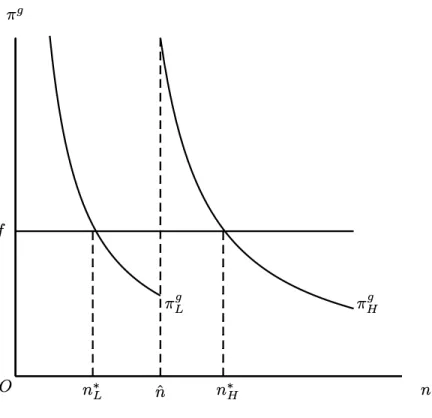
Figure 1 illustrates the industrialization condition in (15) with two gross profits schedules in interme-diate production (more precisely, they express the gross return rates of skilled labor input. See Appendix for the derivation of these schedules). A schedule labeled asπgHsatisfies the industrialization condition. As the number of intermediate varieties increases,πgHmonotonically decreases, and the intersection with a horizontal line of f gives the equilibrium level of intermediate varieties, where n∗H> ˆn.
In any of the adverse shocks in L, t, and η, the gross profit schedule shifts leftward. The schedule labeled asπgLis located far left relative toπgH. The equilibrium mass of varieties n∗Ldoes not satisfy the condition for industrialization. In such a case, the economy cannot be industrialized and has to stay at the nonindustrial stage.
Proposition 2 An economy with a larger population, an efficient education for skill formation, and a
smaller non-tradable final sector tends to have a comparative advantage in manufacturing and a larger possibility of industrialization.
The industrialization condition of (15) is a necessary condition because the model has two equilibria even if n∗ > ˆn is satisfied. Industrialization and nonindustrial equilibria are stable. To observe this, in the nonindustrial state (n= 0), the payable manufacturing wage is 0, and thus, the sector cannot attract workers who obtain w= 1 in the other sectors. Hence, this nonindustrial equilibrium is stable. However, as Figure 1 shows that once the economy somehow acquires ˆn of intermediate varieties (and the economy has a sufficiently large production capacity), firm entry occurs and the economy can reach n∗H. Thus, the industrialization equilibrium is also stable. The economy has an “industrialization trap" stemming from a coordination failure problem in the manufacturing sector.
The economy might resolve the coordination failure problem and succeed in fostering the manu-facturing sector. A simple solution is a voluntary coordination among intermediate firms. If a group of intermediate firms can collude and coordinate their actions and the group size is at least as large as ˆn, then they could successfully establish the manufacturing sector. However, if such voluntary coordi-nation based on private motivation is too small to surpass ˆn, then, there can be scope for government interventions.
Suppose that there is a relatively small private coordination such that nmin < ˆn. Effective policy
interventions aim to reduce the threshold varieties of intermediate inputs, ˆn and not to increase the equilibrium varieties, n∗. Equation (10) indicates two potential measures. The first one is raising the domestic manufacturing price by import tariffs (or any non-tariff measures to restrict imports). How-ever, this intervention is problematic in terms of feasibility and efficiency. Trade agreements, such as the GATT/WTO, regulate the use of import restrictions. Furthermore, import restrictions yield economic distortions, thereby reducing economic welfare.5
The second possible measure is enhancing education efficiency. This measure also helps increasing
n∗by exploiting gains from division of labor although pushing up n∗itself is not necessary for initiating the manufacturing sector. The model highlights the importance of education for acquiring appropriate skills for avoiding the industrialization problem.6
5There exists a large body of literature discussing the pros and cons of import restrictions. Krueger (1984), a classical survey
on trade policy in developing countries, comprehensively discusses the costs of trade protection. For a more recent survey on the effect of trade policy, see Goldberg and Pavcnik (2016).
6Readers may point out that importing intermediate goods or hosting subsidiaries of multinational companies can solve the
“industrialization trap" illustrated here. Hence, this papers’ results depend on the assumption of non-tradability of intermedi-ate goods. For the possibility of imports of intermediintermedi-ate goods, intermediintermedi-ate inputs often include non-tradable services, such as accounting, legal, and consulting services. Thus, the assumption of non-tradable intermediate goods is not so unrealistic. Multinationals often bring supporting firms (their intermediate good suppliers) to host developing countries. In this sense, the host developing countries can be industrialized. However, the developing countries may still face another challenge, namely, upgrading their role in the supply chains led by multinationals, including fostering local companies able to supply to
multina-Proposition 3 Even if an economy has the potential of industrialization, the economy can still be trapped
in a nonindustrial state in an open economy because of a coordination failure problem. Government interventions may help fostering a sufficiently large specialized intermediate input sector, with which the economy can escape from the nonindustrial trap. Among others, improving education (or vocational training) efficiency would be feasible and effective.
4
COVID-19 Considerations
4.1 Erosion of Comparative Advantage
The COVID-19 pandemic is primarily a health crisis, forcing us to self-isolate (e.g. lockdowns, work-place closures, and stay at home). An immediate consequence is tougher labor supply constraints (e.g. Bonadio, Huo, Levchenko, and Pandalai-Nayar, 2020). Working from home (WFH) can mitigate the impact of labor supply constraints. However, not all jobs can be done from home, and especially, lower-income economies have lower shares of WFH available jobs compared with high-lower-income countries (Din-gel and Neiman, 2020). Thus, one of the major impacts of the pandemic is perceived as a labor supply contraction, that is, a decrease in L in the present model.
Another great concern is a serious disruption of education systems (United Nations, 2020). Social distancing causes a direct negative impact on education efficiency although online classes can substitute in-person classes to a certain extent (which holds particularly in higher education, such as colleges and universities). However, a lack of resources or enabling environment to access online-learning is a serious issue particularly in developing economies. Education financing is another concern for both households and governments because of the deep world-wide recession that we are facing. In our model, this type of shocks can be dealt with as increases in the education cost t for acquiring skills for participating in the increasing-returns-to-scale sector.
Although world trade has sharply dropped since the outbreak of the pandemic because of the supply and demand shocks, the effect on the world prices of manufacturing goods is much less clear. This effect may vary across goods/sectors, which makes speculating the direction of changes in a country’s terms of trade less easy. Thus, this paper will not discuss terms-of-trade changes as a consequence of the COVID-19 pandemic.7 In what follows, I will discuss the effects of the pandemic on industrialization from the perspectives of labor supply and education shocks.
We infer that the COVID-19 crisis makes the small economy’s industrialization difficult by gen-erating tougher labor supply constraints (L ↓) and more costly education (t ↑). The threshold size of intermediate-good sector for industrialization increases, whereas the economy’s realizable size of intermediate-good sector decreases for the reasons discussed in the previous section. Consequently, the model predicts that nonindustrial economies before the pandemic tend to suffer from the prolonged un-derdevelopment stage.
Economies that have been successfully industrialized before the pandemic will be divided to two
tionals. The current model can illustrate this problem by replacing the agricultural sector with another manufacturing sector with a lower intermediate intensity (i.e. unskilled labor intensive manufacturing). The small economy now faces a problem that it may be trapped in the less sophisticated manufacturing sector with a lower intermediate intensity. Hence, this paper’s major points are largely unchanged.
7One exception is the effect of international supply-chain disruptions pointed out by Baldwin and Freeman (2020).
Manu-facturers rely on intermediate imports from economies that are greatly affected by the pandemic tend to experience more severe production disruptions. Although our model does not have foreign intermediate goods as a manufacturing input, international supply-chain disruptions can be qualitatively analyzed as a negative productivity shock. As a result, manufacturers’ unit cost
cM increases, which is equivalent to a decline in the manufacturing price pM. Thus, ˆn shifts rightward, and industrialization
groups: those maintaining their prior comparative advantage and those failing to do so. The threshold size ˆn shifts to the right and the realizable size n∗shifts to the left. If ˆn does not surpass n∗, then the pandemic shock will be temporary. As labor supply constraints are relaxed, the economy can recover the original position. However, if ˆn surpasses n∗, then the economy becomes unstable because condition (15) is violated. One exit from the intermediate sector induces another exit, and this vicious cycle continues until the intermediate sector completely shuts down. The economy will be trapped in the nonindustrial state even if the pandemic ends because of the coordination failure problem.
In sum, our model suggests that cross-country disparities in the degree of industrialization of de-veloping economies in the post-COVID-19 era will be widened. Some already-industrialized countries will recover to the original state. Such countries feature a large working population, good eduction (job training) systems, and smaller shares of non-tradable sectors (or informal sectors). By contrast, if these features are not satisfied, then even already-industrialized countries may experience erosion of the man-ufacturing base and comparative advantage reversal, leading to a nonindustrial state. The nonindustrial state is a stable equilibrium. Thus, once the economy falls into a nonindustrial state, the economy may stay in this state for long periods.
Proposition 4 Labor supply constraints and education disruptions because of the COVID-19 pandemic
adversely affect the industrialization of developing economies. For nonindustrial countries, industri-alization will be more difficult. Already-industrialized countries can be separated into two groups: those with a large working population, good eduction (job training) systems, and smaller shares of non-tradable sectors will recover to the original state in the post-pandemic. However, those without such features would experience a comparative advantage reversal and deindustrialization, which may last for long periods.
4.2 Automation
The speculation that the COVID-19 pandemic will accelerate recent trends of automation appears to be a consensus among academia and policy and business circles (e.g. Seric and Winkler, 2020). Several reasons have been given as to why the pandemic accelerate manufacturing automation (e.g. Bloom and Prettner, 2020). One clear explanation for automation spurring is that machines are not susceptible to pathogens, unlike humans. In economics terms, the COVID-19 pandemic and assured occurrence of future pandemics not only lower the expected labor productivity but also increase labor adjustment costs, making machine (capital) usage advantageous. Indeed, long before the COVID-19 pandemic, trends of automation were observed in manufacturing in developing countries because of machine progress and wage increases. Thus, the current pandemic strengthens the trend of automation even in developing countries.
We attempt to derive the consequences of automation in our small open economy by slightly mod-ifying the model. We model the process of automation by replacing unskilled labor input in the manu-facturing sector (LM) with capital input (K). We provide a special assumption about capital endowment:
the small economy has no capital stock but can rent capital as much as it wants from the world capital market at a given rental rate r∗. Although no domestic capital endowment is extreme, this specification is helpful to highlight the effect of (financial) globalization on savings-constrained developing countries. If r∗is lower than unskilled wages, manufacturers have the incentive to replace unskilled labor with capital, and we assume that it is the case. Hence, the labor market-clearing condition is now
L= nt + LN, (16)
to either the intermediate-good sector after taking taking job training (incurring t) or the non-tradable good sector.
We also need to modify the aggregate income because the small economy has to pay the capital cost
r∗K to the world financial market. Gross national income remains intact as wL. Thus, aggregate income
that individuals can spend on consumption is
E= wL − r∗K, (17)
which is equivalent to balanced trade.
Labor demand from the non-tradable sector is still given by (3). Substituting (17) to (3), we obtain
LN = ηL −
r∗
wK. (18)
Thus, when the small economy borrows foreign capital and uses it for the manufacturing sector, the labor-intensive non-tradable sector declines, which is consistent with the Rybczynski effect.
The capital input in the manufacturing sector is analogous to LX: equation (6) holds with replacing
LXand w with K and r∗, respectively:
K= 1− β
β ·
PXX
r∗ . (19)
To avoid explanatory redundancy , I relegate the detailed derivation process to the Appendix and state results with minimum algebra. Using (16), (18), and (19) along with the zero- profit condition pM =
r∗1−βPβX, the equilibrium number of intermediate goods is
n∗k = β(1 − η)L
(2β − 1)t,
in which we add a parameter restrictionβ > 0.5 to warrant the model’s solution.8
As expected, the equilibrium number of varieties increases relative to the one without labor replace-ment with capital (see (13)). The small economy can exploit more gains from the division of labor, and economic welfare increases. The results of capital introduction are summarized in the following proposition.
Proposition 5 In the small economy, manufacturing automation that replaces unskilled labor with
capi-tal borrowed from the international market leads to a contraction of the non-tradable good sector and an expansion of the manufacturing sector with increased skill-intensive intermediate-good varieties. Thus, economic welfare increases.
The model highlights that introducing machines (capital use in the model) to the manufacturing sector in replacement of unskilled labor yields various benefits to the economy: human capital accumulation, a richer industry base (a wider range of intermediate varieties and advanced division of labor), contraction of the relatively-unproductive non-tradable sector, and wage increases. The COVID-19 pandemic is likely to impose labor supply constraints more or less (e.g. due to health problems, social distancing, and occasional lockdowns). Hence, when evaluating the total economic impact of automation, the effect of long-lasting labor supply constraints should be considered, which reduces L in the model. Nevertheless, the current model suggests that the positive effects of machine introduction on the small open economy is compelling.
8Thus, the manufacturing sector has to be intermediate-goods intensive to a certain degree, when the economy borrow all the
necessary capital from the world market. This restriction can be relaxed either by assuming a positive home capital endowment or allowing to running a current account deficit. Thus, the conditionβ > 0.5 is not so restrictive as appeared.
In developing countries, non-tradable sectors largely coincide with informal sectors. Thus, the con-traction of the non-tradable sector presented here may be good news for policymakers in such countries. However, notably, the predictions illustrated here are a long-run (rosy) picture in the sense that the econ-omy finishes all necessary structural adjustments, in particular, labor movements in terms of skills and sectors. In the real world of developing countries (and to a lesser extent in developed countries), this may be one of the most difficult problems to be resolved. What if manufacturing automation occurs with slow labor adjustments? I illustrate this issue in the following section.
4.3 Stagnant Social Mobility
To make the problem of slow labor adjustments crystal-clear, I consider it an extreme case. Suppose that the small open economy with the manufacturing sector cannot increase the number of skilled workers from the initial level. Then, the manufacturing firms start to use capital instead of unskilled workers as before.
Two points are immediate. First, the wage equation in (5) is not applicable because of no labor upgrading from unskilled to skilled. As a result, the wage gap increases (more than just compensating the training cost). Second, all unskilled workers who are former employed in manufacturing move to the non-tradable good sector. Thus, the non-tradable good sector expands and the unskilled wage declines.
As the model is easy to solve, I summarize the equilibrium with stagnant labor mobility. The labor market-clearing condition of (16) is still applicable by just applying n∗in (13). The equilibrium labor allocation to the non-tradable sector is given by
LN = [1 − β(1 − η)]L,
which is greater than the size without capital inflows LN = ηL.
As shown in the Appendix, the ratio of the skilled wage to unskilled wage is given by
ws
w =
1− β + η βη t.
Recall that the wage gap before the capital introduction is ws/w = t. Hence, the wage gap unambiguously
increases. Intuitively, although the skilled wage increases because of the unskilled labor replacement, the unskilled wage decreases because the unskilled workers released from the manufacturing sector enter the non-tradable final good sector.
Skilled workers are better off because pN falls. Unskilled workers are worse off because their wage
w decreases. Thus, on average, real income per capita may fall, depending on the share of unskilled
workers.9 If the economy has a relatively small manufacturing base (a low number of specialized inputs), the economy is likely to suffer from a real income decrease.
Proposition 6 If the cost for skill accumulation is prohibitively high, then manufacturing automation
ex-pands the non-tradable good (service) sector. Consequently, the wage gap between skilled and unskilled labor grows. Gains from automation is ambiguous.
The proposition emphasizes that flexible skill accumulation is crucial to obtain gains from automa-tion. Given that the COVID-19 pandemic likely causes education disruption, our results stress that improving education systems (particularly for supplying workers contributing manufacturing bases) is more important.
9The payment of the rental cost of capital r∗K must be incurred across the economy’s population. For simplicity, I assume
In addition, it is well known that financial globalization does not always generate good economic performances, such as high economic growth, and some expositions have been proposed (e.g. Dani and Subramanian, 2009). However, the reason for the disappointing financial globalization is still an open question (Kose, Prasad, Rogoff, and Shang-JIn, 2010). Our model provides an alternative exposition: high costs for skill acquisition in developing economies hinder human capital accumulation, resulting in low labor mobility and divided labor markets.
5
Concluding Remarks
The COVID-19 pandemics has not only generated the deepest world recession in our living memory but also convinced us about future pandemics recurring, which almost assures long-lasting effects on economies. Long before the pandemic, automation and digital technologies and trade and production networks have evolved hand-in-hand, forming two dominant world trends. The COVID-19 pandemic seems to strengthen these trends with some alternations from health and risk concerns. I have argued in this paper that these trends are important from the point of view of industrialization of developing economies, proposing a simple open economy model with the development trap.
The following findings are emphasized. First, the pandemic may cause comparative advantage re-versal by imposing labor supply constraints through curtailing worker mobility (social distancing) and degrading education systems. In particular, education systems can be easily damaged for several reasons, including school closures, poor access environments for remote learning, public financial shortages and household income falls by the recession. If comparative advantage reversal does not occur, a developing economy will recover to the original state. However, if comparative advantage reversal is the case, the original state turns to be an unstable equilibrium and the economy will be trapped in a nonindustrial equilibrium. Hence, the negative impact will be long-term.
Second, manufacturing automation supported by international capital inflows improved the econ-omy’s welfare by enhancing the manufacturing base and making the (relatively) unproductive non-tradable sector smaller. Human capital accumulation (increases in skilled labor) will increase. However, to exploit these upsides of automation, labor mobility, especially smooth acquisition of skills, is critical. Otherwise, as the model suggests, manufacturing automation may leads to an expansion of the non-tradable sector, and thus, the wage gap between skilled and unskilled labor will grown, thereby lowering economic welfare. Thus, this paper emphasizes that enhancing social mobility, that is, labor movements across sectors and skill acquisition, becomes more important in the era of global pandemic risks.
The model’s predictions are intuitive, and their logic is clear. However, empirical validation is de-sirable to make them more useful for policy practitioners. In addition, although this paper’s model is deliberately kept simple to highlights the major logic, some extensions, including endogenous sector size, are also desirable to make the model a base for empirical studies. These research agendas are left for future work.
Figure 1: Industrialization Threshold
References
Atkin, D. (2016): “Endogenous Skill Acquisition and Export Manufacturing in Mexico,” American
Eco-nomic Review, 106(8), 2046–2085.
Baldwin, R., and R. Freeman (2020): Supply Chain Contagion Waves: Thinking Ahead on
Manu-facturing ‘Contagion and Reinfection’ from The COVID Concussion. https:
//voxeu.org/article/covid-concussion-and-supply-chain-contagion-waves, Accessed September 20, 2020.
Bloom, D., and K. Prettner (2020): The Macroeconomic Effects of Automation and The Role of
COVID-19 in Reinforcing Their Dynamics. https:
//voxeu.org/article/covid-19-and-macroeconomic-effects-automation, Accessed September 20, 2020.
Bonadio, B., Z. Huo, A. A. Levchenko,andN. Pandalai-Nayar (2020): “Global Supply Chains in the
Pandemic,” Working Paper 27224, National Bureau of Economic Research.
Dani, R.,andA. Subramanian (2009): “Why Did Financial Globalization Disappont?,” Discussion Paper
56(1), IMF Staff Papers.
Dingel, J. I., and B. Neiman (2020): “How Many Jobs Can Be Done at Home?,” Journal of Public
Economics, 189, 104235.
Dornbusch, R., S. Fischer,andP. A. Samuelson (1977): “Comparative Advantage, Trade, and Payments
in a Ricardian Model with a Continuum of Goods,” The American Economic Review, 67(5), 823–839. Eichengreen, B., D. Park,andK. Shin (2014): “Growth Slowdowns Redux,” Japan and the World
Epifani, P.,andG. Gancia (2009): “Openness, Government Size and the Terms of Trade,” The Review of
Economic Studies, 76(2), 629–668.
Ethier, W. J. (1982): “National and International Returns to Scale in the Modern Theory of International Trade,” The American Economic Review, 72(3), 389–405.
Goldberg, P.,andN. Pavcnik (2016): “The Effects of Trade Policy,” vol. 1 of Handbook of Commercial
Policy, chap. 3, pp. 161–206. North-Holland.
ILO (2018): “Women and Men in the Informal Economy: A Statistical Picture. Third Edition,” Discus-sion paper, the International Labour Organization.
Kose, M. A., E. Prasad, K. Rogoff,andW. Shang-JIn (2010): “Financial Globalization and Economic
Policies,” vol. 5 of Handbook of Development Economics, chap. 65, pp. 4283–4362. North-Holland. Krueger, A. O. (1984): “Trade Policies in Developing Countries,” vol. 1 of Handbook of International
Economics, chap. 11, pp. 519 – 569. Elsevier.
Rodr´iguez-Clare, A. (1996): “Multinationals, Linkages, and Economic Development,” The American
Economic Review, 86(4), 852–873.
Rodrik, D. (1996): “Coordination Failures and Government Policy: A Model with Applications to East Asia and Eastern Europe,” Journal of International Economics, 40(1), 1–22.
(2016): “Premature Deindustrialization,” Journal of Economic Growth, 21, 1–33.
Seric, A., and D. Winkler (2020): “COVID-19 Could Spur Automation and Reverse
Global-isation – To Some Extent,” https:
//voxeu.org/article/covid-19-could-spur-automation-and-reverse-globalisation-some-extent, Accessed September 20, 2020.
UNIDO (2020): “Managing COVID-19: Why Poorer Countries May Drop Out of Indus-trialization,” https: //www.unido.org/stories/managing-covid-19-why-poorer-countries-may-drop-out-industrialization, Accessed September 27, 2020.
United Nations (2020): Policy Brief: Eduction during COVID-19 and beyond. United Nations.
Venables, A. J. (2017): “Breaking into Tradables: Urban Form and Urban Function in a Developing City,” Journal of Urban Economics, 98, 88–97.
A
Derivation of the gross profits of intermediate firms
Labor constraints in an industrialized economy are given by
LX+ nt(ψx + f ) + LN = L, (A.1)
where LN is the labor demand from the non-tradable sector. For labor requirements from
intermediate-good production, t is multiplied to convert units from skilled to unskilled. Applying LX = (1 − β)nt/β to
(A.1) and factoring with respect to x,
x= β 1− β + βψ (L− L N nt − f ) . (A.2)
Using (A.2), the gross profitsπg = wsx/σ can be expressed by
πg(n)= βws σ − β (L− L N nt − f ) , Equivalently, in the return rate of skilled labor,
πg(n) ws = β σ − β (L− L N nt − f ) , (A.3)
which is decreasing in n. New firm entry continues until the return rate decreases until f . It is immediate thatπg/wsschedule shifts leftward by a higher training cost (t↑) or a larger non-tradable sector (LN ↑).
B
Capital Introduction
The labor market clearing is now given by (16). Solving it with respect to n,
nk = L− LN t ¯x . (B.1) Substituting LNin (18) into (B.1), nk = (1− η)L + (r∗/w)ηK t ¯x . (B.2) K is given by (19). K= 1− β β · PXX r∗ = 1− β β · nktw ¯x r∗ . (B.3)
Substituting (B.3) into (B.2), we have
nkt ¯x= (1 − η)L + r∗ w × 1− β β · ηnktw ¯x r∗ ⇔nk = β(1 − η)L [β − (1 − β)η]t ¯x. (B.4) Since pM= (r∗)1−βPβX = (r∗)1−β[n1/(1−σ)tw]β, the equilibrium unskilled wage is
w= 1 t [ pM (r∗)1−β ]1/β n1k/(σ−1), (B.5)
where nkis given by (B.4). Capital input is K= 1− β β · nktw ¯x r∗ = 1− β β · nk r∗ × [ pM (r∗)1−β ]1/β n1k/(σ−1)= 1− β β (p M r∗ )1/β ¯xnσ/(σ−1)k . (B.6) Aggregate income is given by
E = wL − r∗K = L t [ pM (r∗)1−β ]1/β n1k/(σ−1)−1− β β [ pM (r∗)1−β ]1/β ¯xnσ/(σ−1)k = [ pM (r∗)1−β ]1/β n1k/(σ−1) [ L t − 1− β β ¯xnk ] = [ pM (r∗)1−β ]1/β n1k/(σ−1)L t [ 1− (1− β)(1 − η) β − (1 − β)η ] = L t [ 2β − 1 β − (1 − β)η ] [ pM (r∗)1−β ]1/β n1k/(σ−1).
Income per capita is
E L = 1 t [ 2β − 1 β − (1 − β)η ] [ pM (r∗)1−β ]1/β n1k/(σ−1).
C
Manufacturing and Non-tradable Outputs and Employment
Without borrowing capital from the international capital market, manufacturing output is given by
yM = ( X β )β( LX 1− β )1−β = [ nσ/(σ−1)¯x β ]β[ (1− β)nt ¯x β(1 − β) ]1−β = β¯xt1−βn1+β/(σ−1).
When capital (machines) is introduced, manufacturing output is
yMk= ( X β )β( K 1− β )1−β = [ nσ/(σ−1)¯x β ]β[ (1− β)ntw ¯x r∗β(1 − β) ]1−β = [ nσ/(σ−1)¯x β ]β[ 1 β (p M r∗ )1/β ¯xnσ/(σ−1) ]1−β = ¯x β (p M r∗ )(1−β)/β nσ/(σ−1), where (B.6) is used.
Output elasticities with respect to the mass of intermediate goods are given by ϵyn≡ d ln yM d ln n = 1 + β σ − 1 = σ − (1 − β) σ − 1 without capital ϵykn≡ d ln yMk d ln n = σ σ − 1 with capital
It is straightforward to observeϵyn < ϵykn. Manufacturing output is more elastic with respect to the size
of the manufacturing base when capital is used instead for unskilled labor. Intuitively, this is because the capital supply is infinitely elastic for the small economy. When the small economy uses only domestic production resources (i.e. skilled and unskilled labor), the production resource constraint is more severe than when it borrows capital from the international market.
Both n∗and n∗k are proportional to L. Thus, the impact of labor supply constraints (possibly caused by the COVID-19 pandemic) is more severe for manufacturing output in the economy with imported capital.
Likewise, both n∗and n∗kare proportional to the inverse of t, and ϵyt= d ln yM d ln t = β − 1. ϵykt = d ln yMk d ln t = − σ σ − 1.
Costly education (possibly caused by the COVID-19 pandemic) also is more severe for manufacturing output in the economy with imported capital.
Without imported capital, the output of non-tradable good is simply given by
yN = ψNLN = ψNηL.
Since the employment in the N sector isηL, the employment share is simply LN/L = η.
When the economy uses imported capital in the manufacturing sector,
yN = ψNLN = ψNη [ L−r ∗ wK ] = ψNη [ L− r ∗ w × 1− β β · nktw ¯x r∗ ] = ψNη [ L−1− β β · nkt ¯x ] = ψNηL [ 1− (1− β)(1 − η) β − (1 − β)η ] = ψNηL [ 2β − 1 β − (1 − β)η ] . The corresponding employment is
LN = ηL [ 2β − 1 β − (1 − β)η ] . Since 2β − 1 < β − (1 − β)η ⇔ η < 1,
LNdeclines when the economy uses capital in the manufacturing sector.
D
Stagnant Labor Mobility
LN = [1 − β(1 − η)]L, (D.1) K= 1− β β · PXX r∗ = 1− β β · n∗tw ¯x r∗ . (D.2) Since n∗= β(1 − η)L/(t ¯x), K = 1− β β · tw ¯x r∗ × β(1 − η)L t ¯x = (1 − β)(1 − η) w r∗L. (D.3) Total expenditure E= wsn∗¯x+ wLN− r∗K (D.4)
Market clearing of the non-tradable good (services) sector:
ηE = wLN (D.5)
Perfect competition
Equation (D.6) determines ws: ws= [ p M r∗1−β(n ∗)−1/(1−σ)]1/β. (D.7)
Comparing to the skilled wage before capital introduction, ws in (D.7) increases because r∗ < w by
assumption.
Using (D.4) and (D.5) and eliminating E, we obtain
η[wsn∗¯x− r∗K]= (1 − η)wLN. (D.8)
Further substituting (D.1), (D.3), and n∗in (13) into (D.8), we obtain the ratio of skilled to unskilled wages (i.e. skill premium) such that
ws
w =
1− β + η
βη t. (D.9)
Since 1−β+η > βη is immediate, the wage gap increases compared to the one before capital introduction. With w and LN, (D.5) gives E. Then, (D.4) gives K. Thus, the model is solved.