Sustainable River Basin Governance. Chapter 6
Irrigation and River Basin Management in
Japan: Toward Sustainable Water Use
権利
Copyrights 日本貿易振興機構(ジェトロ)アジア
経済研究所 / Institute of Developing
Economies, Japan External Trade Organization
(IDE-JETRO) http://www.ide.go.jp
シリーズタイトル(英
)
IDE Spot Survey
シリーズ番号
28
journal or
publication title
Promoting Sustainable River Basin Governance
-Crafting Japan-U.S. Water Partnerships in
China
page range
83-101
year
2005
Chapter 6
Irrigation and River Basin Management in Japan:
Toward Sustainable Water Use
Nanae Yamada
I
NTRODUCTION“Water will never be polluted while it is managed by people who have the sense of ownership over water.”
by Tsuneichi Miyamoto, Japanese folklorist (Satake 1989, p.181). Agriculture is the leading water using sector in
most of the Monsoon Asian countries, Japan and China are no exceptions. In Japan it accounted for approximately 66 percent of the total water usage in volume in 2002 (Ministry of Land, Infrastructure and Transport of Japan 2002) slightly less than the 68 percent agricul-ture used in China in 2002 (Ministry of Water Resources of China 2002). How agricultural water is used both in Japan and China has had a serious impact on the water ecosystems in each country— particularly because irrigation water is used on vast agricultural land or stored in large reservoirs. Moreover, most big cities are located in the downstream reaches of river basins and often suffer from the water pollution and excessive water use by upstream agricul-tural users. To be more specific in Japan most of the irrigation water in Japan is drawn from riv-ers and irrigation water is used repeatedly from upstream to downstream paddies. In light of these characteristics if irrigation water is not properly managed, rivers will suffer both in terms of quality and quantity and strong water governance of rivers will not be possible. Of course, many cast doubt on the efficiency of irri-gation and there are pros and cons on its impact on the environment, including the argument of multi-functionality of irrigation. In light of the central role agricultural water use plays in both quantity and quality of rivers, this paper will explore the role of irrigation management in river basin governance in Japan.
Although greatest care should be taken when
comparing two countries with different politi-cal, economic and social institutions, it is inter-nationally recognized China’s current water problems relating to irrigation are following a very similar trajectory as those in Japan. This similarity partially explains the commitment of Japanese overseas development assistance (ODA) in this sector in China. For example, the Japan International Cooperation Agency (JICA) has been carrying out technical cooperation with China on the country’s National Irrigated Agri-culture Water Saving Program for 20 years with the purpose of promoting sustainable and pro-ductive agriculture. While other international assistance (e.g., World Bank and bilateral aid from other donor countries) has also been focused on irrigation in China, Japan’s ODA is perhaps the most long-standing assistance. This research paper aims to outline the experience of irrigation management in post-war Japan to illustrate potentially useful lessons learned for modern China, which is undergoing similar water challenges.1 Our lens into Japan’s experi-ence will focus on how the roles between gov-ernment and farming communities have been divided to achieve better watershed governance, with a particular emphasis on river irrigation of paddy fields.
The content of this paper is as follows. Section 1 provides an overview of the history of Japanese irrigation and problems during and after the pro-mulgation of the Agricultural Basic Law (ABL) of 1961, which promoted rapid modernization of farming with the goal of diminishing the 1. One of the major precedence studies on Japanese irrigation aimed at giving lessons to other Asian countries is Tamaki et al. (1984).
income gap between agriculture and non-agri-culture sectors. Chinese policymakers view the construction of more wastewater treatment facilities and modernization of irrigation infra-structure in rural areas to increase production as urgent tasks. It merits mention, however, that modern farming techniques bring not only better productivity but also—as occurred in Japan—can lead to serious negative impacts on river basin environments. Therefore, the Chinese government had best consider lessons from countries like Japan, which possesses two very relevant policy experiences in developing new strategies for managing irrigation—high-lighted in the latter part of this paper. One is how the government-led Land Improvement Project (LIP) involved farmers in water man-agement, forcing them to bear the burden of sus-tainably managing water resources. The second relevant experience is how the Japanese govern-ment reacted to the water problems caused by urbanization and change in water use during the post-war era. While Japan’s experiences in pro-moting sustainable water management in rural areas have not always been successful they still
hold good lessons for China today. In section 2 the Japanese government’s LIP, which played the central role in irrigation policy in post-war Japan will be introduced. Within LIP this paper will focus on the function of the Land Improve-ment District—a structure for decentralized irri-gation management—which is an example of Participatory Irrigation Management (PIM).2 PIM is highlighted because it has generated glo-bal attention among international cooperation agencies such as the World Bank and JICA as a “principle management concept with which reform of the agricultural water sector and transfer of irrigation management to farmers” can be undertaken (World Bank Beijing Office 2002, p. 2). Finally, in section 3 this paper dis-cusses two policy measures—the Rural Sewage Project and Agricultural Water Use Rationaliza-tion Project (AWUP)—that have been pursued in Japan to solve the problems of balancing development and economic and environmental sustainability in paddy irrigation and discus-sions on water management in Japan today. In the last section, the author concludes with some lessons for China.
1. M
ODERNIZATIONANDTHEC
HANGEOFR
URALW
ATERU
SE The origin of Japanese irrigation harkens backto 3rd century B.C.E. Over the centuries, suc-cessive rulers have devoted considerable finan-cial and human resources (i.e., the labor of farmers) to the development of new paddy fields and water sources. The result of this long history of paddy construction is an impressive web of irrigation waterways covering the entire country that has modified the fluctuation of rainfall in the monsoon climate, hydrated the land, and brought stable, bountiful harvests to this island nation. In modern times while the government has taken initiative in constructing large irriga-tion systems keeping pace with diffusion of both machines and chemical fertilizers, water man-agement of smaller facilities has been left to farmer water associations that utilize traditional water use and farming practices. In fact, farmers have devised highly sustainable farming by combining field cropping and livestock farming into rice production, even domestic and human waste has been taken into the cyclical use of water and land resources. This holistic approach
to water use in rural areas is reflected in the Jap-anese language, in that until recently in rural Japan the term water has been used synony-mously with the term irrigation water.
It was in the spectacular economic growth era beginning in the late 1950s into the 1960s that Japanese agriculture was totally transformed. Like many industrialized countries, rural Japan has undergone massive depopulation while urban areas have exploded with growth. This shift in population has necessitated the develop-ment of a modernized way of farming, which has totally changed villages. This transition of the agricultural sector has created a clash between the historic farming traditions and modern techniques, as well as sparked serious water pollution, water disputes, and other envi-ronmental problems, some of which remain unsolved today.
To clarify the background of Japan’s water problems, the first section of this paper will 2. Any involvement of local farmers traditional community groups to the irrigation project or O&M seems to be rare in Asia, with a
examine the establishment of the modern water system and then discuss the transition of agri-culture and villages since the period of extraor-dinary rapid economic growth. The section will conclude with an introduction of domestic debates on Japan’s water problems.
1. 1 Historical Aspects of Irrigation System in Modern Japan3
In the late 17th and early 18th centuries, Japan’s feudal lords rushed into paddy development, which caused numerous disputes over scarce water in drought periods. To mitigate these con-flicts, the competing local farmers created a complicated system of local water rights rules referred to as the Customary Water Use Prac-tice4 (Mase 1994). Though farmers were under the rule of feudal lords, their water rights enabled them to manage irrigation water auton-omously. After the birth of the modern state in 1868, Regular Water Use Cooperatives—based on traditional community water management practices—were incorporated in the modern legislative system within the Water Association Law and Land Improvement Law. Moreover, most of the farmers’ traditional water rights were given legal basis as Customary Water User Rights (CWUR) in the Old River Law enacted in 1896. This duality in law in water user rights created considerable ambiguity over water rights, which some have declared a “victory of Japanese agrarian society over modernization” (Tamaki 1979, p.15). In the post-war period irri-gation facilities were developed under the gov-ernment-led Land Improvement Project (LIP) scheme. To sum up the history of Japanese irri-gation in modern times, the autonomous O&M of irrigation by farmers has been sustained while the government had played an increas-ingly stronger role in subsidizing and carrying out multiple projects to develop large irrigation facilities. Prior to the 1950s these formal gov-ernment and traditional rural institutions to maintain irrigation were properly balanced and worked well. As elaborated below, water prob-lems began to grow as Japan’s economy exploded in growth in the 1950s and this
bal-ance gradually changed, threatening the water management systems of rivers and other water bodies.
1. 2 Rural Change in the Years of Spectacular Economic Growth
From late 1950s to the late 1960s Japan’s aver-age annual GDP growth was more than 10 per-cent. Notably, while this economic boom led industrial sectors to thrive, the rate of agricul-ture’s share of the GDP from 1960 to 1980 fell from 9.2 to 2.4 percent (see Table 1). Over the same time period cultivated land area in Japan was decreased by 10 percent. Not surprisingly, these shifts in the economy led the agricultural income to fall considerably, causing a mass exo-dus from rural areas to big cities and an increase in part-time farmers. To halt the decline in rural population, increase farmer incomes, and strengthen agricultural production the Japanese government enacted the Agricultural Basic Law (ABL) in 1961, which promoted mechanization of farming and expansion of farm size.
This mechanization of agriculture and signifi-cant rise in the use of chemical fertilizers and pesticides did lead to an increase in agricultural productivity—specifically, 1.4 times from 1960 to 1980 (FAO Website). The consumption of chemical fertilizer per hectare (ha) peaked at 428 thousand tons in 1979. In Japan pesticide use peaked in the mid-1970s until many, such as mercury, DDT, BHC and parathion were banned due to discoveries they caused serious human and environmental health hazards. The growth in production of Japanese agriculture between 1960 and 1980 was made possible by laborsaving technology, intensification of pesti-cide and fertilizer use, and farmland consolida-tion.5 Japan’s trends are in sharp contrast to most developed countries, which usually achieve high agricultural productivity through farm size expansion. While over the same 20 years China introduced the production responsi-bility system, which led agricultural productiv-ity to triple through a rapid diffusion of machinery, chemical fertilizers, and pesticides.6 3. The descriptions of Japanese paddy irrigation history and CWUR are mainly based on MAFF (1960), Nagata (1971), Imamura
(1977), Tamaki (1979), and Nougyou Suiri Kenkyukai (1980). Discussions on the farming technology development were drawn from MAFF(1995) and Teruoka (2003).
4. According to the survey by Construction Ministry’s River Bureau in 1967, out of 1,765 registered CWUR, 79.5 percent started
tak-ing water before 1896 and 12.1 percent after 1896.
5. According to the estimates by the Ministry of Agriculture, Forestry and Fisheries of Japan (MAFF), the public investment for the
LIP over the past 80 years totals 39.5 trillion Yen, of which 60 percent was spent in the period of 1960 to 1980 (Shogenji et al. 1997, p.78).
Figure 1 shows the chemical fertilizer use in Japan in comparison to China, which is follow-ing a similar trajectory.
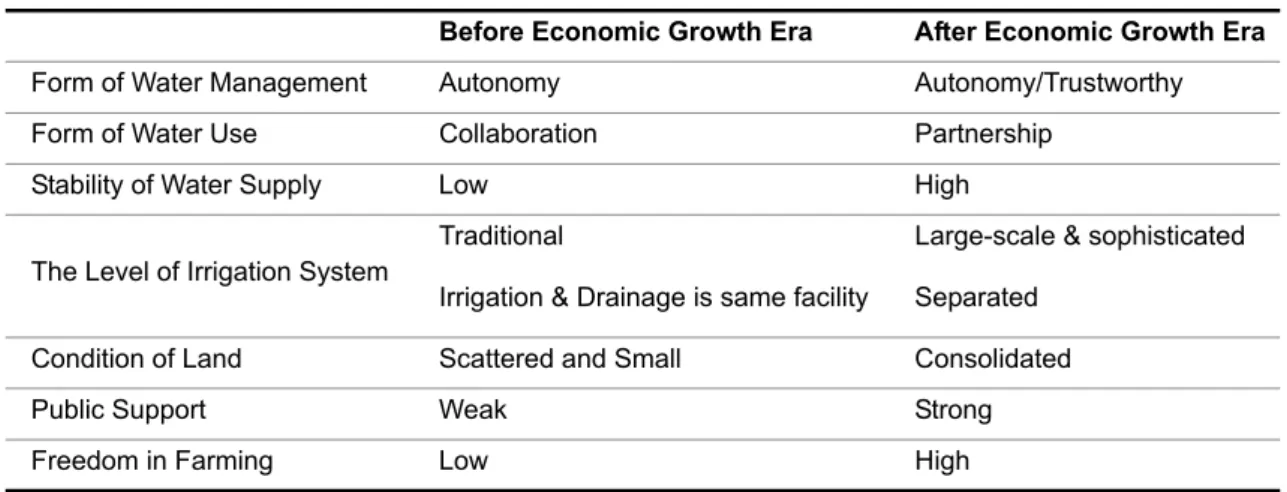
Mizutani (2001) describes the involvement of farmers and government in river basin manage-ment today as providing “autonomy and trusty 6. The production responsibility system was a contract system in which farmers agreed to provide a certain amount of grain to the
state, but could also grow more profitable crops to sell on the free market. While production and farmer incomes initially grew, the increased pesticides and chemical fertilizers have caused serious water pollution and health hazards throughout China (Maurer et al., 1998; Hamburger, 2002). Source: FAO. 1961 1964 1967 1970 1973 1976 1979 1982 1985 1988 1991 1994 1997 2000 year China Japan 0 50 100 150 200 250 300 350 400 450 amount (1000 tons)
Fig. 1. Consumption of Chemical Fertilizer per Hectare in Japan and China Table 1. Change in Japanese Agriculture (1960-2000)
Notes:1) Figure in 2000 is based on CIA data.
2) Farm households is the sum of the number of commercial farm households and that of noncommercial farm households.
3) Cultivated land includes all kind of agricultural land such as paddy, crop field, pasture and land for perma-nent crops.
Source:Japan Statistical Yearbook, Bureau of Statistics, Officer of Prime Minister, Statistics and Information Depart-ment, MAFF.
Year 1960 1970 1980 1990 2000
1) Rate of agriculture in GDP (%) 9.2 4.2 2.4 1.8 2.0 2) Farm households (1000 households) 6057 5402 4661 3835 3120 Farm household population (1000 people) 34546 26595 21366 17296 10467 Rate of farm household population in total population (%) 37.0 25.3 18.3 14.0 8.3 Rate of population in rural area (%) 37.5 28.8 23.8 22.6 21.2 3) Cultivated land (1000ha) 6010 5796 5461 5243 4830 Rate of cultivated land in total land area (%) 16.3 15.4 14.5 13.9 12.8 Irrigation rate (%) 41.4 51.0 50.4 50.0 50.2
water management” (Table 2). Since 1950 the large and sophisticated irrigation facilities con-structed by the government required highly spe-cialist knowledge and techniques to operate. Thus, large-scale Land Improvement Districts (LIDs, elaborated in the next section) often employ fulltime technical experts. He noted that coincident with the realization of stable water supply, water management has been taken away from farmers and put into the hands of technical managers, whose expensive expertise is sup-ported by public funds, which ultimately adds to the farmers’ burden.7
1. 3 Emerging Problems in Japan
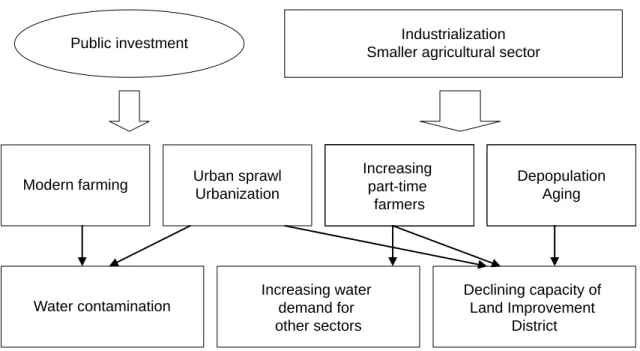
The problems all these changes of farming vil-lages highlighted above caused in rural Japan are classified into three groups: (1) increase in water pollution by both intensified agriculture and other water users, (2) decline in the capacity of local communities to manage their water, and (3) emergence of water disputes between the farming and other sectors. Figure 2 shows the relations among major changes of farming areas and the water problems.
One of the first major water problems in rural Japan has been the escalation of water pollution due to increased competition between agricul-tural and non-agriculagricul-tural water users. As farm-ers came to adopt intensive one-crop production, they started to use chemicals instead of compost and gave up traditional composition of rice pro-duction, upland cropping and livestock. These
changes in farming practices produced consider-able water degradation from both the growing livestock industry and non-point source pollu-tion from farmland. Although the enforcement of industrial effluent control resulted in better water quality in Japan’s rivers, non-point source pollution is still a significant polluter today along with domestic wastewater of rivers, espe-cially closed water bodies such as lakes and bays because it is difficult to identify and control the polluter. For example, Figure 3 delineates the sources of pollution into Biwa and Kasumigaura lakes in 2000. One other serious problem regard-ing water pollution is the irrigation water con-tamination by industrial and domestic effluent in modernized and urbanized villages. The damage to agricultural land by polluted irrigation water started to increase significantly around 1950, peaking at 194 thousand ha in 1970, which rep-resents 6.1 percent of Japan’s total paddy fields.8 The damage caused by the industrial sector was reduced due to more stringent controls enforced under the 1970 Water Pollution Control Law and other policy measures.
Talking about water pollution conservation pol-icy in rural areas in postwar Japan, former bureaucrat of the Ministry of Agriculture, For-estry and Fisheries (MAFF) Satake (2003) pointed out that in the 1950s and 1960s Japan’s agricultural administer dealt with the eutrophi-cation of rivers as a technical problem to be solved by the construction of facilities such as separated irrigation and drainage canals and under drainage. These technical solutions were 7. For a through discussion on the challenges faced by LIDs see Minagawa (2003) and Okabe (2003).
8. The major polluters were industry (39%), domestic (34%), and mines (16%) (Moritaki 1982). Table 2. Transition of Water Management
Source: Mizutani and Chen 2001, p.177.
Before Economic Growth Era After Economic Growth Era
Form of Water Management Autonomy Autonomy/Trustworthy Form of Water Use Collaboration Partnership
Stability of Water Supply Low High The Level of Irrigation System
Traditional Large-scale & sophisticated Irrigation & Drainage is same facility Separated
Condition of Land Scattered and Small Consolidated
Public Support Weak Strong
built on the concept that wastewater should be removed as quickly as possible and be treated out of sight from local citizens. Setting aside the question of whether such hidden technical rem-edies to wastewater problems is proper, it appears that rural people’s consciousness of water became weaker and they became tap water users just like their urban counterparts. Public funds for these water quality problems were very limited, so that only reactive
emer-gency measures, such as building some farm community effluent processing facilities, not the needed drastic institutional reform, were taken. The second major cause of water problems in rural Japan has been rapid economic growth. Economic growth is (both directly and indi-rectly) a powerful driver of declining capacity of water management groups in rural areas as well. Specifically, economic growth sparked Notes:1) Left: Biwa lake, right: Kasumigaura lake.
2) There is no classification of “farmland” for Kasumigaura and “others” includes all kind of non-point source pollution like road, rain fall, farmland and forest.
Source: Okada and Peterson (1991).
Others Farmland Fishery Livestock Industry Sewage 28% 23% 3% 0% 13% 33% 34% 12% 3% 7% 0% 44%
Fig. 3. Sources of Pollution into Biwa and Kasumigaura Lakes (COD) Source: Author.
Public investment
Modern farming Depopulation
Aging Urban sprawl Urbanization Water contamination Increasing water demand for other sectors Declining capacity of Land Improvement District Industrialization
Smaller agricultural sector
Increasing part-time
farmers
rural depopulation and urban sprawl, which has brought about significant changes in rural life-style and water use. Though farmers day-to-day O&M of water was drastically simplified by the separation of irrigation and drainage, as well as the introduction of pipe drains, some scholars have pointed out that the capacity of a major government initiative to help improve the irriga-tion and development in rural areas—the LIP, described in full below—is declining because of: (1) aging rural populations (most younger farmers have long-departed for urban areas) and, (2) increasing part-time farmers (JIID 2003c and Tamaki et al. 1984).
The third water problem is the increasing water disputes among agriculture and other sectors because of the rapidly increased water demand from industry and domestic sectors during the economic growth era. Some explanation may be needed here on why many monsoon rice pro-ducing Asia countries including Japan do not adopt a water pricing system although such sys-tem is internationally heralded as a means to help mediate disputes over water allocation. Water pricing and water market systems are successful in dry areas like California in the USA and Chile where: (1) agricultural produc-tion is on a commercial base, not like Japan where there are many miniature farms with water rights (mostly consisting of Customary Water Rights) run by families for their own con-sumption, and (2) the amount of rainfall is somewhat predictable so demand and supply are easily calculated, although there are difficulties in estimating water demand due to the seasonal-ity of Monsoon Asia in Japan. Researchers at the Japanese Institute of Irrigation and Drainage (JIID 2004) pointed out five difficulties in the possible introduction of water pricing in densely populated river basins in Japan: (1) specification of beneficiaries, (2) estimation of externalities, (3) adoption of methods for bearing the mainte-nance cost, (4) question of whether to separate the construction and maintenance costs and (5) difficulty in how to levy the cost. In fact the Jap-anese government has never adopted water pric-ing or water market systems, choospric-ing instead to carry out two administrative methods of water reallocation methods: (1) water saving in rural areas that are then allocated to cities during abnormal droughts, (2) permanent water reallo-cation through the Agricultural Water Use
Rationalization Project in normal times (dis-cussed later in the paper), in some urbanized area where agricultural water demand dimin-ished while urban water increased.
The temporal water reallocation in Japan was utilized only in some comparatively dry regions or in times of abnormal drought in summer, for thanks to the abundant rainfall, the macro water supply in most parts of Japan usually matches the demand and the balance tends to be stable. However, the abnormal drought in 1996 sparked a national discussion on water use efficiency in the agricultural sector.9 Not surprisingly, most of the criticisms were from the urban side—e.g., “agriculture wastes water,” “agriculture won’t give over water to other sectors,” and “Custom-ary Water User Rights (CWUR) are not trans-parent.” Prior to 1950, in conventional village society strict water control rules (which included punishment for violations) made vil-lagers work together to undertake water quantity and quality management. Today, however, CWUR make the price of irrigation water nearly zero in Japan, which means there is no strong incentive for farmers to save water. In fact when compared to 1975, agriculture water use slightly increased from 570 trillion tons to 572 trillion tons in 2000, while the paddy, the largest water use in the agricultural sector occupying 95% of the total, decreased from 3.2 million ha to 2.6 million ha. It is therefore understandable that the agricultural sector is criticized for its ineffi-cient water use. However, some insist that it is not easy to reduce the water use in agriculture due to some technical reasons of paddy irriga-tion (Satoh, 1997):
(1) Special features of rice-paddy irrigation. The reduction of irrigation area does not directly result in the decline of required water;
(2) Water and property rights linkage. Water rights in Japan are usually attached to the property rights of agricultural land; and, (3) Desire to increase agricultural production.
Surplus water is used to compensate the underlying water demand of farmers to increase production or improve labor effec-tiveness.
Discussions between urban and rural sectors are not easily resolved, but neither side seems to 9. These discussions are partly based on Sato (1985), JIID (2003a, 2003b, 2004).
understand that water users on both sides are drawing from the same river basin. Reallocation of rural water to cities demands not just strict monitoring of farmers, but more importantly
open dialogue among all relevant urban and rural parties. In short, communication among users will help promote more sustainable water use in both sectors.
2. T
HER
OLEOFG
OVERNMENTANDF
ARMINGC
OMMUNITIES: L
ANDI
MPROVEMENTP
ROJECTThis section will detail the structure and the function of the government’s Land Improve-ment Program (LIP), which has played a major role in the construction of farm roads, irrigation infrastructure, farmland consolidation, and maintenance of the farm-related facilities in the post-war period. These construction projects were highly subsidized, usually by more than 80%. The main objectives of the program are to promote effective agricultural production, revi-talize rural regions, stabilize the supply of food, and conserve national land and the environment (MAFF 1997). The objectives and the composi-tion of the budget for this program have been driven by changes in Japan’s agricultural policy. In the period right after the end of World War Two the government’s first major objective was to increase food production. Next in the period of Agricultural Basic Law (ABL), beginning in 1961, the government’s main agricultural policy objective was to save labor and increase the pro-ductivity in light of the declining capacity of farm villages caused by: (1) a smaller agricul-tural sector, (2) rural exodus to booming cities, and (more recently) (3) the desire to pay more attention to rural revitalization and environmen-tal conservation.
The following section introduces LIP with an emphasis on the role of government, the way of investment, and the cost-sharing system among water users in irrigation. This introduction is followed by a description of the structure and functions of LIP’s farmers organization—called Land Improvement Districts (LIDs)— for LIDs have played the most significant role in irriga-tion construcirriga-tion and management in Japan. 2. 1 LIP and Public Investment for Irrigation Three of the more remarkable institutional fea-tures of LIP are that this institution: (1) addresses both water and land issues; (2) has effectively organized work in both the invest-ment and O&M sectors, which are now tightly integrated; and (3) requires that the projects are
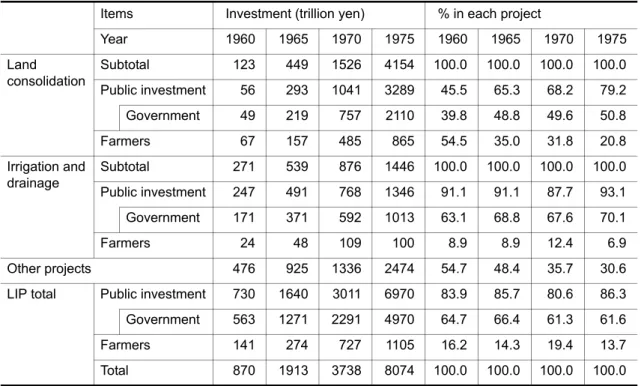
all led by the central government (Nakashima 1996). The question of why the involvement of government is so large can be explained with the special characteristics of land and water as economic capital: (1) the historical continuity of the traditional rules and titles formed in the his-tory of Japan’s rural areas, (2) the big impact of irrigation on the rural environment, and (3) the many years and uncertainty for investment into irrigation facilities. The government views LIP as a project making a socially optimum invest-ment into land and water protection, which nei-ther farmers nor the private sector would undertake due to high transaction costs. The change in budget of LIP from 1960 to 1975 is shown in Table 3, which indicates that between 90 and 70 percent of the projects were covered by public subsidies. As of 1975, in these subsidized project farmers only had to bear around 12 percent of the cost. This high rate of subsidies within LIP was aimed at avoid-ing market failure in the construction of expen-sive irrigation infrastructure. Such market failure occurred in China, where construction of irrigation facilities has stagnated since 1980s (Uchida 1996), mainly due to the lack of funds and low incentives for farmers to do voluntary maintenance.
The composition ratio of LIP in the same period is shown in Table 4 and Figure 4. In short, irri-gation and drainage projects occupied 30% of total LIP expenditures in the 1960s but declined in the 1970s, which resulted in the significant increase in irrigation rates from nearly 40% in the 1960s to 50% in the 1970s. In the 1970s more government investment was put into farm-land consolidation, which increased to nearly 50% of the LIP expenditures due to the rapid diffusion of agricultural machinery. The main purpose of the project shifted from increasing agriculture production to laborsaving initiatives. In addition, the farmer’s burden is bigger in farmland consolidation because the beneficiary of this project is more specific than in irrigation
Table 3. Burden of Government and Farmers in LIP
Source:MAFF, Imamura (1984, p.122).
Table 4. Budget of Land Improvement Project by Fund Source (1960-75)
Note: Others includes road construction, disaster prevention etc.
Source:MAFF Nougyou oyobi nouka no syakaikanjyou (Social Accounts for Agriculture and Farms), various years, Imamura (1984, p.124).
Items Total investment (trillion yen) % in total investment Year 1960 1965 1970 1975 1960 1965 1970 1975 Subsidiary project Subtotal 870 1913 3738 8075 80.4 84.9 89.7 88.3 National and prefectural 657 1528 2886 6692 60.7 67.8 69.2 73.2 Loan 73 111 126 277 6.7 4.9 3.0 3.0 Farmer 141 274 727 1105 13.0 12.2 17.4 12.1 Loan 99 186 469 1028 9.1 8.3 11.3 11.2 Individual 42 87 258 77 3.9 3.9 6.2 0.8 Non-subsidiary project Sub-total 126 211 330 651 11.6 9.4 7.9 7.1 Loan 97 160 231 518 9.0 7.1 5.5 5.7 Individual 29 29 99 133 2.7 1.3 2.4 1.5 Project by farmers 86 130 101 419 7.9 12.0 4.5 10.1 Total 1082 2254 4168 9145 100.0 100.0 100.0 100.0
Items Investment (trillion yen) % in each project
Year 1960 1965 1970 1975 1960 1965 1970 1975 Land consolidation Subtotal 123 449 1526 4154 100.0 100.0 100.0 100.0 Public investment 56 293 1041 3289 45.5 65.3 68.2 79.2 Government 49 219 757 2110 39.8 48.8 49.6 50.8 Farmers 67 157 485 865 54.5 35.0 31.8 20.8 Irrigation and drainage Subtotal 271 539 876 1446 100.0 100.0 100.0 100.0 Public investment 247 491 768 1346 91.1 91.1 87.7 93.1 Government 171 371 592 1013 63.1 68.8 67.6 70.1 Farmers 24 48 109 100 8.9 8.9 12.4 6.9 Other projects 476 925 1336 2474 54.7 48.4 35.7 30.6 LIP total Public investment 730 1640 3011 6970 83.9 85.7 80.6 86.3 Government 563 1271 2291 4970 64.7 66.4 61.3 61.6 Farmers 141 274 727 1105 16.2 14.3 19.4 13.7 Total 870 1913 3738 8074 100.0 100.0 100.0 100.0
development projects.
2. 2 The Structure and the Characteristics of Land Improvement Districts (LIDs)
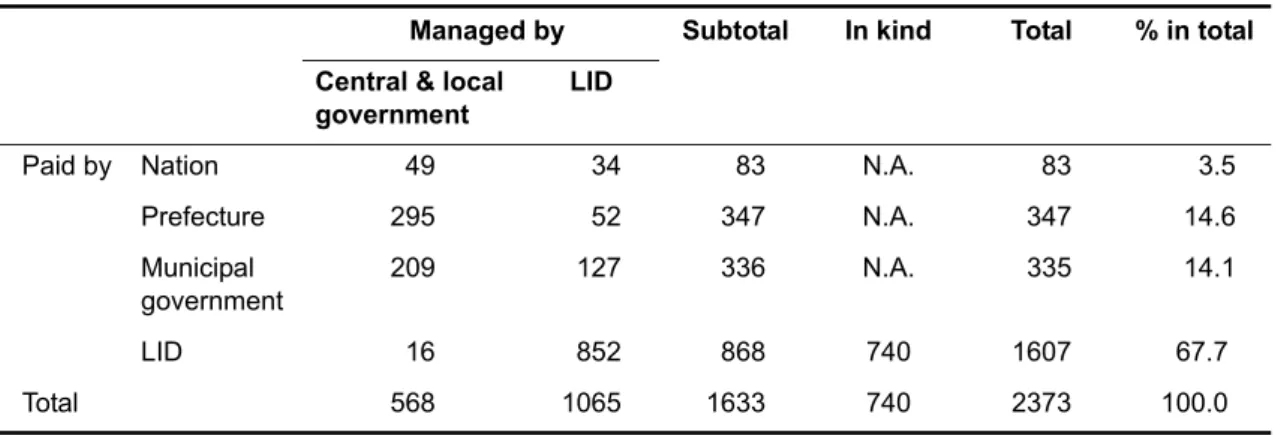
LIDs are associations of farmers—beneficiaries of LIP—who were given legal foundation in the Land Improvement Law to use and responsibly manage irrigation water. Today 65 percent of Japan’s irrigation facilities and 61 percent of the canals are managed by LIDs, which also cover two-thirds of the O&M costs for irrigation (See Tables 5 & 6). In principle any cultivator of land is qualified to join the LIDs, which means tenant cultivators often become the members instead of landowners.
LID is internationally known as a good example of Participatory Irrigation Management (PIM) because local farmers are involved in every stage of decision-making and cost bearing in LIP for: (1) the establishment of LIDs, (2) the irrigation facility construction plan, (3) the ex post maintenance project, and (4) day-to-day management. The day-to-day operation has a dual system in which LIDs operate the relatively large backbone premises while smaller farmer groups maintain the ending channel facing their own paddy. What is more, LID collects charges
from farmers.
The procedure for the farmers’ involvement in LIP from the establishment of LID to the ex post O&M project in general is as follows. The Land Improvement Law requires that more than two-thirds of a group of 15 or more local farmers be in agreement to establish a LID. Once a LID is created and more than two-thirds of the group members agree on undertaking a construction projects, any farmers who disagreed with the project are actually compelled to join in the project. The construction can commence after the LID, in collaboration with the national, pre-fectural, or city governments, undertakes a cost-benefit analysis. This majority rule and compul-sory participation of opposition farmers imply that facility construction decision-making tends to prioritize benefits to the whole society over the interest of the individual. The construction project is usually attached to an ex post O&M project and the agreement of beneficiaries on the participation is collected through LIDs. In addition, LIDs collect the burden charge of the project from the beneficiaries as well. For the O&M part, LIDs play a leading role in manag-ing irrigation facilities from the branch lines to the end, although large facilities, such as head works, are often under government and prefec-Source: MAFF, Imamura (1984, p.124).
0 1000 2000 3000 4000 5000 6000 7000 8000 9000 1960 1965 1970 1975 year trillion yen Others
Mining Pollution Recovery Disaster Prevention Farmland Construction Irrigation and Drainage Land Condolidation Fig. 4. Budgets for LIP by Project
tural government control because they demand professional skills to operate. On the other hand, in drought periods, LID plays an important role in collecting and adjusting the information on water demand from small farmer’s groups and some villages implement irrigation by rotation practice,10 which is coordinated by the repre-sentatives of the irrigation association who instruct farmers on how to adjust water alloca-tion among water channels or villages.
The levying system of the LIDs includes three kinds of burden charges paid by beneficiaries: special fees, current fees, and maintenance fees. The first two types are collected at the LID level. The responsibility of construction cost of irrigation facilities on the beneficiaries’ side is collected as a special fee, while the maintenance cost and water fees are collected as a current fee. The current fee of an individual farmer is calcu-lated by land area, not water usage volume,
because the irrigation channel is an open system and it is difficult to know the exact water usage volume. The third type is an informal fee cover-ing maintenance cost in the hamlet and is usu-ally collected in the form of a resident’s association fee. This type of fee sometimes takes the form of small labor, for example, mowing and dredging of small channels. It is not easy to judge whether the burden of mainte-nance is big or small for farmers because the load will be decided by the price of agricultural products, inflation rate and other factors, but it is said the farmer’s burden has been increasing significantly in recent years.
Despite the contribution of the Land Improve-ment Program (LIP) in reducing maintenance costs of irrigation facilities, the capacity of LIDs has been declining because of the growing per-centage of elderly in rural areas, rural depopula-tion, increase of part-time farmers, and 10.A typical customary water use practice for controlled water distribution at timed intervals. Depending on the region, it was either
carried out on an annual basis (in the case of pond or small reservoirs) or only in times of drought (in case of river-based irrigation).
Table 5. Management of Irrigation Facilities (2000)
Source:Land Improvement Planning Department, Rural Areas Promotion Bureau (Minagawa 2003, p.31). Table 6. Burden of O&M cost (1996, trillion yen)
Source:Land Improvement Planning Department, Rural Areas Promotion Bureau.
Manager Main facilities Agricultural canals and drains
Number % in total Length (km) % in total
Nation 20 1.3 94 0.5 Prefecture 241 15.7 565 2.9 Municipal government 258 16.8 6688 34.9 LID 1001 65.3 11775 61.4 Others 14 0.9 52 0.3 Total 1534 100.0 19174 100.0
Managed by Subtotal In kind Total % in total
Central & local government
LID
Paid by Nation 49 34 83 N.A. 83 3.5
Prefecture 295 52 347 N.A. 347 14.6 Municipal government 209 127 336 N.A. 335 14.1 LID 16 852 868 740 1607 67.7 Total 568 1065 1633 740 2373 100.0
urbanization. What is worse, in recent years, farmers tend to separate off in two groups, full-time commercial farmers who actively expand farm size by borrowing land and small noncom-mercial part-time farmers. These two groups have different economic incentives towards irri-gation water. This mixed structure cannot allow
farmers to bear equal burden of land improve-ment. For example, in the case of tenant cultiva-tors serious questions arise as to who should pay the burden of improving the land. There is the possibility that farmer’s irrigation burden is becoming larger due to the growing internation-alization of Japanese agriculture.
3. P
OLICYM
EASURESFORW
ATERC
ONSERVATIONINR
URALJ
APAN This section will first discuss the policymea-sures that have been undertaken in Japan to solve Japan’s rural water quantity and quality problems. Next this section will introduce two projects that were created to address rural water problems in Japan: (1) the Rural Sewerage Project that deals with the water pollution, and (2) Agricultural Water Use Rationalization Project (AWURP) that targets the transference of irrigation water to other purposes. As water management in rural area had been dealt with within the LIP scheme under agricultural policy, LIP itself had been transformed as the govern-ment has changed agricultural policy to reflect the transition of Japanese agriculture.
As the alternative of the former Agricultural Basic Law of 1961, the Japanese Diet passed the Basic Law on Food, Agriculture and Rural Areas in July 1999, which “outlines the princi-ples and directions of Japanese agricultural pol-icy for the 21st century” (Honma 2000, p.12). This new law contains three principles, namely: (1) securing a stable food supply, (2) sustainable agricultural development, and (3) development of rural areas. The second principle in particular highlights the maintenance and promotion of natural cyclical function of agriculture through securing the proper use of agricultural chemi-cals, fertilizers, and livestock manure, which was not covered in the previous law. Of course, some of the project under LIP—including the two projects described below—has changed reflecting the new agricultural law to which sus-tainable use of land and water resources was added as one of the main objectives.
3. 1 Water Quality Conservation: Rural Sewerage Project11
The rural sewerage project started in 1983 to construct rural effluent treatment facilities for the conservation of river water and improve-ment of the rural living environimprove-ment. This project handles not only the consevation of irri-gation and public water by building sewage sys-tems but also, in some regions, by supporting water recycling treatment and the use of organic fertilizer.
This ambitious project targets the development of water treatment facilities and compost cen-ters,12 which the prefectural governments and LIDs run. The water treatment and compost projects are rather small in scale—serving a range of 20 households to 1,000 people on the ground. Such small, decentralized wastewater treatment often costs less than a big, broad-based plant. In 1997, the rural sewage project targeted 2,000 districts and succeeded in treat-ing a total of 150 million square meters of efflu-ent a year. Most of the treated water is reused downstream for irrigation (See Table 7). The compost sector is gradually expanding and almost half of the irrigation districts are using the compost on farmland today.
The rural sewage project was implemented as one of the components of LIP when it was under the supervision of Ministry of Agriculture, For-estry and Fisheries (MAFF). It was not until the late 1990s that two other ministries—the Minis-try of Health, Labor and Welfare and Land and the Ministry of Infrastructure and the Transpor-tation—joined MAFF in sewage processing issues in order to promote the integrated man-11.This section is written based on Kokyo Toshi Journal (2002) and Taniyama et al. (2000).
12.Since its establishment, the rural sewage project has gradually enhanced its services reflecting changing needs in rural
communi-ties. In 1995, a rebuilding program was institutionalized as the beneficial areas expanded and the number of aging premises in-creased. In addition, in 2000 an initiative to build facilities to reuse the treated water as general service water was added to the project’s scheme.
agement of Japan’s river basins. These three ministries submitted a joint instruction on the basic principle of establishing a sewage facili-ties development plan in 1997, which led to a liaison conference meant to spark local govern-ments to draft comprehensive future plans on sewage processing. Since 1999, these three min-istries have guided 12 cities and towns in creat-ing and executcreat-ing effective sewage management plans.
3.2 Water Quantity Control: Temporary Water Transfer and Agricultural Water Use Rationalization Project
As mentioned in the first section of this paper, there are two types of water transfers in Japan— negotiations between parties in times of drought13 and the permanent transfer through the official Agricultural Water Use Rationaliza-tion Project (AWURP).14 The first type is usu-ally a temporary transfer in cases of drought, carried out in the spirit of sharing advocated in the River Law, which primarily puts precedence
on older water rights. In drought periods farm-ers give surplus water to the river administrator who directs it to other, usually urban and indus-trial, sectors. The increase in O&M cost in transporting this water saving is not usually born by urban side therefore the cost became a significant burden for agricultural water users. In the drought period or in some perennially dry areas, there are some methods to save and real-locate agricultural water temporarily. In the drought of 1994, for example, agriculture sector pooled 120 trillion cubic tons, which was 65% of the total pooling of water, sometimes restricted withdrawal by more than 70%, for more than 100 days (see Table 8), while the expenses of LID, or farmers’ water use associa-tion increased by 30% to 80% compared to the normal year (JIID 2003b). Why do farmers save water so much through intensive management of water while there is no compensation for all this hard work during droughts? The author can-not give readers a clear-cut answer to this ques-tion but the answer is most likely linked to two key characteristics of the rural water sector: (1)
13.Temporary water transfer in drought in 1996 is fully described in Ministry of Construction (1997), JIID (2004). 14.Information in this section on the AWURP is mainly based on JIID (2003a, 2003b, 2004) and Moritaki (2003).
Table 7. Recycling of Treated Water
Note: The data is from the districts which joined the project before 1992. Source:Taniyama (2000).
Destinations of treated water Number of districts % in total
For agricultural use To accequia 989 75.0
For irrigation 5 1.0
To river with intake facilities 212 16.0
To irrigation pond 3 N.A.
Subtotal 1209 92.0
No recycling To river without intake facilities 84 6.0
To the sea 10 1.0
Others 8 1.0
Total 1311 100.0
Table 8. Pooling of Agricultural and Domestic Water Supply During 1994 Water Shortage
Source:JIID (2003b).
Domestic Agriculture Pooled value (million m³) 1354 12183
% in total 10 90
Number of cases 18 34
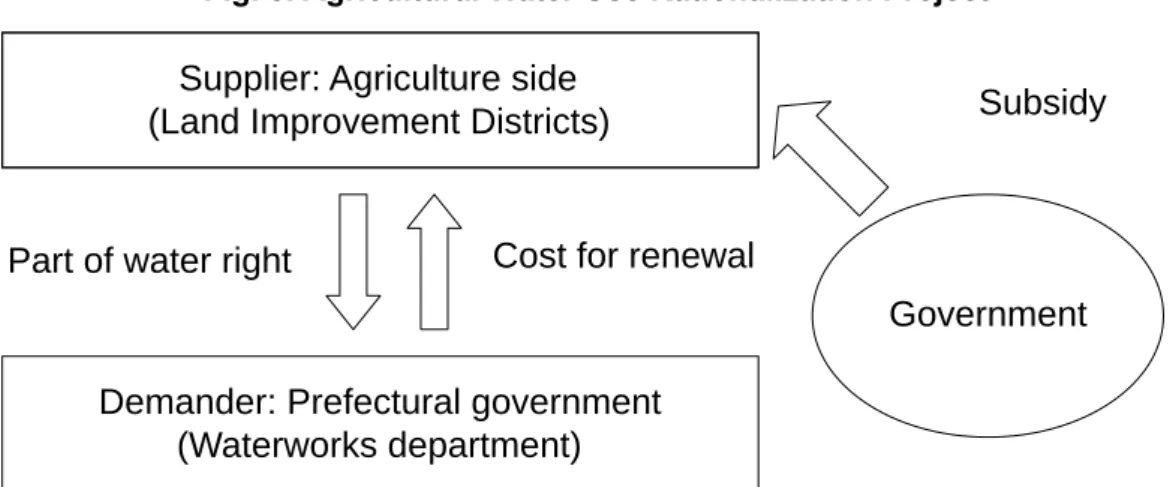
the existence of traditional network of local community for water management, and (2) pub-lic investment in the form of various subsidies to rural areas to support farmer’s income. The amendment of the Land Improvement Law in 1972 enabled surplus irrigation water to be transferred to other sectors in a smoother way under what is called AWURP. Under this law urban water users bear a part of the renewal cost of irrigation facilities and are given a part of the water right from the agricultural users in return (see Figure 5). The ratio of the cost will depend on the ratio of benefit each side will receive in the transfer project. The government gives the non-agricultural/urban side the water right, for which they must reimburse the relevant LIDs. The agricultural water users can rebuild or
remodel the irrigation facilities at a lower cost by giving up a part of their water right to urban-ites. Although AWURP has enabled the perma-nent transfer of water rights in some suburban regions of Japan by giving economic incentives to both urban and rural water users, the project has not been fully successful because: (1) it is one of the components LIP, in other words, since LIP gives a huge amount of financial sup-port to farmers one cannot provide a pure eco-nomic incentives to both sides; (2) as the Japanese economic growth has slowed down, the water demand from the industrial side decreased that there are fewer transfer projects these days; and (3) the impact on river ecosys-tem due to the water reallocation is not empha-sized in these transfers.
4. C
ONCLUSIONAs we have just seen above, the Japanese national government has invested huge amounts into land improvement projects in a concen-trated and well-planned manner throughout the country’s rapid economic growth era. The goal of such investment has been to develop a mod-ern, laborsaving, highly productive agricultural sector and to diminish the domestic income gap between rural and urban areas. This investment achieved the primary objective at the expense of becoming both directly and indirectly the cause of serious water problems such as water pollu-tion in rivers and lakes by: (1) supporting urban-ization and modernurban-ization of farming, (2) weakening power of traditional farmer commu-nity-based water management, and (3) decreas-ing the interest in rural communities in local
water by separating water treatment from com-munities. Many other countries have also faced these challenges caused by the modernization of agriculture and villages, thus it is not surprising that in Japan such negative aspects of rural development have been ignored as the country’s economy boomed.
This paper discussed some of the policies the Japanese government has implemented to address water challenges in rural areas. The pos-itive and negative aspects of these policies hold four valuable lessons for China, which also is facing major difficulties in reforming rural water management while also protecting river basin ecosystems.
Source: Author.
Supplier: Agriculture side
(Land Improvement Districts)
Demander: Prefectural government
(Waterworks department)
Part of water right
Cost for renewal
Government
Subsidy
(1) Harmonization of Agricultural and Environmental Policies
Agriculture is an industry deeply connected to the regional environment, especially water. Pol-icymakers must therefore design institutions for regional resource management from a broader point of view. Future irrigation investment plan-ning should not only stress short-term increases in higher agricultural production, but also a comprehensive vision that includes long-term improvement of rural society and river basin conservation. Regardless of how much further Japan and China industrialize, maintaining their vast rural areas will be crucial in order to protect land and water resources, as well as the welfare of rural society. Strengthening food production capacity is one of the most urgent issues facing China today, and food production policy should not be discussed separately from river basin governance.
(2) The Role of Government and Farming Communities
The LIP system in Japan has been supported by vast public funding and contains large modern irrigation projects while also maintaining histor-ical small water management practices by farm-ers (e.g., in the LIDs). The strong government intervention in construction of irrigation facili-ties in Japan prevented market failure for the most part and thus promoted high agricultural productivity while the autonomous water man-agement has kept the relationship between local water and its users tight. But, as described in the precious section, the LIP scheme is facing limi-tations in balancing the role of government and farmers due to the declining significance of agriculture in the national economy and the weakened power of farming communities both in labor and financial potentiality because of aging and rural exodus. China is likely to be at an earlier stage of rural modernization and financial support from the central government will attempt to gradually increase to improve irrigation, but it is unlikely enough money will be invested.15 To create a sense of ownership and promote sustainable rural water manage-ment, the Chinese government needs to
estab-lish a scheme for collecting funding and labor from farmers. While in general the Chinese gov-ernment has not enthusiastically embraced the concept of strong farmer organizations, there have been some experiments in China (with World Bank funding) to create farmer associa-tions to improve irrigation management and maintenance. There exists a need for compara-tive study and further analysis on various PIM schemes that international aid agencies are implementing in China, regardless of their suc-cess. Many such PIM projects have been mod-eled on LIP in Japan and other countries. (3) Treatment for Water Pollution
Irrigation has both positive and negative exter-nalities—the former refers to the so-called multi-functionality of irrigation, the latter is water pollution and other problems.16 It is quite difficult to prevent the water pollution from non-point sources like farmland. Measures should be taken to address such pollution at the earliest stages of modernizing rural areas, espe-cially in areas where farm runoff flows into lake and bays, for once they are contaminated the pollution will last long and potentially cause irreversible damage to the water ecosystems. Limiting the use of chemical fertilizers and pes-ticides, perhaps by increasing organic farming methods, is recommended. Ultimately, as pollu-tion worsens this will causes a decrease in avail-able water and become a new cause of disputes over water allocation, which is becoming increasingly common in China. The develop-ment of the proper method of estimating the positive and negative externality of irrigation on quality is an urgent issue to ensure transparent governance and building partnerships between villages and cities.
(4) Water Reallocation among Users
The accumulation of the Japanese experience of technical, political and economic measures in water transfer from irrigation could be intro-duced abroad, particularly in Monsoonal Asia where governments find it difficult to adopt the water pricing system or water market models because of the uncertainty in the volume and 15.To mitigate the income gap among regions, large-scale irrigation districts in China were constructed in western and north central
regions (Iijima & Suzuki 2001, JIID 2003c). Notably many of these irrigation districts are in ecologically fragile areas plagued with poverty—due in no small part to water shortages and pollution problems. The Chinese leadership’s concern about the growing pov-erty in rural areas and maintaining sufficient grain stores led the central government in the late 1990s to substantially increase fi-nancial support for irrigation projects, which had heretofore been mainly funded at the provincial level (World Bank 2002).
16.In Japan the bad effect of irrigation on the environment is not high in the public’s consciousness. Instead, many see irrigation as
seasonality of rainfall. In Japan there is some black box in the efficiency of irrigation water and this uncertainty provokes distrustfulness between urban and rural water users in the same river basin. So correct information on water supply and demand within a river basin is required in designing transparent institutional scheme. Moreover, strong communication and cooperation among water users, water
adminis-ters and various government ministries are cru-cial for proper water allocation and river basin governance. While not discussed in this paper, it is crucial to provide a scientific basis to water governance through the development of reliable environmental impact assessments of water reallocation project, which is a future challenge in Japan as well.
R
EFERENCESFAO. FAOstat. http://faostat.fao.org/. Rome: FAO. ________. 1961-2003. Production Yearbook. Rome: FAO.
Latz, Gil. 1986. Contemporary and Historical irrigation in Japan: Selected Terminology and
Illustrations. Tokyo: Toyota Foundation.
Hamburger, Jessica. 2002. “Pesticides in China: A Growing Threat to Food Safety, Public Health, and the Environment.” China Environment Series Issue 5. Washington, DC.: Woodrow Wilson Center: 29-44.
Honma, Masayoshi. 2000. “The New Agricultural Basic Law and Trade Policy Reform in Japan.” In
A Way Forward for Japanese Agriculture? Pacific Economic Papers Vol.300. Canberra:
Australia-Japan Research Centre.
Iijima, Takashi, and Naoto Suzuki. 2001. “Chyugoku no mizushigen to sessui kangai (Water
Resources and Water Saving Irrigation in China).” Journal of the Society of Irrigation, Drainage
and Reclamation Engineering Vol.69, No.4: 363-366. (in Japanese)
Imamura, Naraomi et al. 1977. Tochi kairyou hyakunen shi (100 Years of Land Improvement). Tokyo: Heibonshya Press. (in Japanese)
Japanese Institute of Irrigation and Drainage (JIID). 2003a. Suido no chi wo kataru: 21 seiki ha mizu
no seiki (Wisdom of Land and Water: 21st century, the century of water.). JIID Books Vol.1.
Tokyo: JIID. (in Japanese)
________. 2003b. A Message from Japan and Asia to the World Water Discussions: Mutually
Recognizing Diversity of Irrigation in Arid and Humid Regions. Booklet prepared for the 3rd
World Water Forum. Tokyo: JIID.
________. 2003c. Kangaihaisuijigyou chiku no kanritaisei (Management System of Irrigation and
Drainage District). Chyugoku no tochikairyou (Land Improvement in China) Vol.19. Tokyo:
JIID. (in Japanese)
________. 2004. Suido no chi wo kataru: Sekaitekina Muzugiron no ba heno nihon ajia karano
hasshin (Wisdom of Land and Water: Message from Japan and Asia to the International Discussions on Water.). JIID Books Vol.3. Tokyo: JIID. (in Japanese)
Kokyo Toshi Journal. 2002. Nougyou shyuraku haisui jigyou handbook (Handbook for Rural Sewage
Mase, Toru. 1994. Mizu ga tsukutta ajia (Asia, Made from Water). Tokyo: Ienohikarikyoukai Press. (in Japanese)
Mauer, Crescencia; Chanhua Wu; Yi Wang; and Shouzheng Xue. 1998. “Water Pollution and Human Health in China.” China Environment Series Vol. 2. Washington D.C.: China Environment Forum: 28-38.
Minagawa, Yoshitsugu. 2003. “Tochikairyou shisetsu no ijikanri wo meguru kadai (Challenges for the Maintenance of Land Improvement Facilities).” Nouchihou Kenkyu May 2003: 29-41.
(in Japanese)
Ministry of Agriculture, Forestry and Fisheries of Japan (MAFF). various years. Nougyou oyobi
nouka no syakaikanjyou (Social Accounts of Agriculture and Farm). Tokyo: MAFF. (in Japanese)
________. 1995. Showa nougyou gijyutsu hattatsu shi (History of Technological Progress in Showa
Era), Vol.1, 2, 7. Tokyo: Rural Culture Association. (in Japanese)
MAFF, Land Bureau. 1960. Nihon nougyou to mizu riyou (Japanese Agriculture and Water Use). Tokyo: Suirikagaku kenkyujyo. (in Japanese)
MAFF, Regional Planning Section of the Structural Improvement Bureau. 1997. Kaisetsu Tochi
kairyo no keizai kouka (Description of the Economic Effect of Land Improvement). Tokyo: Taisei
Press. (in Japanese)
Ministry of Construction of Japan, River Bureau. 1997. Drought Conciliation and Water Rights:
Japanese Experience. Tokyo: Infrastructure Development Institute.
Ministry of Land, Infrastructure and Transport, Water Resources Division, Land and Water Resources Bureau. 2002. Nihon no mizu shigen (Japan’s Water Resources). Tokyo: Ministry of Land, Infrastructure and Transport. (in Japanese)
Ministry of Water Resources of China. 2003. China Water Resource Bulletin 2002. Beijing: MWR. Mizutani, Masakazu, and Jing Chen. 2001. “Daikibo kangai shisutemu no bunkenteki kanri
(Decentralized Management of Large Scale Irrigation System).” In Monsun Ajia no mizu to
shyakai kankyou (Water and Social Environment in Monsoon Asia), ed. Kazuko Fujita. Tokyo:
Sekaishisoushya Press. (in Japanese)
Moritaki, Kenichirou. 1982. Gendai nihon no mizusigen mondai (Water Resource Problems in Japan
of Modern Times). Tokyo: Chyobunshya Press. (in Japanese)
Nagata, Keijyuro. 1971. Nihon nougyou no suiri kouzou (The Water System of Japanese Agriculture). Tokyo: Iwanami Shyoten Press. (in Japanese)
Nakashima, Yasuhiro. 1996. “Tochi kairyo seido to seihu no yakuwari (Land Improvement Project and the Role of Government).”In Kawaru shyokuryou, nougyou seisaku: shijyo no kinou to seihu
no yakuwari (Food and Agricultural Policy at crossroad: the market function and the role of government), ed. Shinichi Shogenji. Tokyo: Daimindo hakkou Press. (in Japanese)
Nougyou Suiri Kenkyukai. 1980. Nihon no nougyo yousui (Japanese Agricultural Water). Tokyo: Chikyushya Press. (in Japanese)
Okabe, Mamoru. 2003. “Henyou suru mizu kanri sosiki: mattan suiri sosiki no kinou teika (Water Management Association in Transition: the weakening of smallest irrigation association).” In 21
seiki mizu kiki: nou kara no hassou (21st Century Water Crisis: Message from Agriculture.), ed.
Yamazaki agriculture research institute. Tokyo: Rural Culture Association. (in Japanese)
Okada, Mitsumasa, and Spencer A. Peterson. 1991. Water Pollution Control Policy and Management:
The Japanese Experience. Tokyo: Gyosei.
Satake, Goroku. 1989. Nousei, Tochi, Mizu: sono tenkai houhou to kadai (Agricultural Policy, Land,
Water: Future Development and Challenges). Tokyo: Souzou Shobo Press. (in Japanese)
________. 2003. “Kokudo mizu kankyou to nougyou suiri: seisakuron no shiten kara (National Environment and Irrigation: From the Policy Perspective).” In 21 seiki mizu kiki: nou kara no
hassou (21st Century Water Crisis: Message from Agriculture.), ed. Yamazaki agriculture
research institute. Tokyo: Rural Culture Association. (in Japanese)
Satoh, Masayoshi. 1997. “Nougyou yousui no tokusei to kongo no arikata (The Feature of Irrigation Water and its Role in the Future).” Journal of Water and Environmental Issues Vol.10: 1-8. (in Japanese)
Sato, Toshiro et al. 1985. Mizu wo ikasu: suiri chitsujyo no shintenkai (Make the Best Use of Water:
New Order of Water Management. Tokyo: Tsukuba shyobo. (in Japanese)
Shogenji, Shinichi et al. 1997. Nougyou keizai gaku (Agricultural Economics). Tokyo: Tokyo University Press. (in Japanese)
________. 1998. Gendai nougyou seisaku no keizaibunseki (Economic Analysis of Modern
Agricultural Policy). Tokyo: Tokyo University Press. (in Japanese)
Tamaki, Akira. 1976. Fudo no keizaigaku (The Economics of Climate). Tokyo: Shinhyoron Press. (in Japanese)
________. 1979. “Nihon inasaku kangai shyakai no Kindaika (The Modernization of Japanese Paddy Irrigation Society).” In Kangai nougyou syakai no shyokeitai (Various Forms of Irrigation
Agrarian Society). Tokyo: IDE Press. (in Japanese)
Tamaki, Akira; Isao Hatade; and Naraomi Imamura.1984. Suiri no shyakai kouzou (Social Structure
of Irrigation). Message from Japanese experience series, United Nations University project.
Tokyo: United Nations University Press. (in Japanese)
Taniyama, Shigetaka et al. 2000. Atarashii mizukankyou no soushyutu: nougyou shyuraku haisui
system to sono gijyutsu (Creating New Aquatic Environment: Rural Sewage System and its Technology). Tokyo: Rural Culture Association. (in Japanese)
Teruoka, Shyuzou. 2003. Nihon no nougyou 150 nen: 1850-2000 nen (150 Years of Japanese
Agriculture: 1850-2000). Tokyo: Yuhikaku Books Press. (in Japanese)
Uchida, Tomoyuki.1996. “Chyugoku: Shisen shyo Seito heigen no jirei wo chyushin to shite (China: A Case Study of Chendu Plain in Sichuan Province).” In Ajia no kagai seido: mizu riyou no
kourituka ni mukete (Irrigational Institutions of Asia: toward efficient water use), ed. Kenzo
Horii, Takashi Shinoda and Hirokazu Tada. Tokyo: Shinhyoron Press. (in Japanese) United Nations. Various years. Statistical Yearbook. NY: United Nations.
World Bank Office, Beijing. 2002. Participatory Irrigation Management By Farmers: Local
Incentives for Self-Financing Irrigation and Drainage District in China. Beijing: World Bank.
World Bank. 2002. China Country Water Resources Assistance Strategy. http://www.worldbank.org.cn/English/Content/cas03.pdf.